Updated List of Top Posts for 2024

In August, I listed the Top EWED Posts of 2024. Here are a few more highlights. This list is roughly based on web traffic, starting with the highest number of views for 2024, since the August list.  

  1. Mike Makowsky has the top post since August with Bad service is a sign of a better world. “What if service in restaurants, hospitality, etc is, in fact, lower in quality than it was one or two decades ago? I would like to suggest that this is a good sign of improving times.”  Thoughtful. Recommended. Bosses will not be requiring “15 pieces of flair” anymore. I have noticed that restaurant servers these days seem to wear whatever they want. It was previously noted by Mike that Kitchen staff were canaries in the coal mine.

2. Grocery Inflation Since 2019: BLS Data is Probably About Right by Jeremy-“What if we actually looked at receipts?”-Horpedahl. You can find him on Twitter/X.

3. You know it’s good when a post with such a cryptic title goes viral. Mike wrote about the topic people were thinking about, in the moment: At the moment (updated 10/22/24) Sometimes we write about the economics community and what began as a critical mass of people that used to call itself #EconTwitter. Some of those people have moved to Bluesky. You can find Mike there at @mikemakowsky.bsky.social, and most of us have accounts there. Getting social media just right is tricky. If you follow the right people and don’t waste too much time on it, then social media can be part of How to Keep Up With Economics (James).

4. Predicting College Closures: Now with Machine Learning James Bailey brings the important (unwanted) news that not all college are going to make it through the next decade, and there are signs. This follows up on what was previously listed as a top post in August: Predicting College Closures

5. Publish or Perish: A Hilarious Card Game Based on Academia My review of a new board game. If it’s not for you, it’s not for you. I played a test copy with some fellow nerds and had a great time.

6. Jeremy explains, “… fast food prices (“limited service meals”), which have definitely outpaced wages over the past 4 years, and continue to grow…” Grocery Inflation is Under Control, Fast Food Prices Aren’t

7. Jeremy asks, Did 818,000 jobs vanish?

8. Scott’s saga is perhaps attracting traffic from search engines from people with the same problem. Recovering My Frozen Assets at BlockFi 2. Scams and More Scams

9. Post-Pandemic Lumber Market Zachary Bartsch writes, “People used to talk about higher gasoline prices all the time, but never discussed with the same enthusiasm when prices fell. The same is true for lumber.” Good for teaching about supply and demand.

10. I Give Up, Standard & Poor’s Wins James lets us learn from his journey- “my stock picks underperformed the incredible 26% return the S&P has posted so far this year.”  This is something most people would rather not admit, and yet for most of us it’s true.

11. James explains, “Cheapflation”: Inflation Really Does Hit the Bottom Harder. People were mad about inflation. Voters were mad about inflation. It’s worth understanding better. Some of us are in an echo chamber and need to peer out, especially if we think a lot about how (in fact) the world is getting better. Or maybe we even think about data indicating that On Average, American Wage Earners are Better Off Than They Were Four Years Ago (Jeremy).

12. Why Podcasts Succeeded in Gaining Influence Where MOOCs Failed attracted some attention. If you are being honest, would you have predicted a priori that Joe Rogan talking in a closed room FOR HOURS would outdo Ivy League professor lectures? In retrospect, it might seem obvious, but I probably would have gotten the prediction wrong. MOOCs and podcasts both launched around the same time because the internet lowered the cost of broadcasting. They both had some success. In terms of shaping culture or voting behavior, I think it’s clear that podcasts win. Until a product is launched on the market, we just don’t know what will become popular, which is a topic that came up in the podcast I recorded recently: Joy on The Inductive Economy podcast

Speaking of what I don’t predict, EWED is starting to get web traffic from LLMs like chatgpt.com. Right now, it’s very small compared to Google search. For a while, I wondered if LLMs would simply plagiarize us without giving us any credit. Maybe that’s our raison d’être. Here’s me being dramatic about it in 2022  –  “Because of when I was born, I believe that something I have published will make it into the training data for these models. Will that turn out to be more significant than any human readers we can attract?” 

However, writers of the world, LLMs might start giving you credit. There is some demand from users for sources and citations. (My paper on made up sources). 

A little more credit to the true 2024 EWED all-stars, even though they were already listed in August: Young People Have a Lot More Wealth Than We Thought, by Jeremy Horpedahl,  continues to be a top performer. And, Mike wrote about an important current event in culture: Civil War as radical literalism   

While we are settling scores and doing web traffic round-ups, there is one thing I’d like to put on the record. I made one resolution last year, publicly on January 3, 2024. I have made good on this promise. The people who run the AdamSmithWorks website have informed me that I wrote their top post of the year, Would Adam Smith Tell Taylor Swift to Attend the Super Bowl?

Economic Nostalgia: 1890s Edition

You see a lot of nostalgia for the recent past. People pining for the simpler life of the 1950s, or claims that wages have stagnated since the late 1970s or early 1980s. I’ve tried to take these arguments seriously and respond to them, such as in a paper I wrote with Scott Winship and summarized in a blog post last June. But occasionally, you find really weird economic nostalgia, like for the 1890s. Yes, the 1890s, not the 1990s.

Here’s one example: a cartoon shared on social media of workers being oppressed in the 1890s, with the caption “the problem has only gotten worse.” That post received 2 million views on Twitter, possibly because many people are criticizing it, but it also has a lot of retweets and likes.

If it was just one semi-viral social media post from an anonymous Twitter account, we could easily dismiss it. But 1890s economic nostalgia has been coming from another important place lately: President Elect Trump. Of course he is nostalgic for the policies of the 1890s. But on occasion, Trump will say things like “Go back and look at the 1890’s, 1880’s with McKinley and you take a look at tariffs, that was when we were at our richest” (emphasis added).

Really, our richest in the 1890s? Can this be true? Are the anonymous socialist Twitter accounts correct? Let’s look at the data. But the answer probably won’t surprise you: your intuition is correct, we are much better off today than the 1890s, in almost every way of looking at it economically.

Continue reading

Seven Reasons Why Americans Pay So Much for Health Care

Ken Alltucker at USA Today recently published a piece titled Seven reasons why Americans pay more for health care than any other nation. It starts off:

Americans spend far more on health care than anywhere else in the world but we have the lowest life expectancy among large, wealthy countries.

A lot of that can be explained by the unique aspects of our health care system. Among other things, we reward doctors more for medical procedures than for keeping people healthy, keep costs hidden from customers and spend money on tasks that have nothing to do making patients feel better.

“We spend more on administrative costs than we do on caring for heart disease and caring for cancer,” said Harvard University economist David Cutler. “It’s just an absurd amount.”

The article notes that the whole system is skewed towards high costs. It is not just profiteering insurance companies. Seven factors are listed. I will excerpt them in italics below, and close with a few of my comments.

Reason 1: Lack of price limits

U.S. hospitals have more specialists than do medical facilities in other nations. Having access to 24/7 specialty care, particularly for hospitals in major metro areas, drives up costs… Patients have more elbow room and privacy here. U.S. hospitals typically have either one or two patients per room, unlike facilities abroad that tend to have open wards with rows of beds, Chernew said. He said differences in labor markets and regulatory requirements also can pack on costs.

Of the $4.5 trillion spent on U.S. health care in 2022, hospitals collected 30% of that total health spending, according to data from the Centers for Medicare & Medicaid Services. Doctors rank second at 20%. Prescription drugs accounted for 9% and health insurance − both private health insurance and government programs such as Medicare and Medicaid − collect 7% in administrative costs.

Reason 2: Hospitals and doctors get paid for services, not outcomes

Doctors, hospitals and other providers are paid based on the number of tests and procedures they order, not necessarily whether patients get better.  The insurer pays the doctor, hospital or lab based on negotiated, in-network rates between the two parties.

Critics of this fee-for-service payment method says it rewards quantity over quality. Health providers who order more tests or procedures get more lucrative payments whether the patients improve or not.

Reason 3: Specialists get paid much more ‒ and want to keep it that way

Doctors who provide specialty care such as cardiologists or cancer doctors get much higher payments from Medicare and private insurers than primary care doctors.

Some see that as a system that rewards doctors who specialize in caring for patients with complex medical conditions while skimping on pay for primary care doctors who try to prevent or limit disease.

[My comment: There is a saying in management science that your system is perfectly designed for the results you are getting. In other nations with a fixed pot of money, doled out by the government, to mainly non-profit health providers, there is (in theory, at least) an incentive system that would work towards minimizing overall health expenses. In the U.S., though, we have a mainly for-profit system, that collects more moolah the more health problems we have, and the more expensive are the treatments. Most healthcare providers try to be noble-minded and work for the good of their patients, but still the overall financial incentives are what they are.  The health insurance companies are one of the few forces working against endless upward spiraling of healthcare costs. ]

Under the current system, doctors are chosen or approved by the American Medical Association to a 32-member committee which recommends values for medical services that Medicare then considers when deciding how much to pay doctors. Some have compared the idea of doctors setting their own payscale to the proverbial fox guarding the henhouse.

Reason 4: Administrative costs inflate health spending

One of the biggest sources of wasted medical spending is on administrative costsseveral experts told USA TODAY….Harvard’s Cutler estimates that up to 25% of medical spending is due to administrative costs.

Health insurers often require doctors and hospitals to get authorization before performing procedures or operations. Or they mandate “step therapy,” which makes patients try comparable lower-cost prescription drugs before coverage for a doctor-recommended drug kicks in.  These mandates trigger a flurry of communication and tasks for both health insurers and doctors.

Reason 5: Health care pricing is a mystery

Patients often have no idea how much a test or a procedure will cost before they go to a clinic or a hospital. Health care prices are hidden from the public. …An MRI can cost $300 or $3,000, depending on where you get it. A colonoscopy can run you $1,000 to $10,000.

Economists cited these examples of wide-ranging health care prices in a request that Congress pass the Health Care Price Transparency Act 2.0, which would require hospitals and health providers to disclose their prices.

Reason 6: Americans pay far more for prescription drugs than people in other wealthy nations

There are no price limits on prescription drugs, and Americans pay more for these life-saving medications than residents of other wealthy nations.

U.S prescription drug prices run more than 2.5 times those in 32 comparable countries, according to a 2023 HHS report…. Novo Nordisk charged $969 a month for Ozempic in the U.S. ‒ while the same drug costs $155 in Canada, $122 in Denmark, and $59 in Germany, according to a document submitted by Sanders.

[My comment: Yes, this disparity irks me greatly].

Reason 7: Private Equity

Wall Street investors who control private equity firms have taken over hospitals and large doctors practices, with the primary goal of making a profit. The role of these private equity investors has drawn increased scrutiny from government regulators and elected officials.

One example is the high-profile bankruptcy of Steward Health Care, which formed in 2010 when a private equity firm, acquired a financially struggling nonprofit hospital chain from the Archdiocese of Boston.

Private equity investors also have targeted specialty practices in certain states and metro regions.

Last year, the Federal Trade Commission sued U.S. Anesthesia Partners over its serial acquisition of practices in Texas, alleging these deals violated antitrust laws and inflated prices for patients. …FTC Chair Lina Khan has argued such rapid acquisitions allowed the doctors and private equity investors to raise prices for anesthesia services and collect “tens of millions of extra dollars for these executives at the expense of Texas patients and businesses.”

[ This also concerns me. That anesthesia monopoly should never have been allowed, in my opinion. The reason the PE firm paid to acquire all those individual practices was so that they could raise prices while minimizing services. Duh. That is the PE gamebook. When they do a corporate takeover, they nearly always fire employees and raise prices on products, to goose profits. This would not be a problem if the business were, say, selling pet rocks, but healthcare is different.

In many metro areas now, nearly all healthcare providers (even if they seem to retain their private practices) have become part of one or two mega conglomerates that cover the area. I feel fortunate because at least on of the mega conglomerates in my area is a high-quality non-profit, but I pity those whose only choice is between two for-profits.]

Final comments: I think another factor here is in our private enterprise system, it is so costly to become a doctor that they have to charge relatively high fees to compensate. This leads to a system where there are layers and layers of admins and nurses to shield you from actually seeing the doctor. As an example, I sliced my finger a couple of years ago, and went to an urgent care facility. There was an admin at the desk who took down my insurance info and relayed my condition to the back. Some time later, an aide took me back and weighed me and took my blood pressure. I think a nurse swung by as well. Finally, The Doctor Himself sailed in, to actually patch me up. And of course there were layers of administrative paperwork between me, the care facility, and my insurance company, to settle all the charges.

In contrast, a friend told me that when he broke his arm in the UK, he went to the local clinic, which was staffed by a doctor, and no one else. The doc set his arm, charged him some nominal fee, and sent him on his way.

There are other factors, I’m sure, such as the unhealthy lifestyle choices of many Americans. Think: obesity and opioids, among others.  I suspect that is to blame for the poorer health outcomes in this country, more than the healthcare system.

In favor of the current U.S. system, although we pay much more, I think we do get something in return. It seems that with a good health plan, the availability of procedures is better in the U.S. than in many other countries, though I am open to correction on that.

Predicting College Closures: Now with Machine Learning

Small, rural, private schools stand out to me as the most likely to show up on lists of closed colleges. This summer I discussed a 2020 paper by Robert Kelchen that identified additional predictors using traditional regression:

sharp declines in enrollment and total revenue, that were reasonably strong predictors of closure. Poor performances on federal accountability measures, such as the cohort default rate, financial responsibility metric, and being placed on the most stringent level of Heightened Cash Monitoring

Kelchen just released a Philly Fed working paper (joint with Dubravka Ritter and Doug Webber) that uses machine learning and new data sources to identify more predictors of college closures:

The current monitoring solution to predicting the financial distress and closure of institutions — at least at the federal level — is to provide straightforward and intuitive financial performance metrics that are correlated with closure. These federal performance metrics represent helpful but suboptimal measures for purposes of predicting closures for two reasons: data availability and predictive accuracy. We document a high degree of missing data among colleges that eventually close, show that this is a key impediment to identifying institutions at risk of closure, and also show how modern machine learning algorithms can provide a concrete solution to this problem.

The paper also provides a great overview of the state of higher ed. The sector is currently quite large:

The American postsecondary education system today consists of approximately 6,000 colleges and universities that receive federal financial aid under Title IV of the federal Higher Education Act…. American higher education directly produces approximately $700 billion in expenditures, enrolls nearly 25 million students, and has approximately 3 million employees

Falling demand from the demographic cliff is causing prices to fall, in addition to closures:

Between the early 1970s and mid-2010s, listed real tuition and fee rates more than tripled at public and private nonprofit colleges, as strong demand for higher education allowed colleges to continue increasing their prices. But since 2018, tuition increases have consistently been below the rate of inflation

Most college revenue comes from tuition or from state support of public schools; gifts and grants are highly concentrated:

Research funding is distributed across a larger group of institutions, although the vast majority of dollars flows to the 146 institutions that are designated as Research I universities in the Carnegie classifications…. Just 136 colleges or university systems in the United States had endowments of more than $1 billion in fiscal year 2023, but they account for more than 80 percent of all endowment assets in American higher education. Going further, five institutions held 25 percent of all endowment assets, and 25 institutions held half of all assets

Now lets get to closures. As I thought, size matters:

most institutions that close are somewhat smaller than average, with the median closed school enrolling a student body of about 1,389 full-time equivalent students several years prior to closure

As does being private, especially private for-profit (states won’t bail you out when you lose money):

As do trends:

variables measuring ratios of financial metrics and those measuring changes in covariates are generally more important than those measuring the level of those covariates

When they throw hundreds of variables into a machine learning model, it can predict most closures with relatively few false positives, though no one variable stands out much (FRC is Financial Responsibility Composite):

My impression is that the easiest red flag to check for regular people who don’t want to dig into financials is “is total enrollment under 2000 and falling at a private school”.

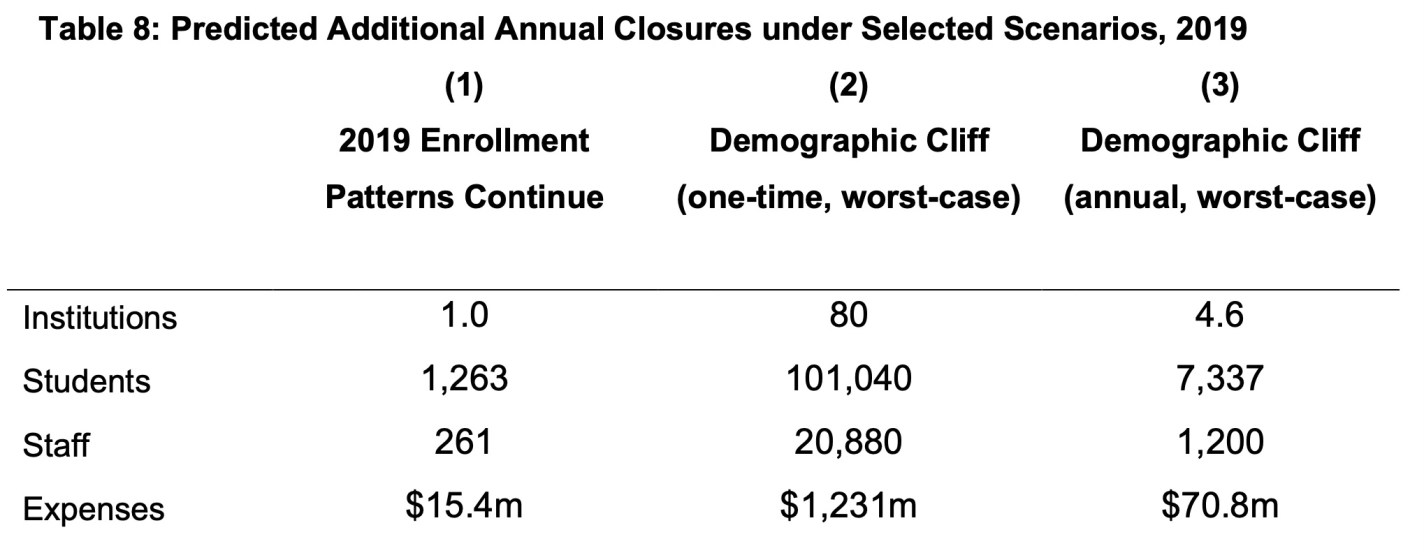
They predict that the coming Demographic Cliff (the falling number of new 18-year-olds each year) will lead to many more closures, though nothing like the “half of all colleges” you sometimes hear:

The full paper is available ungated here. I’ll close by reiterating my advice from the last post: would-be students, staff, and faculty should do some basic research to protect themselves as they consider enrolling or accepting a job at a college. College employees would also do well to save money and keep their resumes ready; some of these closures are so sudden that employees find out they are out of a job effective immediately and no paycheck is coming next month.

House Prices and Quality: 1971 vs 2023

Last week I did a comparison of “time prices” for several goods and services in 1971 compared with 2024. For almost all goods and services, it took fewer hours of work in 2023 to purchase them. In some cases, huge increases in affordability; air travel is 79% cheaper and milk is 59% cheaper, in terms of how much time an average worker needs to labor to pay for them.

There was one major exception though: housing. Especially the cost of buying a new home. Just using the median sale price of a home, the cost (in terms of hours of work) roughly doubled between 1971 and 2024. That’s not good!

Many who commented on the post mentioned that houses are much bigger today, and I noted that in the post but still claimed this is a worrying trend: “since 1971 you can’t really argue the quality improvements make up for the increase. Yes, houses are much bigger (about double in size), but that’s not clearly driven by consumer demand (more so by zoning and other laws). The 1971 house also had indoor plumbing (but maybe not air conditioning).”

Furthermore, housing is the largest expense for most families, both today and in 1971. In the early 1970s it was 30.8% of consumer spending, and in 2023 it was slightly higher at 32.9%. Given all this, it is worth investigating further.

First, let’s consider the size of a typical house. For most of the 1971 data, I will use this HUD report on new single-family homes. And I will use the similar Characteristics of New Housing report for 2023 (the latest year available) to compare.

Are houses bigger today? Yes, but not nearly enough to account for the decreasing affordability I showed in the previous post. In 1971, the median new home had 1,400 square feet of floor space. In 2023, it was 2,286. That’s a big increase (over 60%), but let’s now do the time-price affordability calculation, which I show in the table below.

Continue reading

Handmade Sweaters Cost $500

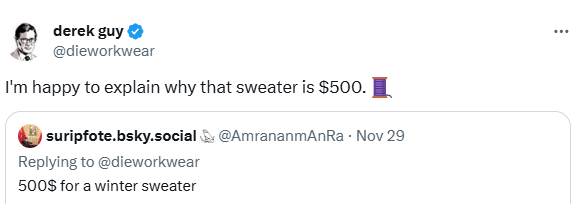
If you spend any time on Twitter/X, you must know the suit guy, Derek. Given my interest in the economics of fast fashion, I read his new thread about expensive craft sweaters.

He explains that some clothes on this earth are still made by hand. Artisan sweaters cost a lot because of the labor. Supporting that art or tradition is fine, if you have $500 on hand.

The comments on the thread are interesting as well. (Caveat, a good number of anonymous accounts are trolls bent on your destruction – read accordingly always.)

One comment, presumably by an amateur knitter in a rich country: “As a knitter, I know how much work would go into hand making sweaters like these. That’s not even taking into account the cost of a good wool yarn. If anything, they are underpriced.”

Not a lot of people want to spend $500 on a sweater. I really loved this reply about thrift stores. We don’t all have to buy the sweater new.

Someone who has been thinking about how goods change hands in the modern economy is Mike Munger who wrote Tomorrow 3.0: Transaction Costs and the Sharing Economy.

My related posts on fast fashion (a.k.a. factory-made sweaters cost $5):

Cato Globalization book out in paperback – my most optimistic take on this is that AI will facilitate the sharing part of the sharing economy, which will help justify the cost of high-quality new garments.

Is the repair revolution coming? – in my opinion, probably not, although I still think AI could help with this

(Tweet HT: Tyler)

We’ve Got You Covered

That’s the title of a recent book by Liran Einav and Amy Finkelstein, subtitled “Rebooting American Health Care”. I reviewed the book for Independent Review; the short version of my review is that while I don’t agree with all of their policy proposals, the book makes for an engaging, accurate, and easily readable introduction to the current US health care system. Here’s the start of the review:

Liran Einav and Amy Finkelstein are easily two of the best health economists of their generation. They have each spent twenty years churning out insightful papers published in the top economics journals. As a young health economist, I would read their papers and admire how well they addressed the technical issues at hand, but I was always left wondering what they thought about the big picture of health care in the United States….

The book’s prologue describes how Finkelstein’s father-in-law finally bullied her into writing on the topic, using almost the exact words I always wanted to: “I know these are hard issues. But come on … You’ve been studying them for twenty years. You must be one of the best placed people to help us understand the options. Do you really have nothing to say on this topic?”

The conclusion:

I learned a lot reading the book, despite having already studied U.S. health financing for over a decade—for instance, that the first compulsory health insurance program in the U.S. was a 1798 law pushed by Alexander Hamilton to cover foreign sailors. While the authors are more used to writing math-heavy academic papers, We’ve Got You Covered reads like the popular press book it is. Perhaps the highest endorsement comes from a non-academic family member of mine who picked up the book and noted, “These are not dry writers … this doesn’t sound like a book written by economists, no offense.”

The full review is free here, the book is for sale here.

“Time Prices” Today Compared With 1924 and 1971

I’ve written before on this blog about “time prices”: the amount of time it takes at a particular wage to buy a specific product. Time prices are especially useful for making historical comparisons of the real price of a good or service. Rather than adjusting historical prices for inflation (which only tells you whether they have increased faster or slower than average prices), time prices give you a real comparison of whether a good has become more or less affordable.

Antony Davies recently did a 100-year comparison of time prices for an average worker in the US. He compared prices in 1924 for several common food items, gasoline, electricity, movie tickets, airline tickets, an automobile, and several measures of housing costs to the best comparable thing in 2024. This following table shows his results:

You will notice a few things here. For the median worker, most things are much more affordable in 2024. Some things are dramatically so! For many items, the median worker in 2024 is similar to someone in the top 1% in 2024. Huge improvements in the standard living.

It will probably not surprise you that one major exception is housing. For renters, things are not obviously worse, but they are not better, depending on what size of city you are in (renters also have lower incomes, but that would be true in both time periods). However compared to the average home price, things look much worse in 2024. You can reasonably reply that the home is much larger and better quality in 2024 (as late as 1940, barely half of homes had complete indoor plumbing!), and this is all true. Still, an average house today is much better, but also much less affordable.

Despite the high cost of housing, the average worker today is much better off than 1924. It’s hard to deny it.

But what about more recent times? As a recurring meme likes to date it, what about since 1971?

Continue reading

Lump Sum Taxes: Never by Popular Demand

The tax code is complex. That’s not news. The US federal tax code is also very progressive. Apart from that, the tax code pushes social or other policy goals. The Earned Income Tax Credit, for example, acts as a negative income tax and increases after-tax wages for those who can claim it. The idea is to incentivize earnings.

Economists tend to really like lump-sum taxes (in theory). But, despite the profession’s influence, almost nobody supports them. First, what is a lump-sum tax? It’s a tax that ignores any activities of the target. A per capita lump-sum tax would target the young, the old, the indigent, the working, the rich, the disabled… everyone. The idea is that no behaviors, aside from breathing, incur or disqualify a person from owing the tax.

Economists like them because they don’t change the relative price of labor and leisure. Whereas a marginal tax rate reduces a worker’s effective wage, a lump sum tax leaves it unaffected. People aren’t disincentivized from working/earning. Using jargon, we say that a lump-sum tax is non-distortionary.

In the simple two-good model of consumption and leisure, marginal tax rates reduce the amount of consumption that one can afford with each hour of work, making leisure relatively more attractive. Lump-sum taxes reduce the affordable amount of both leisure and consumption. Affording less leisure is the same as saying that people work more hours. It happens for two reasons. 1) Poorer people must work enough to pay the inevitable tax bill and also reach an income level of sustenance. However much work sustenance entails, it’s surely more when there is a tax. 2) Since working and earning itself is not taxed, people at all levels of income decide to work more because their after-tax wage is higher relative to the case of a marginal income tax.

At this point someone gets what I call the “French” idea. The French idea is that if we provide a lump-sum subsidy, then we can all leisure more and consume less – the opposite of a lump sum tax. What a life! We can avoid the prisoner dilemma problem where we can’t credibly commit to shirking together or actually taking a lunch. By forcing a lump-sum subsidy on everyone, we’d work a little less and do it voluntarily. We can sit outside a cafe, enjoying our coffee, baguette, and cigarette without having to worry about our neighbor with their “go get’em” attitude making us look bad.

Continue reading

The Laboratory of the States: Regulatory Reform Edition

The US Federal government has been considering major reforms like the REINS Act, which would require Congressional approval of major regulations proposed by executive branch agencies, or bringing back the “two in one out” rule from the first Trump administration. What would these do?

Right now it’s hard to say much for sure. But similar reforms have already been implemented in the states; as usual, the states provide a laboratory for investigating how policies work and whether they deserve broader adoption. It’s especially valuable to inform the debate over reforms like the REINS act that are still being considered at the federal level. Even for federal reforms that have already happened, it can be easier to evaluate the state version, since states make better control groups for each other than other countries do for the US.

But so far we’ve mostly been ignoring our laboratory results from recent state regulatory reforms. For instance, Broughel, Baugus, and Bose (2022) released a dataset that could be used to evaluate state regulatory reforms, but it has only been cited 3 times. This is why I’m adding this to my ideas page as a good subject for future academic research.  Do state REINS or Red Tape Reduction Acts actually reduce either the stock or flow of regulation? If so, which types of regulations are affected, and does this have any effect on downstream measures like economic growth or new business formation?

Any research along these lines could help inform policy debates in the states, as well as for a new Presidential administration coming in with hopes of boosting economic growth through deregulation.

HT: Adam Millsap