Income Growth Since 1966 in the US

Has the US tax and transfer system reached an egalitarian ideal? That’s one reading of this new working paper “How Progressive is the U.S. Tax System?” by Coleman and Weisbach. After accounting for all taxes and transfers (red lines in the charts), Americans across the income distribution saw roughly 250% real gains in income since 1966:

While market income has grown faster at the top of the income distribution (especially the top 1%), we also tax the rich heavily and use much of that tax revenue to fund direct transfers to poorer Americans and fund programs (such as Medicaid) which benefit poorer Americans. Put it all together, and everyone has seen similar gains over the past five decades, and these gains are fairly large: no Great Stagnation!

Almost Observable Human Capital

I’ve written about IPUMS before. It’s great. Among individual details are their occupations and industry of their occupation. That’s convenient because we can observe how technology spread across America by observing employment in those industries. We can also identify whether demographic subgroups differed or not by occupation. There’s plenty of ways to slice the data: sex, race, age, nativity, etc.

But what do we know about historical occupations and what they entailed? At first blush, we just have our intuition. But it turns out that we have more. There is a super boring 1949 report published by the Department of Labor called the “Dictionary of Occupational Titles”. The title says it all. But, the DOL published another report in 1956 that’s conceptually more interesting called “Estimates of Worker Trait Requirements for 4,000 Jobs as Defined in the Dictionary of Occupational Titles: An Alphabetical Index”.  The report lists thousands of occupations and identifies typical worker aptitudes, worker temperaments, worker interests, worker physical capacities, and working conditions. Below is a sample of the how the table is organized:

Continue reading

How to Keep Up With Economics

… other than reading our blog, of course.

I was writing up something for my graduating seniors about how to keep learning economics after school, and realized I might as well share it with everyone. This may not be the best way to do things, it is simply what I do, and I think it works reasonably well.

Blogs by Economists: There are many good ones, but besides ours Marginal Revolution is the only one where I aim to read every post

Economic News: WSJ or Bloomberg

Podcasts on the Economy: NPR’s The Indicator (short, makes abstract concepts concrete), Bloomberg’s Odd Lots (deeper dives on subjects that move financial markets)

Podcasts by Economists: Conversations with Tyler and Econtalk (note that both often cover topics well outside of economics). Macro Musings goes the other way and stays super focused on monetary policy.

Twitter/X: This is a double-edged sword, or perhaps even a ring of power that grants the wearer great abilities even as it corrupts them. The fastest way to get informed or misinformed and angry, depending on who you follow and how you process information. Following the people I do gives you a fighting chance, but even this no guarantee; even assuming you totally trust my judgement, sometimes I follow people because they are a great source on one issue, even though I think they are wrong on lots of other things. Still, by revealed preference, I spend more time reading here than other single source.

Finance/Investing: Making this its own category because it isn’t exactly economics. Matt Levine has a column that somehow makes finance consistently interesting and often funny; unlike the rest of Bloomberg, you can subscribe for free. He also now has a podcast. If you’d like to run money yourself some day, try Meb Faber’s podcast. If you’d like things that touch on finance and economics but with more of a grounding in real-world business, try the Invest Like the Best podcast or The Diff newsletter.

Economics Papers: You can get a weekly e-mail of the new papers in each field you like from NBER. But most econ papers these days are tough to read even for someone with an undergrad econ degree (often even for PhDs). The big exception is the Journal of Economic Perspectives, which puts in a big effort to make its papers actually readable.

Books: This would have to be its own post, as there are too many specific ones to recommend, and I don’t know that I have any general principle of how to choose.

This is a lot and it would be crazy to just read all the same things I do, but I hope you will look into the things you haven’t heard of, and perhaps find one or two you think are worth sticking with. Also happy to hear your suggestions of what I’m missing.

Where’s the Deflation?

Inflation continues to remain stubbornly high in the US. While Core CPI is down to 3.6%, the lowest it has been in 3 years, this is still well above the Fed’s 2% target (the Fed’s preferred Core PCE is a bit lower at 2.8%). But consumers are tired of the cumulative inflation, which, depending on your preferred gauge of inflation, is somewhere around 20% in the past 4 years. Consumers want to know: will prices ever go down again?

The answer is: Yes, and some prices already have declined!

For example, you can look at broad categories of consumer purchases, such as durable goods, which are down almost 5 percent since the peak in August 2022. Durable goods include items such as used cars (down 17.3 percent since February 2022), furniture (down 6 percent since August 2022), and appliances (down 7.2 percent since March 2023).

We can even jump into the nondurables category and look at specific items, such as groceries which seem to be on everyone’s mind. Here’s a list of items and the price decrease since their peak (I ignore a few items where it is only a purely seasonal cycle that made them cheaper in April 2024):

  • Spaghetti and macaroni: -4.3% (Feb 2023)
  • Bacon: -12.8% (Oct 2022)
  • Chicken legs: -10.6% (Aug 2023)
  • Chicken breasts: -14.4% (Sept 2022)
  • Eggs: -40.6% (Jan 2023)
  • Milk: -8.3% (Nov 2022)
  • Cheddar cheese: -9.4% (Sep 2022)
  • Bananas: -2.6% (Sept 2022)
  • Oranges: -14.7% (Sept 2022)
  • Lemons: -12.3% (May 2022)
  • Strawberries: -12.9% in the past year (and down 34.6% since seasonal peak in Dec 2022)
  • Ground coffee: -6.2% (Dec 2022)

It’s true that this is a cherry-picked list: lots of items are at all-time highs! My goal here is to show that, Yes!, some prices will fall. Others may too in the near future. And while it’s also true that most prices are still well above 2019 levels, that’s not universally true. The April 2024 prices of lemons, strawberries, and tomatoes are roughly equal to their April 2019 prices.

And it’s not just food. Natural gas this January was 20% cheaper than January 2023. Regular unleaded gasoline is down 11.6% from 2 years ago (and down 25% from the peak in Summer 2022, but we’ll wait to see what this summer looks like). Even some services, such as airline fares, are down 6.7% from 2 years ago (and down 16% from June 2022).

Some of these price decreases could be due to factors specific to the production and supply of those goods, but another factor is monetary policy. Broad measures of the money supply such as M2 show a decline of about 4 percent in the past 2 years. That hasn’t yet produced overall deflation, but it has probably contributed to the decline in the goods and services mentioned.

Looking at price changes can only tell us so much though, especially focusing on individual item prices. The big picture is that over the past 4 years, wages have increased more than prices overall across most of the income distribution (only the highest quintile lost out on the race between wages and prices). Falling prices would certainly help this trend continue, but most consumers have more buying power than they did in 2019, even if they don’t feel like they do.

Why Don’t Full Daycares Raise Prices?

We put my daughter on a waitlist for the daycare her siblings attended when she was one month old. Fourteen months later, she is still waiting, and we are looking around for other options. Almost every daycare I contact is full, with many saying their waitlists run into 2025.

This sounds like a classic shortage: demand exceeds supply at prevailing prices. But I am puzzled by such a shortage in the absence of price controls. Why don’t these daycares simply raise prices enough to eliminate their waitlists?

Theories:

  1. The kind of person who runs a daycare is not inclined to act as a ruthlessly efficient profit maximizer. This probably explains some of it, but some of the daycares are literally publicly traded for-profit corporations, and they still have big waitlists.
  2. Daycares deliberately underprice infant care as a loss leader to sell care to older kids. Sure, they could raise prices for infants and make more money today, but they want to make sure their preschool stays full down the road, and the easy way to do that is to keep infants as they age.
  3. This is a temporary dislocation due to Covid. Demand fell off during Covid, some centers closed, then demand came back and the remaining centers are full. Perhaps opening a new center would be a good business, but regulation is slowing this down, or people just haven’t realized the opportunity yet.

I think there is something to each of these, but I still feel puzzled, especially since the most expensive locations seem to have the longest waits (at least here in Rhode Island). I can’t come up with a definite answer without lots more data on prices, waitlist sizes, entry, and exit. But I’d love to hear your theories.

Proposal: Mandating Hard Prison Time for CEO’s of Companies Whose Consumer Data Gets Hacked Would Cut Down on Data Breaches

Twice in the past year, I have received robo notices from doctors’ offices, blandly informing me that their systems have been penetrated, and that the bad guys have absconded with my name, phone number, address, social security number, medical records, and anything else needed to stalk me or steal my ID.  As compensation for their failure to keep my information safe, they offer me – – – a year of ID theft monitoring. Thanks, guys.

And we hear about other data thefts, often on gigantic scales. For instance, this headline from a couple of months ago: “Substantial proportion” of Americans may have had health and personal data stolen in Change Healthcare breach”. By “substantial proportion” they mean about a third of the entire U.S. population (Change Healthcare, a subsidiary of UnitedHealth, processes nearly half of all medical claims in the nation). The House Energy and Commerce  Committee last week called UnitedHealth CEO Sir Andrew Witty to testify on how this happened. As it turned out:

The attack occurred because UnitedHealth wasn’t using multifactor authentication [MFA], which is an industry standard practice, to secure one of their most critical systems.

UnitedHealth acquired Change Healthcare in 2022, and for the next two years did not bother to verify whether their new little cash cow was following standard protection practices on the sensitive information of around a hundred million customers. Sir Andrew could not give a coherent explanation for this lapse, merely repeating, “For some reason, which we continue to investigate, this particular server did not have MFA on it.”

But I can tell you exactly why this particular server did not have MFA on it: It was because Sir Andrew did not have enough personal liability for such a failure. If he knew that such an easily preventable failure would result in men in blue hauling him off to the slammer, I guarantee you that he would have made it his business within the first month of purchasing Change Healthcare to be all over the data security processes.

Humans do respond to carrots and sticks. The behaviorist school of psychology has quantified this tendency: establish a consistent system to reward behavior X and punish behavior not-X, and behaviors will change. As one example, Iin one corporate lab I worked in, a team of auditors from headquarters came one year for a routine, scheduled audit of the division’s operations. If the audit got less than the highest result, the career of the manager of the lab would be deeply crimped. Our young, ambitious lab manager made it crystal clear to the whole staff that for the next six months, the ONLY thing that really mattered was a spotless presentation on the audit. It didn’t matter (to this manager) how much productivity suffered on all the substantive projects in progress, as long as he was made to look good on the audit.

Let me move to another observation from my career in industry, working for a Certain Unnamed Large Firm, let’s called it BigCo. BigCo had very deep pockets. Lawyers loved to sue BigCo, and regulators loved to fine BigCo, big-time. And it would be a feather in the cap of said regulators, or other government prosecutors, to throw an executive of BigCo in the slammer.

Collusion among private companies to fix prices does do harm to consumers, by stifling competition and thereby raising prices. So, back in the day when regulators fiercely regulated, statutes were enacted making it a criminal act for company agents to engage in collusion, and authorizing severe financial penalties. American authorities were fairly aggressive about following up potential evidence, and over in Europe, police forces would engage in psychological warfare using their “dawn raid” tactic: just as everyone had sat down at their desks in the morning in would burst a SWAT team armed with submachine guns and lock the place down so no one could leave. I don’t know if the guns were actually loaded, but it was most unpleasant for the employees.  BigCo’s main concern was avoiding multimillion dollar fines and restrictions on business that might result from a collusion conviction, so they devoted significant resources to training and motivating staff to avoid collusion.

Every year or two we researchers had to troop into a lecture hall (attendance was taken) and listen to the same talk by the same company lawyer, reminding us that corporations don’t go to jail, people (i.e. employees) go to jail, by way of motivating us to at all costs avoid even the appearance of colluding with other companies to fix prices or production or divide up markets or whatever. This was a live issue for us researchers, since some of us did participate in legitimate technical trade associations where matters were discussed like standardizing analytical tests. If memory serves, the lawyer advised us that if anyone in a trade association meeting, even in jest, made a remark bordering on a suggestion for collusion, we were to stand up, make a tasteful scene to make it memorable, and insist that the record show that the BigCo representative objected to that remark and left the meeting, and then stride out of the room. And maybe report that remark to a government regulator. That maybe sounds over the top, but I was told that just such a forceful response in a meeting actually saved BigCo from being subjected to a massive fine imposed on some other firms who did engage in collusion

My point is that if the penalties (on the corporate or managerial level) for carelessness are severe enough, the company WILL devote more substantial resources to preventing fails. It seems to me that the harm to we the people is far greater from having our personal data sucked out of health care and other company databases, than the harm from corporate collusion which might raise the price of copier paper or candle wax. Thus, I submit that if someone in the C-suite, like the chief information officer or the CEO, were liable to say 90 days in jail, management would indeed apply sufficient resources to data integrity to thwart the current routine data theft.

If I were king, this would be the policy in my realm. I recognize that in the current U.S. legal framework, the corporate structure shields management from much in the way of personal liability, and there are good reasons for that. I suppose another way to get at this is to have automatic fines structured to strip away nearly all shareholder value or management compensation, whilst still allowing the company to operate its business. This would be another route to put pressure on management to prioritize protection for their customers. Sir Andrew’s total compensation package has been running about $20 million/year. To my knowledge, the impact of the recent gigantic data breach on him has been fairly minimal in the big picture. Sure, it was aggravating for him to have to tell the U.S. Congress that he had no idea why his corporate division screwed up so badly, and to have to devote a good deal of effort to damage control, but I am guessing that his golf game (if he is a golfer) was not unduly impacted. He is still CEO, and collecting a princely compensation. But what if the laws were such that a major data hack would automatically result in a claw-back of say 95% of his past two years of compensation, and dismissal from any further management role in that company?  I submit that such a policy would have motivated the good Sir Andrew to have devoted proper diligence and company resources to data integrity, such that this data breach would not have happened.

I don’t mean to pick on Andrew Witty as being uniquely negligent. By all accounts he is a nice guy, but his behavior is paradigmatic of ubiquitous benign management neglect, which has consequences for us little people.

These are just some personal musings; I’m sure readers can improve on these proposals.

Social Cost Irregularities

If you want an economist to support a government intervention, then there are two major sets of logic that they generally find attractive.

The first concerns rate of return and attracts narrower support. If the government can invest in a project in a way that the private sector couldn’t/wouldn’t and the payoff is bigger than the investment by enough, then the project should be built. 

The second set of logic is more accepted more broadly. If there is an externality, and the administration costs are small relative to the change in the externality, then the project should be pursued in order to increase total welfare.

I’m going to criticize and refine the second argument.  I was inspired by a student who wrote about education creating positive externalities for “all”. They kept using the word “all”. And I notated each time “not *all*”. While we might refer to something called ‘social’ cost and value, the existence of externalities does not imply that everyone is affected by the them identically. That’s a representative agent fallacy. The externalized costs and benefits are often irregularly distributed among 3rd parties. This is important because government intervention can impose its own externalities depending on how the administrative costs funded.

I’ll elaborate with two examples that illustrate when an irregular distribution of externalities is a problem and when it isn’t a problem.

Electric Plant Pollution

The first example illustrates how resolving an irregular distribution of externalities can be resolved without issue. Consider a coal-powered electric plant that serves a metropolitan area and creates pollution. That pollution drifts east and passively harms residents in the form of asthma exacerbation and long-term ill health. The residents to the west are unaffected by the pollution, thanks to favorable weather patterns. Obviously, one would rather live on the west side, all else constant (importantly, all else it not always constant and there is a case to be made that there is no externality here).

To resolve the externality, the government imposes a tax per particle on the power plant at a low administrative cost. That’s nice and efficient – we won’t waste our time with means-oriented regulations. In turn, the cost of electricity increases for all metropolitan residents, both those in the east and in the west. Why is this appropriate? Prior to the intervention, the electricity users in the west were enjoying electricity at a low price, failing to pay for the harm done by their consumption. For that matter, the residents to the east are also paying the higher rates, but now they enjoy better health.

In the end, the externality is resolved by imposing a cost on all consumers of the good – which happens to be everyone. This circumstance is not pareto efficient, but it is Kaldor-Hicks efficient. Everyone now considers the costs that they were previously able to impose on others and ignore.

That’s the best case scenario.

Continue reading

How Much Inflation Do Americans Want?

If we have learned anything in the past 2 years, it’s that people don’t like inflation. Well, you probably already knew that. But I guess we learned that they really, really don’t like inflation. Polls of various sorts still indicate that Americans are upset about inflation, even though the worst of it was happening in June 2022, almost 2 full years ago.

But how much inflation do Americans want? The answer: almost 0%. In fact, the median preference is exactly 0% according to a new working paper titled simply “Inflation Preferences.” The mean preference was 0.2%.

But this paper does more than just survey people on their preferences. It also presents to them several “narratives” about inflation, and to see whether people who have considered those narratives have different preferences. Given my many blog posts about the relationship between wages and inflation (or rather, the race between them), this narrative was interesting to me:

T4 (Wage inflation) When prices increase over time (inflation), worker’s wages may not immediately adjust in proportion. Inflation, therefore, affects the amount of goods and services that workers can buy with their wages. By keeping inflation low, workers can buy a similar amount of goods and services over time.

People who had considered that narrative (wages increases trail price increases) tended to prefer even lower inflation rates, by about 0.7 percentage points. Again, perhaps this is obvious, but it is important to understand how different individuals think about inflation (it was the only one of five narratives that had a statistically significant negative impact on inflation preferences).

Finally, as one final interesting tidbit, survey respondents that were also Economics Majors in college reported higher inflation preferences, by about 1 percentage point.

How Do Certificate of Need Laws Affect Health Care Workers?

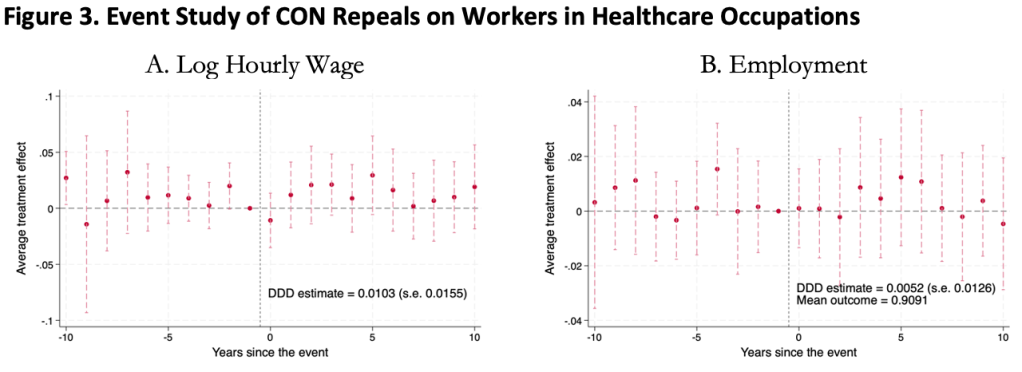
The short answer is that they don’t affect wages or overall employment levels, at least according to a new article in the Southern Economic Journal (ungated version here) by Kihwan Bae and me.

This was surprising to me, as I kind of expected CON laws to harm workers. Certificate of Need laws require many types of health care providers to obtain the permission of a state board before they are allowed to open or expand. This could lead to fewer health care facilities, and so less demand for health care workers, lowering wages and employment. It could also lead to less competition among health care employers, to similar effect.

On the other hand, less competition in the market for health services could raise profits, with room to share them in the form of higher wages. Or, CON being primarily targeted at capital expenditures like facilities and equipment could increase the demand for labor (to the extent that labor and capital are substitutes in health care). All these competing theories seem to cancel out to one big null when we look at the data.

We use 1979-2019 data from the Current Population Survey and a generalized triple-difference approach comparing CON-repealing to CON-maintaining states, and find a bunch of fairly precise zeroes. This holds for many different definitions of “health care worker”: those who work in the health industry, in health occupations, in hospitals, in health care outside hospitals, nurses, physicians, and more.

This is the first word on the topic, not the last; I wouldn’t be too surprised if someone down the road finds that CON does significantly affect health care workers. In this paper we pushed hard on the definition of “health care workers”, but not on “Certificate of Need” or “wages”. We simply classify states as “CON” or “non-CON” because that is what we have data for, but some states have much stricter programs than others, and some day someone will compile the data on this back to the 1970’s. The easier thread to pull on is “wages”. We use one good measure (the natural log of inflation-adjusted hourly real wages), but don’t do any robustness checks around it; considering “business income” could be especially important here. It is also possible that CON affects workers in other ways; we only checked wages and employment.

The full paper is here (ungated here) if you want to read more.

Counting Jobs (Revisited)

In January 2023 I had a post looking at the different ways that the Bureau of Labor Statistics measures employment. Those who follow the data closely probably know about the difference between the household and establishment surveys, which the monthly jobs report data is based on. But these are just surveys.

The more comprehensive data (close to the universe of workers, roughly 95%) is the Quarterly Census of Employment and Wages. While more comprehensive, this data comes out with a much longer lag, and is only released once per quarter. The QCEW is just the raw count of workers, which is useful in some ways, but we also know that there are normal seasonal fluctuations, which the QCEW doesn’t adjust for. Therefore, year-over-year changes in jobs are the best way to look at trends in this data. In September 2023 (latest month available), the US had 2.25 million more workers than in the previous September. For comparison, the establishment survey showed an increase of 3.13 million jobs that month, and the household survey showed a change of 2.66 million — suggesting they both might be overstating job growth.

Still with me? Here’s one more set of jobs data: the Business Employment Dynamics data. This dataset is built on the QCEW data, but allows more fine detailed insights into what types and sizes of firms are gaining or losing jobs. Like the QCEW, the most recent data is for the 3rd quarter of 2023 (just released today), but when looking at the aggregate data, it has one advantage over the QCEW: it is seasonally adjusted, so we can look at the most recent quarterly change (not really useful for not-seasonally-adjusted data). The BED data also looks only at private sector jobs, so it is looking at the health of the private labor market (and ignoring changes in government employment).

The latest BED data do show a possibly worrying trend: the 3rd quarter of 2023 showed a net loss of 192,000 private-sector jobs. That’s the first loss since the height of the pandemic, and ignoring the first half of 2020, the only quarterly decline since 2017. Here’s the chart (note: y-axis is truncated because the 2020q2 job loss is so large it makes the chart unreadable):

I should note that this data is subject to revisions, even though the QCEW is mostly complete. The second quarter of 2022 originally showed a decline, but that was later revised upwards as QCEW is updated and seasonal adjustment factors are updated. Still as, this data stands, it is a worrying jobs number that differs from the monthly surveys. For the change from 2023q2 to 2023q3, the establishment survey shows a gain of 640,000 jobs and the household survey also shows a gain of 546,000. Like the QCEW raw data, the BED seasonally adjusted data suggests that the monthly surveys may be overstating job growth.