Consumption as Inflation Hedge

The emerging market in digital art as nonfungible tokens is the strongest signal of expected inflation I’ve seen to date.

Let’s back up.

Digital art is being sold as nonfungible tokens (NFTs). Is this a bubble? Don’t know. Is this art? Don’t care. Is a piece of digital art as an NFT harder easier or harder to duplicate? I imagine it is easier for the artist, but they have an incentive not to issue duplicates, because doing so erodes the market value of all future digital art NFTs the producer might issue. Is a piece of digital art as NFT harder to duplicate for a forger? I imagine so. The NFT as both art and artists signature is certainly harder to duplicate than traditional media and penmanship. Which is to say we have little reason to worry about the value of a piece of art being inflated away by the artist or criminal forgers.

Now that’s interesting.

The general rule of thumb is that the more consumption value a good offers, the worse it will perform, on average, as an investment. Art, baseball cards, comic books, vinyl records, memorabilia, homes – these are all generally inferior to equities as investments. It stands to reason, though I certainly haven’t checked, that the same logic applies to hedging against inflation as well. Precious metals, while less fun, should offer a superior hedge against inflation than art, particular in relation to art by living artists, where the supply is anything but fixed.

In this regard, however, NFTs are a bit of a game changer. The supply of any given Beeple NFT is fixed forever at one, and there is as yet no reason to believe otherwise. Storage and security costs approach zero, which is something that can’t be said about a 20-foot tall metallic balloon dog. The consumption value is subjective and I’ll leave it to market auctions to suss that out. The inflationary hedge value, however – in this manner NFTs may be an game-changing innovation for prominent living artists, allowing them to capture rents from the value they create that has previously eluded them prior to shedding their mortal coil.

The bond market isn’t giving unambiguous signals of inflationary pressures yet, but signs are creeping in, and among those signs I include seemingly rabid excitement for mixing cultural-status consumption with cryptocurrency-enabled hedges against the prospect of what would be the first real wave of inflation we’ve seen in 40 years.

Which is a long winded way of saying I’m not rooting for inflation, but I’d also be happy to sell my mint-condition complete set of 1987 Fleer baseball cards if you’re looking to hedge your portfolio.

Retailer Support for Consumer to Consumer

I was not going to post about consumer-to-consumer markets again, but one of my favorite brands has just set up a re-sale site.

M.M. LaFleur is what would happen if I moved to New York City and started a fashion company along with clones of myself, knowing that my consumers are me as a corporate lawyer. I have bought a few pieces from them that I like and wear to work. Even though I don’t plan to buy from them again soon, I enjoy getting their promotional emails.

I’m not a cynic, not when it comes to M.M. LaFleur or re-using consumer goods. I like that they are giving people a chance to reduce waste by getting unwanted clothes to new users. What they are doing is also good business. M.M. LaFleur is making it easier to clear out your closet and offering to pay you in credits to buy new stuff from them.

Continue reading

Rationality and economics

Lately I have been thinking a lot about rationality and economics. In my Economics of the Family and Religion course I exhort students to take the approach, “crazy is lazy”. Like archeologists that brush away the dust from artifacts we should brush away the dust of human decision-making and find the rationality. This is especially useful when it comes to understanding observed patterns in religious practice across time and space. You don’t get very far with, “people are nuts”.

Humans make decisions on purpose. They weigh the costs and benefits of an action and make the choice that seems best to them given their available opportunities. Some students have struggled to integrate this message with their other classes. At FSU we have a deep bench of experimental and behavioral economists so there are ample opportunities for students to see courses with a more psychological approach.

In one famous study, Khaneman and Tversky manipulate whether there is a positive or negative frame on a treatment for a deadly disease. In the positive frame, there was a 33 percent chance that treatment could save the 600 people with the deadly disease. In the negative frame, there was a 66 percent chance the treatment could kill the 600 people with the deadly disease. Notice that both of those probabilities result in 200 people being saved. However, people were far more favorable to the positive frame (72%) compared to the negative frame (22%).

Then there are numerous other behavioral economics findings about seemingly small things that impact the decisions people make. For example, in research about bidding behavior psychologists Dan Ariely and Drazen Prelec and economist George Loewenstein passed out sheets of paper and had students write the last two digits of their social security number (SSN) at the top before they placed a bid for each item on a sheet. Students with SSN in the top 20 percent of the distribution bid 216 to 346 percent higher for the items compared to those with SSN in the bottom 20 percent.

We could go on. In the face of those kind of results, it is no wonder that students pause to reflect about how these findings fit into the larger corpus of economics. Are they useful observations to the extent they help us improve the predictions of our models? Are they damning demonstrations that cut out the heart of the economic approach?

Continue reading

Dow 1,000,000?

While the Dow Jones Industrial Average is one of the most widely quoted stock market indexes, it is well known to have many shortcomings. Specifically, it is price weighted (most indexes are value weighted), and that the 30 companies included are arbitrarily chosen.

But there’s an even bigger problem: it excludes dividends. This doesn’t matter much day-to-day, but it does matter a lot in the long run.

A new working paper, “Replicating the Dow Jones Industrial Average,” looks at both of these problems. First, they find that while price-weighting is weird, it doesn’t matter much. Also, if you just used the 30 largest companies in the US, rather than the 30 that are somewhat arbitrarily included, the return doesn’t change much. Either way, you get an average annual return of between 6.5% and 7.0% over the period 1929-2019. The DJIA is indeed a weird index, but that doesn’t seem to matter.

But the exclusion of dividends (and their reinvestment) is a massive problem over the long run. The authors find that the DJIA would have finished 2019 at a value over 1 million (specifically: 1,113,047) if dividend reinvestments were included (referred to as the “total return” index) rather than the 28,538 that it actually closed at. In other words, the average annual return of the DJIA from 1929-2019 was 11% rather than 7% (these are nominal returns, not inflation-adjusted).

If you know anything about compound growth, this is huge! At 11%, an investment will double roughly every 6 years rather than roughly every 10 years at 7% (using the rule of 70, or more precisely the rule of the natural log of 2). Over a 90 year period, that means the investment will be worth 40 times as much. Even using a log scale, as the chart here does, the dramatic difference is clear when you include dividends.

Economists can’t offer too much in the way of investment advice, other than: get your money into an index fund! Now!

GDP Growth in 2020

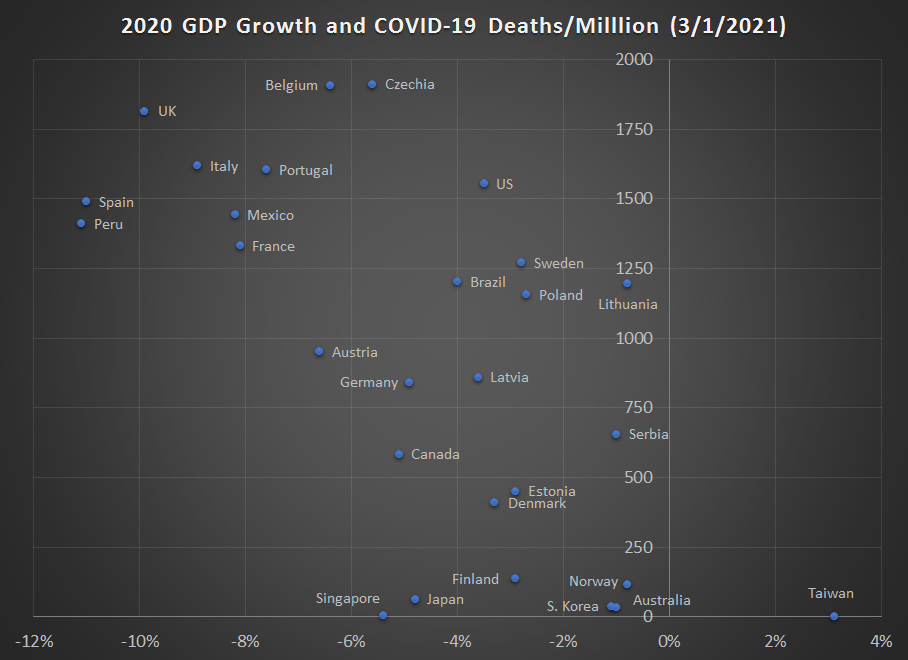
Last year was a historically bad year for many reasons, but to economists that badness is most visible in our widest measure of the economy: Gross Domestic Product. All issues with GDP aside, especially as a perfect measure of relative living standards, the annual real (inflation-adjusted) growth rate of GDP gives us a good picture of how much national economies were harmed by the pandemic, private behavior changes, and government restrictions (disentangling these three effects is hard — I will leave that to the academic journals rather than a blog post).

While GDP is reported with a lag of several months and is subject to revision, many countries have now reported full GDP data for 2020. For those that don’t follow GDP very closely, for a developed country an annual rate of growth of about 2% is pretty normal and respectable. For further context, in the US recent recessions had declines of -2.5% in 2009, -0.1% 1991, and -1.8% in 1982 (the 2001 recession never had an annual decline, only a few quarterly declines). While it is unusual for countries to go more than 10 years without a decline, it does happen. For example, Australia’s last annual decline was in 1991, when it declined -1.3%. But that’s unusual.

This chart shows the 2020 GDP growth rates (mostly negative, with one exception — Taiwan) for 2020 for most countries were I could find data. What this number shows us is the total amount of economic activity in 2020 compared with the total amount of economic activity in 2019 (adjusted for inflation, of course). I believe this is a better measure than others you might see, such as data that compares the level in the 4th quarters of 2020 and 2019 (a country could have had a terrible 2nd quarter but still gotten back close to the prior year level, and a simple Q-over-Q measure would miss that decline). As I did for the 3rd quarter data, this chart also plots the cumulative COVID-19 death rates on the vertical axis.

GDP data comes from government statistical agencies and media reports. COVID-19 death data is from Our World in Data.

What can we learn from this data?

Continue reading

Dolly Parton and the Danger of Doing What You Love

Let’s get through the easy parts quick. This Vox feature does its best to argue for, without ever explicitly stating or committing to, the thesis that Dolly Parton should be canceled because she has never said or done anything controversial, let alone anything justifying cancelation.

It is not good and is largely unworthy of comment. As much as some of you crave dunking on the proponents of cancel culture with a an intensity that sometimes feels a lot like, well…cancel culture, I’m bored with the whole family of skirmishes, vendettas, and public identity burnings.

I want to talk about sh*t jobs.

I don’t mean unpleasant, dangerous, or low status jobs. There are positive compensating wage differentials for such things. No, I submit to you that the new sh*t jobs of the modern developed economy are relatively pleasant, safe, and within the appropriate social circles, quite high status. And therein lies the trap. Let me set the scene.

You’re at a top 100 undergraduate university. English is your first language, you’re accustomed to receiving high grades, and are sufficiently socially adept that attending college parties is at least moderately enjoyable. In choosing your major, you are persuaded that you should choose the subject within which you experience the greatest pleasure executing your assignments and participating in class. While math is by no means beyond your capacity, studying it brings you little pleasure, and there is no similar mechanism for you to earn approbation from your professor or impress you classmates. You don’t get excited about telling your friends you are planning to become an engineer or chemist, and, perhaps most importantly, imagining your future self as an employee in sensible work slacks fills you with an almost crippling amount of ennui.

So you start on the path to become a writer. You know that fiction writing is a brutally competitive field, dominated by a handful of (what you imagine to be) supernovas of talent. You’re practical, you tell yourself, and imagine a career in journalism or journalism adjacent publications where you research beat stories and features, allowing yourself to get excited about climbing the ladder and eventually writing a regular column where you blow our collective minds with your insight and pith. It only takes six months into your first gig that you realize the problem. The really big problem.

Every other English major in the country had exactly the same idea. A lot of sociology, history, critical theory, and field studies majors, too. The field is flooded. But it gets worse. It’s also filled with engineers, economists, psychologists, biologists – people with specialized knowledge, often with advanced degrees, all competing with you for space in a brutally selective ecosystem where every ounce of attention and influence is measured to the last eyeball.

But it gets so much worse.

Thousands of those people are willing to do the job– your job — for free. For nothing. Hell, some of them are willing to pay the publisher for the opportunity to do what you considered the vocation that would pay your rent. How can you compete with that? It’s beyond our fears of being underbid by people willing to take less pay, of our job being outsourced to workers in another country with a lower standard of living and weaker labor laws. Nobody’s worried about the execs at their company discovering a sweatshop in Vietnam full of employees willing to pay your boss for the right to do your job.

But that is exactly what’s happened to everyone who wanted to write about sports, music, partisan politics, or, for that matter, any subculture where being a tastemaker or cultural curator is catnip for the teenage soul. There’s been a revival of unionization in the digital print business and its easy to see why: they need to close shop. Everyone who’s gotten their foot in the door and ridden the elevator up to their new 6th floor cubicle has been greeted with the same horrifying sight. Teeming masses, as far as the eye can see, all desperate for their job, for their identity, as a writer. So desperate they’ll do it for free. Some want a chance to prove themselves, but many of them just want a hobby. They competently teach 7th grade band during the day for a pay package that includes health and dental insurance, all while wearing a very sensible skort from Costco. But by night they write fiery, in-depth, shockingly well-informed features about their favorite North London soccer team, Icelandic DJ subculture, or how to get the most bang for your buck shopping at Costco. The research, the writing, the promotion, they do all of this for free.

Which means every assignment could be your last. Which means you need to get attention, no matter what. Most days it’s not that big a risk. You churn out 1-2 posts per day, mostly just recapping news or taking a few shots at someone who wrote something you don’t like or, at least, you think other people won’t like. But every now and then you shoot the moon on a big feature, going through old sources, putting together a collage of links that you think will jar readers into not only reading your work, but responding to it and, most importantly, sharing it with others on Facebook, Twitter, or even Instagram. A viral hit is the kind of thing that your overlords will remember the next time your writing hits a fallow period.

But if your feature doesn’t pan out, that could be a problem. If a beloved country singer with a reputation for virtuoso talent, kindness, and often overwhelming generosity that actually makes the world a measurably better place, well, you don’t have the luxury of letting three weeks go to waste. If you can’t find evidence that she’s a bad person, well, you’ll have to go with your gut. And your gut tells you that everyone who is successful is a bad person. Lack of evidence to their secret depravity is itself only evidence to how much they have invested to hide said depravity.

That’s the problem with trying to make what you love at 19 into a career. You’re a kid, you don’t know that much about what you’re going to like in 10 years, all you know is what is fun and what is hard. And, in rough approximation, the same things are fun and hard for all of us. Only studying the things that are fun, dodging whenever possible the things that are hard, will leave you with nothing to rely on but your talent. And, ample as that talent may be, it is unaugmented by the skills and tools that are harder and less fun to come by, tools which would differentiate you from the teaming oceans of talent sloshing against the sides of that cubicle, all desperate to do your job. For free.

Economic Research on COVID-19

The past 12 months has been dominated by COVID-19, the related recession, the government response, and other matters. But it has not just dominated our lives, it has also dominated new research, including research by economists!

Working papers from the National Bureau of Economic Research are one place to track on-going research by economists. While not all economic research is released as an NBER working paper (there are other series, and some economists just post them on their own website or department page), the volume of NBER papers should tell us something about the trends.

Here’s a chart showing the weekly NBER working papers that are in some way related to COVID-19. The first batch of three papers was released in late February, one long year ago. The second batch of nine papers came one month later. Since then, there have been papers released every single week, with the exception of the week of Christmas.

In total, there have 373 papers released that relate to COVID-19. The peak comes in late May and early June, with 61 papers released in a 4-week period and 21 of those papers coming out on May 25 alone. Since the May-June peak, we’ve seen a slow decline in papers on COVID-19, and we are now at our lowest level, with just 14 papers released in the past 4 weeks.

Continue reading

Cryptocurrencies, 1: What Exactly Is Bitcoin?

Everybody knows that Bitcoin is a “digital currency”. But what does that really mean, and what is Bitcoin really good for? Who developed it? Turns out, oddly, that we don’t actually know. Can you buy a pizza with it? Turns out that perhaps the most famous pizza purchase of all time was made with Bitcoin.

Continue reading

Academia as tax shelter

A very brief story:

My advisor was Laurence Iannaccone, student of Gary Becker, seminal and in many ways founding contributor to the economic study of religion, now of Chapman University. His observation is a common one in academia, a point of pride for some even, though that varies greatly by discipline, as does their market options outside of the academy. And, yes, flexible work schedules, post-tenure job security, and sometimes picturesque campuses all should be counted towards the total compensation of those fortunate enough to secure a faculty appointment. But the power of the observation goes far beyond proper labor market accounting.

As I find so often to be the case, there is good sociology to be done, but the best first step in doing so is a little bit of economics. To wit:

The academy is, on average, considerably to the left of the population at large. Now this difference, mind you, is grossly exaggerated by your typical right-wing windbag who seems to think that universities begin and end in the English department, but the difference remains. So why would your typical economics, chemistry, or architecture professor tend to be left of the popular center? Well, if the median self-identified lefty got to choose the federal and state tax rates, what would they be? Ok, and how much of that will I have to pay out of my non-pecuniary income? Until they figure out how to tax the thrill of pursuing my own self-determined research agenda, not very much. Taxes are cheap when half of your compensation is non-pecuniary.

The academy is a club.

Scratch that.

The academy is a hierarchy of nested clubs. Which means that we often suffer from exclusionary FOMO akin to fourth tier English gentry trying to marry off five daughter in the early 19th century. Membership in those clubs– those famed research groups, donor-named centers, or even (god forbid) schools of thought — they become more than just sources of funding, workshop critique, and coauthor match-making sock hops. These clubs become the well springs from which ever increasing portions of our non-pecuniary income come from. They become our social networks, our friends, and even ,with a handful of co-authors you’ve gone into scientific battle alongside, a second family. The next time you see someone dig in their heels, seemingly denying the mounting evidence that they were on the wrong side of a scientific argument, don’t just blindly assume they are too stubborn and arrogant to acknowledge they might have been wrong. Consider how unfunded or, more importantly, how lonely they stand to be if they’re the first to give up the fight.

It’s why we covet tenure so much. Don’t get me wrong, everyone wants job security. But for most of us, the prospect of being laid off doesn’t necessarily include the possibility of being jettisoned from what you’ve slowly constructed as a separate parallel universe within which you have carefully curated the technical, educational, and social capital necessary to produce your career and life. If you get laid off from programming for Netflix, the next few weeks or months will be unpleasant, scary even. You may begin to doubt your ability or life choices. But that next job will come, and you will as often as not find yourself with a nearly identical life on the other side.

There are those in the academy though for whom this is all they’ve ever known. Bachelors, doctorate, tenure-track academic placement. Throw in a post-doc and that’s 20 years, and you’re entire adult life, in and around universities. Even if they’re from a field fortunate enough to have robust private sector options, how much will doubling your salary really soften the blow for such a person?

I say all of this now not as a critique of academia, or even to lead to prescriptions or advice. You want my advice? Fine, here: don’t go straight to grad school. Dip your toe in the real world, see how you like it. Come back in a few years with a little experience and distaste for office life. It’ll serve you well when your dissertation hits one of its many inevitable nadirs.

Rather, I invite you to consider this: what does the world start to look like when our utility comes less from the goods that we buy and the experiences we have, and more from the clubs we are members of? What does it look like when those clubs find newer and better ways to monitor our behavior and our expressed beliefs? What does it look like when the purging of membership rolls becomes a part of the culture of those clubs?