Last year, Jeremy wrote “Where Can You Still Buy an Affordable Home in the US?” He pointed out a few metro areas in the US that are not classified as “unaffordable”. All of the biggest cities have nice amenities such as great restaurants but are very expensive.
There is such a thing as an American town that is too small to find a good restaurant. But you don’t have to go all the way to the middle of New York or Chicago to find interesting menus. If you love food and good creative restaurants, there are some smaller cities that can deliver. Parking and hotels should be cheaper, so you can spend more of your money on food. (I don’t have any data on hand with regard to how menu prices in Birmingham compare to menu prices in NYC. Presumably they are lower here where labor is relatively cheaper.)
I think I care more about food quality than “service.” Nothing has bothered me about the gradual nation-wide shift away from table service toward placing my order at the counter or from a computer screen.
I don’t do much with them, but Jeremy is an advocate for restaurant apps. If you track deals and order directly through the app, you might save around 10% on low-to-mid quality restaurant food.
On a side note, I’m wondering if and when AI will approach the service level of a personal chef. I wish I could outsource all family meals to someone else. I have experimented with grocery delivery and “meal kits” and recipe apps. Nothing ever feels like a personal chef, although some of those services are nice to have. I feel like a superintelligence could encompass all of the restaurant apps, and grocery delivery and family meal planning together. I wish I could just enter a list of taste and health preferences and then not think about it anymore.
Interest rates communicate the value of resources over time. For example, if you take out a loan, then the interest rate tells you how much you must to pay in order to keep that money over the life of the loan. The interest rate also reflects how much the lender will be compensated in exchange for parting with their funds. On the consumer side, the interest rate reflects the price that the borrower is willing to pay in order to avoid delaying a purchase.
When a business borrows, the interest rate reflects the minimal amount of value that they would need to create in order to make an accounting profit. For example, if a business borrows $100 for one year at an interest rate of 5%, then they need to earn $105 by the time that they repay the loan in order to break even with zero profit. The business would need to earn more than 5% in order to earn a profit on their borrowing and investment venture.
The longer the business takes to repay their loan, the more interest that accrues. And, the higher the interest rate, the more they need to earn in order to repay their loan.
This logic applies to all production because all production takes time. If production takes very little time, then the impact of the interest cost is miniscule. But, if production takes longer, then interest rates become increasingly relevant. These kinds of products include trees, cheese, wine, livestock, etc. Anything that ages, ferments, or has a lengthy production process will be more sensitive to the cost of borrowing.
How?
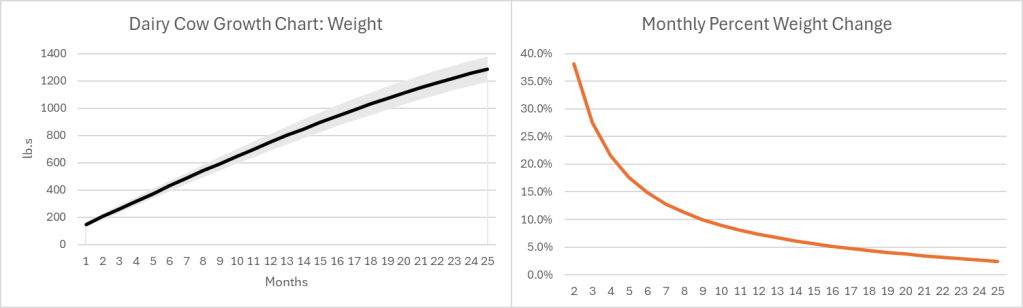
The growth pattern for most (all?) goods looks similar. Below-left is a growth chart for dairy cows . Notice that calves grow quickly at first, and their growth slows over time. For the sake of argument, let’s say that the change in value of a cow mimics the change in weight (Yes, I know that dairy and beef cows are different, but the principle is the same). Below-right is the monthly percent change. Even at an age of 25 months a cow is still growing in value at 2.4% per month or 33% per year.
Of course, there is a risk that some cows don’t survive to slaughter, lowering the expected growth rate. Since most cattle are slaughtered between 18 and 24 months of age, their growth rate at the time of slaughter is 4.4%-2.7% per month. As the interest rate at which farmers borrow rises, the optimal age at slaughter falls. Otherwise, the spread between the growth rate and the interest rate could go negative. Even so, what an investment! If you can borrow at, say, 8% per year, then you’ll make money hand-over-fist on the spread.
Except… Cows cost money to raise, and most of that cost is feed. According to the production indicators and estimated returns published by the USDA, the cost of feed in February of 2023 was $158.11 per hundred pounds of beef. The selling price of beef was $161.07. That leaves $2.96 or a profit of 1.87% earned over the course of 1.5-1.75 years. That investment is starting to look a lot less good, especially since it doesn’t include the cost of maintaining facilities, insurance, etc. It’s no wonder that farmers and ranchers are serious about their subsidies. Clearly, with such tight margins, farmers and ranchers are going to look good and hard at the interest rates that they pay on their debt. And, they do have debt.
However, the recent increase in beef prices is not caused by higher interest rates.
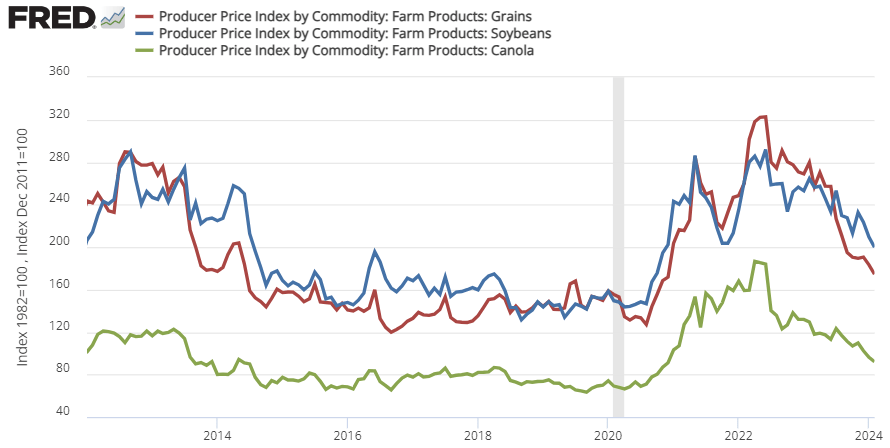
That 1.87% profit margin is at prices and costs from February 2023. Since 2020, the price of cattle feed ingredients (grain, bean, and oil) peaked in the summer of 2022 and are still substantially more expensive than pre-Covid (see below). That means that cows getting slaughtered right now were raised on more expensive feed. This February 2024, the cost of feed per 100lb. of cattle was $191.80. But the cattle selling price was only $180.75. That’s a $11.05 loss for cattle raising. Wholesale prices of cattle might be up recently, but the cost of feed is up by more. It’s not the cattle farmers who are benefiting from the high beef prices. In fact, they’re getting squeezed hard.
There is good news. The cost of feed ingredients has been falling recently, which means that beef farmers should begin to see some relief if the recent trend continues. For Consumers, the price of beef is already down from its 2023 peak.
By now, hopefully we’ve all heard of shrinkflation. But if you haven’t, it’s when the unit price (e.g., the cost per pound) increases not because the price of the good went up, but because the product shrank in size.
Let’s be clear about a few things. First, this is nothing new. Here’s an Economist story from 2019 (pre-pandemic and pre-Bidenflation) talking about shrinkflation. You can find many such anecdotal stories back even further.
Second, the BLS is aware of this. They track it, and price it into the CPI. Take a look at the price data which underlies the CPI: it’s all stated in units. Price per pound, price per dozen, etc.
Moreover, the BLS also recently gave us some data on how frequently this happens. It’s pretty rare. Even among food items, which are a category the includes a fair amount of shrinkflation, only about 3 percent of products experienced any downsizing or upsizing from 2015-2021. That’s right, sometimes packages get larger, not smaller, which effectively lowers the unit price. “Shrinkdeflation” anyone?
We’ve all heard the stereotype. Millennials eat avocado toast (so say the older generations). The uncharitable version is that they can’t afford other things like cars, houses, etcetera due to their expensive consumption habits otherwise. And avocado on toast is the standard bearer for that spendthrift consumption.
I’m here to tell you that it’s bunch of nonsense and that the older folks are just jealous. Millennials, those born between 1981 & 1996, weren’t intrinsically destined to spend their money poorly as some generational sense of entitlement. Nor did the financial crisis imbue them with the mass desire for small but still affordable treats. The reason that millennials got the reputation for eating avocado on toast is that 1) it’s true, 2) because they could afford it, and 3) older generations didn’t even have access.
Asked for its methodology, the White House pointed us to a Nov. 15 blog post by Jeremy Horpedahl, an associate economics professor at the University of Central Arkansas.
“When people ask what Civilization VI’s “cultural victory” condition would look like in the real world, this is it. Write it in the manual.”
When people ask what Civilization VI’s “cultural victory” condition would look like in the real world, this is it. Write it in the manual. https://t.co/i88RmJF7qr
Despite recent increases in prices of food, we should still all be very thankful this Thanksgiving for the abundance of affordable food available in the modern world. Looking back at my past few blog posts, I notice that I have been very food-centric in my choice of topics! And last week I also showed how the Thanksgiving meal this year will be the second cheapest ever (only behind 2019). While it’s absolutely true that food prices are up a lot in the past 2 and 4 years, they probably aren’t up as much as you have heard.
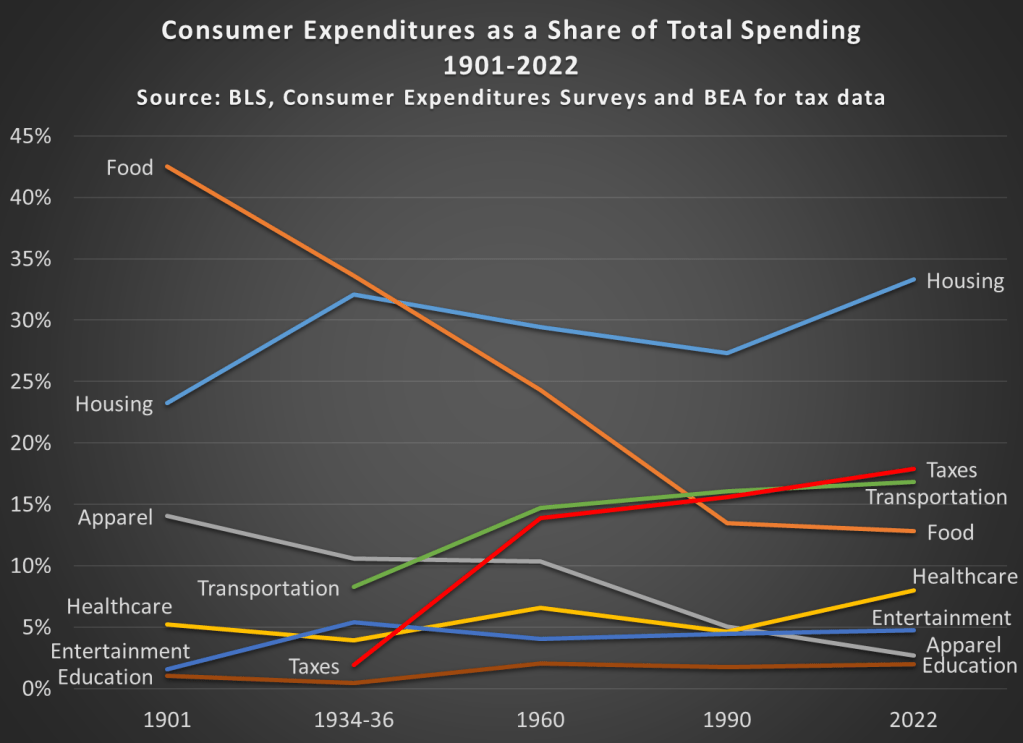
It’s always my preference to take as long-term perspective as possible when thinking about economic progress. So here’s the best way I’ve come up with to show how cheap and abundant food is today: food as a share of household spending fell dramatically in the 20th century.
Most of the data in this chart comes from the BLS Consumer Expenditure Surveys. This survey was done occasionally since 1901, and then annually since 1984. I also use BEA data to estimate personal taxes paid as a percent of spending (the CEX Surveys have some tax data, but it’s not reliable nor consistent). I picked as close to 30-year intervals as I could (with a preference for showing the earliest and latest years available), and I chose spending categories that are 90-100% of total expenditures in most of these years. Keep in mind also that these are consumer expenditures. As a nation, we spend a lot more on healthcare and education than this chart suggests, but most of that spending is not directly from households (of course, it is indirectly). Think of this chart as an average household budget.
I hope the thing that jumps out at you is that the amount money households spend on food has fallen dramatically since 1901, from over 42 percent to under 13 percent of household expenditures. To be clear, this data includes both spending on food at home and at restaurants (after 1984 we can track them separately, and groceries are pretty consistently about 60 percent of food spending). And you may be wondering about very recent trends too, such as before the pandemic. In 2022, household spent slightly less on food than they did in 2019, falling from 13.5 to 12.8%.
You may also notice that taxes have increased, though not much since 1960. Housing cost have been consistently high, and also a bit higher than 1990, going from 27 percent to 33 percent in 2022. And housing is now the single largest budget expenditure category, but for most of the first half of the 20th century, it was food that was the largest. And since people aren’t changing their housing situation more than once a year (if that), it would also have been food that dominated weekly and monthly budget decisions and worry about price fluctuations.
This year there will be lots of complaining about prices around the Thanksgiving table. And much of that is warranted! But let’s also be thankful on this food-intensive holiday for how cheap the food is.
And if some smart-aleck youngster tries to tell you that they learned on TikTok that things were better during the Great Depression (yes, people are really saying this!), have them watch this video by Christopher Clarke. Or show them that in the mid-1930s an average family spent one-third of their budget on food in my chart above, or how much labor it would have taken to buy that turkey in the 1930s (about 40 times as much time spent working as today).
Continuing my tradition of Thanksgivingposts, Farm Bureau released today the latest data on the cost of a traditional Thanksgiving meal. There is welcome news for consumers, as the nominal price of the dinner is slightly lower than last year: $61.17 vs. $64.05 in 2022. The big factor in this decline was the fall in the price of turkeys, though eight of the 12 items in this meal are lower than 2022. As they note in the press release, this is still significantly higher than 2019: about 25% higher.
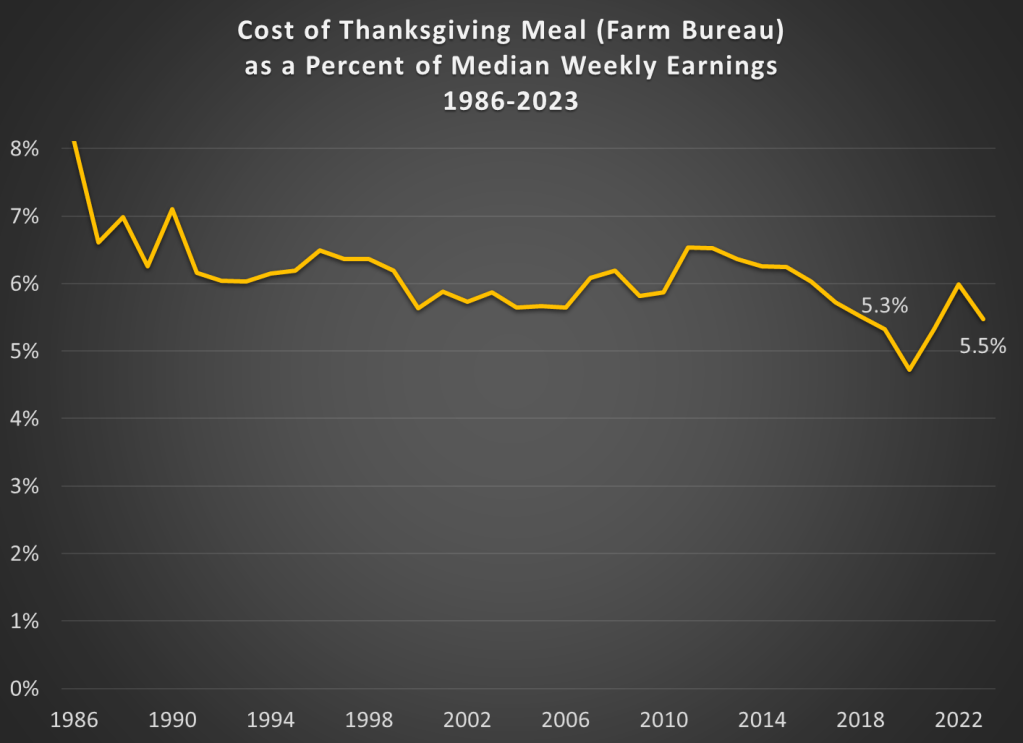
Regular readers will know what’s coming. Let’s compare those prices (and some historical prices) to earnings:
The Farm Bureau turkey dinner stands at about 5.5 percent of median weekly earnings from the third quarter of this year. That’s a touch higher than 2019, when it was 5.3 percent of weekly earnings. But notice that other than 2019, the figure for 2023 is the lowest ever! (Ignoring the weird years of the pandemic, when wage data is hard to interpret.) So we haven’t quite gotten back to 2019 levels, but we are at the same level as 2018. And lower than 2017. And all prior years too.
The last few Thanksgivings have been tough for Americans. This year, we can all be thankful for falling prices and rising wages.
Last week I gave some advice on how to save money on food. Food prices are up a lot in the past 4 years, but especially since the beginning of 2021. Over the 32 months since January 2021, grocery prices (according to the CPI) are up 20 percent (keep that number in mind). To give you an idea of how unusual that is, in the 32 months before the pandemic (up to January 2020), grocery prices only rose 2 percent. Perhaps even more astonishingly, if we look at October 2019 grocery prices, they were slightly lower on average than 4 years earlier in October 2015. From a flat 4 years to a 25 percent increase over the next 4 years. That’s a huge change for consumers.
But we also shouldn’t overstate the price increases. As you might guess, the best place for overstatements is social media. You can find plenty of them. For example, this very viral video claims that her family’s grocery prices doubled (in fact, almost exactly doubled, to the penny, which is suspicious) in just one single year, from August 2021 to August 2022. According to the CPI data, grocery prices were up 13.5 percent over that period — which, don’t get me wrong, is a lot! But it’s not 100 percent. I’ll focus on this one example, but I’m sure you will believe me that you can find dozens of examples like this on social media every single day (for example, yesterday someone claimed bread prices had tripled since 2019).
Let’s leave aside for a moment that in that viral video she claims to spend $1,500 per month on groceries. This would be a massive outlier for 2022. A family in the middle income quintile spent $460 per month on groceries in 2022, and $713 on all food including restaurants. So even if this family eats every single meal at home, they are still spending twice as much as a middle income family. Even a family with 5 or more people (the largest bucket BLS uses in that report) spent $755 per month on groceries ($1,232 on all food). According to the Consumer Expenditure survey, the middle quintile grocery spending went up 16%, and the five-person household went up 19% from 2021 to 2022. Big increases, no doubt! But not 100%.
So who are we to believe? Have prices roughly doubled since 2021? Or are they up about 20 percent? People are sometimes skeptical of the consumer price index, so let’s look at the actual price data that goes into the index. BLS has data on hundreds of individual food items, but here’s a summary chart with eight common food items. Here’s the change in the prices of those items since January 2021:
The other day I was chatting on Zoom with a friend. She noted that she and a couple of girl friends go on an interesting vacation each year. They start off by each of them writing down their top three destinations, and then comparing notes. This year, it is a tour of the Danube region.
Thinking of a similar “Where do we go next year for kicks, guys?” scenario in the movie City Slickers, I jokingly suggested running with the bulls in Pamplona. That is kind of a guy thing (50-100 injuries each year, occasional fatal goring), but it triggered a comeback from her: “Well, maybe the tomato festival instead.”
So of course I started poking around the internet to see what was up with tomato festivals. They sounded less than exhilarating, on a par with a midwestern pumpkin growing contest. Now, in Lancaster County, PA (Amish country), some of the tomato festivals feature..wait for it….a bounce house! That’s nice, but maybe not worth a plane flight to get there.
Nashville goes all out with their Tomato Art Fest, with food vendors, live performances and people walking around costumed as giant tomatoes. This year’s theme was, ““THE TOMATO: A Uniter, NOT A Divider! – Bringing Together Fruits & Vegetables.” In Leamington, Ontario they get really physical by putting a layer of tomatoes in kiddie pools on the ground, so you can take off your shoes and socks and step in and squoosh those tomatoes under your bare feet. Woo hoo!
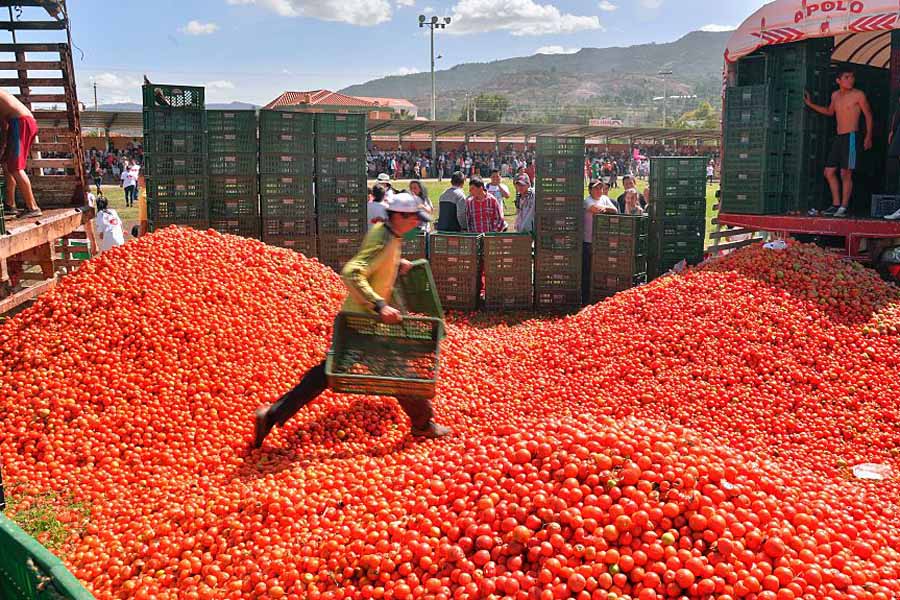
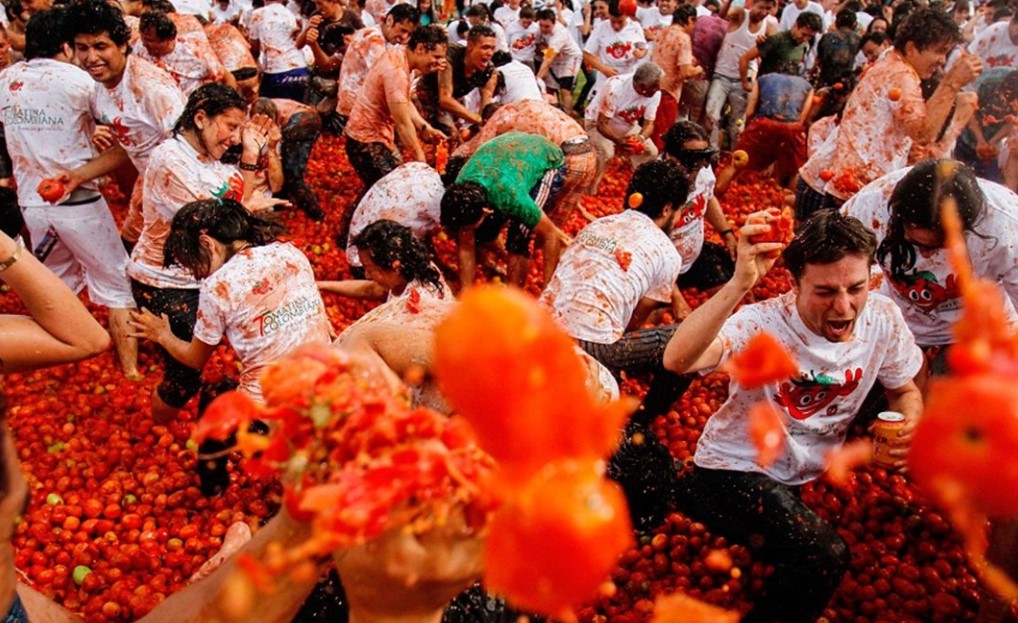
But it turns out the real action is La Tomatina in Bunol, near Valencia (Spain). Excitement builds as truckloads of ripe tomatoes are brought into town:
Then there is the greasing of a tall pole with lard; a ham is perched at the top of the pole. And then (since the pole is unclimbable), enthusiastic people pile their bodies up around the pole till someone can reach the top of the pole and cast down the ham, whereupon a signal cannon fires.
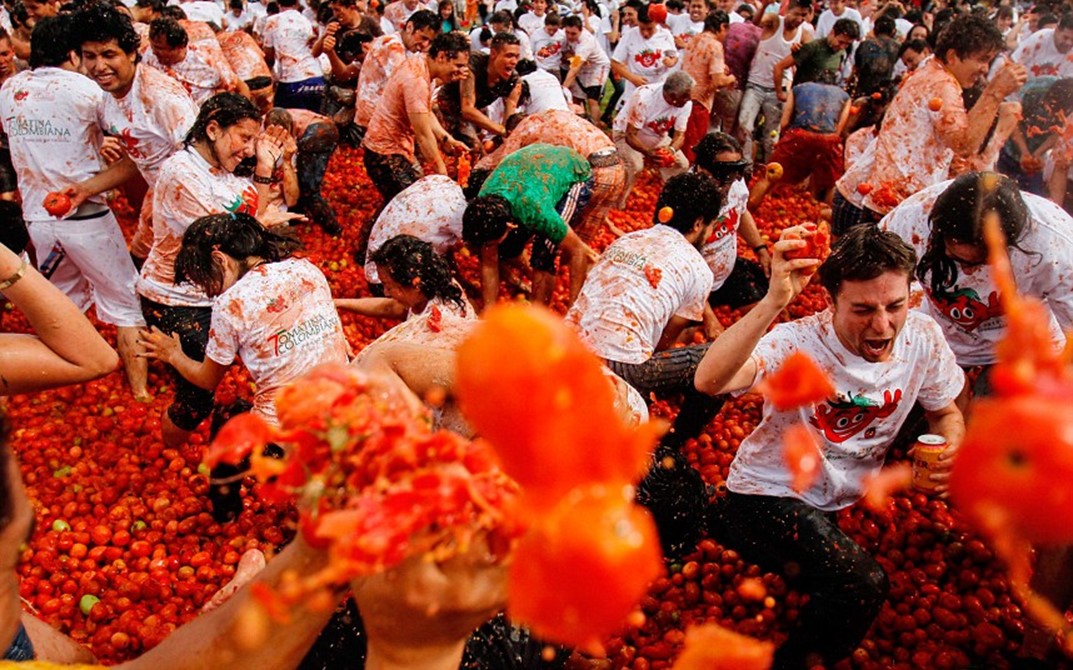
That is the signal for total mayhem to erupt – 20,000 people (you have to buy a ticket beforehand) hurling tomatoes at each other, until the whole town square is deep in squishy red pulp. Participants are asked to hand-squash each tomato before throwing it.
After an hour, a second cannon fires to signal cease firing. Local residents may hose you off, or you can go wash off in the river. (Tips include bringing a change of clothes, because you aren’t allowed on the train or bus with your gooey clothes). Afterward, the firetrucks come and hose down the town square. Reportedly, due to the annual rinsing with acidic tomato juices, the town streets appear remarkably clean. During the days leading up to the main event, there are local parades and tours and a paella cooking contest. (Paella is an amazing local rice-based dish, worth of a blog article of its own)
So if you want to do something memorable in Spain but you are too lazy to walk 500 miles on the Camino de Santiago pilgrimage, or you are too chicken to run in front of a crowd of angry bulls, put La Tomatina on your bucket list.
It’s the time of the year when we share ideas for things to buy, possibly as Christmas or other holiday gifts. But I’m going to share with you not a specific thing to buy, but instead a method for buying things. And probably not the kind of thing you might think of sticking in a wrapped present: food.
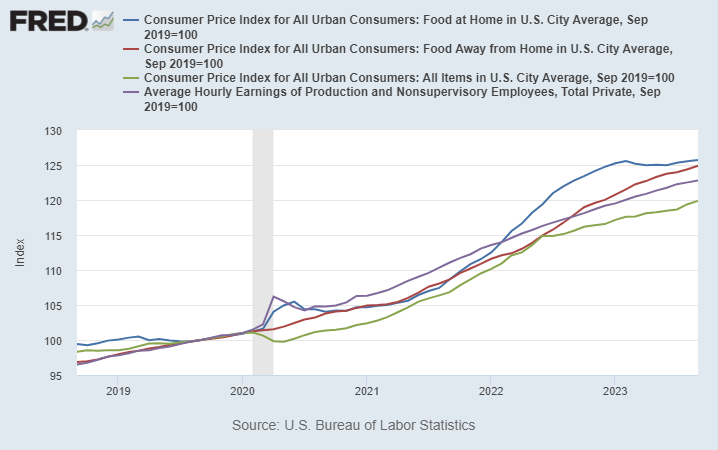
We’ve all heard about and felt inflation lately. But food prices have been especially noticeable to consumer, and not just because it’s a product you frequently buy and probably know the price of many food items. Food prices, both at home and restaurants, have increased much more than the average price levels.
On average, prices are up about 20 percent in the US over the past 4 years. But food prices are up about 25 percent, on average.
Wages (the purple line) actually have increase faster than the general price level over the past 4 years — that may shock you given what we constantly hear in the traditional and social media about “price increases outpacing wage gains” — but it is true when we are talking about food. Your dollar doesn’t go quite as far as it used to for food.
In some sense these costs are hard to avoid: food is a necessity. But there are ways to reduce your costs, and you probably know the general tips. Eat less at restaurants. Buy generic. Buy in bulk. Etc. These are good tips, but they all involve some sacrifice or annoyance. Is there anything else a consumer can do?
Yes. Here’s a few tips that can save you money, without the sacrifice. There is some thought involved, and perhaps a slight annoyance, but I’ve found that once you get in these habits, the mental and time cost is pretty low.
1. RESTAURANT APPS
You should always be ordering your food through restaurant apps when possible, especially for fast food. I try to track limited good deals on Twitter, but most restaurants offer on-going good deals. For example, McDonalds usually has a 20% off coupon, just for using the app. Taco Bell has a $6 box you can build, which would cost around $10 to order as a combo or à la carte at the restaurant. That’s a 40% discount for using the app.
Using apps also means you are using the restaurant’s rewards programs. Valuations vary, but McDonald’s rewards are roughly worth 10% cash back.
2. CHASE THE SALES AT GROCERY STORES
Clipping coupons is the classic way of saving money at the grocery store (we even have reality shows about it), but in the modern world grocery stores have expanded the ways to effectively save the same amount of money. The clearest example is, once again, the rise of apps. Stores will often have “digital only” coupons that you need to access through their app (which is also tied to your rewards account, just like restaurants).
While I’m a strong advocate of coupon clipping (and the virtual equivalent), it can be time consuming. Another strategy that can save you is thinking ahead about seasonal and other cyclical prices. For example, my kids like M&M’s. We usually buy a bulk 62-ounce container at Sam’s Club (already a savings), but today I took the additional saving step of buying the Halloween-themed bulk container. It was 36 percent less than the identical Christmas-themed M&M’s container right next to it. And I was replacing the Easter-themed bulk container that we purchased back in April, and they just finished.
Of course, I had to be planning ahead and know that November 1st was a great day to buy M&M’s. That takes some mental effort, sure. And you might think these kinds of deals are fairly limited in nature. But holidays aren’t the only kind of seasonal deals. For example, even though most fruit is generally available year-round now, there are still predictable price cycles of when things are “in season” and when they have to be imported from expensive locations. Even if you are only able to find these cyclical deals for 10 percent of your purchases, saving 30-50% on cyclical goods will shave another 3-5% off your grocery bill — bringing it closer in line to the average increase in prices (and wages).
3. CASH BACK CREDIT CARDS
I could write an entire post about credit card rewards. But let me focus here on credit cards that are especially good for buying food. At a minimum you should be getting 2 percent back on all of your purchases, as there are several no-annual-fee cards that give you 2 percent: the Citi Double Cash and Wells Fargo Active Cash are good examples.
But on food purchases, you should be able to beat 2 percent. For example, the Citi Custom Cash card gives you 5 percent back on your top spending category each month, up to $500 of spending. This can be on either groceries or restaurants. And since a family in the median quintile spends $250 at restaurants and $460 on groceries per month, you should be getting 5 percent back on basically all of your purchases in one of these two categories. (Personally I stick to restaurants for this card, because I buy most of my groceries at Walmart and Sams Club, which don’t count towards the grocery cash back.) Or if you want a simple card that gives you 3 percent back on both groceries and restaurants, check out the Capital One SavorOne card (again, no annual fee).
There are also several cards that have rotating 5 percent cash back categories each quarter, and they often include either restaurants or groceries. How do I keep track of which card to use for what kind of purchase? Simple: put a strip of masking tape on the card with a label. This will get some chuckles from your friends or the server at the restaurant, but that’s just an opportunity to tell them how to save money too!
Is There Really a Free Lunch?
Some of my economist friends are probably skeptical at this point. Aren’t I say there is a free lunch here? Isn’t the extra hassle of the steps I suggested going to outweigh any discount you get?
The answer is No. And while economists are quick to bring up the concept of opportunity cost, I find that most people tend to overestimate their opportunity cost. But even if you don’t overestimate your opportunity cost, you can bring in another useful economic concept: price discrimination.
Restaurants are very much in the business of price discrimination, and always have been. Tuesday Night specials, happy hours, etc. Every consumer has a different willingness to pay, and since it’s hard to resell a restaurant meal, restaurants can potentially use this technique to their advantage (and yours, if you are willing to look for discrimination). Grocery stores don’t have as much of an opportunity to discriminate, but they still find ways.
Don’t be afraid of price discrimination: use it to your advantage!



 Economist Writing Every Day