Bored?  You Can Join in a Giant Tomato Fight in Spain!!

The other day I was chatting on Zoom with a friend. She noted that she and a couple of girl friends go on an interesting vacation each year. They start off by each of them writing down their top three destinations, and then comparing notes. This year, it is a tour of the Danube region.

Thinking of a similar “Where do we go next year for kicks, guys?” scenario in the movie City Slickers, I jokingly suggested running with the bulls in Pamplona. That is kind of a guy thing (50-100 injuries each year, occasional fatal goring), but it triggered a comeback from her: “Well, maybe the tomato festival instead.”

So of course I started poking around the internet to see what was up with tomato festivals. They sounded less than exhilarating, on a par with a midwestern pumpkin growing contest.
Now, in Lancaster County, PA (Amish country), some of the tomato festivals feature..wait for it….a bounce house! That’s nice, but maybe not worth a plane flight to get there.

Nashville goes all out with their Tomato Art Fest, with food vendors, live performances and people walking around costumed as giant tomatoes. This year’s theme was, ““THE TOMATO: A Uniter, NOT A Divider! – Bringing Together Fruits & Vegetables.” In Leamington, Ontario they get really physical by putting a layer of tomatoes in kiddie pools on the ground, so you can take off your shoes and socks and step in and squoosh those tomatoes under your bare feet. Woo hoo!

But it turns out the real action is La Tomatina in Bunol, near Valencia (Spain). Excitement builds as truckloads of ripe tomatoes are brought into town:

Source https://allthatsinteresting.com/wordpress/wp-content/uploads/2016/08/tomato-stockpile.jpg

Then there is the greasing of a tall pole with lard; a ham is perched at the top of the pole. And then (since the pole is unclimbable), enthusiastic people pile their bodies up around the pole till someone can reach the top of the pole and cast down the ham, whereupon a signal cannon fires.

That is the signal for total mayhem to erupt – 20,000 people (you have to buy a ticket beforehand) hurling tomatoes at each other, until the whole town square is deep in squishy red pulp. Participants are asked to hand-squash each tomato before throwing it.

PHOTO  https://www.centives.net/S/wp-content/uploads/2015/08/082715_1146_TheEconomic1.jpg

After an hour, a second cannon fires to signal cease firing. Local residents may hose you off, or you can go wash off in the river. (Tips include bringing a change of clothes, because you aren’t allowed on the train or bus with your gooey clothes). Afterward, the firetrucks come and hose down the town square. Reportedly, due to the annual rinsing with acidic tomato juices, the town streets appear remarkably clean. During the days leading up to the main event, there are local parades and tours and a paella cooking contest. (Paella is an amazing local rice-based dish, worth of a blog article of its own)

So if you want to do something memorable in Spain but you are too lazy to walk 500 miles on the  Camino de Santiago pilgrimage, or you are too chicken to run in front of a crowd of angry bulls, put La Tomatina on your bucket list.

Finding Deals on Food

It’s the time of the year when we share ideas for things to buy, possibly as Christmas or other holiday gifts. But I’m going to share with you not a specific thing to buy, but instead a method for buying things. And probably not the kind of thing you might think of sticking in a wrapped present: food.

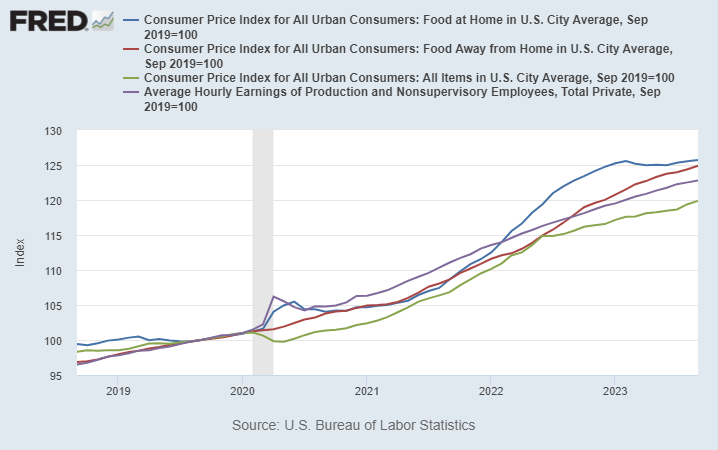
We’ve all heard about and felt inflation lately. But food prices have been especially noticeable to consumer, and not just because it’s a product you frequently buy and probably know the price of many food items. Food prices, both at home and restaurants, have increased much more than the average price levels.

On average, prices are up about 20 percent in the US over the past 4 years. But food prices are up about 25 percent, on average.

Wages (the purple line) actually have increase faster than the general price level over the past 4 years — that may shock you given what we constantly hear in the traditional and social media about “price increases outpacing wage gains” — but it is true when we are talking about food. Your dollar doesn’t go quite as far as it used to for food.

In some sense these costs are hard to avoid: food is a necessity. But there are ways to reduce your costs, and you probably know the general tips. Eat less at restaurants. Buy generic. Buy in bulk. Etc. These are good tips, but they all involve some sacrifice or annoyance. Is there anything else a consumer can do?

Yes. Here’s a few tips that can save you money, without the sacrifice. There is some thought involved, and perhaps a slight annoyance, but I’ve found that once you get in these habits, the mental and time cost is pretty low.

1. RESTAURANT APPS

You should always be ordering your food through restaurant apps when possible, especially for fast food. I try to track limited good deals on Twitter, but most restaurants offer on-going good deals. For example, McDonalds usually has a 20% off coupon, just for using the app. Taco Bell has a $6 box you can build, which would cost around $10 to order as a combo or à la carte at the restaurant. That’s a 40% discount for using the app.

Using apps also means you are using the restaurant’s rewards programs. Valuations vary, but McDonald’s rewards are roughly worth 10% cash back.

2. CHASE THE SALES AT GROCERY STORES

Clipping coupons is the classic way of saving money at the grocery store (we even have reality shows about it), but in the modern world grocery stores have expanded the ways to effectively save the same amount of money. The clearest example is, once again, the rise of apps. Stores will often have “digital only” coupons that you need to access through their app (which is also tied to your rewards account, just like restaurants).

While I’m a strong advocate of coupon clipping (and the virtual equivalent), it can be time consuming. Another strategy that can save you is thinking ahead about seasonal and other cyclical prices. For example, my kids like M&M’s. We usually buy a bulk 62-ounce container at Sam’s Club (already a savings), but today I took the additional saving step of buying the Halloween-themed bulk container. It was 36 percent less than the identical Christmas-themed M&M’s container right next to it. And I was replacing the Easter-themed bulk container that we purchased back in April, and they just finished.

Of course, I had to be planning ahead and know that November 1st was a great day to buy M&M’s. That takes some mental effort, sure. And you might think these kinds of deals are fairly limited in nature. But holidays aren’t the only kind of seasonal deals. For example, even though most fruit is generally available year-round now, there are still predictable price cycles of when things are “in season” and when they have to be imported from expensive locations. Even if you are only able to find these cyclical deals for 10 percent of your purchases, saving 30-50% on cyclical goods will shave another 3-5% off your grocery bill — bringing it closer in line to the average increase in prices (and wages).

3. CASH BACK CREDIT CARDS

I could write an entire post about credit card rewards. But let me focus here on credit cards that are especially good for buying food. At a minimum you should be getting 2 percent back on all of your purchases, as there are several no-annual-fee cards that give you 2 percent: the Citi Double Cash and Wells Fargo Active Cash are good examples.

But on food purchases, you should be able to beat 2 percent. For example, the Citi Custom Cash card gives you 5 percent back on your top spending category each month, up to $500 of spending. This can be on either groceries or restaurants. And since a family in the median quintile spends $250 at restaurants and $460 on groceries per month, you should be getting 5 percent back on basically all of your purchases in one of these two categories. (Personally I stick to restaurants for this card, because I buy most of my groceries at Walmart and Sams Club, which don’t count towards the grocery cash back.) Or if you want a simple card that gives you 3 percent back on both groceries and restaurants, check out the Capital One SavorOne card (again, no annual fee).

There are also several cards that have rotating 5 percent cash back categories each quarter, and they often include either restaurants or groceries. How do I keep track of which card to use for what kind of purchase? Simple: put a strip of masking tape on the card with a label. This will get some chuckles from your friends or the server at the restaurant, but that’s just an opportunity to tell them how to save money too!

Is There Really a Free Lunch?

Some of my economist friends are probably skeptical at this point. Aren’t I say there is a free lunch here? Isn’t the extra hassle of the steps I suggested going to outweigh any discount you get?

The answer is No. And while economists are quick to bring up the concept of opportunity cost, I find that most people tend to overestimate their opportunity cost. But even if you don’t overestimate your opportunity cost, you can bring in another useful economic concept: price discrimination.

Restaurants are very much in the business of price discrimination, and always have been. Tuesday Night specials, happy hours, etc. Every consumer has a different willingness to pay, and since it’s hard to resell a restaurant meal, restaurants can potentially use this technique to their advantage (and yours, if you are willing to look for discrimination). Grocery stores don’t have as much of an opportunity to discriminate, but they still find ways.

Don’t be afraid of price discrimination: use it to your advantage!

Analysts See Sweeping Financial Impact of New Weight Loss Drugs; Reality May Fall Short

Wall Street analysts love to get out ahead and tout The Next Big Thing. Earlier this year it was Generative AI that was going to Change Everything. I am old enough to remember a surge of enthusiasm when fractal number sets were going to Change Everything  (“How did we manage to get along without fractals?” was a question that was really asked), so I tend to underreact to these breathless hot takes.

Well, The Next Big Thing as of last week seemed to be the new generation of weight loss drugs. With names like Ozemic and Wegovy and Mounjaro (who thinks up these names, anyway?), these are mainly GLP-1 blockers which up till now have been mainly used in treating Type 2 diabetes.

From the august Mayo Clinic:

These drugs mimic the action of a hormone called glucagon-like peptide 1. When blood sugar levels start to rise after someone eats, these drugs stimulate the body to produce more insulin. The extra insulin helps lower blood sugar levels.

Lower blood sugar levels are helpful for controlling type 2 diabetes. But it’s not clear how the GLP-1 drugs lead to weight loss. Doctors do know that GLP-1s appear to help curb hunger. These drugs also slow the movement of food from the stomach into the small intestine. As a result, you may feel full faster and longer, so you eat less.

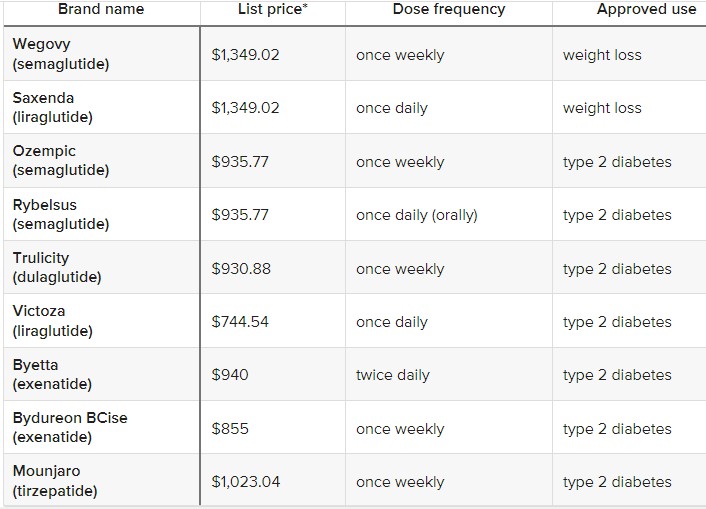
I’ll append a table at the end with a bunch of these drug names, for reference. At this point, most of them are only FDA approved for diabetes treatment, but are being prescribed off-label for weight control. It is no secret that obesity is rampant in America, and is spreading in other regions. The knock-on health problems of obesity are also well-known. So, these treatments might be very helpful, if they pan out.

What does Wall Street think of all this? Well, there is first the potential profit to accrue to the makers of these wonder drugs. You typically take them via daily or weekly skin injections, similar to insulin shots. A month’s worth of these meds may cost a cool $1000. Cha-ching right there, for makers like Novo Nordisk and Eli Lilly.

But wait, there’s more – Jonathan Block at Seeking Alpha calls out a number of possible financial angles for these drugs:

While at first glance the impact of these medications — known as GLP-1 agonists — might just impact food and beverages, the reality is that they could influence many other consumer industries.

Apparel retailers, casino/gaming names, and even airlines are just some of the industries that could see an impact from the growing popularity of weight loss drugs.

The thinking is that folks who lose 15 pounds will go out and buy a whole new wardrobe, which is good for clothing makers and retailers. On the other hand, gambling is highly correlated with obesity, so maybe casino business will fall off.  There are claims that kidney health is so improved with these drugs that purveyors of dialysis equipment may be under threat.

Fuel represents some 25% of airlines’ expenses, so somebody with a sharp pencil at Jefferies sat down and calculated that for one airline (United) the cost savings would be $80 million per year if the average passenger shed 10 pounds.  And who know, if people get really thinner, maybe the airlines can pack in an extra row of seats…

A concern over declining food sales has cut into the prices of companies like Walmart:

Analysts estimate that nearly 7% of the U.S. population could be on weight loss drugs by 2035, which could lead to a 30% cut in daily calorie intake due to the consumption changes for the targeted group. There is also some conjecture that the increased attention to dieting and weight loss in general could have a downstream impact on the consumption of snacks and sweets.

Real World Efficacy of Weight Loss Drugs May Fall Short of Clinical Trials

Throwing buckets of cold water on these scenarios of slenderized Americans is a study by RBC Capital Markets suggesting that the actual impact of these meds may be much less than indicated by clinical trials:

“Unlike clinical studies, insights from real-world use of these drugs imply weight loss can be limited or short-lived as a result, making it difficult for some users to justify the treatment’s lofty price tag,” RBC analyst Nik Modi said. “Recent insurance claims data on 4k+ patients who started taking GLP-1s in 2021 indicate only 32% remained on therapy and just 27% adhered to treatment after 1 year, citing an increase in healthcare costs.” He mentioned one study on 3.3k subjects that found after a year on the drugs, patients saw an average of just 4.4% weight loss. That is significantly less than declines cited by Novo Nordisk (NVO) and Eli Lilly (LLY) in their studies.

Also, he said IQVIA data found that the growth in GLP-1s is due mostly to new prescriptions, not refills, “making us question its sustainability.” Given this information, “we believe GLP-1s have genuine hurdles to prolonged use that have the potential to limit their long-term societal/economic impact.” To back up his argument, Modi provided several real-life examples of drugs or products where hype that it would shake up a consumer segment ended up falling flat.

The clinical trials for the GLP-1 blockers were paid for by the manufacturers, so they tend to be skewed to the positive. It is not clear whether these flattish real-world results are due to the drugs themselves not being so effective, or to other factors. These factors include side effects, unpleasantness of self-injection, and the  huge out-of-pocket cost (~ $12,000/year).  Weight loss drugs are often not covered by insurance, since obesity is considered a behavioral outcome, not a disease.

My guess is the final outcome will fall somewhere between mass weight loss and nothing. We hope that progress continues to be made in this area, since so many other health conditions are worsened by being overweight. For instance, fellow blogger Joy Buchanan recently  linked to an article by Matt Iglesia in which he described significant and long-lasting weight loss from bariatric surgery.

And as promised, that list of diabetes/weight-loss meds:

Help! My Celery is Too Stringy to Eat!

For maybe three purchases of celery, bought in 2023 from different stores, the fibers or strings in them were so tough that we could not chew them to point of chopping them into small enough pieces to comfortably swallow. We would chew away for several minutes, masticating and swallowing most of what we bit off from the stalk, but this left a tangle of intact strings in our mouths, to be spit out. Prior to 2023, we never recall having a batch of celery that was simply inedible like this. For at least one batch we were so disgusted that we just threw it out.

I tried steaming a couple of stalks for a minute or so in microwave. This turned most of the celery into unappealing mush, whilst doing the stalks no apparent harm.

For the most recent bunch of unchewable celery, I finally got wise and harnessed the vast power of the internet to solve this problem. I did not have to invoke ChatGPT, so I was perhaps spared an AI hallucination regarding string theory. A simple DuckDuckGo search (this search engine respects your privacy, unlike You Know Who) found there are at least three reasonable ways to strip the offending strings out of a celery stalk. This article from Kitchen Ambitions does a great job describing these three ways:

( 1 ) Carefully snap the stalks in half the correct way (it is obvious when you think about it; or see the article), leaving the two halves connected by the strings. Then you can peel the strings down the lengths of the stalks. This is the easiest and cleanest way. I found I usually had to do a second round of snapping and peeling to get the rest of the strings.

Or

( 2 ) At one end of the stalk, use sharp knife to tease up the ends of several strings at a time, and peel them down the length of the stalk.

Or

( 3 ) A brute force approach is to use a vegetable/carrot peeler. This does work, but removes more of good celery along with the strings.

Hurray for economical life hacks – – the internet knows everything.

Solar Cookers: Save Money, Save Lives, Save the Planet by Cooking with the Sun’s Rays

The Case for Solar Cooking

We all know we ought to reduce our CO2 generation to mitigate global warming and to conserve limited fuel reserves. Without descending into a tussle over exactly how man-made it is or whether it is part of a natural cycle which may turn soon to plunge us into yet another ice age, it does seem clear that the earth is experiencing a warming trend with possible serious consequences, and it is obvious that fossil fuel reserves (oil, natural gas, coal) are finite.

Although domestic cooking in developed countries comprises only a tiny fraction of total energy consumption, this is not true in some regions. Some 2 billion people still cook over fires of wood, charcoal, or animal dung. It is usually the women doing the cooking over these fires, inhaling smoke with all its consequences. Also, it is again women who largely end up gathering the fuel. All this gathering and fire-tending consumes time which takes away from other tasks like raising food. Also, women are often assaulted in the forests while they are foraging for wood.

It is possible to construct devices which capture enough of the sun’s rays to cook food (more technical details below). Many NGOs try to help people in poor, mainly sunny/tropical regions and in refugee camps to purchase or construct solar cookers. It is possible to set up cottage industries for locally making and selling these devices at low cost. It is just a win-win-win.  Solar Cookers International specializes in this work, and has developed and shared some of the most useful technology here. They claim some four million solar cookers are in use, and present figures for how much CO2 emissions and money for fuel are saved.

Why is this relevant to us in the West? Well, if we care to help the lot of the less-fortunate, we can give money to support these solar cooking initiatives. As noted, they can help the well-being of people, especially women, in many ways. A less-obvious  impact of us using solar cookers in our own homes is that folks in other lands are aware of our life-styles. It turns out that a non-trivial barrier to wide-spread adoption of solar cooking is that they are suspicious of Western aid workers promoting a method of cooking that no one back in the developed countries uses. If solar cooking could be more visible in our lifestyles it would have a significant effect in lands where it is really needed.

And getting around to our more personal motivations – it is kind of intriguing and rewarding to cook directly from the sun. On a hot day, it can mean cooking a casserole without heating the oven/kitchen. You can do great projects with kids (your own or others), designing and making and using solar ovens. And of course, you can signal your virtue by reducing your CO2 footprint.

If you find yourself in some situation when you have no other means to cook, a solar cooker could be a life-saver. To temper this reality, however, in most  temperate regions there will be many days without sufficient sunshine to make these work. Also, they are often much slower to heat up and cook than conventional stoves, so you need to plan ahead. That said, if you have a sunny morning or afternoon, you can put your pot of rice or whatever out to cook in the sun, go about your business, and come back in 2-3 hours, knowing your “solar crock pot” will have simmered your dish without burning it.

Types of Solar Cookers

I find the technical details here fascinating, but I will skip the juicies here and just briefly describe how these things are made and how they work. In all cases, there are some mirrored reflecting surfaces which concentrate the sun’s rays onto a cooking pot. For reflecting surfaces, one can glue aluminum foil onto cardboard. However, the foil grows dull with time, so it is better to use some kind of aluminized plastic surface, such as car windshield reflectors, mirrored craft adhesive sheeting, or even the insides of potato chip bags. Usually, the pot is in some kind of enclosure which is transparent to let the sunlight in but traps heat around the pot.  

There are a number of configurations that work. A description of various designs, with illustrations, is here  and here.

Perhaps the most minimalistic solar cooker is the panel cooker. Here, the pot is enclosed in a clear  oven bag or within two glass bowls. Segmented or curved reflective panels are arranged to reflect the sun on the pot from multiple angles. Solar Cookers International’s Cookit ($50) is said to be the most widely produced solar cooker, and it is of this design. There are many DIY designs floating around, including ones made from bent car windshield sun screens. A high-end, high-performance panel solar cooker is the Haines 2 ($100). These panel cookers lose effectiveness in cold, windy conditions, due to excessive heat loss.

Another design that people make a lot at home (see the internet) is a box solar cooker. Typically, you use a smaller cardboard box within a larger box, with the spaces between the two boxes filled with some kind on insulation (e.g., crumpled newspaper). A hinged glass lid and some reflecting panels on top of the box complete the device. A very expensive ($450) but very effective box-type solar cooker is the All-American Sun-Oven. This can function year-round, but takes up a lot of space in storage.

In tropical regions with the sun high overhead, there is some use of a plain, large parabolic mirror which can focus a very hot spot of sunlight onto the bottom of a pot or pan suspended above the mirror.

A more recent, high-tech approach is the line of solar cookers from Go-Sun. These feature smallish parabolic reflectors that focus the rays on a long, skinny cooking tube inserted in a double-walled glass tube with vacuum insulation. These cookers have only medium size capacity, but cook food really hot, really fast (e.g., can bake biscuits) and are not affected by cold weather. So, they are the most convenient and versatile cookers in many ways, although they do best with relatively solid foods like hot dogs or breads or cut-up meat or vegetables, not with liquidy loads like stew or soup or simmering beans. (Full disclosure: I caved in to my itch for one of these things, and have put it on my birthday list).

My $109 Raspberry Plant: Growing “Raspberry Shortcake” in a Container

One of Warren Buffet’s most famous quotes (channeling the venerable Benjamin Graham) is: “Price is what you pay; value is what you get.”  He thus rationalizes buying top-quality companies or stocks, even if their price is not beaten down. So, allow me to explain why I put over $100 into a single, not-very-large raspberry plant.

In various earlier homes I have lived in, I have grown raspberries. To my way of thinking, this is an ideal crop for a home gardener. You can get maybe five bare-root dormant plants from a gardening supply house like Burpee in the early spring, plant them in the ground, and by that fall have a crop of sweet, flavorful berries you can eat right off the bush. And then you have a perennial bed that will fill in with even more canes each year. The “everbearing” (“fall-bearing” or primocane) varieties like Heritage or Caroline can produce from June through early October, depending on your climate zone. Not many pests attack raspberries, and the only maintenance needed is pruning, fertilizing, and watering during droughts. They do need nearly full sun, and well-drained soil.

I now live in a townhouse, However, I did want to grow raspberries, partly for the fun of growing my own food, partly out of nostalgia, and partly to give my grandson the experience of picking food from a plant instead of from a grocery store shelf.

The townhouse I live in now only gets nearly-full sunlight at one corner of the house. There is no appropriate garden bed there, so I need to use a container. Raspberries normally grow 3-4 feet tall, with roots that go down maybe two feet. I did not really have the space for a two-foot high/two-foot diameter container, and such a large container would be hard to move around. So last year I tried to grow a regular raspberry (Glencoe variety) in maybe a 14-inch x 14-inch pot. It was a total fail. The root space was just too small for this large a plant, I think.

So this year I regrouped, dug deep in my wallet, and bought a special dwarf raspberry called “Raspberry Shortcake.” This variety is bred to grow in small spaces. This plant is mostly supplied in a #1 size pot (nominally 1 quart, but actually smaller). I was impatient and wanted a larger plant that would bear fruit this year, so I spent more and bought a larger (# 2 pot) plant from Plant Addicts. It arrived in late April, and I transplanted it to a 16” x 16” (40 cm x 40 cm) plastic pot from Better Homes and Gardens. This pot is white, which I hope will reflect some of the sun’s heat during the summer.

This is a summer-bearing (floricane) raspberry, so it will only bear fruit for a few weeks in June-July. However, there is a new Asian fly pest spreading in the U.S. that attacks raspberries later in the season, so it may be best to avoid the fall-bearing varieties now anyway.

The plant had been pruned back to several slender, woody stems about ten inches high. Each of these stems has since put out several side shoots, most of which have now borne clusters of berries at their tips. I have enjoyed several dozen berries, and they are still coming. Also, I have had the pleasure of seeing my grandson pick and eat berries off the bush. I am a satisfied customer. Photos:

And close-up on the berries:

This plant cost me $72 ($57 plus $15 shipping). We got lucky with the pot, paying only about $22, when you can easily pay twice that for this sized pot. Potting soil was another $15. So about $109 all-in.

Obviously, I could have bought many little cartons of raspberries in the store instead for $109. I paid a high price for my plant, but got a value that I am satisfied with.

POSTSCRIPT: Just for completeness, to inform other would-be buyers of this plant – – it’s berry production peaked in mid-June here in U.S. growing zone 7a. It continued to produce a few berries a day till the end of the month. Since about July 1, it still produces perhaps an average of one berry a day, with 6-7 visible on the bush at any one time, but they are not ripening properly. Sometimes they just fall off before they are ripe, but most often they ripen very unevenly: some of the little “drupes” turn dark red (and then sometimes fall off) while the rest are still whitish. This may be a reaction to the heat, it is sunny and has hit 90 degrees F nearly every day, so the soil around the roots in the pot is way hotter than it would be for an in-ground planting . Anyway, none of this takes away from the satisfactory performance in June.

Post-PostScript: After watering the plant more frequently to let it transpire like crazy in the heat, and also after I loosely wrapped a 14-inch high strip of aluminum flashing around the pot to deflect some of the sun’s rays, the berries seem to be ripening better…getting 1-2 berries a day, though July 15, though they really are petering out now.

Chocolate Prices Will Shoot Up

I write about various topics, usually with at least some loose connection to economics. Sometimes these are fairly macro issues, other times there are specific, actionable observations. For instance, back in March of 2021, we inferred from the critical shortages of semiconductors that car manufacturing would be severely crimped, likely leading to big price increases in cars.  Our post “Chip Shortages Shutting Down Auto Assembly Lines; Buy Your Car Now Or Else” came out just in time (red arrow below) to alert the readership here:

https://fred.stlouisfed.org/series/CUSR0000SETA02 – – Consumer Price Index for All Urban Consumers: Used Cars and Trucks in U.S. City Average

Chocolate Prices

But now, a price increase of more ubiquitous import looms. Most of us were not in the market for cars in March of 2021, but some 81% of us eat chocolate, with the average American consuming about 9.5 pounds a year. Indeed, 50% “cannot live without it every day.”

And so, it is with a heavy heart that I bring warning of a rise in the price of chocolate. Back in pandemic lockdown, I was bored and speculated a few bucks in cocoa futures, as tracked by the NIB exchange traded fund. My shares went up, and then down, and I sold out to limit losses (which was a good move at the time), and moved onto other investments.

Imagine my surprise when I randomly checked on NIB this week and saw the price ramp-up in the past few months:

Source: Seeking Alpha

A quick internet search led to a CNBC article which confirmed my worst fears:

“The cocoa market has experienced a remarkable surge in prices … This season marks the second consecutive deficit, with cocoa ending stocks expected to dwindle to unusually low levels,” S&P Global Commodity Insights’ Principal Research Analyst Sergey Chetvertakov told CNBC in an email.

…Chetvertakov added that the arrival of the El Niño weather phenomenon is forecast to bring lower than average rainfall and powerful Harmattan winds to West Africa where cocoa is largely grown. Côte d’Ivoire and Ghana account for more than 60% of the world’s cocoa production

The price of cocoa will feed into the price of consumer chocolate products, especially dark chocolate which has more actual cocoa content. And the price of sweets generally will rise on the back of sugar prices, which stand at 11-year highs, driven again largely by weather.

There is still time to stock up ahead of the hoarders…

Unpopular Grocery Opinions

You needn’t stop at stop signs in parking lots.

Road signs on private land are often not legally enforceable by the police. You can ignore right-of-way and most signage in a parking lot or a parking-lot-adjacent path. I’m not saying that signs don’t serve a useful function. The stop in front of a Target or Publix is there to help coordinate drivers and pedestrians. It’s mostly a prudential matter. If it’s crowded, then those signs act coordinate us where norms might differ. But, if it’s late and no one is around, then you can safely run all of the parking lot stop signs with impunity. Be careful, however. The police can’t get you. But if you harm someone or something, then you can still be liable for neglect in a civil suit. That’s because neglect is contextual and expectations matter. If people treat parking lot signs like there are real road signs, then flaunting them can be construed as neglect.

You Can Park in Handicap Spaces.

If you’re *really* anti-social, then you should look up your local or state handicap accessible parking rules. Usually, police do have the power to ticket vehicles lacking the proper disability tags. BUT, the handicap parking space must conform to specifications. Where I live, for example, there must be an minimum sized sign that stands completely above 5 feet high in order to clearly demark the space. Therefore, if you see a handicap spot that is only noted by asphalt paint, then you’re free to park there.

Return your Shopping Cart… Or Don’t

Nothing says that you must return your shopping cart to an outdoor, covered, or indoor corral. People say that they have strong feelings about this (it’s not clear to me that they actually do). I say it’s not a fruitful exhortation. Let’s consider multiple perspectives and set aside the issue of civil liability due to neglect that I outlined above.

Continue reading

Twenty Years of Animal Protein Affordability

Have you heard the hubbub about eggs? People say that they’re expensive. My wife told me that if she’s going to pay an arm and a leg, then she may as well get the organic, pasture raised eggs. Absolutely. That’s what the substitution effect predicts. As the price ratio of low-quality to high-quality eggs rises, we’re incentivized to consume more of the high-quality version. It has to do with opportunity costs.

Consider a world in which the low-quality eggs cost $2 and the high-quality eggs cost $6 per dozen. Every high-quality egg costs 3 low-quality eggs. You might still choose the high-quality option, but you know that you’re giving up a lot by doing so. Consider the current world where low-quality eggs are priced on par with high-quality eggs. Now, the opportunity cost of consuming the fancy, pasture-raised eggs has fallen. When consuming one high-quality egg costs you one low-quality egg, it’s much easier to opt for the high-quality version. You’re not giving up as much when you purchase it.

For vegetarians, the recent price swing has probably been rough. Not eating meat, they’re facing the price squeeze more so than their omnivorous counterparts. Through the magic of math, median wages, and average retail prices, the figure below charts the affordability of eggs and dairy products.* The median person has been facing falling egg affordability for two decades. Indeed, it’s only been the past few years, punctuated by the Covid crisis, that consumers experienced more affordable eggs.

Dairy products, however, have become much more affordable. The median American can now afford 50% more of their namesake cheese. Further, we can afford 20-25% more whole milk and cheddar cheese. So, the vegetarians are not so poorly off after all.

But how do meatier sources of protein compare?

Continue reading

The Social Drug of Prohibition

Why does the average drinker consume alcohol? There are plenty of reasons, one of which is social. Alcohol, while inhibiting clarity, precision, and discretion, is a social lubricant. If you’re one of those drinking, then it’s enjoyable to be around other drinkers. Also, people build the habit of drinking *something* while socializing. We all know that prohibition resulted in bootlegging and tainted cocktails. But what were the legal alternatives? One was that you could purchase grape juice and make your own wine (that’s a story for another time). Another is to switch to another drug.

Alcohol is a depressant and arguably the most popular one in the US. It’s not a clear substitute for alcohol in terms of its direct effects on the body. However, it’s a liquid, safe, and tasty. That make is a good candidate for satisfying the physical urge to imbibe. But, importantly, it is also a social drug. People would get so hopped up on coffee and feed off of one another’s high that Charles the II of England banned coffee houses in order to prevent seditious fomentation. This brings us to an important characteristic of coffee. It’s a stimulant. You’d think that a stimulant would not be a substitute for alcohol. If anything, one might think that they are complements. Coffee helps to provide that kick in the pants after having an enjoyable night. But, the social feature makes coffee a good candidate to substitute alcohol, should the times be dire.

Illegal activity aside, people wanted an outlet for their physical and social proclivities. They wanted intoxication. Coffee provided exactly that. Conveniently, the continental US didn’t grow any of its own coffee. That means that imports and domestic consumption have a tight relationship.

Continue reading