Why Low Returns Are Predicted for Stocks Over the Next Decade

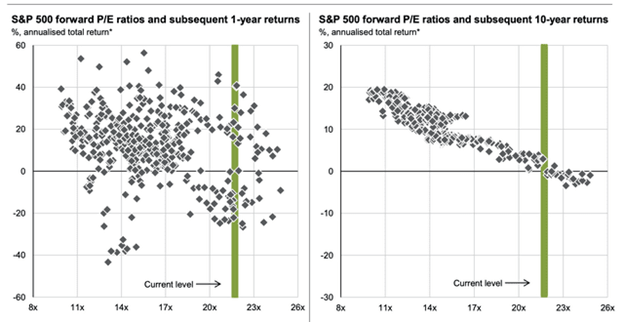
I saw this scary-looking graphic of S&P 500 returns versus price/earnings (P/E) ratios a couple of days ago:
JPMorgan

The left-hand side shows that there is very little correlation between the current forward P/E ratio and the returns in the next year; as we have seen in the past few years, and canonically in say 1995-1999, market euphoria can commonly carry over from one year to the next. (See here for discussion of momentum effect in stock prices). So, on this basis, the current sky-high P/E should give us no concern about returns in the next year.

However, the right-hand side is sobering. It shows a very strong tendency for poor ten-year returns if the current P/E is high. In fact, this chart suggests a ten-year return of near zero, starting with the current market pricing. Various financial institutions are likewise forecasting a decade of muted returns [1].

The classic optimistic-but-naïve response to unwelcome facts like these is to argue, “But this time it’s different.” I am old enough to remember those claims circa 1999-2000 as P/E’s soared to ridiculous heights. Back then, it was “The internet will change EVERYTHING!”.  By that, the optimists meant that within a very few years, tech companies would find ways to make huge and ever-growing profits from the internet. Although the internet steadily became a more important part of life, the rapid, huge monetization did not happen, and so the stock market crashed in 2000 and took around ten years to recover.

A big reason for the lack of early monetization was the lack of exclusive “moats” around the early internet businesses. Pets.com was doomed from the start, because anyone could also slap together a competing site to sell dog food over the internet. The companies that are now reaping huge profits from the internet are those like Google and Meta (Facebook) and Amazon that have established quasi-monopolies in their niches.

The current mantra is, “Artificial intelligence will change EVERYTHING!” It is interesting to note that the same challenge to monetization is evident. ChatGPT cannot make a profit because customers are not willing to pay big for its chatbot, when there are multiple competing chatbots giving away their services for practically free. Again, no moat, at least at this level of AI. (If Zuck succeeds in developing agentic AI that can displace expensive software engineers, companies may pay Meta bigly for the glorious ability to lay off their employees).

My reaction to this dire ten-year prognostication is two-fold. First, I have a relatively high fraction of my portfolio in securities which simply pump out cash. I have written about these here and here. With these investments, I don’t much care what stock prices do, since I am not relying on some greater fool to pay me a higher price for my shares than I paid. All I care is that those dividends keep rolling in.

My other reaction is…this time it may be different (!), for the following reason: a huge fraction of the S&P 500 valuation is now occupied by the big tech companies. Unlike in 2000, these companies are actually making money, gobs of money, and more money every year. It is common, and indeed rational, to value (on a P/E basis) firms with growing profits more highly than firms with stagnant earnings. Yes, Nvidia has a really high P/E of 43, but its price to earnings-growth (PEG) ratio is about 1.2, which is actually pretty low for a growth company.

So, with a reasonable chunk of my portfolio, I will continue to party like it’s 1999.

[1] Here is a blurb from the Llama 3.1 chatbot offered for free in my Brave browser, summarizing the muted market outlook:

Financial institutions are forecasting lower stock market returns over the next decade compared to recent historical performance. According to Schwab’s 2025 Long-Term Capital Market Expectations, U.S. large cap equities are expected to deliver annualized returns of 6% over the next decade, while international developed market equities are projected to slightly outperform at 7.1%.1 However, Goldman Sachs predicts a more modest outlook, with the S&P 500 expected to return around 3% annually over the next decade, within a range of –1% and 7%.42 Vanguard’s forecasts also indicate a decline in expected returns, with U.S. equities falling to a range of 2.8% to 4.8% annually. These forecasts suggest that investors may face a period of lower returns compared to the past decade’s 13% annualized total return.

After the Fall: What Next for Nvidia and AI, In the Light of DeepSeek

Anyone not living under a rock the last two weeks has heard of DeepSeek, the cheap Chinese knock-off of ChatGPT that was supposedly trained using much lower resources that most American Artificial Intelligence efforts have been using. The bearish narrative flowing from this is that AI users will be able to get along with far fewer of Nvidia’s expensive, powerful chips, and so Nvidia sales and profit margins will sag.

The stock market seems to be agreeing with this story. The Nvidia share price crashed with a mighty crash last Monday, and it has continued to trend downward since then, with plenty of zig-zags.

I am not an expert in this area, but have done a bit of reading. There seems to be an emerging consensus that DeepSeek got to where it got to largely by using what was already developed by ChatGPT and similar prior models. For this and other reasons, the claim for fantastic savings in model training has been largely discounted. DeepSeek did do a nice job making use of limited chip resources, but those advances will be incorporated into everyone else’s models now.

Concerns remain regarding built-in bias and censorship to support the Chinese communist government’s point of view, and regarding the safety of user data kept on servers in China. Even apart from nefarious purposes for collecting user data, ChatGPT has apparently been very sloppy in protecting user information:

Wiz Research has identified a publicly accessible ClickHouse database belonging to DeepSeek, which allows full control over database operations, including the ability to access internal data. The exposure includes over a million lines of log streams containing chat history, secret keys, backend details, and other highly sensitive information.

Shifting focus to Nvidia – – my take is that DeepSeek will have little impact on its sales. The bullish narrative is that the more efficient algos developed by DeepSeek will enable more players to enter the AI arena.

The big power users like Meta and Amazon and Google have moved beyond limited chatbots like ChatGPT or DeepSeek. They are aiming beyond “AI” to “AGI” (Artificial General Intelligence), that matches or surpasses human cognitive capabilities across a wide range of cognitive tasks. Zuck plans to replace mid-level software engineers at Meta with code-bots before the year is out.

For AGI they will still need gobs of high-end chips, and these companies show no signs of throttling back their efforts. Nvidia remains sold out through the end of 2025. I suspect that when the company reports earnings on Feb 26, it will continue to demonstrate high profits and project high earnings growth.

Its price to earnings is higher than its peers, but that appears to be justified by its earnings growth. For a growth stock, a key metric is price/earnings-growth (PEG), and by that standard, Nvidia looks downright cheap:

Source: Marc Gerstein on Seeking Alpha

How the fickle market will react to these realities, I have no idea.

The high volatility in the stock makes for high options premiums. I have been selling puts and covered calls to capture roughly 20% yields, at the expense of missing out on any rise in share price from here.

Disclaimer: Nothing here should be considered as advice to buy or sell any security.

DeepSeek vs. ChatGPT: Has China Suddenly Caught or Surpassed the U.S. in AI?

The biggest single-day decline in stock market history occurred yesterday, as Nvidia plunged 17% to shave $589 billion off the AI chipmaker’s market cap. The cause of the panic was the surprisingly good performance of DeepSeek, a new Chinese AI application similar to ChatGPT.

Those who have tested DeepSeek find it to perform about as well as the best American AI models, with lower consumption of computer resources. It is also available much cheaper. What really stunned the tech world is that the developers claimed to have trained the model for only about six million dollars, which is way, way less than the billions that a large U.S. firm like OpenAI, Google, or Meta would spend on a leading AI model. All this despite the attempts by the U.S. to deny China the most advanced Nvidia chips. The developers of DeepSeek claim they worked with a modest number of chips, models with deliberately curtailed capacities which met U.S. export allowances.

One conclusion, drawn by the Nvidia bears, is that this shows you *don’t* need ever more of the most powerful and expensive chips to get good development done. The U.S. AI development model has been to build more, huge, power-hungry data centers and fill them up with the latest Nvidia chips. That has allowed Nvidia to charge huge profit premiums, as Google and other big tech companies slurp up all the chips that Nvidia can produce. If that supply/demand paradigm breaks, Nvidia’s profits could easily drop in half, e.g., from 60+% gross margins to a more normal (but still great) 30% margin.

The Nvidia bulls, on the other hand, claim that more efficient models will lead to even more usage of AI, and thus increase the demand for computing hardware – – a cyber instance of Jevons’ Paradox (where the increase in the efficiency of steam engines in burning coal led to more, not less, coal consumption, because it made steam engines more ubiquitous).

I read a bunch of articles to try to sort out hype from fact here. Folks who have tested DeepSeek find it to be as good as ChatGPT, and occasionally better. It can explain its reasoning explicitly, which can be helpful. It is open source, which I think means the code or at least the “weights” have been published. It does seem to be unusually efficient. Westerners have downloaded it onto (powerful) PCs and have run it there successfully, if a bit slowly. This means you can embed it in your own specialized code, or do your AI apart from the prying eyes of ChatGPT or other U.S. AI providers. In contrast, ChatGPT I think can only be run on a powerful remote server.

Unsurprisingly, in the past two weeks DeepSeek has been the most-uploaded free app, surpassing ChatGPT.

It turns out that being starved of computing power led the Chinese team to think their way to several important innovations that make much better use of computing. See here and here for gentle technical discussions of how they did that. Some of it involved hardware-ish things like improved memory management. Another key factor is they figured out a way to only do training on data which is relevant to the training query, instead of training each time on the entire universe of text.

A number of experts scoff at the claimed six million dollar figure for training, noting that if you include all the costs that were surely involved in the development cycle, it can’t be less than hundreds of millions of dollars. That said, it was still appreciably cheaper than the usual American way. Furthermore, it seems quite likely that making use of answers generated by ChatGPT helped DeepSeek to rapidly emulate ChatGPT’s performance. It is one thing to catch up to ChatGPT; it may be tougher to surpass it. Also, presumably the compute-efficient tricks devised by the DeepSeek team will now be applied in the West, as well. And there is speculation that DeepSeek actually has use of thousands of the advanced Nvidia chips, but they hide that fact since it involved end-running U.S. export restrictions. If so, then their accomplishment would be less amazing.

What happens now? I wish I knew. (I sold some Nvidia stock today, only to buy it back when it started to recover in after-hours trading). DeepSeek has Chinese censorship built into it. If you use DeepSeek, your information gets stored on servers in China, the better to serve the purposes of the government there.

Ironically, before this DeepSeek story broke, I was planning to write a post here this week pondering the business case for AI. For all the breathless hype about how AI will transform everything, it seems little money has been made except for Nvidia. Nvidia has been selling picks and shovels to the gold miners, but the gold miners themselves seem to have little to show for the billions and billions of dollars they are pouring into AI. A problem may be that there is not much of a moat here – – if lots of different tech groups can readily cobble together decent AI models, who will pay money to use them? Already, it is being given away for free in many cases. We shall see…

Buying on Margin is Like an Option

Over the winter break I was able to catch up on a lot of podcasts. I also began listening to the Marginal Revolution podcast (which is phenomenal). I especially enjoyed the final episode of season 1 about options and how many transactions can be characterized as giving someone an option. Here, the term option echoes a financial option. You pay today for the ability to do something in the future. In financial markets, you can purchase the right to buy or sell at a particular price in the future.

But lots of things count as options. Staying in the financial context, purchasing a stock gives you the option to sell that stock at the future spot price. So, in this way, something can be characterized as an option even though we are not accustomed to describing as such explicitly. More mundane transactions can also be interpreted as options. Assume that you buy a can opener. You are buying the option to have that tool on hand in the future and to open some shelf-stable food. You can choose to exercise the option simply by opening your kitchen drawer.

But financial options often include the possibility of losing money. It may be that your grocery purchases never include canned items and that you never have occasion to use your can opener. Maybe that’s a bad investment. You sunk your money into something that you never used. Except… You did in fact have the option to use the can opener. Maybe you had peace of mind that you were well prepared just in case a guest arrived with a can of something. Buying a can opener is like buying an option.

Returning to the realm of finance, let’s discuss buying on margin. Buying an asset on margin is when you borrow from your broker in order to purchase a financial asset. It’s not entirely free money. They have rules about the amount you can borrow and, of course, you must pay back the loan with interest.

Continue reading

Forecasting 2025

WSJ’s survey of economists reports that inflation expectations for 2025 were around 2% before the election, but are closer to 3% now. Their economists expect GDP growth slowing to 2%, unemployment ticking up slightly but staying in the low 4% range, with no recession. The basic message that 2025 will be a typical year for the US macroeconomy, but with inflation being slightly elevated, perhaps due to tariffs.

Kalshi has a lot of good markets up that give more detailed predictions for 2025:

For those who hope for DOGE to eliminate trillions in waste, or those who fear brutal austerity, the message from markets is that the huge deficits will continue, with the federal debt likely climbing to over $38 trillion by the end of the year. This is one reason markets see a 40% chance that the US credit rating gets downgraded this year.

While the US has only a 22% chance of a recession, China is currently at 48%, Britain at 80%, and Germany at 91%. The Fed probably cuts rates twice to around 4.0%.

Will wage growth keep pace with inflation? It’s a tossup. Corporate tax cuts are also a tossup. The top individual rate probably won’t fall below it’s current 37%.

If you want to make your own predictions for the year, but don’t want to risk money betting on Kalshi, there are several forecasting contests open that offer prizes with no risk:

ACX Forecasting Contest: $10,000 prize pool, 36 questions, must submit predictions by Jan 31st

Bridgewater Forecasting Contest: $25,000 prize pool, half of prizes are reserved for undergraduates. Register now to make predictions between Feb 3rd and March 31st. Doing well could get you a job interview at Bridgewater.

The Little Book of Common Sense Investing

John Bogle, the founder of Vanguard, wrote a short book in 2006 that explains his investment philosophy. I can sum it up at much less than book length: the best investment advice for almost everyone is to buy and hold a diversified, low-fee fund that tracks an index like the S&P 500.

Of course, a strategy that is simple to state may still take time to understand and effort to stick to. So the book helps to build intuition for why this strategy makes sense. I think Bogle makes his case well, though the book is getting a bit dated- the charts and examples end in 2006, and he sets up mutual funds as the big foil, when today it might be high-fee index funds or picking your own stocks.

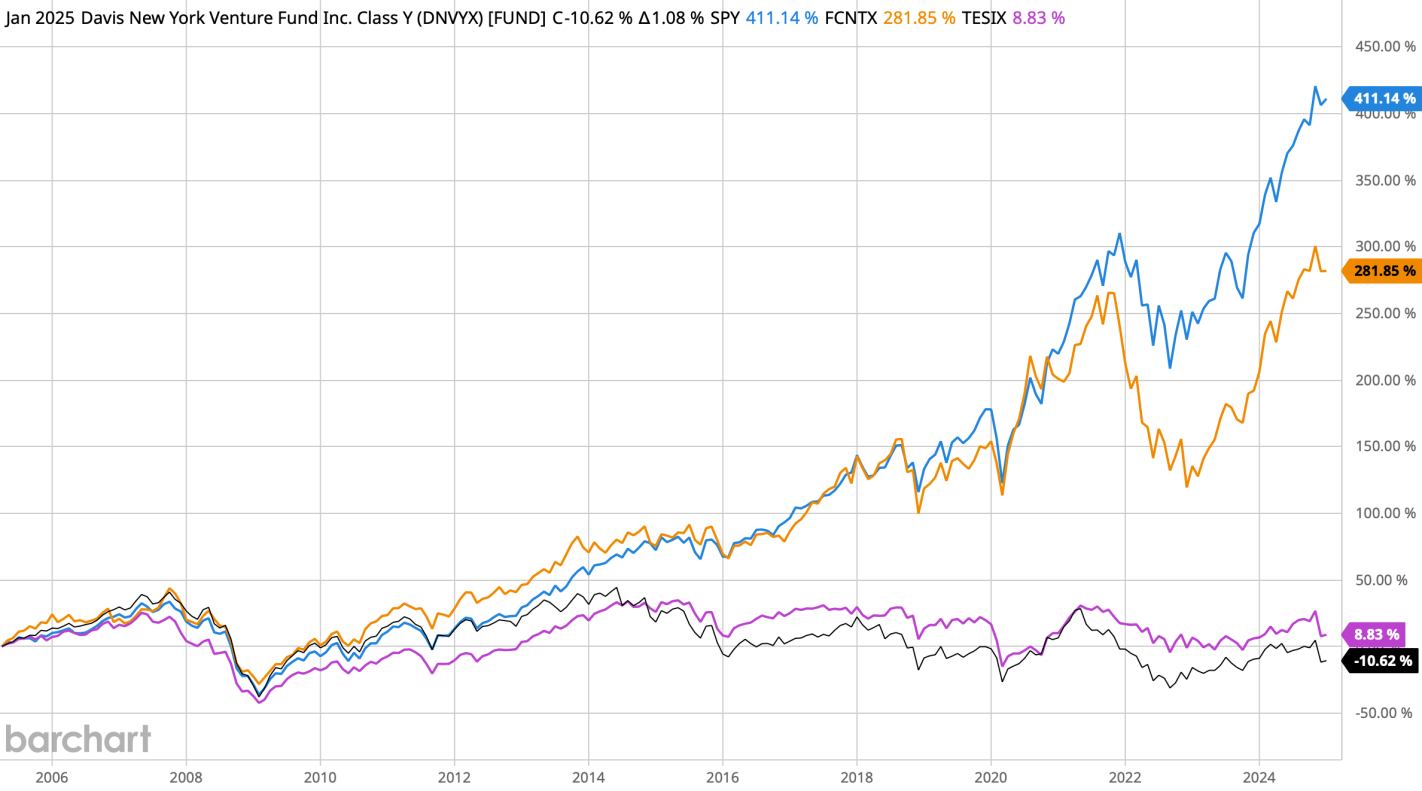
The silver lining of any dated investing book is that we can check up on how its predictions have fared. In chapter 8, Bogle compared the performance of the 355 equity mutual funds that existed in 1970 to that of the S&P over the 1970-2006 period. He notes that 223 of the funds had gone out of business by 2006, and even most of the surviving funds underperformed the S&P. But he identifies 3 funds that outperformed the S&P significantly (over 2% per year) on a sustained basis (consistently good performance, not just high returns at the beginning when they were small): Davis New York Venture, Fidelity Contrafund, and Franklin Mutual Shares. But how have they done since the book came out?

It is a huge victory for the S&P (in blue). Franklin Mutual Shares is basically flat over the past 20 years, while Davis New York Fund actually lost money. Fidelity Contrafund returned a respectable 281% (about 7% per year), and matched the S&P as recently as 2020. But as of 2025 the S&P is the clear winner, up 411% in 20 years (over 8% per year). Score one for Bogle.

But I still have to wonder if there is a way to beat the S&P- and I think one of Bogle’s warnings is really an idea in disguise. He warns repeatedly about “performance chasing”:

But whatever returns each sector ETF may earn, the investors in those very ETFs will likely, if not certainly, earn returns that fall well behind them. There is abundant evidence that the most popular sector funds of the day are those that have recently enjoyed the most spectacular recent performance, and that such “after-the-fact” popularity is a recipe for unsuccessful investing.

The claim is that investors pile into funds that did well over the past 1-3 years, but these funds subsequently underperform. But if this is true, could you succeed by reversing the strategy, buying into the unpopular sectors that have recently underperformed? I’ve been wondering about this, though I have yet to try seriously backtesting the idea. I was surprised to see Mr. Index Fund himself support such attempts to beat the market toward the end of his book:

Building an investment portfolio can be exciting…. If you crave excitement, I would encourage you to do exactly that. Life is short. If you want to enjoy the fun, enjoy! But not with one penny more than 5 percent of your investment assets.

He goes on to say that even for the fun 5% of the portfolio he still doesn’t recommend hedge funds, commodity funds, or closet indexers. But go ahead and try buying individual stocks, or actively managed mutual funds “if they are run buy managers who own their own firms, who follow distinctive philosophies, and who invest for the long term, without benchmark hugging.”

2024 in Books

Quick thoughts on what I read in 2024- though note that none of these were published in 2024, since almost all the best stuff is older. First some econ books I reviewed here this year:

Rockonomics– “Alan Kreuger’s 2019 book on the economics of popular music…. a well-written mix of economic theory, data, and interviews with well-known musicians, by an author who clearly loves music.”

We’ve Got You Covered– “Liran Einav and Amy Finkelstein are easily two of the best health economists of their generation.… while I don’t agree with all of their policy proposals, the book makes for an engaging, accurate, and easily readable introduction to the current US health care system.”

The Psychology of Money– “Morgan Housel’s Psychology of Money is not much like other personal finance books…. The book is not only pleasant to read, but at least for me exerts a calming effect I definitely do not normally associate with the finance genre, as if the subtext of ‘just be chill, be patient, follow the plan and everything will be alright’ is continually seeping into my brain.”

One Up on Wall Street– “Peter Lynch was one of the most successful investors of the 1970’s and 1980’s as the head of the Fidelity Magellan Fund. In 1989 he explained how he did it and why he thought retail investors could succeed with the same strategies”

Leave Me Alone and I’ll Make You Rich– “a 2020 book by Dierdre McCloskey and Art Carden…. attempts to sum up McCloskey’s trilogy of huge books on the ‘Bourgeois Virtues‘ in one short, relatively easy to read book”

Non-fiction I didn’t previously mention here:

The Simple Path to Wealth (JL Collins, 2016): the book is indeed simple, and its advice is indeed likely to leave you fairly wealthy in terms of money. One sentence summarizes it well: save a large portion of your income and invest it in VTSAX, and perhaps VBTLX. Easy to read, a bit like reading a series of blog posts, which is how much of the material originated. Good introduction to the lean-FIRE type mentality. But the book, like that mentality, is too frugal and debt-averse for my taste, and I say that as someone much more frugal and debt-averse than the average American.

The Great Reversal: How America Gave Up on Free Markets: Thomas Philippon argues that markets have been growing less competitive in America because of weakening antitrust enforcement, and that this has harmed consumers and productivity. He acknowledges that over-regulation can also harm competition, but clearly thinks antitrust is much more important; I think otherwise and didn’t find the book convincing. He sets European markets as an example for what America should aspire to, which means the book has aged poorly since its 2019 publication. It still of course has some value, and I may do a full review at some point.

The Storm Before the Storm: The Beginning of the End of the Roman Republic (Mike Duncan, 2017): Non-fiction but more exciting than most novels. A story of obvious importance to those who worry about modern republics teetering, but fresh compared to the much more famous events around Julius and Augustus Caesar and the ‘official’ fall of the Republic. Though arguably the Republic fell in the 80s BC, not the 40s- the book explains that Rome was taken over three times in this era by armies seeking political change.

Self-Help Is Like a Vaccine: Essays on Living Better: Nice collection of Brian Caplan blog posts on the subject.

Fiction:

Ivanhoe (Walter Scott, 1819): A particularly medieval telling of the Robin Hood tale, with a focus on the nobility and knights of England at that time. Chivalric romance, trial by combat, storming a castle. Highs are high but it needed an editor, could be cut by at least 1/3 without losing anything.

Kim (Rudyard Kipling, 1901): Three books in one, all excellent: a coming of age story, a spy thriller, and a portrait of the many different types of people and religions to be found in India around 1900. All wrapped together with beautiful English prose that makes heavy use of Indian loan words.

Final Thoughts:

Obviously I’m not Tyler Cowen reading a book a day, unless you count the kids books I read to my 1-year-old. But overall 2024 was a good year, better than I realized before I put this post together. Partly I credit the 1-year-old who wants to take my phone and computer but doesn’t mind when I have a book in my hands.

Red Lobster Out of Bankruptcy Proceedings, Set Up to Be Plundered Again by Private Equity

Red Lobster is a large, historic seafood restaurant chain operating in the U.S. and Canada. Last summer I wrote on how it got driven into bankruptcy: How an All-U-Can-Eat Special Driven by a Controlling Investor Pushed Red Lobster Over the Edge

Red Lobster used to be a pretty profitable business. Then in 2014 its owners sold it to a private equity firm called Golden Gate Capital. This private equity firm promptly plundered Red Lobster by selling its real estate out from under it, with those funds going to the PE firm. Instead of owning their own land and buildings, now the restaurants had to pay rent to landlords.  This put a permanent hurt on the restaurant chain’s profits. I don’t know this as fact, but because it is part of the usual PE playbook, I assume that the PE firm also made Red Lobster issue debt (bonds) so the PE firm could further plunder Red Lobster by having it pay “dividends” to its PE firm owners, using the money raised by issuing the bonds. After this glorious financial engineering, the private equity firm in 2019 sold a 49% stake to a company called Thai Union. Thai Union bought out the rest of Red Lobster ownership from Golden Gate in 2020.

Thai Union did a poor job managing the U.S. based restaurant chain, forcing cost-cutting measures that were counterproductive, and finally forcing a continual all-you-can-eat shrimp special, against the better judgment of on-the-ground Red Lobster management. That shrimp special made Red Lobster buy a lot of Thai Union’s shrimp, but led to large losses last year. The business had been suffering for a couple of years, with Covid shutdowns and competition from nimbler eateries, but the losses from the shrimp special sent it scurrying for bankruptcy protection back in May.

There are two main flavors of business bankruptcy. The direst form is Chapter 7, where the assets of the firm are sold off to meet obligations to creditors, and the firm goes out of business.

The more common form is Chapter 11, where the intent is to keep the business going (see Appendix). Somebody gets stiffed in the process, of course. Usually, common shareholders get almost nothing except maybe a reduced number of shares in the reorganized company. Preferred shareholders often get a few more shares. Unsecured bondholders may get 30-40 cents on the dollar as a settlement, or a reduced amount of bonds in the new company, or maybe stock shares. Sometimes the company will issue a new set of bonds which are “senior” to the old bonds, which reduces the value of old bonds. Other unsecured creditors like vendors may get something like 50 cents on the dollar.  

Secured creditors are higher up in the pecking order, and so often get higher recoveries. (The “covenant” for a bond or loan would specify if the loan is secured by, say, the value of the equipment in the restaurant).

Red Lobster restaurants have kept operating this year (2024), while creditors were kept at bay via the protection offered by the bankruptcy filing. As of September, Red Lobster emerged from the chapter 11 bankruptcy. A private equity group has taken over operations. They have injected some $60 million cash, which is actually not very much for this situation.

I was curious about what happened to Red Lobster’s creditors, such as vendors and bond holders. A first-level internet search, even with AI help, did not tell me how they fared as part of the settlement. I had read earlier this year that Red Lobster had something like $ 1 billion in debt, so I assume that a lot of bondholders got stiffed in this process.

In May the company announced that it had “ voluntarily filed for relief under Chapter 11 of the Bankruptcy Code in the United States Bankruptcy Court for the Middle District of Florida. The Company intends to use the proceedings to drive operational improvements, simplify the business through a reduction in locations, and pursue a sale of substantially all of its assets as a going concern…Red Lobster’s restaurants will remain open and operating as usual during the Chapter 11 process, continuing to be the world’s largest and most-loved seafood restaurant company. The Company has been working with vendors to ensure that operations are unaffected and has received a $100 million debtor-in-possession (“DIP”) financing commitment from its existing lenders.”

The “working with vendors” is an important piece here. When I peered at the official Red Lobster court bankruptcy website to try to glean more intel on the fate of the creditors, there was a list of leading “Unsecured Creditors”. These included Pepsico (supplying beverages) and Gordon Food Services, a major Canadian food supplier, as well as the owner of the store properties (Realty Income Corporation), which was presumably owed a lot of unpaid back rent.

Ironically, after one private equity firm plundered Red Lobster, then sold it to the hapless Thai Union (which ended up taking a $540 million write-down on their investment), the restaurant chain is now in the hands of yet another PE firm. I could not find definite information on the deal, but again we may assume that the PE firm got the creditors (bondholders, vendors, etc.) to accept “haircuts” on what they were owed, as opposed to getting almost nothing if Red Lobster went Chapter 7 and shut down. Thus, the new PE firm will start off with a relatively virgin company to plunder again.

My Brave AI search agrees with that assessment:

The company’s restructuring efforts may prioritize the interests of new investors and creditors over those of existing bondholders, potentially resulting in a less favorable outcome for bondholders… It is likely that the bondholders will be subject to a restructuring plan that may involve debt forgiveness, debt-for-equity swaps, or other arrangements that could result in a loss of principal or interest for the bondholders.

Side comment: If you, too, want to feed at the trough of private equity, there are a number of PE firms you can buy stock shares in so you can join in their profits. See 50% Endowment Returns Driven by Private Equity Investments: How Rich Universities Get Richer (But You Can, Too) .

APPENDIX: EXPLANATION OF CHAPTER 11 BANKRUPTCY

The text below is from the North Carolina bankruptcy law firm Stubbs Perdue:

Chapter 11 bankruptcy is a legal process that allows businesses to reorganize their debts and operations while continuing to operate. Unlike Chapter 7, which involves liquidating assets to pay off creditors, Chapter 11 aims to restructure a company’s obligations to improve financial stability and pave the way for future growth. Chapter 13, on the other hand, is typically reserved for individuals with a regular income, focusing on debt repayment plans.

Typical Chapter 11 Process

Chapter 11 process typically involves several key steps:

  • Filing the Petition: The process begins with the company filing a petition in bankruptcy court.
  • Developing a Reorganization Plan: The company works with its creditors to create a plan that outlines how it will restructure its debts and operations.
  • Negotiating with Creditors: The plan is subject to approval by the court and the creditors, who may negotiate the terms to protect their interests.

Throughout this process, the court plays a supervisory role to ensure fair treatment of all parties involved.

Ho Ho Ho – – It’s Time for the Annual Santa Claus Stock Rally

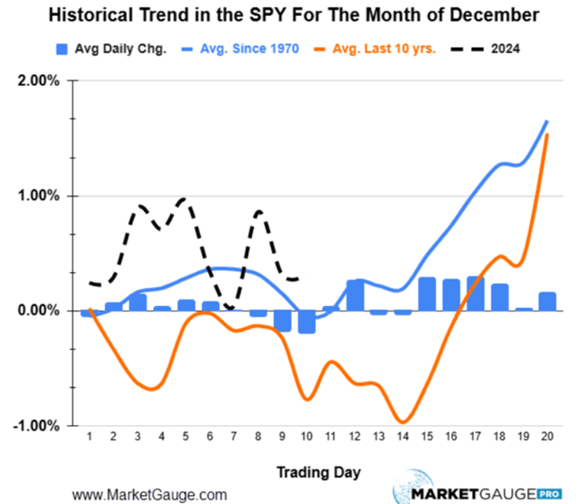
There tends to be a significant rise in broad stock indices the last two weeks of the old year and into the first two trading days of the new year. This is termed the “Santa Claus” rally. Sometimes it is focused on the last five trading days of the old and the first two days of the new.

Here is a chart showing average changes in S&P 500 prices for the month of December for 1970-2023 (blue line), and more recent data (last ten years, orange line).

Seeking Alpha

Some possible reasons for this year-end rally are:

Tax-loss harvesting: Investors may sell stocks at the end of a year to claim capital losses, to offset capital gains. They may then repurchase these stocks at the start of the new year.

Low trading volume: Larger institutional investors often go on holiday in this timeframe, leaving the market more to individual retail investors, who may be more optimistic.

Herd mentality: If most investors believe stocks will go up, then probably stocks will go up.

Santa Predicts the Future

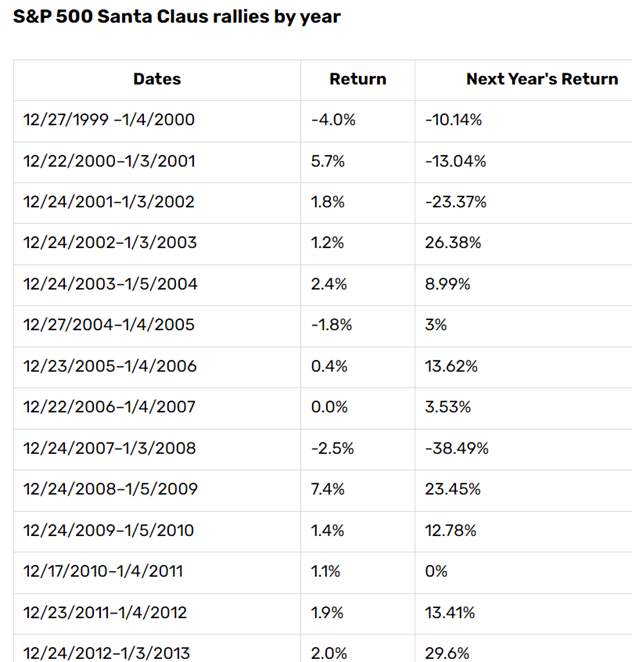
Perhaps even more significant is the power of the Santa Claus rally to predict stock returns in the coming year. The following table lists returns for the last five trading days of the old year plus the first two days of the new year, and also the returns for the whole new year:

The Street

The table above was published in 2023, so the full year 2023 stock returns at that point were “TBD”. We now know the 2023 returns were hugely positive (approx. 23%). So, for 1999-2023, Santa came to town 19 out of 24 times for a year-end rally. Also, since 1999, the market rose 19 times during the Santa Claus rally; the following year, the S&P posted gains 15 times. Out of the 5 times the market lost ground during same period, the market fell in 3 of the following years. So the market performance in this transitional timeframe correlates well with the stock gains for the whole new year.

Will stocks soar again this holiday season? I have no idea. We are off to a shaky start, with the S&P 500 down about 1.5% in the past five days , through 12/22. This after the market hated the Fed’s more hawkish stance last week, being now likely slower to reduce interest rates than previously assumed.

As usual, nothing here should be considered advice to buy or sell any security.

My Frozen Assets at BlockFi, Part 4: Full Recovery of My Funds

In March and April of this year, I moaned and groaned here in blogland, chronicling my attempts to recover my funds from an interest-bearing account at crypto firm BlockFi.

Back in 2021, interest rates had been so low for so long that that seemed to be the new normal. Yields on stable assets like money market funds were around 0.3% (essentially zero, and well below inflation), as I recall. As a yield addict, I scratched around for a way to earn higher interest, while sticking with an asset where (unlike bonds) the dollar value would stay fairly stable.

It was an era of crypto flourishing, and so I latched onto the notion of decentralized finance (DeFi) lending. I found what seemed to be a reputable, honest company called BlockFi, where I could buy stablecoin (constant dollar value) crypto assets which would sit on their platform. They would lend them out into the crypto world, and pay me something like 9 % interest. That was really, really good money back then, compared to 0.3%.

On this blog, I chronicled some of my steps in this journal. First, in signing up for BlockFi, I had to allow the intermediary company Plaid complete access to my bank account. Seriously, I had to give them my username and password, so they could log in as me, and not only be able to withdraw all my funds, but see all my banking transactions and history. That felt really violating, so I ended up setting up a small auxiliary bank account for Plaid to use and snoop to their heart’s content.

I did get up and running with BlockFi, and put in some funds and enjoyed the income, as I happily proclaimed (12/14/2021) on this blog, “ Earning Steady 9% Interest in My New Crypto Account “.

BlockFi assured me that they only loaned my assets out to “Trusted institutional counterparties” with a generous margin of collateral. What could possibly go wrong??

What went wrong is that BlockFi as a company got into some close relationship with Sam Bankman-Fried’s company, FTX.  Back in 2021-2022, twenty-something billionaire Sam Bankman-Fried (“SBF”) was the whiz kid, the visionary genius, the white knight savior of the crypto universe. In several cases, when some crypto enterprise was tottering, he would step in and invest funds to stabilize things. This reminded some of the role that J. P. Morgan had played in staving off the financial panics of 1893 and 1907. SBF was feted and lauded and quoted endlessly.

For reasons I never understood, BlockFi as a company was having a hard time turning a profit, so I think the plan was for FTX to acquire them. That process was partway along, when the great expose’ of SBF as a self-serving fraudster occurred at the end of 2022. FTX quickly declared bankruptcy, which forced BlockFi to go BK as well. SBF was eventually locked up, but so were the funds I had put into BlockFi. The amount was not enough to threaten my lifestyle, but it was enough to be annoying.

BlockFi Assets Begin to Thaw

I got emails from BlockFi every few months, assuring customers that they would do what they could to return our assets. Their bankruptcy proceedings kept things locked, but eventually they started to return some money.

 As I noted in a blog post, in April, 2024, I was able to recover about 27% of my account. At the time, there was no clear prospect of getting the rest.   Along the way, I clicked on a well-camouflaged scam email link, which gave me some heartburn but fortunately no harm came of it.

And now, hooray, they have finally returned it all, following their successful claw-back of assets from SBF’s organization(s). This vindicates my sense that the BlockFi management was/is fundamentally honest and good-willed, and was just a victim of SBF’s machinations.

Some personal takeaways from all this:

  • Keep allocations smallish to outlier investments
  • Sell out at the first serious signs of trouble
  • Triple-check before clicking on any link in an email
  • Having been forced to engage in opening crypto wallets and transferring coins, I have a better feel for the world of crypto which had seemed like a black box. It does not draw me like it does some folks, but if circumstances ever require me to deal in crypto (relocate to Honduras?), I could do it.