Funds Paying “Return of Capital” Give You (Sort of) Tax-Free Income

The stock of an individual company like AT&T, or a stock fund, often pays a dividend or distribution. Typically, these dividends are taxed as income. If you buy shares of a fund like MUNI that hold municipal bonds from U.S. states and cities, the dividends from that are not taxed by the feds (they are taxed on state income taxes). That’s nice, but the yield from a muni fund MUNI is only 3.3%, and the share price of MUNI drifts around with bond prices; it does not grow like the S&P500 stocks do.

What if there was a way to get highish dividends that are not taxed, at least not in the short term? There is. Funds classify their distributions or dividends in various categories. Net investment income or short-term capital gains are taxed like interest or ordinary income (highest rates). Qualified dividends or long-term capital gain returns are taxed at a lower rate. But “Return of Capital” (ROC) distributions are not taxed at all, when you receive them. (The accounting fiction is that ROC is simply your own investment money being handed back to you, rather than you getting interest or profit, which is why it is not taxed).

ROC only catches up with you when you sell your shares. Every dollar you pocket in ROC goes to lower the formal cost basis of your shares, so that increases the capital gains tax you pay when you sell.  Still, it can mean you defer paying taxes for many years, and when you do sell after many years, you will pay mainly long-term capital gains. Long-term capital gains have relatively low tax rates, and sometimes can be offset with capital losses elsewhere. So, this is a pretty good deal overall. All this only benefits you if you are holding these stocks in a taxable account, not in an IRA.

And, there are ways to not sell your shares, and hence never pay an inflated capital gains tax from all that ROC. One way not to sell your shares is to die (!). Your heirs inherit the funds at the current market value i (stepped-up basis”), without having to pay capital gains. So older folks do deliberately lard up their portfolios with ROC-paying funds or stocks, to leave to their heirs.

Another tactic is to donate the shares to charity. As I understand it, the donation gets valued at current market price, regardless of your cost basis. So, for instance, you might buy shares of XYZ fund at $100/share, collect say $50 in untaxed ROC over the next five years, and then donate the shares for a tax deduction at say $100/share (if their market price had not changed in five years). Obviously, this is only attractive if you wanted to make a charitable donation anyway.

OK, what are some funds or stocks that pay out ROC? There are number of funds which hold stocks, and write (sell) call options on them to generate income. (See here on selling options). Some (not all) of these funds pay out as mainly ROC, and are discussed here. SPYI and ETV are plain vanilla funds holding a basket of S&P500 type stocks, usually with a skew towards tech, and selling call options on them. (Or usually, selling options on an index like SPX or QQQ).  SPYI is currently paying about 11.5% yield, and ETV about 9%, both mainly ROC. ETV happens to be a closed-end fund, which can be good or bad, depending on whether you buy in when the share price is at a discount or premium to the asset value. Right now, ETV is at about a 5% discount, so it is a relatively good time to buy.

It is essential to note with these high yielding funds, the raw yield is practically meaningless. You have to look at total return, which factors in stock price over time as well as cash payout. The reason is that some funds “cheat” by paying huge yields, which sucks in investors, but those yields are not really earned by the fund, so those big payouts gradually deplete the fund’s assets.

FEPI holds an equally-weighted basket of fifteen tech stocks, and sell options on them. By selling options on individual stocks, the options income is huge; FEPI pays about 20% yield. The share price bounces around heavily, being so narrowly concentrated. If tech has a bad/good day, FEPI goes way down/up. QDTE also pays about 20%. It has a more novel strategy, selling “zero-day” options, which I won’t try to explain here. It has only been running about 6 months, but is doing OK.

A problem with all these option-selling funds is that their asset value goes down 10% if the underlying stocks go down 10%, but if stocks recover fast, the value of the funds typically do not recover as much. So, the share price of these funds keeps slipping below the price of a plain stock fund like SPY or QQQ. Now, if stocks go up (which they do most years), the price of an options fund can also go up, just not as much. The lag of these options fund is significant enough that on a total return basis (i.e. with dividends and stock price included), they usually lag behind just holding the stocks. Thus, the only reason to hold these funds is to harvest the tax-free ROC, or if you have a reason to want to generate steady income without selling off stocks.

Some 1-year total returns:

SPY        26.7%   Plain S&P 500  stock fund

SPYI       8.5%      Option fund

ETV        8.8%      Option fund

FEPI       20.2%   Option fund

QDPL     25.9%   Quadruple stock divi fund          

(Note, it is a little random that FEPI looked so good and SPYI and ETV looked poor in the past 12 months; that is not always the case. In the past 6 months, FEPI fared much worse than SPYI and ETV, which only lagged SPY by 1-2%). Some other newish option funds that pay mainly ROC are ISPY (8% yield, sells daily options, very little return lag) and three more with fairly low return drag: XDTE and QDTE (~20% yields, daily options on S&P500 and on NASDAQ 100); QYLG (6% yield; monthly options on half of NASDAQ 100).

Another fund I became aware of recently that pays mainly ROC is QDPL. It does not sell options, so it does not suffer the return lag the other funds do. It uses a futures strategy to take about 15% of the fund assets to garner roughly 4X the normal stock dividends of the S&P500 stocks. It only yields about 5.5%, but its total return keeps up pretty well with SPY. I like this one, and am including it in my portfolio with some of the options funds discussed above.

A whole other class of stocks that pay out mainly ROC is limited partnerships. These are common, e.g., among oil and gas pipeline companies like ET and EPD. These pay 7-8% and also are having strong share price appreciation. But they issue K-1 tax forms, which most mortals don’t want to deal with (I don’t).

As usual, this discussion does not constitute advice to buy or sell any security.

Many Impressive AI Demos Were Fakes

I recently ran across an article on the Seeking Alpha investing site with the provocative title “ AI: Fakes, False Promises And Frauds “, published by LRT Capital Management. Obviously, they think the new generative AI is being oversold. They cite a number of examples where demos of artificial general intelligence were apparently staged or faked.  I followed up on a few of these examples, and it does seem like this article is accurate. I will quote some excerpts here to give the flavor of their remarks.

In 2023, Google found itself facing significant pressure to develop an impressive innovation in the AI race. In response, they released Google Gemini, their answer to OpenAI’s ChatGPT. The unveiling of Gemini in December 2023 was met with a video showcasing its capabilities, particularly impressive in its ability to handle interactions across multiple modalities. This included listening to people talk, responding to queries, and analyzing and describing images, demonstrating what is known as multimodal AI. This breakthrough was widely celebrated. However, it has since been revealed that the video was, in fact, staged and that it does not represent the real capabilities of Google’s Gemini.

… OpenAI, the company behind the groundbreaking ChatGPT, has a history marked by dubious demos and overhyped promises. Its latest release, Chat GPT-4-o, boasted claims that it could score in the 90th percentile on the Unified Bar Exam. However, when researchers delved into this assertion, they discovered that ChatGPT did not perform as well as advertised.[10] In fact, OpenAI had manipulated the study, and when the results were independently replicated, ChatGPT scored on the 15th percentile of the Unified Bar Exam.

… Amazon has also joined the fray. Some of you might recall Amazon Go, its AI-powered shopping initiative that promised to let you grab items from a store and simply walk out, with cameras, machine learning algorithms, and AI capable of detecting what items you placed in your bag and then charging your Amazon account. Unfortunately, we recently learned that Amazon Go was also a fraud. The so-called AI turned out to be nothing more than thousands of workers in India working remotely, observing what users were doing because the computer AI models were failing.

… Facebook introduced an assistant, M, which was touted as AI-powered. It was later discovered that 70% of the requests were actually fulfilled by remote human workers. The cost of maintaining this program was so high that the company had to discontinue its assistant.

… If the question asked doesn’t conform to a previously known example ChatGPT will still produce and confidently explain its answer – even a wrong one.

For instance, the answer to “how many rocks should I eat” was:

…Proponents of AI and large language models contend that while some of these demos may be fake, the overall quality of AI systems is continually improving. Unfortunately, I must share some disheartening news: the performance of large language models seems to be reaching a plateau. This is in stark contrast to the significant advancements made by OpenAI’s ChatGPT, between its second iteration (GPT-2), and the newer GPT-3 – that was a meaningful improvement. Today, larger, more complex, and more expensive models are being developed, yet the improvements they offer are minimal. Moreover, we are facing a significant challenge: the amount of data available for training these models is diminishing. The most advanced models are already being trained on all available internet data, necessitating an insatiable demand for even more data. There has been a proposal to generate synthetic data with AI models and use this data for training more robust models indefinitely. However, a recent study in Nature has revealed that such models trained on synthetic data often produce inaccurate and nonsensical responses, a phenomenon known as “Model Collapse.”

OK, enough of that. These authors have an interesting point of view, and the truth probably lies somewhere between their extreme skepticism and the breathless hype we have been hearing for the last two years. I would guess that the most practical near-term uses of AI may involve some more specific, behind the scenes data-mining for a business application, rather than exactly imitating the way a human would think.

Robinhood’s Casino Comps

I just got the new Robinhood Gold credit card after 4 months on their waitlist. It offers 3% cash back on everything- except travel, which is an even better 5%. This seems to be a much better deal than the typical credit card (which offers ~0-1% back in cash or equivalents), and even better than the previous best alternative I know of (the Citi Double Cash, which pays 2% back). So, is there a catch?

As far as I can tell, there are two, but one is minor and the other is avoidable.

The minor catch is that while they advertise the Gold Card as having no annual fee, you need to be a Robinhood Gold member to get it. Robinhood Gold has a $50/year fee, though it comes with other benefits, and getting the extra 1%+ back on the credit card will itself pay for the fee assuming you spend at least $5k/yr on the card.

The potentially major catch, and the reason I assume Robinhood is offering such a good deal, is that they want to entice you to open a brokerage account and to make bad decisions with that account that make them money. Much like a casino that offers you free drinks and cheap hotel rooms in the hope that you will choose to gamble and end up losing way more than the cost of the “complimentary” things they gave you. This is a major risk, but if you know what to avoid you can still come out ahead. The last time my friends dragged me to a casino I got handed plenty of free drinks despite the fact that I never gambled. Similarly, Robinhood might nudge its users to lose money in ways large (options) and small (overtrading with market orders).

But while Robinhood’s interface might suggest these bad choices, it absolutely does not require them. You can simply choose not to enable options trading, not to over-trade (and to turn off price alerts that nudge you to do so), and to use limit orders instead of the default market orders when buying stocks. In fact, you could avoid using Robinhood to buy stocks altogether, and simply use their brokerage account as a way to earn 5% interest while using it to pay off your credit card (though on the other hand, Robinhood could benefit people if it nudges them to do stock investing at all instead of keeping everything in a checking account).

The fact that Robinhood Gold brokerage accounts pay 5% interest on uninvested cash is its other big advantage. You can find savings accounts elsewhere paying 5% or a bit more, but many won’t maintain that rate, and they have transaction limits. Robinhood also pays a 1% bonus on cash transferred in if you keep it there.

Someone moving to the Robinhood ecosystem from a bad setup (paying with cash, or debit cards, or credit cards with no rewards that are paid off from a checking account that earns 0%) could in theory increase their real spending power by 8%+. Even someone in a more common situation (has a 1% rewards card but most of their spending is on things like mortgages that aren’t credit-card-eligible, pays the credit card from a 0% interest checking account but sweeps excess cash to a high-yield savings account paying 4%) could still increase their total spending power 1-3%. Not huge, but a big deal for something that can be set up for less than a days work.

This is now the best single-account setup I know of- assuming you can stay out of their casino. Churning through different accounts can get you a better return, but it is also a lot more work and has its own risks. If you want to up your returns some without the fees or risk of the Robinhood ecosystem, then something like the Citi Double Cash paid from a high-yield (4%+) savings account is probably the way to go.

Disclaimer: I might be wrong about this but if so I am honestly wrong; this post is not sponsored and I’m not even using referral links when I easily could. Still, do your own research and let me know if I’ve missed anything

Update: Robinhood CEO Vlad Tenev did an interview on Invest Like the Best this week where, reading between the lines, he confirms both the positive and negative things I say here. They make most of their money overall on options and active traders; 3% cash back exceeds the interchange fees they get from merchants, but they expect the card to be profitable because some users will carry a balance (and pay interest) and because it will push people to sign up for Gold (so pay fees and perhaps trade more). He notes that there is another card that offers 3% cash back, but it is only available to those with at least $2 million managed by Fidelity.

Behind Last Week’s Stock Minicrash: Unwind of the Yen Carry Trade

Last Monday, August 5, the S&P 500 crashed by 3.5% from the previous close. That is a huge daily move, which seems to have been a surprise to most market watchers. The VIX index, a measure of the cost of options and widely seen as a measure of fear in the markets, went off the charts that day. What happened?

The previous week, there was an employment report that showed higher than expected jobless claims. Although that led to angst over a recession, a genuine serious dent in employment would bring the Fed roaring in with interest rate cuts, and the stock market loves rate cuts. In addition, as we have highlighted in recent posts (here and here), there is increasing skepticism that the monster spends on AI will produce the profits that Big Tech hopes. However, the AI skepticism and the employment worries seemed already baked into stock prices by the Friday close.

What apparently happened over the weekend was the unwinding of a big part of the yen carry trade.

What is that, you ask? To frame this, imagine you have $100 to invest in something very safe, like short term Treasury securities. In the simplest case, you go buy a 1-year T-bill which yields 4.5%. You will make $ 4.50 in a year, from this transaction. If you had $100 million to invest, you would make $ 4.5 million.

Now suppose that you could use that $100 as collateral to borrow $1000 at 0.05%. You then take that $1000 and buy $1000 worth of 4.5% T-bills. Voila, instead of making a measly $ 4.50, you can now make  1000*(4.5% – 0.05%) = $44.5. This is nearly ten times as much, a 44.5% return on your $100. Financial alchemy at its finest!

Now, if instead of investing in boring 4.5% T-bills, you had been buying Microsoft and Apple shares (up 25% and 21%, respectively, in the past twelve months), just imagine the profits from this 10X leveraged trade. Especially if you started with a $100 million hedge fund instead of $100.

Where, you may ask, could you borrow money at 0.05%? The answer is Japan. The central bank there has kept rates essentially zero for many years, for reasons we will not canvass here. This scheme of borrowing in yen, and investing (mainly in the US) in dollars is termed the yen carry trade. Besides this borrowing/investing, simply betting that the Japanese yen would decline against the dollar has been profitable for the past 18 months.

What could possibly go wrong with such a scheme? Well, you have to do this borrowing in Japanese yen. So, if you borrow in yen and then convert it to dollars and invest in the dollar world, you can be in a world of hurt if the value of yen in dollars goes up by the time you need to close out this whole trade (i.e. cash in your T-Bills into dollars, convert back to yen, and pay off your yen borrowings.

What happened on Wednesday, July 31 was the Bank of Japan unexpectedly raised its key interest rate target from 0-0.1% to around 0.25%, and announced they would scale back their QE bond-buying, in an effort to address inflation. As may be expected, that raised the value of the yen on Thursday and Friday, though not by much. But the yen made a surge up at the end of Friday’s trading.

Apparently, that caused enough angst in the carry trade community that participants in the carry trade started running for the exits, selling dollar-denominated assets (including stocks) and scrambling to buy yen. Naturally, that shot the price of yen up even more, so on Monday, Aug 5, we had a disorderly market rout.

Bad news sells, and so all the finance headlines on Monday were blaring about the stock price collapse and start of an awful bear market. However, nothing substantive had really changed. By Friday, the S&P 500 had recovered from this big head-fake.

As usual, investors sold stocks (at a low price) on Monday, and presumably bought them back at a higher price later in the week. This is why the average investor’s returns fall well below a simple buy and hold. But that is another subject for another time.

Recession Prospecting & Fed Tea Leaves

Will a recession happen? It’s famously hard/impossible to predict. Personally, I have a relatively monetarist take. I consider the goals of the Federal reserve, what tools they have, and how they make their decisions. I also think about the very recent trend in the macroeconomy and how it’s situated relative to history. Right now, the yield curve has been inverted for quite some time and the Sahm rule has been satisfied, both are historical indicators of recession.

Recessions are determined by the NBER’s Business Cycle Dating Committee. They always make their determination in hindsight and almost never in real time. They look at a variety of indicators and judge whether each declines, for how long, how deeply, and the breadth of decline across the economy. So plenty of ‘bad’ things can happen without triggering a recession designation.

In my expert opinion, recessions can largely be prevented by maintaining expected and steady growth in NGDP. This won’t solve real sectoral problems, but it will help to prevent contagion and spirals.  The Fed can control NGDP to a great degree. In doing so, they can affect unemployment and growth in the short run, and inflation in the medium to long run.

One drawback of the NGDP series is that it’s infrequent, published only quarterly. It’s hard to know whether a dip is momentary, a false signal that will later be updated, or whether there is a recession coming. So, what should one examine? One could examine leading indicators or the various high-frequency indicators of economic activity. But those are a little too much like tarot cards and fortune telling for my taste.

Continue reading

Will the Huge Corporate Spending on AI Pay Off?

Last Tuesday I posted on the topic, “Tech Stocks Sag as Analysists Question How Much Money Firms Will Actually Make from AI”. Here I try to dig a little deeper into the question of whether there will be a reasonable return on the billions of dollars that tech firms are investing into this area.

Cloud providers like Microsoft, Amazon, and Google are building buying expensive GPU chips (mainly from Nvidia) and installing them in power-hungry data centers. This hardware is being cranked to train large language models on a world’s-worth of existing information. Will it pay off?

Obviously, we can dream up all sorts of applications for these large language models (LLMs), but the question is much potential downstream customers are willing to pay for these capabilities. I don’t have the capability for an expert appraisal, so I will just post some excerpts here.

Up until two months ago, it seemed there was little concern about the returns on this investment.  The only worry seemed to be not investing enough. This attitude was exemplified by Sundar Pichai of Alphabet (Google). During the Q2 earnings call, he was asked what the return on Gen AI investment capex would be. Instead of answering the question directly, he said:

I think the one way I think about it is when we go through a curve like this, the risk of under-investing is dramatically greater than the risk of over-investing for us here, even in scenarios where if it turns out that we are over investing. [my emphasis]

Part of the dynamic here is FOMO among the tech titans, as they compete for the internet search business:

The entire Gen AI capex boom started when Microsoft invested in OpenAI in late 2022 to directly challenge Google Search.

Naturally, Alphabet was forced to develop its own Gen AI LLM product to defend its core business – Search. Meta joined in the Gen AI capex race, together with Amazon, in fear of not being left out – which led to a massive Gen AI capex boom.

Nvidia has reportedly estimated that for every dollar spent on their GPU chips, “the big cloud service providers could generate $5 in GPU instant hosting over a span of four years. And API providers could generate seven bucks over that same timeframe.” Sounds like a great cornucopia for the big tech companies who are pouring tens of billions of dollars into this. What could possibly go wrong?

In late June, Goldman Sachs published a report titled, GEN AI: TOO MUCH SPEND,TOO LITTLE BENEFIT?.  This report included contributions from bulls and from bears. The leading Goldman skeptic is Jim Covello. He argues,

To earn an adequate return on the ~$1tn estimated cost of developing and running AI technology, it must be able to solve complex problems, which, he says, it isn’t built to do. He points out that truly life-changing inventions like the internet enabled low-cost solutions to disrupt high-cost solutions even in its infancy, unlike costly AI tech today. And he’s skeptical that AI’s costs will ever decline enough to make automating a large share of tasks affordable given the high starting point as well as the complexity of building critical inputs—like GPU chips—which may prevent competition. He’s also doubtful that AI will boost the valuation of companies that use the tech, as any efficiency gains would likely be competed away, and the path to actually boosting revenues is unclear.

MIT’s Daron Acemoglu is likewise skeptical:  He estimates that only a quarter of AI-exposed tasks will be cost-effective to automate within the next 10 years, implying that AI will impact less than 5% of all tasks. And he doesn’t take much comfort from history that shows technologies improving and becoming less costly over time, arguing that AI model advances likely won’t occur nearly as quickly—or be nearly as impressive—as many believe. He also questions whether AI adoption will create new tasks and products, saying these impacts are “not a law of nature.” So, he forecasts AI will increase US productivity by only 0.5% and GDP growth by only 0.9% cumulatively over the next decade.

Goldman economist Joseph Briggs is more optimistic:  He estimates that gen AI will ultimately automate 25% of all work tasks and raise US productivity by 9% and GDP growth by 6.1% cumulatively over the next decade. While Briggs acknowledges that automating many AI-exposed tasks isn’t cost-effective today, he argues that the large potential for cost savings and likelihood that costs will decline over the long run—as is often, if not always, the case with new technologies—should eventually lead to more AI automation. And, unlike Acemoglu, Briggs incorporates both the potential for labor reallocation and new task creation into his productivity estimates, consistent with the strong and long historical record of technological innovation driving new opportunities.

The Goldman report also cautioned that the U.S. and European power grids may not be prepared for the major extra power needed to run the new data centers.

Perhaps the earliest major cautionary voice was that of Sequoia’s David Cahn. Sequoia is a major venture capital firm. In September, 2023 Cahn offered a simple calculation estimating that for each dollar spent on (Nvidia) GPUs, and another dollar (mainly electricity) would need be spent by the cloud vendor in running the data center. To make this economical, the cloud vendor would need to pull in a total of about $4.00 in revenue. If vendors are installing roughly $50 billion in GPUs this year, then they need to pull in some $200 billion in revenues. But the projected AI revenues from Microsoft, Amazon, Google, etc., etc. were less than half that amount, leaving (as of Sept 2023) a $125 billion dollar shortfall.

As he put it, “During historical technology cycles, overbuilding of infrastructure has often incinerated capital, while at the same time unleashing future innovation by bringing down the marginal cost of new product development. We expect this pattern will repeat itself in AI.” This can be good for some of the end users, but not so good for the big tech firms rushing to spend here.

In his June, 2024 update, Cahn notes that now Nvidia yearly sales look to be more like $150 billion, which in turn requires the cloud vendors to pull in some  $600 billion in added revenues to make this spending worthwhile. Thus, the $125 billion shortfall is now more like a $500 billion (half a trillion!) shortfall. He notes further that the rapid improvement in chip power means that the value of those expensive chips being installed in 2024 will be a lot lower in 2025.

And here is a random cynical comment on a Seeking Alpha article: It was the perfect combination of years of Hollywood science fiction setting the table with regard to artificial intelligence and investors looking for something to replace the bitcoin and metaverse hype. So when ChatGPT put out answers that sounded human, people let their imaginations run wild. The fact that it consumes an incredible amount of processing power, that there is no actual artificial intelligence there, it cannot distinguish between truth and misinformation, and also no ROI other than the initial insane burst of chip sales – well, here we are and R2-D2 and C3PO are not reporting to work as promised.

All this makes a case that the huge spends by Microsoft, Amazon, Google, and the like may not pay off as hoped. Their share prices have steadily levitated since January 2023 due to the AI hype, and indeed have been almost entirely responsible for the rise in the overall S&P 500 index, but their prices have all cratered in the past month. Whether or not these tech titans make money here, it seems likely that Nvidia (selling picks and shovels to the gold miners) will continue to mint money. Also, some of the final end users of Gen AI will surely find lucrative applications. I wish I knew how to pick the winners from the losers here.

For instance, the software service company ServiceNow is finding value in Gen AI. According to Morgan Stanley analyst Keith Weiss, “Gen AI momentum is real and continues to build. Management noted that net-new ACV for the Pro Plus edition (the SKU that incorporates ServiceNow’s Gen AI capabilities) doubled [quarter-over-quarter] with Pro Plus delivering 11 deals over $1M including two deals over $5M. Furthermore, Pro Plus realized a 30% price uplift and average deal sizes are up over 3x versus comparable deals during the Pro adoption cycle.”

How to (Almost) Double Your Investing Returns 3. “Stacked” Multi-Asset Funds

Two weeks ago we described a simple way to achieve roughly double investing returns on some asset class like an S&P 500 stock basket, or on some commodity like gold or oil, by buying shares in an exchange-traded fund (ETF) whose price moves up or down each day two times as much as the price of the underlying stocks or commodities. For instance, if the S&P 500 stocks go up (or down) by 2% on a given day, the price of the SSO ETF will move up (or down) by 4%.  And last week we noted that buying deep in the money call options can also result in an investment which can move up or down by twice the percentage of the underlying stock. These call options side-step the volatility drag implicit in the 2X funds, but require some housekeeping on the investors part to roll them over once or twice a year.

Today we present a third approach for multiplying the return on your investment dollars. This is to buy shares of a fund which holds two different asset classes, in a leveraged form. As an example: if you buy $100 worth of the fund PSLDX, you are buying the equivalent of $100 worth of S&P 500 stocks PLUS about $100 worth of long-dated US Treasury bonds. (PSLDX happens to be an old-fashioned mutual fund, not an ETF, but no matter). It works like this: The fund takes your $100 and buys a bucket of bonds. It then uses those bonds as collateral, and uses futures to get around $100 worth of exposure to the price movements of the S&P 500 stocks. There is not quite a free lunch here, since there is a “carry” cost on the futures, which is about equal to the LIBOR/SOFR short term interest rates (currently ~ 5%).

PSLDX does not promise exactly 100/100  stock/bond exposure, but it comes out pretty close much of the time. A similar product is NTSX which is leveraged x1.5. It gives 90/60 stocks/mixed-term bonds. NTSX has outperformed PLSDX in recent years, since the price of long-term (10-20 year) bonds has been crushed due to the rise in interest rates. RSSB is a recent entry into this space, offering 100/100 exposure to global stocks/laddered Treasuries.

Another reason these leveraged stock/bond products have done relatively poorly in the past two years is that the cost of leverage is actually higher than the bond coupons, due to the inverted yield curve.  This problem will go away if the Fed lowers short-term rates back down to near zero, as they were prior to 2022, but lingering inflation makes that prospect unlikely.

That said, if I have $200 to invest and want $100 stock and $100 bond coverage, I can put $100 into one of these 100/100 funds, and still have $100 left to collect interest on or to invest in some other, hopefully higher-yielding venue. So, these stock/bond funds have their place.

Where this so-called asset stacking shines even more is combining stocks or bonds with something like managed futures. Managed futures are an excellent diversifier for equities (see here). Moreover, since managed futures are typically held in both long and short positions, there will be less financing (carry) cost associated with them. When both stocks and bonds cratered in 2022, managed futures went up. Thus, funds like BLNDX (50 global stocks/100 managed futures) and MAFIX (stocks plus managed futures) went up in 2022, and then continued to rise as stocks recovered. Thus, the returns for these two funds have been steadier and higher than plain stocks (SP 500) over the past three years:

Total returns for past three years, for BLNDX (50 stocks/100 managed futures), SP500 stocks, BND broad US bonds, and MAFIX stacked multi-asset.

BLNDX and its sister fund REMIX are readily available at most brokerages (I hold some), while MAFIX may have daunting minimum investment requirements. RSST is a recent 100/100 stock/managed futures ETF that is easily invested in, and seems to be performing well.

Disclaimer: As usual, nothing here should be considered advice to buy or sell any investment.

One Up on Wall Street in the Meme Stock Era

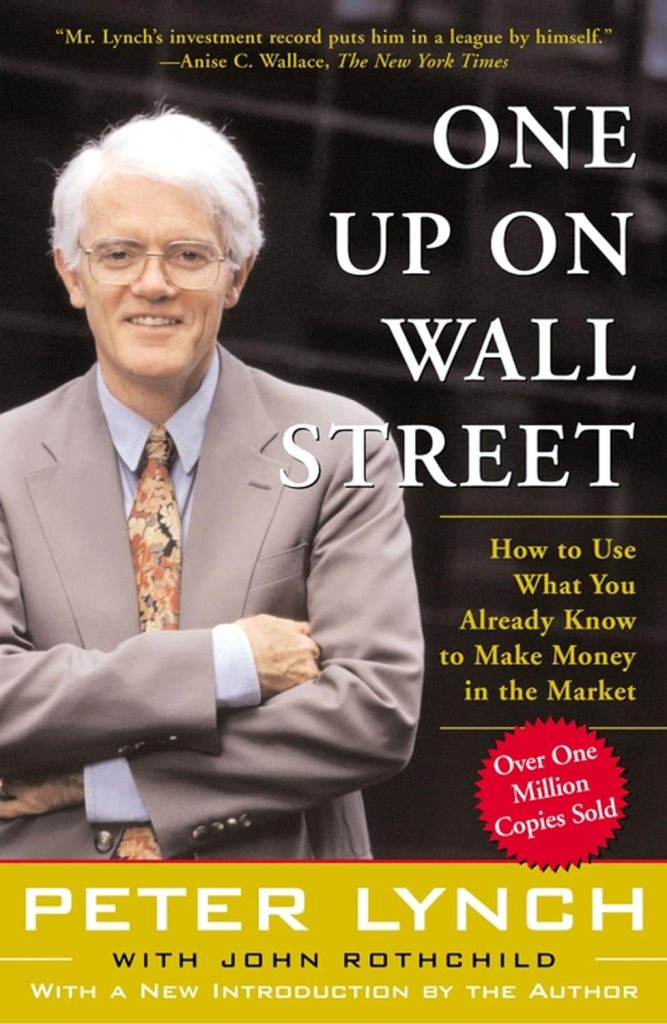
Peter Lynch was one of the most successful investors of the 1970’s and 1980’s as the head of the Fidelity Magellan Fund. In 1989 he explained how he did it and why he thought retail investors could succeed with the same strategies in the bestselling book “One Up on Wall Street”. Given the meme stock exuberance of retail investors in the past few years, I thought the book might be due for a comeback.

Instead interest seems flat, and when I do hear Peter Lynch mentioned it is by institutional investors more than retail. But the book seems to me like it is still valuable, so I’ll share some highlights here. This one could easily have been written this year:

Where did the Dow close? I’m more interested in how many stocks went up versus how many went down. These so-called advance/decline numbers paint a more realistic picture. Never has this been truer than in the recent exclusive market, where a few stocks advance while the majority languish. Investors who buy “undervalued” small stocks or midsize stocks have been punished for their prudence. People are wondering: How can the S&P 500 be up 20 percent and my stocks are down? The answer is that a few big stocks in the S&P 500 are propping up the averages.

I see why the book hasn’t caught on with meme stock traders:

Nobody believes in long-term investing more passionately than I do… I think of day-trading as at-home casino care.

I’ve never bought a future nor an option in my entire investing career, and I can’t imagine buying one now. It’s hard enough to make money in regular stocks without getting distracted by these side bets, which I’m told are nearly impossible to win unless you’re a professional trader.

So where does he think retail investors have a chance to get “One Up on Wall Street”?

Continue reading

How to (Almost) Double Your Investing Returns 2. Buy Deep in the Money Calls

Last week we described a simple way to achieve roughly double investing returns on some asset class like an S&P 500 stock basket, or a narrow class of stocks such as semiconductors, or on some commodity like gold or oil. That way is to buy one of the many exchange-traded funds (ETFs) which use sophisticated derivatives to achieve a 2X or even 3X daily movement in their share prices, relative to the underlying asset. For instance, if the S&P 500 stocks move up by 2% on a given day, the SSO ETF will rise by 4%.

Of course, these leveraged funds will also go down two or three times as much. They also have a more subtle disadvantage, which is that when the markets go up and down a lot, they tend to lose value due to their daily reset mechanism.

In this post we describe a different way to achieve roughly double returns, which does not suffer from this volatility drag issue. This way is to buy long-dated deep in-the-money call options on a stock or a fund.

Say what? We have described how stock options work here and here. The reader who is unfamiliar with options should consult those prior articles.

A stock option is a contract to buy (if it is a call option) or to sell (if it is a put option) a given stock at some particular price (“strike price”), by some particular expiration date. Investors generally buy calls when they believe that the price of some stock or fund will go up.  For a call option with a strike price far below the current market price of a stock, the market price of the option will move up and down essentially 1:1 with the market price of the stock.

For instance, as I write this the market price of Apple is about $230. Suppose I think Apple is going to go up by say $40 in the next six months. One way for me to capture this gain is to invest $230 in buying Apple stock. The alternative propose here is to instead of buying the stock itself, buy, say, a call option with a strike price of $115 and an expiration date of January 17, 2025. The current market price of this option is about $119.

Other things being equal, we expect that the market value of this call option will go up by $40 if Apple itself goes up by $40. But we have invested only $119, rather than $230, so our return on our investment is roughly double with the option than by buying the stock itself.

There is a subtle cost to this approach. At a stock price of $230 and a strike price of $115, the intrinsic value of this call option is $115. But we pay an extra $3 of extrinsic value when we buy the option for $118. This extrinsic value will gradually decay to zero over the next six months.

Thus, if Apple went up by $40 within the next month or so, we could turn around and sell this call option for nearly $40 more than our purchase price. But if we wait for six months before selling it, we would only net $37 (i.e., $40 minus $3). This is still fine, but it illustrates that there is a steady cost of holding such options. This annualized cost is about equal to or slightly higher than the prevailing short term interest rate (5% /year). This option pricing makes sense, since an alternative way to control this many shares would be to borrow money at current interest rates (5%) and use those borrowed funds to buy Apple shares. Options and futures pricing is generally rational, to make things like this equivalent, or else there would be easy arbitrage profits available.

As a side comment, the reason I am focusing on deep in the money calls here is that the extrinsic premium you pay in buying the call gets lower the further away the strike price is (i.e. deeper in the money) from the current stock price. A deeper in the money call does cost you more up front, but net net its dollar movements up and down more closely track (1:1) the movements of the underlying stock. So, if I am not trying to guess right on any market timing, but simply want to get the equivalent of holding the underlying stock but tying up less money to do so, I find buying a call that is about 50% in the money generally works well.

How I Use Deep in the Money Call Options

I consider the technology-oriented stock fund QQQ to be a core holding in my portfolio, so I would like to stay exposed to its movements. But I might as well do this on a 2X basis, to make better use of my funds. I do hold some of the 2X ETF QLD. But if we experience a lot of market volatility, the price of QLD will suffer, as explained in our previous post.

As a more conservative approach here, I recently bought a deep in the money call on the QQQ ETF. As usual, I went for a call option with a strike price roughly half of the market price, with an expiration date 6-12 months away. When this gets close to expiration (May-June next year), I will “roll” it forward, by selling my existing call option, and buying a new one dated yet another 6-12 months further out. This takes little work and little decision making. I will pay the equivalent of about 5% annualized cost on the decay of the extrinsic option premium, but I come ahead as long as QQQ goes up more than 5% per year.

This is a little more work than just holding the 2X QLD ETF, but it gives me a bit more peace of mind, knowing I have done what I can to smooth out some of the risk there. Of course, if QQQ plunges along with the markets in general, I will be looking at double the losses. For that reason, I am taking some of the money I am saving by using these leveraged approaches, and stashing it in safe money market funds. In theory that should give me “dry powder” for buying more stocks after they drop. In practice, I may be too frozen with fear to make such clever purchases. But at any rate, I should not be appreciably worse off for having used these leveraged investments (2X funds or deep in the money calls).

Disclaimer: As usual, nothing here should be considered advice to buy or sell any investment.

From Cubicles to Code – Evolving Investment Priorities from 1990 to 2022

I’ve written before about how we can afford about 50% more consumption now that we could in 1990. But it’s not all bread and circuses. We can also afford more capital. In fact, adding to our capital stock helps us produce the abundant consumption that we enjoy today. In order to explore this idea I’m using the BEA Saving and Investment accounts. The population data is from FRED.

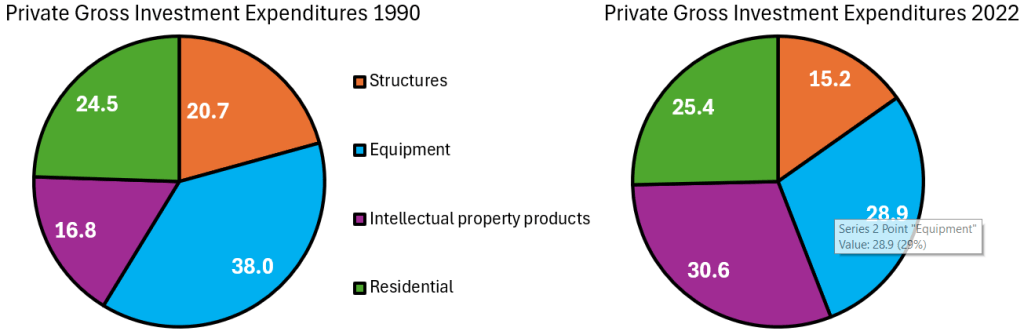
The tricky thing about investment spending is that we need to differentiate between gross investment and net investment. Gross investment includes spending on the maintenance of current capital. Net investment is the change in the capital stock after depreciation – it’s investment in additional capital not just new capital.  Below are two pie charts that illustrate how the composition of our *gross investment* spending has changed over the past 30 years. Residential investment costs us about the same proportion of our investment budget as it did historically. A smaller proportion of our investment budget is going toward commercial structures and equipment (I’ve omitted the change in inventories). The big mover is the proportion of our investment that goes toward intellectual property, which has almost doubled.

It’s easiest for us to think about the quantities of investment that we can afford in 2022 as a proportion of 1990. Below are the inflation-adjusted quantities of investment per capita. On a per-person basis, we invest more in all capital types in 2022 than we did in 1990. Intellectual property investment has risen more than 600% over the past 30 years. The investment that produces the most value has moved toward digital products, including software. We also invest 250% more in equipment per person than we did in 1990. The average worker has far more productive tools at their disposal – both physical and digital. Overall real private investment is 3.5 times higher than it was 30 years ago.

Continue reading