Warsh’s Low/No Guidance Approach at Fed Makes Market Participants Nervous – – Which May Be a Good Thing

Under Jerome Powell, a typical FOMC meeting had become almost a market event in itself. Traders didn’t just care about the rate decision. They dissected every word of the statement, every sentence of the press conference, and especially the “dot plot,” looking for clues about where rates might be six months or a year from now. The Fed wasn’t simply setting monetary policy—it was guiding expectations. Markets often moved as much on hints about future decisions as on the decision itself.

The first two FOMC meetings under Kevin Warsh have felt very different. The dot plots are gone. Forward guidance has largely disappeared. Instead of trying to signal the likely path of policy, Warsh has repeatedly stressed that the Fed will respond to incoming data when it arrives, not commit itself to forecasts that could prove wrong. At his latest press conference, he described avoiding forward guidance as “prudent” given current uncertainty, while reminding reporters that “There is no soft or alternative inflation target—only 2%.”

This is a huge change in communication style, which is having real world consequences.

Warsh long argued that forward guidance can box policymakers into decisions based on yesterday’s forecasts instead of tomorrow’s realities. That is, once their tentative plans had been put out in public, there was a psychological bias among Fed members to lock in on those projections, which would inhibit their ability to rationally interact with the most recent data and situation. So now, rather than telling markets what the Fed expects to do, he wants investors to make decisions based on fundamental economic conditions, knowing that the central bank will react only after the facts justify it. At the latest FOMC meeting he said, “Market participants are learning to play the ball, not the referee—and market prices will continue to respond in the direction and magnitude they see fit. This is, in my view, a change for the better—and we are just getting started.”

That approach chips away at what investors have come to call the “Fed Put”—the belief, built up since the 2008 financial crisis, that the central bank will fairly quickly and forcefully step in to support markets whenever things get rough.

If that belief fades, financiers may think twice before taking excessive risks. Leverage becomes more dangerous if there is less confidence that easier monetary policy will quickly arrive to cushion losses. Risk premiums may better reflect actual economic uncertainty rather than expectations of future Fed support. That is the possible good side of Warsh’s more hands-off approach. Ideally, business people will exercise more prudence on their own, lessening the odds of financial catastrophes that would require Fed intervention.

On the other hand, markets hate uncertainty, and less guidance means more volatility around Fed meetings. I think Powell tried to use sheer talking (jaw-boning) as a tool to influence market rates, lessening the need for the Fed to actually employ its blunt instruments there. Warsh seems to have taken that tool off the table.

Also, I think some (not all) the causation for the rise in 30-year Treasury bonds to twenty-year highs, and of home mortgage rates to one-year highs accrues to Warsh. First, by eliminating dot plots and forward guidance, he has increased uncertainty about the future path of policy. Investors can no longer confidently assume the Fed will ease at the first sign of economic weakness. That uncertainty can raise the term premium, pushing long-term yields higher.

Second, if markets believe the “Fed Put” is weaker, they may demand higher yields to hold long-term bonds because they perceive less protection from adverse economic or financial shocks. In other words, investors require more compensation for risk.

Whether today’s higher long-term rates are a healthy reflection of economic realities, or an unhealth drag on growth, is a matter of debate.

Looking Ahead: Post-Powell Interest Rates

Jerome Powell’s term as Fed Chair ends in late May 2026. President Trump has said that he will nominate a new chair and the US senate will confirm them. It may take multiple nominations, but that’s the process. The new chair doesn’t govern monetary and interest rate policy all by their lonesome, however. They have to get most of the FOMC on board in order to make interest rate decisions. We all know that the president wants lower interest rates and there is uncertainty about the political independence of the next chair. What will actually happen once Jerome is out and his replacement is in?

The treasury markets can give us a hint. The yields on government debt tend to follow the federal funds rate closely (see below). So, we can use some simple logic to forecast the currently expected rates during the new Fed Chair’s first several months.

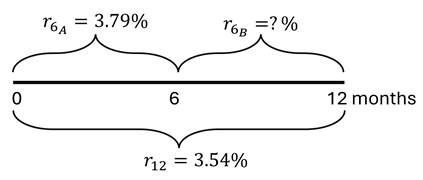
Here’s the logic. As of October 16, the yield on the 6-month treasury was 3.79% and the yield on the 1-year treasury was 3.54%. If the market expectations are accurate, then holding the 1-year treasury to maturity should yield the same as the 6-month treasury purchased today and then another one purchased six months from now. The below diagram and equation provide the intuition and math.

Since the federal funds rate and US treasury yields closely track one another, we can deduce that the interest rates are expected to fall after 6 months. Specifically, rates will fall by the difference in the 6-month rates, or about 49.9 basis points (0.499%).  This cut is an expected value of course. Given that the cut is between a half and a zero percent, we can back out the market expectation of for a 0.5% vs 0.0% cut where α is the probability of the half-point cut.* Formally:

Continue reading

Don’t Cut Rates

The Federal Reserve will probably cut rates next week:

I can’t advise them on the complex politics of this, but based on the economics I think cutting would be a mistake. I see one good reason they want to cut: hiring is slow and apparently has been for a year. But that could be driven by falling labor supply rather than falling demand, and most other indicators suggest holding rates steady or even raising them.

Most importantly, inflation is currently well above their 2% target, 2.9% over the past year and a higher pace than that in August. Inflation expectations remain somewhat elevated. Real GDP growth was strong in Q2 and looks set to be strong in Q3 too, and NGDP growth is still well above trend.. The Conference Board’s measure of consumer confidence looks bad, but Michigan’s looks fine.

Financial conditions are loose, with stocks at all time highs and credit spreads low. Its only September and we’ve already seen more Initial Public Offerings than in any year since 2021 (when the last big bout of inflation kicked off):

Source: https://stockanalysis.com/ipos/statistics/

Crypto prices are back near all time highs and crypto is becoming more integrated into public stocks through bitcoin treasury companies and IPOs from Gemini and Figure.

The Taylor Rule provides a way of putting all this together into a concrete suggestion for interest rates. Some versions of the rule say rates are about on target, while others including my preferred Bernanke version suggest they should be closer to 6%. To me this is what the debate should be- do we keep rates steady or raise them? I see good arguments each way, but the case for a cut seems very weak.

I look forward to finding out in a year or two whether I or the FOMC is the crazy one here.

* The Usual Disclaimer, hopefully extra obvious in this case: These views are mine and I’m not speaking for any part of the Federal Reserve System.

Recession Prospecting & Fed Tea Leaves

Will a recession happen? It’s famously hard/impossible to predict. Personally, I have a relatively monetarist take. I consider the goals of the Federal reserve, what tools they have, and how they make their decisions. I also think about the very recent trend in the macroeconomy and how it’s situated relative to history. Right now, the yield curve has been inverted for quite some time and the Sahm rule has been satisfied, both are historical indicators of recession.

Recessions are determined by the NBER’s Business Cycle Dating Committee. They always make their determination in hindsight and almost never in real time. They look at a variety of indicators and judge whether each declines, for how long, how deeply, and the breadth of decline across the economy. So plenty of ‘bad’ things can happen without triggering a recession designation.

In my expert opinion, recessions can largely be prevented by maintaining expected and steady growth in NGDP. This won’t solve real sectoral problems, but it will help to prevent contagion and spirals.  The Fed can control NGDP to a great degree. In doing so, they can affect unemployment and growth in the short run, and inflation in the medium to long run.

One drawback of the NGDP series is that it’s infrequent, published only quarterly. It’s hard to know whether a dip is momentary, a false signal that will later be updated, or whether there is a recession coming. So, what should one examine? One could examine leading indicators or the various high-frequency indicators of economic activity. But those are a little too much like tarot cards and fortune telling for my taste.

Continue reading

Fed Dot Plot vs Markets

After their last meeting in March, the Federal Open Market Committee released the summary of economic projections. Most of the variables they project are inherently difficult to predict: GDP, unemployment, inflation. But their forecasts of the Federal Funds rate should be pretty good, since they’re the ones that get to pick what it will be. The median FOMC member thinks the the Federal Funds rate will be just under 2% by the end of 2022.

I said in my last post that the Fed is under-reacting to inflation. Markets seem to agree, but they also think that the Fed will change. Kalshi runs prediction markets on what the Fed Funds rate will be, which they recently started to summarize using this nice curve:

So traders think that the Fed will raise rates faster than the Fed thinks they will, with rates getting to 2.5% by year end. Traders at the Chicago Mercantile Exchange see an even bigger change, with rates at 2.75% by year end, and 3.5% by July 2023 (the longest-term market they offer).

I lean toward the markets on this one; if they are wrong there is plenty of money to be made by betting so.

