WSJ Guidance on Rate Cuts

With the government back open and a little more official data coming out, the WSJ reports a picture of the typical Fed dilemma ahead:

Hiring Defied Expectations in September, With 119,000 New Jobs

The latest data will likely do little to resolve the debate at the Federal Reserve, where some policymakers, wary of inflation, want to leave rates on hold, while others are pushing for a rate cut in December as insurance against a labor market deterioration.

Hawks can point to the bump up in job growth as a reason to postpone any further easing, while doves can focus on rise in the unemployment rate, as well as the general trend toward weaker job growth, as reasons to cut. Thursday’s report was the last official snapshot the Fed will see before the next rate-setting meeting in December. As a result of the shutdown, the Labor Department pushed back its release of the November jobs report to Dec. 16, the week after the rate decision.

“I’m sure we’ll see plenty of articles now claiming that AI is creating jobs, right?”

People who think there isn’t enough work to go around must not be moms or be fighting infertility.

Looking Ahead: Post-Powell Interest Rates

Jerome Powell’s term as Fed Chair ends in late May 2026. President Trump has said that he will nominate a new chair and the US senate will confirm them. It may take multiple nominations, but that’s the process. The new chair doesn’t govern monetary and interest rate policy all by their lonesome, however. They have to get most of the FOMC on board in order to make interest rate decisions. We all know that the president wants lower interest rates and there is uncertainty about the political independence of the next chair. What will actually happen once Jerome is out and his replacement is in?

The treasury markets can give us a hint. The yields on government debt tend to follow the federal funds rate closely (see below). So, we can use some simple logic to forecast the currently expected rates during the new Fed Chair’s first several months.

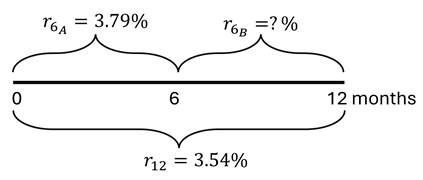
Here’s the logic. As of October 16, the yield on the 6-month treasury was 3.79% and the yield on the 1-year treasury was 3.54%. If the market expectations are accurate, then holding the 1-year treasury to maturity should yield the same as the 6-month treasury purchased today and then another one purchased six months from now. The below diagram and equation provide the intuition and math.

Since the federal funds rate and US treasury yields closely track one another, we can deduce that the interest rates are expected to fall after 6 months. Specifically, rates will fall by the difference in the 6-month rates, or about 49.9 basis points (0.499%).  This cut is an expected value of course. Given that the cut is between a half and a zero percent, we can back out the market expectation of for a 0.5% vs 0.0% cut where α is the probability of the half-point cut.* Formally:

Continue reading

Can the President Fire a Member of the Federal Reserve Board of Governors?

That’s exactly what he tried to do this past Monday. Trump announced on social media that Lisa Cook, appointed by Biden in 2022, is now fired. Things are about to get awkward.

First, Trump can’t simply fire Fed governors willy-nilly. Remember when DOGE was involved in all of those federal workforce lay-offs earlier in the year? I know, it seems like forever ago. The US Supreme Court ruled on the legality of those firings, including some at government corporations and ‘independent agencies’. The idea behind such entities is that they are supposed to be politically insulated and less bound by the typical red tape of the government. But Trump’s administration argued that the separation from the rest of the executive branch is a fiction and that there is no one else in charge of them if not the president. The Supreme Court agreed with the administration, with one exception.

Continue reading

Government Makes Quasi-Nationalization Deal to Assure Supply of Critical Rare Earths for Defense 

If top government officials were regular readers of this blog, they would have been warned by a headline here more than two years ago, “China To Squeeze West by Restricting Export of Essential Rare Earths “.  For the last few years, the U.S. has been trying to limit Chinese access to the most powerful computing chips, which are largely made by American company Nvidia. But China has some high cards to play in this game. It produces some 90% of refined rare earths and rare earth products like magnets.  These super-powerful neodymium-containing magnets are utterly critical components in all kinds of high-tech products, including wind turbine generators and electric motors for electric vehicles and drones, and miscellaneous military hardware.

It has been painfully obvious at least since 2010, when China put the squeeze on Japan by unofficially slowing rare earth exports to Japan over a territorial dispute, that it was only a matter of time before China played that card again. But the West slumbered on. There is a reasonable amount of rare earth ores that are mined outside China, but nobody wanted to build and operate the expensive and environmentally messy processes to refine the rare earth minerals (carbonates, oxides, phosphates) into the pure metals. Unlike the esoteric and hard-to-imitate processing for cutting edge computing chips, anyone can gear up and start refining rare earth ores. It mainly just takes money, lots and lots of it, to build and operate all the processing equipment for the multiple steps involved*. There was little free market incentive for a Western company to invest in expensive processing, since China could readily bankrupt them by cutting prices as soon as they started up their shiny new process line. Reportedly, the Chinese used this tactic twice before (in 2002 and 2012) to kill nascent refining of the rare earth ores at Mountain Pass mine in California.

As of April of this year, in response to ongoing U.S. export restrictions on chips, China threw its latest rare earth card down on the table, requiring export licenses and imposing other restrictions that throttled rare earth exports. Western manufacturers were soon howling in pain. As of early June:

Global automakers are sounding the alarm on an impending shortage of rare earth magnets as China’s restrictions on the material vital for the automotive, defence and clean energy industries threaten production delays around the world.

German automakers became the latest to warn that China’s export restrictions threaten to shut down production and rattle their local economies, following a similar complaint from an Indian EV maker last week. U.S., Japanese and South Korean automakers warned President Donald Trump on May 9 car factories could close.

The Trump administration quickly caved on chips and in July permitted boatloads of high-end H20 Nvidia chips to ship to China, in return for resumption of rare earth exports from China. Score one for the CCP. As of mid-August, rare earth shipments had climbed back to around half of their pre-May levels, but China ominously warned Western companies against trying to stockpile any reserves of rare earths, or they would “face shortages” in the future.

After this ignominious face-slapping, the administration finally did something that should have been done years ago: they gave an American company a solid financial incentive to buckle down and do the dirty work of refining rare earth ores at large scale. The Defense Department inked a deal with MP Materials Corp, the current operator of the Mountain Pass mine and the modest refining operation there to quickly ramp up production:

The Department of Defense is investing capital in MP across several fronts. This includes a $400 million convertible preferred equity, struck at a fixed conversion price of $30.03. The government gets 10-year MP stock warrants also set for a $30.03 price. As planned, this would get the Department of Defense to about a 15% ownership position in MP Materials. In addition, the Department of Defense will lend MP Materials $150 million at a highly competitive interest rate to help the company expand its heavy rare earth element separation capabilities.

It’s not just a financing deal, however. This arrangement also provides a striking level of influence over pricing and profitability for MP Materials going forward.

For one thing, the Department of Defense will provide a price floor of $110 per kilogram for NdPr. NdPr is a product that is a combination of neodymium and praseodymium. This is a generous floor price…

The Department of Defense’s involvement now gives MP Materials the runway necessary to build what’s being dubbed the 10X magnet manufacturing expansion plant. The Department of Defense is committed to buying the output of this plant with a controlled cost-plus pricing structure. And there will be a profit split with the DoD getting a significant chunk of the upside above certain EBITDA thresholds.

This is being billed as a private-public partnership, but it is akin to nationalization. The government will be heavily involved in planning output and setting pricing here, as well as sharing in profits.  Fans of laissez-faire free markets may be understandably queasy over this arrangement, but national security considerations seem to make this necessary.

I predict that further “private-public” deals will be struck to subsidize Western production of vital materials. Let’s be clear: massive subsidies or similar incentives, in one form or another, will be needed. And this means that Americans will have to devote more resources to grinding out industrial materials, and less to consumer goods; hence, we will likely live in smaller houses, perhaps (gasp) lacking granite countertops and recessed lighting. Economics is all about trade-offs.

Due to its vast, lower-paid, hard-working and highly-capable workforce, the whole Chinese supply chain and production costs run far, far cheaper than anything in the West. We don’t have to produce 100% of what we use, even say 40% might be enough to keep from being helplessly squeezed by another nation. How to do this without descending into unproductive rent-seeking rip-offs will be a challenge.

Some other materials candidates:  China has as of December 2024 completely shut off exports to the U.S. of three key non-rare earth technical elements, gallium, germanium and antimony, so those might be a good place to start. China mines or refines between half and 90% of global supply of those minerals. Also, China has instituted export regulations of for more key metals (tungsten, tellurium, bismuth, indium and molybdenum-related products), so these may be further subjects for squeeze plays. Finally, “China is the world’s top graphite producer and exporter, and also refines more than 90% of the world’s graphite into a material that is used in virtually all EV batteries,” so that is yet another vital material where the West must decide how much it is worth to break its dependence on an unreliable trading partner.

Waymo and Pictures Online

Memes on Twitter are at least as important today as political cartoons of the 19th and 20th centuries. Two memes went viral this week, surrounding the events of protests in Los Angeles.  

The first meme reflects how Lord of the Rings is deeply embedded in American culture. Two million views means that most people don’t need the joke explained. (Part of the Lord of the Rings story is that the wise and powerful elves abandon chaotic Middle Earth for the safety of the Grey Havens. Similarly, the Waymo cars quietly drove themselves to safety away from Los Angeles after several had been vandalized and burned.)

I worry that The Lord of the Rings has made us too optimistic. Americans rarely tolerate stories that do not have happy endings. Has that made it hard for us to understand global events, or impaired our ability to accurately predict how most battles will end?

The next viral meme about the Waymos has two tweets to track. The originator of the joke got half a million views. Someone who added AI-generated images to the original text got half a million views as well.

The four quadrants form is a common meme format. Starting in the upper left, perhaps the best way to explain this is that a rigid socialist might resent Waymo as a symbol of Big Tech. At the very least, a socialist who wields state control might want to nationalize Waymo if there are going to be autonomous cars.

“Protect the Waymos” voices support for the police and traditional property rules. This is a joke, keep in mind, so it’s not meant to make perfect sense. The Libertarian Right might be more likely to support individuals protecting themselves with their own weapons as opposed to relying on the police state.

Compare the meme world to the news. I feel like this might become quaint soon, so here’s what it looks like to use the Google News search function.

The Los Angeles Times reports

The autonomous ride-hailing service Waymo has suspended operations in downtown Los Angeles after several of its vehicles were set on fire during protests against immigration raids in the area.

At least five Waymo vehicles were destroyed over the weekend, the company said. Waymo removed its vehicles from downtown but continues to operate in other parts of Los Angeles.

The flaming Waymo image is all over the news and internet. For one thing, people are interested in it because it’s real. This was supposed to be the year of deepfakes, and yet it’s mostly real images and real gaffes that are still making the news.

At this moment in time, most Americans do not yet have Waymo in their cities. Oddly enough, losing an inventory of several cars might be well worth the publicity the company is receiving. Two million viewers of the video of the little driverless cars making an orderly exit from Los Angeles might come away thinking driverless cars are safe and sensible.

Here are more posts from my long-standing interest in cartoons and internet culture.

Kyla Scanlon also felt like the little cars on fire was worth a newsletter post. She wrote

We scroll past the burning car to see arguments about whether the burning was justified, then scroll past those to see memes about the arguments, then scroll past those to see counter-memes. The cycle feeds itself!

Tariff Tilly (Satire)

Satire news shows are, in my opinion, one of the higher forms of art that my country has produced (and an example of our exports). “Meet Tariff Tilly, the perfect replacement for the 37 dolls your kid does not need” from The Daily Show

“Tariff Tilly” builds. There is even a comment on interest rates (addressed in my previous post).

In this house, we believe in economists writing about dolls. You can find more at https://economistwritingeveryday.com/?s=barbie or https://economistwritingeveryday.com/?s=dolls

When Commitment Backfires: The Economics Behind Gang Tattoos and Changing Incentives

In economics, commitment devices are often seen as clever solutions to self-control problems—ways people can tie their future hands to avoid giving in to temptation. A smoker throws away their cigarettes, a dieter pays in advance for healthy meals, a student announces a deadline publicly so they can’t back out. The idea is that by limiting future choices, a person can force themselves to stick with a preferred long-term strategy. But commitment devices also show up in places far removed from personal productivity—and in some cases, they carry bad unintended consequences when the strategic landscape shifts.

Consider the case of gang tattoos, especially those associated with MS-13. For years, highly visible tattoos served as a powerful way to demonstrate loyalty to the group. These tattoos—sometimes covering the face, neck, or arms—weren’t just aesthetic. They signaled that the individual was fully committed to the gang. In economic terms, they functioned as a high-cost, hard-to-fake commitment device. By making oneself easily identifiable as a gang member, a person burned bridges to legitimate employment or life outside the gang. That might seem irrational at first glance, but it was often a rational decision in context. Within certain neighborhoods or prisons, that signal provided protection, status, and trust among peers. The visible commitment reduced the gang’s uncertainty about who was loyal and who might defect.

But the rules of the game changed. In March 2022, El Salvador launched an aggressive crackdown on gangs following a sharp spike in homicides. Under a sweeping “state of exception,” authorities suspended constitutional rights, arrested tens of thousands of people, and expanded prison capacity dramatically. Tattoos quickly became one of the easiest ways for police to identify and detain suspected gang members. News reports describe men being pulled from buses or homes not for current criminal activity, but simply because of the ink on their skin. In many cases, the tattoos were from years earlier—when the wearer had been young and immersed in a world where signaling loyalty felt necessary for survival. Now, those same signals serve as evidence in court or grounds for indefinite detention.

Continue reading

Understanding Inflation and Interest Rates

Anyone who teaches Macroeconomics knows that these concepts are hard for people to understand at first.

A clip about inflation has been making the rounds.

Transcripts provided by CNN show the following

CNN NewsNight with Abby Phillip
Aired April 17, 2025 – 22:00 ET

ABBY PHILLIP, CNN ANCHOR

BATYA UNGAR-SARGON, AUTHOR, HOW THE ELITES BETRAYED AMERICA’S WORKING MEN AND WOMEN

CHARLOTTE HOWARD, EXECUTIVE EDITOR, THE ECONOMIST

PHILLIP: Jerome Powell is the head of the Fed and has a mandate to keep inflation low and employment high. So if there are, you know, macroeconomic things that are happening in the economy that make it very difficult for him to do that, you don’t think he’s going to comment?

UNGAR-SARGON: Do you know what would have really helped? What would be a really good idea right now to help bring down inflation and make sure that things keep running smoothly? It’s dropping interest rates. Why doesn’t he do that?

PHILLIP: Why doesn’t he do that?

HOWARD: So interest rates, if you were to drop interest rates, you would stoke inflation.

GPT expands on Howard’s point: “Dropping interest rates would not lower inflation—in fact, it typically makes inflation worse.

Interest rates are a key tool the Federal Reserve uses to manage inflation. When rates are lowered, it becomes cheaper to borrow money. This encourages people and businesses to take out loans, spend more, and invest more, which increases demand for goods and services.

But when demand rises faster than supply can keep up, prices go up—that’s inflation.

So, in a time of high inflation, cutting interest rates would likely make the problem worse, not better. The Fed raises interest rates to make borrowing more expensive, which slows down spending and cools demand, helping to bring inflation under control.”

Recall that the United States achieved disinflation starting in 2022, largely due to the Federal Reserve’s aggressive interest rate hikes. Tyler calls the disinflation America’s triumph.

As for the commentariat, a diverse array of economists ranging from the Keynesian Paul Krugman to many conservative economists recognized that rate increases and disinflation were necessary and had to be done with promptness and fortitude. And so credibility reigned.

Joy on Al Jazeera

An Al Jazeera talk show called The Steam asked me to join a discussion on fast fashion as the contrarian or as “the economist.” The found me because of the my article “Fast Fashion, Global Trade, and Sustainable Abundance” 

Episode website: https://www.aljazeera.com/program/the-stream/2025/3/25/trends-trash-and-truth-fast-fashion-phenomena

“Trends, trash and truth: Fast fashion phenomena”

The guests were

Venetia La Manna – fair fashion campaigner

Walden Lam – president and co-founder, Unspun

Katia Osei – lead researcher and bioengineer, Or Foundation

Joy Buchanan – associate professor, Samford University

I am a small part of the 25-minute show. You can hear me  from about minute 9:20 to 11:35 and then at the end from 23:30 to 24:45.

The points I made are that “fast” fashion has a good side for consumers, even though people are worried about the environmental impact of clothing waste. I got a few seconds to talk about my ideas for solutions which include labels about clothing durability and AI help with sorting. At the end I said that, as people become more aware of the downsides of fast fashion, we could stop putting social expectations on each other to wear a new outfit to every party and buy a custom shirt for every club event.

How Americans Can Thank the World

Dear World,

Thank you for the heritage of philosophical and scientific ideas, preserved through an international effort over thousands of years. Thank you for coming to study at American universities in this century, and for staying to teach.

Thank you all for buying into our heroes. What is Star Wars without a global audience? Your enthusiasm transforms our characters into shared legends. Thank you for cheering on Harrison Ford and Will Smith. Thank you for feeling the joys and heartbreaks of Taylor Swift, Luke Combs and Beyoncé. Thank you for sending us Lord of the Rings, Howl’s Moving Castle, and Squid Game.

Video games unite us all. Thanks for Elden Ring from Japan, and Minecraft, which started in Sweden before it was acquired by Microsoft. It helps us be more creative when the world buys U.S.-made games like Call of Duty and Fortnite.

Merci France, for helping us in our war of independence and giving us the Statue of Liberty. (And for printing my cartoon.)

Thank you to England, for the inheritance of a system of limited government, whose principles of common law, parliamentary tradition, and constitutional rights became the foundation upon which we built our republic.

Thank you, world, for listening to our national anthem at the Olympics. For training with us and competing against us in feats of endurance and collectively celebrating as humans have recently broken so many records of performance. Congrats to Eliud Kipchoge and Katie Ledecky.

Thank you for believing in the American Dream. The wealth enjoyed by average Americans today would not be possible without globalization.

Thank you for seeing good in us and trusting our soldiers and businesses.

Thank you for trading with us. Thanks for keeping the modern F-150 truck affordable.  Quality is better today, because it’s more powerful with stronger engines and still gets better gas mileage while being safer. Part of what keeps the price down is getting so many component parts through imports from places like Mexico and Asia.

Thank you for sharing your genuine thoughts on our social media platforms. Thank you for making the World Wide Web worldwide, starting with http://info.cern.ch.

Thailand, thank you for welcoming my college friends who do not speak your language. You gave them a break from the monotony of their local landscapes. What would our Instagram be without you, and Iceland and Ecuador? The generosity with which you welcome travelers enriches not just our photo albums, but our perspectives.

We are who we are because of you.