On May 6, 2022, the governor of Florida, Ron DeSantis, signed House Bill 7071. The bill was touted as a tax-relief package for Floridians in order to ease the pains caused by inflation. In total, the bill includes $1.2 billion in forgone tax revenues by temporarily suspending sales taxes that are levied on a variety of items that pull at one’s heartstrings. Below is the list of affected products.
A minor political point that I want to make first is that the children’s items are getting a lot of press, but they are only about 18.4% of the tax expenditures. The tax break on hurricane windows and doors received 37% of the funds and gasoline is receiving another 16.7%. There are ~$150 million in additional sales, corporate, and ad valorem tax exemptions. Looking at the table, it seems that producers of hurricane windows and doors might be the biggest beneficiary and that that the children’s items are there to make the bill politically palatable. Regardless, this is probably not the best use of $1.2 billion.
There are at least three economic points worth making.
As you drive, walk, or bike around your city, what do you think about as you see the various buildings and other structures? Perhaps you think about the lives of the people in them, or the architecture of the buildings themselves, or the products and services that the businesses offer for sale. For me, lately I’ve been thinking about one thing as I make my way around town: zoning. It’s not something I had thought about before very much, but after reading Nolan Gray’s new book Arbitrary Lines: How Zoning Broke the American City and How to Fix It, I’ve been thinking about zoning a lot more.
(Disclosure: I know the author of the book, but I paid for my own copy and got it in advance through the luck of the Amazon-pre-order draw.)
The book does a wonderful job of explaining what zoning is (and importantly, also what it is not), where zoning comes from historically (it’s a development of the early 20th century), and how zoning affects our cities. I really like the way that the book encourages the reader to be a part of the story of zoning. In Chapter 2, Gray encourages you to put down the book and locate your city’s zoning map to learn more about how zoning impacts your life.
I immediately did so and had no trouble finding zoning maps for the city I live in, Conway, Arkansas. Conveniently, my city provides both a simple PDF map and an interactive map, which provides a lot more detail. The interactive map even has embedded links with historical information on different pieces of property. For example, I found the ordinance for when my college, the University of Central Arkansas (previously Arkansas State Teachers College), was annexed by the City in 1958. Pretty cool!
Looking over the map, it’s pretty clear that most of the city that I live in is covered by R-1 and R-2 zoning. But what exactly do these designations mean? You can probably guess that “R” designates residential, but what does it proscribe about land use?
For that, you must dig into the zoning ordinances. And as Gray cautions in the book (somewhat tongue-in-cheek), you might not want to get in too deep with your zoning ordinances, since they can run hundreds or thousands of pages. But I was brave enough to do so, and located my zoning code online (the PDF runs a modest 253 pages).
What did I learn about the zoning that covers my city?
The United States is a uniquely violent country among high-income democracies. And by the best available data on homicides, the US has always been more violent. Homicides are useful to look at because we generally have the best data on these (murders are the most likely crime to be reported) and it’s the most serious of all violent crimes.
Just how much more violent is the US than other high-income democracies? As measured by the homicide rate, about 6-7 times as violent. We can see this first by comparing the US to several European countries (and a few groupings of similar countries).
Let me make a few things clear about this chart. First, this is data for homicides, which are typically defined as interpersonal violence. Thus, it excludes deaths on the battlefield, genocides, acts of terrorism (generally speaking), and other deaths of this nature. That’s how it is defined. If we plotted a chart of battlefield deaths, it would look quite different, but there’s not much good reason to combine these different forms of violent death.
On the specifics of the chart, prior to 1990 these data are averages from multiple observations over multi-year timespans (generally 25 or 50 years). The data on European countries comes from a paper by Eisner on long-term crime trends (Table 1). The countries chosen are from this paper, as are the years chosen. Remember that historical data is always imperfect, but these are some of the best estimates available. For the US, I used Figure 5 from this paper by Tcherni-Buzzeo, and did my best to make the timeframes comparable to the Eisner data. The data are not perfect, but I think they are about as close as we can get to long-run comparisons. For the data from 1990 forward, I use the IHME Global Burden of Disease study, and the death rates from interpersonal violence (to match Eisner, I average across grouped countries).
When we average across all the European countries in the first chart and compare the US to Europe, we can see that the US has always been more violent, though the 20th century onwards does seem to show even more violence in the US relative to Europe. (These charts are slightly different from some that I posted on Twitter recently, especially the pre-1990 data as I tried to more carefully use the same periods for the averages — still only take this a rough guide).
And what is the main form by which this violence is carried out? In the US, it is undeniably clear: firearms. Between 1999 and 2020, there were almost 400,000 homicides in the US (using CDC data). Over 275,000 of these, or about 70%, were carried out with firearms. The next largest category is murder with a knife or other sharp object, with about 10% of murders. And homicides have become even more gun-focused in recent years: about 80% of murders in 2020-21 were committed with guns.
So, there’s the data. But the important social scientific question is: Can we do anything about it? Are there any public policies, either about guns or other things, that will reduce gun violence? Could restrictions on gun use actually increase homicides, since no doubt guns are also used defensively?
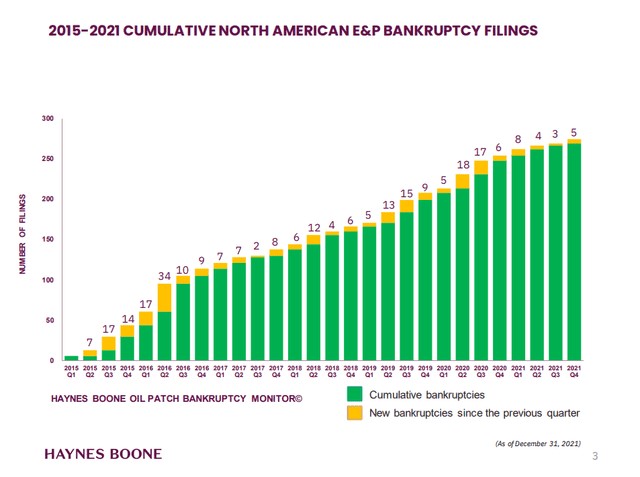
Oil production is a difficult, risky business even under favorable regulatory regimes. For instance, here is a chart of cumulative bankruptcy filings of exploration and production (E&P) companies for 2015-2021:
A few companies go bust every year, but there are some years like 2015-2016 and 2019-2020 when a lot of companies go bust. That happens when the oil industry collectively has overproduced and driven the price of oil below the effective cost of production. Even the mighty ExxonMobil ran deep in the red in 2020, losing an eye-watering 22.4 billion dollars. With all that in mind, shareholders since 2020 have been pressuring companies to show “financial discipline”, which means “drill less”.
Beyond these basic business realities, there is a whole new set of pressures to inhibit petroleum production. Environmental activists have pushed banks to withhold funding from petroleum companies, to strangle further oil production. It was big news in 2020 when activists, alarmed by ExxonMobil’s plans to actually (gasp) increase its oil production, successfully elected several alternative members to the board of directors with the specific goal of curtailing further drilling.
There have been attacks on the oil industry on the political front, as well. Joe Biden ran on a platform of banning drilling on public lands, and one item he checked off his to-do list on his first day in office was to issue an executive order killing a pipeline that would have facilitated imports of oil from the abundant reserves in Canada. One of his nominees for a top financial regulatory post remarked regarding oil producers that “we want them to go bankrupt if we want to tackle climate change”. All these are the sorts of things that make execs less willing to commit capital for expensive drilling programs that may take years to pay back. (The counter-claim by the administration that the U.S. oil industry is just sitting on thousands of unused oil leases is a red herring).
There is only a finite amount of oil in the ground, so it makes sense to move with all deliberate speed toward renewable and nuclear energy (which emits little or no CO2). However, our European friends who have installed lots of solar panels and windmills have discovered that the sun does not shine at night (!) and the wind does not always blow strongly (!!) , and so during their energy transition they need to maintain an adequate supply of fossil fuel power in order to keep the lights on. They elected to let their own oil and gas production dwindle, and rely instead on gas and oil purchased from Russia. We warned back in September that this European policy would give Russia leverage for harassing Ukraine, but apparently not enough EU leaders read this blog. Anyway, even back in the fall of 2021, Russia had restricted natural gas deliveries to Europe, causing sky-high prices there for gas and power.
The European experience ought to have been a cautionary tale for America, but political attacks on oil production continued in the halls of Congress itself. In an October 2021 hearing over climate change prevention, Carolyn Maloney (D-NY) and Ro Khanna (D-CA) insisted that Big Oil commit to reducing US oil and gas production by 3-4% annually (50-70% total by 2050). In a follow-up February 8, 2022 hearing, the two legislators again demanded concrete commitments from oil companies to reduce their domestic production (although, strangely, Mr. Khanna supported President Biden’s call for other regions, such as OPEC and Russia to increase production).
With oil drilling having been curtailed for the past several years (as desired by environmentalists), the world has now flopped from an oil surplus to an oil shortage, exacerbated by Russia’s invasion of Ukraine and subsequent sanctions. And of course world oil prices (which are not under the control of U.S. companies) have gone up in response. Oil companies are actually making money again instead of going bankrupt like two years ago
In 2021 Apple had a 26% net profit margin and an effective tax rate of only 13%, while the oil industry had an average profit margin of 8.9% and an effective tax rate of 26.9%. Yet Congress (mainly Democrats) “investigates” price gouging every time gas prices go up, without hauling in Tim Cook to grill him over the price of each new iPhone model. Repeated previous investigations have shown that domestic gasoline prices are mainly a function of world oil prices, which are not under the control of U.S. companies. Nevertheless, after berating oil execs for increasing oil production, here come the grandstanding Congressional attack dogs, holding a hearing last week titled (wait for it…) “Gouged at the Gas Station: Big Oil and America’s Pain at the Pump”.
The oil producers patiently explained that “We do not control the price of crude oil or natural gas, nor of refined products like gasoline and diesel fuel,” and “”It [the U.S. oil industry] is experiencing severe cost inflation, a labor shortage due to three downturns in 12 years, shortages of drilling rigs, frack fleets, frack sand, steel pipe, and other equipment and materials.” But it is not clear that anyone was listening to the facts.
I choose to believe these tweets are true because I want to write about it. I’m pretty sure they are, but unlike some people, I don’t have “medievalist friends” to verify it and I’m to tired to open Google.
Regardless of whether the “the book preciptated witch hunting” is true, I am in full agreement that much of misinformation is demand driven. Even when motivated by an alterior motive, disinformation has to be wrapped in the candy-coating of something people want to believe is true. For all the talk of disinformation though, the connection to witch hunting and religion is what I find most interesting, particularly in our pandemic times. There’s been a lot of frustration over people’s eagerness to believe non-scientific and pseudo-scientific garbage, but what I find most concerning is how rapidly identities solidified around believing experts and not believing experts. My suspicion is that this is, at least partly, a symptom of becoming a more broadly secular society, where political and scientific beliefs have for many people substituted for faith affiliations as group signifiers and shibboleths.
Religion makes for better and safer group identities than science. Why? Because religion is predominantly interested in untestable assertions whose veracity is entirely orthogonal to the quality of our lives and how we function as a society. This isn’t to say that societies can’t just as easily violently fracture as peacefully congeal around these beliefs, but the “truth” of them is entirely irrelevant. Communities and sub-communities can form Russian nesting dolls all the way up to continents and all the way down to Tilda Swinton, and the truth of the individual sets of religious beliefs won’t matter in the slightest.
Science, on the other hand, is a vastly different story. Groups that form around disbelief in the germ theory of disease or the food safety of the Green Revolution in agriculture will face vastly more limited prospects in the lives of members and their future generations. Groups naturally split into insiders and outsiders– that’s how we solve whole swaths of the collective action problems and Prisoner’s Dilemmas we face everyday.
Science needs religion to stake out territory in the ineffable and claim beliefs as their own. From these beliefs religion can provide people with the tools to tell stories, form bonds, and cultivate trust beyond the limits of kinship and familiarity. Religion needs to thrive so that science can work its way unmolested, and unco-opted, through the unending labryinth of truth-seeking, of learning and unlearning, discarding old truths as evidence mounts. It’s hard enough to accept evidence denying old truths when repuations are built around them (science does, after all, advance “one funeral at a time”). But it’s nearly impossible to discard old truths if they are holding a community together. People will cling to them because there’s too much immediately at stake, and in doing so you become trapped at the sclerotic local maximum of a costly falsehood.
I know there’s a tendency to focus on shared social media clips of preachers advocating against vaccines and masks and what not. But I don’t think that’s religion competing with science. I think that’s ostensibly religious leaders giving up on their faith to sell what they see people buying. Yesterday they were selling God, today they’re selling disinformation. Not because God is disinformation, but because they are seeing more demand for disinformation than God.
I don’t have a faith to sell anyone, and I certainly don’t have a policy solution in my back pocket (though I can only assume the answer starts with crypto and ends with profit). But I do think that if we are going to keep science safe from the short-term vicissitudes of our petty political identities, we will have to better resist the urge to call ourselves, our group, pro-science. It inevitably creates an anti-science opposition, cornering people into rallying around ideas that benefit no one in the long run. And we also have to have more faith in our faiths. If you don’t hold that your beliefs, and the community you’ve built around them, are appealing enough on their own merits,then you’re not really a believer. You’re not a scientist either. You’re a salesman, and one with a bad product at that.
Last week President Biden released his Fiscal Year 2023 budget proposal. The annual release of the budget proposal is always exciting for economists that study public finance. The president’s proposal is the first step in the federal budgeting process, which in some cases leads to the full passage of a federal budget by the start of the fiscal year in October (though perhaps surprisingly, the process rarely works as intended).
This year’s budget is especially interesting to look at because it gives us our first look at what post-pandemic federal budgeting might look like. And while the budget has a lot of detail on the administration’s priorities, I like to go right to the bottom line: does the budget balance? What are total spending and revenue levels?
The bottom line in the Biden budget this year is that permanently large deficits are here to stay. Keep in mind that a budget proposal is just a proposal, but it’s reasonable to interpret it as what the president wants to see happen with the budget over the next 10 years (even if Congress might want something different). Over the next 10 years, Biden has proposed that budget deficits remain consistently right around 4.5% of GDP, with no plan to balance the budget in the near future.
How does this compare to past budget proposals? For comparison, I looked at the final budget proposals of Biden plus his two predecessors. I start Obama’s in 2021 to match Trump’s first year, and all three overlap for 2023-2026. I put these as a percent of GDP so we don’t have to worry about inflation adjustments (though we might worry about optimistic GDP forecasts, see below).
The destruction of value is graphic and tragic, caused by Russia invading Ukraine this month. Of course violence is common, around the world and throughout history. Violence and repression lead to poverty. Only in rare circumstances have autocracy and despotism been escaped, so that commerce can flourish and wealth can be shared.
Last week I blogged about my nice experience at Disney World. I was happy to see them telling the story of technological growth at The Carousel of Progress ride. At Disney, people really commit to their stories. Adults don’t wear mouse ears or Jedi robes ironically, in the park. The Carousel of Progress message is 100% optimistic about our future, without any cynicism or hedging. There is no mention of government institutions or which legal arrangements will allow progress to continue.
Here is some political economy that is missing from the ride. I quote, without indenting, from the late P.J. O’Rourke’s book On the Wealth of Nations. O’Rourke explains, sometimes using Adam Smith’s words, how in rare circumstances humans managed to rise out of poverty and subjugation.
Beginning of Chapter 7: The first two books of The Wealth of Nations are Adam Smith’s creed of economic progress. Smith placed his faith… in the logic of common sense. We are required to care for ourselves. We act upon this requirement. Our actions are demonstrably beneficial to others. The economy progresses, QED. Or it would, Smith wrote, “if human institutions had never thwarted those natural inclinations.”
More from Chapter 7, on pre-Medieval history of Europe: Smith wrote that the “rapine and violence which the barbarians exercised” left Western Europe “sunk into the lowest state of poverty.” Commerce was destroyed, towns were deserted, fields were left uncultivated. But although the rule of law and the legal title to property that goes with it were destroyed, the result was not “Imagine no possessions/ I wonder if you can.”
End of Chapter 7, an explanation of how economic progress started in the Westwhen the merchants gained some freedom: Adam Smith argued that the inclination of the feudal overlords to be selfish was so strong that it overwhelmed their instinct for self-preservation:
All for ourselves, and nothing for other people, seems, in every age of the world, to have been the vile maxim of the masters of mankind. As soon, therefore, as they could find a method of consuming the whole value of their rents themselves, they had no disposition to share them with other persons. For a pair of diamond buckles… they exchanged… the price of the maintenance of a thousand men for a year, and with it the weight and authority which it could give them. The buckles, however, were to be all their own… whereas in the more ancient method of experience they must have shared with at least a thousand people… and thus, for the gratification of… vanities, they gradually bartered their whole power and authority.
Never complain that the people in power are stupid. It is their best trait.
Joy writing again: “Stupid” refers to the fact that the European lords could have maintained their own power if they had been willing to keep themselves and everyone else poor through continued violence. Consider who is currently being being crazy versus “stupid,” in Europe and elsewhere.
In Disney World’s Magic Kingdom, you can get off the Carousel of Progress and walk across the park, past the Main Street shops, to a dark scary ride called The Pirates of the Caribbean. Someone could teach a travel course where students do both rides and then discuss wealth creation. It would pair nicely with a Doug North reading. Then, everyone could ride “It’s Small World” ironically.
The saying that “The first casualty of war is the truth” has been credited to anti-war Senator Hiram Warren Johnson in 1918 and also to the ancient Greek dramatist Aeschylus. We have seen this played out dramatically with Russia’s invasion of Ukraine. From the Ukrainian side have come the predictable overinflated estimates of the enemy’s losses, and perhaps understated reporting of their own casualties. Also, on the first day or two of the war there was a raunchy defiant response of Ukrainian defenders to a “Russian ship” that was demanding their surrender; as far as I know that exchange was for real, but the initial report by Ukraine that all the heroic defenders were killed was not true. Maybe I am biased here, but these sorts of excesses are stretching some core truth, not trampling over it roughshod.
On the Russian side, perhaps because there is no even vaguely legitimate justification for their invasion, the lies have been simply ludicrous. Apparently, the Russian troops have been told that they are going there to rescue Ukrainians from the current regime which is a bunch of “neo-Nazis”. If Putin’s thugs had a sense of humor or perspective, they might have discerned the irony of characterizing the Ukrainian regime as “neo-Nazi” when the president (Zelenskyy) is a Jew, whose grandfather’s brothers died in Nazi concentration camps.
And the Russian lies go beyond ludicrous, to revolting and inhuman. Russian Foreign Minister Sergey Lavrov has dismissed concerns about civilian casualties as “pathetic shrieks” from Russia’s enemies, and denied Ukraine had even been invaded.
The Associated Press snapped a picture in the besieged city of Mariupol a few days ago which went viral, showing a pregnant woman with a bleeding abdomen being carried out on a stretcher from a maternity hospital which the Russians had bombed. The local surgeon tried to save her and her baby, but neither one survived. The Russian side put out a string of bizarre and contradictory stories, claiming that they had bombed the hospital because it was a militia base (a neo-Nazi militia, of course) but also that no, they didn’t bomb it, the hospital had been evacuated and the explosions were staged by the Ukrainians, and the bloody woman in the photos was a made-up model. Ugh. I find it chilling to observe a regime in operation where there is absolutely no respect for what the truth actually is; rather, lies are manufactured to serve whatever purpose will suit the regime.
I know that some of that goes on even with Western democracies, but we are still usually ashamed of outright lying, and stand discredited when exposed. But with hardcore authoritarian regimes, there does not seem to be even this minimal respect for integrity.
Freedom of speech becomes even more critical as cynicism about truth becomes more widespread in the world, even in our own political discourse. Putin is trying to suppress the truth within Russia, now with very harsh penalties (fifteen years in prison) for those disseminating information contrary to the party line. All he needs to do is deem such talk as “treasonous”, and into the clink you go.
I do worry about similar trends towards censorship within the West. In our case, it is not so much governments (so far) doing the censorship, but Big Tech. If Google [search engine and YouTube] / Facebook/Twitter disapprove of your content, they can label it “hate speech” or whatever, and your voice disappears from public discourse. But what gives the high priests of big tech the authority and the powers of moral discernment to rule on what discourse is permissible? Also, the algorithms of social media sites usually direct you towards other sites that reinforce your own point of view, so you rarely get exposed to why the other side believes what it does. However annoying it may be to see various forms of nonsense circulating on-line, the time-tested democratic response is to allow (nearly) all points of view to be fairly stated, and to trust in the people to figure out where the truth lies. Otherwise, the truth can become a casualty of culture wars, as it is in shooting wars.
Overall, I’ve been disappointed with the reporting on the US embargo against Russian oil. The AP reported that the US imports 8% of Russia’s crude oil exports. But then they and other outlets list a litany of other figures without any context for relative magnitudes. Let’s shine some more light on the crude oil data.*
First, the 8% figure is correct – or, at least it was correct as of December of 2021. The below figure charts the last 7 years of total Russian crude oil exports, US imports of Russian crude oil, and the proportion that US imports compose. That 8% figure is by no means representative of recent history. The average US proportion in 2015-2018 was 7.8%. But the US share as since risen in level and volatility. Since 2019, the US imports compose an average of 11.9% of all Russian crude oil exports.
As an exogenous shock, the import ban on Russian crude oil might have a substantial impact on Russian exports. However, many of the world’s oil importers were already refusing Russian crude. The US ban may not have a large independent effect on Russian sales and may be a case of congress endorsing a policy that’s already in place voluntarily.
The man of the hour is Volodymyr Zelenskyy. Russia underestimated the amount of resistance they would face in their invasion of Ukraine, and Zelensky is the heart and face of that resistance. The usual pattern in countries like Ukraine with a history of corrupt leadership is that when hostile armies close in on the capital, the leaders stuff money and jewels into suitcases and disappear to some safe haven (think: Afghanistan). Zelensky has chosen to stay and fight against Vladimir Putin, a man with a fearsome reputation for brutal military tactics (see: Chechnya and Syria) and for political assassinations.
Where did Zelenskyy come from? American politicians are nearly all lawyers or businessmen. Zelenskyy was a professional comedian. He did get a law degree, but then went into stage and film comedy. He starred in a number of lightweight films such as Love in the Big City, Office Romance, and the zany Rzhevsky Versus Napoleon:
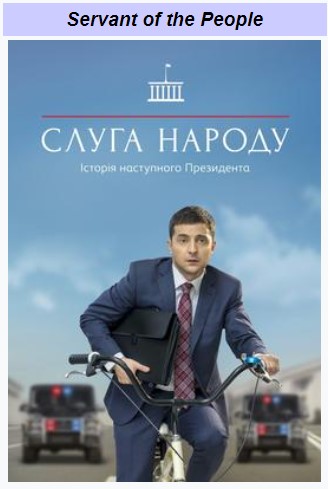
In 2015 the actor created, produced and starred in a comedic television series, Servant of the People:
In this political satire, a young high school teacher happens to let loose with a rant about corruption in Ukraine. One of his students captures this rant on his phone and puts it out on the internet. That YouTube video goes viral, and (to his complete surprise) the teacher gets elected president of Ukraine. He then proceeds to govern honorably, amidst various comedic situations.
In a case of life-mimics-art, the real Zelenskyy ran for the presidency of the country in 2019. Fueled by the popularity of the TV series, Zelenskyy’s campaign was almost entirely virtual. It succeeded in unseating the incumbent candidate, with Zelenskyy receiving a landslide 73% of the vote.
Although his Ukrainian presidency began on a whimsical note, it has turned into a global epic. However, it is difficult to envisage an ending to this epic that is not tragic. Drawing on his acting skills, Zelenskyy has been a master of internet communications in the present crisis, but there is only so much that can be done in the face of hard military realities. While the images of Ukrainian resistance are inspiring, the Russians have far greater military might and have the will to employ it as needed. And as long as Europe continues to fund Russia by guzzling Russian natural gas, sanctions can only bite moderately hard.





 Economist Writing Every Day