You Shouldn’t Be Writing (All the Time)

Many people get the idea that they should be working all the time. Certainly many academics do, which for us means a continuous internal reminder that “you should be writing”.

I thought this way in grad school but I don’t anymore. I now almost never work on nights & weekends, and often not on afternoons. Yet I get just as much work done, maybe more, and I’m much happier about it. How can this be?

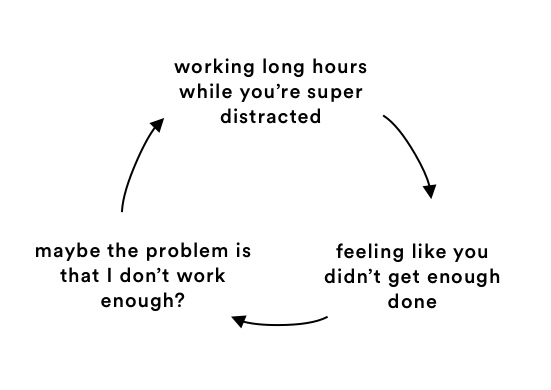
This post from Ava provides a great explanation. Its very short and you should read it, but I think it illustrates best through its literal illustrations:

Today is a good example. I’m writing this at noon, having just finished the revisions requested by a journal after 3 hours of solid work. Now, rather than start revising the next article & doing a bad job of it, I’ll take the rest of the day off. Real original thought is hard- I know I can do it for about 3 hours on a typical day, I have no one to impress by pretending to work longer, and one way or another the output will speak for itself. As remote work grows, this ability to do the real work and then stop rather than fill time “working” should be available to more people outside of academics.

The Research Process: Building and Utilizing a Research Network

This summer I’m writing a series of posts about the curriculum of the research process, from the initial idea to the development of a complete draft. This week, I’m focusing on how to build and utilize a research network to support the development of your project from the initial idea to the data scaffolding of the first draft.

Why do you need a network? Why can’t you just lone wolf this research thing? For starters, going solo necessarily means you’re going to try reinventing the wheel at some point. Beyond that, your network can help you avoid common pitfalls in finding and using specific datasets, alert you to working papers in your general field, expose you to new methods that are being piloted in your discipline, and provide support when the going gets rough (it’s going to at some point). Your network also includes people who could be potential readers for your paper before you submit it to a journal and people who use their platform to boost junior scholars by inviting them to present in conference sessions, seminars, and workshops.

Continue reading

The Research Process: Identifying the Ideas that Motivate You

Hello to all the EWED readers! I’m Dr. Darwyyn Deyo, an Assistant Professor of Economics at San José State University and a Visiting Scholar at the Knee Center for the Study of Occupational Regulation. I research law and economics, occupational licensing, and the economics of crime. I would also like to thank Joy for inviting me to write some blog posts this summer! I’ll be writing a series of posts about the curriculum of the research process, from the initial idea to the development of a complete draft. This week, I’m focusing on the mechanics behind choosing that initial idea.

Continue reading

Working Hard for the Money

40 hours. That’s what we think of as a typical workweek. 8 hours per day. 5 days per week. Perhaps the widespread practice of working from home during the pandemic (as well as the abnormal schedule changes for those unable to work from home), has led some to rethink the nature of the workweek. But the truth is that the workweek has always been evolving.

Take this chart, for example. It comes from Our World in Data (be sure to read their excellent related essay as well), and the historical data comes from a paper by Huberman and Minns. I’ve singled out 4 countries, but you can add others at the OWiD link.

The historical declines are dramatic. This is especially true in Sweden. The average Swedish worker labored for over 3,400 hours per year in 1870. Today, that’s down to 1,600 hours. In other words, the typical Swede works less than half as many hours as her historical counterpart. Wow! The decline for the US is not quite as dramatic, but still astonishing: a US worker today labors for only about 57% of the hours of his 1870 predecessor.

It’s tempting to focus on the differences across countries today: the average worker in the US works about 250 hours more than the average French worker. That’s 6 weeks of vacation! And as recently as 1980, the US and France were roughly equal on this measure. We might also wonder why these historical changes happened. For a very brief introduction to the research, I recommend the last section of this essay by Robert Whaples.

But still, the historical declines are dramatic, even if we in the US haven’t seen much improvement in the past generation (and those poor Swedes, working 100 hours per year more than 40 years ago).

I think another natural question to ask is whether GDP data is distorted, at least as a measure of well being, given these differences in working hours. The answer is partially. Let’s look at the data!

Continue reading

Power Drill Versus Python 3.9

I wrote this Complaint on Wednesday:

Consider the power drill. I learned how to use one when I was a child. I have one today that I occasionally bring out for home repair projects. It works just the way it did when I was 8 years old, and I expect nothing to change. There is something nice about tools that function the way they worked the last time you pulled them out of the basement.

Consider programming a web app. Two years ago, I created a web app that I will refer to as Buchanan2. This week I wanted to create a new web app, called Buchanan3. I thought, if I’m lucky, I can use Buchanan2 code as a scaffold upon which to build Buchanan3 in a matter of hours.

To build Buchanan2, I used ToolA and ToolB and Python-based coding. When I opened up ToolA, I got a message that Old ToolA would be deleting next month, so I better upgrade to New ToolA. Ok. I upgraded, hoping it wouldn’t break Buchanan2. Then I opened up ToolB, and it was worse in the sense that more had changed. Also, Buchanan2 had been build using Old Python. New ToolA will not tolerate Old Python. I must figure out how to upgrade to New Python. I fear that Buchanan2 will break if I make all these changes.

While navigating all the changes and upgrades, I fight to stay on the free tier of ToolB, since I already pay for ToolA.

I spent hours searching through documentation. Maybe I could have worked faster. The flesh rebels against this labyrinth, as you would flee a room when the fire alarm sounds. Suddenly, I was on Twitter, and then I was in the kitchen getting snacks.

These situations make me very frustrated, but not hopeless. I have faith that if I bang my head against the desk enough times, and read one more message board reply, that Buchanan3 will work. It has to work. It will work, eventually. I hate New Python, and New ToolB, and anyone who would force me to learn new things all over again. Yet, in this fashion, I somehow got Buchanan2 to work, years ago.

I will keep at it, as a reluctant irritable self-taught programmer.

Today is Sunday. Since writing that, I have progressed and I feel much better. One thing that helped was getting on the lowest paid tier of Tool B and writing an email directly to the creator of Tool B. He wrote back quickly and helped me see my user error. If I’m lucky, Buchanan3 will be working within 2 weeks.

This situation reminds of research by David Deming and Kadeem Noray of Harvard. They find that recent STEM graduates make more money than their peers who picked softer subjects to study in college. Demin and Noray suggest that technical skills become obsolete in a matter of years and thus the wage premium for studying STEM in college declines over the first decade of working life.

My experience is just one anecdote, but there is no way that my college education a decade ago could have exactly prepared me for New Python, New ToolA and New ToolB. Those tools didn’t exist back then.

Gen Z on Deep Work

I asked students to read an excerpt of the first chapter of Cal Newport’s book Deep Work and comment in a discussion board. The prompt asked whether deep work goes on in college and what are the barriers to deep work. I think it’s important for society that some people engage in deep work on our problems. I’m interested in how 20-year-olds perceive Newport’s ideas on focus and what barriers they identify to deep work.

Replies ranged from “I do believe that deep work is happening at college, but I think that it is hard to find students using this strategy regularly.” to “I know multiple people who do not practice deep work….” They each have a different subjective view of “deep work” and their replies are anecdotal. It’s possible that some students are too hard on themselves, considering that I biased them to be negative with the discussion prompt. Some of them might have thought that “deep work” requires many consecutive hours of focus, which is not actually what I expect of undergraduates. Still, the discussion could be helpful to others who aspire to deep work.

The following barriers to deep work were identified:

“The barriers that we experience include social media, roommates, friends, significant others, going to classes, having to work, and any number of other things that cause our day to become disjointed …  We are the first generation that has spent the majority of our life utilizing social media… and in general, are used to taking in information from a large number of sources over a short period of time.

“Most students cannot spend a large amount of hours just focused on the one task at hand and that is required for deep work. For most college students it will be nearly impossible to practice deep work because of a job, outside social life, or a heavy class workload …

“I believe that deep work happens in college a lot.  Students often times must prepare/study for tests for a long time and that is when it happens the most.  When someone has to study for hours they are intensely focused if they put themselves in a good studying environment…

“This can be achieved when you are able to clear your mind of external things and place yourself in a non-distracting environment. As a college student, this can be difficult especially because we are constantly thinking about our to-do list, when will we hang out with friends, or what’s for dinner.

Continue reading

Andrew Weaver is Searching for the Skills Gap

Andrew Weaver is doing interesting work on “the skills gap.” One of his key methods is to create new data by interviewing firms. As someone who has looked hard for good data on the skills gap, I can say that we need more work like his.

Weaver’s 2017 paper with Paul Osterman is about data for U.S. manufacturing firms. These findings may or may not generalize perfectly outside of manufacturing, but I think this was a great place to start. There is plenty of talk about the decline of U.S. manufacturing and at least some of the talk was about a lack of skilled Americans to meet the great demand for high-tech doings. For this survey, they only ask about “core workers” who are doing the specialized roles of making widgets.  

Here are two important empirical questions:  a.) do American manufacturing firms want high-skill workers? b.) do they have trouble finding them? The authors answer, “not as much as you might think from policy discussions.”

There are lots of details in the paper that I don’t have time to cover. In table 2, they go over the determinants of a firm facing long-term vacancies. What is common among the (minority of) firms that report having long-term vacancies? Advanced computer proficiency is not associated with difficulty of filling jobs. The implication is that most manufacturing companies around 2017 were able to find workers who had the computer-related skills needed to do the core production tasks. What seemed to be a limiting factor was not computer skills but advanced reading skills. Half of the establishments surveyed said that they require workers with extended reading skills. That could mean, for example, reading a 10-page technical article in a trade journal.

Continue reading

Scheduling The Day

What to do on the Monday before Christmas? My 5-y-o son was beginning a long winter break from school. Thanks to Covid, we were home all day. I wanted my son to do a few chores and some learning.

There were some fun activities I knew we would end up doing that day, such as playing chess and letting him watch some TV. One option would have been for me to order him around all day. If he balked at cleaning up his room, I could threaten to withhold TV. Instead, I made a jar of activities written on slips of paper.

He picked papers out one at a time. The only rule I imposed was that he would do that activity immediately. If he drew tidying his room, then we went straight to his room. Mixing in papers that read “30 minutes of TV” and “pick a snack to share” made the game seem fun. He would have ended up watching TV anyway. I included a paper in the bowl that said, “give Mommy a compliment.” Everyone needs some affirmation!

This tactic was so successful that it got me thinking about how adults, including myself, could benefit from something similar. Adults need structure. I contemplated whether I would want someone to put all my activities for the day in a jar. Something I have done and even paid for is to go to a gym and have a fitness instructor tell me what to do for an hour.

One reason the jar game worked is that my son could not do all the fun activities first before the more unpleasant tasks (i.e. math worksheet). Almost every successful writer says that they write first thing in the morning. They don’t procrastinate.

If you’d like to hear from a real live human who actually does the writing scheduling thing, you can listen to Jennifer Doleac’s recent interview on The Hidden Curriculum podcast. She really does the thing! No wonder she’s so amazing and professionally successful. (She’s also generous with her time and supportive of young scholars.)

I think many of us could think of an excuse for not scheduling every hour of our work days a week ahead of time, as she does. I feel like I have excuses, but I also bet I could get closer. A great book on productivity is Deep Work. Something I took away from that book is that, even if you can’t go full Doleac, every person can do better.

The author, Cal Newport, points out something we all know by now: constantly checking email and social media eats up your day and reduces productivity. After arguing that it’s optimal to block out hours for exclusive intense focus, Newport deals with the objection that some people need to be accessible to others throughout the day. A manager or teacher needs to read and respond to emails promptly. Newport’s response was something like “Ok. However, you can probably check your email LESS frequently than you currently do.”

The New Year is coming. Let’s try again. Let’s try harder. I want to waste LESS time than I currently do. And I’ll so some more of the surprise jar game with my son.
Thanks for the Patent System

Although I write on a variety of subjects, my main professional training (through the PhD level) is as a chemical engineer. Chemical engineering is one of the broader technical disciplines. It bridges between chemistry, which is mainly associated with academic-type laboratory work, and huge chemical plant equipment. One year I was making and testing catalysts in the lab, then next I was calculating fluid flows and designing internals for a 100 ft high distillation tower (and climbing around inside that tower to insure the parts were being properly welded in place):

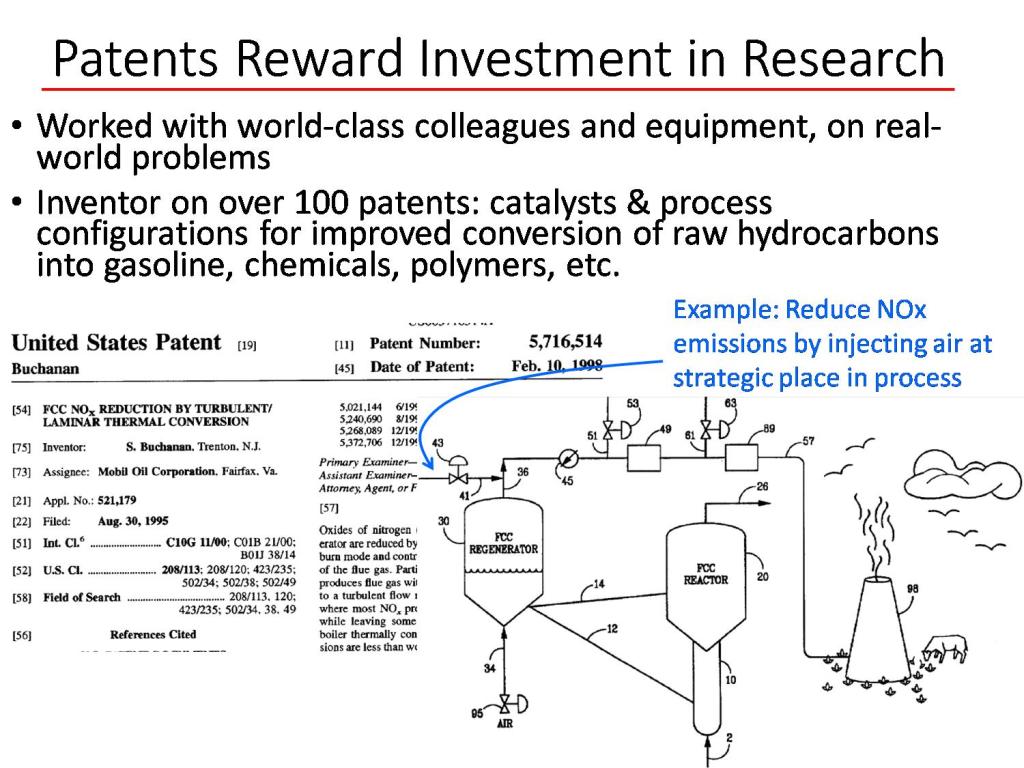
In my work in industrial research, I have been paid to develop technical improvements which could have economic value. A key incentive my company had for investing in this research was the expectation that if we came up with a novel improvement, that we could have exclusive rights to practice that improvement. There would have been little point in paying for research if our competitors could immediately make use of our hard-won insights. A snip of one of my patents is shown below.

For the world, and for most large groupings such as nations, the average income per capital is roughly equal to the average production per capita. The way to get more “stuff” (goods and services, and all their benefits) is to make more stuff. The way to make more stuff (per capita, and for fixed a workweek) is to make workers more productive. A key factor in productivity is technology. Two hundred years ago, nearly everyone in the U.S. had to be out in the sun and cold, working the soil, sowing by hand and plowing with the aid of animals, to grow enough food to feed everyone. Now I believe we are fed by only 2% of the workforce, using artificial fertilizers, improved seeds, huge tractors and combines, and satellite-aided computer scheduling. Most of the rest of us get to work in air-conditioned offices (or homes, in a pandemic year) and eat as much food as we want.

The patent system of the U.S. and other nations is designed to promote progress in productive technology. Early on, the newborn U.S. Congress passed the Patent Act of 1790, titled “An Act to promote the progress of useful Arts”.  Without getting into all the legal details, a valid U.S. patent allows the inventor to exclude any other party from practicing their invention, for a period of twenty years. However, one of the requirement for a patent application is to clearly explain to the public how the invention works. When the twenty years is over, anyone can take advantage of the technology which the inventor has disclosed, which hopefully leads to widespread practice of technical improvements. While we can always ponder improvements to our system of patents, readers can thank it in part for many medical advances, and for delivering them from trudging behind a plow.