How to Read Aloud Kindle and Other Text on iPhone, iPad, and Android

What if you could get your phone or tablet to read Kindle or other text aloud to you? I have recently come across an easy way to do this. This is an economics blog, so I will note that this approach saves considerable money versus paying for audio books like Audible, or paying for the Narration option on Kindle.  Most of us already have text books we have bought from e.g. Kindle. Also, if you search on the subject, there are various sources for free on-line books, including hundreds of thousands titles available through Libby/Overdrive via your public library. This text-to-voice method should work with all of these e-books.

Directions for iPhone/iPad: A short YouTube video “How to get your iPhone to read Kindle books aloud” by Kyle Oliver tells you all you need to know. The key step is to go to Settings, then Accessibility, then Spoken Content. At that screen, turn on Speak Screen. With Speak Screen ON, whenever you are on a page with text (including Kindle or other e-book), you swipe down from the top of the screen with two fingers. That will activate reading of that page of text. Also, a little speech control panel will appear. That panel will allow you to play/pause/jump forward and back. It will also allow you to  you toggle between multiple speeds: 1x, 1.5x, 2x, & 1/2x. 

If you want, while you are in the Spoken Content screen you can also turn on Speak Selection. That will give a Speech option to read aloud just whatever text that you have select, and then stop.

Also, on in the Spoken Content screen there is a Voices link, for selecting what voice you want to hear. You can experiment with various voices. I have found that the male Siri voice (“Siri voice 1”) is preferable. The female Siri is too syrupy sweet listen to for long, and most of the other voices are robotic. I find that if I select a new voice, I have to turn the reading off, then on again to get the new voice to start working. One more tip from that YouTube is to dim your screen, since with continuous reading of Kindle pages, the screen will stay on, and drain the battery quickly if the screen is bright.

Once you do the two-finger swipe down to commence reading, it should keep reading onto following pages as well. For unknown reasons that does not work sometimes. I find that using the jump forward then jump back buttons on the little speech control panel unsticks this functionality.

For Android: The YouTube How to Turn On Text To Speech Read Aloud on Android/Samsung – 2022 by ITJungles has comparable directions for Android. This involves installing the Android Accessibility Suite from the Play Store.  The 2020 video Text To Speech Options On Android – TalkBack, Select To Speak, Voice Assistant, Screen Reader by The Blind Life gives several different options for getting text read aloud on Android phones.

(In this blog post I originally referenced 2017 video Kindle Android Text to Speech . This got rave comments back when it was first put on YouTube, but more recent comments there suggest that Android may have changed so that this approach no longer works well).

There is a harder way to do all the above, which is to download a separate text-to-speech app like Speechify or Voice Dream Reader. These apps will read most text that is on your screen, but NOT Kindle or other e-books that have Digital Rights Management (DRM) protection. For these e-books, you’d have to download yet another app such as Epupor Ultimate on your computer, download your Kindle files onto your computer, then run Epupor on these files to create unprotected versions. Then, I suppose, load these files back onto your phone/tablet where the text-to-speech app can access them to read aloud. This does not seem worth it (compared to the simple method above using built-in iPhone/Android capabilities) unless you want to utilize some extra feature of the outside text-to-speech app.

Note: Under the subject of low cost text to speech, there are apps like Librivox or (using your local library) Overdrive or Libby that offer free audiobooks – see this article by LifeWire. Also, you can find audio versions (which probably violate copyright) of many popular and classic books on YouTube. If a book is already available as an audiobook, it is probably better to use that format for listening to it, rather than downloading it in text form and then using the approach here for listening.

New Fossil Discoveries Shed Light on When and How the Dinosaurs Died Out

For nearly 200 million years, reptiles were the dominant animals on land, in the air (e.g. pterodactyls), and in the sea (e.g. mosasaurs). They were efficient herbivores, munching on lush vegetation, and also were efficient carnivores (think: T. rex). They were protected by scaly skin and often horns or armor plates. Mammals at this point were typically small, rat-like creatures, hiding in their burrows from the reptiles, and creeping out at night to feed.

However, the Age of Reptiles came to a sudden end 66 million years ago. Dinosaurs and many other large reptiles disappeared, which gave opportunity for mammals to rapidly evolve and proliferate to fill many key ecological niches. What happened to all those reptiles? The leading hypothesis is that a huge meteorite impacted the earth near what is now the Yucatan peninsula of Mexico. The dust and aerosol cloud that was thrown into the atmosphere darkened the skies around the world enough to shut down photosynthesis long enough to starve the reptilian herbivores, which in turn starved the reptilian carnivores. Somehow enough mammals survived the event to repopulate the earth (my guess is they ate insects which ate dead dinosaurs).

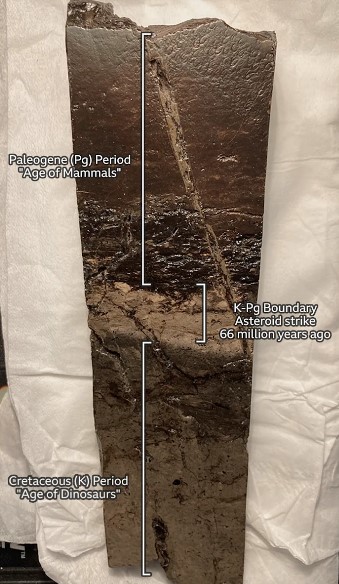
The impact blasted tons of molten rock droplets high in the air, which then fell as little glassy spheres or dust particles all over the world, and especially in North America. Where these “tektites” fell in undisturbed places like bogs, they accumulated as a distinct layer. Over time, these spheres decomposed into a clay layer which is distinguished by a high iridium content. Here is a cut-out section of rock which shows this meteorite-derived boundary layer between lower (older) rocks that contain dinosaurs and an overlying layer where dinosaurs are absent:

Rock section showing layers from the Cretaceous Period (when dinosaurs lived), overlaid by boundary layer material from the asteroid strike 66 million years ago, and then younger Paleogene rocks (no dinosaurs). Source: Phil Manning/Uni of Manchester, UK.

Exactly When and How Did the Dinosaurs Perish?

The picture is complicated by the fact that very few dinosaur fossils have been found in roughly three meters (ten feet) of sedimentary rocks immediately below the Ir-rich meteorite layer. This is known as the “three-meter problem”, and suggests that the dinosaurs had already largely died out from other causes; maybe the meteorite impact just finished them off. Shortly before the impact event, there was a massive series of volcanic eruptions in the Deccan Traps area of India which released enormous amounts of sulfur dioxide and other gasses in the atmosphere, which probably altered the climate. It has been proposed that this fatally stressed the dinosaur populations.

Recent finds from the “Tanis” fossil site in North Dakota have brought clarity to this question. Apparently when the meteorite hit in what is now Mexico, it created a forceful earthquake. When this tremor rolled up to North Dakota, it caused several large waves of water to surge upstream in a creek near the sea, which deposited layers of muddy clay on preexisting sandbars. This occurred several hours after the impact. Providentially, that was just when some of the small glassy spheres which were blasted into the atmosphere were raining down on North Dakota. Some of these spheres, and even their little impact depressions from smacking into the mud at terminal velocity, have been found in the layers of sediment deposited on the sandbars. So we know that whatever fossil remains we find in these sediments were entombed there on the very day the meteorite hit.

It turns out that numerous fossils of dinosaurs have been found in these Tanis mud layers, indicating that there was a thriving community of huge reptiles right up until the impact. These finds include a dinosaur hip/leg with exquisite details of skin preserved, and an egg with a partly-developed pterosaur embryo visible in it:

Ornithischian dinosaur hip/leg/skin from Tanis site.  Source: BBC

Fossilized egg with bones of pterosaur embryo in it. Source: Yahoo

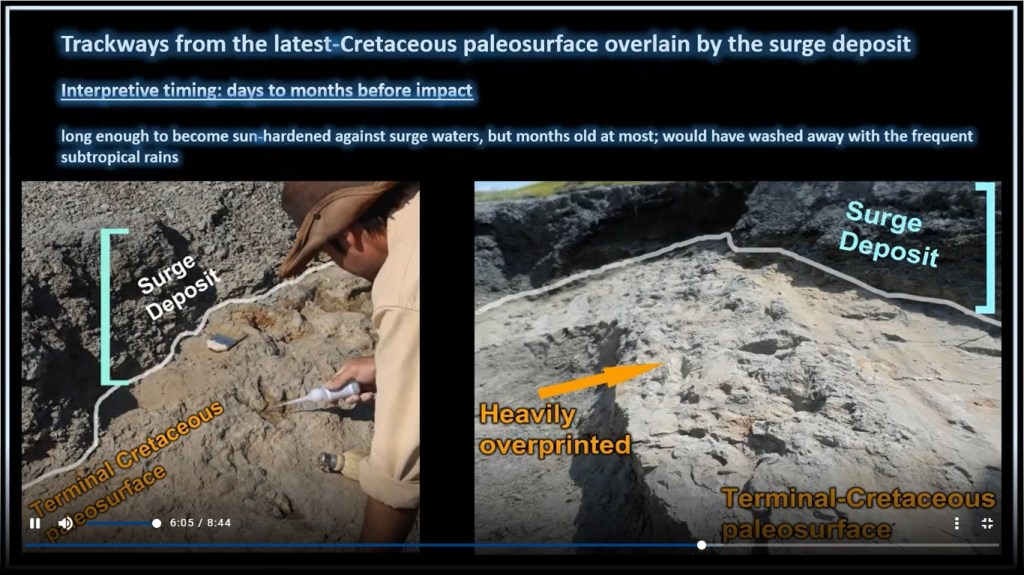
Also, immediately below the mud deposit layer have been found numerous dinosaur footprints, indicating the juvenile and adult dinosaurs from a variety of species were tramping around shortly before the impact event:

Source: Riley Wehr et al. paper at 2021 GSA Conference

Bottom line: it looks like we humans do owe our existence in large part to this one, seemingly random meteorite impact which cleaned out the dominant reptiles and made room for mammals.

The Congress That Berated Oil Companies for Producing Oil Is Now Berating Them for Not Producing Oil

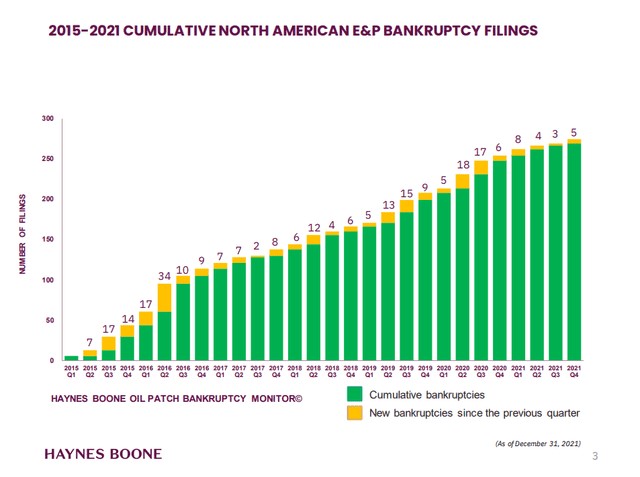
Oil production is a difficult, risky business even under favorable regulatory regimes.  For instance, here is a chart of cumulative bankruptcy filings of exploration and production (E&P) companies for 2015-2021:

A few companies go bust every year, but there are some years like 2015-2016 and 2019-2020 when a lot of companies go bust. That happens when the oil industry collectively has overproduced and driven the price of oil below the effective cost of production. Even the mighty ExxonMobil ran deep in the red in 2020, losing an eye-watering 22.4 billion dollars. With all that in mind, shareholders since 2020 have been pressuring companies to show “financial discipline”, which means “drill less”.

Beyond these basic business realities, there is a whole new set of pressures to inhibit petroleum production. Environmental activists have pushed banks to withhold funding from petroleum companies, to strangle further oil production. It was big news in 2020 when activists, alarmed by ExxonMobil’s plans to actually (gasp) increase its oil production, successfully elected several alternative members to the board of directors with the specific goal of curtailing further drilling.

There have been attacks on the oil industry on the political front, as well. Joe Biden ran on a platform of banning drilling on public lands, and one item he checked off his to-do list on his first day in office was to issue an executive order killing a pipeline that would have facilitated imports of oil from the abundant reserves in Canada. One of his nominees for a top financial regulatory post remarked regarding oil producers that “we want them to go bankrupt if we want to tackle climate change”. All these are the sorts of things that make execs less willing to commit capital for expensive drilling programs that may take years to pay back. (The counter-claim by the administration that the U.S. oil industry is just sitting on thousands of unused oil leases is a red herring).

There is only a finite amount of oil in the ground, so it makes sense to move with all deliberate speed toward renewable and nuclear energy (which emits little or no CO2). However, our European friends who have installed lots of solar panels and windmills have discovered  that the sun does not shine at night (!) and the wind does not always blow strongly (!!) , and so during their energy transition they need to maintain an adequate supply of fossil fuel power in order to keep the lights on. They elected to let their own oil and gas production dwindle, and rely instead on gas and oil purchased from Russia. We warned back in September that this European policy would give Russia leverage for harassing Ukraine, but apparently not enough EU leaders read this blog. Anyway, even back in the fall of 2021, Russia had restricted natural gas deliveries to Europe, causing sky-high prices there for gas and power.

The European experience ought to have been a cautionary tale for America, but political attacks on oil production continued in the halls of Congress itself. In an October 2021 hearing over climate change prevention, Carolyn Maloney (D-NY) and Ro Khanna (D-CA) insisted that Big Oil commit to reducing US oil and gas production by 3-4% annually (50-70% total by 2050). In a follow-up February 8, 2022 hearing,  the two legislators again demanded concrete commitments from oil companies to reduce their domestic production (although, strangely, Mr. Khanna supported President Biden’s call for other regions, such as OPEC and Russia to increase production).

With oil drilling having been curtailed for the past several years (as desired by environmentalists), the world has now flopped from an oil surplus to an oil shortage, exacerbated by Russia’s invasion of Ukraine and subsequent sanctions. And of course world oil prices (which are not under the control of U.S. companies) have gone up in response. Oil companies are actually making money again instead of going bankrupt like two years ago

In 2021 Apple had a 26% net profit margin and an effective tax rate of only 13%, while the oil industry had an average profit margin of 8.9% and an effective tax rate of 26.9%.   Yet Congress (mainly Democrats) “investigates” price gouging every time gas prices go up, without hauling in Tim Cook to grill him over the price of each new iPhone model. Repeated previous investigations have shown that domestic gasoline prices are mainly a function of world oil prices, which are not under the control of U.S. companies. Nevertheless, after berating oil execs for increasing oil production,  here come the grandstanding Congressional attack dogs, holding a hearing last week titled (wait for it…) “Gouged at the Gas Station: Big Oil and America’s Pain at the Pump”.

The oil producers patiently explained that “We do not control the price of crude oil or natural gas, nor of refined products like gasoline and diesel fuel,” and “”It [the U.S. oil industry] is experiencing severe cost inflation, a labor shortage due to three downturns in 12 years, shortages of drilling rigs, frack fleets, frack sand, steel pipe, and other equipment and materials.” But it is not clear that anyone was listening to the facts.

The Different Classes of Crypto Stablecoins and Why It Matters

Last month the Biden administration issued an executive order outlining some priorities and aspirational goals regarding government initiatives and future regulations regarding cryptocurrencies.
These goals may be summarized as:

1.         Protect Investors in the Crypto Space

2.         Mitigate Systemic Risks from Innovations

3.         Provide Equitable Access to Affordable Financial Services

4.         Ensure Responsible Development of Digital Assets

5.         Limit Illicit Use of Digital Assets

6.         Research Design Options of a U.S. Central Bank Digital Currency (CBDC)

7.         Promote U.S. Leadership in Technology


These positions seem generally reasonable and moderate, and were welcomed by the cryptocurrency community, which had feared a more restrictive stance. (China, for instance, has banned cryptocurrency use altogether).

Why Fear Stablecoins?

Here I’d like to focus on #2, “Mitigate Systemic Risks from Innovations”. Although so-called stablecoins are not explicitly mentioned in the executive order, it is understood that they represent a key area of concern for regulators.

A stablecoin typically has its value pegged 1:1 to a leading national or international currency such as the U.S. dollar or the euro, or to some commodity like gold, or even to other cryptocurrencies. In practice, most of them have generally held pretty well to their pegs. So what’s not to like about them? Why would they be perceived as more of a threat that, say, bitcoin, whose dollar value is all over the map?

I think the reason is that market participants count on them maintaining their (say) dollar peg. These coins are used as dollar substitutes in billions of dollars’ worth of transactions and are depended on to hold their value.The total value of stablecoins in use is nearly $200 billion and is growing fast.  If a major stablecoin crashed somehow, it could lead to significant instability, which regulators don’t like.

Four Major Types of Stablecoins

Stablecoins may be classified according to how their “tether” is maintained:

( 1 ) Pegged to fiat currency, maintained by a central stablecoin issuer

The biggest U.S.-based stablecoin is USD Coin (USDC), which is backed by significant financial institutions. There is every reason to believe that there is in fact a dollar backing each USDC. Gemini Dollar (GUSD) is smaller, but also takes great pains to garner trust. Its issuer, Gemini, operates under the regulatory oversight of the New York State Department of Financial Services (NYDFS). It boasts, “The Gemini Dollar is fully backed at a one-to-one ratio with the U.S. dollar. The number of Gemini dollar tokens in circulation is equal to the number of U.S. dollars held at a bank in the United States, and the system is insured with pass-through FDIC deposit insurance as a preventative measure against money laundering, theft, and other illicit activities.”

So far, so good. The huge stinking elephant in the room here is a stablecoin called Tether. Tether is the largest stablecoin by market capitalization (at $79 billion), and is heavily used as a dollar substitute, mainly in Asia. It has been widely criticized as a shady, unaudited operation, operating from shifting off-shore locations to avoid regulation (and prosecution). There are justified doubts as to whether the claimed 1:1 dollar backing for Tether is really there. Tether sort-of disclosed its backing reserves in the form of a sparse pie-chart. Very little was in the form of cash or even “fiduciary deposits”. Some was in the form of “loans” to who-knows-what counterparties. The majority of their holdings were “commercial paper”; but nobody can find any trace of Tether-related commercial paper in the whole rest of the financial universe (it has become a sort of game for financial journalists to try to the be first one to actually locate any legitimate Tether assets).

So, Tether by itself may justify concern on the part of regulators. Also, without diving too deeply into it, a plethora of financial institutions and tech companies are starting to issue their own stablecoins, which again are purported to be as good as cash, and so are vulnerable to abuse.

( 2 )  Stablecoins backed by commodities

Tether Gold (XAUT) and Paxos Gold (PAXG) are two of the most liquid gold-backed stablecoins. Other coins are tied to things like oil or real estate. The holder of these coins is depending the  coins issuer to actually have the claimed backing.

( 3 )  Cryptocurrency Collateral (On-Chain)

It is hard to explain in a few words how this type of coin works.  A key point here is that your stablecoins are backed by other, leading cryptocurrecies (such as Ethereum), with the process all happening on the decentralized blockchainvia smart contracts. A leading coin here is DAI, an algorithmic stablecoin issued by MakerDAO, that seeks to maintain a ratio of one-to-one with the U.S. dollar. It is primarily used as a means of lending and borrowing crypto assets without the need for an intermediary — creating a permissionless system with transparency and minimal restrictions.

Unlike with the two types of stablecoins discussed above, you are not dependent on the honesty of some central issuer of the stablecoin. On the other hand, Wikipedia notes:

The technical implementation of this type of stablecoins is more complex and varied than that of the fiat-collateralized kind which introduces a greater risks of exploits due to bugs in the smart contract code. With the tethering done on-chain, it is not subject to third-party regulation creating a decentralized solution. The potentially problematic aspect of this type of stablecoins is the change in value of the collateral and the reliance on supplementary instruments. The complexity and non-direct backing of the stablecoin may deter usage, as it may be difficult to comprehend how the price is actually ensured. Due to the nature of the highly volatile and convergent cryptocurrency market, a very large collateral must also be maintained to ensure the stability.

( 4 ) Non-Collateralized Algorithmic Stablecoins

The price stability of such a coin results from the use of specialized algorithms and smart contracts that manage the supply of tokens in circulation,  similar to a central bank’s approach to printing and destroying currency. These are a less popular form of stablecoin. The algorithmic coin FEI proved unstable upon launch, although it has since achieved an approximate parity with the dollar.

Some takeaways:

Stablecoins are a big and fast-growing piece of practical finance.

These coins bring a different kind of risk, because (unlike Bitcoin or Ethereum), users depend on them holding a certain value.

For the coins backed by major fiat currencies or commodities,  risk is introduced by the need to depend on the honesty and competence of the centralized coin issuers.

For the non-centralized stablecoins like DAI and FEI, there are risks associated with proper automatic functioning of their protocols.


One can understand, therefore, the urge of the federal government to impose regulations in this area. That said, it does not seem to me that the existing system is broken such that the feds need to come in to fix it in a major way. The main shady actor in all this is Tether, which everyone knows to be shady, so caveat emptor (and the vast majority of Tether transactions occur outside the West, in the East Asian shadowlands).

How Overzealous Green Policies Force Europe to Bankroll Putin’s Military

There is a difference between healthy zeal for a basically good cause like reducing CO2 emissions, and unbalanced myopia. Back in September I wrote about the European power debacle (skyrocketing gas and electricity prices):

Shut down your old reliable coal and nuclear power plants. Replace them with wind turbines. Count on natural gas fueled power plants to fill in when the breeze stops blowing. Curtail drilling for your own natural gas, and so become dependent on gas supplied by pipeline from Russia or by tankers chugging thousands of miles from the Middle East. What could possibly go wrong?

Well, now we know what can go wrong.

In January I noted more specifically, “This energy shortage also makes Europe very vulnerable to Russia, at a time when Putin is menacing Ukraine with invasion.” Now it has come to pass. All the huffing and puffing about economic sanctions on Russia is mainly just hot air. Because Europe is utterly dependent on Russian gas, massive “carve-outs” have been made in sanctions in order to continue these purchases to continue. The vaunted SWIFT restrictions on Russian banks have been carved down to practical irrelevance. While sanctions may impact the lifestyles of oligarch playboys, this flow of euros to Russia ensures that Putin will not run short of money for his war.

Ecomodernist Michael Shellenberger writes that behind the Ukraine military drama “is a story about material reality and basic economics—two things that Putin seems to understand far better than his counterparts in the free world and especially in Europe.” Shellenberger asks, “How is it possible that European countries, Germany especially, allowed themselves to become so dependent on an authoritarian country over the 30 years since the end of the Cold War?” and then answers this question in his trademark style:

Here’s how: These countries are in the grips of a delusional ideology that makes them incapable of understanding the hard realities of energy production. Green ideology insists we don’t need nuclear and that we don’t need fracking. It insists that it’s just a matter of will and money to switch to all-renewables—and fast. It insists that we need “degrowth” of the economy, and that we face looming human “extinction.” (I would know. I myself was once a true believer.)

… While Putin expanded Russia’s oil production, expanded natural gas production, and then doubled nuclear energy production to allow more exports of its precious gas, Europe, led by Germany, shut down its nuclear power plants, closed gas fields, and refused to develop more through advanced methods like fracking.

The numbers tell the story best. In 2016, 30 percent of the natural gas consumed by the European Union came from Russia. In 2018, that figure jumped to 40 percent. By 2020, it was nearly 44 percent, and by early 2021, it was nearly 47 percent.

…The result has been the worst global energy crisis since 1973, driving prices for electricity and gasoline higher around the world. It is a crisis, fundamentally, of inadequate supply. But the scarcity is entirely manufactured.

Europeans—led by figures like Greta Thunberg and European Green Party leaders, and supported by Americans like John Kerry—believed that a healthy relationship with the Earth requires making energy scarce. By turning to renewables, they would show the world how to live without harming the planet. But this was a pipe dream. You can’t power a whole grid with solar and wind, because the sun and the wind are inconstant, and currently existing batteries aren’t even cheap enough to store large quantities of electricity overnight, much less across whole seasons.

In service to green ideology, they made the perfect the enemy of the good—and of Ukraine.

There we have it.  It’s not just the Europeans. As I write this, shells are raining down on Ukrainian cities but the U.S. is not restricting its imports of Russian oil, lest our price of oil go even higher. The present oil shortage (even before the Ukraine invasion) is what happens when a president on his first day in office signs an executive order to cancel a pipeline expansion which would have enabled increased oil production from Canada’s massive oil sands, and the whole ESG movement hates on investing in projects for producing oil or gas.

All that said, what the West gives with one hand it may take back with the other. Although energy exports from Russia are theoretically permitted, Western private enterprises, including finance arms, are pulling back from any dealings with Russia. This means in practice, lots of wrenches are being thrown into the machinery of international finance, such that energy exports from Russia are being slowed, though not stopped. But in turn, the Russians are getting higher prices per barrel for the oil that does get exported. There are many moving parts to all this, so we will see how it all shakes out.

How to Set Working Directory in R for Replication Packages

The AEA Data Editor kicked it all off with this tweet:

“Please stop using “cd” (in Stata) or “setwd()” (in R) all over the place. Once (maybe, not really), that’s enough.”

Replies proliferated on #EconTwitter this week. In this blog post I am collecting solutions for R.   These days you might share the code used to generate your results for an empirical paper. That code would ideally be easy for other people to run on their own computers. File paths are hard (as I blogged previously).

A project for a single paper might have multiple code files. The code interacts with data stored somewhere. Part of the task of the code is to point the statistical program to the data set. It is frustrating if an outsider is trying to replicate a result and must alter the code in multiple places to point to their own location of the data.

Here is a concise summary of good practice, for any code language: “cd and setwd() specify the directory. When you share code and run on a different computer, they don’t work. Therefore, good practice to only specify once, at the beginning”

Continue reading

Half of Deliberately Exposed Unvaccinated Volunteers in UK Study Did Not Get COVID; Why?

A British study by Ben Killingley and 31 co-authors recently appeared in pre-print form, where 36 (heroic) healthy young adult volunteers were deliberately exposed to the Covid virus by nasal drops. These volunteers then went into quarantine for 14 days, and logged their symptoms and were subjected to various tests for a total of 28 days.


Of the 36 subjects, only 18 (53%) became infected with the virus, as determined by PCR testing (the gold standard for Covid tests) and by direct counting of viral loads in mucus cells by FFA.

The study found that viral shedding (as estimated by mucus viral loads) begins within two days of exposure and rapidly reaches high levels, then declines. Viable virus is still detectible up to 12 days post-inoculation. This result supports the practice of people quarantining for at least 10 days after they first exhibit symptoms of infection. There were significant higher viral loads in the nose than in the throat,  which supports the practice of wearing masks that cover the nose as well as the mouth.


The cheap, fast, LFA rapid antigen test method (used in home tests) performed fairly well. Because it is less sensitive, it did not it did not yield positive results for infected individuals until an average of four days after infection, or about two days after viral shedding may have begun. But from four days onward, the LFA method was sensitive and reasonably accurate which supports the ongoing use of these quick, cheap tests.

These direct inclusions from the paper are helpful, but not earthshaking. The elephant in the room, which the paper did not seem to directly address, is why nearly half of the people who were exposed did NOT become infected. This raises all kinds of issues about what mechanisms the human body may have to naturally fight off COVID or similar viral infections. Gaining insight on this could lead to breakthroughs in preventing or mitigating this pernicious virus.

An article by Eileen O’Reilly at Axios probes these questions. There is nothing conclusive out there, but four ideas that are under investigation are:

1. Cross-immunity from the four endemic human coronaviruses is one hypothesis. Those other coronaviruses cause many of the colds people catch and could prime B-cell and T-cell response to this new coronavirus in some people.

2. Multiple genetic variations may make someone’s immune system more or less susceptible to the virus.  Some 20 different genes have been identified which affect the likelihood of severe infection, and a genetic predisposition to not getting infected is seen in other diseases where people have one or multiple factors that interfere with the virus binding to cells or being transported within.

3. Mucosal immunity may play an underrecognized role in mounting a defense.

This suggests nasal vaccines might have a chance at stopping a virus before it invades the whole body.

4. Where the virus settled on the human body, how large the particle was, the amount and length of exposure, how good the ventilation was and other environmental circumstances may also play a role.

These considerations support continuing with the usual recommendations of social distancing, wearing facemasks, and ventilating buildings, especially when caseloads are peaking. Also, the doses administered to the volunteers in the study were considered quite small by clinical standards. It was surprising that such a low dose was effective as it was in causing full-blown infections; and the particular strain used in the experiment was not necessarily one of the more recent highly virulent variants. After reading these results,  it is more understandable to me why so many reasonably careful friends and family members of mine (nearly all vaccinated, fortunately) have come down with (presumably) omicron COVID in the past two months. Just a little dab will do ya.

“Pfumvudza” Planting Technique Revolutionizes Crop Yields in Zimbabwe

Birth of a New Farming Method

Brian Oldreive is a Zimbabwean, born there in 1943. A star cricket player as a young man, he moved on to become a successful tobacco farmer. In 1978, he became convinced (given the harm that tobacco causes) that he should no longer grow tobacco. When he tried to switch to food crops like corn (called maize in Africa), using standard agricultural practices, he could not make a go of it. He ended up losing his farm and his livelihood due to his moral stand against growing tobacco. He went to work for another large farm, but even there it was a struggle to grow food at a profit. Soil was eroding and crop yields were falling.

He began to think that maybe there was a better way to farm than the usual Western model. One day in 1984 when he was walking in the forest, he noticed that the trees and bushes there grew just fine, with no help from humans, no plowing or irrigation. How was that possible? He observed two things. First, the ground was covered with a thick layer of leaves and other debris, which formed a natural mulch. Beneath this mulch layer (“God’s blanket”), the soil was moist. This was while the region was experiencing drought, and regular farmers’ fields were parched. Secondly, the undisturbed mulch layer naturally decayed to return nutrients to the soil.

Oldreive parlayed those observations into a system of no-till agriculture which mimics the created order. He called this “Farming God’s Way”. The emphasis is on high productivity from a small plot. This involves precision planting at the proper time, crop rotation (corn/beans), and deep mulching to retain moisture and keep weeds down. Nutrients are supplied by both compost and chemical fertilizers.

This method can be practiced by farmers owning no tool other than a hoe. This breaks the cycle of farmers or nations going into debt to purchase expensive Western agricultural machinery, which then may become useless due to inadequate maintenance out in the bush.    

This approach contrasts with conventional farming practice which plows up the soil, leaving it to erode away when it rains and to dry out when it doesn’t rain. Plowing also disturbs the natural ordering of the microbial communities within the upper and lower soil layers. (There is aerobic metabolism near the surface, and a whole different anaerobic community in the soil lower down).

Oldreive started by planting one small plot using this approach in the estate he was then managing:

I decided to copy what God does in natural creation and I observed that the leaves fall down on the ground and the grass dies down and there is a protective blanket over the earth, and that is how God preserves soil to infiltrate the water that we receive…

Many people did not believe me and said I was wasting time. But I was not deterred because I was convinced that this method would work. I decided to put the model into practice by starting with just two hectares. I prayed for wisdom and God showed me how to plant maize into wheat straw residue. This is just the same as what God does in nature.

That two-hectare (about 5 acre) plot confounded the skeptics, yielding about ten times more corn per hectare than the local average yields. He then planted more acreage using this approach. Over the next few years, while a number of conventionally-run farms around him went broke, he kept expanding and growing more food with his system.

Oldreive believed these insights were gifts from God which were meant to be shared with others. Therefore, he shifted his effort towards teaching other Africans how to farm with this method.

Things Fall Apart in Zimbabwe

Continue reading

Optimal Policy & Technological Contingency

A person’s optimal choice depends on what they know. To consume more ice cream? Or to consume more alcohol? It depends on what we know about the expected utility across time. If a person thinks that alcohol has few calories, then it is understandable that they would choose to drink rather than eat. The person might be totally wrong, but they are acting optimally contingent on their knowledge about the world. (FWIW, 4oz of ethanol has 262 calories and 4oz of typical ice cream has 228 calories.)

The case is analogous for good government policy. The best policy is contingent on accessing the distribution of knowledge that’s inside of multiple people’s heads. It’s not sensible to assert that a policy is suboptimal if the optimal policy requires knowledge that neither a single individual nor all people together have. Even if the sum of all knowledge does exist, it may not be possible to access it.

Economists like to tell their undergraduate classes that it doesn’t matter who you tax. But that’s contingent on 1) identical compliance costs among buyers and sellers and 2) identical relevant information. If a tax comes as a surprise to the buyer or the seller, then it absolutely matters who is taxed.

When I was in 1st grade in North Carolina, my class went on a field trip to a Christmas tree farm. We learned a bunch about maintaining the farm and we got to choose a pumpkin to take home. At the end of our visit we took turns perusing the gift shop. My mother had generously given me a dollar to spend  and I was eager to spend it (I rarely had money to spend). Unfortunately, even in the early mid-90s, most of the things in the shop cost more than $1. So, I settled on purchasing some beef jerky that cost 99 cents.

Continue reading

The Return of Independent Research

Universities have been around for about a thousand years, but for much of that time it was typical for cutting-edge research to happen outside of them. Copernicus wasn’t a professor, Darwin wasn’t a professor. Others like Isaac Newton, Robert Hooke, and Albert Einstein became professors only after completing some of their best work. Scientists didn’t need the resources of a university, they simply needed a means of support that gave them enough time to think. Many were independently wealthy (Robert Boyle, Antoine Lavoisier) or supported by the church (Gregor Mendel). Some worked “real jobs”, David Ricardo as a banker, Einstein famously as a patent clerk.

Over time academia grew and an increasing share of research was done by professors, with most of the rest happening inside the few non-academic institutions that paid people to do full time research: national labs, government agencies, and a few companies like Xerox Parc, Bell Labs and 3M. In many fields research came to require expensive equipment that was only available in the best-funded labs. “Researcher” became a job, and research conducted by those without that job became viewed with suspicion over the 20th century.

But the Internet Age is leading to the growth in opportunities outside academia, opportunities not just economic but intellectual. Anyone with a laptop and internet can access most of the key tools that professors use, often for free- scientific articles, seminars, supercomputers, data, data analysis. Particularly outside of the lab sciences, the only remaining barrier to independent research is again what it was before the 20th century- finding a means of support that gives you time to think. This will never be easy, but becoming a professor isn’t either, and a growing number of people are either becoming independently wealthy, able to support themselves with fewer work hours (even vs academics), or finding jobs that encourage part time research. If you work for the right company you might even get better data than the academics have.

Particularly in artificial intelligence and machine learning, the frontier seems to be outside academia, with many of the best professors getting offers from industry they can’t refuse.

Even in the lab sciences, money is increasingly pouring in for those who want to leave academia to run a start-up instead:

I think it’s great for science that these new opportunities are opening up. A natural advantage of independent research is that it allows people to work on topics or use methods they couldn’t in academia because they are seen as too high risk, too out there, make too many enemies, or otherwise fall into an academic “blind spot“.

I’m still happy to be in academia, and independent research clearly has its challenges too. But over my lifetime it seems like we have shifted from academia being the obvious best place to do research, to academia being one of several good options. Even as research has begun to move elsewhere though, universities still seem to be doing well at their original purpose of teaching students. Almost all of the people I’ve highlighted as great independent researchers were still trained at universities; most of the modern ones I linked to even have PhDs. There are always exceptions and the internet could still change this, but for now universities retain a near-monopoly on training good researchers even as the employment of good researchers becomes competitive.

As an academic I may not be the right person to write about all this, so I’ll leave you with the suggestion to listen to this podcast where Spencer Greenberg and Andy Matuschak discuss their world of “para-academic research”. Spencer is a great example of everything I’ve said- an Applied Math PhD who makes money in private sector finance/tech but has the time to publish great research, partly in math/CS where a university lab is unnecessary, but more interestingly in psychology where being a professor would actually slow him down- independent researchers don’t need to wait weeks for permission from an institutional review board every time they want to run a survey.