How Ceramic Pans Work and How to Restore Their Non-Stick Coating

I really don’t like the time and effort wasted in cleaning crudded-up frying pans, so I appreciate non-stick coatings. I have a small diameter Gotham ceramic pan that works well, and I was thinking of getting a larger one for cooking bigger loads. As usual, I went to the internet for wisdom on preferred ceramic pans to buy.

However, in the course of trying to get a fix on how they work, I fell down a rabbit hole. It turns out that this subject is complex and controversial. I will try to summarize my understanding in a brief post, with the caveat that I am not sure of everything here.

First of all, the “ceramic” coating is not really ceramic. Typical ceramics are made from firing powders of inorganic materials like silicon/aluminum oxides (including clays) at extremely high temperatures to where the particles fuse together. For the ceramic coatings on pans, this is not the case. I looked pretty hard on line without success to pin down the actual process or composition of the pan coating. It seems to involve some sort of silicone or silica polymer, applied using a sol-gel process. (Silica is just silicon and oxygen – quartz and white sand are pure silica – while silicone is typically a Si-O-Si-O-Si polymer with two extra hydrocarbon side groups attached to each Si).

100% silicone, in the form of rubbery sheets or cupcake papers for cooking on or in, is known to give a non-stick cooking surface. The “ceramic” coating in pans appears to be a solid equivalent of silicone cookware. A key factor mentioned in why it is slick and why it loses its slickness is that (supposedly) a thin layer of silica or silicone comes off with each cooking episode, and that thin layer is what gives the non-stick effect. (I would not mind ingesting a little adventitious silica, but eating random silicone worries me a little – but I don’t know if all this is actually true).

See this link for further discussion of the safety of ceramic versus teflon coatings. Be aware that makers of teflon coatings often choose names for their coatings that include the words “stone” or “granite”, perhaps to make the unwary consumer believe that these are ceramic coatings. My teflon pans have usually started to flake (into my food!) after a couple years’ use. A happy exception is a newer electric skillet which has temperature control so it never gets above about 425 F (high temperature destroys teflon). We do keep it oiled in use. Its teflon coating is still good as new after two years.

There seems to be general agreement that ceramic pans start off super slick, that fried eggs slide right out, but that after some months of use, food starts sticking noticeably. It helps to use a little oil every time you cook, and to avoid using metal utensils or abrasive cleaning pads, and to avoid very high temperatures or the use of cooking sprays (which deposit something harmful to the ceramic coating) or olive oil (which can burn on). Some users say it is important to clean the pan well between uses, e.g., using salt as a mild abrasive.

Why Do Ceramic Pans Lose Their Non-Stickiness?

There seem to be two main schools of thought as to the deterioration of performance. One school points to the (alleged) continual loss of silica particles or (presumably oily) silicone from the surface; perhaps once this surface layer is depleted, it’s game over. Another camp points to the buildup of burned-on deposits, even very thin, nearly invisible deposits, that then become a locus of food sticking.

What Can Be Done to Restore a Ceramic Pan Coating?

It is common to read that you just have to be prepared throw the pan away every 1-2 years. However, this does not seem economical. Can these pans be salvaged?  One author claims that slickness can be restored by “seasoning” a ceramic pan, similar to how cast-iron pans are treated: after cleaning the pan, rub a very thin layer of a recommended oil (e.g. soybean oil, not olive oil) on the pan and then heat it to the smoke point. This should bond a polymerized oil layer to the surface. I have not tried this, but it might be worth a try.

A diametrically opposite approach is recommended by the maker of GreenPan ceramic pans. Here the theory is that if an offending film of cooked-on crud is removed, the native, clean ceramic layer beneath will once again be non-stick. A wet Magic Eraser type cleaning pad is recommended.

A similar remedy touted on the internet (e.g. here and here) is to rub with coarse salt (for long time, but not too hard) to get down to a pristine ceramic surface. Good results are claimed.

As a (retired) experimental scientist, I was itching to try something like this. At a family member’s house, I found an older ceramic pan that was not in really bad shape, but had lost its primal non-stick.
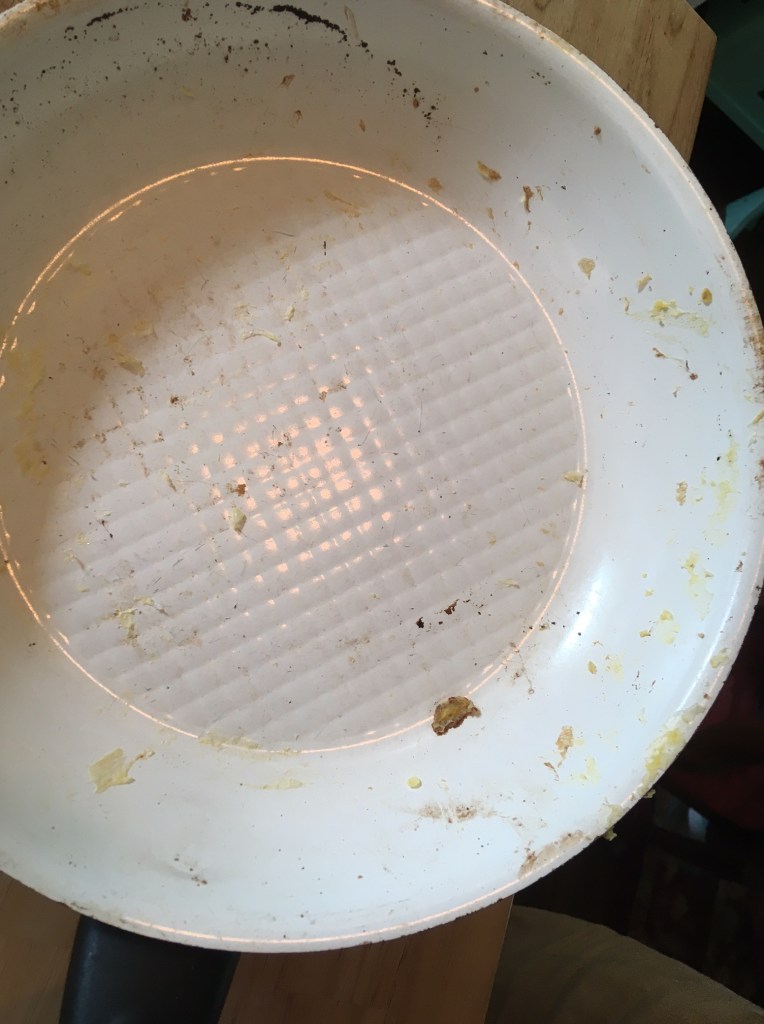
The BEFORE picture is above. There was a persistent brown film in parts of the pan, and cooked omelets (my test vehicle) did not simply slide out. I cleaned the pan with soap and water and a sponge, then went at it with a wetted Magic Eraser. I got the brown film off, though you could still see some pitting in the coating due to the use of metal utensils.

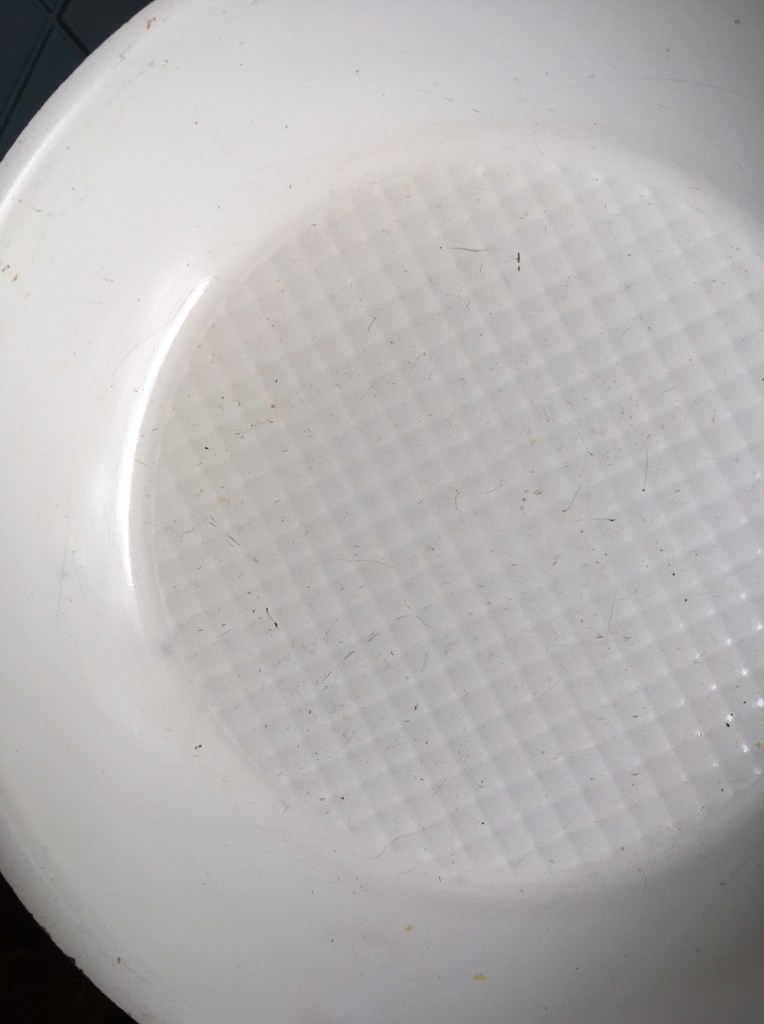
The AFTER picture is below. This is after cooking yet another omelet (with oil), and just wiping the pan with paper towel afterward. I can’t say that it was a night and day difference, but the Magic Eraser treatment definitely seemed to improve the performance. Score one for sustainability.
APPENDIX:  Finally Understanding What Make Ceramic Pan Coatings Non-Stick

As noted in the original article above, I was puzzled over how the ceramic coatings worked. The descriptions in articles I could find on-line talked of forming these coatings from sol-gel solutions, using ingredients such as tetraethoxysilane. Without going into details, my chemical intuition led me to believe that, yes, you could form a dense silica pan coating from that, but the final outer surface would have Si-OH groups, like quartz or glass or ordinary “enamel” ceramic pan coatings. This would not give the oily, silicone-like surface that is evident with the nonstick ceramic pan coatings.

My “Aha” moment came when examining a patent application ( United States Patent Application No. 20180170815) for making a GreenPan ceramic pan coating. Among the ingredients for making the coating is methyltrimethoxysilane (MTMS).  And THAT should give Si-CH3 groups on the outer surface, which is exactly the type of oil-like outer surface that silicone has.  (The -CH3 methyl group is a fairly nonpolar, “oily” hydrocarbon type group).

A restless itch has now been scratched. I think I now understand why fresh ceramic pan coating can have such fine non-stick properties, and perhaps why they might be vulnerable to losing their non-stick properties. With Teflon type pan coatings, it is plasticky, oily Teflon all the way down, so if you abrade off a hundred molecular layers, it should make no difference. But with the ceramic coatings, it is not clear to me whether the oily Si-CH3 groups are only in the topmost atomic layer; maybe if that gets abraded off, there is only the quartz-like Si-OH groups to be found; or maybe there is a substantial (in atomic terms) topmost layer rich in Si-CH3 groups. Anyway, it makes sense to keep using oil when cooking on ceramic pans, to keep a hydrocarbon-type surface coating going there, and to avoid using metal utensils that can scrape and scratch the coating.

Sep 2026 Update:

For readers here, I figured I should harness the power of AI, so I asked Claude about restoring ceramic pan coatings. Some takeaways, which basically agree with the above:

For cleaning deposits off the pan, as an alternative or supplement to Magic Eraser, try : Simmer a mix of water + a few tablespoons of baking soda in the pan for 8–10 minutes, then let cool and wipe out. For stubborn buildup, a paste of baking soda + a little water…left on for 15–20 minutes, then scrubbed gently with a soft sponge (never steel wool or abrasive scrubbers — that’s what actually damages ceramic).

After cleaning, re-season lightly: wipe a thin layer of a high-smoke-point oil (avocado, grapeseed) over the warm, dry pan and heat it for a few minutes, then wipe off the excess. This won’t rebuild the ceramic, but it restores some slickness by filling in micro-pores.

Prevention going forward: avoid metal utensils, avoid high heat above medium (ceramic coatings degrade faster than PTFE at high temps), hand-wash rather than dishwasher, and avoid cooking sprays with lecithin (like Pam), which leave a residue that’s notoriously hard to remove and accelerates the buildup that looks like “degradation.”
New Paper with Evidence that ChatGPT Hallucinates Nonexistent Citations

I posted a new working paper with systematic evidence for false citations when ChatGPT (GPT-3.5) writes about academic literature.

Buchanan, Joy and Shapoval, Olga, GPT-3.5 Hallucinates Nonexistent Citations: Evidence from Economics (June 3, 2023). Available at SSRN: https://ssrn.com/abstract=4467968 or http://dx.doi.org/10.2139/ssrn.4467968

Abstract: We create a set of prompts from every Journal of Economic Literature (JEL) topic to test the ability of a GPT-3.5 large language model (LLM) to write about economic concepts. For general summaries, ChatGPT can perform well. However, more than 30% of the citations suggested by ChatGPT do not exist. Furthermore, we demonstrate that the ability of the LLM to deliver accurate information declines as the question becomes more specific. This paper provides evidence that, although GPT has become a useful input to research production, fact-checking the output remains important.

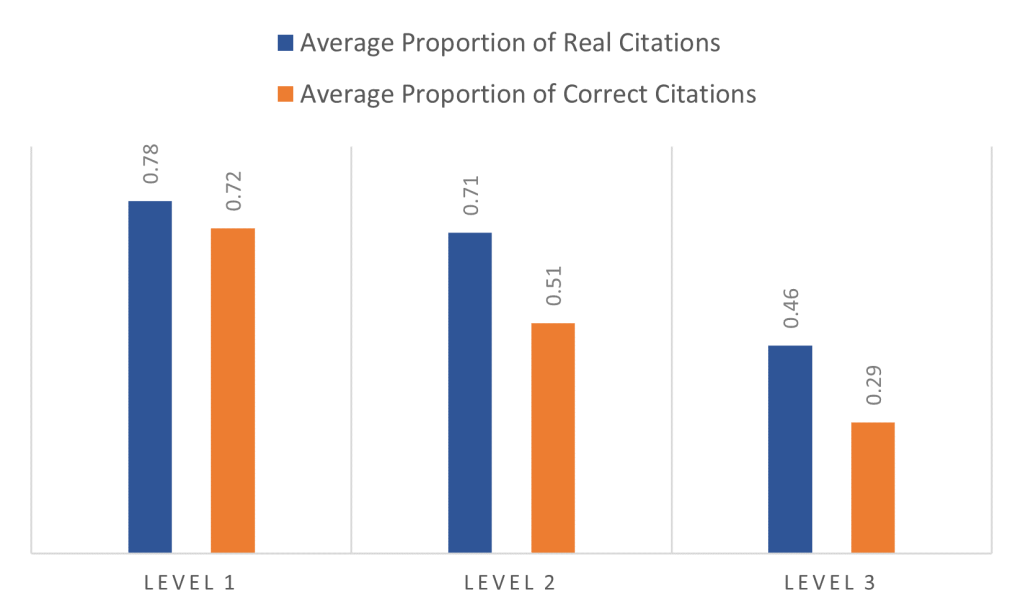
Figure 2 in the paper shows the trend that the proportion of real citations goes down as the prompt becomes more specific. This idea has been noticed by other people, but I don’t think it has been documented quantitatively before.

We asked ChatGPT to cover a wide range of topics within economics. For every JEL category, we constructed three prompts with increasing specificity.

Level 1: The first prompt, using A here as an example, was “Please provide a summary of work in JEL category A, in less than 10 sentences, and include citations from published papers.”

Level 2: The second prompt was about a topic within the JEL category that was well-known. An example for JEL category Q is, “In less than 10 sentences, summarize the work related to the Technological Change in developing countries in economics, and include citations from published papers.”

Level 3: We used the word “explain” instead of “summarize” in the prompt, asking about a more specific topic related to the JEL category. For L we asked, “In less than 10 sentences, explain the change in the car industry with the rising supply of electric vehicles and include citations from published papers as a list. include author, year in parentheses, and journal for the citations.”

The paper is only 5 pages long, but we include over 30 pages in the appendix of the GPT responses to our prompts. If you are an economist who has not yet played with ChatGPT, then you might find it useful to scan this appendix and get a sense of what GPT “knows” about varies fields of economics.

If SSRN isn’t working for you, here is Also a Google Drive link to the working paper: https://drive.google.com/file/d/1Ly23RMBlim58a7CbmLwNL_odHSNRjC1L/view?usp=sharing

Previous iterations of this idea on EWED:

https://economistwritingeveryday.com/2023/04/17/chatgpt-as-intern/ Mike’s thoughts on what the critter is good for.

https://economistwritingeveryday.com/2023/01/21/chatgpt-cites-economics-papers-that-do-not-exist/  This is one of our top posts for traffic in 2023, since this is a topic of interest to the public.  That was January of 2023 and here we are in June today. It’s very possible that this problem will be fixed soon. We can log this bug now to serve as a benchmark of progress.

A check in and comparison with Bing:

Save $$$, Easily Change Your Car Cabin Air Filter Yourself

I have done various maintenance and repairs on my cars over the decades. Usually, they turn out to be harder and more time-consuming than I thought. Changing the engine oil and oil filter has become genuinely harder since the oil filters have migrated deep up under the engine, where it is hard to access them without putting the car on a lift, and disposing of a milk jug of used oil has gotten more difficult.  I used to be able to easily change out a light bulb in the headlight, but the last car where that needed doing required you to take apart much of the front end of the car to get at the headlight. However, I recently found that changing the cabin air filters in my two vehicles (van and sedan) is so easy, I wish I had started doing it years ago.

Why Change the Cabin Air Filter?

The cabin air filter filters the air coming into the passenger section of the car. It knocks out road dust and pollen, and other bits of whatever that might get sucked into your air system as you are going down the road. So, it protects your and your family’s lungs as well as the components of the air handling system. Typical recommendations are to change out the filter about once a year or every 15,000-20,000 miles.

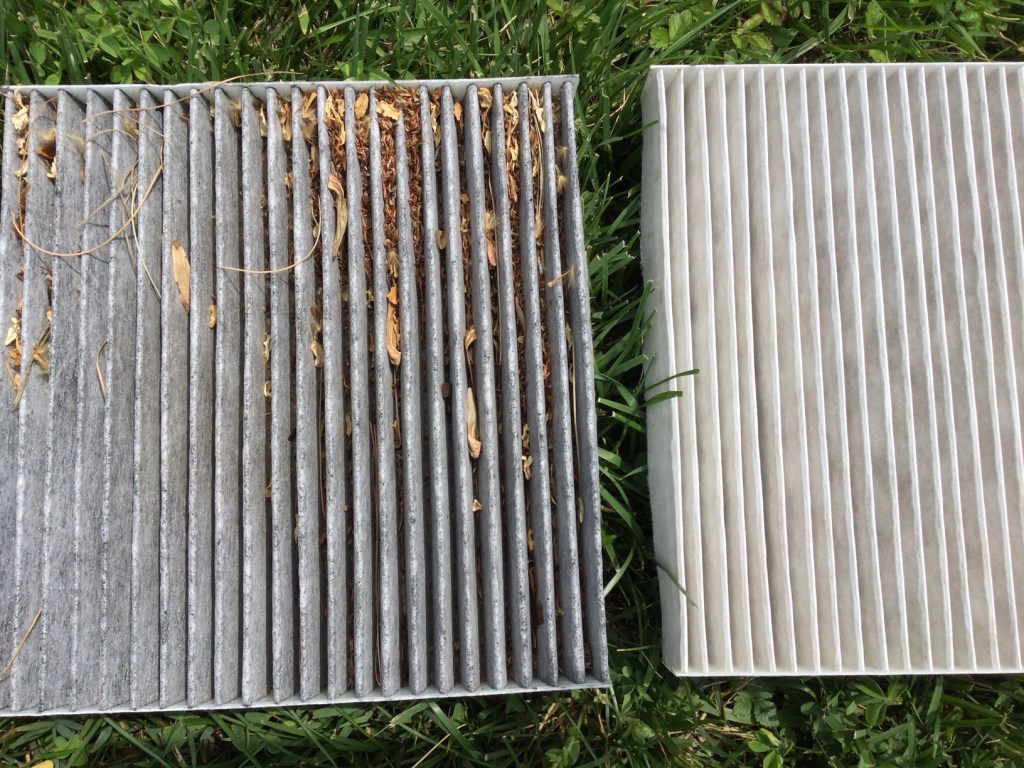
The photo below shows the cabin air filter I just pulled out of my van after maybe 2 years and 25,000 miles, next to a relatively clean filter. Obviously, I let this one go a bit too long: it is grey with dust/dirt, and partly blocked with plant debris.

I have not been quick to change out these filters because garages or dealers often charge something like $80-$100 for this. And until recently, I never considered doing it myself, because for some reason I thought it was a hard job. I had read of people having to contort in unnatural positions with heads inserted under dashboards as they disassemble layers of car to get at the filter.

It Is (Often) Super Easy to Change a Cabin Air Filter

It all depends on where the filter is located. For most models of cars, you can find guidelines on line, including YouTube videos. There are some models where you indeed may have to unscrew a cover plate somewhere below the dashboard to expose the filter. But in most cars, you remove the glove box to expose the filter. That may involve undoing come screws or a snap or strut, and squeezing the edge of the glove box inward. For my Hondas, all I had to do was empty the glovebox, (authoritatively) squeeze in the edges, and the glove box pivoted down, and behold, there was the filter in its little holder. Then slide out the holder, pull out the old filter and put in the new filter (purchased at AutoZone for $20 each), slide the holder back in place, and finally tilt the glovebox back up until it snapped in place.

Ten minutes max, easy-peasy. Obviously, this saved money, but it also felt empowering. I highly recommend trying it.

Video of Joy Buchanan on Tech Jobs and Who Will Program

Here are some show notes for a keynote lecture to a general audience in Indiana. This was recorded in April 2023.

Minute Topic
2:00“SMET” vs STEM Education – Does Messaging Matter?  
(Previous blog post on SMET)
5:00Is Computer Programming a “Dirty Job”? Air conditioning, compensating differentials, and the nap pods of Silicon Valley  
(post on the 1958 BLS report)
7:50Wages and employment outlook for computer occupations
10:00Presenting my experimental research paper “Willingness to be Paid: Who Trains for Tech Jobs?” in 23 minutes  

Motivation and Background 10:00 – 15:30
Experimental Design         15:30 – 22:00
Results                    22:00 – 30:00
Discussion                 30:00 – 33:30
33:50Drawbacks to tech jobs  

See also my policy paper published by the CGO on tech jobs and employee satisfaction
35:30The 2022 wave of layoffs in Big Tech and vibing TikTok Product Managers  

I borrowed a graph on Tech-cession from Joey Politano and a blog point from Matt Yglesias, and of course reference the BLS.
39:00Should You Learn to Code? (and the new implications of ChatGPT)  

Ethan Mollick brought this Nature article to my attention. 
Tweet credits to @karpathy and @emollick
48:00Q&A with audience

China To Squeeze West by Restricting Export of Essential Rare Earths

Rare earths are a set of 17 metals with properties which make them essential to a swathe of high-tech products. These products include lasers, LEDs, catalysts, batteries, medical devices, sensors, and above all, magnets. Rare earth magnets are used in electric motors and generators and vibrators, making them essential to electric cars, wind turbine generators, cell phones/tablets/computers, airplanes, phones, and all sorts of military devices. 

China happens to have large amounts of rare earth oxide ores for mining, relatively lax environmental standards, and a large, compliant workforce. The Chinese government has harnessed these resources to make the nation by far the largest producer of rare earths. Their massive, relatively low-cost production has suppressed production in other countries. This has been a conscious policy, to achieve global control over a vital raw material.

The first time China used this effective monopoly as a political weapon was in a maritime dispute with Japan in 2010. China cut off exports of rare earth metals to Japan for two years, crimping the Japanese electronics industry.  Other nations took note of this threat, and since then have been a number of half-hearted (in my opinion) efforts in various Western nations to develop some domestic capacity and to redesign motors to reduce dependence on rare earth materials.

 China’s share of rare earth ore mined is down to 60%, but they totally dominate processing the ore to metals, and subsequent fabrication of magnets from the metal.  Nearly all of the ore mined in the U.S. is shipped over to China for processing, mainly because of environmental regulations here.  

According to the Asia Times,

The PRC still dominates the entire vertical industry and can flood global markets with cheap material, as it has done before with steel and with solar panels. In 2022, it mined 58% of all rare earths elements, refined 89% of all raw ore, and manufactured 92% of rare earths-based components worldwide.

There is no other global industry so concentrated in the hands of the Chinese Communist Party, nor with such asymmetric downstream impact, as rare earths.

It seems the only way for the West to blunt the Chinese monopoly in rare earths is with large, long-term subsidies (since the Chinese can always undersell the rest of the world on a free market basis) and probably some pushing past environmental objections.

Alarmed by the rapid buildup of Chinese military forces (towards a possible invasion of Taiwan), the U.S. and its allies have begun restricting exports of the highest-power silicon chips to China. In retaliation, China has reportedly made plans to restrict exports of rare earths, starting in 2023. If they follow through, that move would crush fabrication of magnets and of magnet-dependent devices like motors and generators in other countries; the rest of the world would have to come crawling to China for all these items.

This move would in turn cause the rest of the world to accelerate its plans to produce rare earths outside China, but there would be several years of great disruption, and Chinese-made final devices like motors and generators would always have a huge price advantage, due to their cheaper raw material inputs.

I suspect there may be a high-stakes game of brinksmanship going on behind the scenes. The Chinese leadership presumably knows that they can only play this rare earth export ban card once, and the West does not really want to plow a lot of resources into producing large amounts of rare earths much more expensively than they can be bought from China. So maybe we will see some relaxation in chip export controls for China in exchange for them not pulling the final trigger on a rare earth export ban.

We live in interesting times.

Bitcoin’s Dramatic Comeback: Resurrection or Dead Cat Bounce?

In the past year, one cryptocurrency firm after another has gone bust, culminating in the grand implosion of the FTX exchange. The crypto vortex also contributed to some of the recent banking failures.

The prices of cryptocurrencies shot up in 2021, probably fueled by pandemic stimulus money sloshing around in the bank accounts of restless 20- and 30-somethings. All this came crashing back to earth in 2022, giving ample scope for skeptics to say, “I told you this was all foolishness.” Last rites were said, and crypto was left for dead.

But wait… in 2023, when no one was looking, the lid of the crypto coffin started to rattle, a bony hand reached out, and…crypto is back!!

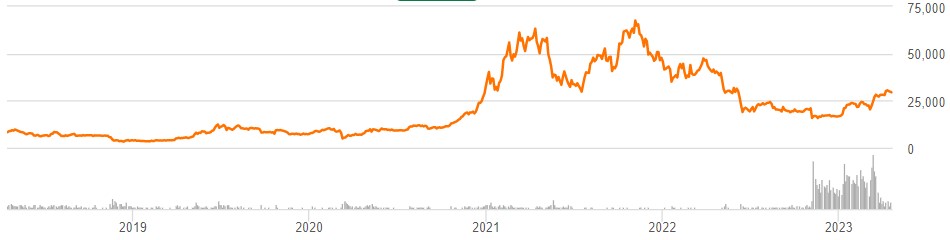
Well, sort of. Here is a five-year chart of Bitcoin from Seeking Alpha, in U.S. dollars:

And here is the past six months:

We can see that Bitcoin took its final big leg down in November, 2022, with the FTX collapse. Its price stayed fairly plateaued down there (with heavy trading volume) until January. Since then, it has nearly doubled.

What has triggered this rise in 2023? Observers such as Michael Grothaus at Fast Company suggests some four factors:

( a ) A shift to “risk-on” with the prospect of the Fed easing off with interest rate hikes this year.

( b ) A flight to alternative assets in the wake of the turbulence in the banking sector. Also, since the total amount of bitcoin is programmed to never increase over a certain number, Bitcoin should be a hedge against inflation. (Many observers believe that the Fed will live with 3-4 % inflation indefinitely, to help inflate away the gigantic debt that the federal government incurred with pandemic relief).

( c ) Buying of Bitcoin by traders who were short, and now need to cover their positions.

( d ) The usual rise in Bitcoin values as a bitcoin “halving” event is on the horizon. (About every four years, with the next time scheduled for May 2024, the rewards for mining new bitcoins drops by 50%).

Will the rise in Bitcoin prices continue? Is this truly a resurrection from the dead, or just a “dead cat bounce”? [1] Nobody knows. But this latest, sustained rally seems to have helped it recover some luster of legitimacy as an asset class. Here is a list of some popular crypto exchanges that are still in operation.

My personal take: I hold a sliver of the Bitcoin fund GBTC, just to have some skin in the game. I have been too lazy to learn about and activate an actual crypto wallet. I think Bitcoin in particular is an intriguing entity. Many other cryptos at some level depend on some centralized administration, but Bitcoin embodies the ideal of a decentralized, power-to-the-people form of something like money.

[1] From Wikipedia: In finance, a dead cat bounce is a small, brief recovery in the price of a declining stock.  Derived from the idea that “even a dead cat will bounce if it falls from a great height”, the phrase is also popularly applied to any case where a subject experiences a brief resurgence during or following a severe decline. This may also be known as a “sucker rally”.

Comparing ChatGPT and Bing for a research literature review in April 2023

We wrote “ChatGPT Cites Economics Papers That Do Not Exist”

I expect that problem to go away any day, so I gave it another try this week. For the record, they are currently calling it “ChatGPT Mar 23 Version” on the OpenAI website.

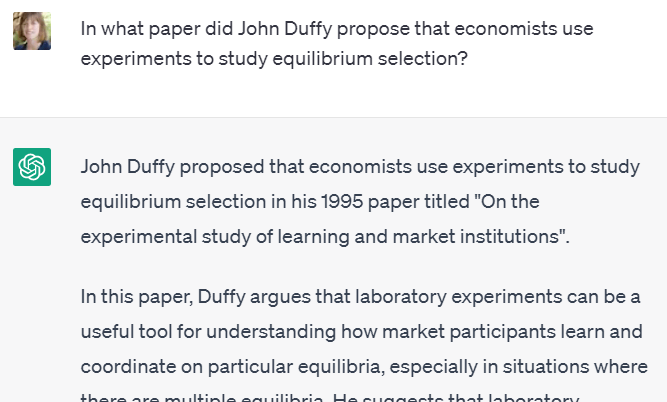
First, I asked ChatGPT for help with the following prompt:

ChatGPT is at it again. There is no such paper, as I will verify by showing John Duffy’s publications from that year: 

ChatGPT makes up lies (“hallucinations”). It is also great for some tasks, and smart people are already using it to become more productive. My post last week was on how impressive ChatGPT seemed in the Jonathan Swift impersonation. I didn’t take any time to do fact checking and I would bet money that at least something was made-up-facts in there.

I posed the same question to the Bing plug-in for the Edge browser (Microsoft). Yup, I have opened Edge for the first time in forever to use Bing.

Bing handles the prompt by linking to a useful relevant paper – so if you click the link you will get to a helpful and not misleading answer. Just being a smart search engine instead of hallucinating randomly is better, for my purposes.

The actual paper I wanted returned was this one, by the way:

Duffy, John. “Experimental macroeconomics.” Behavioural and Experimental Economics (2010): 113-119.

There is no reason that ChatGPT should be better than an expert in a subfield of a field of economics. But that’s the genius of a good search engine. You ask it “Can I repair a broken fiddlewhat?” The search engine does not claim to know but rather directs you to the blog of the world expert in fiddlewhats.

I can’t find the link to it, but I’m going to toss in one more thing here. Tyler Cowen did an interview this Spring on AI. There was a newspaper reporter who had a “creepy” interaction with an AI that made for the topic of a viral internet article. Tyler made a very contrarian point by saying that he interprets this as a case of AI alignment. The reporter wanted something sensational and he got what he wanted.

So, it will probably be true for a long time that if you want to find a failure of AI, you can get what you want. Still, I’m putting this on the record here because I wonder if this particular problem will get solved quickly.

GPT showing off on Conversations with Tyler

Since posting it in January of 2023, our post on a failure of ChatGPT has been one of the most popular articles of the year in terms of web traffic. Read ChatGPT Cites Economics Papers That Do Not Exist

LLMs will make up nonsense lies, but it might sound sophisticated and serious. As human editors, we are not used to detecting that kind of problem, because usually if something sounds serious that means it has been written by a serious thoughtful person (usually).

That’s a problem, but ChatGPT is really good at some tasks.

Instead of pointing out the fact that ChatGPT is not perfect, Tyler Cowen wants people to see the potential. He has done an entire podcast interview with ChatGPT, asking it to take on the voice and role of deceased writer Jonathan Swift.

I’ll share part of the transcript:

COWEN: In 1709, you, Jonathan Swift, still were calling yourself a Whig. What exactly induced you to switch to the Tory side of the ledger?

SWIFT: My shift from the Whigs to the Tories was a gradual and complex process, influenced by several factors, including personal connections, political developments, and ideological disagreements.

During my early years in politics, I was indeed more aligned with the Whigs, who championed principles such as constitutional government, religious toleration, and the supremacy of Parliament over the monarchy. However, over time, I became increasingly disillusioned with the Whigs, particularly as their internal factions and power struggles intensified.

The Whigs’ support for the war with France, which began in 1702, was a point of contention for me. I believed that the war was costly…

The replies seem nuanced and insightful. Nothing made me suspect that they were factually inaccurate, although I do not know enough about Irish history to judge.

Is there any human who could have produced this script? I think so, although it would have required a lot of work. If one of these replies is better than anything a human Swift scholar would produce, how would we know?

GPT4 can write good summaries for the work of a prolific author like Swift, because the model can train on lots of examples.

GPT4 could probably write a good biography of a modern figure by pulling together all of the writing by them and about them. Maybe GPT4 could efficiently scrape up all mentions of this figure online and synthesize them faster than a human scholar. However, we observed GPT3 completely making up citations when we tried to get it to do economics summaries.

I’m concerned that humans will use GPT4 to write but not do the requisite fact-checking. That could introduce a new corpus of work that the next LLMs will train on, which might be full of lies. Humans might not admit to using GPT, and therefore we wouldn’t have a mechanism for using extra scrutiny on AI-generated writing from 2023. Humans can make mistakes too… so the ultimate solution could be an all-powerful AI that somehow does begin with a fairly accurate map of the world and goes around fact-checking everything faster than human editors ever could.

Self-Replicating Machines: A Practical Human Response

Currently, we have software that can write software. What about physical machines that can produce physical machines? Indeed, what about machines that can produce other machines without human direction?

First of all, machines-building machines (MBM) still require resources: energy, transportation, time, and other inputs. A well-programmed machine that self-replicates quickly can grow in number exponentially. But where would the machines get the resources that enable self-replication? They’d have to purchase them (or conquer the world sci-fi style). Where would a machine get the resources to make purchases of necessary inputs? The same place that everyone else gets them.

Continue reading →

Yes, it was SMET

Last week I posted about the transition from SMET to STEM at the National Science Foundation. I was repeating a story that can be found on several websites including an entry in Britannica.

Andrew Ruapp reached out to me about a possible error in my post. He presented some evidence that the term STEM has been used prior to 2001. Casually Googling the topic did not bring me to a reputable source for the claim I had made last week. “SMET” is comically bad. So, I did start to wonder if it had never been officially used at the NSF and was just a funny story getting repeated online.

To solve this problem, I reached out directly to the person who was credited with making the transition. Dr. Judith Ramaley is currently President Emerita and Distinguished Professor of Public Service at Portland State University.

Having her permission to share, here is our email correspondence:

Encouraged by her reply, I looked online and found a public NSF document from 1998 that clearly uses SMET.

Lastly, I asked her several questions, in a mini email interview:

  1. Are you surprised by how widespread the STEM term has become?

Ramaley: I wasn’t surprised because once NSF adopted the new acronym, I expected it would catch on.

2. Do you feel that the “STEM” brand has been successful?

Ramaley: STEM isn’t really a brand. It is simply an acronym. It works better than SMET I think because engineering and technology are framed by science and mathematics rather than trailing along behind as if less important. I am fascinated by the growing pressure to add other elements to STEM, making it STEAM, for instance. 

3. My son in 2nd grade goes to a STEM activity class once a week. (They just call it “STEM.”) This week he tells me they are working on a pollination project. Would you recommend anything different than the current system for encouraging American students to pursue technology fields?

Ramaley: Your third question is a sweeping one. It would help to know what a STEM activity means each week in your son’s second grade class.  I am drawn to ways of learning STEM that encourage students to approach these issues in an inquiry-based way that lets them explore what it means to ask interesting questions and work out ways to try to answer them. Young people are very curious about how the world works. I doubt that I need to tell you that since I bet your son sometimes drives you nuts with WHY and HOW questions. Questions like that are beautiful questions.