The song “Anti-Hero” by Taylor Swift was the number-one song on charts in the United States and globally when it was released in October of 2022. Based on the record-breaking and continued popularity of the song, Swift’s struggles with self-loathing resonates with us.
It’s me, hi, I’m the problem, it’s me At tea time, everybody agrees
The theme of the song is that Swift feels like a moral monster who is exposed to the watching eyes of society. She imagines proper people gossiping about her flaws at teatime. This reference to British tea culture makes a perfect segue to the moral philosophy of Adam Smith. Those who only think of Smith as an early observer of modern economies might be surprised, but regular readers of AdamSmithWorks won’t be.
The impartial spectator is a key concept in Smith’s theory…
James wrote about our posting philosophy in “Always Be Posting”. The regularity is the point. This strategy is not our original idea, but this specific manifestation of blogging is a kind of experiment that we are running in front of everyone. I’ll add a few comments on this practice.
I blogged more than once a week at first. Although I believe in the benefits of writing, once a week is the right amount for me.
Tyler recently asked Brad Delong about Substack. Delong says, “Substacking is blogging, except that Substacking is blogging where you have explicit permission to send things to people’s email inboxes, and also to have a rather large tip jar.” Tyler mentioned that Substack posts tend to be longer. Delong admits, “I thought blogging was more fun.” Delong thinks longer posts are better because they fight the trend of short posts that I earlier called Poastmodernism. I would say that if you are going to blog regularly for free like we do, it should be fun. That is also what Tyler said when I asked him if young people should blog regularly in “The New Econ Bloggers.”
If you are going to blog, you might wonder when you should start. Society seems obsessed with young geniuses today. I started blogging before tenure but not when I was very young. I should not have started any earlier. Think about the research that shows your brain is still forming until you are about 25. If Leonardo DiCaprio would date you, then be careful about what you say on the internet. What I would hope for teens or undergraduates is that they would have smart safe people to bounce ideas off of. You certainly need to practice writing and questioning. Even though it nearly kills me at the end of every semester, I assign papers in my classes, because I believe that college students should be writing. I was and am lucky to have teachers and friends who I talk to one-on-one when I want to try out ideas. You should be “posting” in the most abstract sense when you are young, but a private paper journal is not a bad place to start.
When the internet first started, I don’t think anyone would have guessed how much content people would create for free. People are posting so much. Despite worries that media pirating would lead to too little content creation, we have more content than ever.
Something fun about regular short posts is that you can put a stake down and then revisit it years later. Here are two of my posts that have turned out well.
In 2022, I went to Disney World for the first time. Ross Douthat criticized Disney World in his book The Decadent Society. I like the book, but I thought that he clearly hadn’t been there. I wrote a whole blog about Disney being the opposite of infrastructure stagnation. Here is Ross now with his New York Times column saying “Wow, I had never actually been there, and the physical infrastructure is amazing.”
In 2021, I wrote “I encourage parents to read fantasy with children. I see a lot of children’s books that promote science or STEM-readiness… Those games that try to trick 5-year-olds into “programming” are less valuable than reading and discussing fantasy stories… What your child will need to be able to do when they are 20 is read and comprehend a textbook that explains a totally new technology that no one alive today understands. Then they will need to think of creative ways to apply that technology to real world problems.” The developments in ChatGPT are making this look pretty good, even earlier than I expected.
The key lesson, the thing I would impart to any aspiring bloggers, content creators, or newsletter proprietors, is that the cornerstone of internet success is not intelligence or novelty or outrageousness or even speed, but regularity. There are all kinds of things you can do to develop and retain an audience — break news, loudly talk about your own independence, make your Twitter avatar a photo of a cute girl — but the single most important thing you can do is post regularly and never stop.
Granted, “work hard and keep doing the thing you’re doing” is probably above-replacement advice for any kind of entrepreneurial activity. But it’s particularly true for online content creation. As Yglesias suggests, the internet and feed-based social platforms have constructed an insatiable demand for content, so if you can produce content mechanically, without requiring expensive resources (such as time, wit, or subject-specific knowledge), you’re in an excellent position to take advantage. But most importantly, this demand is so insatiable that there is currently no real economic punishment for content overproduction. You will almost never lose money, followers, attention, or reach simply from posting too much.
That is from an excellent post by Max Read. It is fairly short and has some good examples, so I recommend reading the whole thing. Tyler Cowen made a similar point back in 2019:
There’s a certain way in which on the internet you can’t be overexposed. There’s just a steady stream of you, it feels like being overexposed compared to the standards of 1987 or whenever, but in fact it’s not and people are picking and choosing. And you end up just dominating a particular space in a particular kind of way. And I think most older people have not made that transition mentally to understanding how you should exist intellectually on the internet.
Of course, this is also part of Joy’s idea with this site and why we write every day:
It’s just time to start writing more. This is a model that I have learned from Tyler Cowen, and most writers I admire write every day whether or not they have time for it. David Perell has tweeted that writing and thinking are the same thing. Thus, if you are a thinker, writing is not a waste of time. Writing is the thing you are doing anyway in your muddled head.
I have been investigating how to get more talent in the tech industry for a while. There is not a lot of data on precisely how people select into tech and what might cause more people to train for in-demand jobs. Gordon Macrae, in his substack The View, has a recent relevant post Issue #9: Tracking 100 bootcamp graduates from 2015.
Gordon ran his own survey of 100 graduates of coding bootcamps. Coding bootcamps are a fascinating element that help fill in the skills gap. They are not well-understood, and we don’t have much publicly available data of the sort that helps researchers measure the outcomes of a traditional college education.
Here are some of his results from this preliminary survey:
Of this total, 68% of the graduates surveyed in 2022 were doing roles where the bootcamp was necessary for them to work in that role. What I found fascinating, though, was that this figure varied wildly depending on the bootcamp they attended.
On the lowest end, just 50% of graduates from Bootcamp A were doing jobs in 2022 that required having gone to a bootcamp. Conversely, 90% of Bootcamp D graduates were working in technical roles seven years after graduating.
What is more, the percentage of bootcamp graduates in technical roles at 7 years after graduation has gone done by 15%. The average immediately after graduation was 82% working in a technical role.
Authors of the kinds of books I read present themselves as a voice of reason against our declining society that no longer can evaluate arguments or define moral principles. (I’m fun at parties.) “Postmodernism” has been attacked all my life.
For a while, I have been looking for a successor of postmodernism. To simply define our age as the one that came after modernism seems unsatisfactory. How many more decades can we coast along on this antithesis idea?
One reason I don’t like the term postmodernism is that it gives a sense of progress where we might be losing ground. If you aren’t modern, then you are pre-modern. If you aren’t a verbal culture, then you have regressed to pictographs. If you aren’t engaging arguments, then you have degenerated to tribalism. So, postmodern might be dressing up a decline with a word that is too respectable sounding.
Calling people who use smartphones premodern does not seem right. But, what information are they consuming on those screens? Is it mostly low-quality videos and quick poasts? That doesn’t seem like what someone in 1900 would expect of a modern person.
Here’s an idea for the new century. We are in an age of poastmodernism, beginning with the founding of Twitter. This is different from the kind of skepticism or moral relativism that defined postmodernism. The poasters and their followers can be earnest. They retweet like evangelists. (A “poast” is a message posted in an internet forum.)
Poasts are short. This does not allow for nuance or traditional rational forms of argumentation. A poast could be referencing a rich history or body of literature, but if this generation has not evaluated those original sources then they are really just getting the meme. The poast does not provide its own context. Tyler Cowen says that people who think “modern art” is absurd have no context. Context for modern art would be the classical art and realistic landscape paintings that came before. Most Americans including myself are pretty ignorant about classical art. Similarly, how much value would teenagers get from Lord of the Rings internet memes if they have never seen the movies or read the books?
I’m on Twitter. The pace of discourse is more fun than reading a 50-page econ journal article. I get the appeal of poasting. It’s easy. Our first pediatrician told us not to let our baby use touchscreen games. She told us that it is good for a child to struggle to touch a ball that is two feet away across the floor. Better that they cry over the ball than get the dopamine too easily on a tablet game. Tapping on a screen trains kids for instant rewards. Something that concerns me about a generation that was not raised on books is that they will actually enjoy poasting less than I do, because they will be used to the rapid pace of reward. Twitter as a company benefits from the current generation of people who did not grow up with Twitter.
Poasting affects politics. This week two US Senate candidates had a debate. What would someone who gets most of their news from social media learn about the debate? Some top poasts about the debate have almost zero positive policy substance. Campaigners use the internet medium to dunk on their opponents instead of offer solutions to problems. What attracts engagement is the fire emoji.
It says a lot about Blake Masters that he’s the only one on this stage who never wore a uniform for our country, and yet he thinks he knows better than our military on how to fight wars.
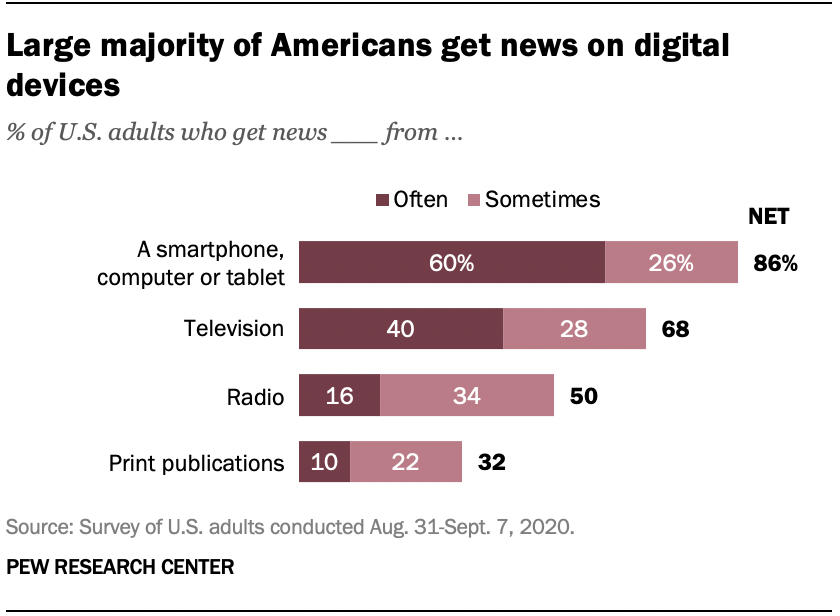
This is not meant as a comment on either men as candidates. I share these jabs because lots of Americans are consuming their “news” in this form (see Pew Research chart). In postmodernism a successful political candidate has to appeal to feelings as much as reason. In poastmodernism, they only have 280 characters to work with. (Donald Trump was a skilled poaster.)
Getting elected today might require great poasting, but that has little to do with being good at governing. Most people think the details of government are dull. Ten minutes into a city council meeting, I’m bored and ready to check the notifications on my phone. And yet, we cannot just poast about poasting. It’s the physical political world and the classic books that make the best subjects of conversation. So, I’m not sure if the era of poastmodernism will last for a long time, or simply to the end of my lifetime. Millennials are not going to give up the dog fire meme.
You’ll have to pry it from our hands after our large generation has passed on. But will it inspire people in the future? I have already been informed that teenagers are calling our gifs “cringe”. They seem to prefer 90 second videos of their peers dancing to pop music. Don’t ask me what comes next after that.
I’ll end on a positive note by saying that sometimes shorter is better. Get to the point quickly, if you can. Some of the novels produced in the modern era were too long. Adam Smith’s books would be more widely read if they were shorter. Long-winded speeches are not necessarily good and I’m glad I am not forced to listen to them. (I get the tl;dr the next day.)
A lot of bad ideas were dressed up in pages of smart-sounding language and then passed off for wisdom in the modern era. It might be harder to pull that off today. Authoritarian regimes in the past relied on being able to lie about conditions on the ground. Today, we know what is happening because of individuals on the ground sharing to Twitter (although social media can also be used for disinformation). American elites believed lies about what was going on inside the Soviet Union for years. That would be more difficult today.
No matter how you feel about intelligent machines, you’ll be talking to them soon.
Talking to voice assistants right now feels stilted because it's slow, inaccurate, and you can't interrupt.
Widely-available high-quality fast ASR and TTS, paired with LLMs, is coming soon and will enable much more natural conversations. https://t.co/8UQP5YRZ5l
This restaurant has several robots delivering food and drinks to tables. It’s strange at first but easy to get used to. The robots can tolerate people walking in front of them and mild harassment from children. pic.twitter.com/F47IcPqruU
Russia’s attack on Ukraine has generated a lot of attention. Many people care deeply about this unfolding crisis. I wondered back in March 2022 where all this energy would end up getting channeled?
TBH, I have been wondering if the Reddit army and auxiliary will be able to come up with any creative solutions to the problem. What can half a billion keyboard warriors accomplish?
What I had in mind was not an army of “cartoon dogs”, and yet here we are. Official coverage of the #NAFO dog memes this week has come from the Economist and Politico.
The North Atlantic Fella Organisation (spellings vary) is a tongue-in-cheek label adopted by a virtual army that champions Ukraine’s cause and harangues its foes on social media. Its members don the avatar of a cartoon shiba inu dog…
When your enemy is as humorless as Putin, there is an advantage to being funny. After circulating in internet backwaters for weeks, official Ukrainian accounts have acknowledged the help offered by the movement.
The effects of #NAFO are 1) to influence the flow of information/opinions and 2) raise money for Ukraine defense.
And this is a just an aid organization that is not very funny but helps refugees in Lviv.
An explainer of a different Very Online thing is https://www.slowboring.com/p/dark-brandon-explained. Dark Brandon and #NAFO are similar in the sense that supporters are made to feel like they are part of a brotherhood of winners who share fun jokes.
Balaji Srinivasan recently released a book called The Network State suggesting that online communities of likeminded people are so powerful that they could supplant what we have known as “countries” for a few centuries. From what I can tell, families want to live in a real place that has tangible services and security. The interesting thing about #NAFO is that it’s purpose is to support an old-fashioned country defending its physical borders.
Meanwhile, in the country of Russia, as reported by the WSJ, “The chairman of Russia’s second-largest oil-and-gas giant, Lukoil PJSC, died Thursday after falling from a hospital window in Moscow, according to Russian state media agency TASS.”
Things go by online about moms and kids that bother me. Here I will Be Like Pete and try to articulate a positive vision. We could talk more about parenting small children.
Ambitious people, both men and women, might want to be parents. Time spent on parenting takes away from other projects, so the earlier you start planning the better. Hearing about the experiences of other parents is both instructive and inspiring.
Parenting, like modern creative careers, is an unpredictable enterprise. Maybe one reason people are not encouraged more to plan is because the disappointments can be so devastating in this arena. There is a risk that I will sound insensitive if I am too positive. That said, I feel like discussions I see in public miss the point too often and fail to use the “billboard space” we have effectively. There is an ocean of thoughtful honest free content for How to Achieve Your Writing Goals, but there is very little on how to achieve your parenting goals that resonates with ambitious young people. The writing advice can be ignored by those who don’t want to write; parenting advice can be ignored by those who don’t want kids.
Economists talk a lot about parents and children, especially now that the US is near population decline. One particular point I have heard is: “Data shows that piano lessons do not have a causal impact on lifetime earnings, so your problems are solved. Everyone sit back and enjoy your kids.”
This message may be helpful to some people, but it seems like primarily a lie to me. “Enjoy your kids” assumes a lot. I’d prefer an honest approach about the sacrifice involved, or the “opportunity cost”. I think that the benefits of parenting outweigh the cost, but it’s not inspirational to say “selfish lazy people will enjoy parenting.” Raising kids who you enjoy being around is not easy, but there are tricks and proven methods to help.
The economist who gets it is Emily Oster. Her books go more like this: “You probably aspire to having family meals that you can enjoy. Sit down with your co-parent 6 months ahead of time and plan out how you are going to achieve such a wonderful ambitious goal while also being able to schedule other events and pursuits.”
Emily Oster books/newsletter is a great place to start. She’s not for everyone, but if you are reading an econ blog then she might be for you. The good news for ambitious parents is that many books have been written that explain how to achieve certain results. Ambitious smart people can figure out good techniques, although as I said earlier be prepared for things not to go as planned. It helps to start on the learning process before you have kid to care for. Once you become a primary caregiver, you will have less time to read, so read widely and often whenever you can. We have a /Parenting category in this blog, to curate some of the good stuff.
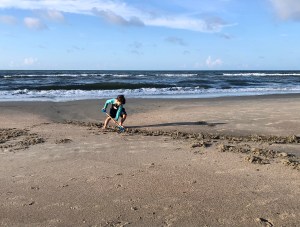
This boy’s ambition was to dig a trench from a tidal pool all the way to the ocean.
Kids could come up in conversation about ambition more, as a possible complement not just as a substitute.
This Elon tweet has layers: “Being a Mom is just as important as any career” What do you think the subtext is? How would a college student understand this?
Why use this hackneyed phrase when he could say something to actually inspire both his male and female Gen Z fans to become parents? If Elon is a good parent, then teach us how he combines it with an ambitious life. And if he’s a bad parent, he should say less about it. If he’s trying to elevate mothers, then retweet a mother.
Similarly, a male economist who writes books about how easy parenting is should explain how he got through the first 5 years. Either someone else raised his children or he worked hard to maintain a routine and boundaries. Did he create his own routine from scratch or did he borrow from someone else’s model? Were his children in daycare 40 hours a week?
It can be hard to write about these topics honestly, because of privacy issues. So, we are back to Emily Oster, because she has been willing to tell the world what really goes on in her own family. Elon should just tweet out her newsletter every week if he’s such an advocate for mothers.
Dr. Oster is not the only one. There are millions of mothers creating content who would value the exposure. What if Elon (or some other ambitious person with a large platform) retweeted a trick for getting children to try carrots. “Wow, genius technique. Follow this Mom for more…” Or, Elon could highlight a man who being a great parent.
Ambitious people just talking about their kids and their own honest personal experiences is a good way to achieve Elon’s stated goal of getting more people to have kids. If Elon wants to tell us that he loves his kids, then that’s inspirational, and I don’t think it’s a lie.
I will engage in some introspection here, not because I think I’m so interesting, but because I see pro-natalist men talking past everyone else on how to raise the birth rate. I had a parenting win this past week. I solved a behavioral problem in a creative way and I’d love to talk about it. I’d like to feel like I’m part of a community conversation. I’d like to be recognized for my expertise. That’s what most people want, right? More resources in the attention economy devoted to parents is a form of compensation that I have not heard discussed before.
I have heard advice to female professors to not put up pictures of their children at the office. If colleagues know you care about your children, then you might be ostracized from the intellectual community that you have spent your whole life trying to join. In my own small way, I have pushed back against this norm by occasionally talking about kids and babies, so that other people who want families can feel part of a bigger community online and in academia. My broader point in this post is that there is a kind of rhetoric about family life and parenting strategies that would make young ambitious people think that having kids will not prevent them from pursuing other goals.
It’s not bad to talk about a 14-hour workday or an organizational strategies for achieving professional goals. I wouldn’t want to censor anyone or stop them from sharing how they accomplished something valuable. On the margin, more conversations could also include a discussion of how life changes if you become a parent, so that ambitious young people can build mental categories for this.
Stephen Dubner brought the teen children of famous economists on his show to talk about what it was like to grow up with those weirdos. It’s funny. Listeners will not feel like they are being told what to do or judged. Dubner is simply lending his platform to parents and children. He’s using the billboard space. There is parenting content on the internet already, but if it’s all siloed over at parents.com then it may not make it to the young person who is trying to figure out what “the Good” is.
Science keeps getting bigger- more researchers, more funding, and of course more publications. Scientific progress is much harder to measure, but there are good arguments that it’s roughly flat over time. This implies that productivity per researcher is plummeting.
There’s been a lively debate about what drives this falling productivity- is it that the easy discoveries got made first, leaving only harder ones for today’s scientists? Or is something else tanking scientific productivity, like the bureaucratic way we organize scientific research today?
A recent paper, “Slowed canonical progress in large fields of science“, suggests that the growth in the number of researchers and publications could itself be part of the problem. Comparing scientific fields over time, they find that:
When the number of papers published per year in a scientific field grows large, citations flow disproportionately to already well-cited papers; the list of most-cited papers ossifies; new papers are unlikely to ever become highly cited, and when they do, it is not through a gradual, cumulative process of attention gathering; and newly published papers become unlikely to disrupt existing work. These findings suggest that the progress of large scientific fields may be slowed, trapped in existing canon.
What is driving this? They argue:
First, when many papers are published within a short period of time, scholars are forced to resort to heuristics to make continued sense of the field. Rather than encountering and considering intriguing new ideas each on their own merits, cognitively overloaded reviewers and readers process new work only in relationship to existing exemplars. A novel idea that does not fit within extant schemas will be less likely to be published, read, or cited. Faced with this dynamic, authors are pushed to frame their work firmly in relationship to well-known papers, which serve as “intellectual badges” identifying how the new work is to be understood, and discouraged from working on too-novel ideas that cannot be easily related to existing canon. The probabilities of a breakthrough novel idea being produced, published, and widely read all decline, and indeed, the publication of each new paper adds disproportionately to the citations for the already most-cited papers.
Second, if the arrival rate of new ideas is too fast, competition among new ideas may prevent any of the new ideas from becoming known and accepted field wide.
Supposing they are correct, it’s not totally clear what to do. At the biggest level we could fund fewer researchers in large fields, or push more fields to be like economics, where the quality of each researcher’s publications is valued much more than the quantity. But what can an individual researcher do differently? One idea is “boutique science” or “hipster science”, trying to find the smallest or newest field you could reasonably attach yourself to.
Another idea is that the role of generalists and synthesizers is becoming more valuable, as Tyler Cowen often says and David Esptein applies to science in his book Range. When papers are coming out faster than anyone can read, we need more people to sift through them and explain which few are actually important and which are forgettable or wrong. There are lots of ways to do this- review articles, meta-analysis, replication at scale, and of course blogs. But the junk pile is going to keep growing, so we’ll need new and better ways of finding the hidden gems.

:format(webp)/cdn.vox-cdn.com/uploads/chorus_image/image/49493993/this-is-fine.0.jpg)