If Tariffs Are So Bad, Why Are They So Common?

Upfront disclaimer: This post is NOT about the most recent salvo of U.S. tariffs – enough apoplectic digital ink is gushing there already. It is about is an underlying question that these tariffs raised in my mind, which is the title of this article.

If there is one thing that nearly all economists, left, right, and center, can agree on, it is that free trade is good (see, for instance, a classic exposition of gains from trade on EcoNomNomNomics) and thus tariffs are bad. The main reason the local producers would need “protection” is because their goods (and services) are more expensive than the imports, and so by definition the consumers will pay more for their stuff. Thus, as is always noted, tariffs are a kind of tax on consumers. And yet…as far as I can tell all or nearly all nations impose tariffs on imported goods. So, what’s up with that?

This is not an area of expertise for me, so I went roaming the web to get some various opinions. The main reason given is to “protect local industry/agriculture”, and by extension, local jobs. We have to drill down deeper to see the reasoning involved.

In some cases, it is a simple, unsavory matter of a local industry having a powerful enough clout either at the business level or the labor level to lobby for special treatment (which costs the rest of the consumers more). But there are other cases where it is argued that it is important for national security to maintain a certain level of domestic production. For instance, historically nations like Japan and Switzerland maintained high tariffs on certain agricultural imports, in order to retain some domestic food production so they would not starve if something happened to interrupt international trade. Ditto for defense-related or other “strategic” production, and so on.

And in many cases, there just seems to be a gut feel that it is more patriotic or economically healthy to promote in-country production. Also, if a certain inefficient industry employs a lot of workers, the medium-term pain of letting that industry fail while resources shift elsewhere may be unacceptable. Economists promise us that the sooner or later those unemployed workers and empty factories will be put to some other, more worthy use, but it can be hard to believe in the “invisible hand” when suddenly you cannot pay your rent and no other jobs are available.

Two other factors came up. One is that for less developed counties without sophisticated internal revenue services, tariffs are a convenient way to collect revenue, and in fact may provide a significant share of government support. If I recall my high school history correctly, the fledgling United States government supported itself largely by tariffs, back in the day.

Another motive is what I would call “smart” tariffs, aimed not at indefinitely protecting inefficient producers, but at promoting improved production. What I have in mind is something I read some years ago, in an article I cannot now lay hands on, describing Korea’s path to industrialization. Protectionism was very much a part of that. The nation’s consumers did forgo short-term cheap consumption, in exchange for the development of domestic production which would in the long-term benefit everyone. I think one example was cigarettes. The government decided that cigarette production was a reasonable place to start industrializing, so they taxed imports to drive the price high enough to justify putting in cigarette-making equipment. After some years, they were happily making cigarettes, employing Koreans and building institutional muscle for the next phases of industrialization.

China has maintained a high degree of protectionism, including capital controls, and has grown and prospered mightily. So, I think that in assessing tariffs, it is essential to look past the immediate effects (which economists can always argue are “bad”, i.e., reduced consumption) to the longer-term impacts. Smart tariffs of the kind that East Asian countries have employed seem to have parlayed short-term consumer pain into long-term societal gains. Non-smart tariffs – -maybe not so much.
We did this to ourselves

What, you think I’m going to pretend anyone is paying attention to anything but the trainwreck on Wall Street? As of 10:15AM this morning, the market is down 8% in 5 days, almost 20% off it’s peak, and is still falling. It’s entirely attributable to a unfathomably stupid trade war that has been forecast for months, if not years. This is the kind of probabalistic event that is usually internalized within the market in advance, which suggests that either very few people thought Trump a) was telling the truth, b) would be able to execute, or c) other forces within government would be able to stop him.

The legislative branch has largely ceded power to the executive, with only the judicial hanging on as some check against power. The open question, then, is at what level of damage will the legislative branch find incentive to reassert itself against an executive that (probably) doesn’t have the constraint of a future electoral victory to pursue? Will the destruction of great swaths of the US and global economy warrant reclaiming of power or impeachment of an executive?

I’m not optimistic.

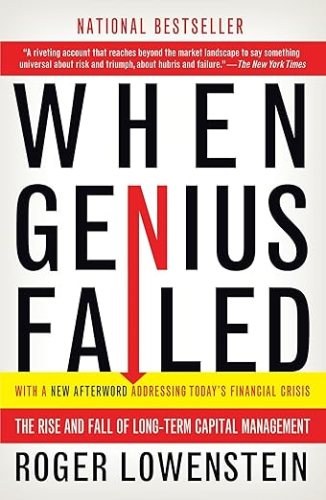
When Genius Failed

Myron Scholes was on top of the world in 1997, having won the Nobel Prize in economics that year for his work in financial economics, work that he had applied in the real world in a wildly successful hedge fund, Long Term Capital Management. But just one year later, LTCM was saved from collapse only by a last-minute bailout that wiped out his equity (along with that of the other partners of the fund) and cast doubt on the value of his academic work.

Roger Lowenstein told the story of LTCM in his 2001 book “When Genius Failed“. I finally got around to reading this classic of the genre this year, and I’d say it is still well worth picking up. The story is well-told, and the lessons are timeless-

  • Beware hubris
  • Beware leverage
  • Bigger positions are harder to get out of (especially once everyone knows you are in trouble)
  • In a crisis, all correlations go to one
  • Past results don’t necessarily predict future performance
  • Sometimes things happen that are very different from anything that happened in your backtest window.

The book came out in 2001 but it presages the 07 financial crisis well- not about mortgage derivatives specifically, but the dangers of derivatives, leverage, using derivatives to avoid regulations restricting leverage, and over-relying on mathematical models of risk based on past behavior. If Fed had let LTCM fail, could we have avoided the next crisis? Perhaps so, as their counterparties (most major Wall Street banks) who got burned would have been more careful about the leverage and derivatives used by themselves and their counterparties, and regulators may have taken stronger stances on the same issues.

Perhaps some more recent well-contained blowups foreshadow the next big crisis in the same way, like FTX or SVB?

Some more specific highlights about LTCM:

Continue reading

Join Joy to discuss Artificial Intelligence in May 2025

Podcasts are emerging as one of the key mediums for getting expert timely opinions and news about artificial intelligence. For example, EconTalk (Russ Roberts) has featured some of the most famous voices in AI discourse:

EconTalk: Eliezer Yudkowsky on the Dangers of AI (2023)

EconTalk: Marc Andreessen on Why AI Will Save the World 

EconTalk: Reid Hoffman on Why AI Is Good for Humans

If you would like to engage in a discussion about these topics in May, please sign up for the session I am leading. It is free, but you do need to sign up for the Liberty Fund Portal.

The event consists of two weeks when you can do a discussion board style conversation asynchronously with other interested listeners and readers. Lastly, there is a zoom meeting to bring everyone together on May 21. You don’t have to do all three of the parts.

Further description for those who are interested:

Timeless: Artificial Intelligence: Doom or Bloom?

with Joy Buchanan

Time: May 5-9, 2025 and May 12-16, 2025

How will humans succeed (or survive) in the Age of AI? 

Russ Roberts brought the world’s leading thinkers about artificial intelligence to the EconTalk audience and was early to the trend. He hosted Nick Bostrom on Superintelligence in 2014, more than a decade before the world was shocked into thinking harder about AI after meeting ChatGPT. 

We will discuss the future of humanity by revisiting or discovering some of Robert’s best EconTalk podcasts on this topic and reading complementary texts. Participants can join in for part or all of the series. 

Week 1: May 5-9, 2025

An asynchronous discussion, with an emphasis on possible negative outcomes from AI, such as unemployment, social disengagement, and existential risk. Participants will be invited to suggest special topics for a separate session that will be held on Zoom on May 21, 2025, 2:00-3:30 pm EDT. 

Required Readings: EconTalk: Eliezer Yudkowsky on the Dangers of AI (2023)

EconTalk: Erik Hoel on the Threat to Humanity from AI (2023) with an EconTalk Extra Who’s Afraid of Artificial Intelligence? by Joy Buchanan

“Trurl’s Electronic Bard” (1965) by Stanisław Lem. 

In this prescient short story, a scientist builds a poetry-writing machine. Sound familiar? (If anyone participated in the Life and Fate reading club with Russ and Tyler, there are parallels between Lem’s work and Vasily Grossman’s “Life and Fate” (1959), as both emerged from Eastern European intellectual traditions during the Cold War.)

Optional Readings:Technological Singularity” by Vernor Vinge. Field Robotics Center, Carnegie Mellon U., 1993.

“‘I am Bing, and I Am Evil’: Microsoft’s new AI really does herald a global threat” by Erik Hoel. The Intrinsic Perspective Substack, February 16, 2023.

Situational Awareness” (2024) by Leopold Aschenbrenner 

Week 2: May 12-16, 2025

An asynchronous discussion, emphasizing the promise of AI as the next technological breakthrough that will make us richer.
Required Readings: EconTalk: Marc Andreessen on Why AI Will Save the World 

EconTalk: Reid Hoffman on Why AI Is Good for Humans

Optional Readings: EconTalk: Tyler Cowen on the Risks and Impact of Artificial Intelligence (2023)

ChatGPT Hallucinates Nonexistent Citations: Evidence from Economics” (2024) 

Joy Buchanan with Stephen Hill and Olga Shapoval. The American Economist, 69(1), 80-87.

What the Superintelligence can do for us (Joy Buchanan, 2024)

Dwarkesh Podcast “Tyler Cowen – Hayek, Keynes, & Smith on AI, Animal Spirits, Anarchy, & Growth

Week 3: May 21, 2025, 2:00-3:30 pm EDT (Zoom meeting)
Pre-registration is required, and we ask you to register only if you can be present for the entire session. Readings are available online. We will get to talk in the same zoom room!

Required Readings: Great Antidote podcast with Katherine Mangu-Ward on AI: Reality, Concerns, and Optimism

Additional readings will be added based partially on previous sessions’ participants’ suggestions

Optional Readings: Rediscovering David Hume’s Wisdom in the Age of AI (Joy Buchanan, EconLog, 2024)

Professor tailored AI tutor to physics course. Engagement doubled” The Harvard Gazette. 2024. 

Please email Joy if you have any trouble signing up for the virtual event.

Now published: Human capital of the US deaf Population, 1850-1910

Myself and a student coauthor worked hard on our article that is now published in Social Science History. It’s the first modern statistical analysis of the historical deaf population. We bring an economic lens and statistical treatment to a topic that previously included much anecdotal evidence and case study. We hope that future authors can improve on our work in ways that meet and surpass the quantitative methods that we employed.

Our contributions include:

  • A human capital model of deafness that’s agnostic about its productivity implications and treats deaf individuals as if they made decisions rationally.
  • A better understanding of school attendance rates and the ages at which they attended.
  • Deaf children were much more likely to be neither in school nor employed earlier in US history.
  • The negative impact of state ‘school for the deaf’ availability on subsequent economic outcomes among deaf adults. We speculate that they attended schools due to the social benefits of access to community.
  • Deaf workers did not avoid occupations where their deafness would be incidentally detectable by trade partners, implying that animus discrimination was not systemically important for economic outcomes.
Continue reading

Trump’s National Sales Tax

Tariffs are going up to levels last seen in the 1930 Smoot-Hawley tariffs that helped kick off the Great Depression:

Tariffs are taxes- roughly, a national sales tax with an exemption for domestically-produced goods and services. I think the words make a difference here- “raising tariffs on countries who we run a trade deficit with” just sounds abstruse to most people, while “raising taxes on goods bought from firms in net-seller countries” sounds negative, but they are the same thing.

Of course, in this case the plan is to raise taxes to at least 10% on goods from all other countries even if they aren’t net-sellers, and raise taxes up to 49% on those that are. This is not a negotiating tactic. We know this from the math- the new tax formula uses net imports from a country rather than a country’s tariff rates, so a country could cut their tariffs on US goods to zero today and it wouldn’t necessarily reduce our “reciprocal” tariffs at all; at best it would reduce them to 10%. We also know it isn’t about negotiating because the administration says it isn’t. Their goal, obviously, is to reduce trade, not to free it.

They say they are doing this to bring manufacturing back to America and to promote national defense. But American manufacturers don’t seem happy. Even before the latest huge tax increase, trade war was their biggest concern:

The National Association of Manufacturers Q1 2025 Manufacturers’ Outlook Survey reveals growing concerns over trade uncertainties and increased raw material costs. Trade uncertainties surged to the top of manufacturers’ challenges, cited by 76.2% of respondents, jumping 20 percentage points from Q4 2024 and 40 percentage points from Q3 of last year.

The National Association of Manufacturers responded to the latest tax increase with a negative statement; so even the one major group that might have benefitted from tariffs is unhappy. Foreign producers and US consumers will of course be very unhappy. I think Trump is making a huge political blunder alongside the economic one- he got elected largely because Biden allowed inflation to get noticeably high, but now Trump is about to do the same thing.

I also see this as a huge national security blunder. For tariffs on China, I at least see their argument- we should take an economic hit today in order to become less reliant on our peer-competitor and potential adversary. But the tariffs on allies make no sense- they are hitting the very countries that are most valuable as economic and/or military partners in a conflict with China, like Canada, Mexico, Japan, South Korea, Vietnam, India, and Taiwan (!!!). One of our biggest advantages vs. China has been that we have many allies and they have few, and we appear to be throwing away this advantage for nothing.

What can you or I do about this? Stock up on durable goods before the price increases hit. Picking investment winners is always hard, but things this makes me consider are gold, stocks in foreign countries that trade little with the US, and companies whose stocks took a big hit today despite not actually being importers. Finally, we can try nudging Congress to do something. The Constitution gives the power to levy taxes to the legislative branch, but in the 20th century they voted to delegate some of this power to the executive. Any time they want, Congress could repeal these tariffs and take back the power to set rates. I have some hope they actually will- just yesterday the Senate voted to repeal some tariffs on Canada, and more votes are planned. The alternative is to risk a recession and a wipeout in the midterms:

Freedom to Trade Internationally

How much does the US and our trading partners adhere to the principles of free trade? The Fraser Institute’s Economic Freedom of the World report includes a category that helps to answer this question. Fraser’s measure includes not just tariff rates, but also non-tariff barriers, trade regulations, black market exchange rates, and controls on the movement of capital and people. Each country is assigned a score from 0 to 10, with 10 being the most freedom to trade internationally.

Overall, the US gets a pretty good score, slightly over 8 out of 10, which ranks us as the 53rd most free trading country in the world (data from 2022). That’s pretty good, but clearly not the most open: 52 countries have more trade freedom! Here’s how the US and our 10 largest trading partners look on that measure (I’ve truncated the axis to show roughly the current range of country scores worldwide):

Countries/regions with the highest scores on this measure are Hong Kong and Singapore, and almost every European country scores higher than the US.

What if we just look at tariffs? The US has a slightly higher score at 8.3 out of 10, but our rank on tariffs is slightly lower at 59th most free in the world (this includes not just tariff rates, but also the standard deviation of tariff rates and revenue from the trade sector).

Relative to our largest trading partners, the US does look better on this subcomponent for tariffs, but is still lower than some of our trading partners (note the axis is slightly different than the first chart, to once again roughly show the international range on this measure):

Finally, we might be interested in how much these scores have changed over time. You might sometimes hear that the US has opened up more to trade, while the rest of the world has moved in the opposite direction. This might be true on some margins, but not overall according to the Fraser scores. I use 1990 as the baseline, which is before a lot of the free trade agreements and WTO changes that would happen over the next decade or so (Fraser has no data for Vietnam in 1990, so they are excluded):

Overall, the US and our major European trading partners have reduced the ability of their citizens to trade internationally, while places like China and India have opened up massively to trade. In 1990 China had a mean tariff rate of 40% and India’s was a whopping 79%. Today their tariff rates are still higher than the US: 7.5% in China and 18% in India, compared with 3% in the US. But they are the ones who have massively opened up their economies to international trade, when we consider all aspects of international trade, even if this opening up isn’t as complete as the US. The US ranked as the 12th highest on Fraser’s freedom to trade internationally component in 1990, but is down to 53rd in the most recent data.

My Visit to a Maple Syrup Producer in Vermont

While I was in southern Vermont last month, I visited a maple syrup production operation. The actual shed is called a “sugar house”, and the operation is called sugaring, even though the main product is the syrup.

When I was a boy, my dad hung some buckets on taps into the two maple sugar trees in our yard to collect the sap. He boiled the sap in a big old copper tub/kettle set on cinder blocks over a wood fire. You do have to boil and boil, since it takes about 45 gallons of sap to make one gallon of syrup. The other 44 gallons is boiled off by the heat of the burning firewood.

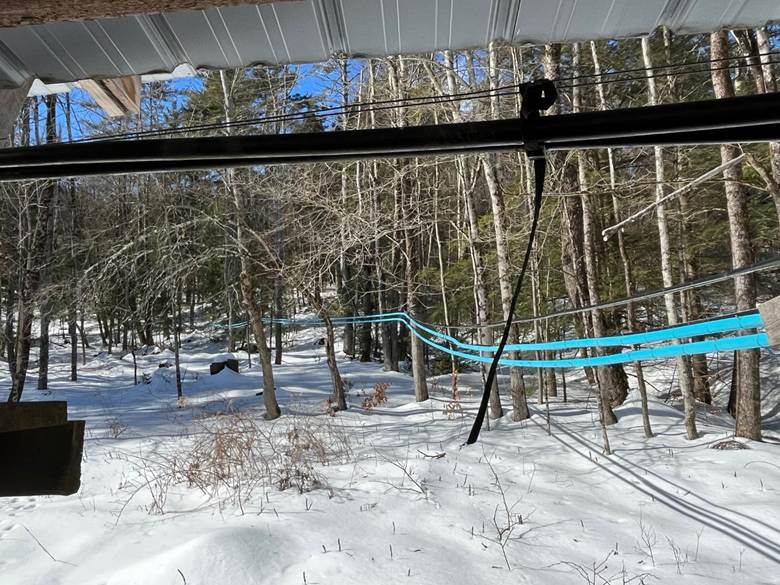
David Franklin’s operation in Guilford, VT (near Brattleboro) is much more efficient than that. The sugar house is set at the base of a long slope. The sap from the taps in the trees goes into tubing that connects into more tubing which goes downhill, so hundreds of trees feed into the long blue tubing shown here, which goes into collection tankage:

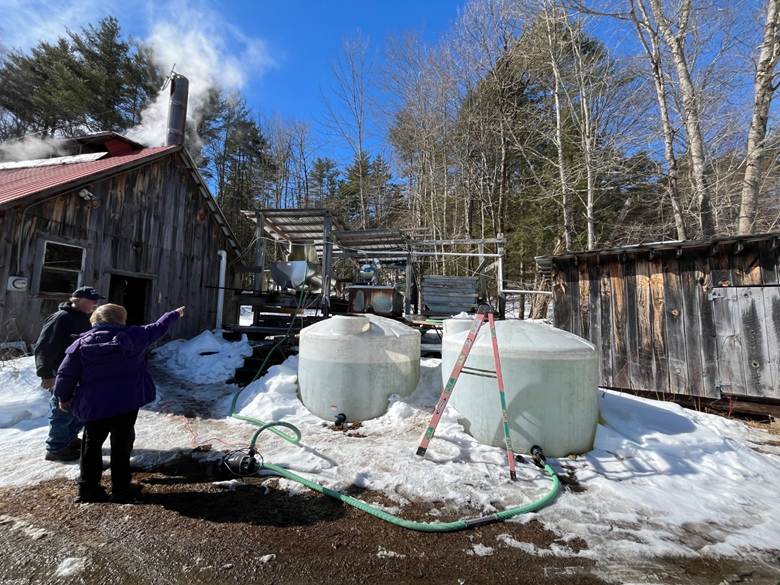
The tanks and pumps are arranged to optimize storage and then allow gravity flow into the equipment in the sugar house:


There is a big vat in the shed, around 4 ft wide x 12 ft long, where the sap is boiled by a wood fire kept going in a lower chamber.

The men have been cutting and splitting wood for months, to get ready for the sugaring season.  Running this operation takes two or three people. Typically, there is one man keeping his eye fixed on the temperature and other properties of the sap that is being boiled, to make sure that the syrup is drawn off at the right consistency and is not overcooked. The syrup should be drawn off when the temperature reaches 219 degrees F (104 C). Another man keeps a timer set, and every six minutes he opens the door to the fire box and throws in half a dozen pieces of wood to keep the fire burning hot:

There is also filtering and handling of the drawn-off syrup, and checking the tankage outside.
As a (retired) chemical engineer, I appreciated an improvement that was added to the boiling operation. Originally, all the steam from the boiling just went into the air of the shed, making it clammy and causing condensation from the roof to drip down onto workers’ heads. The heat of this steam was basically wasted. But they added a fairly high-tech “Steamaway” heat exchanger that sits on top of most of the boiling vat. The steam rises up through channels of incoming sap from the outside. The cool sap is warmed by the rising steam to around 194 F before entering the boiling vat. This preheating means less firewood is needed to make the syrup. Also, much of the steam is condensed into hot water which can be used for washing operations. A bonus is that much less steam ends up in the atmosphere of the shed, so no more dripping onto heads.


The owner, David Franklin, and his family had the vision for this operation. They built the large shed that houses the operation themselves, and invested in the expensive equipment. David is an old-school farmer, of the type skilled in every aspect of workmanship so they can do their own welding and building and equipment repair instead of paying others to do it. Keeping a large farm running smoothly is a complex task that takes more energy and practical know-how than most suburbanites or city dwellers can imagine. The other men running the sugaring operation are all smart and efficient and hard-working, and all retired from responsible, skilled professions. It seems they do the sugaring largely out of the enjoyment of doing a job well alongside worthy companions.

However, they are all over sixty years old. They can’t keep it up indefinitely since there is a lot of physical labor involved, yet the operation can’t afford to hire young people who would do the work just for money.

It is not clear to me, therefore, what the future of operations like this will be in 15 years, as this current generation of workers ages out. Unlike a lot of production, maple syrup making cannot be simply outsourced to Asia.

Anyway, David Franklin’s syrup is delicious. You can buy some on-line here.  Or if you swing by the Franklin Family Farm in Guilford, you can also get some farm fresh eggs and certified organic hamburger, and stew meat.

On Da Vinci and Boredom

I’m finally watching the Ken and Sarah Burns documentary on Da Vinci. It is, predictably, excellent. If you are heavily read on Da Vinci then there probably isn’t much that will be new to you, but the visual composition really adds something to what is less a propulsive story and more an attempt to capture the raw capaciousness of this person’s mind. It’s breathtaking, humbling, and inspiring.

There is a temptation to marvel at his dedication, ability to learn, and breadth. To relegate his accomplishments to the realm of outlier genius. Fight that temptation. Instead, take a moment to consider how dedicated he was to being unencumbered. To finding projects and patrons that would service to subsidize his pursuits in totality.

More than anything, observe a brilliant person for whom both the prospect and opportunity of boredom led him to follow his curiousity into whatever intellectual avenues it wanted to pursue, and then turning his imagination into product manifest in text and on canvas.

Boredom is an opportunity we increasingly don’t afford ourselves nearly enough of. We are starved for boredom. Allow for its sustenance.

Get your HHS Data Ahead of Cuts

The US Department of Health and Human Services has announced it is cutting 10,000 of its 82,000 jobs and restructuring:

As part of the restructuring, the department’s 10 regional offices will be cut to five and its 28 divisions consolidated into 15, including a new Administration for a Healthy America, or AHA, which will combine offices that address addiction, toxic substances and occupational safety into one central office.

AHA will include the Office of the Assistant Secretary for Health, the Health Resources and Services Administration, the Substance Abuse and Mental Health Services Administration, Agency for Toxic Substances and Disease Registry, and the National Institute for Occupational Safety and Health.

These divisions do many different jobs, but as usual what stands out to me is their data- both because it is what I have found directly useful in the past, and because it is what I still have some control over now. Writing your Representatives or writing an op-ed has a minuscule chance of changing Federal policy, but if you download data, you definitely have that data.

What worries me here is that some of the agencies being consolidated might discontinue some of their data products going forward, or even pull some of what they have already created offline. I don’t think this is farfetched given what has happened so far, and given that even in good times these agencies pull down data they painstakingly prepared. For instance, HRSA only publicly posts the State- and County-level Area Health Resources File back to 2019, even though they have annual data going back to 2001.

Probably all 13 of the reorganizing divisions have data worth looking into, and given the staff cuts, even data products in the other divisions could be at risk. But my plan is to focus on the two reorganizing divisions whose data I have previously found useful- HRSA and SAMHSA. HRSA has a nice data download page with 16 different datasets, including the Area Health Resources File, which offers detailed information on the health care workers and facilities in each US county. SAMHSA offers the National Substance Use and Mental Health Services Survey, the Treatment Episode Data Set, and the National Survey of Drug Use and Health. I have previously cleaned and archived the state-level version of the NSDUH, but not the individual-level version that is for now still available from SAMHSA.

All of these datasets are easy to download now, and some will probably become very hard to access later, so now is a good time to take a few minutes and save whatever you think you might need.