Housing is certainly more expensive than in the past. I have written about this several times, including a post from last year showing that between about 2017 and 2022 housing started to get really expensive almost everywhere in the US, not just on the West Coast and Northeast (as had previously been the case). I don’t think the housing affordability crisis is in serious doubt anymore, and it can’t be explained over the past few years by increasing size and amenities, since those haven’t changed much since 2017 (though it is relevant when comparing housing prices to the 1970s).
But why did this happen? Knowing why is crucial, not merely to blame the causes, but because the policy solution is almost certainly related to the causes. I and many others have argued that supply-side restrictions, such as zoning laws, are the primary culprit. The policy solution is to reduce those restrictions. But a recent op-ed titled “Why your parents could afford a house on one salary – but you can’t on two,” the authors place the blame for housing prices (as well as the stagnation of living standards generally) on a different factor: Nixon’s 1971 “severing the dollar’s link to gold.” The authors have a book on this topic too, which I have not yet read, but they provide most of the relevant data in this short op-ed.
Does their explanation make sense? I am skeptical. Here’s why.
A couple of days ago I spoke with a friend who was troubled by the case of Adam Raine, the sixteen-year-old who was counseled by a ChatGPT AI therapy chatbot into killing himself. That was of course extremely tragic, but I hoped it was kind of an outlier. Then I heard on a Bloomberg business podcast that the number one use for AI now is personal therapy. Being a researcher, I had to check this claim.
So here is an excerpt from a visual presentation of an analysis done by Marc Zao-Sanders for Harvard Business Review. He examined thousands of forum posts over the last year in a follow-up to his 2024 analysis to estimate uses of AI. To keep it tractable, I just snipped an image of the first six categories:
It’s true: Last year the most popular uses were spread across a variety of categories, but in 2025 the top use was “Therapy & Companionship”, followed by related uses of “Organize Life” and “Find Purpose”. Two of the top three uses in 2024, “Generate Ideas” and “Specific Search”, were aimed at task productivity (loosely defined), whereas in 2025 the top three uses were all for personal support.
Huh. People used to have humans in their lives known as friends or buddies or girlfriends/boyfriends or whatever. Back in the day, say 200 or 2000 or 200,000 or 2,000,000 years ago, it seems a basic unit was the clan or village or extended kinship group. As I understand it, in a typical English village the men would drift into the pub most Friday and Saturday nights and banter and play darts over a pint of beer. You were always in contact with peers or cousins or aunts/uncles or grandmother/grandfathers who would take an interest in you, and who might be a few years or more ahead of you in life. These were folks you could bounce around your thoughts with, who could help you sort out what is real. The act of relating to another human being seems to be essential in shaping our psyches. The alternative is appropriately termed “attachment disorder.”
The decades-long decline in face-to-face social interactions in the U.S. has been the subject of much commentary. A landmark study in this regard was Robert Putnam’s 1995 essay, “Bowling Alone: America’s Declining Social Capital”, which he then expanded into a 2000 book. The causes and results of this trend are beyond the scope of this blog post.
The essence of the therapeutic enterprise is the forming of a relational human-to-human bond. The act of looking into another person’s eyes, and there sensing acceptance and understanding, is irreplaceable.
But imagine your human conversation partner faked sympathy but in fact was just using you. He or she could string you along by murmuring the right reflective phrases (“Tell me more about …”, “Oh, that must have been hard for you”, blah, blah, blah) but with the goal of getting money from you or turning you towards being an espionage partner. This stuff goes on all the time in real life.
The AI chatbot case is not too different than this. Most AI purveyors are ultimately in it for the money, so they are using you. And the chatbot does not, cannot care about you. It is just a complex software algorithm, embedded in silicon chips. To a first approximation, LLMs simply spit out a probabilistic word salad in response to prompts. That is it. They do not “know” anything, and they certainly do not feel anything.
Here is what my Brave browser embedded AI has to say about the risks of using AI for therapy:
Using AI chatbots for therapy poses significant dangers, including the potential to reinforce harmful thoughts, fail to recognize crises like suicidal ideation, and provide unsafe or inappropriate advice, according to recent research and expert warnings. A June 2025 Stanford study found that popular therapy chatbots exhibit stigmatizing biases against conditions like schizophrenia and alcohol dependence, and in critical scenarios, they have responded to indirect suicide inquiries with irrelevant information, such as bridge heights, potentially facilitating self-harm. These tools lack the empathy, clinical judgment, and ethical framework of human therapists, and cannot ensure user safety or privacy, as they are not bound by regulations like HIPAA.
AI chatbots cannot provide a medical diagnosis or replace human therapists for serious mental health disorders, as they lack the ability to assess reality, challenge distorted thinking, or ensure safety during a crisis.
Research shows that AI systems often fail to respond appropriately to mental health crises, with one study finding they responded correctly less than 60% of the time compared to 93% for licensed therapists.
Chatbots may inadvertently validate delusional or paranoid thoughts, creating harmful feedback loops, and have been observed to encourage dangerous behaviors, such as promoting restrictive diets or failing to intervene in suicidal ideation.
There is a significant risk of privacy breaches, as AI tools are not legally required to protect user data, leaving sensitive mental health information vulnerable to exposure or misuse.
The lack of human empathy and the potential for emotional dependence on AI can erode real human relationships and worsen feelings of isolation, especially for vulnerable individuals.
Experts warn that marketing AI as a therapist is deceptive and dangerous, as these tools are not licensed providers and can mislead users into believing they are receiving professional care.
There’s nothing to untangle here. No confusion over the underlying economics. No panic or fear mongering through false claims of violent crime. It’s blocking high skilled workers our economy is desperate for in hopes that the prospects of enormous damage will create yet another source of power that will lead to wealth being transferred from industry into the pockets of the administration.
It’s bad. It’s getting worse. It’s the first time I’ve experienced a steady stream of economic policy that there is no one to argue with because there is no earnest belief that this will improve social welfare. It’s just a grift.
The only thing that remains certain is that there will be a new version of this every week and month until they are stopped. I’m pretty sure I can just replace the details of the story, and then copy and paste the rest of this post going forward.
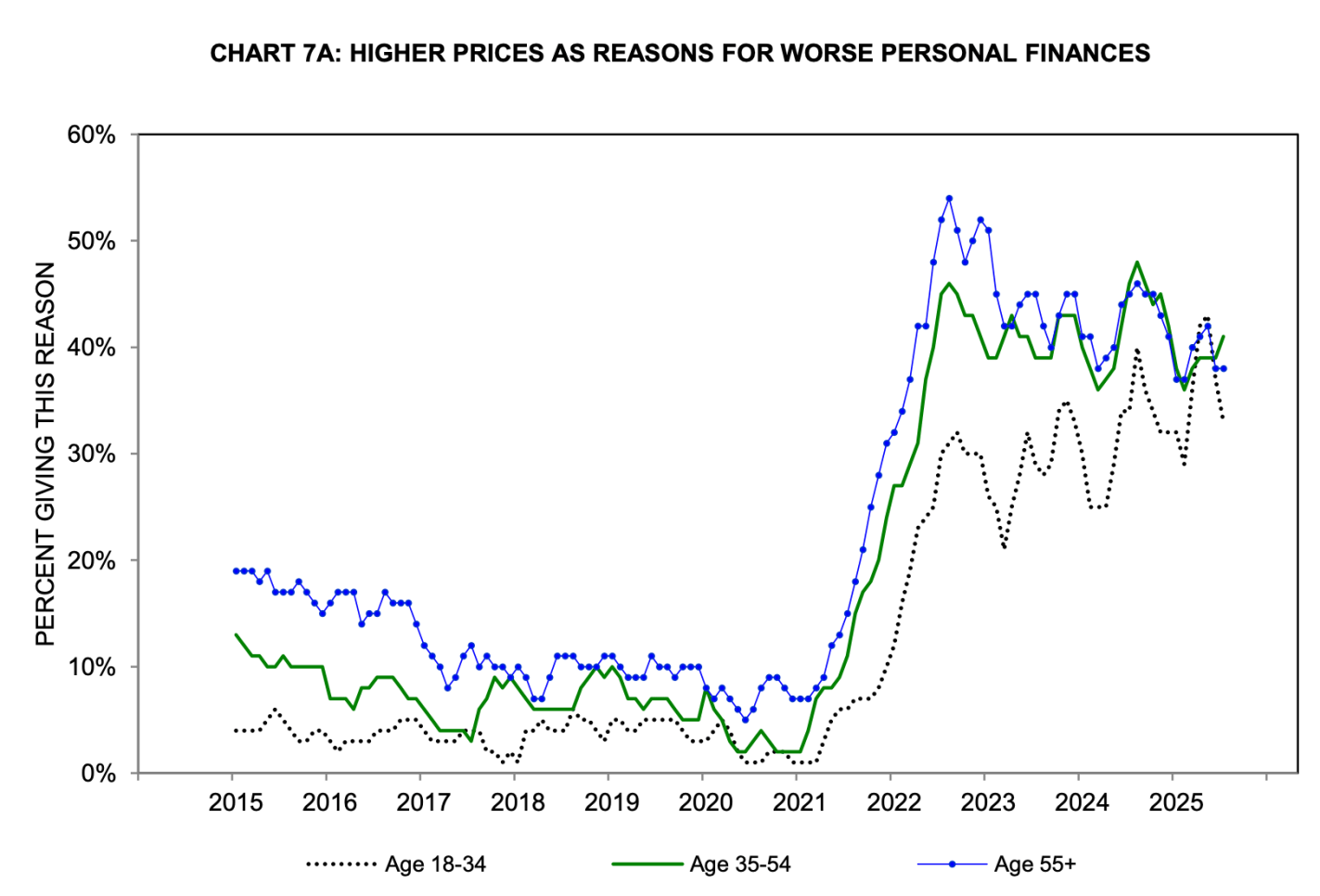
But as Jeremy often points out here, young adults have actually been doing pretty well at building wealth. So why are they so gloomy?
Since I’ve now aged out of the young adult category, I’m obligated to start by wondering if kids these days are just whinier, and need to quit doomscrolling and toughen up. But if I try to see things their way, here’s what I can come up with for why their pessimism could be rational:
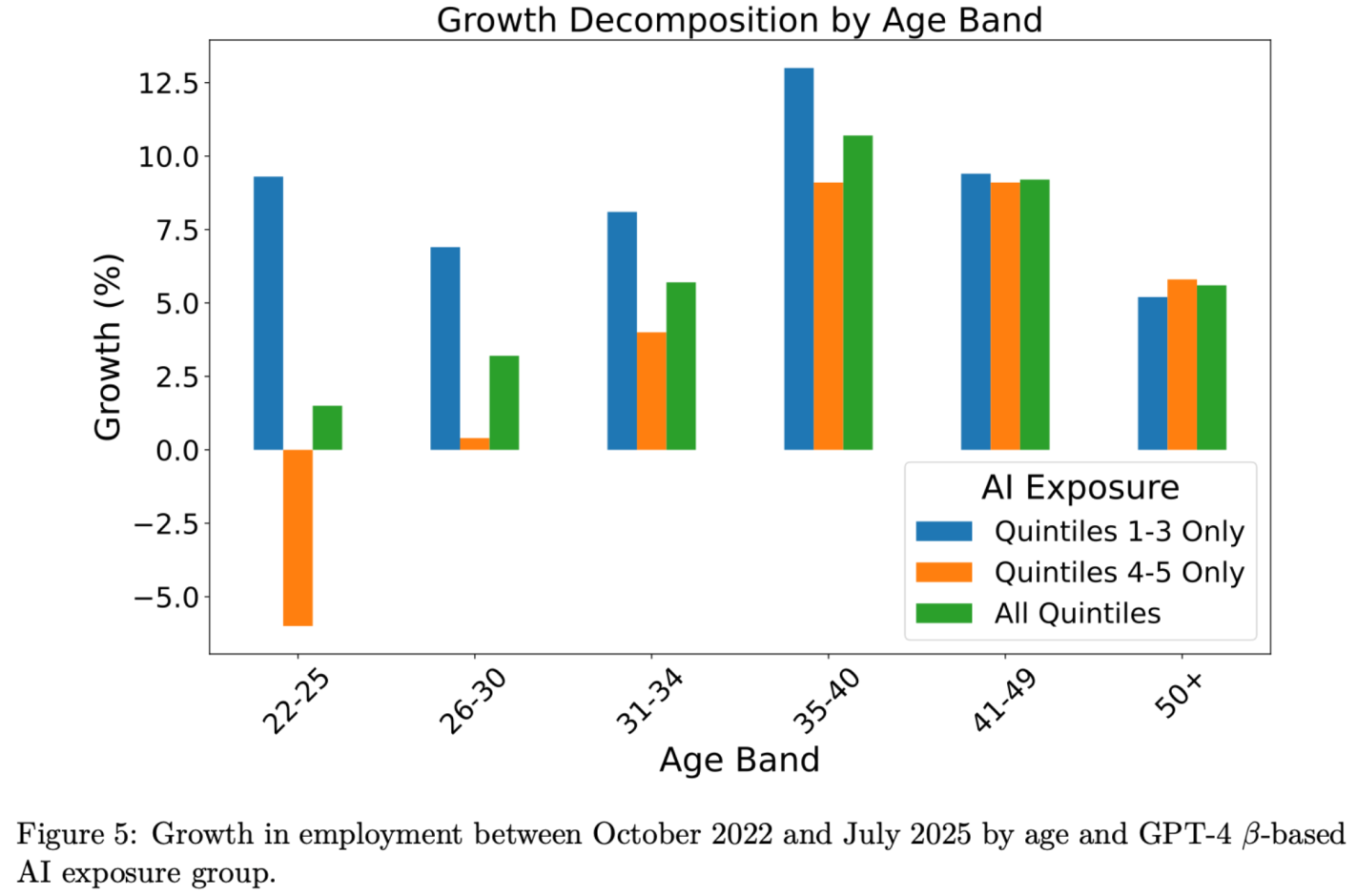
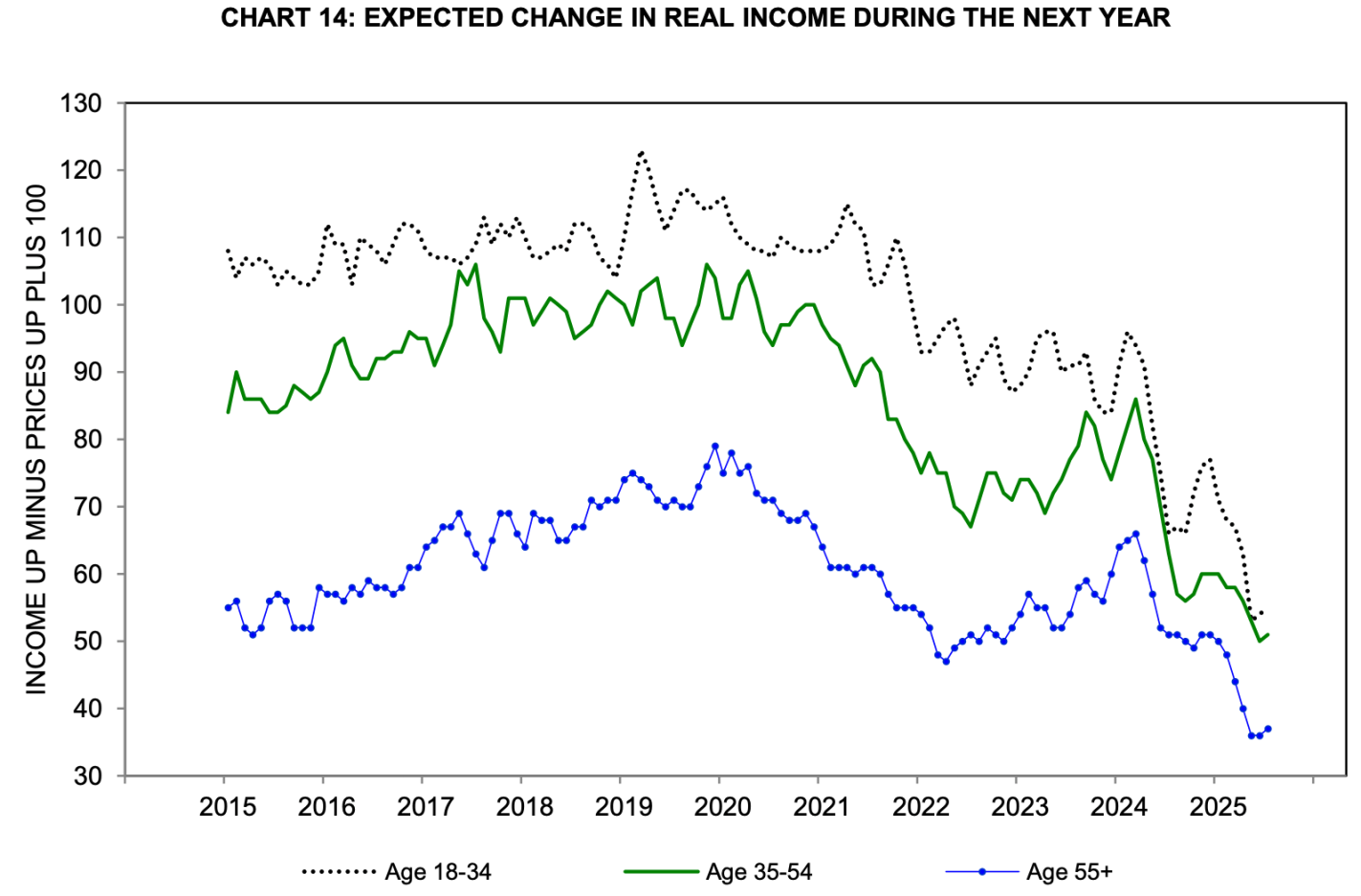
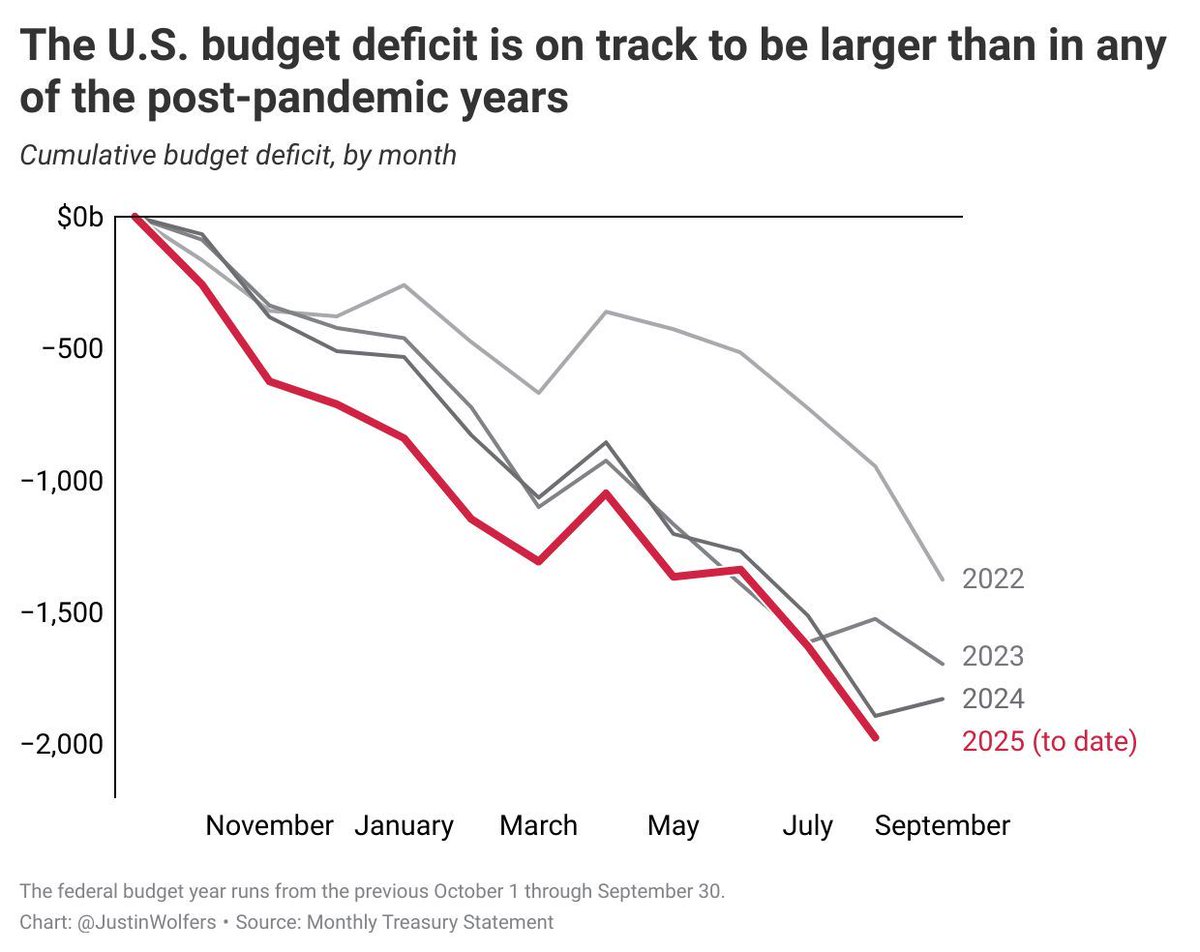
It’s About The Future: Sure things have been fine, but that is about to change. The more farsighted youth know they will be the ones expected to pay back the big deficits the Federal government is running. They have student loans to pay today now that payments have fully resumed. I predicted after the 2022 student loan forgiveness that we would be back to all-time highs in student debt by 2028, but in fact we are there already. The youth unemployment rate is now 10.5%, up from 6.6% in April 2023, and could rise a lot more if AI really starts displacing jobs:
Source: Brynjolfsson, Chandar and Chen 2025.Source: Michigan Consumer Survey
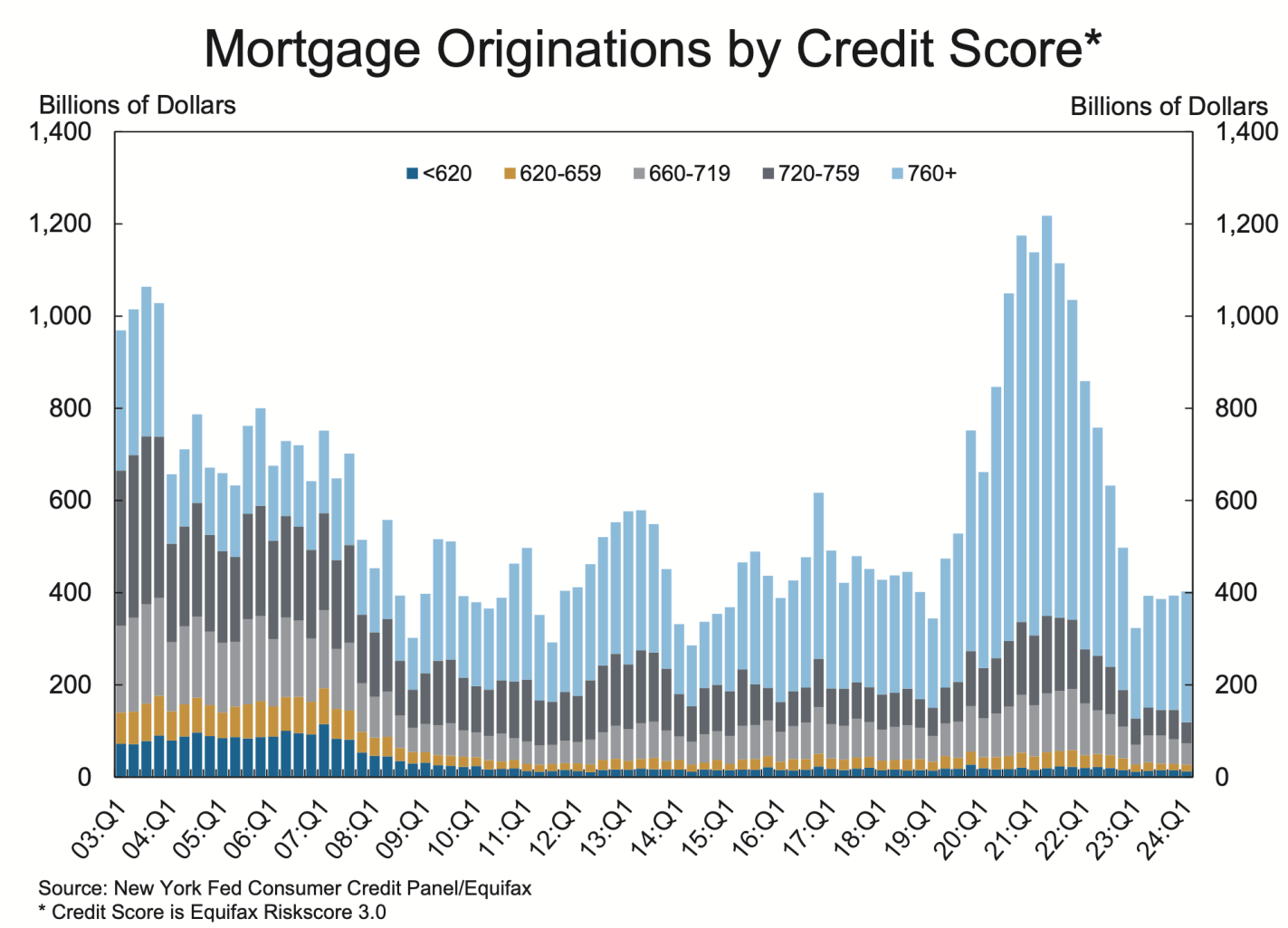
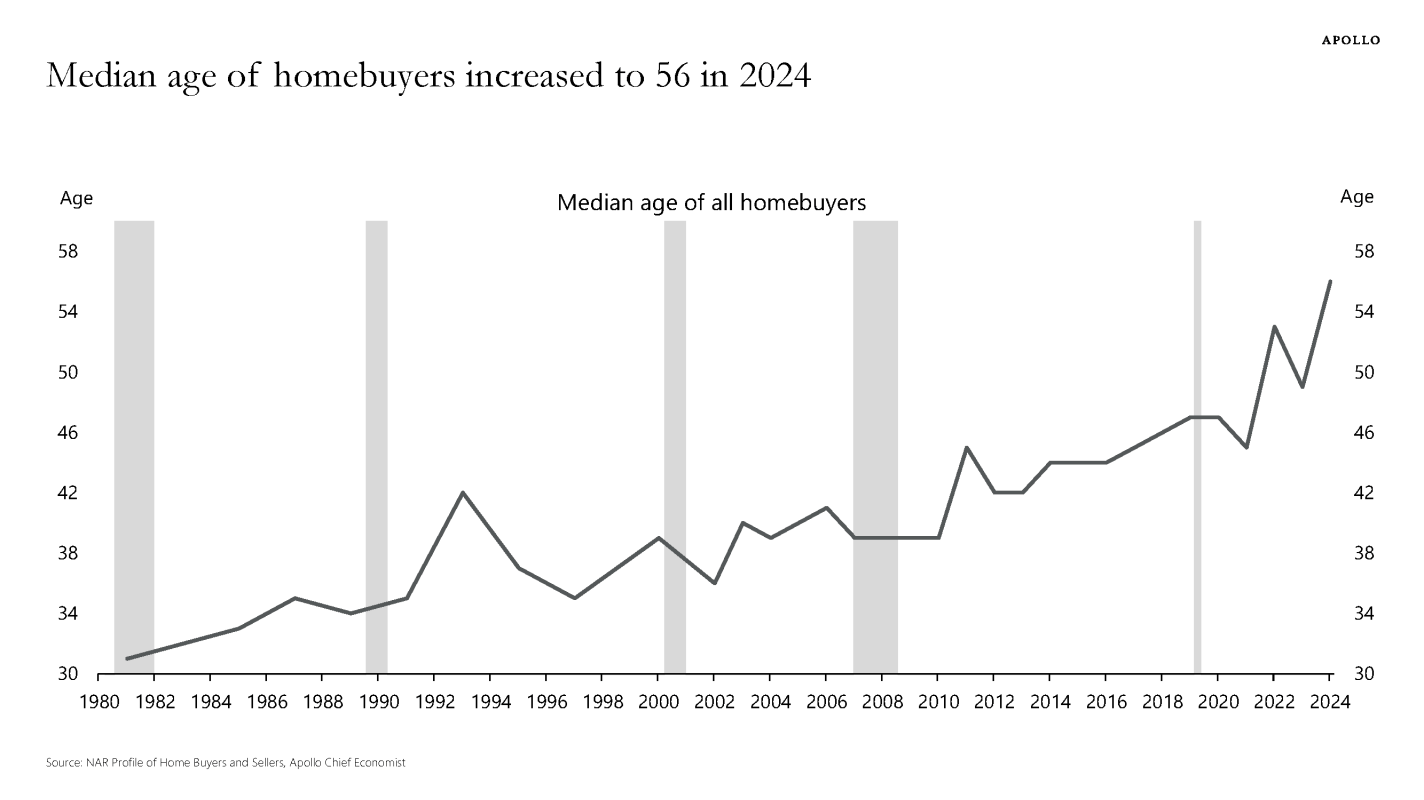
2. It’s About Housing: House prices are at all time highs (far above the prices during the 2000s “bubble”). Mortgage rates remain high, and to the extent that Fed rate cuts push them down, they will likely push prices higher, leaving homes hard to afford. High credit standards post-Dodd-Frank mean younger buyers in particular find it hard to get a mortgage; homeownership rates are falling while the average age of homeowners shoots upward. Most older people already own a house, while most young people want to buy but see that as increasingly out of reach.
Good luck getting a mortgage without super-prime creditEveryone thinks it’s a bad time to buy a house, but this matters most if you’re young and don’t already own oneThe median American is 39 years old but the median homebuyer is 56
There are two main questions. Will AI companies need to pay compensation to authors they are currently training off of? Secondly, how important is it for human writing to be a paying career in the future, if AI continues to need good new material to train from?
There is more at the link but here are some quotes:
If human writing ceases to be a viable career due to inadequate compensation, will LLMs lose access to fresh, high-quality training data? Could this create a feedback loop where AI models, trained on degraded outputs, stagnate?
This case also blurs the traditional divide between copyright and patents. Copyrighted material, once seen as static, now drives “follow-on” innovation derived from the original work. That is, the copyright protection in this case affects AI-content influenced by the copyrighted material in a way that previously applied to new technology that built on patented technical inventions. Thus, “access versus incentives” theory applies to copyright as much as it used to apply to patents. The Anthropic settlement signals that intellectual property law, lagging behind AI’s rapid evolution, must adapt.
This is post coauthored with Jack Cavanaugh, Ave Maria University Graduate of 2025.
Say that you want to become a successful lawyer. What does that mean? One possible meaning is that you are well-compensated. Money is not everything, but it does give people more options for how to spend their time and resources. Law degrees are a type of graduate degree. So, what bachelor’s degree major should one choose in preparation for law school? We lack rich administrative data on college majors and LSAT scores.
Luckily, the 2023 American Community Survey (ACS) comes to the rescue. It has all of the typical demographic covariates, income, occupation, and college major. So, if we make the small leap that well-prepared law school students become high-performing lawyers who are ultimately paid more, then what college major puts you on the right path? What should your major be?
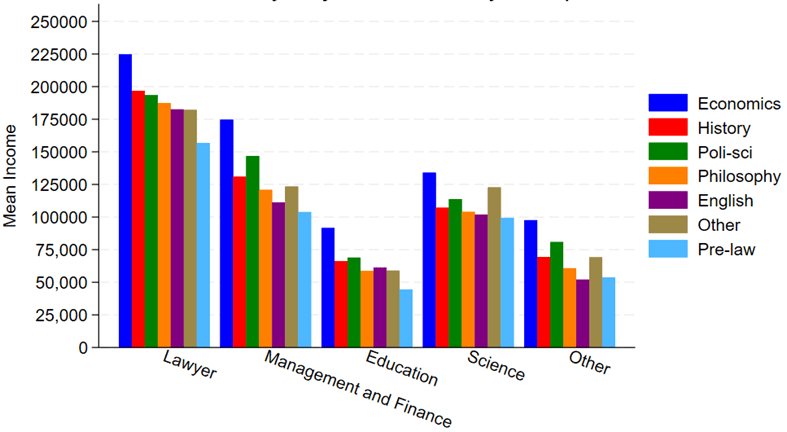
We don’t look at an exhaustive list. We place several occupations into bins and examine only a few alternative majors. Any unlisted major falls under ‘other’. Below are the raw average incomes by occupational category and college major. Note two majors in particular. First, Pre-law literally has the word ‘law’ in the name and is marketed as preparation for law school. However, it is the undergraduate major associated with the lowest paid lawyers. For that matter, Pre-law majors have the lowest pay no matter what their occupation is. Second, Economics majors are the most highly paid in all of the occupations.
The Fed has had an official inflation target of 2% since 2012, a commitment they reaffirmed just last month after their policy review:
The Committee reaffirms its judgment that inflation at the rate of 2 percent, as measured by the annual change in the price index for personal consumption expenditures, is most consistent over the longer run with the Federal Reserve’s statutory maximum employment and price stability mandates.
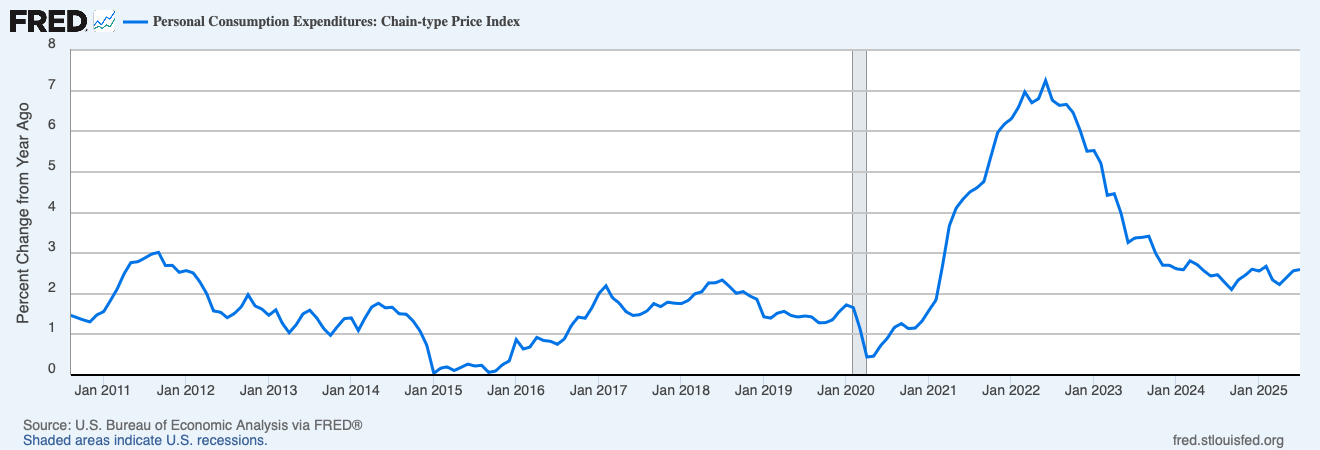
But since 2020, they haven’t been acting like it. Lets look at their preferred measure of inflation, the annual change in the PCE price index:
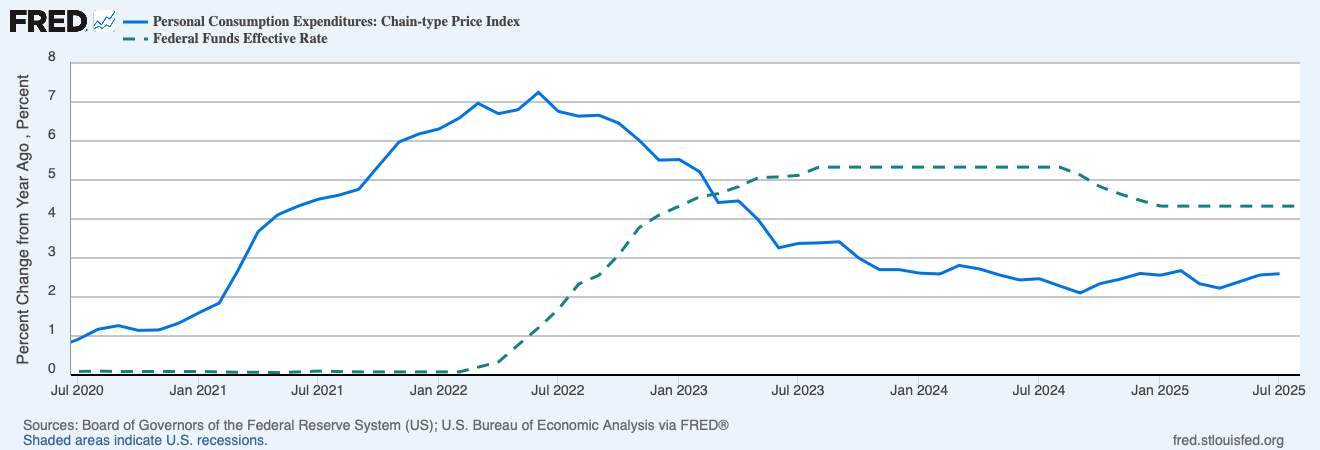
The last time annual inflation was at or below 2.0% was February 2021. The Fed just cut rates despite inflation being at 2.6%. If you didn’t know about their 2% target and were trying to infer their target based solely on their actions, what would you guess their target is?
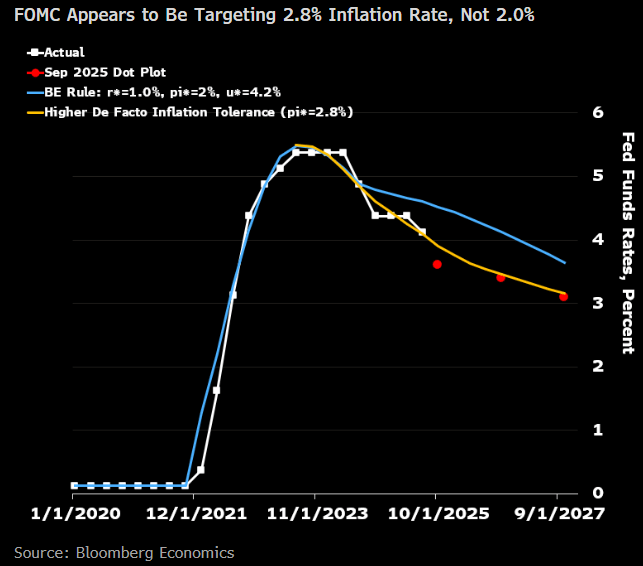
Considering the post-Covid period, I see their actions as being more consistent with a 3% target than a 2% target. They stopped raising rates once inflation got below 3.4%, and started cutting them again once inflation got below 2.4%. The Fed’s own projections show more rate cuts coming despite the fact that they don’t expect inflation to get back to 2.0% until 2028! Bloomberg’s Anna Wong does the math and infers their target is 2.8%:
Perhaps the Fed’s target should be higher than 2%, but if they have a higher target, they should make it explicit so as not to undermine their credibility. Or at least make explicit that their target is loose and they’d rather miss high than low, if that is in fact the case. This is what Greg Mankiw would prefer:
I feel strongly that a target of 2 percent is superior to a target of 2.0 percent….. It would be better if central bankers admitted to the public how imprecise their ability to control inflation is. They should not be concerned if the inflation rate falls to 1.6. That comfortably rounds up to 2. And they should be ready to declare victory in fighting inflation when the inflation rate gets back to 2.5. As the adage goes, that is good enough for government work. Maybe the Fed should even ditch a specific numerical target for inflation and instead offer a range, as some other central banks do. The Fed could say, for example, that it wants to keep the inflation rate between 1 and 3. Doing so would admit that the Fed governors are notquite as godlike as they sometimes feign.
The Fed seems to have taken Mankiw’s approach to heart, except with a preferred range of 2.0-3.5%. I take Mankiw’s point about not being able to fine-tune everything, but given the bigger picture I think the Fed should if anything err on the low side of 2.0%. The Federal deficit is in the trillions and rising, inflation has been above target since 2021, and consumers never got over the Covid-era increase in the price level:
Source: Michigan Consumer Survey
The Fed let inflation stay mostly below 2% during the 2010s, to the detriment of the labor market. They updated their policy framework in 2020 to allow for “Flexible Average Inflation Targeting”, where they would let inflation stay above 2% for a while to make up for the years of below 2% inflation. This is part of why they let inflation get so out of hand in 2022. This made up for the 2010s and then some- our price level is now 3-4% higher than it would be if we’d had 2.0% inflation each year since 2007. But the sudden big burst of inflation in 2022 led the Fed to abandon this flexible targeting idea in the 2025 framework. The lack of “make up” policy latest framework means that they don’t see themselves as needing to do anything to repair their 2022 mistake- “just don’t do it again”.
We’re certainly being stuck with permanently higher prices as a result, and I worry we will be stuck with higher inflation too.
This is from the latest Census release of CPS ASEC data, updated through 2024 (see Table F-23 at this link). In 1967, only 5 percent of US families earned over $150,000 (inflation adjusted).
Addendum: Several comments have asked how much of these trends can be explained by the rise of dual-income households. The answer is some, but not all of it, which I have written about before. Dual-income households were already the most common family structure by the 1980s. There hasn’t been an increase in total hours worked by married households since Boomers were in their 30s. You can explain some of the increase up until the Boomers by rising dual-income households, but this doesn’t explain the continued progress since the 1980s. And as Scott Winship and I have documented, even if you look just at male earnings, there has been progress since the 1980s.
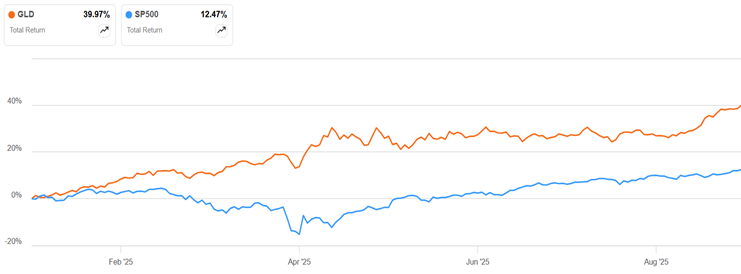
Stocks (e.g., S&P 500) are up 12.5 % year to date. That is pretty good for 9.5 months. But gold has been way better, up 40%:
Fans of gold cite various reasons for why its price should and must keep going up (out of control federal debt and associated money-printing, de-dollarization by non-Western nations, buying by central banks, etc.). I have no idea if that is true. But if it is, that raises the question in my mind: for the limited amount of funds I have to invest in gold, can I get more bang for my investing bucks, assuming gold continues to rise?
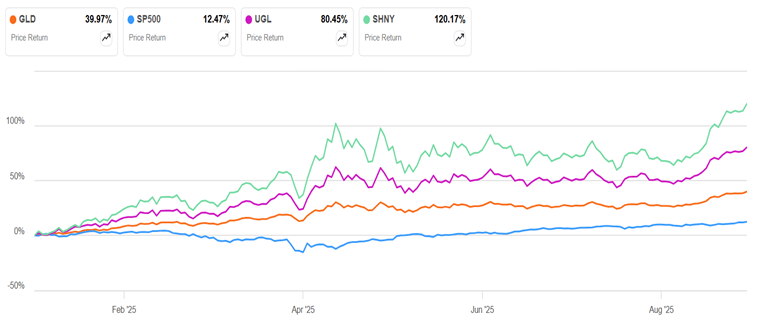
It turns out the answer is yes. A straightforward way is to buy into a fund which is 2X or 3X leveraged to the price of gold. If gold goes up 10%, then such a fund will go up 20% or 30%. Let’s see how two such funds have done this year, UGL (a large 2X gold fund) and a newer, smaller 3X fund, SHNY:
Holy derivatives, Batman, that leverage really works! With GLD (1X gold) up 40%, UGL was up 80% year to date, and 3X SHNY is up 120%. So, your $10,000 would have turned into $24,000. The mighty S&P500 (blue line) looks rather pitiful in comparison.
But wait, there’s more. Let’s consider gold “streamers”, like WPM (Wheaton Precious Metals) or FNV. They give money to mines in return for a share of the production at fixed, discounted prices, so their cash flow soars when gold prices rise. Year to date, FNV is up 73%, while WPM is up 91%.
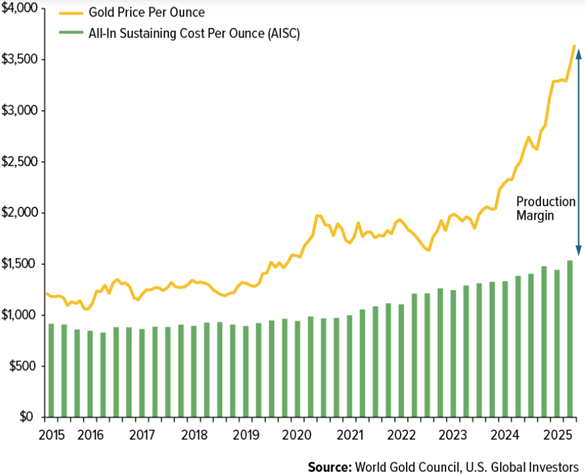
And then there are the gold miners themselves. They tend to have fairly fixed breakeven costs of production, currently around $1200-1400/oz. Again, their profit margin rockets upward when gold prices get far above their breakeven:
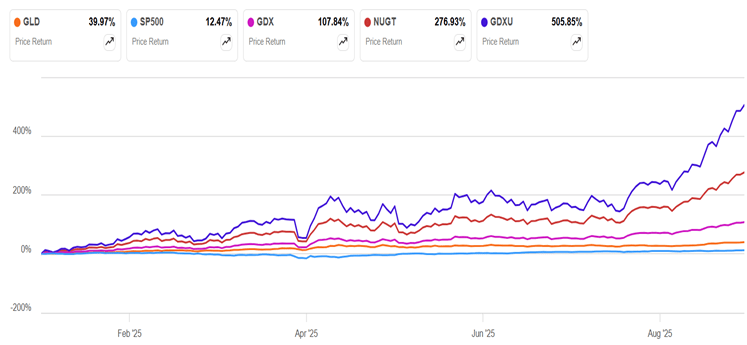
GDX is a large fund of representative mining stocks. For icing on the cake, there are funds that are 2X (NUGT) or 3X (GDXU) leveraged to the price changes in mining stocks. The final chart here displays their year-to-date performance in all their glory:
The blue S&P 500 line is lost in the noise, and even the orange 40% GLD line is left in the dust. The 1X miner fund was up 108%, the 2X fund NUGT was up 276%, and the 3X GDXU was up 506%. Your $10,000 would have turned into $51,000.
Of course, what goes up fast will also come down fast, since leverage works both ways. For instance, from Oct 21 to Dec 30, 2024, gold was down a mere 4%, but WPM was down 15%, the 1X gold miner GDX was down 20%, and 3X GDXU down an eye-watering 54%. That means that your $10,000 turned into $4,600 in two months. Imagine watching that unfold, and not panic-selling at the bottom. Gold fell by more than half between 2011 and 2015. If it fell by even 20% (i.e., gave up half of this year’s gains), I could see a 3X miner fund losing over 90% of its value (just a guess).
One more twist to mention here is the “stacked” fund GDMN, which uses derivatives to be long 1X gold PLUS 1X gold miners. It is up 151% this year, which is nearly four times as much as gold. This fund seems to have a nice combination of decent leverage with moderate volatility. It has on average kept pace with the 2X miner fund NUGT, with shallower dips. NUGT has surged way ahead in the past two months as miner stock prices have gone nuts, but that is somewhat exceptional.
Disclaimer: As usual, nothing here should be considered advice to buy or sell any security.
I’ve been making a point to fill in the “gaps” in my film history lately. Yesterday I finally watched the John Cassavettes classic “A Woman Under the Influence” starring Gena Rowlands and Peter Falk. It is a fantastic film, with two incredible performances by the leads, but it is also emotionally exhausting as you watch an already strained woman entirely unravel. It’s the kind of movie that a modicum of chain smoking would probably make for easier viewing. I broke it into two separate sittings.
Nobody needs a new review of a 50 year old film- Roger Ebert already covered it ably, but there is reason to see it with fresh eyes. The principal word used to describle Mabel (played by Rowlands in a jaw dropping performance) is “crazy”. A least one person refers to her as anxious, but insanity is the general catch-all concept.
When you watch it now, though, you see a woman who would likely be be diagnosed with some variation of bipolar disorder, triggered by social anxiety. If she were to grow up today the observation of repeated physical “ticks” might have been associated with Tourettes or identified as the physical coping mechanisms of a child on the autism spectrum dealing with an avalanche of indecipherable social cues. I don’t actually know – the character is fictional and I am not a psychiatric professional. The point is that there are social, medical, and educational mechanisms in place to help a greater variety of people thrive. Maybe it’s just that we recognize a richer set of personal attributes and diversity of personalities than prior decades. There are handles for a person to grab on to before their life spins out of control.
There exists a sentiment that maybe we’ve gone too far, that we’re overdiagnosing, over- compartmenalizing, and over-accomodating a variety of behaviors as mental illness or disorder. And I can see the logic sometimes. But I think we’ve come so far that we can sometimes lose sight of the incredible value of the progress made. There are easily thousands, likely millions, of people who would have in prior generations been expected to endure a life of quiet misery or, barring that, be pushed sufficiently to the periphery that their suffering was just out of earshot. Instead they are provided language to understand themselves and communicate their needs to others, and sometimes the tools to optimize within their diverse set of needs and constraints. That’s much better.
Nirvana fallacies abound, especially when nostalgia paints over the obviously inferior parts of our personal histories. The present is taken for granted, it’s flaws drawn in sharp relief against an imagined perfect future rather than vastly inferior past. There is little to be looked back upon fondly in the formal and informal institutions of mental health. Better to have progressed an overly diagnosed and indulgent inch passed the unknowable social optimum than regress to a past where ignorance obstructed our empathy.