Free Webinar, Jan. 25: Practical and Ethical Aspects of Future Artificial Intelligence

As most of us know, artificial intelligence (AI) has taken big steps forward in the past few years, with the advent of Large Language Models (LLM) like ChatGPT. With these programs, you can enter a query in plain language, and get a lengthy response in human-like prose. You can have ChatGPT write a computer program or a whole essay for you (which of course makes it challenging for professors to evaluate essays handed in by their students).

However, the lords of Big Tech are not content. Their goal is to create AI with powers that far surpass human intelligence, and that even mimics human empathy. This raises a number of questions:

Is this technically possible? What will be the consequences if some corporations or nations succeed in owning such powerful systems? Will the computers push us bumbling humans out of the way? Will this be a tool for liberation or for oppression? This new technology coming at us may affect us all in unexpected ways. 

For those who are interested, there will be a 75-minute webinar on Saturday, January 25 which addresses these issues, and offers a perspective by two women who are leaders in the AI field (see bios below). They will explore the ethical and practical aspects of AI of the future, from within a Christian tradition. The webinar is free, but requires pre-registration:

Here are bios of the two speakers:

Joanna Ng is a former IBM-er, pivoted to a start-up founder, focusing on Artificial Intelligence, specialized in Augmented Cognition, by integrating with IoT and Blockchain, in the context of web3, by applying design-thinking methodology. With forty-nine patents granted to her name, Joanna was accredited as an IBM Master Inventor. She held a seven-year tenure as the Head of Research, Director of the Center for Advanced Studies, IBM Canada. She has published over twenty peer-reviewed academic publications and co-authored two computer science books with Springer, The Smart Internet, and The Personal Web. She published a Christianity Today article called “How Artificial Intelligence Is Today’s Tower of Babel” and published her first book on faith and discipleship in October 2022, titled Being Christian 2.0.

Rosalind Picard is founder and director of the Affective Computing Research Group at the MIT Media Laboratory; co-founder of Affectiva, which provides Emotion AI; and co-founder and chief scientist of Empatica, which provides the first FDA-cleared smartwatch to detect seizures. Picard is author of over three hundred peer-reviewed articles spanning AI, affective computing, and medicine. She is known internationally for writing the book, Affective Computing, which helped launch the field by that name, and she is a popular speaker, with a TED talk receiving ~1.9 million views. Picard is a fellow of the IEEE and the AAAC, and a member of the National Academy of Engineering. She holds a Bachelors in Electrical Engineering from Georgia Tech and a Masters and Doctorate, each in Electrical Engineering and Computer Science, from MIT. Picard leads a team of researchers developing AI/machine learning and analytics to advance basic science as well as to improve human health and well-being, and has served as MIT’s faculty chair of their MindHandHeart well-being initiative.

Paying people not to work can save a lot of money

Failure to elucidate (or the intended obscuring) of unseen policy costs and benefits is the kind of stuff that sends economists to an early retirement. The most common example is the unrealized gains from potential trade that haunt any and all forms of protectionism, but I often find more “micro” examples easier to convince an audience of because it allows them to delve into their own lived experience for supporting evidence.

I’m a big fan of this conversation with co-founder Reed Hastings about severance package generosity at Netflix. The interviewer is absolutely baffled that they offer a minimum of 4 months severance for all employees, with 100% pay and benefits, immediately after hiring, and it grows with length of tenure after that. How could a company afford such a costly line item, particularly one that yields no benefits at all? It’s exactly the kind of policy a central casting stereotype of an MBA would never consider or, perhaps more telling, would be the first on the chopping block when cutting costs to pump up quarterly earning numbers.

What Hastings lays out, besides just the warm-glow benefits of a more “compassionate” severance policy, is the subtle efficiency at the margin. The people making the decision to lay off an employee are sympathetic, pro-social, perfectly normal human beings. They don’t want to hurt someone else which means, perhaps even selfishly, they will take a series of costly intermediate steps to delay the prospective firing of a poorly matched or unproductive employee. The manager will incur costs that perhaps signal to the employee that they are inherently valued, that they, the manager and the company, want the employee to succeed, that any eventually possible firing is only an action of last resort. These actions, as anyone who’s ever had a job will know, rarely if ever succeed in reorienting the employee to a new and fruitful line of productivity. Rather, they simply delay their eventual firing, leaving them in the lurch to find new employment. The costs incurred to soften the impact of the inevitable firing are internalized as benefits by neither the employee nor the firm.

The more efficient policy, to the benefit of everyone involved, is to make the employment separation as early as possible, rolling over as much of those saved costs into a (nearly) pure cash severance that will soften their landing and subsidize their search for their next job. In anything less than the weakest job market four months is enough time to not just find a job, but to be selective in that search. Extended severance strengthens the bargaining power of the former employee in their job search because they don’t have to say yes to the first offer.

From the employer side, they can rest easy knowing that because their managers will not have to incur the emotional cost of wrecking their employees lives with cold calculating decisions to leave in employees in the lurch with 2 weeks pay and a “good luck” out the door, managers will, in turn, make employment decisions faster and more decisively. Generous severance pay is a perfect example of an excellent policy that only looks inefficient to those naive to the actual decisions being made on the ground. Conversely, a more draconian policy carries the pretense of a colder efficiency, when the reality is a flailing hodgepodge of spinning wheels and sundry transaction costs.

What other policies, micro or macro, might see their efficiency aspirations and denunciations wholly inverted if we were to consider not just their line item magnitudes on a spreadsheet, but the whole of their of interconnected costs and benefits?

The Chair on Netflix

The Chair on Netflix is entertaining and I’d recommend it to EWED readers.

Plot, via Wikipedia: Professor Ji-Yoon Kim is the newly appointed chair of the English department at Pembroke University. The first woman chosen for the position, she attempts to ensure the tenure of a young black colleague, negotiate her relationship with her crush, friend, and well-known colleague Bill Dobson, and parent her strong-willed adopted daughter.

Something I like about the writing is that there is genuine suspense. Going into the last episode, I didn’t know what would happen with the romance or the threat of job dismissals.

The show is funny, occasionally. If you are looking for something easy to watch in 30-minute episodes at the end of the day that won’t leave you too upset, this will work.

Some of the issues they raise deserve serious treatment, but the serious treatment will not be found in The Chair. It’s for Netflix, with binge watching potential. Without offering any spoilers, I’d say they supply the kind of ending that viewers want. You need not overthink it.

Continue reading

Intersectionality Eliminates Measured Hiring Bias

The US Equal Opportunity Commission identifies characteristics by which an employee can’t be harassed, hired, paid, or promoted. A challenge with enforcing the non-discriminatory standards is that the evidence must be a slam dunk. There needs to be a smoking gun of a paper trail, recorded conversation, or multiple witnesses. Mere statistical regularities are insufficient for demonstrating that characteristics like race, age, or sex are being considered inappropriately.

If employees are all identically qualified, then we’d expect the employment at a firm to reflect the characteristics of the applicant pool, within a margin of error due to randomness. One difficulty is that plenty of discrimination can occur within that margin of error. A firm may not have sexist policies, but a single manager can be sexist once or even multiple times and still keep the firm-level proportions within the margin of error. This is especially stark if the company managers or officers are the primary positions for which discrimination occurs.

Another difficulty is that randomness can cause extreme proportions of employee characteristics. Having a workplace that is 95% male when the applicant pool is 60% male isn’t necessarily discriminatory. In fact, given a sample size, we can calculate how likely such an employee distribution would occur by randomness. Even by randomness, extreme proportions will inevitably occur.  As a result, lawsuits or complaints that have only statistical evidence of this sort don’t  go very far and tend not to win big settlements.

But this doesn’t stop firms from avoiding the legal costs anyway. Firms generally prefer not to have regulatory authorities snooping around and investigating. Most people break some laws even unintentionally or innocuously, and a government official on the premises increases the expected compliance costs. Further, even if untrue accusations are made, legal costs can be substantial. Therefore, firms have an incentive to ensure that they can somehow demonstrate that they are not being discriminatory based on legally protected characteristics.

However, as I said, extreme proportions happen randomly. If those extremes are interpreted as evidence of illegal discrimination, then the firms have an incentive to hire among identical applicants in a non-random manner. They have an incentive to tilt the scales of who gets hired in favor of achieving a specific distribution of race, sex, etc. People have a variety of feelings about this. Some call it ‘reverse discrimination’ or discrimination against a group that has not historically experienced widespread disfavor. Others say that hiring intentionally on protected characteristics can help balance the negative effects of discrimination elsewhere. I’m not getting into that fight.

Continue reading

The Little Book of Common Sense Investing

John Bogle, the founder of Vanguard, wrote a short book in 2006 that explains his investment philosophy. I can sum it up at much less than book length: the best investment advice for almost everyone is to buy and hold a diversified, low-fee fund that tracks an index like the S&P 500.

Of course, a strategy that is simple to state may still take time to understand and effort to stick to. So the book helps to build intuition for why this strategy makes sense. I think Bogle makes his case well, though the book is getting a bit dated- the charts and examples end in 2006, and he sets up mutual funds as the big foil, when today it might be high-fee index funds or picking your own stocks.

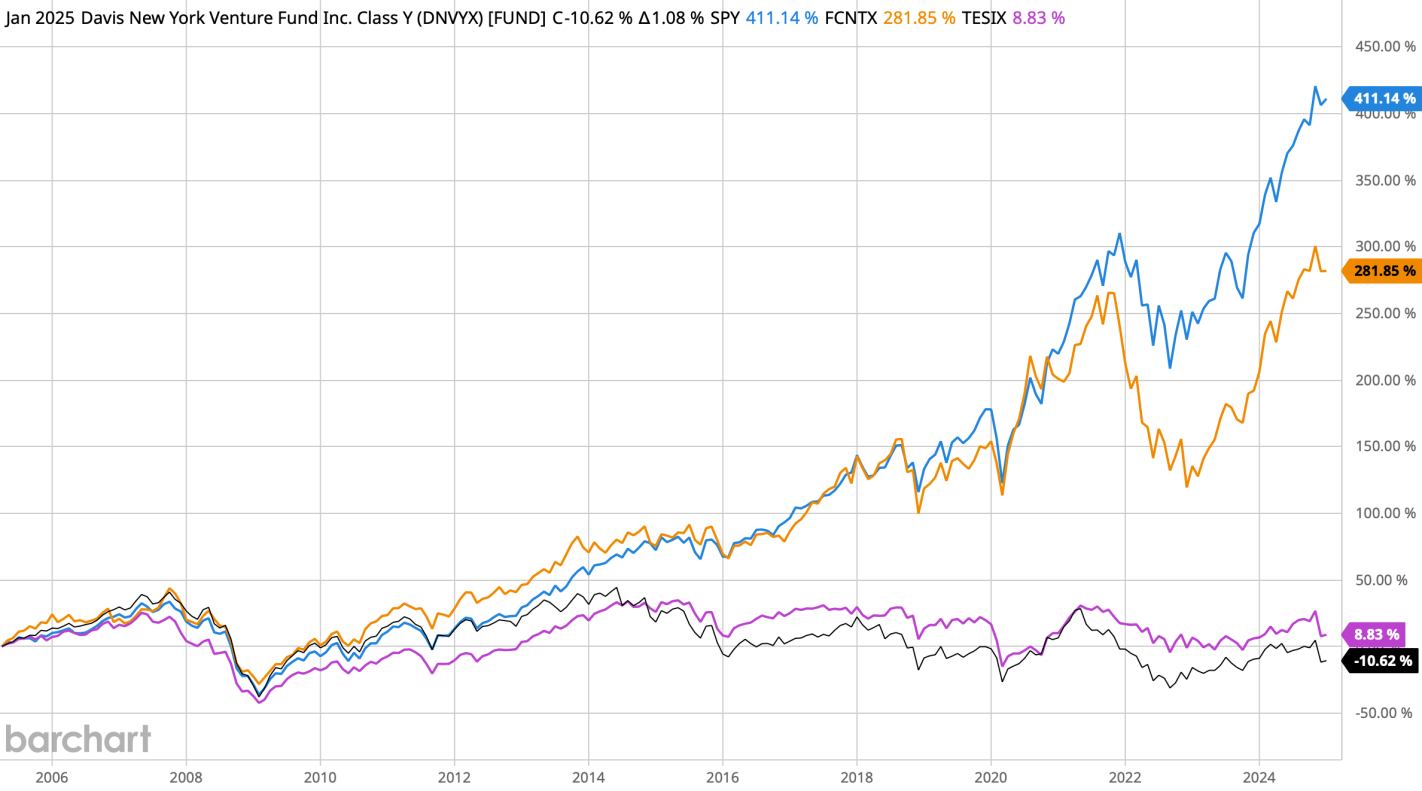
The silver lining of any dated investing book is that we can check up on how its predictions have fared. In chapter 8, Bogle compared the performance of the 355 equity mutual funds that existed in 1970 to that of the S&P over the 1970-2006 period. He notes that 223 of the funds had gone out of business by 2006, and even most of the surviving funds underperformed the S&P. But he identifies 3 funds that outperformed the S&P significantly (over 2% per year) on a sustained basis (consistently good performance, not just high returns at the beginning when they were small): Davis New York Venture, Fidelity Contrafund, and Franklin Mutual Shares. But how have they done since the book came out?

It is a huge victory for the S&P (in blue). Franklin Mutual Shares is basically flat over the past 20 years, while Davis New York Fund actually lost money. Fidelity Contrafund returned a respectable 281% (about 7% per year), and matched the S&P as recently as 2020. But as of 2025 the S&P is the clear winner, up 411% in 20 years (over 8% per year). Score one for Bogle.

But I still have to wonder if there is a way to beat the S&P- and I think one of Bogle’s warnings is really an idea in disguise. He warns repeatedly about “performance chasing”:

But whatever returns each sector ETF may earn, the investors in those very ETFs will likely, if not certainly, earn returns that fall well behind them. There is abundant evidence that the most popular sector funds of the day are those that have recently enjoyed the most spectacular recent performance, and that such “after-the-fact” popularity is a recipe for unsuccessful investing.

The claim is that investors pile into funds that did well over the past 1-3 years, but these funds subsequently underperform. But if this is true, could you succeed by reversing the strategy, buying into the unpopular sectors that have recently underperformed? I’ve been wondering about this, though I have yet to try seriously backtesting the idea. I was surprised to see Mr. Index Fund himself support such attempts to beat the market toward the end of his book:

Building an investment portfolio can be exciting…. If you crave excitement, I would encourage you to do exactly that. Life is short. If you want to enjoy the fun, enjoy! But not with one penny more than 5 percent of your investment assets.

He goes on to say that even for the fun 5% of the portfolio he still doesn’t recommend hedge funds, commodity funds, or closet indexers. But go ahead and try buying individual stocks, or actively managed mutual funds “if they are run buy managers who own their own firms, who follow distinctive philosophies, and who invest for the long term, without benchmark hugging.”

Is the Great Grocery Inflation Over?

The average price of a dozen eggs is back up over $4, about the same as it was 2 years ago during the last avian flu outbreak. Egg prices are up 65% in the past year. But does that mean the grocery inflation we experienced in 2021-22 is roaring back?

No really. Spending on eggs is around 0.1% of all consumer spending, and just about 2% of consumer spending on groceries. Symbolically, it may be important, since consumers pick up a dozen eggs on most shopping trips. But to know what’s going on with groceries overall, we have to look at the other 98% of grocery spending.

It’s been a wild 4 years for grocery prices in the US. In the first two years of the Biden administration, grocery prices soared over 19%. But in the second two years, they are up just 3% — pretty close to the decade average before the pandemic (even including a few years with grocery deflation!).

As any consumer will tell you, just because the rate of inflation has fallen doesn’t mean prices on average have fallen. Prices are almost universally higher than 4 years ago, but you can find plenty of grocery items that are cheaper (in nominal terms!) than 1 or 2 years ago: spaghetti, white bread, cookies, pork chops, chicken legs, milk, cheddar cheese, bananas, and strawberries, just to name a few (using BLS average price data).

There is no way to know the future trajectory of grocery prices, and we have certainly seen recent periods with large spikes in prices: in addition to 2021-22, the US had high grocery inflation in 2007-2009, 1988-1990, and almost all of the period from 1972-1982 (two-year grocery inflation was 37% in 1973-74!). Undoubtedly grocery prices will rise again. But the welcome long-run trend is that wages, on average, have increased much faster than grocery prices:

Study Shows AI Can Enable Information-Stealing (Phishing) Campaigns

As a computer user, I make a modest effort to stay informed regarding the latest maneuvers by the bad guys to steal information and money. I am on a mailing list for the Malwarebytes blog, which publishes maybe three or four stories a week in this arena.

Here are three stories from the latest Malwarebytes email:

 ( 1 )   AI-supported spear phishing fools more than 50% of targets A controlled study reveals that 54% of users were tricked by AI-supported spear phishing emails, compared to just 12% who were targeted by traditional, human-crafted ones. ( 2 )  Dental group lied through teeth about data breach, fined $350,000 Westend Dental denied a 2020 ransomware attack and associated data breach, telling its customers that their data was lost due to an “accidentally formatted hard drive”. The company agreed to pay $350,000 to settle HIPAA violations ( 3 ) “Can you try a game I made?” Fake game sites lead to information stealers Victims lured to a fake game website where they were met with an information stealer instead of the promised game.

The first item here fits with our interest in the promise and perils of AI, so I will paste a couple of self-explanatory excerpts in italics:

One of the first things everyone predicted when artificial intelligence (AI) became more commonplace was that it would assist cybercriminals in making their phishing campaigns more effective.

Now, researchers have conducted a scientific study into the effectiveness of AI supported spear phishing, and the results line up with everyone’s expectations: AI is making it easier to do crimes.

The study, titled Evaluating Large Language Models’ Capability to Launch Fully Automated Spear Phishing Campaigns: Validated on Human Subjects, evaluates the capability of large language models (LLMs) to conduct personalized phishing attacks and compares their performance with human experts and AI models from last year.

To this end the researchers developed and tested an AI-powered tool to automate spear phishing campaigns. They used AI agents based on GPT-4o and Claude 3.5 Sonnet to search the web for available information on a target and use this for highly personalized phishing messages.

With these tools, the researchers achieved a click-through rate (CTR) that marketing departments can only dream of, at 54%. The control group received arbitrary phishing emails and achieved a CTR of 12% (roughly 1 in 8 people clicked the link).

Another group was tested against an email generated by human experts which proved to be just as effective as the fully AI automated emails and got a 54% CTR. But the human experts did this at 30 times the cost of the AI automated tools.

…The key to the success of a phishing email is the level of personalization that can be achieved by the AI assisted method and the base for that personalization can be provided by an AI web-browsing agent that crawls publicly available information.

Based on information found online about the target, they are invited to participate in a project that aligns with their interest and presented with a link to a site where they can find more details.

~ ~ ~ ~ ~ ~ ~ ~ ~ ~ ~ ~

But there is good news as well. We can use AI to fight AI: … LLMs are also getting better at recognizing phishing emails. Claude 3.5 Sonnet scored well above 90% with only a few false alarms and detected several emails that passed human detection. Although it struggles with some phishing emails that are clearly suspicious to most humans.

In addition, the blog article cited some hard evidence for year-over-year progress in AI capabilities: a year ago, unassisted AI was unable to match the phishing performance of human-generated phishing messages. But now, AI can match and even slightly exceed the effectiveness of human phishing. This is….progress, I guess.

P.S. I’d feel remiss if I did not remind us all yet again, it’s safest to never click on a link embedded in an email message, if you can avoid it. If the email purports to be from a company, it’s safest to go directly to the company’s website and do your business there.

Is there a fiduciary obligation to be extorted?

All the big companies are suddenly finding themselves compelled to donate to Trump’s inauguration. That a bunch of large businesses with significant regulatory exposure would want to lobby the President isn’t terribly surprising. Such things are endemic, if not inherent, to any democracy. Perhaps heightened by the media, but I can’t help but think that the prospect of targeted tariffs, elimination of key visa programs, and the general animus projected towards seemingly anyone and everyone by the administration have changed the tone of this particular round of contributions. In short, it feels less like traditional lobbying and more like extortion.

“Nice business you have there. It’d be a shame if something undermined its market integrity. You know, for a few million dollars we could help you out. Pennies, really, when you think about the billions of dollars at stake.”

Which brings me to my absolutely genuine, I actually don’t the answer, question. Does a company have a fiduciary obligation to its shareholders to be a rent seeker? Is there a fiduciary obligation to give in to political extortion?

There is legal precedent that a company does not have an obligation to give in to ransom or criminal extortion. Common law duty of care (Meinhard v. Salmon, 164 N.E. 545 [N.Y. 1928]) does not extend to unlawful acts. 18 U.S.C. § 873 prohibits the receipt of funds in response to extortion. 18 U.S.C. § 1201 imposes criminal penalties for aiding or abetting kidnappers. 18 U.S.C. § 2339B may indirectly criminalize paying ransoms to terrorists. The Foreign Corrupt Practices Act (FCPA) dictates that paying bribes or ransoms may violate anti-corruption statutes.

But what if the extortion isn’t explicitly illegal? As some have suggested, certain activities are not in fact illegal if the President does it, a sentiment that has only gained legal standing. Which brings up the next point: could shareholders sue Amazon, Google, or Meta if they in fact chose not to donate to the inauguration? What if they released a joint statement that they had been approached by the administration but refused to donate? Could a civil case be launched against them on behalf of shareholders? I don’t think so, but we’re in a wild enough world where such a action could be profitable if only as a threat.

Maybe this is just another case where politicians are increasingly willing to “say the quiet part out loud”. Yes, it’s extortion, but it’s also always been extortion; the new administration is simply more willing to make political extortion more explicit. It’s just rent seeking as usual, only louder. Which, fine, it’s business as usual, but the volume does matter. Explicitness is a signal of voraciousness and intensity, that they are unlikely to be constrained by shame or the costs of overplaying a hand in the repeated game of lobbying and favorable policy outcomes that is replayed between industries and political parties across decades.

These things can and do come to a head eventually. These businesses are smart, they know how to discount repeated costs and figure out when it’s time to say no. A million here and milllion there, pretty soon you’re talking about real money. Everyone’s always asking when someone is going to stand up to a bully. The answer is straightforward, if easier said than done: when the benefits outweigh the costs. Eventually the administration is going to make promises that yield big donations. Either those donations will serve to stabilize policy, at least in the interest of the donors (which will hopefully extend to vast swaths of the US marketplace), or they will renege on those promises and then things get…interesting. The word will get out and then it will all cascade down in a hilarious carnival of vicious public statements and political threats. The collateral damage could be minimized as an administration finds its impact limited and hands tied. Or the collateral damage is maximized as influence is sought to be reestablished through chaotic political writhings of a cornered animal.

I guess we have to root for stability? I’m not excited about it, but maybe the best thing for the US is for politicla extortion to be significantly remunerative that the administrative decides the most profitable choice is to in fact release the hostage that is the US economy.

I guess I’m just hoping the lessons of Speed have been rightly lost to time.

No Tech Workers or No Tech Jobs?

Several recent tweets(xeets) about tech talent re-ignited the conversation about native-born STEM workers and American policy. For the Very Online, Christmas 2024 was about the H-1B Elon tweets.

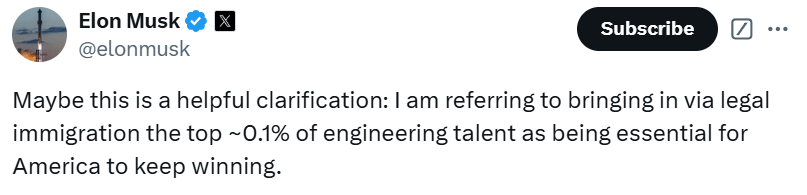
Elon Musk implies that “elite” engineering talent cannot be found among Americans. Do Americans need to import talent?

What would it take to home grow elite engineering talent? Some people interpreted this Vivek tweet to mean that American kids need to be shut away into cram schools.

The reason top tech companies often hire foreign-born & first-generation engineers over “native” Americans isn’t because of an innate American IQ deficit (a lazy & wrong explanation). A key part of it comes down to the c-word: culture. Tough questions demand tough answers & if we’re really serious about fixing the problem, we have to confront the TRUTH:

Our American culture has venerated mediocrity over excellence for way too long (at least since the 90s and likely longer). That doesn’t start in college, it starts YOUNG. A culture that celebrates the prom queen over the math olympiad champ, or the jock over the valedictorian, will not produce the best engineers.

– Vivek tweet on Dec. 26, 2024

My (Joy’s) opinion is that American culture could change on the margin to grow better talent (and specifically tech talent) resulting in a more competitive adult labor force. This need not come at the expense of all leisure. College students should spend 10 more hours a week studying, which would still leave time for socializing. Elementary school kids could spend 7 more hours a week reading and still have time for TV or sports.

I’ve said in several places that younger kids should read complex books before the age of 9 instead of placing a heavy focus on STEM skills. Narratives like The Hobbit are perfect for this. Short fables are great for younger kids.  

The flip side of this, which creates the puzzle, is: Why does it feel difficult to get a job in tech? Why do we see headlines like “Laid-off techies face ‘sense of impending doom’ with job cuts at highest since dot-com crash” (2024)

Which is it? Is there a glut of engineering talent in America? Are young men who trained for tech frustrated that employers bring in foreign talent to undercut wages? Is there no talent here? Are H-1B’s a national security necessity to make up the deficit of quantity?

Previously, I wrote an experimental paper called “Willingness to be Paid: Who Trains for Tech Jobs?” to explore what might push college students toward computer programming. To the extent I found evidence that preferences matter, culture could indeed have some impact on the seemingly more impersonal forces of supply and demand.

For a more updated perspective, I asked two friends with domain-specific knowledge in American tech hiring for comments. I appreciate their rapid responses. My slowness, not theirs, explains this post coming out weeks after the discourse has moved on. Note that there are differences between the “engineers” whom Elon has in mind in the tweet below versus the broader software engineering world.

Software Engineer John Vandivier responds:

Continue reading

Keeping Receipts

Online shopping is convenient and even the norm for many items. Going to the store sounds like a time-consuming labor or an exceptional outing. My family, for example, lives in a suburban location that doesn’t have well-priced grocery home delivery. Shipping only works for some non-perishables. So, for many items we order online and do ‘drive-up pick-up’. We don’t even need to go into the store for many items. And reordering the same items repeatedly is a breeze.

We are also accustomed to the ability to return things. If your blender breaks on your first smoothie, then no worries – you can return it. If the chocolate cookies don’t taste like chocolate? Return it – satisfaction guaranteed. You can buy three pairs of shoes in different sizes and then keep the ones you want at the original sale price. Return the others.

For me, besides the time saved and convenience, a major factor in my decision to make purchases online is the documentation. I don’t need to save the receipt in a shoe box, Ziploc, or file drawer – the online retailer keeps an archive of all my purchases. Often this includes the date, amount, and shipping details including delivery date. There’s a super convenient digital paper trail.

If I need to contact a seller in order to exercise a warranty, then I have their contact information. I don’t need to retain the product packaging or investigate the brand at a future inopportune time. For example, I recently bought a Little Tykes water table for my kids. As I was assembling it on Christmas Eve I realized that I was missing a small part. I was able to work around it. But I was also able to immediately contact the manufacturer with a copy of my invoice. I emailed the date of purchase, the product model number, and the instruction manual had conveniently included part numbers. They were able to ship me the parts after a single email. Online shopping, and the resulting trail of evidence, makes the process much more practical than keeping paper records in a likely unorganized fashion.

There are other benefits to the paper trail. Back before widespread online shopping, retailers would often offer rebates as a sales strategy. In the year 2004, I bought a computer hard drive for $120 before a $40 mail-in rebate. The retailer (or manufacturer, I can’t remember) was hoping that people saw the post-rebate price and then failed to redeem it. And that often happened.  You needed to fill out a rebate form on an index card, cut the UPC bar code of the product packaging, and then mail them with your receipt to the company rebate department in a stamped envelope. If you dragged your feet, then you’d probably lose an important piece of the crucial combination and lose out on your $40 rebate. If the items were lost in the mail, then you were shucks-out-of-luck. Now, rebates have gone the way of the dodo since receipts are automatically retained and retrievable.

Continue reading