We’ve Got You Covered

That’s the title of a recent book by Liran Einav and Amy Finkelstein, subtitled “Rebooting American Health Care”. I reviewed the book for Independent Review; the short version of my review is that while I don’t agree with all of their policy proposals, the book makes for an engaging, accurate, and easily readable introduction to the current US health care system. Here’s the start of the review:

Liran Einav and Amy Finkelstein are easily two of the best health economists of their generation. They have each spent twenty years churning out insightful papers published in the top economics journals. As a young health economist, I would read their papers and admire how well they addressed the technical issues at hand, but I was always left wondering what they thought about the big picture of health care in the United States….

The book’s prologue describes how Finkelstein’s father-in-law finally bullied her into writing on the topic, using almost the exact words I always wanted to: “I know these are hard issues. But come on … You’ve been studying them for twenty years. You must be one of the best placed people to help us understand the options. Do you really have nothing to say on this topic?”

The conclusion:

I learned a lot reading the book, despite having already studied U.S. health financing for over a decade—for instance, that the first compulsory health insurance program in the U.S. was a 1798 law pushed by Alexander Hamilton to cover foreign sailors. While the authors are more used to writing math-heavy academic papers, We’ve Got You Covered reads like the popular press book it is. Perhaps the highest endorsement comes from a non-academic family member of mine who picked up the book and noted, “These are not dry writers … this doesn’t sound like a book written by economists, no offense.”

The full review is free here, the book is for sale here.

“Time Prices” Today Compared With 1924 and 1971

I’ve written before on this blog about “time prices”: the amount of time it takes at a particular wage to buy a specific product. Time prices are especially useful for making historical comparisons of the real price of a good or service. Rather than adjusting historical prices for inflation (which only tells you whether they have increased faster or slower than average prices), time prices give you a real comparison of whether a good has become more or less affordable.

Antony Davies recently did a 100-year comparison of time prices for an average worker in the US. He compared prices in 1924 for several common food items, gasoline, electricity, movie tickets, airline tickets, an automobile, and several measures of housing costs to the best comparable thing in 2024. This following table shows his results:

You will notice a few things here. For the median worker, most things are much more affordable in 2024. Some things are dramatically so! For many items, the median worker in 2024 is similar to someone in the top 1% in 2024. Huge improvements in the standard living.

It will probably not surprise you that one major exception is housing. For renters, things are not obviously worse, but they are not better, depending on what size of city you are in (renters also have lower incomes, but that would be true in both time periods). However compared to the average home price, things look much worse in 2024. You can reasonably reply that the home is much larger and better quality in 2024 (as late as 1940, barely half of homes had complete indoor plumbing!), and this is all true. Still, an average house today is much better, but also much less affordable.

Despite the high cost of housing, the average worker today is much better off than 1924. It’s hard to deny it.

But what about more recent times? As a recurring meme likes to date it, what about since 1971?

Continue reading

Weight Lifting is for You

This is a guest post by Mary Buchanan, a Board Certified Behavior Analyst. Here she explores the intersection of behavioral economics with her own health and fitness behavior change.

My childhood dentist often said, “Take care of your teeth, or they’ll go away.” As I approach my 40th birthday, I’m learning the same is true of my muscle mass. I can use it or lose it. And I can lose it faster or slower based on my lifestyle choices. 

As a behavior analyst, I have spent many years practicing the science of behavior, specifically teaching others how to master new, meaningful skills. I see myself as my own client now as I work to replace my old aimless approach to fitness with evidence-based eating and exercise interventions. 

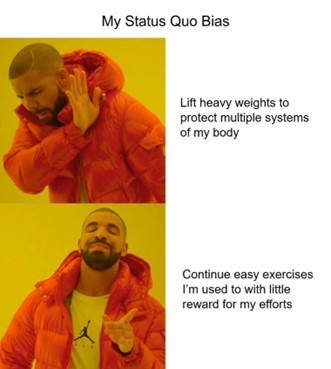
I wish I could say I embraced strength training as soon as I heard about its benefits. Instead, as I noticed more and more recommendations for women to “lift heavy”, I kept filing that information away for someday in the future. When I joined a gym last January, I returned to what I used to do in years past: Pilates classes or cardio machines. After 9 months of that approach with no benefits to show for my efforts, it was time to change my behavior.

Behavioral economics has a term for what causes people to resist changing their behaviors without a significant incentive for doing so: status quo bias

Another behavioral economics term, loss aversion, helps to explain what moved me into action. Loss aversion refers to how people are often more motivated not to lose something they have than they are motivated to gain something similar. All humans start to lose muscle mass around age 30, but that fact was not on my radar until recently. I wasn’t interested in building muscles when I thought mine were adequate to my daily tasks. Now that I realize my muscle loss has been underway for years and the liabilities of that loss are clear to me, I’m motivated to rebuild and mitigate future muscle loss. How? By doing heavy lifting 2-3x per week and eating enough protein for my body to keep the muscle it makes. 

There are many great resources that provide advice in this area, but I’ve decided to begin
with learning from Dr. Stacy Sims since she specializes in what works for women. Based on what I’ve learned, here are my target behaviors for increase:

  • Practice strength training for at least 30 minutes, 2x per week.
    Dr. Sims says 3x per week is better, but 2x is an acceptable minimum that I can commit to either through classes at a gym or YouTube videos. As a behavior analyst, I know that I’m more likely to maintain a new behavior pattern when it is easy to feel successful early and often.
  • Continue to challenge myself throughout strength training by adding weight as I get stronger.
    To stimulate muscle growth you must challenge your muscles so they break down and repair stronger. How heavy is enough? If you lift a weight 10x and it’s difficult to lift on the last two reps, but still possible for you to maintain good form, that is an appropriate weight for you to train with. When that weight gets easy to lift, it’s no longer heavy enough for your training purposes.
  • Increase my healthy protein intake.
    In Roar, Dr. Sims suggests that women aim for .75-0.8 grams of protein per lb. on a light or non-training day, and increase to 1-1.2 grams of protein per lb. on strength training days. 

Working on these goals together creates synergy. I am more motivated to make healthier eating choices because my eating is connected to my strength training goal. Strength training has also become more exciting for me the more I’ve learned about its benefits, including:

  • Increased metabolic rate
  • Improved posture and stability
  • Stronger bones
  • Better blood pressure control
  • Improved immunity
  • Maintenance of healthy body composition (lifting heavy helps maintain lean muscle and reduce fat gain)

As if that weren’t enough, I have another reason to keep going. As soon as I started resistance training, my sleep improved! I’ve had difficulty sleeping for many years already, both with falling asleep and staying asleep, and honestly, if sleeping through the night was the only benefit available to me from resistance-based workouts, I would still be all in.

While none of this constitutes professional medical advice, it is worth looking into, especially if you, like me, never saw role models strength training as a young person. Once you understand how it works in your favor now and as you age, the benefits are too good to pass up.

RESOURCES

Stacy Sims, MSC, PHD is an exercise physiologist and nutrition scientist. She specializes in teaching women what works for their bodies based on their body type, stage of life, and fitness goals. 

My first introduction to her work and recommendations was this 26-minute interview: https://www.youtube.com/watch?v=APwKKUtjINo

Her book, Roar, is helpful for those who want to learn about general women’s health, though it is especially geared towards female athletes. https://www.amazon.com/ROAR-Revised-Fitness-Physiology-Performance/dp/059358192X/

Next Level focuses on the physical changes women experience with the natural aging process. It clearly presents how we can use the latest research to work with what is happening in the body instead of against it. https://www.amazon.com/Next-Level-Kicking-Crushing-Menopause-ebook/dp/B091JVW6QR/

Pistol Squats Complete the Home Workout from James

The customer is often wrong

There’s probably nothing more dangerous to an already successful business than giving customers what they say they want. This is not to say you can give customers something they don’t want, quite the opposite in fact. Rather, it’s to never deny the preeminence of revealed preferences.

People want things. They don’t always, however, enjoy how those preferences might be perceived by others (or by themselves). Customizing your consumption to fit the preferences that you would prefer to signal is not a luxury that we can often indulge, however. Basic instrumental needs have to come first. Once a good is already in a household’s portfolio of consumption, however, it is relatively low cost to signal alternative preferencs to peers, surveyers, or focus group organizers. If a producer were to take these signals as earnest, however, they could end up undermining the good already previously purchased and consumed, leading to a business catastrophe. “Trust people’s actions over words” is at least a cliche, if not an outright proverb. I’ll leave it to you to find its most archaic analogue.

I’ve been thinking about this a lot, and no, not in the context of political polling and the recent election, though I will grant the relevance. I’ve been thinking about it more when watching sports and consuming the news.

Soccer in the top leagues, particularly the English Premiere League (currently the best in the world) is in year 5 of a growing injury crisis. Most seasons the winner can be predicted based on total salary outlays. Not because of superior top line talent, however, but because they can afford 11 second string players of top quality to play when the starters are inevitably injured. This is largely because of a tragedy of the commons in international soccer, but it’s been massively exacerbated because the EPL responded to the perceived request from consumers that the sport become “more physical”. This amorphous physicality has been granted in the form of more lenient refereeing. The result of this has not been to increase the “fight in the game”, but to grant less talented players greater license in kicking and sliding through the legs of more talented players. I don’t know the full economics of modern sports, but I’m pretty sure fans don’t pay large ticket prices to see the best players in the world on the sidelines in high-end athleisure wear draped discreetly over a walking boot.

As for the news, I see a related, but not identical phenomena. Being a GenX-er, I spent a lot of time in heavy conversation during college bemoaning the impact of advertisers on media content. The “news as propaganda” bit is not a new concept, I assure you. What very, very few us would have guessed, however, is that Craigslist destroying the ad revenue of newspapers and the internet walking off with the customer base most interested in news as information source would lead television program producers untethered to the desires of their advertising sponsors, leaving them to create bespoke content for their new overlords: the consumer. As it turns out, what the remaining subset of customers most wants isn’t information or insight, it’s reaffirmation. We wanted advertisers out of content, but it turns out you got better news when the true customers were corporate overlords hawking sugar water and baggy clothes. People signaled that they wanted deep reporting, uncompromised integrity, and uncomfortable truths. And hey, more people than ever subscribe to The Economist. But it turns out most people just wanted confirmation bias.

Sure, by clicking on the link to this post you’ve signaled to me that you want a depth of insight you just can’t get anywhere on the internet. But I, enwisened scribe, know that what you really want is cliched aphorisms.

Be careful what you wish for.

Joy on AI in Higher Education

I was interviewed for an article “Navigating AI in Christian Higher Education“. Here’s an excerpt:

Rosenberg: What impact do you foresee in your field due to the increasing sophistication of AI, and what kind of skills do you think your students will need to be successful?

Buchanan: AI will reshape economic analysis and modeling, making complex data processing and predictive analytics more accessible. This will lead to more sophisticated economic forecasting and policy design. Economists will become more productive, and expectations will rise accordingly. While some fields might resist change, economics will be at the forefront of AI integration.

For students aiming to succeed, it’s crucial to embrace AI tools without relying on them excessively during college. Strong fundamentals in economic theory and critical thinking remain essential, coupled with data science and programming skills.

Interdisciplinary knowledge, especially in tech and social sciences, will be valuable. Adaptability and lifelong learning are key in this evolving field. Human skills like creativity, communication, and ethical reasoning will remain crucial.

While AI will alter economics, it will also present opportunities for those who can adapt and effectively combine economic thinking with technological proficiency.

Lump Sum Taxes: Never by Popular Demand

The tax code is complex. That’s not news. The US federal tax code is also very progressive. Apart from that, the tax code pushes social or other policy goals. The Earned Income Tax Credit, for example, acts as a negative income tax and increases after-tax wages for those who can claim it. The idea is to incentivize earnings.

Economists tend to really like lump-sum taxes (in theory). But, despite the profession’s influence, almost nobody supports them. First, what is a lump-sum tax? It’s a tax that ignores any activities of the target. A per capita lump-sum tax would target the young, the old, the indigent, the working, the rich, the disabled… everyone. The idea is that no behaviors, aside from breathing, incur or disqualify a person from owing the tax.

Economists like them because they don’t change the relative price of labor and leisure. Whereas a marginal tax rate reduces a worker’s effective wage, a lump sum tax leaves it unaffected. People aren’t disincentivized from working/earning. Using jargon, we say that a lump-sum tax is non-distortionary.

In the simple two-good model of consumption and leisure, marginal tax rates reduce the amount of consumption that one can afford with each hour of work, making leisure relatively more attractive. Lump-sum taxes reduce the affordable amount of both leisure and consumption. Affording less leisure is the same as saying that people work more hours. It happens for two reasons. 1) Poorer people must work enough to pay the inevitable tax bill and also reach an income level of sustenance. However much work sustenance entails, it’s surely more when there is a tax. 2) Since working and earning itself is not taxed, people at all levels of income decide to work more because their after-tax wage is higher relative to the case of a marginal income tax.

At this point someone gets what I call the “French” idea. The French idea is that if we provide a lump-sum subsidy, then we can all leisure more and consume less – the opposite of a lump sum tax. What a life! We can avoid the prisoner dilemma problem where we can’t credibly commit to shirking together or actually taking a lunch. By forcing a lump-sum subsidy on everyone, we’d work a little less and do it voluntarily. We can sit outside a cafe, enjoying our coffee, baguette, and cigarette without having to worry about our neighbor with their “go get’em” attitude making us look bad.

Continue reading

The Laboratory of the States: Regulatory Reform Edition

The US Federal government has been considering major reforms like the REINS Act, which would require Congressional approval of major regulations proposed by executive branch agencies, or bringing back the “two in one out” rule from the first Trump administration. What would these do?

Right now it’s hard to say much for sure. But similar reforms have already been implemented in the states; as usual, the states provide a laboratory for investigating how policies work and whether they deserve broader adoption. It’s especially valuable to inform the debate over reforms like the REINS act that are still being considered at the federal level. Even for federal reforms that have already happened, it can be easier to evaluate the state version, since states make better control groups for each other than other countries do for the US.

But so far we’ve mostly been ignoring our laboratory results from recent state regulatory reforms. For instance, Broughel, Baugus, and Bose (2022) released a dataset that could be used to evaluate state regulatory reforms, but it has only been cited 3 times. This is why I’m adding this to my ideas page as a good subject for future academic research.  Do state REINS or Red Tape Reduction Acts actually reduce either the stock or flow of regulation? If so, which types of regulations are affected, and does this have any effect on downstream measures like economic growth or new business formation?

Any research along these lines could help inform policy debates in the states, as well as for a new Presidential administration coming in with hopes of boosting economic growth through deregulation.

HT: Adam Millsap

Don’t Let Nominal Prices Fool You (Thanksgiving Edition)

When you see prices from the past, especially the distant past, your normal reaction is perhaps one of envy or nostalgia. Take for example the Thanksgiving menu from the Plaza Hotel in New York in 1899. As you browse the menu, note that the prices are in cents, not dollars.

The most expensive items on the menu are only a few dollars, while many items can be had for around 50 cents. But hopefully your nostalgia will soon fade when you recall that wages were probably lower back then.

But how much lower?

According to data from MeasuringWorth.com (an excellent resource affiliated with the Economic History Association), the average wage for production workers in manufacturing was 13 cents per hour in 1899. From this we can immediately see that a dish such as Ribs of Prime Beef (60 cents) would take about 4.5 hours of work for a production worker to purchase.

How can we compare these prices and wages from 1899 to today?

Continue reading

My Frozen Assets at BlockFi, Part 4: Full Recovery of My Funds

In March and April of this year, I moaned and groaned here in blogland, chronicling my attempts to recover my funds from an interest-bearing account at crypto firm BlockFi.

Back in 2021, interest rates had been so low for so long that that seemed to be the new normal. Yields on stable assets like money market funds were around 0.3% (essentially zero, and well below inflation), as I recall. As a yield addict, I scratched around for a way to earn higher interest, while sticking with an asset where (unlike bonds) the dollar value would stay fairly stable.

It was an era of crypto flourishing, and so I latched onto the notion of decentralized finance (DeFi) lending. I found what seemed to be a reputable, honest company called BlockFi, where I could buy stablecoin (constant dollar value) crypto assets which would sit on their platform. They would lend them out into the crypto world, and pay me something like 9 % interest. That was really, really good money back then, compared to 0.3%.

On this blog, I chronicled some of my steps in this journal. First, in signing up for BlockFi, I had to allow the intermediary company Plaid complete access to my bank account. Seriously, I had to give them my username and password, so they could log in as me, and not only be able to withdraw all my funds, but see all my banking transactions and history. That felt really violating, so I ended up setting up a small auxiliary bank account for Plaid to use and snoop to their heart’s content.

I did get up and running with BlockFi, and put in some funds and enjoyed the income, as I happily proclaimed (12/14/2021) on this blog, “ Earning Steady 9% Interest in My New Crypto Account “.

BlockFi assured me that they only loaned my assets out to “Trusted institutional counterparties” with a generous margin of collateral. What could possibly go wrong??

What went wrong is that BlockFi as a company got into some close relationship with Sam Bankman-Fried’s company, FTX.  Back in 2021-2022, twenty-something billionaire Sam Bankman-Fried (“SBF”) was the whiz kid, the visionary genius, the white knight savior of the crypto universe. In several cases, when some crypto enterprise was tottering, he would step in and invest funds to stabilize things. This reminded some of the role that J. P. Morgan had played in staving off the financial panics of 1893 and 1907. SBF was feted and lauded and quoted endlessly.

For reasons I never understood, BlockFi as a company was having a hard time turning a profit, so I think the plan was for FTX to acquire them. That process was partway along, when the great expose’ of SBF as a self-serving fraudster occurred at the end of 2022. FTX quickly declared bankruptcy, which forced BlockFi to go BK as well. SBF was eventually locked up, but so were the funds I had put into BlockFi. The amount was not enough to threaten my lifestyle, but it was enough to be annoying.

BlockFi Assets Begin to Thaw

I got emails from BlockFi every few months, assuring customers that they would do what they could to return our assets. Their bankruptcy proceedings kept things locked, but eventually they started to return some money.

 As I noted in a blog post, in April, 2024, I was able to recover about 27% of my account. At the time, there was no clear prospect of getting the rest.   Along the way, I clicked on a well-camouflaged scam email link, which gave me some heartburn but fortunately no harm came of it.

And now, hooray, they have finally returned it all, following their successful claw-back of assets from SBF’s organization(s). This vindicates my sense that the BlockFi management was/is fundamentally honest and good-willed, and was just a victim of SBF’s machinations.

Some personal takeaways from all this:

  • Keep allocations smallish to outlier investments
  • Sell out at the first serious signs of trouble
  • Triple-check before clicking on any link in an email
  • Having been forced to engage in opening crypto wallets and transferring coins, I have a better feel for the world of crypto which had seemed like a black box. It does not draw me like it does some folks, but if circumstances ever require me to deal in crypto (relocate to Honduras?), I could do it.

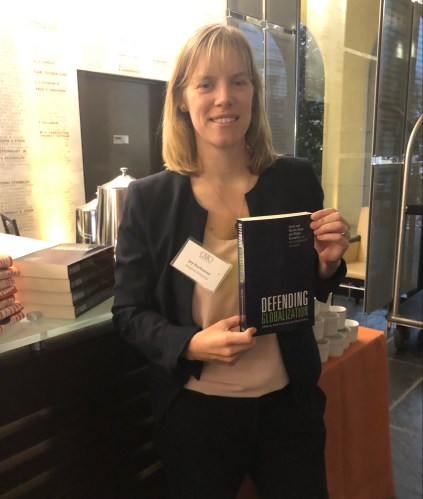
Cato Globalization book out in paperback

A new book is out with chapters by me, Deirdre McCloskey, and others.

Book Title: Defending Globalization: Facts and Myths about the Global Economy and Its Fundamental Humanity

The COVID-19 pandemic, war in Ukraine, simmering US-China tensions, and rising global populism have led to globalization facing renewed attention-and criticism-from politicians and pundits across the political spectrum. Like any market phenomenon, the free movement of people, things, money, and ideas across natural or political borders is imperfect and often disruptive. But it has also produced undeniable benefits-for the United States and the world-that no other system can match. And it’s been going on since the dawn of recorded history.

The original essays compiled in this volume offer a diverse range of perspectives on globalization-what it is, what it has produced, what its alternatives are, and what people think about it-and offer a strong, proactive case for more global integration in the years ahead. Covering the basic economic and political ideas and historical facts underlying globalization, rebutting the most common arguments against globalization today, and educating readers on the intersection of globalization and our societies and cultures-from where we live to what clothes we wear and what foods we eat-Defending Globalization demonstrates the essential humanity of international trade and migration, and why the United States and the rest of the world need more of it.

You can read a summary, in a previous EWED blog post, of my chapter on fashion, previously posted on the Cato website as Fast Fashion, Global Trade, and Sustainable Abundance.

It takes all of us to be rich. We need “a great multitude that no one could count, from every nation, tribe, people and language,” so to speak.

Two years ago, on Twitter, I summarized my contribution as follows, in the form of a dialogue:

Person from the Past: “So, how is it with 8 billion people?”

Me Today: “It’s bad. We have too many clothes.”

Person from the Past: “Right. With 8 billion you wouldn’t have enough clothes for everyone.”

Me Today: “Too many.”

I made it to the book launch event in D.C. near the Capitol.

Some people still have not heard of “fast fashion.” Maybe you heard it here first: New legislation is likely coming to regulate the clothing industry. It might start at the state level, in progressive places like California or Seattle. Demands include making information about supply chains more transparent and taxing the clothing companies in order to pay for trash disposal. For example, you can read about the New York Fashion Act. Similar to the way the food companies have to provide clear information about calories, clothing retailers might have to provide more information about chemicals, labor, and disposal issues.

Plastic fibers making new clothing cheap. I sometimes hate the flood of cheap products that American families are drowning in. Plastic products are so cheap to stamp out and give to kids. Some days you’ll find me grumpy about the latest bag of plastic swag and candy my kids came home with. There are some negative externalities to consuming tons of plastic items and tossing them out.

It’s a privilege to have this problem. Perhaps we are overindulging in clothing abundance and need some modern solutions to modern problems. We also need to figure out how to stop getting obese off of food abundance. (Hello, Ozempic.) But let’s still be grateful for the abundance, on this Thanksgiving week. My controversial take is that it’s good for the cost of clothing to be low. We don’t want to regress. We don’t want to make clothing scarce again.

If you were to want to cite my work on fashion and globalization, then you could use something like this:

Buchanan, Joy. “Fast Fashion, Global Trade, and Sustainable Abundance” (2024) In S. Lincicome, & C. Packard (Eds.), Defending Globalization: Facts and Myths about the Global Economy and Its Fundamental Humanity, Cato Institute, (pp. 367 – 380).