Taxes, Children, and the Zero Bracket

Recently there has been some discussion in the Presidential race about the taxation of parents vs. childless taxpayers. The discussion has been ongoing, but it was kicked up again when a 2021 video of J.D. Vance resurfaced where he said that taxpayers with children should be lower tax rates than those without children. There was some political back-and-forth about this idea, much of it tied up in the framing of the issue, with the usual bad faith on both sides about the fundamental issue (in short: most Democrats and a small but growing number of Republicans support increasing the size of the Child Tax Credit).

Let’s leave the politicking aside for a moment and focus on policy. As many pointed out in response to Vance’s idea, we already do this. In fact, we have almost always done this in the history of the US income tax — “this” meaning giving taxpayers at least some break for having kids. For most of the 20th century, this was done through personal exemptions which usually included some tax deduction for children, and later in the century the Child Tax Credit was added (after 2017, the exemptions were eliminated in favor of a large CTC). Other features of the tax code also make some accounting for the number of children, most notably the size of the Earned Income Credit.

The chart below is my attempt to show how the tax breaks for children have affected four sample taxpaying households. What I show here is sometimes called the “zero bracket” — that is, how much income you can earn without paying any federal income taxes. The four households are: a single person with no children, a married couple with no children, a single person with two children (“head of household”), and a married couple with two children. All dollar amounts are inflation-adjusted to current dollars

Continue reading

Advice For Travelling With Children

My family regularly takes long trips up and down the east coast of the US. It takes us about 6 hours just to travel through Florida. We have several kids between the ages of 1 & 7 and we’ve got it down to a pretty good science. Here’s some great advice for travelling with children. A lot of it is OK advice if you cherry pick, but together their benefits compound.

1) Depart Early

It doesn’t matter if it’s a 3 hour trip or a two day trip. To us, ‘early’ means that our target departure time is 5 AM, but ‘early’ may mean something different for you and yours. Benefits include:

  • Kids may remain or resume sleeping for the first portion of the travel. That’s time that they are occupied.
  • Earlier arrival at your destination gives kids time to burn off some energy and adults time to decompress. For multi-day trips, we like to stop at a hotel that has a pool.

2) Carry-on Backpacks

Just as you would have a small personal item on an airplane, such as a purse, give each child a backpack that contains car-ride content (make sure that they put away one thing before beginning the next). Maybe ensure that each kid has a different color. This puts their stimulation in their own hands. The idea is not to avoid interacting with your kids. The idea is to help them take care of themselves. Here’s what to include:

Continue reading

Was 2022 The “Deadliest Year on Record” For Children in Arkansas?

In my Inbox I read the following sentence, summarizing an article on child health in Arkansas: “The latest Annie E. Casey Foundation KIDS COUNT Data Book shows 2022 was the deadliest year on record for child deaths in Arkansas.”

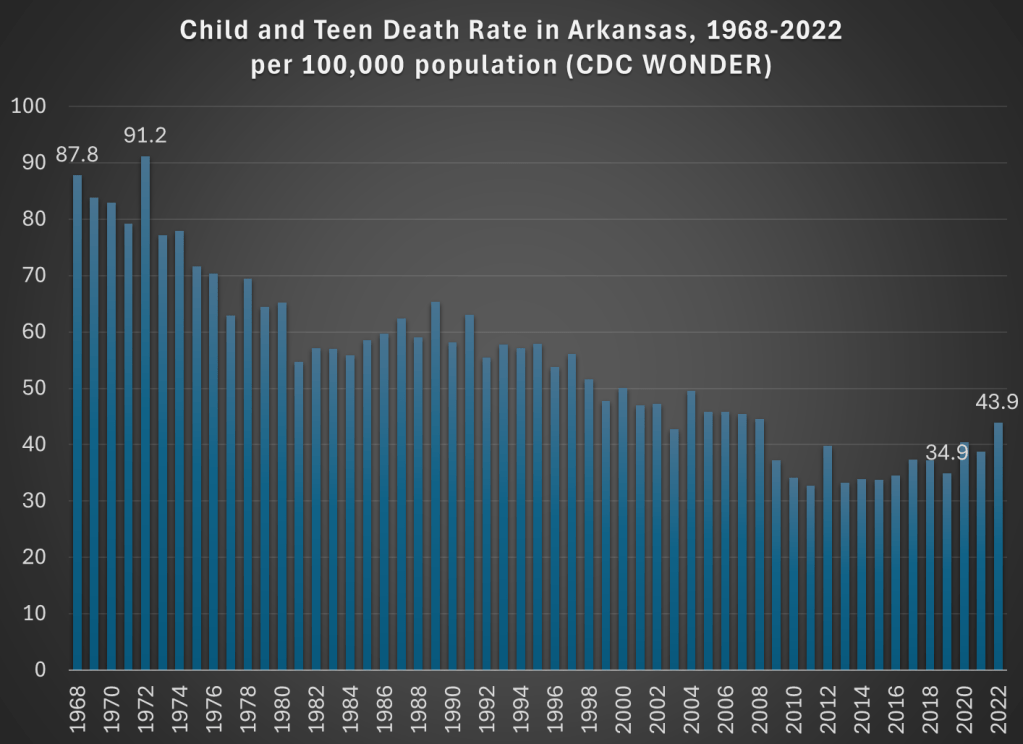
Deadliest on record! That certainly grabbed my attention. I clicked the link and read the article. Indeed, they emphasize three times that 2022 was the “deadliest year” for kids in Arkansas, including with a chart! And the chart does seem to support the claim: in 2022 there were 44 child and teen deaths per 100,000 in Arkansas, higher than any year on the chart.

But wait a minute, this chart only goes back to 2010. Surely the record goes back further than that? Indeed it does. It took me three minutes (yes, I timed myself, and you have to use 4 different databases) to complete the necessary queries from CDC WONDER to extract the data to replicate their 2010-2022 chart, and to extend the data back a lot further: all the way to 1968 (though in 30 seconds I could have extended it back to 1999).

And what do we find in 1968? The death rate for children and teens in Arkansas was twice as high as it was in 2022. Not just a little higher, but double. With some more digging, I might be able to go back further than 1968, but from the easily accessible CDC data, that’s as far back as “the record” goes. Of course, I knew where to look, but I would hope that a group producing a data book on child health also knows where to look. And you don’t need to extend this very far past the arbitrary 2010 cutoff in the article quoted: 2008 and every year before it was more deadly than 2022 for children in Arkansas. Here’s a chart showing the good long-run trend:

Now there is a notable flattening of the long-run trend in the past 15 years or so, and a big reversal since 2019. What could be causing this? The article I read doesn’t get specific, but here’s what they say: “The state data isn’t broken out into cause of death, but firearm-related deaths have become the leading cause of death among U.S. teens in recent years. Deaths from accidents such as car crashes account for most child deaths.”

But using CDC WONDER, we can easily check on what is causing the increase since 2019. “Firearm-related deaths” is an interesting phrase, since it lumps together three very different kinds of deaths: homicides, suicides, and accidents. And while it is true that “deaths from accidents” are the leading category of deaths for children, this also lumps together many different kinds of deaths: not only car crashes, but also poisonings, drownings, or accidental firearm deaths.

For Arkansas in 2022, here are the leading categories of deaths for children and teens (ages 1-19) if we break down the categories a bit:

  • Homicides: 66
  • Non-transport accidents: 58 (largest subcategories: poisonings/ODs and drowning)
  • Transport accidents: 52 (almost all car crashes)
  • Suicides: 24
  • Birth defects: 16
  • Cancers: 14
  • Cardiovascular diseases: 13

And no other categories are reported, because CDC WONDER won’t show you anything smaller than 10 deaths.

We might also ask what caused the increase since 2019, especially since this a report on child health and possible solutions. The death rate increased by 9 deaths per 100,000, and over 80% of the increase is accounted for by just two categories: homicides and non-transport accidents. Car crashes actually fell slightly (though the rate increased a bit, since the denominator was also smaller). Deaths from suicides, cancer, and heart diseases also declined from 2019 to 2022 among children in Arkansas, and these are the three on the list above that we would probably consider the “health” categories. Things actually got better!

But the really big increase, and very bad social trend, is the category of homicides. Among children and teens in Arkansas, it rose from 35 deaths in 2019 to 66 deaths in 2022. It almost doubled. That’s bad! But homicides are not mentioned anywhere in the article on this topic that I read (“firearm-related deaths” is the closest they get). And while car accidents are definitely a major problem, they didn’t really increase from 2019 to 2022 (among kids in Arkansas).

One more thing we can do with CDC WONDER is break down the homicides by age. The numbers so far are looking at a very broad range of children and teens, from ages 1-19. As I’ve written about before, the is a huge difference between homicide rates for older teens versus all of the kids. Indeed for Arkansas we see the same pattern, such as when I run a CDC WONDER query for single-years of age: only the ages 17, 18, and 19 show up (remember, anything less than 10 deaths won’t register in the query).

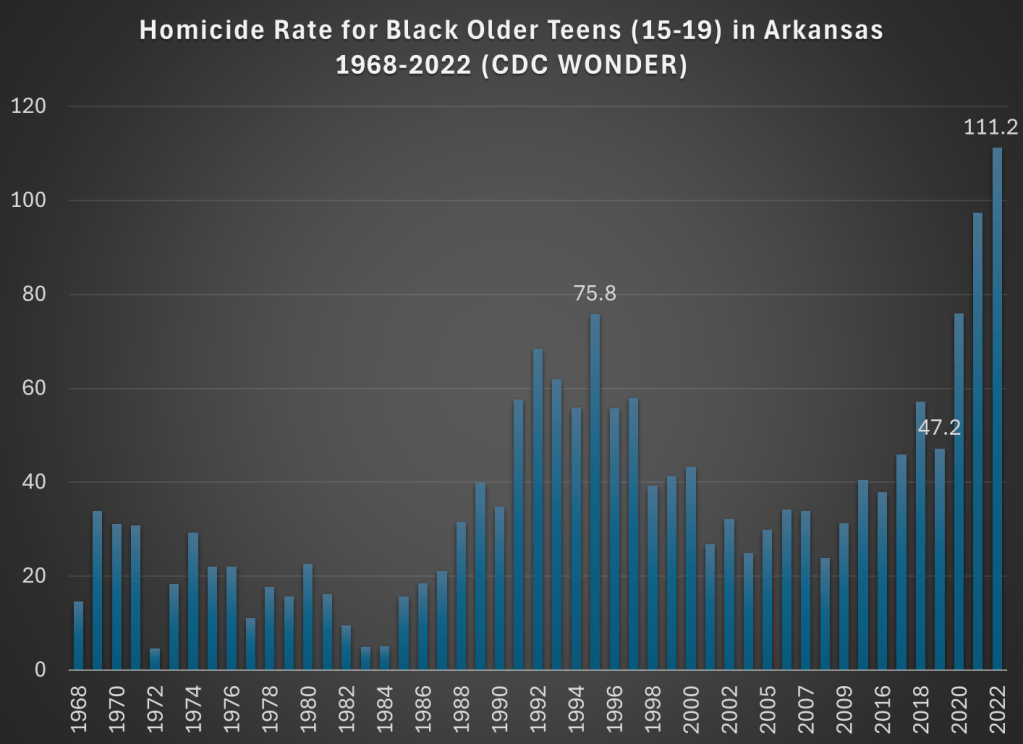
Breaking it down by five-year age groups, we see that 53 of the 66 homicides (in Arkansas among kids and teens) were for ages 15-19, that is 80% of the total. And further if we run the query by race, we see that 40 of the 66 homicides were for African Americans age 15-19. This is clearly a social problem, but it’s an extremely concentrated social problem. And the increase for older teen Blacks has been large too: it was just 17 deaths in 2019, more than doubling to 40 homicides in 2022.

Now, small numbers can jump around a bit, so just looking at 2019 and 2022 might be deceptive. What if we had a longer annual series to look at? Again, CDC WONDER allows us to do this. Here is the chart for homicides among older Black teens in Arkansas:

This is a dramatic chart. The steady rise in homicides among this demographic since 2019 is staggering. Not only the dramatic increase, but notice that 2021 and 2022 are much worse than the crime wave of the early 1990s, which also jump out in this chart. The homicide rate for older Black teens in 2022 was almost 50 percent higher than 1995, the prior worst year on record.

So is there a problem with child and teen deaths in Arkansas? Yes! But with just a few minutes of searching on CDC WONDER, I think we can get a much better picture of what is causing it than the article I read summarizing the report. Indeed, if we read the full national report, the word “homicide” is only mentioned once in a laundry list of many causes of death.

The most important part of addressing a social problem, such as “deadliest year on record for child deaths in Arkansas” is to know some basic details about what is causing a bad social indicator to worsen. Hopefully after reading this blog post you know a little bit more. If you want to read my summary of the research on how to reduce deaths from firearms, see this June 2022 post.

Kids Are Much Less Likely to Be Killed by Cars Than in the Past

On X.com Matt Yglesias posted a chart that sparked some conversation about child safety:

Of course, it was probably more his comment about the “rise of more intensively supervised childhood activities” that generated the feedback and pushback. And I assume his comment was partially tongue-in-cheek, as often happens on Twitter, and designed to generate that very discussion. Still, it is worth thinking about. Exactly why did that decline happen?

I’ve posted on this topic before. In my March 2023 post, I looked at very broad categories of child death. While all death categories have declined, about half of the decrease (depending on the age group, but half is about right) is from a decline in deaths from diseases, as opposed to external causes. And fewer disease death can largely be attributed to improvements in healthcare, broadly defined. Good news!

Of course, that means that about half of the decline is from things other than diseases. What caused those declines? Let’s look into the data. Specifically, let’s look into the data on deaths from car accidents.

Continue reading

The Leading Causes of Death Among Elementary-Age Children

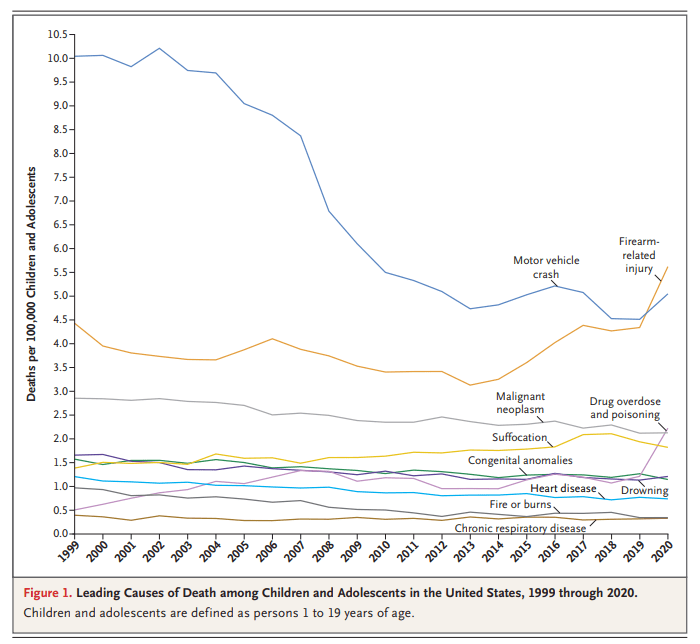
You might have seen this chart recently. It comes from a letter published in the New England Journal of Medicine in April 2022. The data comes directly from the CDC. It shows the leading causes of death for children in the US. You will notice that firearm-related deaths have been rising for much of the past decade, and in 2020 eclipsed car accidents as the leading cause.

Many are sharing this chart in response to the recent elementary school shooting in Nashville. It’s natural to want to study these problems more in the wake of tragedies. After the Uvalde shooting last year, I tried to read as much as I could about the history of homicide and gun violence in the US, and to look at the research on what might work to reduce gun violence, which is summarized in a post I wrote last June.

That being said, I don’t think the chart above accurately characterizes the problem of elementary school shootings. It might accurately describe some broader problem, but it’s misleading with respect to the shooting we all just witnessed. The most important reason is that the definition of “children” here extends to 18- and 19-year-olds. Much of the gun-related homicides for “children” shown here are gang-related violence, not random school shootings at elementary schools. It’s not that we shouldn’t care about these deaths too — we very much should care — but the causes and solutions are entirely different from elementary school mass shootings.

Continue reading

Online Reading Onpaper

We have six weekly contributors here at EWED and I try to read every single post. I don’t always read them the same day that they are published. Being subscribed is convenient because I can let my count of unread emails accumulate as a reminder of what I’ve yet to read.

Shortly after my fourth child was born over the summer, I understandably got quite behind in my reading. I think that I had as many as twelve unread posts. I would try to catchup on the days that I stayed home with the children. After all, they don’t require constant monitoring and often go do their own thing. Then, without fail, every time that I pull out my phone to catch up on some choice econ content, the kids would get needy. They’d start whining, fighting, or otherwise suddenly start accosting me for one thing or another – even if they were fine just moments before. It’s as if my phone was the signal that I clearly had nothing to do and that I should be interacting with them. Don’t get me wrong, I like interacting with my kids. But, don’t they know that I’m a professional living in the 21st century? Don’t they know that there is a lot of good educational and intellectually stimulating content on my phone and that I am not merely zoning out and wasting my time?

No. They do not.

I began to realize that it didn’t matter what I was doing on my phone, the kids were not happy about it.

I have fond childhood memories of my dad smoking a pipe and reading the newspaper. I remember how he’d cross his legs and I remember how he’d lift me up and down with them. I less well remember my dad playing his Game Boy. That was entertaining for a while, but I remember feeling more socially disconnected from him at those times. Maybe my kids feel the same way. It doesn’t matter to them that I try to read news articles on my phone (the same content as a newspaper). They see me on a 1-player device.

So, one day I printed out about a dozen accumulated EWED blog posts as double-sided and stapled articles on real-life paper.

The kids were copacetic, going about their business. They were fed, watered, changed, and had toys and drawing accoutrement. I sat down with my stack of papers in a prominent rocking chair and started reading. You know what my kids did in response? Not a darn thing! I had found the secret. I couldn’t comment on the posts or share them digitally. But that’s a small price to pay for getting some peaceful reading time. My kids didn’t care that I wasn’t giving them attention. Reading is something they know about. They read or are read to every day. ‘Dad’s reading’ is a totally understandable and sympathetic activity. ‘Dad’s on his phone’ is not a sympathetic activity. After all, they don’t have phones.

They even had a role to play. As I’d finish reading the blog posts, I’d toss the stapled pages across the room. It was their job to throw those away in the garbage can. It became a game where there were these sheets of paper that I cared about, then examined , and then discarded… like yesterday’s news. They’d even argue some over who got to run the next consumed story across the house to the garbage can (sorry fellow bloggers).

If you’re waiting for the other shoe to drop, then I’ve got nothing for you. It turns out that this works for us. My working hypothesis is that kids often don’t want parents to give them attention in particular. Rather, they want to feel a sense of connection by being involved, or sharing experiences. Even if it’s not at the same time. Our kids want to do the things that we do. They love to mimic. My kids are almost never allowed to play games or do nearly anything on our phones. So, me being on my phone in their presence serves to create distance between us. Reading a book or some paper in their presence? That puts us on the same page.

College Major, Marriage, and Children Update

In a May post I described a paper my student my student had written on how college majors predict the likelihood of being married and having children later in life.

Since then I joined the paper as a coauthor and rewrote it to send to academic journals. I’m now revising it to resubmit to a journal after referee comments. The best referee suggestion was to move our huge tables to an appendix and replace them with figures. I just figured out how to do this in Stata using coefplot, and wanted to share some of the results:

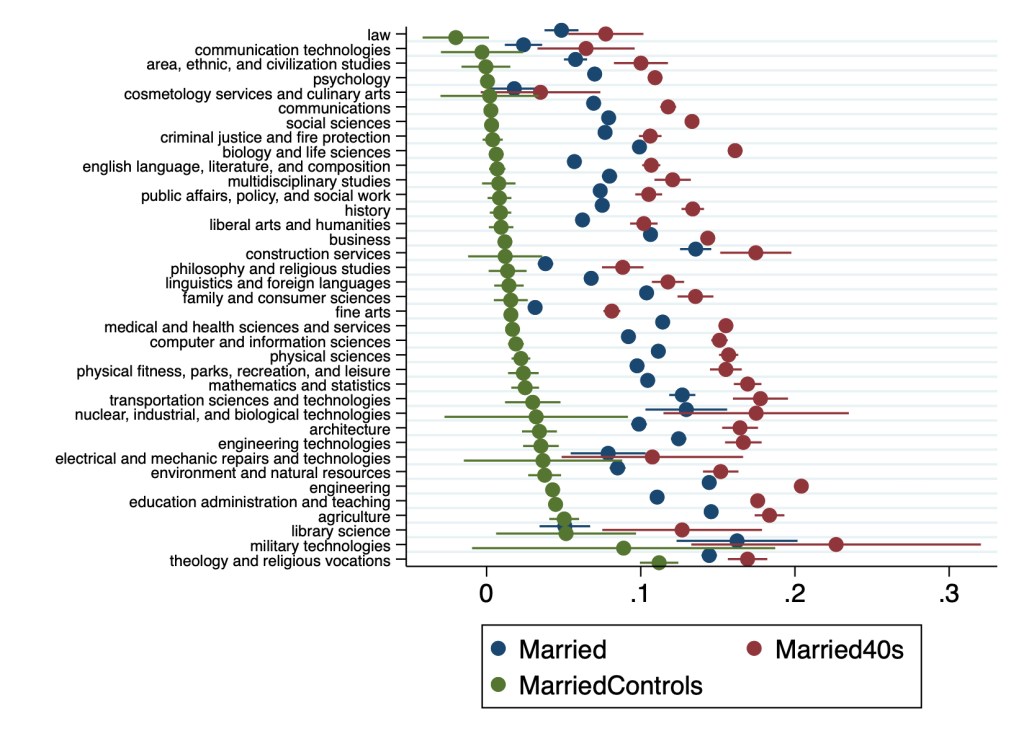
Points represent marginal effects of coefficient estimates from Logit regressions estimating the effect of college major on marriage rates relative to non-college-graduates. All regressions control for sex, race, ethnicity, age, and state of residence. MarriedControls additionally controls for personal income, family income, employment status, and number of children. Married (blue points) includes all adults, others include only 40-49 year-olds. Lines through points represent 95% confidence intervals.
Points represent coefficient estimates from Poisson regressions estimating the effect of college major on the number of children in the household relative to non-college-graduates. All regressions control for sex, race, ethnicity, age, and state of residence. ChildrenControls additionally controls for personal income, family income, employment status, and number of children. Children (blue points) includes all adults, others include only 40-49 year-olds. Lines through points represent 95% confidence intervals.

Many details have changed since Hannah’s original version, and a lot depends on the exact specification used. But 3 big points from the original paper still stand:

  1. Almost all majors are more likely to be married than non-college-graduates
  2. The association of college education with childbearing is more mixed than its almost-uniformly-positive association with marriage
  3. College education is far from uniform; differences between some majors are larger than the average difference between college graduates and non-graduates

The Cost of Raising a Child

Raising kids is expensive. As an economist, we’re used to thinking about cost very broadly, including the opportunity cost of your time. Indeed, a post I wrote a few weeks ago focused on the fact that parents are spending more time with their kids than in decades past. But I want to focus on one aspect of the cost, which is what most “normal” people mean by “cost”: the financial cost.

Conveniently, the USDA has periodically put out reports that estimate the cost of raising a child. Their headline measure is for a middle-income, married couple with two children. Unfortunately the last report was issued in 2017, for a child born in 2015. And in the past 2 years, we know that the inflation picture has changed dramatically, so those old estimates may not necessarily reflect reality anymore. In fact, researchers at the Brookings Institution recently tried to update that 2015 data with the higher inflation we’ve experienced since 2020. In short, they assumed that from 2021 forward inflation will average 4% per year for the next decade (USDA assumed just over 2%).

Doing so, of course, will raise the nominal cost of raising a child. And that’s what their report shows: in nominal terms, the cost of raising a child born in 2015 will now be $310,605 through age 17, rather than $284,594 as the original report estimated. The original report also has a lower figure: $233,610. That’s the cost of raising that child in 2015 inflation-adjusted dollars.

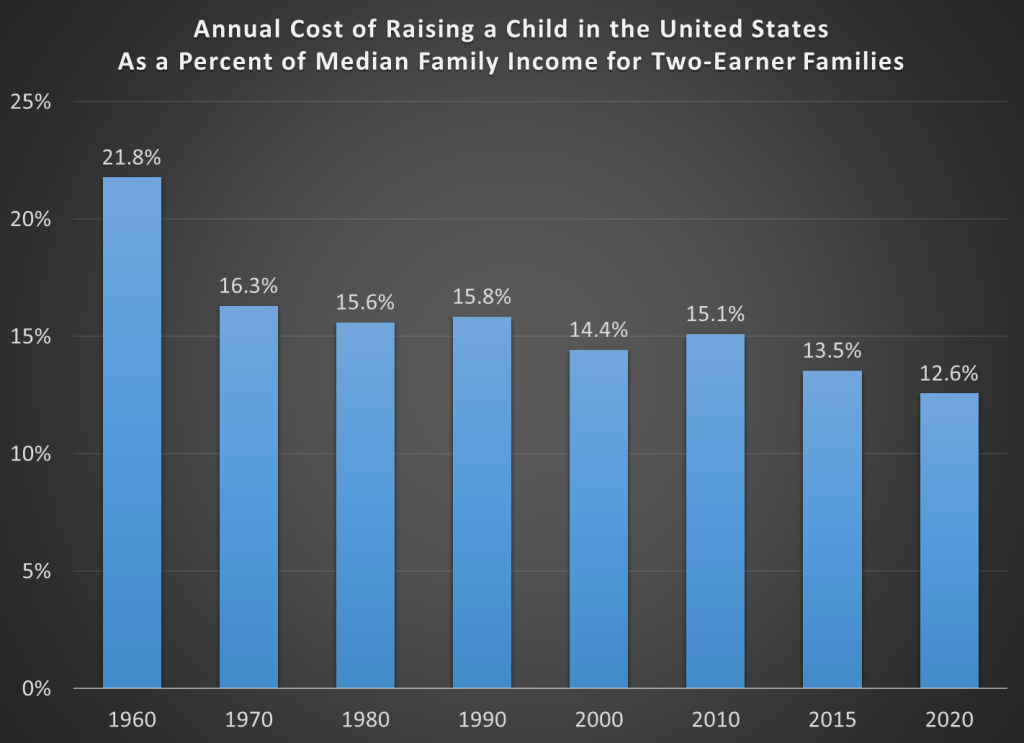
As I’ve written several times before on this blog, adjusting for inflation can be tricky. In fact, sometimes we don’t actually need to do it! To see if it is more or less expensive to raise a child than in the past, what we can do instead is compare to the cost to some measure of income. I will look at several measures of income and wages in this post, but let me start with the one I think is the best: median family income for a family with two earners. Why do I think this is best? Because the USDA and Brookings cost estimates are for married couples who are also paying for childcare. To me, this suggests a two-earner family is ideal (you may disagree, but please read on).

Here’s the data. Income figures come from Census. Child costs are from USDA reports in 1960-2015, and the Brookings update in 2020.

Continue reading

College Major, Marriage, and Children

The American Community Survey began in 2000, and started asking about college majors in 2009, surveying over 3 million Americans per year. This has allowed all sorts of excellent research on how majors affect things like career prospects and income, like this chart from my PhD advisor Doug Webber:

See here for the interactive version of this image

But the ACS asks about all sorts of other outcomes, many of which have yet to be connected to college major. As far as I can tell this was true of marriage and children, though I haven’t searched exhaustively. I say “was true” because a student in my Economics Senior Capstone class at Providence College, Hannah Farrell, has now looked into it.

The overall answer is that those who finished college are much more likely to be married, and somewhat more likely to have children, than those with no college degree. But what if we regress the 39 broad major categories from the ACS (along with controls for age, sex, family income, and unemployment status) on marriage and children? Here’s what Hannah found:

Every major except “military technologies” is significantly more likely than non-college-grads to be married. The smallest effects are from pre-law, ethnic studies, and library science, which are about 7pp more likely to be married than non-grads. The largest effects are from agriculture, theology, and nuclear technology majors, each about 18pp more likely to be married.

For children the story is more mixed; library science majors have 0.18 fewer children on average than non-college-graduates, while many majors have no significant effect (communications, education, math, fine arts). Most majors have more significantly more children than non-college graduates, with the biggest effect coming from Theology and Construction (0.3 more children than non-grads).

In this categorization the ACS lumps lots of majors together, so that economics is classified as “Social Sciences”. When using the more detailed variable that separates it out, Hannah finds that economics majors are 9pp more likely than non-grads to be married, but don’t have significantly more children.

I love teaching the Capstone because I get to learn from the original empirical research the students do. In a typical class one or two students write a paper good enough that it could be published in an academic journal with a bit of polishing, and this was one of them. But its also amazing how many insights remain undiscovered even in heavily-used public datasets like the ACS. We’ve also just started to get good data on specific colleges, see this post on which schools’ graduates are the most and least likely to be married.

Stocking Stuffers: First Mover Advantage & Nested Utility Functions

I have two gift recommendations for you this year. Typically, I purchase a lot of very practical items. My wife makes fun of me for requesting tools and hardware as gifts – but hopefully the following list will provide some crossover between practicality and good gift ideas.

Depending on your family’s traditions both of these gifts are stocking stuffers.

1) Laurie Berkner CDs

Having children means that you hear opinions and preferences from more people. And children are sure to share those opinions. When you’re in the car, I recommend that you strike first with 2 different CDs (or mp3 albums) by Laurie Berkner. Laurie Berkner is a singer songwriter who creates outright good children’s music. She has variety and produces earworms that are not too bad to have around. The Ultimate Laurie Berkner Band Collection is a crowd-pleaser. If you’ve got a more intense personality and your children can handle it, then I strongly recommend The Dance Remixes. It rocks.

The idea here is game theoretical. Your children are going to find something that they like. A lot. Odds are good that waiting for them to encounter something won’t bode well for your happiness once they find it. Take the first-mover advantage and introduce them to Laurie Berkner. They’ll get hooked and you’ll be stuck listening to a lot of children’s music. But at least it will be good/tolerable that you also enjoy… Unlike some other alternatives

2) Highly Specific Treats

We live in a rich society. Most of us walk the store aisles implicitly saying ‘no’ to the vast majority of goods. Even the ones that we like. Take the opportunity that the holiday season provides and say “yes” to getting some special treats. These treats fall into two categories: 1) “Nostalgic Treats” & 2) “I’ve never tried it”.

1) Sharable Nostalgic Treats

When I was about 4-5 years old, I remember getting great big bags of pretzels that were covered in a mustard powder (“mustard pretzels”). As it turns out, they are only a regionally available product and I never saw them again after my family moved from Tennessee. But 33 year old me thought “Surely, the internet has them”. And indeed they do! I made this purchase at a per-unit price that I would not typically indulge. However, I got to share the story and the experience with my family. It pleased me to share a deep memory with them and it pleased them to get a ‘special’ snack. For me, it was mustard pretzels. For my wife, it was a bulk pack of Heath and Skor bars.

2) I’ve never tried it

Separately, while watching Captain America and the Winter Soldier, it occurred to me that I had never knowingly had Turkish Delights. So, I found a variety pack of fancy ones. First, they’re delicious and you feel fancy while eating them. Second, this is 21st century America. What’s the point in saying that we’re rich if we’re not willing to act like it a little? Maybe it’s not Turkish Delights for you. Maybe it’s Pilipino rice candies or Mexican Tamarind candies. Make sure that you get a couple of new treats and share them with others. The purchases are much more worth the price when you consider the nested utility function among your loved ones.