The Ugly Gray Rhino Gathers Speed

A black swan is a crisis that comes out of nowhere. A gray rhino, by contrast, is a problem we have known about for a long time, but can’t or won’t stop, that will at some point crash into a full-blown crisis.

The US national debt is a classic gray rhino. The problem has slowly been getting worse for 25 years, but the crisis still seems far enough off that almost no one wants to incur real costs today to solve the problem. During the 2007-2009 financial crisis and the 2020-2021 Covid pandemic we had good reasons to run deficits. But we’ve ignored the Keynesian solution of paying back the deficits incurred in bad times with surpluses in good times.

We are currently in reasonably good economic times, but about to pass a mega-spending bill that blows the deficit up from its already-too-high-levels. At a time when we should be running a surplus, we are instead running a deficit around 6% of GDP:
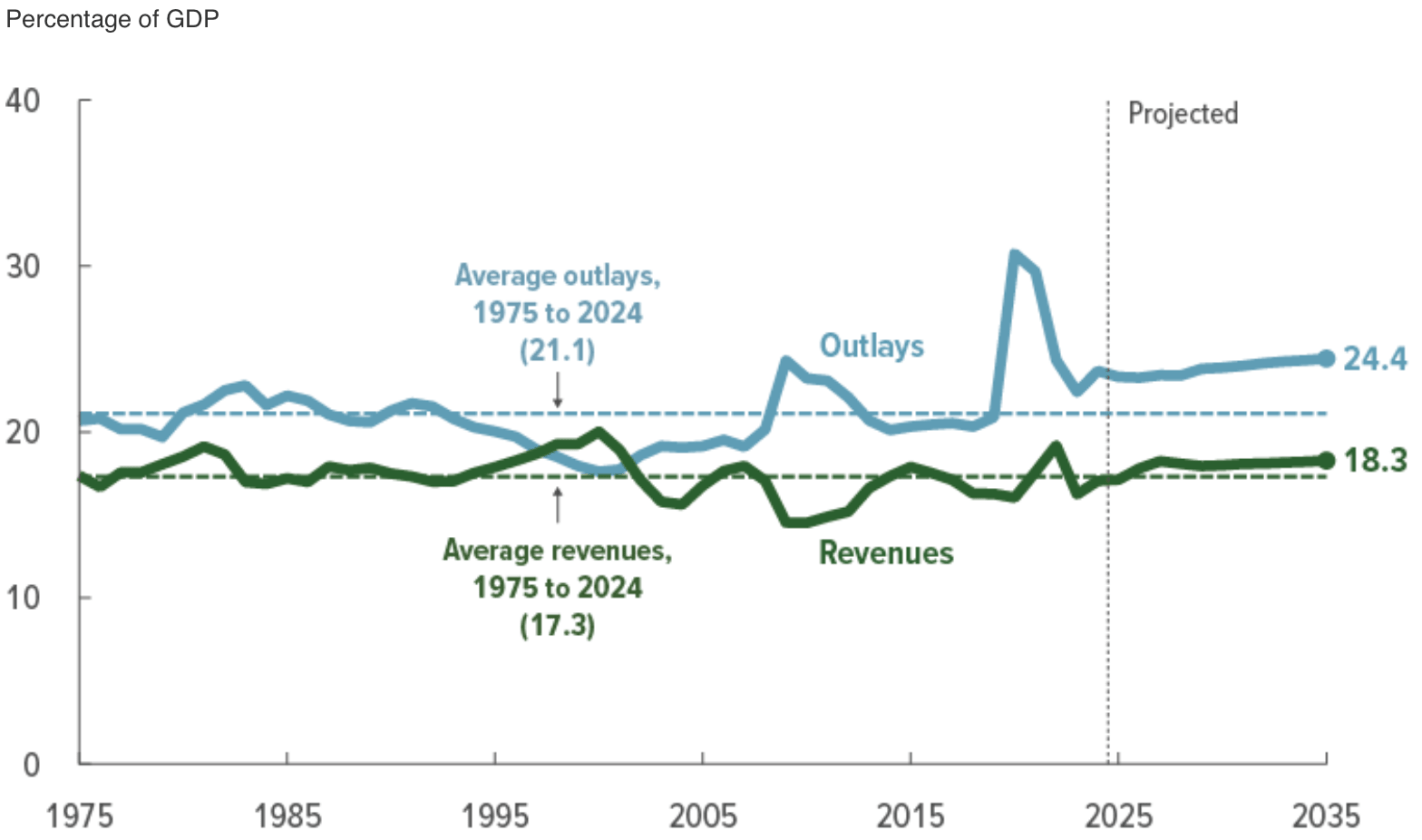
Source: Congressional Budget Office

Our ‘primary deficit’ is lower, a more manageable 3% of GDP. But if interest rates go higher, either for structural reasons or because of a loss of confidence in the US government’s willingness to pay its debts, the total deficit could spiral higher rapidly. The CBO optimistically assumed that the interest rate on 10-year treasuries will fall below 4% in the 2030s, from 4.3% today:

Source: Congressional Budget Office

But their scoring of H.R. 1 (“One Big Beautiful Bill Act”) shows it adding $3 trillion to the debt over the next 10 years, increasing the deficit by ~1% of GDP per year.

I already suspected this gray rhino would eventually cause a crisis, but this bill and the milieu that produced turn it into a near guarantee- nothing stops the deficit train until we hit a full blown crisis. That crisis is no longer just a long-term issue for your kids and grandkids to worry about- you will see it in 7 years or so. Unfortunately, that is still far enough away that current politicians have no incentive to take costly steps to avoid it. In fact, deficits will probably make the economy stronger for a year or two before they start making things worse- convenient for all the Congresspeople up for election in less than 2 years.

Here are the ways I see this playing out, from most to least likely:

  1. By around 2032, either the slowly aging population or a sudden spike in interest rates forces the government to touch at least one of the third rails of American politics: cut Social Security, cut Medicare, or substantially raise taxes on the middle class (explicitly or through inflation).
  2. We get bailed out again by God’s Special Providence for fools, drunks, and the United States of America. AI brings productivity miracles bigger than those of computers and the internet, letting GDP grow faster than our debts.
  3. We default on the national debt (but this is a risky option because we will still want to run big deficits, and lenders will only lend if they expect to get paid back).
  4. We do all the smart policy reforms that economists recommend in time to head off the crisis and stop the rhino. Medical spending falls without important services being cut thanks to supply-side reforms or cheap miracle drugs (GLP-1s going off patent?).

I’m hoping of course for numbers 2 and 4, but after this bill I’m expecting the rhino.

When Will the Fed Raise Rates?

Everyone else keeps asking when the Fed will cut rates, and yesterday Chair Powell said they will likely cut this year. Either they are all crazy or I am, because almost every indicator I see indicates we are still above the Fed’s inflation target of 2% and are likely to remain there without some change in policy. Ideally that change would be a tightening of fiscal policy, but since there’s no way Congress substantially cuts the deficit this year, responsibility falls to the Federal Reserve.

Source: https://fiscaldata.treasury.gov/americas-finance-guide/national-deficit/

Lets start with the direct measures of inflation: CPI is up 3.1% from a year ago. The Fed’s preferred measure, PCE, is up 2.4% from a year ago. Core PCE, which is more predictive of where inflation will be going forward, is up 2.8% over the past year. The TIPS spread indicates 2.4% annualized inflation over the next 5 years. The Fed’s own projections say that PCE and Core PCE won’t be back to 2.0% until 2026.

The labor market remains quite tight: the unemployment rate is 3.7%, payroll growth is strong (353,000 in January), and there are still substantially more job openings than there are unemployed workers. The chattering classes underrate this because they are in some of the few sectors, like software and journalism, where layoffs are actually rising. Real GDP growth is strong (3.2% last quarter), and nominal GDP growth is still well above its long-run trend, which is inflationary.

I do see a few contrary indicators: M2 is still down from a year ago (though only 1.4%, and it is up over the past 6 months). The Fed’s balance sheet continues to shrink, though it is still trillions above the pre-Covid level. Productivity rose 3.2% last quarter.

But overall I am still more worried about inflation than about a recession, as I was 6 months ago. Financial conditions have changed dramatically from a year ago, when the discussion was about bank runs and a near-certain recession. Today the financial headlines are about all time highs for Bitcoin, Gold, Japan, and US stocks, with an AI-fueled boom (bubble?) in tech pushing the valuation of a single company, Nvidia, above the combined valuation of the entire Chinese stock market. All of this screams inflation, though it could also indicate a recession in a year or so if the bubble pops.

At least over the past year I think fiscal policy is more responsible than monetary policy for persistent inflation. But I can’t see Congress doing a deficit-reducing grand bargain in an election year; the CBO projects the deficit will continue to run over 5% of GDP. That means our best chance for inflation to hit the target this year is for the Fed to tighten, or at least to not cut rates. If policy continues on its current inflationary path, our main hope is for a deus-ex-machina like a true tech-fueled productivity boom, or deflationary events abroad (recession in China?) lowering prices here.

Inflation During the Pandemic in the OECD

Inflation is definitely here. The latest CPI release puts the annual inflation rate in the US at 8.5% over the past 12 months, the highest 12-month period since May 1981. That’s bad, especially because wages for many workers aren’t keeping up with the price increases (and that’s true in other countries too).

But what about other countries? Many countries are experiencing record inflation too. The same day the US announced the latest CPI data, Germany announced that they also had the highest annual inflation since 1981.

Using data from the OECD, we can make some comparisons across countries during the pandemic. I’ll use data through February 2022, which excludes the most recent (very high!) months for places like the US and Germany, but most countries haven’t released March 2022 data quite yet.

Let’s compare inflation rates and GDP growth (in real terms, also from the OECD), using the end of 2019 as a baseline. We’ll compare the US, the other G-7 countries, and several broad groups of countries (OECD, OECD European countries, and the Euro area). The chart below uses “core inflation,” which excludes food and energy (below I will use total inflation — the basic picture doesn’t change much).

Continue reading

The Justice Dividend

While I was listening to The New Bazaar and enjoying an episode with Tim Harford, I was reminded that economists don’t just have the job of understanding the world. We have a responsibility to our fellow man of keeping fallacy and economic misunderstanding at bay (a Sisyphean task).  That doesn’t mean that we just teach economic theory. We can and should advocate for good economic policy ideas and try to think up some policy alternatives that fit our political climate.

Here I was sitting, being grumpy at the US Federal deficit, when an idea came to me. I am full of ideas. Especially unpopular ones. So, I especially like ideas that make political sense to me given that the political parties care about their policy values and re-election. Asserting that people in congress actually care about policy apart from re-election is kind of a pie-in-the-sky assertion. But, here we go none the less.

Mancur Olson liked to emphasize the role of concentrated benefits and diffused costs in political decision making. Economists point to it and explain the billion-dollar federal subsidies that go to interest groups. A favorite example is Sugar subsidies. As of 2018 there were $4 billion in subsidies and sugar growers earned $200k on average. The typical family of four pays about $50 more in subsidies each year as a result. The additional tax burden of higher sugar prices is also relatively small. Therefore, says the economist, the few sugar beet and sugar cane farmers have a large incentive to ensure the subsidy’s survival while others pay a relatively small cost to maintain it. That small cost means that there is little money saved and little gain for any individual who might try to fight the applicable legislation.

That’s the standard story. But it’s so much worse than a story of concentrated benefits and diffused costs. The laity don’t know how the world works in two important ways. First, many people will simply say that they are happy to protect American producers for an additional $50 per year. That’s a small price to pay for ensuring the employment and production of our fellow Americans, they say. An economist might reply, in a manner that so automatic that it appears smug, that that $50 would instead go to producers of other goods and that our economy would be more productive if the sugar-producing resources were diverted elsewhere. This is Bastiat’s seen and unseen. Honestly, I suspect that neither economists nor non-economists can adopt the idea without a little bit of faith.

Secondly, people don’t know what causes a particular price to change. Hayek painted this characteristic as a feature of the price system. We are able to communicate information about value and scarcity without evaluating the values of others or the actual quantity of an available resource. However, lacking causal knowledge of prices makes for some bad policies. Say that the subsidies and protections subsided and the price of US sugar declined. The consumer would likely not know anything about the subsidies in the first place, much less that they were rescinded. Further, the world is a complicated place and people are apt to thank/blame irrelevant causes otherwise (corporate greed, anyone?).

When economists blame concentrated benefits and diffused costs, they often assume that there is perfect information. THERE ISN’T. People don’t know how the world works well enough to predict with confidence what will happen in an alternate version of reality without subsidies. Nor do they understand the particular determinants of prices in our current world. Half the battle is a lack of knowledge about the functioning of the world – not just that the costs and benefits fail to provide a strong enough incentive for legislative change.

Continue reading