Bad Claims About Food Stamps (SNAP)

One of the likely effects of the federal government shutdown is that recipients of SNAP benefits (what used to be officially called “food stamps,” a term still used by the general public, especially those that dislike the program) may lose their benefits next month. This would obviously be a hardship for those that depend on this program, but it has also led to bad claims being made about the program, from both supporters and opponents of the program.

Let’s start from the political right: Matt Walsh makes the claim that by subsidizing food consumption “obviously drives up the cost” of groceries.

As with all bad claims, there is a nugget of truth baked into them. If the government subsidizes anything, we would expect demand to increase, and thus unless supply is perfectly elastic, there will be some effect on prices. However, we need to think more carefully about the nature of the subsidy.

The way SNAP works is that beneficiaries receive an electronic voucher to spend at the grocery store, which is about $300 per month on average for a household. That $300 must be spent on groceries. However, if that household had already planned to spend $300 or more on groceries, it is unlikely they will spend all of the additional $300 on food. In the limit, it’s entirely possible they will spend no additional money on groceries, merely reducing their out-of-pocket spending on groceries by $300. They will then effectively have $300 more to spend on other goods. More likely is that they will spend some of the additional $300 on groceries, and some of it on other goods.

Many studies have tried to look at the extent to which SNAP benefits affect household spending, but these were mostly observational studies. There was no treatment and control group. But a 2009 paper titled “Consumption Responses to In-Kind Transfers: Evidence from the Introduction of the Food Stamp Program” has a better approach to studying the question. Since the original Food Stamp program was slowly rolled out across the country over more than a decade, you can compare counties that entered the program first to counties that entered it later. By doing so, Hilary Hoynes and Diane Schanzenbach find out some first interesting things about the causal effects of SNAP benefits.

For the claim by Walsh in his Tweet, the most relevant result from the paper is that food stamps impact household spending similarly to a cash transfer. Yes, the program increases household spending on groceries, but it also increases spending on other goods and services. And it does so almost identically to how cash transfers impact household spending. In other words, while pitching the program as assistance for buying groceries may make it more politically palatable, SNAP benefits are no different from a similarly-sized cash transfer for the average recipient. If they do cause any inflation, they do so in the same way as a cash transfer would, and thus there is no specific impact on food inflation.

A second bad claim about SNAP comes from the political left, in this case Minnesota Governor Tim Walz:

Continue reading

Spending on Necessities Has Declined Dramatically in the United States

Has it gotten easier or harder for Americans to afford the basic necessities of life? Part of the answer to this question depends on how you define “basic necessities,” but using the common triad of food, clothing, and housing seems like a reasonable definition since these composed over 80% of household spending in 1901 in the United States.

If we use that definition of necessities, here is what the progress has looked like in the US since 1901:

The data comes from various surveys that the Bureau Labor Statistics has collected over the years, collectively known as the Consumer Expenditure Surveys. The surveys were conducted about once every 1-2 decades from 1901 up until the 1980s, and then annually starting in 1984. Some of these are multi-year averages, but to simplify the chart I’ll just state one year (e.g., “1919” is for 1918 and 1919). The categories are fairly comprehensive: “food” includes both groceries and spending at restaurants; “housing” includes either mortgage or rent, plus things like utilities and maintenance; and “clothing” includes not only the cost of the clothes themselves, but services associated with them such as repairs or alterations (much more important in the past).

We can see in the chart that over time the share spent on these three areas of spending has declined dramatically, taken as a group. Housing is different, but it has been fairly stable over time, mostly staying between 22% and 29% of income (the Great Depression being an exception). There are two time periods when these costs rose: the Great Depression and the late 1970s/early 1980s. Both are widely recognized as bad economic times, but they are aberrations. The jump from 1973 to 1985 in spending on necessities was fully offset by 2003, and today spending on necessities is well below 1973 — even though for housing, it is a few percentage points greater.

A chart like this shows great progress over time, but it will inevitably raise many questions. Let me try to answer a few of them in advance.

Continue reading

Economic Nostalgia: 1890s Edition

You see a lot of nostalgia for the recent past. People pining for the simpler life of the 1950s, or claims that wages have stagnated since the late 1970s or early 1980s. I’ve tried to take these arguments seriously and respond to them, such as in a paper I wrote with Scott Winship and summarized in a blog post last June. But occasionally, you find really weird economic nostalgia, like for the 1890s. Yes, the 1890s, not the 1990s.

Here’s one example: a cartoon shared on social media of workers being oppressed in the 1890s, with the caption “the problem has only gotten worse.” That post received 2 million views on Twitter, possibly because many people are criticizing it, but it also has a lot of retweets and likes.

If it was just one semi-viral social media post from an anonymous Twitter account, we could easily dismiss it. But 1890s economic nostalgia has been coming from another important place lately: President Elect Trump. Of course he is nostalgic for the policies of the 1890s. But on occasion, Trump will say things like “Go back and look at the 1890’s, 1880’s with McKinley and you take a look at tariffs, that was when we were at our richest” (emphasis added).

Really, our richest in the 1890s? Can this be true? Are the anonymous socialist Twitter accounts correct? Let’s look at the data. But the answer probably won’t surprise you: your intuition is correct, we are much better off today than the 1890s, in almost every way of looking at it economically.

Continue reading

The Mythology of Rice and Beans

I’ve written about proteins twice before. Once concerning protein content generally and then another concerning amino acid content of animal proteins. The reason that I stuck to animal proteins initially was because I held a common and false belief: Singular vegetarian foods aren’t complete proteins. The meat-eaters gotchya claim is that meats contain complete proteins. After all, we’ve heard a million times that beans and grains are often eaten together because they form a complete protein. The native North Americans? Corn and beans. Subcontinent Indians? Rice and Lentils or chickpeas. Japan? Rice and soy. Choose your poor or vegetarian population in the world, and they combine beans and grains. We’ve always been told that it’s because the combination constitutes a ‘complete protein’.

But you know what else constitutes a complete protein? Any of those foods all by themselves. What the heck. I haven’t been lied to. But I’ve certainly been misled. Let me briefly tell you my research journey. My recommended daily intake (RDI) are from the World Health Organization and the amino acid data is from the US Department of Agriculture. Prices are harder to pin down in a representative way, but I cite those too.  

Continue reading

The Price of a Complete [Animal] Protein

I wrote about the protein content of different foods previously. I summarized how much beef versus pea and wheat flour one would need to eat in order to consumer the recommended daily intake (RDI) of ‘complete proteins’ – foods that contain all of the essential amino acids that compose protein. These amino acids are called ‘essential’ because, unlike the conditionally essential or non-essential amino acids, your body can’t produce them from other inputs. Here, I want to expand more on complete proteins when eating on a budget.

Step 1: What We Need

To start, there are nine essential amino acids with hard to remember names for non-specialists, so I’ll just use the abbreviations (H, I, L, K, M, F, T, W, V). The presence of all nine essential amino acids is what makes a protein complete. But, having some of each protein is not the same as having enough of each protein. Here, I’ll use the World Health Organization’s (WHO) guidelines for essential amino acid RDI for a 70kg person. See the table below.

Step 2: What We Need to Eat

What foods are considered ‘complete proteins’? There are many, but I will focus on a few animal sources: Eggs, Pork Chops, Ground Beef, Chicken, & Tuna. Non-animal proteins will have to wait for another time. Below are the essential amino acid content per 100 grams expressed as a percent of the RDI for each amino acid. What does that mean? That means, for example, that eating 100 grams of egg provides 85% of the RDI for M, but only 37% of the RDI for H.

Continue reading

Consumer Expenditures in 2023

Today BLS released the annual update to the Consumer Expenditure Survey, which is exactly what it sounds like: a survey of US consumers about what their spending. The sample size is “20,000 independent interview surveys and 11,000 independent diary surveys” so it’s a pretty big sample. And this is a really great data source, because versions of it go back over 100 years (though the current, annual survey with a lot of detail starts in 1984).

What does this new data tell us? One area that has received a lot of attention lately is food spending (including a lot of attention on this blog), especially the cost of groceries. According to the CPI food at home index, grocery prices are up almost 26 percent since the beginning over 2020. That’s a lot! But incomes are up too, so how does this affect spending patterns?

Here’s what food and grocery spending for middle-quintile households looks like:

Compared to the pre-pandemic 2019 levels, consumers are spending slightly less of their income on food (12.7% vs. 13.2%), though a slightly larger share of their income is being spent on groceries (8.1% vs. 7.8%). Those changes are noticeable, though this isn’t the radical realignment of spending patterns you might expect from such a big change in food prices. The reason is clear: while grocery prices are up about 26%, middle-quintile incomes are up a similar 25% since 2019. That’s falling behind a little bit, but incomes have roughly kept pace with rising food prices. And from 2022 to 2023, both of these percentages decreased slightly, by about 0.3 percentage points.

Continue reading

Grocery Inflation is Under Control, Fast Food Prices Aren’t

Thankfully for US consumers, grocery prices have leveled off. They haven’t fallen, of course, which will still lead to viral complaints about egg prices, etc. But over the past 4 years, wages have almost caught up with grocery prices.

Not so with fast food prices (“limited service meals”), which have definitely outpaced wages over the past 4 years, and continue to grow at an annual rate of about 5 percent (also more than wages).

Furthermore, if we go back to 2014, we see it’s not just a post-pandemic effect on fast food. Prices since 2014 are up 54 percent for fast food according to the BLS, more than the 31 percent overall CPI-U increase and more than average wages (46 percent).

An article from FinanceBuzz puts together some more specific data on a dozen fast-food chains in the US. Consumer favorites for a quick, cheap bite to eat like Taco Bell and McDonald’s have seen menu prices increase by 80 or even 100 percent!

Check out the article for even more specific food item data at each of these restaurants. For example, the most famous of fast-food sandwiches is the Big Mac, which is up from $3.99 in 2014 to $5.99 in 2024, a 50 percent increase. A Whopper meal at Burger King is up 79 percent. All the more reason to seek out deals in the apps, or just good-old in-store discounts, like the “buy one get one for $1” promo at most McDonald’s. This deal would get you two Big Macs for $7, or $3.50 each… less than in 2014! Or since today is Wednesday, you might want to head to Burger King, where Whoppers are $3 at most locations (regular price: around $6).

Price discrimination is alive and well at the drive-thru window, and if you are just ordering from the menu without any discounts, you are really going to feel the pain of inflation.

Food Price Increases Won’t Be Solved by Raising Interest Rates

I make a hobby of reading, and sometimes acting on, investment advice, particularly regarding high-yielding securities (many of my holdings are now yielding over 10%/year). One of the best authors on the Seeking Alpha investing site writes under the name of Colorado Wealth Management. He mainly writes on REIT (real estate investment trust) stocks, but recently opined on the wisdom of raising interest rates to combat inflation regarding some of the major components of CPI.

His article, Why High Yields Will Be Popular Again, may be behind a paywall for some readers, so I will summarize some key points. He kind of sidesteps the influence of massive federal deficit spending that injected trillions and trillions of new dollars into the economy for COVID, which I think has been the major driver for this inflation; and the reignited deficit spending which is already on the books for November and likely even huger for December of this year. However, he does make some interesting (and new to me) points regarding food prices in particular.

He sees the price 2021-2022 price increases in some major food items as being driven by supply constraints, rather then by excessive demand. Specifically eggs, coffee, and vegetable oils have been hit by exogenous factors which have constrained supply; raising interest rates will not help here, and may even hurt if higher rates make it harder for farmers to recover and re-start high production. I’ll transition to his charts and mainly his excerpted words, in italics below:

Avian Flu, Culled Hens, and the Price of Eggs

The background here is that tens of millions of chickens, including egg-laying hens, have been deliberately killed (“culled”) this year in an attempt to slow the spread of avian flu. This, of course, cuts into the egg supply and raises egg prices. We went through a similar cycle in 2015 with avian flu, where culling led to a rise in egg prices, but then prices fell naturally as a new crop of chicks grew into egg-laying hens. Similarly, the current shortage in eggs should correct itself:

Raising interest rates has never produced additional eggs. Raising interest rates and driving a recession (with larger credit spreads) only makes it more difficult for farmers to get the funding necessary to replace tens of millions of hens that were culled to slow the spread of the avian flu….If interest rates don’t work, what will? The cure for high prices is high prices. We can see how it played out with the Avian flu in 2015:

  • Is Jerome Powell going to lay even one egg? Probably not.
  • Are farmers going to focus on turning their chicks into egg-laying hens? Absolutely.

Since eggs go into several other products, it drives inflation throughout the grocery store. Even if a product doesn’t use eggs, the drop in egg production means more people eating other foods.

Drought in Brazil and the Price of Coffee

Coffee prices have been rising rapidly. Well, domestic prices have been rising rapidly. Global prices actually declined since peaking in February 2022:

So, what drove the price up? Brazil normally produces over 35% of the world’s coffee and bad weather in Brazil (not to mention the pandemic impacts) drove dramatically lower production in 2021. As the shortfall in production became evident, global prices began rising rapidly. That’s why the global [wholesale] prices were ripping higher in 2021, not 2022. However, [retail] consumers are seeing most of the impact over the last several months.

War in Ukraine and the Price of Sunflower Oil

Margarine requires vegetable oil. Soybean, palm, sunflower, and canola oil are the key ingredients. What country produces the most sunflower oil? Ukraine. This is one of several inflationary impacts of the war. You can see the impact of reduced supply in the following chart:

Government Bungling in Indonesia and the Price of Palm Oil

What happened to palm oil? How could it soar so much and then fall so hard?

The first issue is that dramatic increases in the price of fertilizer made production more expensive. … That contributed to a reduction in supply. However, Indonesia is the world’s largest exporter of palm oil. Yet exports of palm levy were subject to a huge levy. That made exporting far more expensive. Despite the levy, it was still worth producing and exporting palm oil. Then the Indonesian government decided to simply ban exports over concern about higher domestic prices. Banning exports for a country that produces 59% of the world’s total palm oil exports had a predictable impact.

If you guessed that the supply of palm oil couldn’t be sold domestically, you’d be right. The ban was lifted. However, it was only after:

High palm oil stocks have forced mills to limit purchases of palm fruits. Farmers have complained their unsold fruits have been left to rot. There were 7.23 million tonnes of crude palm oil in storage tanks at the end of May, data from the Indonesian Palm Oil Association (GAPKI) showed on Friday.

With palm oil prices at all time-record highs, nearly triple the level from two years prior, the supply was left to rot. Each business tried to make the best decision they could, given the ban on exports. Rather than record profits for mills and record profits for farmers, the produce was wasted. That’s supply constraints for the global market, and it destroys the local economy.

Global prices are plunging now as mills seek to unload their storage. As bad as the higher prices were for the rest of the world, no one suffered worse than the farmers whose product became worthless as a result of government failure.

Contrary to today’s popular opinion, higher interest rates won’t do anything to improve production of vegetable oil.

Some Countries Use Too Much Fertilizer, and Some Use Too Little

In a world where China and India continue to build huge, CO2-belching coal power plants, and a world where global supply chains can no longer be taken for granted, you might think that a small, crowded country like the Netherlands would prioritize home-grown food production over concerns about greenhouse gas emissions from a relatively small volume of cow manure. But this is Europe, the land of eco-utopianism, and so you would be wrong.

Cow poop does emit nitrous oxide (a greenhouse gas) and ammonia (which can potentially pollute local water if uncontained). In a burst of green virtue,  the Netherlands has, “unveiled a world-leading target to halve emissions of the gasses, as well as other nitrogen compounds that come from fertilizers, by 2030, to tackle their environmental and climate impacts.” This target is expected to result in a 30% reduction in livestock numbers and the closure of many farms. Dutch farmers are not amused, and have vented their ire by dumping hay bales on highways and smearing manure outside the home of the agricultural minister. Protests over green policies hobbling local farmers have spread to Germany and Canada.

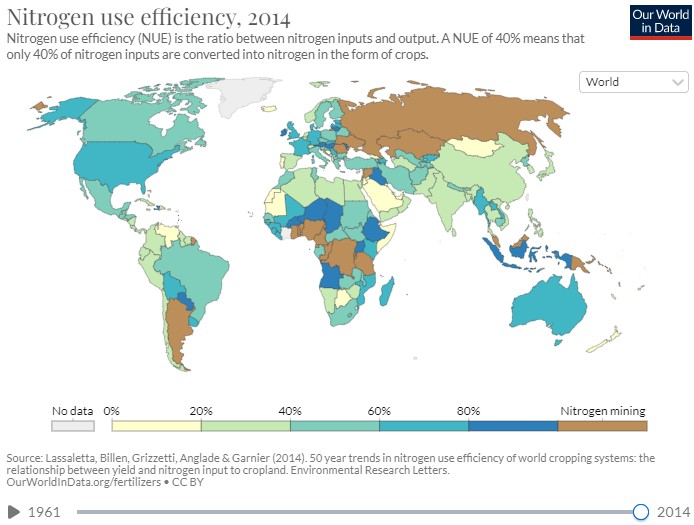
All this raised in my mind the question, could we really get along with using much less nitrogen-based fertilizers? I found a great article by Hannah Ritchie on OurWorldinData.org, “Can we reduce fertilizer use without sacrificing food production?”, which provides lush tables and graphs on the subject.

First, it’s estimated that artificial nitrogen fertilizers (where hydrogen, mainly derived from natural gas, is reacted with atmospheric nitrogen at high pressure over catalysts to make ammonia and derivatives) allow the world’s population to be about twice as high is it would be otherwise. Put another way, take away nitrogen fertilizers, and half of us die. So any campaign to massively scale back on fertilizer usage would result in mass starvation. You first…

That said, Ritchie’s article pointed out that some countries such as China seem to be (inefficiently) using much more fertilizer than they need to get similar results, some countries (e.g. America) seem to be about in balance, and some areas (e.g. sub-Saharan Africa) would benefit from using more fertilizer. So globally we could probably use a bit less fertilizer if the profligate countries used (a lot) less, while the deprived countries used a little more.

I’ll conclude with two charts from Ritchie’s article. The first chart shows, for instance, that Brazil uses twice as much fertilizer per hectare or per acre as the U.S, and China uses three times as much, while Ghana uses about a tenth as much.

The second chart shows estimated nitrogen use efficiency (NUE). An NUE of 40%, for instance, shows that 40% of the nitrogen in the fertilizer is converted to nitrogen in the form of crops, while the other 60% of the nitrogen becomes pollutants. In China and India, only about a third of the applied nitrogen is fully utilized, compared to two thirds in places like the U.S. and France. ( Some countries have a very high NUE – greater than 100%. This means they are undersupplying nitrogen, but continue to try to grow more and more crops. Instead of utilizing readily available nutrients, crops have to take nitrogen from the soil. Over time this depletes soils of their nutrients which will be bad for crop production in the long-run).

Good Old Lemons

This post doesn’t have a darn thing to do with economics, statistics, or finance. This is a post about citrus storage.

There are problems with buying citrus.

  • If you get a big Sam’s Club size bag of limes, then they start going hard and thin-skinned by the end of a week.
  • A bag of grapefruit? There’s usually one in the bag that’s goes moldy almost immediately and you know what they say about one bad grapefruit spoiling the bunch.
  • Mandarins shrink and get hard to peel.
  • Lemons – even if you refrigerate them – get soft and un-zest-worthy.

There is a solution. Now, our lemons and limes last upwards of 6-8 weeks with hardly a symptom of age. Mandarins don’t shrivel and grapefruits remain edible. No, silly goose, the answer isn’t free markets and the price system.

Maybe it’s all of the additional vitamin C that I’m getting. Maybe it’s the warm and fuzzy feeling of money well spent. But I’m now excited each time that we purchase citrus. And I get a cozy feeling of satisfaction whenever I see a nice lemon that definitely should not still be any good.

The answer is really simple. You too can achieve such amazing results. All you have to do is:

  • Rinse your citrus under water, rubbing gently to remove any invisible bad-guy germs. In reality, you’re probably getting rid of mold spores.
  • Place the wet citrus into a ziploc bag, seal, and refrigerate. The refrigeration further retards the growth of any unwanted spores. The sealed bag prevents too much air flow and drying.( I don’t bother refrigerating grapefruit and oranges because I eat them quickly enough).

That’s it. You too can have 8 week old limes and lemons that you bought on sale or in bulk that are nearly as fresh as the day that you purchased them.

Enjoy!