Was the US at Our Richest in the 1890s?

Donald Trump has repeatedly said that the US was at our “richest” or “wealthiest” in the high-tariff period from 1870-1913, and sometimes he says more specifically in the 1890s. Is this true?

First, in terms of personal income or wealth, this is nowhere near true. I’ve looked at the purchasing power of wages in the 1890s in a prior post, and Ernie Tedeschi recently put together data on average wealth back to the 1880s. As you can probably guess, by these measures Trump is quite clearly wrong.

So what might he mean?

One possibility is tax revenue, since he often says this in the context of tariffs versus an income tax. Broadly this also can’t be true, as federal revenue was just about 3% of GDP in the 1890s, but is around 16% in recent years.

But perhaps it is true in a narrower sense, if we look at taxes collected relative to the country’s spending needs. Trump has referenced the “Great Tariff Debate of 1888” which he summarized as “the debate was: We didn’t know what to do with all of the money we were making. We were so rich.” Indeed, this characterization is not completely wrong. As economic historian and trade expert Doug Irwin has summarized the debate: “The two main political parties agreed that a significant reduction of the budget surplus was an urgent priority. The Republicans and the Democrats also agreed that a large expansion in government expenditures was undesirable.” The difference was just over how to reduce surpluses: do we lower or raise tariffs?

It does seem that in Trump’s mind being “rich” in this period was about budget surpluses. Let’s look at the data (I have truncated the y-axis so you can actually read it without the WW1 deficits distorting the picture, but they were huge: over 200% of revenues!):

It is certainly true that under parts of the high-tariff period, we did collect a lot of revenue from tariffs! In some years, federal surpluses were over 1% of GDP and 30% of revenues collected. But notice that this is not true during Trump’s favored decade, the 1890s. Following the McKinley Tariff of 1890, tariff revenue fell sharply (though probably not likely due to the tariff rates, but due to moving items like sugar to the duty-free list, as Irwin points out). The 1890s were not a decade of being “rich” with tariff revenue and surpluses.

Finally, also notice that during the 1920s the US once again had large budget surpluses. The income tax was still fairly new in the 1920s, but it raised around 40-50% of federal revenue during that decade. By the Trump standard, we (the US federal government) were once again “rich” in the 1920s — this is true even after the tax cuts of the 1920s, which eventually reduced the top rate to 25% from the high of 73% during WW1.

If we define a country as being “rich” when it runs large budget surpluses, the US was indeed rich by this standard in the 1870s and 1880s (though not the 1890s). But it was rich again by this standard in the 1920s. This is just a function of government revenue growing faster than government spending. And the growth of revenue during the 1870s and 1880s was largely driven by a rise in internal revenue — specifically, excise taxes on alcohol and tobacco (these taxes largely didn’t exist before the Civil War).

1890 was the last year of big surpluses in the nineteenth century, and in that year the federal government spent $318 million. Tariff revenue (customs) was just $230 million. There was only a surplus in that year because the federal government also collected $108 million of alcohol excise taxes and $34 million of tobacco excise taxes. In fact, throughout the period 1870-1899, tariff revenues are never enough to cover all of federal spending, though they do hit 80% in a few years (source: Historical Statistics of the US, Tables Ea584-587, Ea588-593, and Ea594-608):

One more thing: in some of these speeches, Trump blames the Great Depression on the switch from tariffs to income taxes. In addition to there really being no theory for why this would be the case, it just doesn’t line up with the facts. The 1890s were plagued by financial crises and recessions. The 1920s (the first decade of experience with the income tax) was a period of growth (a few short downturns) and as we saw above, large budget surpluses. The Great Depression had other causes.

One Hundred Years of U.S. State Taxation

From a paper recently published in the Journal of Public Economics by Sarah Robinson & Alisa Tazhitdinova, here is the history of federal and state taxation in the past century in the US in one picture:

The paper primarily focuses on US state taxes, thus mostly ignoring local taxes, but in the Appendix the authors do show us similar charts for local taxes:

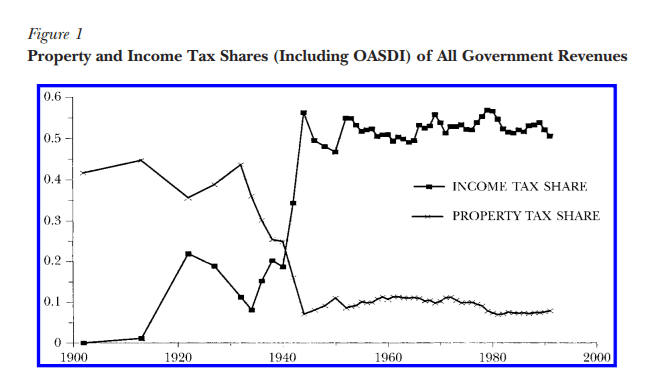
In broad terms, the history of taxation in the US in the 20th century is a history of the decline of the property tax, and the rise of the income and sales taxes. In 1900, there were barely any federal taxes (other than those on alcohol and tobacco), 50% of state taxes were property tax, and almost 90% of local taxes were property taxes. Property taxes were essentially the only form of taxation most Americans would directly recognize (excise taxes and tariffs were baked into the price of the goods).

John Wallis (2000) provided a similar, and simpler picture of these changes: considering all taxes in the US, property taxes were over 40% of the total in 1900, but today are under 10%. Income taxes come out of nowhere and are now about half of all government revenues in the US:

Why Was Federal Tax Revenue Down in 2023?

The year 2023 was a pretty good one for the economy, whether judged by the labor market or economic growth. Despite this good economic growth, total receipts of the federal government were down about 7 percent from 2022 (note: I’m using calendar years, rather than fiscal years). Here’s a chart (note: in NOMINAL dollars) of total federal revenue since 2009:

I want to stress that these are nominal dollars (there, I’ve said it three times, hopefully there is no confusion). Nominal dollars are usually not the best way to look at historical data, but for purposes of looking at recent government budgets, sometimes it is. Especially when revenue is declining: if I adjusted this for inflation, the decline in 2023 would be even larger!

You’ll notice also that the decline in 2023 is even larger than the decline in 2020, the height of the pandemic when many people were out of work due to government regulations and changes in consumer behavior. The 2023 decline is big!

So, what the heck in going on with federal revenue in 2023?

Continue reading

State Tax Revenue is Down a Lot in 2023 (but really just back to normal levels)

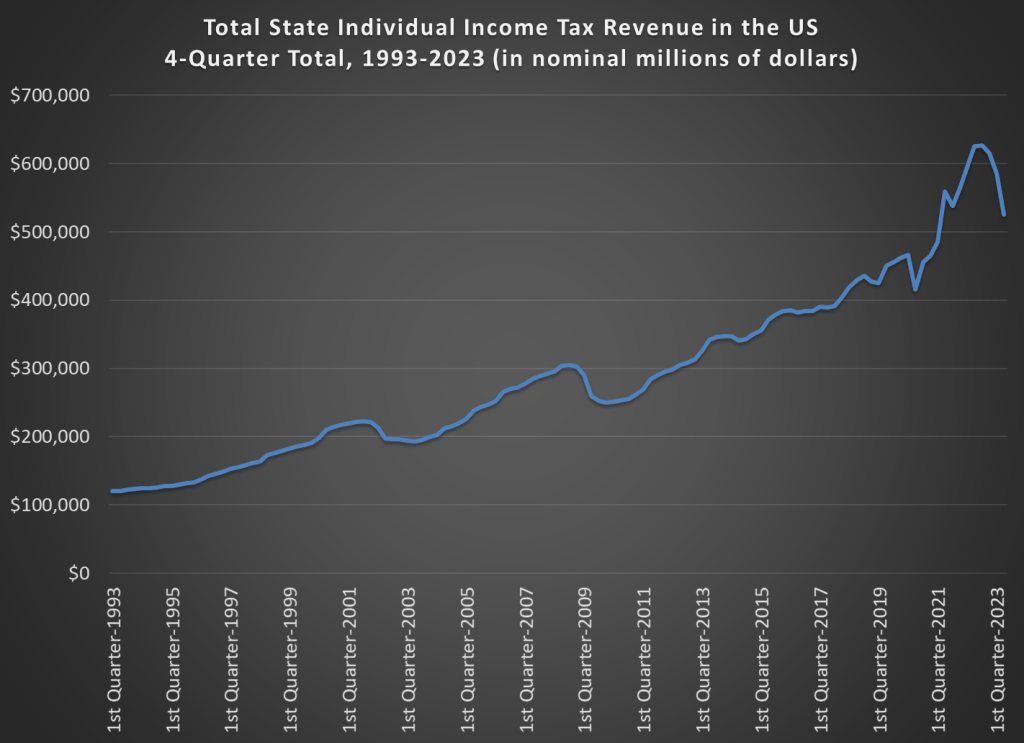
State tax revenue is down a lot since last year. The latest comparable data from Census’s QTAX survey is for the 2nd quarter of 2023, and it shows a massive hit: state tax revenue was down 14% from the same quarter in 2022, which is about $66 billion. Almost all of that decline is from income tax revenue, specifically individual income tax revenue which is down over 30% (almost $60 billion). General sales taxes, the other workhorse of state budgets, is essentially flat over the year.

That’s a huge revenue decline! So, what’s going on? In some states, there has been an attempt to blame recent tax cuts. It’s not a bad place to start, since half of US states have reduced income taxes in the past 3 years, mostly reducing top marginal tax rates. But that can’t be the full explanation, since almost every state saw a reduction in revenue: just 3 states had individual income tax revenue increases (Louisiana, Mississippi, and New Hampshire) from 2022q2 to 2023q2, and they were among the half of states that reduced rates!

To get some perspective let’s look at long-run trends. This chart shows total state individual income tax revenue for all 50 states (sorry, DC) going back to 1993. I use a 4-quarter total, since tax receipts are seasonal (and because states sometimes move tax deadlines due to things like disasters, a specific quarter can sometimes look weird). And importantly, this data is not inflation adjusted. Don’t worry, I will do an adjustment further below in this post, but for starters let’s just look at the nominal dollars, because nominal dollars are how states receive money!

Continue reading

What if You Didn’t Have to File a Tax Return?

Now that we’ve all made it through the 2021 tax filing season, it’s worth thinking about a recurring question in tax policy: is it possible that most of us wouldn’t need to go through this annual ritual? Couldn’t the government just tell us how much we owe (or are due as a refund), or better yet, just deduct the correct amount from our paycheck so we’d have paid the right amount?

We need to imagine such a system: it exists in many developed nations around the world! And it’s true that, at least for many taxpayers, the IRS already has all the information on you it needs to calculate your taxes.

But how many US taxpayers would this be beneficial for? A new working paper which tries to quantify this question. In “Automatic Tax Filing: Simulating a Pre-Populated Form 1040,” the authors use a large sample of tax returns to estimate how many taxpayers a pre-filled return would work for. The results are almost split down the middle: it would work well for maybe half of US taxpayers (41-48% of taxpayers, depending on how we are defining successful). For the other half, it wouldn’t give you an accurate estimate of how much tax you owed.

And the errors can be large. For example, the authors report that “two-thirds of the cases where the lower bound approach is inaccurate, the pre-populated liability is higher than the reported liability, with a median gap of $4,200.” Note: looking at the tables, I think they mean to say “mean,” not “median” here, with the median being $1,400. Still, that’s a lot of errors in a direction that would hurt taxpayers if they didn’t fill it out on their own or pay someone to do it. And it’s not just one thing that’s causing pre-filled returns to be wrong. You might think itemized deductions are a big issue, and they are, but only for about 11% of returns (and in only 4% of returns is this the only issue). They find that 9% of returns didn’t even have the reported wages matching what the IRS showed!

Does this mean that pre-filled returns are doomed in the US? Perhaps not! They seem to work much better for younger, single filers, and as well as filers with very low income, as Figure 1 from the paper shows. Even so, the 60-80% success rate (depending on criteria) for very low income taxpayers isn’t especially encouraging. But one upshot of a pre-filled return is that there are possibly millions of taxpayers (maybe 8 or 12 million?) that don’t file a return because they aren’t legally required to (too low income), but they would benefit if they did because of refundable credits like the EITC and Child Tax Credit.

Maybe there is a compromise position. The IRS could send you a “suggested tax return,” but allow you to modify it. I suspect that, in most cases, those who are currently paying for a person or software to do their taxes would still do it. You can’t know if you are in the one-half of taxpayers where this information is accurate! The IRS could provide a list of “common reasons why you may be in the half of pre-filled tax returns that are wrong,” but we’re still shifting the burden back to the taxpayer.

I would like to suggest, instead, that there are a few changes we could make to our tax system (“simplifications,” if you will) that might make pre-filled returns much more viable.

Continue reading

What Is Income?

The United States, like nearly all countries, has an income tax. What is an income tax? It’s a tax on income. What is income? That’s actually a very hard question.

The question comes up in a recent report by ProPublica on the taxes that very wealthy Americans pay (I’m not going to link to it, because the data was likely illegally obtained, and almost certainly immorally obtained, but you can easily find it). What’s really interesting is that never define income, but they do have an implicit definition which includes changes in net wealth. More on this later, but it does raise an important question under an income tax: what exactly should count as income?

For most wage and salary workers, income is fairly straightforward. It’s the compensation that your employer pays you in exchange for your labor services. Easy enough. There are some wrinkles. For example, most non-cash compensation is not considering income for tax purposes. And even some cash compensation, such as contributions to retirement plans, are not considered income. Still, pretty straightforward.

But what if you own a business? It gets a little more complicated. We could define your income as all of the money you receive when you sell goods and services to your customers. But that has a few problems. Let’s say you run a restaurant. You sell burgers for $5. Should you pay income tax on every $5 burger you sell? Keep in mind that you probably had $4.50 in expenses to sell that burger. You bought the beef, buns, and condiments. You paid your workers. You paid to “keep the lights on” (that’s how small business owners refer to utilities and other overheard). So our income tax system will only tax you on the $0.50 difference, which we usually call profit (in some years, of course, businesses have costs that exceed their sales revenue, in which case they owe no income tax).

Now for the really hard question: what if most of your income is derived from assets that you own? That’s where things get even more complicated, and both legal and philosophical questions come up.

Continue reading

What’s the Worst Tax?

It’s the most wonderful time of the year, when we start to get all those little documents in the mail and electronically showing how much you earned in the past year. The purpose of these little documents, of course, is to complete your federal and state income tax returns. While many Americans dislike paying income taxes, there is another tax that is rated as even worse in surveys: the property tax.

Why do Americans dislike the property tax so much? One popular explanation is that people don’t like the idea that “you never really own your property.” In other words, even after you have paid off your mortgage, you must continue to pay property taxes, which feels like a form of “rent” that you pay to the government. Of course, that “rent” does pay for a variety of public services, primarily K-12 education in most locations, but this still seems to rub many Americans the wrong way. The libertarian phase “taxation is theft” conveys a similar sentiment for income taxes, that you never “really own” your own labor if you must pay taxes on your earnings.

But there is also an economic explanation for the hatred of the property tax: it is very salient, especially to taxpayers that no longer have a mortgage. While those of us that still have a mortgage on our home pay property taxes through our normal monthly mortgage payment, Americans that have paid off their mortgage typically write a check (or two) to pay the full amount of their property tax bill. An interesting paper by Cabral and Hoxby finds that jurisdictions with more taxpayers using escrow for their property taxes (meaning they have a mortgage) also have higher property tax rates. And furthermore, they “find that owners with tax escrow report their taxes much less accurately than those without tax escrow” (look at Figure 2 in the paper to see the huge differences).

Income taxes, on the other hand, are not salient for most Americans. Payroll withholding means that the taxes are taken out before we even get our paycheck, and you’ll only notice them if you look at your pay stub. And about three-quarters of US taxpayers get a tax refund at the end of the year. For most Americans, the only salient part of the income tax system is a check they receive as a refund, rather than writing a check for their property taxes.

What does all this mean? Should income taxes be made more salient? Should property taxes be made less salient? A simple answer could be that all taxes should be equally salient. Or if you view one tax as superior in some way, maybe that tax should be less salient, so there is less opposition to it.

I don’t have the answers to these questions. But I do have a question for readers: do you know your own income tax rate? Specifically, what is the marginal rate on your federal income taxes? I invite readers to write down their guesses, then look up the correct answer. How close were you? Please leave a comment, and be honest!