Is a US Oil Export Ban Coming?

The Iran regime’s military strategy seems to be that by bombing the oil infrastructure of their neighbors and neutral shipping, US gasoline prices will go so high that Americans will demand an end to the war.
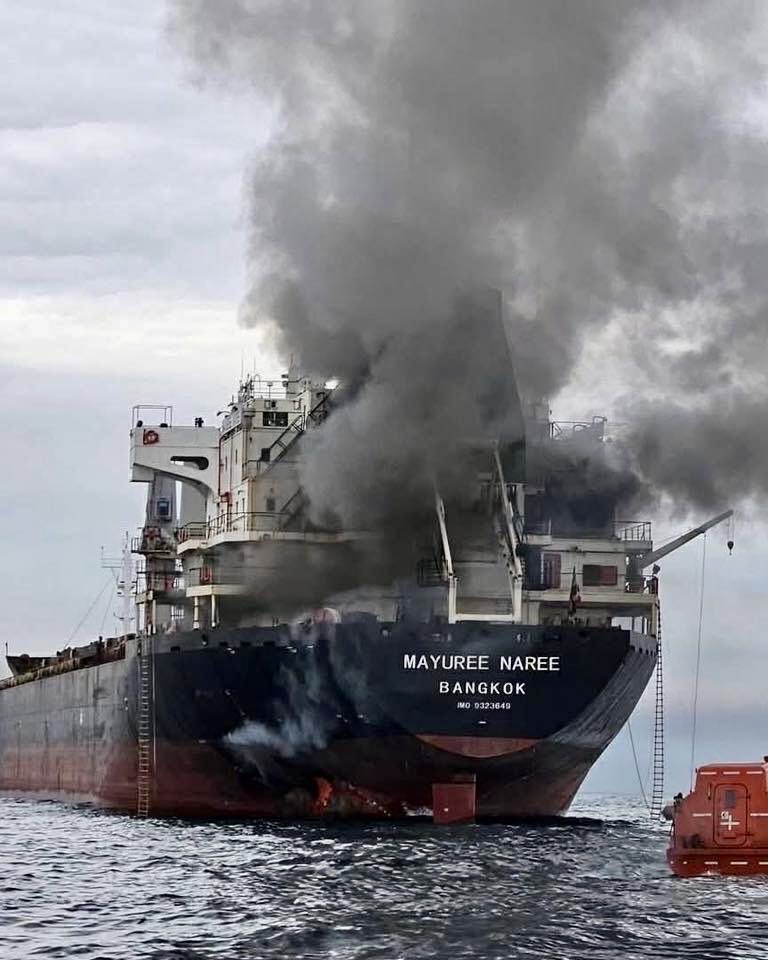
How many Americans would be willing to pay $6/gallon gas for months for a ~50% chance of toppling a regime that oppresses 90 million people and destabilizes its region on the other side of the world? Probably only a minority of voters, especially when the President didn’t make the case to the American people or Congress beforehand.

But the US produces more than enough oil for its own needs. Why does the Strait of Hormuz being closed mean higher gas prices here? Only because US oil companies can sell to global markets, and they won’t choose to sell a barrel of oil to a US refiner for $60 when they could sell it to a foreign refiner for $100. If the government took away the foreign option, US oil producers would sell to US refiners at prices consistent with pre-war sub-$3/gallon gasoline.

Naturally there would be costs to an export ban. US oil producers would miss out on windfall profits, while Russian producers would benefit. Foreign customers of US oil, many of them in allied countries, would be angered by the missed shipments and global oil prices would soar further.

But if the US administration wants to avoid a midterm wipeout driven by high gas prices, I see only 3 options:

  1. Get lucky and see the Iranian regime fall quickly
  2. Negotiate an end to the war quickly (which might itself be unpopular if they can’t get a good deal) or just declare victory and go home (but its not clear whether Iran would re-open the strait now just because the US stopped bombing)
  3. Restrict Exports

I say “restrict” not “ban” because I don’t think a complete export ban is necessary to stabilize US prices. You could instead do an export tax (high enough to stop many exports but low enough to allow the buyers with the highest values / fewest alternatives to stay in the market), or you could do a ban but allow a few export waivers for favored buyers or sellers (which seems like Trump’s style), or similarly a quota limiting exports to a certain number (say, limit each company’s monthly exports to 90% of their volume in the same month last year).

This has an obvious precedent: the Biden administration stopped issuing new permits to export liquified natural gas in 2024 to prevent prices spiking here during the Ukraine war (which led to even higher prices for our European allies). But a total ban on oil exports would be a much bigger deal.

Will the Trump administration actually try something like this? It will be an interesting test of US political economy to see what happens when the interests of the military-industrial complex conflict with the interests of oil producers.

Iran on Markets, Markets on Iran

We’re bombing Iran, and Iran is now bombing most of its neighbors. Oil prices are up ~20% since the bombing began last weekend, and stocks are down.

Iranian “Supreme Leader” Khamenei is now dead. Prediction markets sort of saw this coming; I mentioned here a month ago that markets thought it more likely than not that Khamenei would be “out of office” this year.1

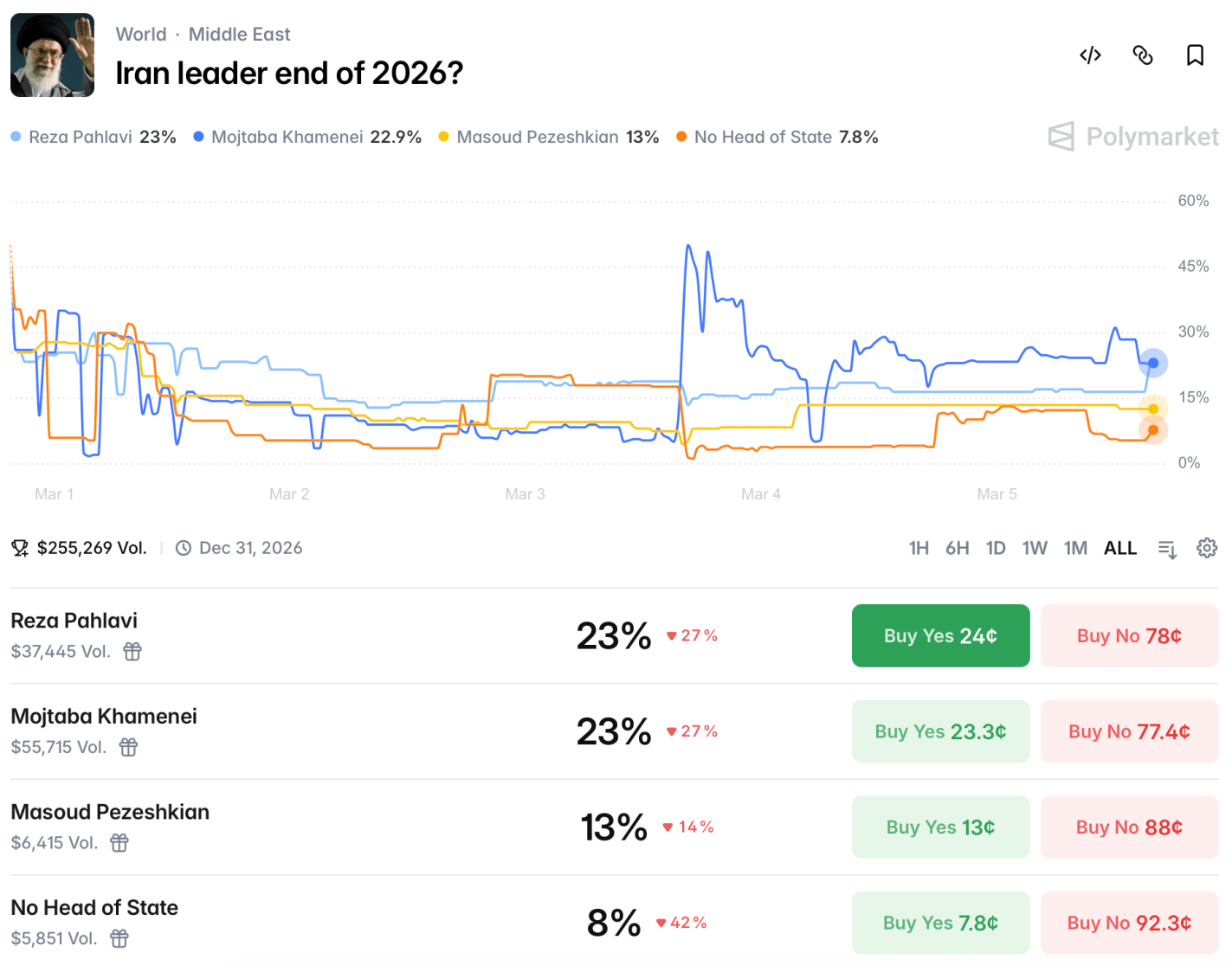
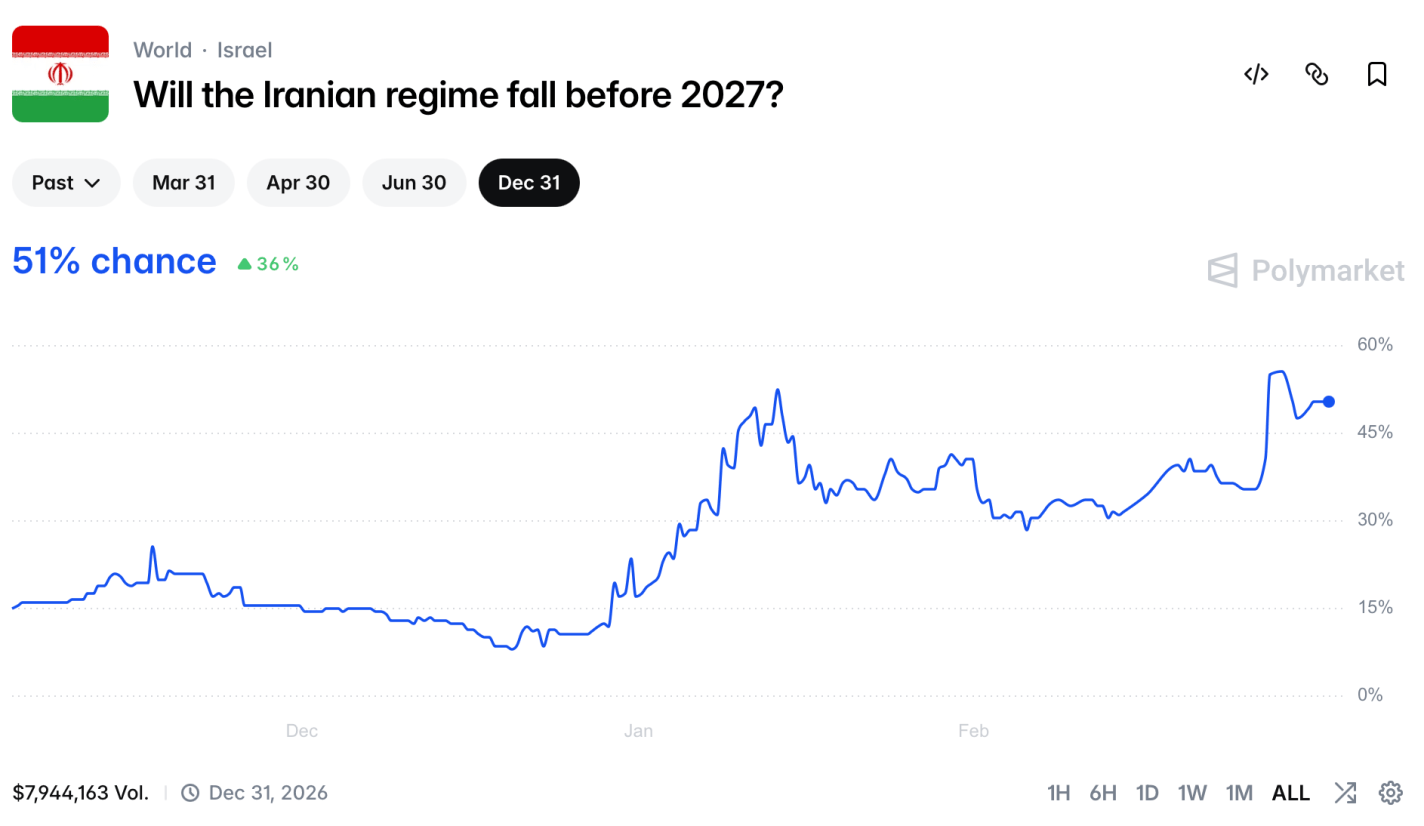
Real-money US-regulated exchanges can’t directly cover the war, but others can and do, such as the international Polymarket:

Polymarket’s argument for why they offer these markets

This market shows that regime change is likely, but will take time- a 51% chance by the end of the year, but only a 13% chance by the end of the month.

How would this be achieved? Markets see a 60% chance that there will be US troops in Iran this year, though this market could be triggered by just a few special forces operators, or by troops visiting for humanitarian purposes after domestically-driven regime change. There will likely be a US-Iran ceasefire by the end of May. It’s not clear at all who will be running Iran at the end of the year:

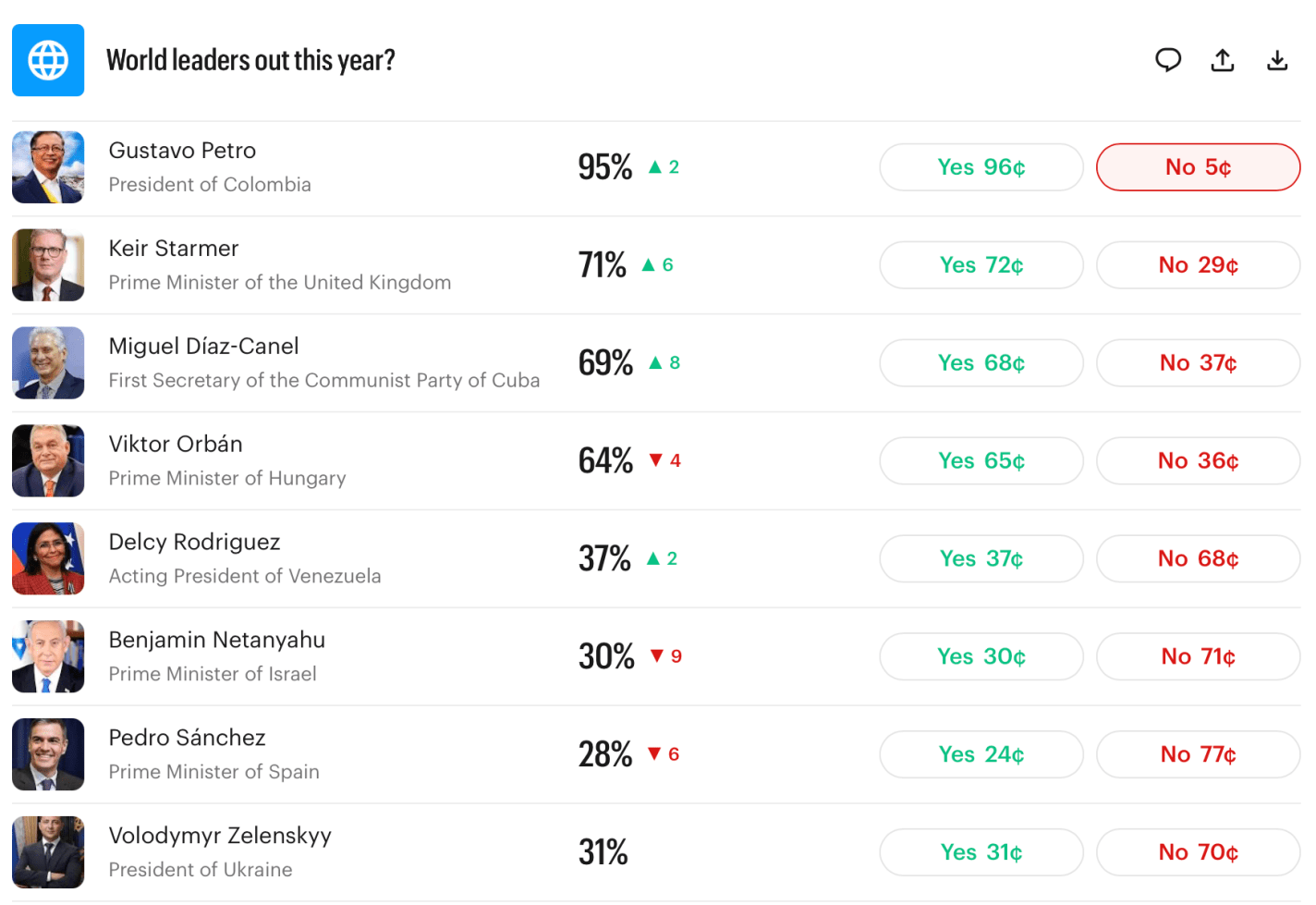
Iran is far from the only country whose future leadership is unclear. Last month I noted that the current leaders of Britain, Hungary, and Cuba would likely be out of office by year end. These are all now looking even more likely than they did a month ago:

So I’ll repeat:

Myself, I find most of these market odds to be high, and I’m tempted to make the “nothing ever happens” trade and bet that everyone stays in office. But even if all these markets are 10pp high, it still implies quite an eventful year ahead. Prepare accordingly.

  1. US-regulated exchanges can’t offer markets on death. Kalshi’s rules stated that if Khamenei died, the market would refund everyone at current prices rather than paying as if he were “out of office”. When he died many people got mad at Kalshi- some who had bet he’d be “out of office” and were mad that they weren’t paid at 100%, others that Kalshi was offering something too close to a death market- “how else would he lose power” (even though Maduro and Assad provide clear recent examples) ↩︎

Forecasting An Eventful 2026

May you live in interesting times – apocryphal Chinese curse

In early 2025 I shared forecasts about the economy that turned out to be pretty good. This year, economic forecasts center around a boringly decent year (2.6% GDP growth, inflation below 3%, unemployment stays below 5%, no recession), though with high variance. But forecasts about politics and war foretell a turbulent year.

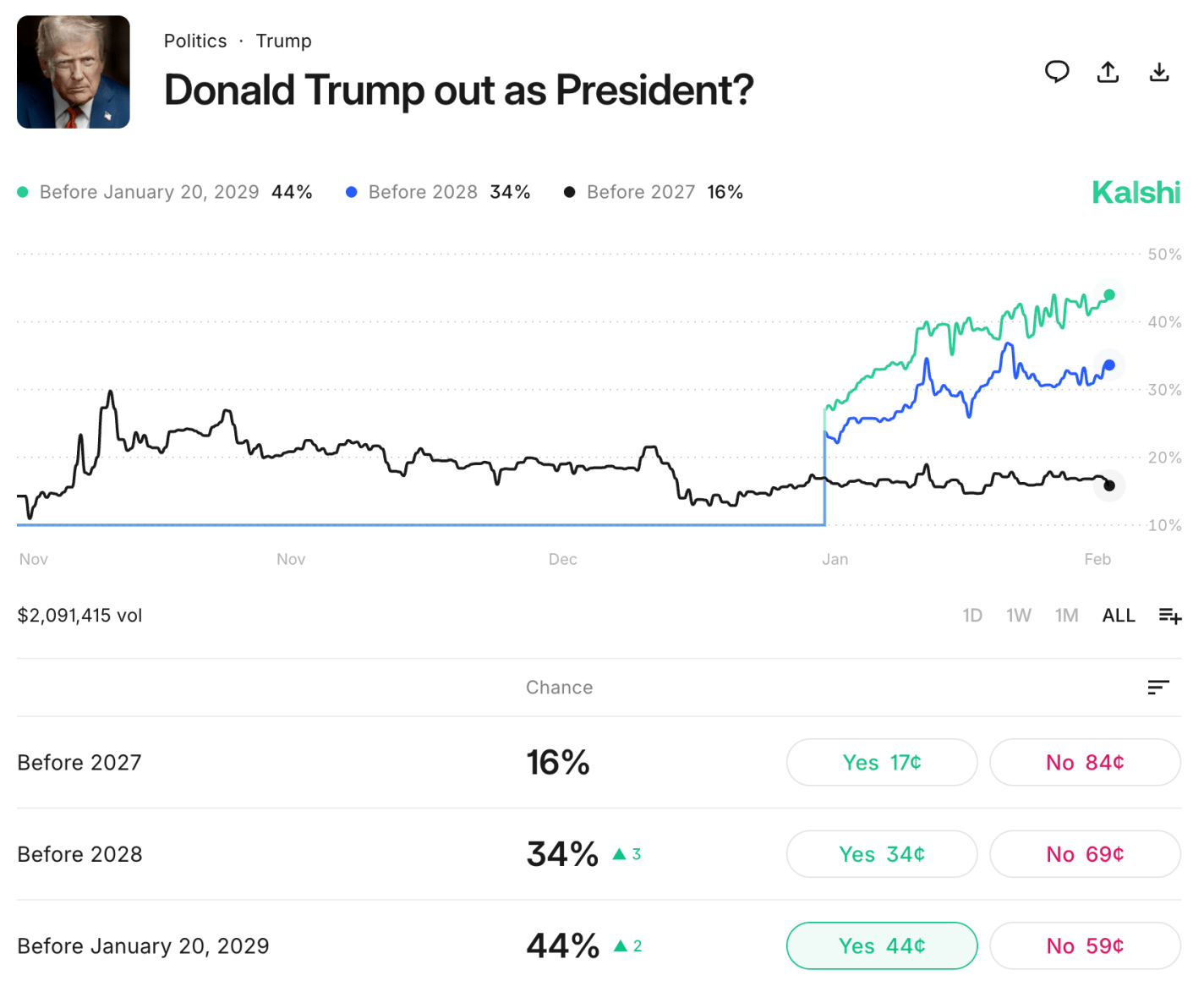
In the US, midterm elections have a 78% chance to flip control of the House and 35% chance to flip the Senate despite a tough map for Democrats. A midterm wave for the out-of-power party is typical in the US, given that the party in power always seems to over-play their hand and voters quickly get sick them. More surprising is that forecasters give a 44% chance that Donald Trump leaves office before his term is up, and a 16% chance that he leaves office this year. Markets give a 20% chance that he will be removed from office through the impeachment process, so the rest of the 44% would be from health issues or voluntary resignation.

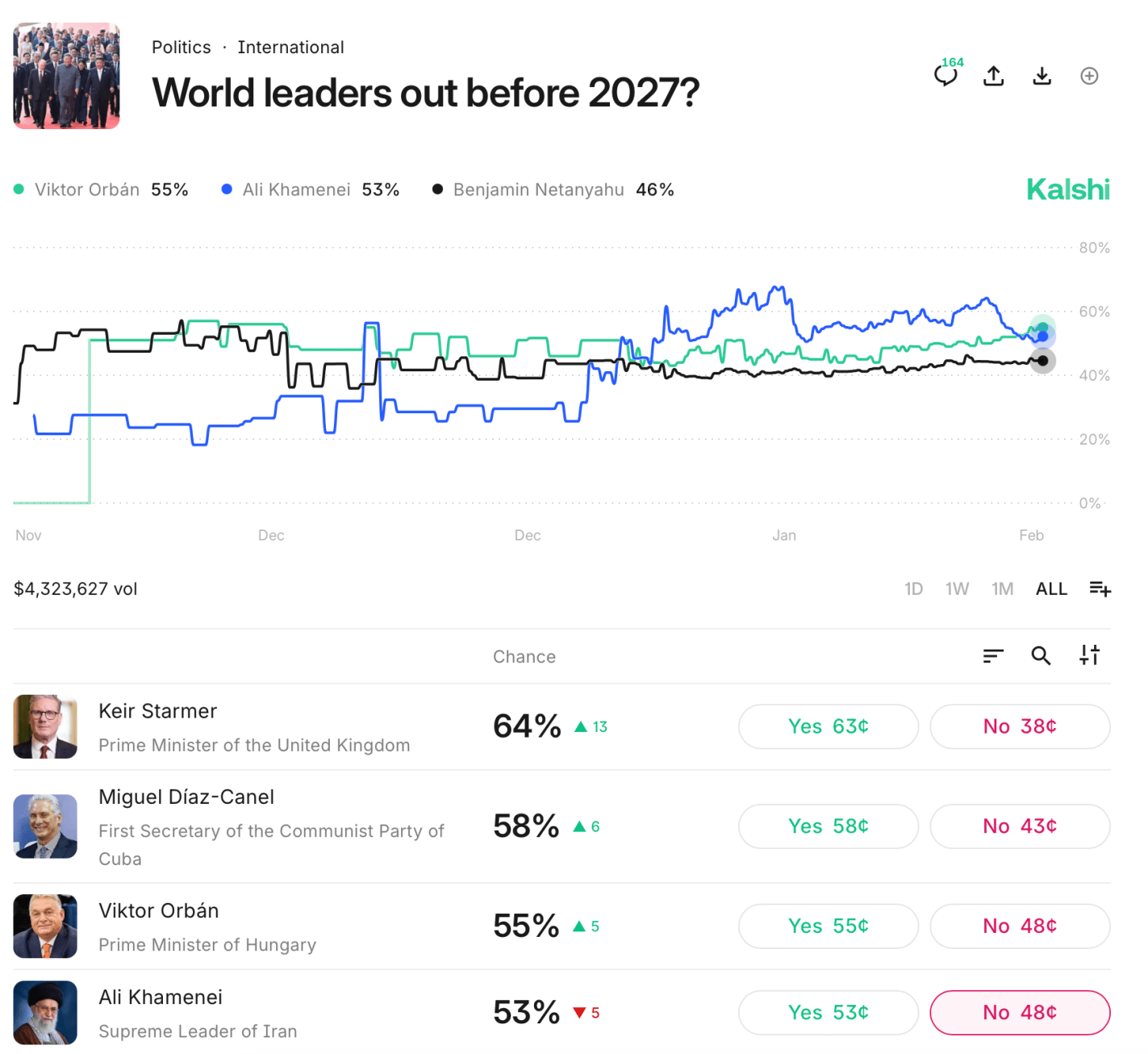
Forecasters at Kalshi predict a greater than even chance that 4 notable world leaders leave office this year:

I find this especially notable because Viktor Orban is the only one who would be removed through regularly scheduled elections. In the UK, Keir Starmer was just elected Prime Minister in 2024 and doesn’t have to face reelection until 2029; but he is so unpopular that his own Labor Party is likely to kick him out of office if local elections in May go as badly as polls indicate. If so, he would join Boris Johnson and Liz Truss as the third British PM in four years to leave office without directly losing an election. The leaders of Cuba and Iran don’t face real elections and would presumably be pushed out by a popular uprising or US military action.

Some other important world leaders will probably stay in office this year, but forecasters still think there is a significant chance they leave: Israel’s Netanyahu (49%), Ukraine’s Zelenskyy (32%), and Russia’s Putin (14%). For the latter two, this belief could be tied to the surprisingly high odds given to a ceasefire in the Russia-Ukraine war this year (45%). Orban leaving office could be tied into this, as Hungary has often vetoed EU support for Ukraine.

Myself, I find most of these market odds to be high, and I’m tempted to make the “nothing ever happens” trade and bet that everyone stays in office. But even if all these markets are 10pp high, it still implies quite an eventful year ahead. Prepare accordingly.