Are Imports Bad for GDP?

A periodically recurring conversation on social media is whether imports are bad for GDP. Everyone thinks they are clearly right, and then they lazily defer to brief dismissal of the opposing view. Some of this might be due to media format. Something just a tiny bit more thorough could help to resolve the painfully unproductive online interactions… And just maybe improve understanding.  

It starts with the GDP expenditure identity:

The initial assertion is that imports reduce GDP. After all, M enters the equation negatively. So, all else constant, an increase in M reduces Y. It’s plain and simple.

Many economists reply that the equation is an accounting identity and not a theory about how the world works and that the above logic is simply confusing these two things. This reply 1) allows its employers to feel smart, 2) doesn’t address the assertion, & 3) doesn’t resolve anything. In fact, this reply erects a wall of academic distinction that prevents a resolution. What a missed opportunity to perform the literal job of “public intellectual”.

How are Imports Bad/Good/Irrelevant for GDP?

Let’s add a small but important detail to the above equation to distinguish between consumption of goods produced domestically and those produced elsewhere.

Continue reading

We Don’t Have Mass Starvations Like We Used To

Two ideas coalesced to contribute to this post. First, for years in my Principles of Macroeconomics course I’ve taught that we no longer have mass starvation events due to A) Flexible prices & B) Access to international trade. Second, my thinking and taxonomy here has been refined by the work of Michael Munger on capitalism as a distinct concept from other pre-requisite social institutions.

Munger distinguishes between trade, markets, and capitalism. Trade could be barter or include other narrow sets of familiar trading partners, such as neighbors and bloodlines.  Markets additionally include impersonal trade. That is, a set of norms and even legal institutions emerge concerning commercial transactions that permit dependably buying and selling with strangers. Finally, capitalism includes both of these prerequisites in addition to the ability to raise funds by selling partial stakes in firms – or shares.

This last feature’s importance is due to the fact that debt or bond financing can’t fund very large and innovative endeavors because the upside to lenders is too small. That is, bonds are best for capital intensive projects that have a dependable rates of return that, hopefully, exceed the cost of borrowing. Selling shares of ownership in a company lets a diverse set of smaller stakeholders enjoy the upside of a speculative project. Importantly, speculative projects are innovative. They’re not always successful, but they are innovative in a way that bond and debt financing can’t satisfy. Selling equity shares open untapped capital markets.

With this refined taxonomy, I can better specify that it’s not access to international trade that is necessary to consistently prevent mass starvation. It’s access to international markets. For clarity, below is a 2×2 matrix that identifies which features characterize the presence of either flexible prices or access to international markets.

Continue reading

A Forgotten Data Goldmine: Foreign Commerce and Navigation Reports

Economists rely on trade data. The historical Foreign Commerce and Navigation of the United States reports detailed monthly figures on imports, exports, and re-exports. This dataset spans decades, providing a crucial resource for researchers studying price movements, consumption patterns, and the effects of war on global trade.

The U.S. Department of Commerce compiled these reports to track the nation’s commercial activity. The data cover a vast range of commodities, including coffee, sugar, wheat, cotton, wool, and petroleum. Officials recorded trade flows at a granular level, enabling economists to analyze seasonal fluctuations, wartime distortions, and postwar recoveries. Their inclusion of re-export figures allows for precise estimates of domestic consumption. Researchers who ignore re-exports risk overstating demand by treating imports as goods consumed rather than goods in transit.

Continue reading

Tariffs: Bad for Revenue

Economists are pretty united against tariffs. There are lots of complicated arguments. Keeping things simple, one reason is that they are bad for welfare. President-elect Trump seems to imply that tariffs can raise a lot of government revenue. But in lieu of what? The Tax Foundation estimates that there is absolutely no way that tariffs can replace all revenue from income taxes. The primary reason that they cite is that imports compose a tiny portion of the potential tax base. There are plenty of goods and services produced domestically that wouldn’t be subject to the tariffs. Any time we add a tax exemption, we’re adding complication, higher compliance costs, and distorting consumption patterns, etc.

For this post I singularly focus on the tax revenue.  In fact, let’s demonstrate what *maximizing* tax revenue looks like under three cases: 1) Closed economy with a tax, 2) Open economy with a tax, & 3) Open economy with a tariff. I’ll use some simple math to demonstrate my point. None of the particulars affect the logic. You’ll reach the same general results with different intercepts, slopes, etc. Let’s start with a domestic demand and domestic supply.

Closed Economy with a Tax

Whenever tax revenue is raised, there is a difference between the price paid by demanders and the price received by suppliers. In a closed economy a tax might be imposed on all goods. In these examples, I treat the tax as some dollar per-unit of output tax. But it’s a short jump to percent of spending taxes, and then another short jump to percent of income taxes. With this in mind, demanders pay more than the suppliers receive by the amount of the tax. Tax revenue is the tax rate times the number of units of output that are subject to the tax. That’s the thing we want to maximize.

Continue reading

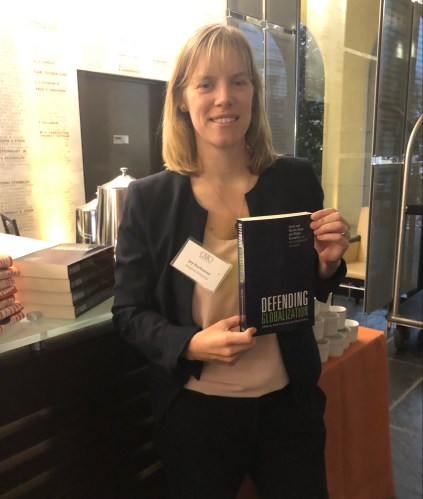
Cato Globalization book out in paperback

A new book is out with chapters by me, Deirdre McCloskey, and others.

Book Title: Defending Globalization: Facts and Myths about the Global Economy and Its Fundamental Humanity

The COVID-19 pandemic, war in Ukraine, simmering US-China tensions, and rising global populism have led to globalization facing renewed attention-and criticism-from politicians and pundits across the political spectrum. Like any market phenomenon, the free movement of people, things, money, and ideas across natural or political borders is imperfect and often disruptive. But it has also produced undeniable benefits-for the United States and the world-that no other system can match. And it’s been going on since the dawn of recorded history.

The original essays compiled in this volume offer a diverse range of perspectives on globalization-what it is, what it has produced, what its alternatives are, and what people think about it-and offer a strong, proactive case for more global integration in the years ahead. Covering the basic economic and political ideas and historical facts underlying globalization, rebutting the most common arguments against globalization today, and educating readers on the intersection of globalization and our societies and cultures-from where we live to what clothes we wear and what foods we eat-Defending Globalization demonstrates the essential humanity of international trade and migration, and why the United States and the rest of the world need more of it.

You can read a summary, in a previous EWED blog post, of my chapter on fashion, previously posted on the Cato website as Fast Fashion, Global Trade, and Sustainable Abundance.

It takes all of us to be rich. We need “a great multitude that no one could count, from every nation, tribe, people and language,” so to speak.

Two years ago, on Twitter, I summarized my contribution as follows, in the form of a dialogue:

Person from the Past: “So, how is it with 8 billion people?”

Me Today: “It’s bad. We have too many clothes.”

Person from the Past: “Right. With 8 billion you wouldn’t have enough clothes for everyone.”

Me Today: “Too many.”

I made it to the book launch event in D.C. near the Capitol.

Some people still have not heard of “fast fashion.” Maybe you heard it here first: New legislation is likely coming to regulate the clothing industry. It might start at the state level, in progressive places like California or Seattle. Demands include making information about supply chains more transparent and taxing the clothing companies in order to pay for trash disposal. For example, you can read about the New York Fashion Act. Similar to the way the food companies have to provide clear information about calories, clothing retailers might have to provide more information about chemicals, labor, and disposal issues.

Plastic fibers making new clothing cheap. I sometimes hate the flood of cheap products that American families are drowning in. Plastic products are so cheap to stamp out and give to kids. Some days you’ll find me grumpy about the latest bag of plastic swag and candy my kids came home with. There are some negative externalities to consuming tons of plastic items and tossing them out.

It’s a privilege to have this problem. Perhaps we are overindulging in clothing abundance and need some modern solutions to modern problems. We also need to figure out how to stop getting obese off of food abundance. (Hello, Ozempic.) But let’s still be grateful for the abundance, on this Thanksgiving week. My controversial take is that it’s good for the cost of clothing to be low. We don’t want to regress. We don’t want to make clothing scarce again.

If you were to want to cite my work on fashion and globalization, then you could use something like this:

Buchanan, Joy. “Fast Fashion, Global Trade, and Sustainable Abundance” (2024) In S. Lincicome, & C. Packard (Eds.), Defending Globalization: Facts and Myths about the Global Economy and Its Fundamental Humanity, Cato Institute, (pp. 367 – 380).

Gear Swaps are Happening

Everyone feels like we throw away too much stuff. One small way to help is to try to find someone who can use the items before you toss them.

I’m happy to say that one of my economic ideas got to the policy implementation stage. I was staring at the Scout gear my son had grown out of and dreading the thought of throwing it away. I could donate it to Good Will, but I thought that the chances it would get to someone who wants it are very low. What parent wants exactly that stuff? So, I emailed our Pack leader and asked if we could start doing a gear swap.

Parents can bring any scout-related items that they do not want anymore to a pack meeting. It is organized on one table with clear information. Anyone can take anything for free if they can use it and store it.  

This works better than posting to internet Buy Nothing groups because the scout parents are right there. No one has to drive across town for a “porch pick up.”

More sports teams or clubs should do this. Seize the moments when like-minded people are already together in one place.

Previously from me on Fast Fashion:

Secondhand for AdamSmithWorks

Is the repair revolution coming?

Joy’s Fashion Globalization Article with Cato

Why Avocado on Toast?

We’ve all heard the stereotype. Millennials eat avocado toast (so say the older generations). The uncharitable version is that they can’t afford other things like cars, houses, etcetera due to their expensive consumption habits otherwise. And avocado on toast is the standard bearer for that spendthrift consumption.

I’m here to tell you that it’s bunch of nonsense and that the older folks are just jealous. Millennials, those born between 1981 & 1996, weren’t intrinsically destined to spend their money poorly as some generational sense of entitlement. Nor did the financial crisis imbue them with the mass desire for small but still affordable treats. The reason that millennials got the reputation for eating avocado on toast is that 1) it’s true, 2) because they could afford it, and 3) older generations didn’t even have access.

Continue reading

Economic Underpinnings of the Renaissance in Northern Italy

The Renaissance in northern Italy was a period between roughly 1350 and 1550 (definitions vary) when a proto-modern outlook and culture and economy replaced  feudal medieval society. We all know about the great artistic and literary and scientific advances made at this time and place. I got curious about the economics behind all this. It is clear that the cities of northern Italy, such as Florence, were extremely prosperous, otherwise they could not have funded all these artists and architects.

It has jokingly been said, “Ah, I don’t see what is so great about Shakespeare – – all he did was string together a bunch of famous quotes.”  Well, since I know little about all this, what I will do here is mainly string together a bunch of relevant quotes.  Let the citations begin….

This blurb from “helenlo-weebly” (?) gives a good overview, noting the  importance of trade and the shift from rural barter to an urban money economy:

Trade brought many new ideas and goods to Europe.  A bustling economy created prosperous cities and new classes of people who had enough money to support art and learning.  Italian city-states like Venice and Genoa were located on the trade routes that linked the rest of western Europe with the East.  Both these city-states became bustling trading centers.  Trading ships brought goods to England, Scandinavia, and present-day Russia.  Towns  along trading routes provided inns and other services for traveling merchants.

          The increase of trade led to a new kind of economy.  During the middle ages people traded goods for other goods.  During the Renaissance people began using coins to buy goods which created a money economy.  Moneychangers were needed to covert one type of currency into another.  Therefore, many craftspeople, merchants, and bankers became more important i society.  Crafts people produced goods that merchants traded all over Europe.  Bankers exchanged currency, loaned money, and financed their own business. 

         Some merchants and bankers grew very rich.  They could afford to help make their cities more beautiful.  Many became patrons and provided new buildings and art; they helped found universities.  This led many city-states to become a flourishing educational and cultural center.

Bartleby.com notes  technical advances in ship construction, and the rise of Florentine bankers:
Genoa and Venice also made advancements in shipbuilding allowing ships to sail all year long and the increased the volume of goods that could be transported (accelerated speed)…Florentine merchants and bankers acquired control of papal banking (acting as tax collectors).

Brewminate  notes the rise of modern commercial infrastructure (which depends on law and order, with contracts being honored) and the virtuous cycle of trade and urban craftsmanship promoting each other. Also, the economic and social impact of the Black Death (which is a huge topic of itself):

The Crusades had built lasting trade links to the Levant, and the Fourth Crusade had done much to destroy the Byzantine Empire as a commercial rival to Venice and Genoa. Thus, while northern Italy was not richer in resources than many other parts of Europe, its level of development, stimulated by trade, allowed it to prosper. Florence became one of the wealthiest cities of the region…

In the thirteenth century, Europe in general was experiencing an economic boom. The city-states of Italy expanded greatly during this period and grew in power to become de factofully independent of the Holy Roman Empire. During this period, the modern commercial infrastructure developed, with joint stock companies, an international banking system, a systematized foreign exchange market, insurance, and government debt. Florence became the center of this financial industry and the gold florin became the main currency of international trade.

The decline of feudalism and the rise of cities influenced each other; for example, the demand for luxury goods led to an increase in trade, which led to greater numbers of tradesmen becoming wealthy, who, in turn, demanded more luxury goods…

The Black Death [in the fourteen century] wiped out a third of Europe’s population, and the new smaller population was much wealthier, better fed, and had more surplus money to spend on luxury goods like art and architecture.

What motivated the newly rich urban elites to so assiduously patronize the arts? According to dailyhistory.org, it was largely a desire to assert one’s status and to curry favor with the local citizens:

The New Elites such as the De Medici used spectacles and display to assert themselves in society and to demonstrate their wealth. Wealthy members of the urban elite and the aristocracy were always keen to demonstrate their status. This need to publicize and affirm one’s status led to the patronage of great artists and writers to provide displays and exhibit the wealth and power of the elite. This need for others’ recognition was vital in the Renaissance, which led to the lavish patronage of the period. This led to a great deal of competition to patronize the best artists and writers.

And there you have it.