Lumon Industries and Drudgery

I have a blog up on the new TV show Severance at the Reading Room.

Some background for those who have not seen the show

Mark Scout (played by Adam Scott) voluntarily undergoes the fictional “severance procedure” so he can work for Lumon Industries. While at work, Mark is cut off from all memories of his personal life. 

One of my contentions is with the way work is questioned by brother in law Ricken without acknowledging what society gets from work . Granted, Ricken is portrayed as someone we should not take seriously.

It is taken for granted that when outie Mark gets home from work he has modern conveniences and access to food and (maybe unfortunately, in his case) alcohol. Those goods are supplied by businesses and specialized workers. Even though his hippie brother-in-law Ricken writes books questioning whether workers are free, Ricken enjoys electricity. Mark’s sister Devon gives birth to Ricken’s firstborn during Season 1. In life before modern corporations, the chances of mothers or babies dying was unacceptably high. While painting Lumon as utterly evil, Severance fails to acknowledge what good can come from work. … there is one insight from Adam Smith that is so basic it cannot even be controversial. Wealth comes from specialization and trade.

The writers gradually make the world in the show bigger. First, it’s just a few nicely-dressed people in a windowless office. By the end, a Senator is involved. We don’t know how deep this rabbit hole will go. I thought Season 1 was exciting, but I’m not sure if they will be able to make audiences happy when the writers try to tie up all the lose threads.

As for what the “data refiners” do for Lumon, I consider their classification task to be somewhat realistic. What they are doing is reminiscent of “check every image that contains a stop sign”. The ultimate purpose of what they are doing remains a mystery for now, but the show hints that Lumon is doing something terrible in secret.

Human Capital is Socially Contingent

The Deaf community is interesting.

Before I did research, I thought that deaf people simply could not hear. After seeing the Spiderman episodes that featured Daredevil, I believed that it was plausible and likely that deaf people had some sort of cognitive or sensory compensatory skill.

But it wasn’t until recently that I learned of the Deaf Studies field. There is an entire field that’s dedicated to studying deaf people. It’s related to, but not the same as Disability Studies. In fact, there are some sharp divisions between the two fields.

Continue reading

Why Many Substance Use Treatment Facilities Don’t Take Insurance

According to the latest data, about one in four facilities doesn’t accept private insurance or Medicaid, and more than half don’t accept Medicare. This makes substance use treatment something of an outlier, since 91% of all US health spending is paid for through insurance. Still, there are many reasons to prefer being paid in cash: insurance might reimburse at low rates, impose administrative hassles, and generally try to tell you how to run things.

Providers generally put up with the hassles of insurance because they see the alternative as not getting paid. But if demand for their services gets high enough that they can stay busy with patients paying cash, they will often try going cash-only. Some try to generate high demand by providing excellent service. Sometimes high demand comes from a growing health crisis, as with opioids.

Demand can also be high relative to supply because supply is restricted. US health care is full of supply restrictions, but in this case I wondered if Certificate of Need laws were playing a role. As we’ve written about previously, CON laws require health care providers in 34 states to get the permission of a government board to certify their “economic necessity” before they can open or expand. But there’s a lot of variation from state to state in what types of services are covered by this requirement; acute hospital beds and long-term care beds are most common. 23 states require substance use treatment facilities to obtain a CON before opening or expanding.

States with Substance Use–Treatment CON Laws in 2020. Created using data from Mitchell, Philpot, and McBirney

How do these laws affect substance use treatment? We didn’t really know- only one academic article had studied substance use CON, finding it led to fewer facilities in CON states. But I’ve studied other types of CON, so I joined forces with Cornell substance use researcher Thanh Lu and my student Patrick Vogt to investigate. The resulting article, “Certificate-of-need laws and substance use treatment“, was just published at Substance Abuse Treatment, Prevention, and Policy. Here’s the quick summary:

We find that CON laws have no statistically significant effect on the number of facilities, beds, or clients and no significant effect on the acceptance of Medicare. However, they reduce the acceptance of private insurance by a statistically significant 6.0%.

Overall I was surprised that CON didn’t significantly affect most of the outcomes we looked at, and appears to be far from the main reason that treatment facilities don’t take insurance. Still, repealing substance use CON would be a simple way to improve access to substance use treatment, particularly since CON doesn’t appear to bring much in the way of offsetting benefits.

Going forward I aim to investigate how these laws affect health outcomes like overdose rates, and to dig more into the text of state laws and regulations to determine exactly what is covered by substance use CON in different states. As the article explains, we identified several errors in the official data sources we were using. This makes me worry there are more errors we didn’t catch, and there are certainly things the sources just don’t specify, like in which states the laws apply to outpatient facilities. So I hope we (or someone else) will have even better work to share in the future, but for now this article is as good as it gets, and we share our data here.

COVID Deaths, Excess Deaths, and the Non-Elderly (Revisited)

While we know that COVID primarily affects the elderly, the mortality and other effects on the non-elderly aren’t trivial. I have explored this in several past posts, such as this November 2021 post on Americans in their 30s and 40s. But now we have more complete (though not fully complete) mortality data for 2021, so it’s worth revisiting the question of COVID and the non-elderly again.

For this post, I will primarily focus on the 12-month period from November 2020 through October 2021. While data is available past October 2021 on mortality for most causes, data classified by “intent” (suicides, homicides, traffic accidents, and importantly drug overdoses) is only fully current in the CDC WONDER data through October 2021. This timeframe also conveniently encompasses both the Winter 2020/21 wave and the Delta wave of COVID (though not yet the Omicron wave, which was quite deadly).

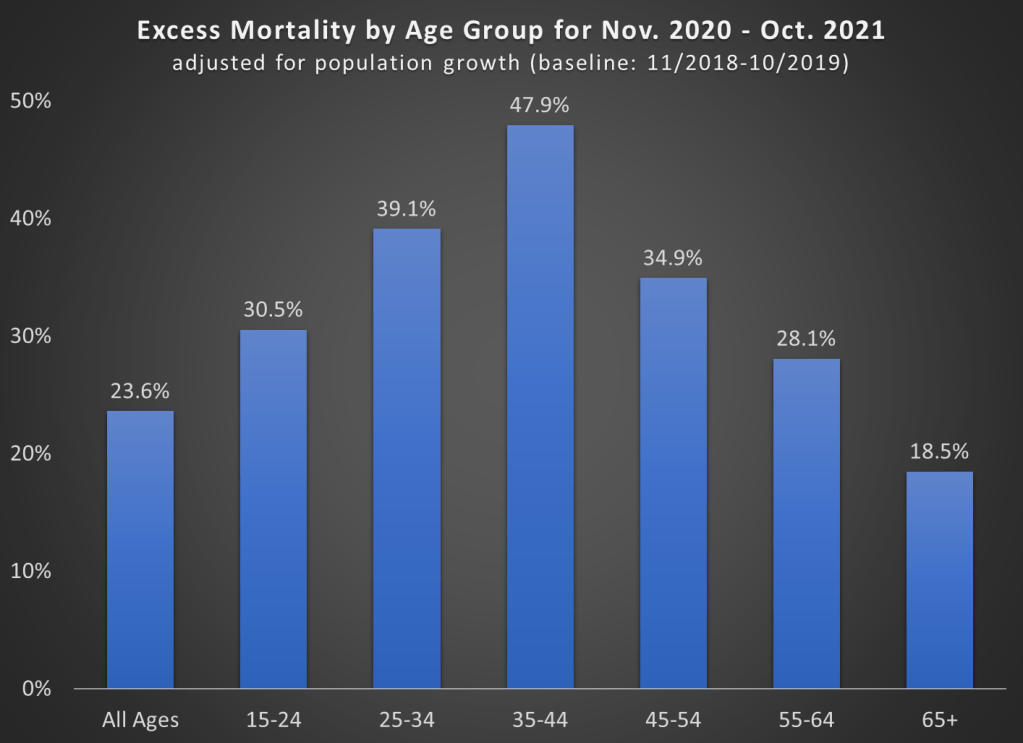
First, let’s look at excess mortality using standard age groups. For this calculation, I use the period November 2018 through October 2019 as the baseline. The chart shows the increase in all-cause deaths in percentage terms. It is also adjusted for population growth, though for most age groups this was +/- 1% (the 65+ group was 3% larger than 2 years prior).

A few things jump out here. First notice the massive increase in mortality for the 35-44 age group (much more on this later). Almost 50% more deaths! To put that in raw numbers, deaths increased from about 82,000 to 122,000 for the 35-44 age group, and population growth was only about 1%. And while that is the largest increase, there were huge increases for every age group that includes adults.

Also notice that the 65+ age group certainly saw an increase, but it is the smallest increase among adults! Of course, in raw numbers the 65+ age group had the most excess deaths: about 450,000 of the 680,000 excess deaths during this time period. But since the elderly die at such high rates in every year, the increase was as large in percentage terms.

One related fact that doesn’t show up in the chart: while there were about 680,000 excess deaths during this time frame in the US in total, there were only about 480,000 deaths where COVID-19 was listed as the underlying cause of death. That means we have about 200,000 additional deaths in this 12-month time period to account for, or a 24% increase (population growth overall was only 0.4%).

That’s a lot of other, non-COVID deaths! What were those deaths? Let’s dig into the data.

Continue reading

Crypto Drama: $40 Billon Vaporized as Terra “Stablecoin” and Luna Implode; Bored Ape NFTs Break Ethereum

Last month I posted on “The Different Classes of Crypto Stablecoins and Why It Matters “.  The main point there is that some so-called stablecoins (e.g., USDC) maintain their peg to the dollar by holding a dollars’ worth of securities (preferably U.S. treasury notes) for each dollar’s worth of stablecoin. This mechanism requires some centralized issuer to administer it. As long as said issuer is honest and transparent, this should work fine.

Crypto purists, however, prefer decentralized finance (de-fi), where there is no central controlling authority. Hence, clever folks have devised stablecoins which maintain their dollar peg through some settled algorithm which operates more or less autonomously out on the web; various other coins or assets are automatically bought or sold, or created/destroyed in order to keep the main stablecoin value more or less fixed versus the dollar. We warned that this type of stablecoin is “potentially problematic”; it is the sort of thing which works until it doesn’t.

In 2018 the Terra project was launched by Do Kwon and others.  The Terra stablecoin (UST) was designed to “maintain its peg through a complex model called a ‘burn and mint equilibrium’. This method uses a two-token system, whereby one token is supposed to remain stable (UST) while the other token (LUNA) is meant to absorb volatility.” Terra grew very rapidly, to become something like the fourth largest stablecoin at over $30 billion in capital value. As the supply of Terra increased, the market value for LUNA also increased. Many investors bought into LUNA and for a while were making big bucks as its value soared. A headline from February read, “LUNA shines with a 75% surge in February as $2.57 billion is delisted.”  Woo-hoo! And this headline from May 10  proclaimed, “Terra Ecosystem is the strongest growing ecosystem in 2021.”

However, just as that laudatory article was hitting the internet, Terra/Luna blew up. I am not clear on the exact sequence of events, especially on whether the catastrophe was a result of just some accidental market fluctuation or of deliberate dumping by some party who was positioned to benefit. In any event, the value of Terra quickly dropped from $1.00 to around $0.61, which triggered the issuing of vast amounts of LUNA, which cratered its value by some 98%. Since Luna was mainly what backed Terra, this was a positive feedback death spiral. This is same way the $2 billion IRON stablecoin imploded in June, 2021: a “stablecoin” was backed by an in-house crypto token whose value depended on more people buying into the system. Ponzi scheme, anyone?

Both Terra and LUNA got delisted from major exchanges for several days. As of today, the value of Terra (UST) is about ten cents.  Poof, there went some $40 billion  of investors’ money, just like that. Do Kwon is under police protection in Seoul after a man who lost $2.3 million in Terra/Luna tried to break into his home to demand an apology.

And this just in today: “DEI becomes latest algorithmic stablecoin to lose $1 peg, falling under 70 cents  “. Ouch. Looks like the federal regulators will be swarming the stablecoin space, or at least we may get some grandstanding Senate hearings out of it.

In other news, transactions connected to the insanely (I chose that word deliberately) popular and costly Bored Ape Yacht Club NFTs overwhelmed the Ethereum transaction network about two weeks ago; this is kind of a big deal because a whole lot of de-fi and other blockchain applications depend on Ethereum as the backbone of their transactions:

When Bored Ape Yacht Club creators Yuga Labs announced its Otherside NFT collection would launch on April 30, it was predicted by many to be the biggest NFT launch ever. Otherside is an upcoming Bored Ape Yacht Club metaverse game, and the NFTs in question were deeds for land in that virtual world. Buoyed by the BAYC’s success — it costs about $300,000 to buy into the Club — the sale of 55,000 land plots netted Yuga Labs around $320 million in three hours.

It also broke Ethereum for three hours.

Users paid thousands of dollars in transaction fees, regardless of whether those transactions succeeded. Because the launch put load on the entire blockchain, crypto traders were unable to buy, sell or send coins for hours. The sale highlights the growing profitability of the NFT market but also the uncertainty around whether blockchains are robust enough to handle the attention.

… Because the Otherside mint impacts the whole Ethereum blockchain, people doing completely unrelated things like selling ether or trading altcoins would also have to pay huge fees and wait hours for their transactions to clear. Someone tweeted a picture of them trying to send $100 in crypto from one wallet to another, showing it required $1,700 in gas fees.

7 Quick Takes of Undeniable Insight, Absent Evidence or Significant Explanation

  1. Over-fraternization within a line of work leads to all kinds of pathologies as social networks become too insular. If you’re a police officer and you spend your days constantly interacting with civilians having the worst day of their life, it’s really important you spend your free time with people who are having a perfectly normal and safe week. Same goes for politics, academia, entertainment, etc. This is not a “pop your bubble to improve the quality of your opinions” take. This is purely advice for your own personal mental health. Academics and entertainers need people in their life that they are rightfully embarrassed to complain in front of, to keep perspective on what the stakes of their decisions actually are. Cops and soldiers need reminders that the world is not constantly coming apart at the seams. Most of us will call the cops maybe once in our lives, and it probably won’t be because something good happened. Not a week goes by in a beat cop’s life where they don’t interact with someone who had to call the cops. They need to fill their set of observed experiences with stories uncorrelated with events where someone had to call the cops.
  2. The distribution of people’s opinions of Elon Musk needs to be compressed. Everyone with an above 75th percentile opinion needs to downgrade their estimation of him as a thoughtleader or agent of positive chaos/liberty. Everyone with a below 75th percentile opinion needs to upgrade their appreciation of him as an engineering genius committed to building tangible infrastructure innovations.
  3. The current political era we are living through isn’t defined by extremism, it’s defined by gambles on different sides of the “median voter vs institutional inertia” coin. The Democratic Party is struggling to hold together a coalition of progressives and moderates with nothing but bubble gum and reproductive rights because they believe the median voter remains an irresistible force. The Republican party, on the other hand, continues to bet the entire franchise on an activated base of extremists and gerrymandering. This bet is not ignorant, or in denial, of the median voter. It’s a bet that institutional inertia combined with potentially two decades of control of the Supreme Court will yield benefits greater than the costs of eventually losing control of all three branches across multiple elections.
  4. The best super hero movies are the ones where they take an auteur with at least 5 movies under their belt and say “make the most ‘you’ movie possible, but with our characters in our universe”. Why is “Doctor Strange and the Multiverse of Madness” so good? Because they hired Sam Raimi and gave him the greenlight to make “Evil Dead 4”.
  5. Even the people who *know* that crypto and blockchain technology will create enormous value – even those people aren’t sure if the coins that currently exist will have significant commodity value down the road.
  6. There are lots of right wing political positions that I view as wrong or costly, but most of them I view as “deviations from an uncertain optimal state of the world” which is to say I don’t worry about them in the slightest. The embrace of White replacement theory and increased framing of their opposition as enabling of sexual predation of children, on the other hand, scares me a lot because there is no action or option that is taken off the table for the people who believe them. Say what you will about corporate conspiracy theories and other intellectual pathologies of the current progressive left, they consistently keep terrorism and violence of the table. It can be hard to pin down the intellectual center of a political party or coalition, but the moral center is always composed of the voices that keep violence out of the choice set. I’m don’t know who those voices currently are in the Republican political and media coalition.
  7. The key to popular support for capitalism is the continued to expansion of mint-chocolate flavored options in our choice sets.

Birthday presents at school parties

I’m on the record as being against preschool classroom Valentine’s Day parties. As Scrooge said, people are “spending the mortgage money on frivolities”. The parents sending in gifts is the pinnacle of the rotten heap. I would abolish daycare Valentine’s Day parties entirely – outlaw them like those super sized soda cups.

Now, with Covid subsiding and my son in elementary school, I’m getting to see school-aged-kid birthday parties (as I mentioned yesterday). The parties as events that build social capital are great. The gifting aspect of it is mostly dumb. I abhor waste. I put “no gifts” on the birthday invitation for my son.* Most guests brought a present anyway. Next year, should I write “if you bring a gift I will burn it in the driveway before you can enter”? These parents would say they are worried about the island of plastic trash in the Pacific, but what do their actions tell?

It would be nice if school birthday parties could adopt the white elephant/Yankee swap convention that keeps present volumes down at Christmas/holiday parties, but it’s impossible for logistical reasons. If it were socially acceptable to grab a lightly used board game out of your basement and wrap it up to give a school friend, that would also be better. Maybe I should write that on our invitation next year and report back to you all! What do the really really crunchy parents do?

Economists think it’s clever to say, “Haha. You thought Christmas presents were wholesome, but they are inefficient. Merry Deadweight Loss.” Personally, I like most Christmas/holiday presents for the signaling value. I’d be happy with Christmas presents if we could get plastic junk for kids under control and heavily curtail presents at other times of the year.

Related resources: 1) Alex and Tyler donned Christmas sweaters to bring you this video on Christmas gift giving 2) Zachary has written about Christmas gifts

*Do you like funny stories? My son can read. When he noticed that I had written “no gifts,” he got mad at me. I explained that people can still bring gifts if they want to. Then I was mortified when he came home from school reporting that he had told his classmates that they can still get him presents.

Inviting the whole class to a birthday

I am preparing to host my son’s first grade class at our house for a birthday party. Even leading up to today (Friday), it has been a lot of work. Now I’m in the home stretch and will not have time to write a real blog. I have no problem blogging while I’m “on vacation” (in quotes because I’m an academic and I never go a day without fielding emails), but this is another level.

  1. Mental load on women – it’s real!
  2. There is a sweet convention in elementary school here that the entire class gets invited to a birthday party. My son is not “the popular kid” in his class, but he still gets chances to enter into homes and social life through these occasional birthday parties. This is weird and speculative… but there are some adults who would benefit from somehow getting integrated into one of these birthday rings. (my previous post on loneliness)
  3. Scott posted this on stablecoins last month. He had said, “…The potentially problematic aspect of this type of stablecoins is the change in value of the collateral and the reliance on supplementary instruments. …” …which is relevant because a major algorithmic stablecoin, TerraCoin, collapsed this week, leading to its de-listing by major crypto exchanges.

Children Are Not 3/55ths of a Person

In the past several years there has been increasing salience and support of pronatalist policies. Several people have turned to the IRS income tax code, which already includes some incentives regarding children. The Child Tax Credit (CTC), which lowers a person’s tax liability on a dollar-per-dollar basis, is the most obvious item that addresses children. The other tax credit is for child care expenses, but I won’t be focusing on that here.

Below are the 2021 marginal tax rate brackets and the standard deductions.  The standard deduction reduces the taxable income, and then the tax rates are applied.

After the tax liability is calculated, it’s reduced by any tax credits, such as the CTC. In 2021, households earned a credit of $3,600 for every child under 6 years old and $3,000 for every child under 18 years old.  Median household income in 2020 was $67,521.  That means that the tax liability was reduced by 5.3% – or 3/55ths – of median gross income. But, I have a problem with that.

Continue reading

College Major, Marriage, and Children

The American Community Survey began in 2000, and started asking about college majors in 2009, surveying over 3 million Americans per year. This has allowed all sorts of excellent research on how majors affect things like career prospects and income, like this chart from my PhD advisor Doug Webber:

See here for the interactive version of this image

But the ACS asks about all sorts of other outcomes, many of which have yet to be connected to college major. As far as I can tell this was true of marriage and children, though I haven’t searched exhaustively. I say “was true” because a student in my Economics Senior Capstone class at Providence College, Hannah Farrell, has now looked into it.

The overall answer is that those who finished college are much more likely to be married, and somewhat more likely to have children, than those with no college degree. But what if we regress the 39 broad major categories from the ACS (along with controls for age, sex, family income, and unemployment status) on marriage and children? Here’s what Hannah found:

Every major except “military technologies” is significantly more likely than non-college-grads to be married. The smallest effects are from pre-law, ethnic studies, and library science, which are about 7pp more likely to be married than non-grads. The largest effects are from agriculture, theology, and nuclear technology majors, each about 18pp more likely to be married.

For children the story is more mixed; library science majors have 0.18 fewer children on average than non-college-graduates, while many majors have no significant effect (communications, education, math, fine arts). Most majors have more significantly more children than non-college graduates, with the biggest effect coming from Theology and Construction (0.3 more children than non-grads).

In this categorization the ACS lumps lots of majors together, so that economics is classified as “Social Sciences”. When using the more detailed variable that separates it out, Hannah finds that economics majors are 9pp more likely than non-grads to be married, but don’t have significantly more children.

I love teaching the Capstone because I get to learn from the original empirical research the students do. In a typical class one or two students write a paper good enough that it could be published in an academic journal with a bit of polishing, and this was one of them. But its also amazing how many insights remain undiscovered even in heavily-used public datasets like the ACS. We’ve also just started to get good data on specific colleges, see this post on which schools’ graduates are the most and least likely to be married.