Vaccine persuasion is cheaper

Canadians are blocking a bridge. For Americans who like to engage in stereotypes about Canadians, this is inexplicable (even though the practice of blocking things in Canada is not new by any means). However, for me as an economist, it is entirely explicable.

Consider what vaccine mandates/passports (which is what initiated the current mayhem) do in pure economics terms: they raise costs for the unvaccinated. They do not alter the benefit of being vaccinated. All they do is raise costs. People could be more or less inelastic to this cost, but the fact that many are willing to spend time and resources (fuel, wear and tear of trucks etc.) to prevent such policies from continuing suggest that their behavior is not perfectly inelastic.

How elastic is it then? Well, we can see that by looking at what happens when we alter the benefit of being vaccinated. This is the case with vaccine lotteries. The “extra” benefits associated with a lottery is that the unvaccinated obtains the value of the vaccine plus the expected value (i.e. the probability) of winning a particular prize. One recent paper in Economics Letters finds that for $55, you can convince an extra person to be vaccinated. That is basically the cost of administering a lottery plus the prizes themselves. That is a relatively cheap way to increase the benefit for the unvaccinated in order to have them change their mind. Another paper, in the American Journal of Health Economics, finds a similar results by concentrating on the Ohio vaccine lottery. The difference is that the amount is $75 instead of $55. Still, pretty cheap for an extra vaccinated person and the generally high social benefit of a vaccine in terms of avoided costs of infections/hospitalizations/deaths.

Thus, we can say that behavior is quite elastic. But this is where the rub comes. When you raise the benefits in this case, the story is over. There is nothing else that happens after that. When you raise the costs, people might resist and adopt other measures to avoid the costs. This includes blocking bridges on the US-Canada border. And what is the social cost of that attempt at avoiding the cost of the coercive private-cost-increasing policy? Pretty high. Probably higher than the cost of a lottery system or other voluntary programs that play with the marginal private benefit of being vaccinated.

The point I am trying to get across to you is quite simple: persuasion works because it essentially increases the perception of benefits from doing X or Y activity. Coercion is impose a private cost of not doing X or Y with the potential downside that people respond in ways that create socially detrimental outcomes. Yup, coercion isn’t cheap.

Did we repeat the Christmas Covid Wave?

The year is 2021

Around January of 2021, hospital staff and other select personnel received the first vaccines meant for the public. As a classroom teacher, I was designated important enough in the state of Alabama to get a Pfizer vaccine as early as February 2021.

Imagine what could have happened next

Americans grew antsy in May of 2021, because less than half of the population had been able to get a vaccine. It was frustrating to see the vaccine winners carrying on with life without fear of the virus while supply constraints made it impossible for everyone to join them at once.

An unintended consequence of the gradual vaccine rollout was that Americans who were initially concerned about vaccine safety had months to observe their family members and neighbors who got in line first. By July of 2021, most Americans personally knew of someone who died from Covid, and almost no one had witnessed a bad vaccine outcome.

By the end of the summer of 2021, over 90% of the American public was fully vaccinated. The economy roared back to life and working parents did not have to worry about school closures anymore.  

Americans felt proud to have invented and implemented the world’s best Covid vaccine. Considering that Trump has started the research and Biden had overseen the distribution, it was one thing that red and blue Americans could unite over.

The internet as a concept was vindicated because anyone who wanted to understand vaccines could do their own research. Scientific knowledge is no longer the domain of a select elite. Anyone can see the Covid death rates for vaccinated versus unvaccinated people. Amateurs can create data visualizations to share. Information on mRNA technology is free to all.

Speech remained free with regard to vaccine dialogue, but those who tried to discourage Americans from getting Covid vaccines were shouted down in all forums or accused of being foreign trolls.

The first Covid wave in April of 2020 was terrible and the second big event around Christmas of 2020 resulted in thousands of deaths per day lasting for months. No one wanted to repeat that.

Of course, that is not what happened.

Now I have the answer to the question I asked two months ago when I wrote https://economistwritingeveryday.com/2021/12/18/will-we-repeat-the-christmas-covid-wave/

The number of Americans who died from Covid in January 2022 is available from the CDC website.

Number of Covid deaths in January 2022, CDC 59367
Number of Covid deaths in January 2021, CDC 97866

We came fairly close (60%) to repeating the tragedy after the Christmas of 2020. The exponential rise and fall of a new Covid variant and the ensuing pattern of deaths is something we have been through several times. We knew this would happen.

Would every one of those deaths have been prevented by higher vaccine take-up? No. But the death rates among vaccinated people are much lower. Charles Gaba, a data analyst, estimates that about 143,000 Americans have died since the summer of 2021 who would have lived if we had a higher vaccine uptake rate.

Ezra Klein also engaged in some wishful thinking this week, so I’m not the only one.

My best explanation for this is that people want to feel like they are in control of their own lives. Due to a variety of factors, a large number of adults have a different concept of being in control than I do.* Something that shaped my personal attitude toward the vaccine was reading about the research and development process in real time, which I largely did by keeping up with Marginal Revolution.

Unrelatedly, Jeffrey Clemens has given our blog a label this week that I’m happy with: “speculative but engaging”

* According to Andrew Sullivan, “There’s something about masking … and vaccines themselves, that some men seem to find feminizing.”

Mises’s Bureaucracy, a Recap

My favorite two economists are Ludwig Von Mises and Milton Friedman. They might consider one another from very different schools of thought, though there is reason to think that they are not so different. As an undergraduate student, I liked them both, but I became more empirics-minded in graduate school and as a young assistant professor.

As I progressed through graduate school and conducted empirical research, my opinions and policy prescriptions changed and were refined from what they once were. In graduate school, I didn’t study Austrian Economics, though it was certainly in the water at George Mason University. Recently, as an assistant professor with a few years under my belt, I picked up Bureaucracy (1944) and read it as a matter of leisure.

One word:

Continue reading

What Proportion of Journalists Live in NYC?

Michael’s post this week on the dangers of high-status, low wage jobs opened by citing this tweet:

Michael presents a fascinating model that applies well beyond journalism. But when his post went viral, some commenters asked how accurate Josh Barro’s claim about half of young journalists living in Brooklyn was. Clearly Michael’s post doesn’t depend on it being true, and I’m not even sure Barro meant it literally, but it got me wondering- just what proportion of all young journalists do live in NYC?

For a first pass, we can look at the BLS Occupational Employment and Wage Statistics for the category “News Analysts, Reporters, and Journalists“. Their latest data (May 2020) shows 41,580 workers employed in those occupations nationwide. It also shows that the NYC metro has by far the most journalists with 5,940, more than twice as many as the second place metro (DC). This implies that 14.2% of all journalists in America live in the NYC metro. Since only 6% of all Americans live in the NYC metro, journalists are clearly clustering there, though clearly well over half of journalists still live elsewhere.

But, this doesn’t quite get at Barro’s claim, which is about journalists under 40 concentrating in Brooklyn. I don’t know of any data source that would let me really test the Brooklyn part, but I can get at the under-40 claim using Microdata from the American Community Survey, which also zooms us in a bit closer to Brooklyn since it tells us who is in NYC proper (not just the metro area).

The 2019 ACS shows that 10% of all “news analysts, reporters, and journalists” are in NYC proper, rising to 14% if I only consider journalists under 40 years old. This is quite concentrated (only 2.5% of all Americans live in NYC proper), but still a lot less that half of all journalists.

As Michael suggested, the vast majority of young NYC journalists are white (77%) with a college degree (91%), though English was only their second most common major after Communications.

The data confirm the last part of Michael’s post quite well- as journalists get older they are likely to move out of NYC and switch to more lucrative fields like PR. Only 5% of all “public relations specialists” are in NYC.

What’s a Sewer Worth?

Have access to clean water and a functioning sewer system is something that many Americans take for granted. Not all Americans, of course, especially those in rural areas not connected to an urban water system. But most Americans do. But how much is it worth?

It’s a hard question to answer. We know clean water and sewers probably have large effects on disease transmission. For example, Ferrie and Troesken (2008) looked at several major improvements in Chicago’s water system, and found that there were large declines in mortality from diseases like typhoid fever after the improvements (here’s an ungated working paper, with the much better title “Death and the City“). But the limits of earlier studies like this are that they primarily looking at a time series of mortality rate and relating this to some change in public infrastructure. A good attempt, but perhaps not convincing to everyone.

A better method would be to look at not mortality rates but property values. People are, surely, willing to pay more for a home with piped water and a sewer system. But how much more? Knowing this could give us better information on the value of the water systems. And that’s exactly what the authors of a new working paper do, once again visiting Chicago in the nineteenth century to look at how much property values increased after the installation of water and sewer systems. The paper is “The Value of Piped Water and Sewers” by Coury, Kitagewa, Shertzer, and Turner (ungated version).

The effects are huge. There most conservative estimate is that sewer and water systems doubled property values (a 110% increase), but the effect could be much larger (almost 4 times as much, if I am reading it correctly, under other reasonable assumptions).

People are willing to pay a lot for sanitation, it turns out.

Continue reading

Controversial Study Finds Lockdowns Don’t Reduce COVID Mortality; Some Less Controversial Takeaways

A recent working paper, A LITERATURE REVIEW AND META-ANALYSIS OF THE EFFECTS OF LOCKDOWNS ON COVID-19 MORTALITY,  released by Steve Hanke (professor of Applied Economics at Johns Hopkins) and other applied economists (Jonas Herby of Denmark and Lars Jonung of Sweden) has been understandably controversial. I will survey some of its methods and conclusions, and (very briefly) some of the reactions to it.

I will not take a position on how valid its conclusions are, for the simple reason that I am totally unqualified to make such a judgement. What I would like to contribute are a couple of takeaways that are worth considering for the next pandemic or even the remainder of this one.

Methodology of the Paper

Where and how you start largely determines where you will end up. The authors included studies which were (as much as possible) straight apples-to-apples ex post empirical observations (e.g., between otherwise similar countries or U.S. states, at similar times), while avoiding ex ante studies which relied primarily on models of what-would-have-happened-without-lockdowns:

They write (I omit some details, marked with ellipses):

We distinguish between two methods used to establish a relationship (or lack thereof) between mortality rates and lockdown policies. The first uses registered cross-sectional mortality data. These are ex post studies. The second method uses simulated data on mortality and infection rates. These are ex ante studies.

We include all studies using a counterfactual difference-in-difference approach from the former group but disregard all ex ante studies, as the results from these studies are determined by model assumptions and calibrations.

Our limitation to studies using a “counterfactual difference-in-difference approach” means that we exclude all studies where the counterfactual is based on forecasting (such as a SIR-model) rather than derived from a difference-in-difference approach. This excludes studies like…We also exclude all studies based on interrupted time series designs that simply compare the situation before and after lockdown, as the effect of lockdowns in these studies might contain time-dependent shifts, such as seasonality. This excludes studies like….

The authors in particular address a study by Seth Flaxman, which had claimed great effectiveness for lockdowns. They note Flaxman’s modeling approach likely overstated the effects of lockdowns, as noted by other critics of Flaxman:

Given our criteria, we exclude the much-cited paper by Flaxman et al. (2020), which claimed that lockdowns saved three million lives in Europe. Flaxman et al. assume that the pandemic would follow an epidemiological curve unless countries locked down. However, this assumption means that the only interpretation possible for the empirical results is that lockdowns are the only thing that matters, even if other factors like season, behavior etc. caused the observed change in the reproduction rate, Rt. Flaxman et al. are aware of this and state that “our parametric form of Rt assumes that changes in Rt are an immediate response to interventions rather than gradual changes in behavior.” Flaxman et al. illustrate how problematic it is to force data to fit a certain model if you want to infer the effect of lockdowns on COVID-19 mortality.

Conclusions and Controversy

In the interests of time/space, I will give just a few snapshots here. A key conclusion is:

Overall, our meta-analysis fails to confirm that lockdowns have had a large, significant effect on mortality rates. Studies examining the relationship between lockdown strictness (based on the OxCGRT stringency index) find that the average lockdown in Europe and the United States only reduced COVID-19 mortality by 0.2% compared to a COVID-19 policy based solely on recommendations. Shelter-in-place orders (SIPOs) were also ineffective. They only reduced COVID-19 mortality by 2.9%.

The authors are well aware that this is highly controversial, so they cite other studies that have reached similar conclusions. They offer further defenses against a number of other objections, which again I will not elucidate here.

As might be expected, U.S. mainstream media outlets (which have long accused red-state governors of reckless endangerment for not locking down as hard as blue states) have either ignored this paper, or tried to discredit it. An article in the Sacramento Bee, for instance, devoted nearly a whole paragraph to statements by Seth Flaxman (yes, that Seth Flaxman, see above) attacking the paper, while not reaching out to the paper’s authors for a response. And as might be expected, right-leaning media outlets are citing the study as vindicating the freedom-loving red states’ policies over against the heavy-handed Establishment.

Some Maybe Useful Takeaways

Pushing past this predictable partisan unpleasantness, I’ll share a couple of items from the paper that seem worth pondering. One was a strong statement of the harms done by lockdowns, with a plea for considering these in future policy-making. This sort of balancing of wide-ranging consequences is normally considered enlightened economics; in general, we as a society do not say, “The only thing that matters is saving/prolonging every life, no matter the other costs” :

The use of lockdowns is a unique feature of the COVID-19 pandemic. Lockdowns have not been used to such a large extent during any of the pandemics of the past century. However, lockdowns during the initial phase of the COVID-19 pandemic have had devastating effects. They have contributed to reducing economic activity, raising unemployment, reducing schooling, causing political unrest, contributing to domestic violence, and undermining liberal democracy. These costs to society must be compared to the benefits of lockdowns.

The other general issue that was touched on at several points in the paper was the importance of voluntary (as opposed to mandated) social distancing. Nothing in this paper disputed that social distancing, especially in pandemic peak periods, will slow the spread of a disease. The issue here is the effectiveness of state-imposed measures versus voluntary actions. These voluntary actions could be (on the positive side) conscious adoption of distancing and masking with or without legal requirement, or (on the other side) flouting of the laws or careless interpersonal contacts which were unsafe even if they were not illegal. These more risky actions may simply reflect local cultural attitudes (which are hard to change), or they may reflect less urgent government messaging (which is something that can be addressed by policy). A couple of relevant paragraphs are:

What explains the differences between countries, if not differences in lockdown policies? Differences in population age and health, quality of the health sector, and the like are obvious factors. But several studies point at less obvious factors, such as culture, communication, and coincidences. For example, Frey et al. (2020) show that for the same policy stringency, countries with more obedient and collectivist cultural traits experienced larger declines in geographic mobility relative to their more individualistic counterpart. Data from Germany Laliotis and Minos (2020) shows that the spread of COVID-19 and the resulting deaths in predominantly Catholic regions with stronger social and family ties were much higher compared to nonCatholic ones…

Government communication may also have played a large role. Compared to its Scandinavian neighbors, the communication from Swedish health authorities was far more subdued and embraced the idea of public health vs. economic trade-offs. This may explain why Helsingen etal. (2020), found, based on questionnaire data collected from mid-March to mid-April, 2020, that even though the daily COVID-19 mortality rate was more than four times higher in Sweden than in Norway, Swedes were less likely than Norwegians to not meet with friends (55% vs. 87%), avoid public transportation (72% vs. 82%), and stay home during spare time (71% vs. 87%). That is, despite a more severe pandemic, Swedes were less affected in their daily activities (legal in both countries) than Norwegians.

And:

We believe that Allen (2021) is right, when he concludes, “The ineffectiveness [of lockdowns] stemmed from individual changes in behavior: either non-compliance or behavior that mimicked lockdowns.” In economic terms, you can say that the demand for costly disease prevention efforts like social distancing and increased focus on hygiene is high when infection rates are high. Contrary, when infection rates are low, the demand is low and it may even be morally and economically rational not to comply with mandates like SIPOs, which are difficult to enforce. Herby (2021) reviews studies which distinguish between mandatory and voluntary behavioral changes. He finds that – on average – voluntary behavioral changes are 10 times as important as mandatory behavioral changes in combating COVID-19. If people voluntarily adjust their behavior to the risk of the pandemic, closing down non-essential businesses may simply reallocate consumer visits away from “nonessential” to “essential” businesses, as shown by Goolsbee and Syverson (2021), with limited impact on the total number of contacts.

Looking at the vastly different death tolls per capita between, say, Australia (with a more rigorous lockdown and quarantining policy) and the U.S. or U.K, I find it difficult to believe that policy mandates have as little effect as found in this study. That point aside, I think the study is helpful in reminding us that it is what people actually do that matters. Foot-dragging compliance with imposed regulations is a different thing than fully-bought-in compliance, which speaks to motivation and values.

Regarding messaging by governments and other organizations, I suspect that there is not a one-size-fits-all motivational message here. It could be worth reflecting on what sort of message would resonate with a particular population subgroup. (This is just basic Marketing 101: Identify your various segments and tailor the messages to them). Berating some subgroup for their poor choices to date may make the berators feel warmly superior, but that does not move things forward.

I’ll close with some anecdotal observations regarding behaviors, independent of mandates. I have personally continued to generally avoid gatherings where large numbers of people are talking or singing, and wear an effective mask*  when in such a meeting, regardless of what the current rules are.

Also, I have shuttled back and forth between northern Virginia (very blue) and Alabama (very red) in the past two years. Whether or not formal lockdowns or mask mandates were in force, I saw much more mask-wearing in northern Virginia, compared to Alabama. I suspect this reflected overall attitudes and behaviors regarding social distancing. Not saying one is right and one is wrong, but the total COVID deaths per 100,000 in Virginia (196) to date are roughly half of deaths in Alabama (356).

*See Suggestions for Comfortable and Effective Face Masks, e.g., Korean KF94’s on effective, comfortable face masks

The dangers of high status, low wage jobs

This tweet first reads as snarky, then insightful, but give it a few seconds and you’ll realize it’s pointing out a real problem.

There are many reasons why an industry can become concentrated within a narrow geographic region. Externally generated increasing returns to scale i.e. a firm becomes more productive simply by being near other firms producing the same thing, is an observation that goes all the way back to Alfred Marshall. That’s the story of Hollywood and Silicon Valley, not to mention a million other micro-industries. The story of journalism, however, is different, because it is not the capital or labor market opportunities, but specifically the labor itself that is concentrated in a narrow location. The “Writer living in Brooklyn” Twitter/LinkedIn/Muckrack bio is a cliche at this point for a reason. But why are they all in Brooklyn? And why do I get the sense that I can summarize at least half of them as White children of the upper-middle class who paid full-freight for an English-adjacent degree from an expensive liberal arts college?

Wages in journalism have gone to hell while, at the same time, there has emerged an extreme upper tail whose public standing achieved escape velocity, allowing them to go independent via Substack and earn vastly higher incomes. These diverging trends have their origin in the same phenomenon: the skyrocketing potential of any one journalist to reach the masses. The power law scale of social networks means every article, post, or tweet has a chance of going viral, and with it the chance to reach tens of millions of eyeballs. Put another way, its gotten easier to reach people, but harder to get paid to reach people.

There is a status that comes with strangers knowing who you are, what you wrote, what your core ideas are. It is also a status that disproportionately recognizes itself. When prominent writers hang out with each other, recognizing the ideas that each carries and communicates to large numbers of people, they reinforce the status that comes with that reach. I’m getting out over my psychological skis a bit here, but I’m willing to wager it feels good, in a way not dissimilar to my research being recognized by my academic peers. With less risk to going beyond my own expertise, I’m willing to argue that the reach, imprint, pageviews, and followers; the eyeballs that your work generates, is the prinicipal source of status within the modern journalist community.

The problem isn’t that writing generates status, but rather that this status is grossly out of proportion to the wages they are earning in the market. Amongst other problems, this selects for people who value status over wages (often because they are independently financially secure). In this light it’s not surprising the community has become so geographically concentrated – there are enormous rewards to living with the people that most recognize and grant this status. This is not unto itself a problem until that concentration is part of greater demand for what is already some of the most expensive real estate in the world. I’d wager there are more than a few writers with non-trivial followings out there whose Brooklyn lifestyle is a net monetary loss every month. Thats bad, but honestly I think its even worse than it sounds.

  1. Status skews even less equally than income

I’m tempted to say that status is a zero-sum game, but that’s not really true. A field or industry can grow in status as a whole, making all its members better off. The distribution of status, however, will tend to be even more skewed than the famously unequal distribution of income, an attribute likely to be all the more acutely observed in a field where attention begets attention – see Exhibit A, the power law distribution of retweets. If you think wage inequality puts people in a frothy rage of perceived unfairness, wait until a group of Brooklynites three drinks deep find out the friend they always hated got retweeted by Drake.

2. Status can’t pay the rent

Unlike wages, status is extremely difficult to directly exchange for goods and services. You need an intermediary, such as a person desperate to market their latest brand of protein powder or neo-fascist authoritarianism, who will pay you for access to your status.

3. Twenty-two year-olds will often accept status in lieu of wages

Makowsky’s law of career planning: never bet your entire future on doing something other people will happily do for free. If you’re curious why unionization has taken the journalism world by storm the last few years, you don’t have to look to politics or in-group signaling for an explanation, basic economics will get you all the way there. If you have an industry where amateurs can provide you the inputs you need at 60% of the quality level as professionals, but for 10% of the costs, the incumbent professionals in your labor force are going to have it rough. If those incumbents can close the shop via unionization and raise the mininmum wages within the profession, the balance will tip back to skilled professionals. You reduce quantity of labor supplied and end up with higher equilibrium wages for those who manage to get their foot in the door. Of course, this will only heighten the favoring of those who can get their foot in the $3200/mo Brooklyn rent door while dressing fashionably and using “semiotics” correctly in a sentence, but that’s neither here nor there.

4. Status rewards lead to homogeneity

Status rewards incentivize geographic concentration, which will in turn intensify herding behavior. If the bulk of your compensation is in-group status, you’re going to want to spend as much time with that group as possible. Your social life will become more important than ever. That also means, however, that anything that might risk disdain or ostracism within the group is to be avoided whenever possible. Opinions, particularly on subjects that don’t directly impact your life, will tend to become more and more homogeneous over time. It also means hypotheses born of motivated reasoning i.e. the next mayor will be super progressive or want to “defund the police” can acquire a life of their own and quickly evolve from idea spoken aloud in a Brooklyn cocktail bar to universally accepted truth within an insular community. This classic herding phenomenon is relevant to the broader world because this particular community spends its working hours delivering the news to us.

5. Homogeneity creates rewards to heresy

Even if you can survive off status and a monthly check from your parents at twenty-two, the same can rarely be said at forty-two. The mortgage needs to be paid, the kid needs braces, and you need to start putting away some money every month so you can die somewhere warm. The only thing you know how to do at a professional level is write, but you can’t find a way to get people to pay you well for what you’ve been writing.

Solution: write something that people will pay you for.

You need to find something that is undersupplied relative to demand. The answer lies in the very same homogeneity being created in your old neighborhood. You want to get paid: move to cheap suburb of a medium sized city and start writing heresy, the more inflammatory the better. Accusations of politicians and celebrities. Cheap pablum for frothing basement trolls and listicles of reasons never to let your kids leave the house. Election conspiracy theories and a new expose on why red wine and chocolate will cure Covid. Corporate public relations expressing the deepest committment of the NFL to protect everyone and only good from here on out. Anything that someone is willing to pay you to write because nobody else will write it for free.

So yeah, a bunch of writers live in Brooklyn and they are currently a hilariously homogeneous monolith of progressive cosplay, often producing little in the way of insight or information, surviving emotionally off the status returns of living in a bubble of mutual-affirmation and shared anxiety. It’d all be pretty innocuous if I didn’t worry that today’s progressive writer’s commune is also a breeding ground for tomorrows purveyors of reactionary fearmongering and misinformation.

Economics, Economic Freedom and the Olympics

The Olympics have begun. Is there anything economists can say about what determines a country’s medal count? You might not think so, but the answer is a clear yes! In fact, I am going to say that both the average economist and the average political economist (in the sense of studying political economy) have something of value to say.

Why could they not? After all, investing efforts and resources in winning medals is a production decision just like using labor and capital to produce cars, computers or baby diapers. Indeed, many sports cost thousand of dollars in equipment alone each year – a cost to which we must add the training time, foregone wages, and coaching. Athletes also gain something from these efforts – higher incomes in after-career, prestige, monetary rewards per medal offered by the government. As such, we can set up a production function of a Cobb-Douglas shape

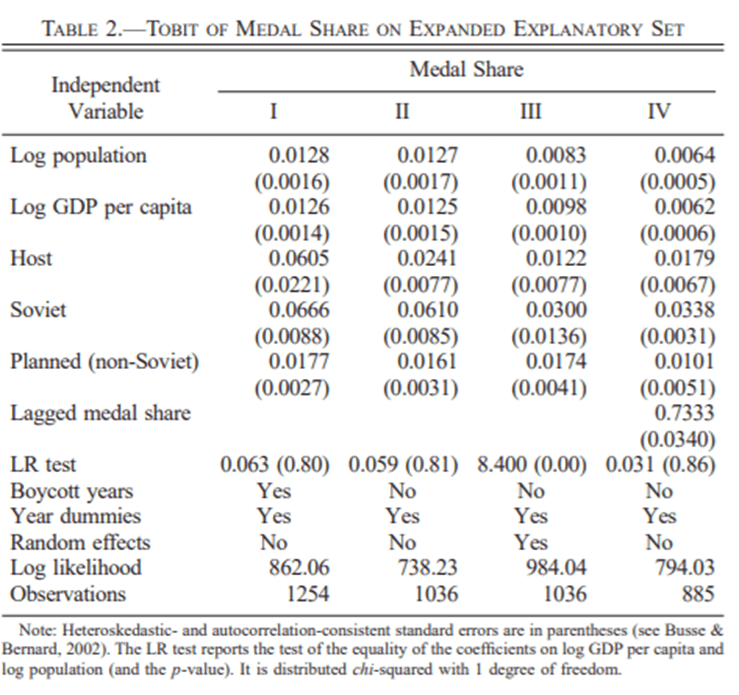
Where N is population, Y is total income (i.e., GDP), A is institutional quality and T is the number of medals being won. The subscript i and t depict the medals won at any country at any Olympic-event. This specification above is a twist (because I change the term A’s meaning as we will see below) on a paper in the Review of Economics and Statistics published in 2004 by Andrew Bernard and Meghan Busse.

The intuition is simple. First, we can assume that Olympic-level performance abilities requires a certain innate skill (e.g. height, leg length). The level required is an absolute level. To see this, think of a normal distribution for these innate skills and draw a line near the far-right tail of the distribution. Now, a country’s size is directly related to that right-tail. Indeed, a small country like Norway is unlikely to have many people who are above this absolute threshold. In contrast, a large country like Germany or the United States is more likely to have a great number of people competing. That is the logic for N being included.

What about Y? That’s because innate skill is not all that determines Olympic performance. Indeed, innate skills have to be developed. In fact, if you think about it, athletes are less artists who spend years perfecting their art. The only difference is that this art is immensely physical. The problem is that many of the costs of training for many activities (not all) are pretty even across all income levels. Indeed, many of the goods used to train (e.g., skis, hockey sticks and pucks, golfing equipment) are traded internationally so that their prices converge across countries. This tends to give an edge to countries with higher income levels as they can more easily afford to spend resources to training. This is why Norway, in spite of being quite small, is able to be so competitive – its quite-high level of income per capita make it easier to invest in developing sporting abilities and innate talent.

Bernard and Busse confirm this intuition and show that, yes, population and development levels are strong determinants of medal counts. The table below, taken from their article, shows this.

What about A? Normally, A is a scalar we use in a Cobb-Douglas function to illustrate the effect of technological progress. However, it is also frequently used in the economic growth literature as the stand-in for the quality of institutions. And if you look at Bernard and Musse’s article, you can see institutions. Do you notice the row for Soviet? Why would being a soviet country matter? The answer is that we know that the USSR and other communist countries invested considerable resources in winning medals as a propaganda tool for the regimes. The variable Soviet represents the role of institution.

And this is where the political economist has lots to say. Consider the decision to invest in developing your skills. It is an investment with a long maturity period. Athletes train for at least 5-10 years in order to even enter the Olympics. Some athletes have been training since they were young teenagers. Not only is it an investment with a long maturity period, but it pays little if you do not win a medal. I know a few former Olympic athletes from Canada who occupy positions whose prestige-level and income-level that are not statistically different from those of the average Canadian. It is only the athletes who won medals who get the advertising contracts, the sponsorships, the talking gigs, the conference tours, and the free gift bags (people tend to dismiss them, but they are often worth thousands of dollars). This long-maturity and high-variance in returns is a deterrent from investing in Olympics.

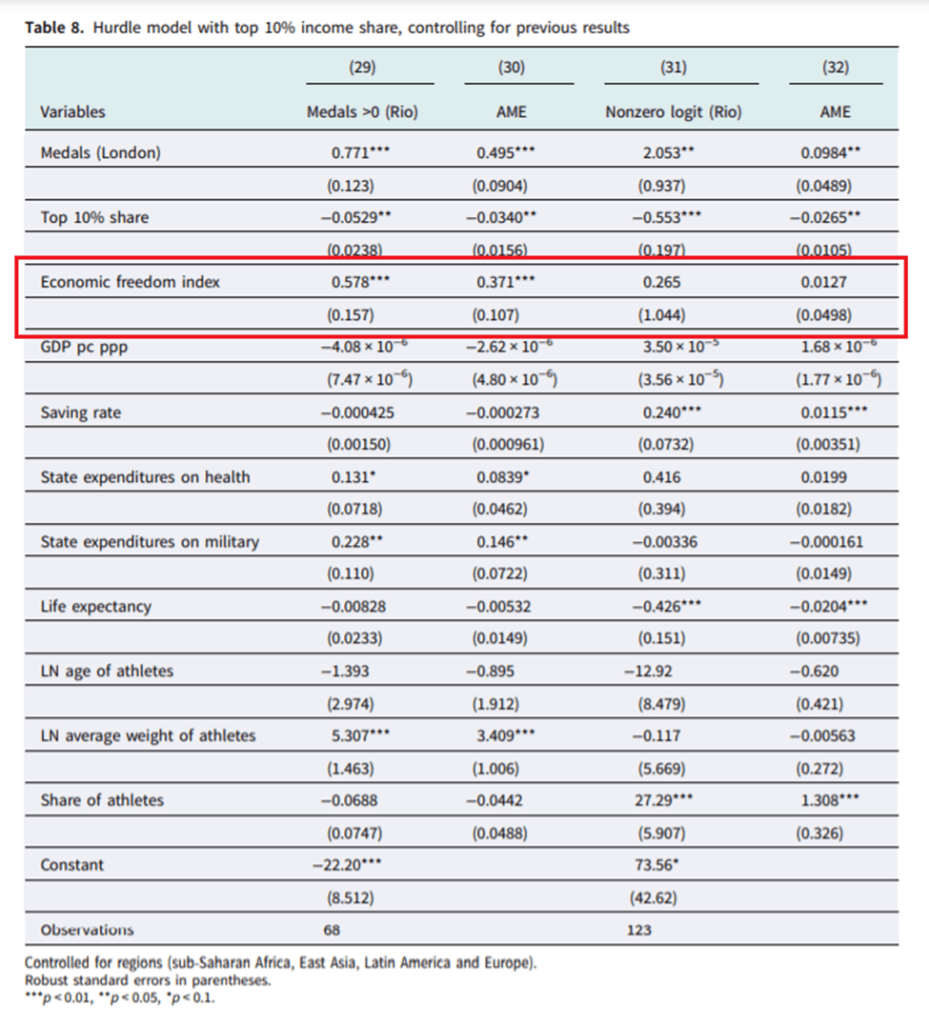
At the margin, insecurity in property rights heighten the deterrent effect. Indeed, why invest when your property rights are not secured? Why invest if a ruler can take the revenues of your investment or if he can tax it to level punitive enough to deter you? In a paper published in Journal of Institutional Economics with my friend Vadim Kufenko, I found that economic freedom was a strong determinant of medal count. Vadim and I argued that secure property rights – one of the components of economic freedom indexes – made it easier for athletes to secure the gains of their efforts (see table below).

Two other papers, one by Christian Pierdzioch and Eike Emrich and the other by Lindsay Campbell, Franklin Mixon Jr. and Charles Sawyer, also find that institutional quality has a large effect on medal counts won by countries. Another article, this time by Franklin Mixon and Richard Cebula in the Journal of Sports Economics, also argues that the effective property rights regime in place for athletes creates incentives that essentially increase the supply of investment in developing athletic skills. The overall conclusion is the same: Olympics medal counts depends in large part in the quality of institutions in an athlete’s country of origin.

Phrased differently, the country that is most likely to win a ton of medals is the economically free, rich and populous one. That’s it!

Day care and new pre-K findings

There was a buzz over a new study showing that pre-K is not necessarily good for children. It’s amazing how experts can be completely surprised by the results of a major study on an issue like pre-K education.* Noah Smith summarized the literature and thought through some policy implications. Emily Oster also just summarized the paper and points out that it provides almost no help for parents making decisions. **

I’ll offer some “amateur astronomer” observations about preschool and childcare.

What to call the daycare I patronize, since it offers all of the pre-K functions? I’ll call it Day-K. My kid comes home from Day-K with worksheets difficult enough for a kindergartener, but it was handed to a 3-year-old and the kid just scrawled a few lines of crayon across it. Most little kids aren’t going to retain material that is beyond their developmental level. Why bother printing these nice worksheets at all instead of just letting them color a bear?

Something that surprised me was how early kids can learn the alphabet and yet how disconnected that is from anything useful such as being able to read words. If a 2-year-old can do it (e.g. recognize “A”) then a 4-year-old can probably pick it up easily anyway.

Good private daycares in desirable urban areas are expensive but have unbelievable waitlists. Donald Shoup advocates that cities should charge more for parking. He reasoned that every city block should have an open parking space. Instead of spending valuable time circling like a vulture, you should just pay a lot of convenient parking or else know you will have to go somewhere else. Would the same logic apply to the good daycares? Should they not charge so much that there is always an open slot for the next parent who can pay? One issue with this from the daycare owner’s perspective is that they don’t want new kids cycling through constantly. A brand-new kid who does not trust the staff and has not learned the routine is a temporary disaster. I believe that the waitlists work because the owners want a predictable flow of great committed customers. By keeping fees low enough to have a long waitlist, they get good families to stay and they can easily fill any holes left by departures or dismissals.

If the program was free, I suspect that would change the dynamic inside compared to high-fee Day-K. Daycare kids are on a regimented schedule. Everyone thrives on the routine. The staff are happy when the kids know the rules. If people were coming and going unpredictably, that might make it harder for kids to learn.

Even under optimal conditions, there are scuffles at daycare. Being pushed down on the playground is often the only thing a kid will remember from a full day of “instruction”. How could pre-K actually negatively affect some kids, as the new study shows? One way I can think of is that the experience a good teacher tries to provide could be ruined by one kid who is loud or violent. If half of the classes are functioning as day care and having no impact at all on future outcomes and half of the classes have a kid hitting, then the average effect for all pre-K classes could be negative. The social environment of pre-K is probably highly variable. Sometimes you could get a great social atmosphere in which kids learn to share and sing. Sometimes the chaos level could make things difficult, I imagine. This is speculative. But I think it’s ok to speculate in the brainstorming period that should follow a surprising result.

Daycare centers have a fantastic physical environment. When I think of the returns to scale, the low table and chairs that fits the 3-year-olds perfectly comes to mind. A preschool classroom has a perfect bathroom with low toilets and sturdy step stools at the sinks. There is no heirloom China or nice upholstery in the room to worry about. There are dozens of age-appropriate toys and craft supplies can be bought in bulk. This physical environment allows kids to be creative and have fun. Adults don’t have to hover over them, afraid that they’ll hurt themselves or break something at any moment. By contrast, having a 2-year-old child roam my house was terrible. I kick myself for not making more up-front investments in kid-proofing and creating safe play areas. But it’s expensive and difficult for a parent to outfit their own home perfectly for each stage of development. The great thing about a daycare classroom for 3-year-olds is that it is perfectly fitted for 3-year-olds, because 3-year-olds will be cycling through it for the next decade. The physical scale factor makes me a daycare optimist for urban areas. However, as I wrote earlier, things could be trickier for low-density population areas.

The study has given us a lot to think about. I hope the research community can be helpful in continuing to figure out the puzzle.

One thing we can conclude, as Noah says in his blog, is that a compulsory university pre-K would be bad. Forcing families to send 4-year-olds to an institutional program (the way 5-16 kids are regulated) would be an expensive “own goal” policy. I don’t know of anyone seriously considering that, which hopefully means that nobody is.

* As a lab experimentalist, I’m used to being surprised by data. Check out this podcast just recorded with John List. He talks about surprising findings from field experiments. You never know until you run the experiment. Hence, my post in September about a rant about behavioral economics.

** Yesterday, Emily Oster announced that she is leaving Twitter because it had become a toxic place for her. You can still find her at substack, instagram, and other traditional publishing outlets (e.g. her books).

Teaching Price Controls (Poorly)

Economics textbooks differ in their treatment of price controls. None of them does a great job, in my opinion. The reason is mostly due to the purpose of textbooks. Despite what you might suspect, most undergraduate textbooks are not used primarily to give students an understanding of the world. They are often used as a bound list of things to know and to create easy test questions. If a textbook has to change the assumptions of a model too much from what the balance of the chapter assumes, then the book fails to make clear what students are supposed to know for the test.

I think that this is the most charitable reason for books’ poor treatment of price controls – even graduate level books. The less charitable reasons include sloppy exposition due to author ignorance or an over-reliance on math. I honestly would have trouble believing these less charitable reasons.

I picked up 5 microeconomics text books and the below graph is typical of how they treat a price ceiling.

The books say that the price ceiling is perfectly enforced. They identify producer surplus (PS) as area C and consumer surplus (CS) as areas A & B. There are very good reasons to differ with these welfare conclusions.

Problem #1

Continue reading