A recent article in The Guardian profiles economist Isabella Weber. She doesn’t seem to like other economists very much, supposedly because we “obsess over ideological purity and are inflexible when searching for solutions.” Weber wants economists to come up with solutions that work even if… I guess, even if they don’t work well in theory? Maybe they will work well in practice?
Anyway, so far as I can tell, the article only gets into details on two concrete solutions to affordability. I’m sure she has more in her book, but let’s see what these are. The first for governments to create “publicly owned entities that can buy and sell grain into its market,” presumably to smooth out fluctuations in grain prices. The second is “the Mexican government’s canasta básica policy, through which retailers voluntarily cap the total price of a basket of two-dozen essential goods.”
Let’s look at the second one, since I think for developed countries like the US, fluctuating grain prices aren’t the primary source of affordability concerns. But perhaps American consumers would like a basket of grocery essentials to be cheaper.
Has this policy in Mexico worked? It was first implemented in 2022, and food inflation has certainly fallen in Mexico since then. But it has also fallen everywhere else in the world — 2022 was peak inflation not just in the US, but in most countries — so we can’t judge the success of the program based on that alone.
Instead, we can look at internationally comparable data on food spending, which comes from the USDA’s Economic Research Service. Our World in Data has a nice chart based on this data, and even though it is now two years out of date (I will provide 2025 data below), the 2023 data makes a case against the success of the “price controls” in Mexico (I put “price controls” in quotes because it is not a true price control, but an attempt to control prices via incentives):
Figure 1
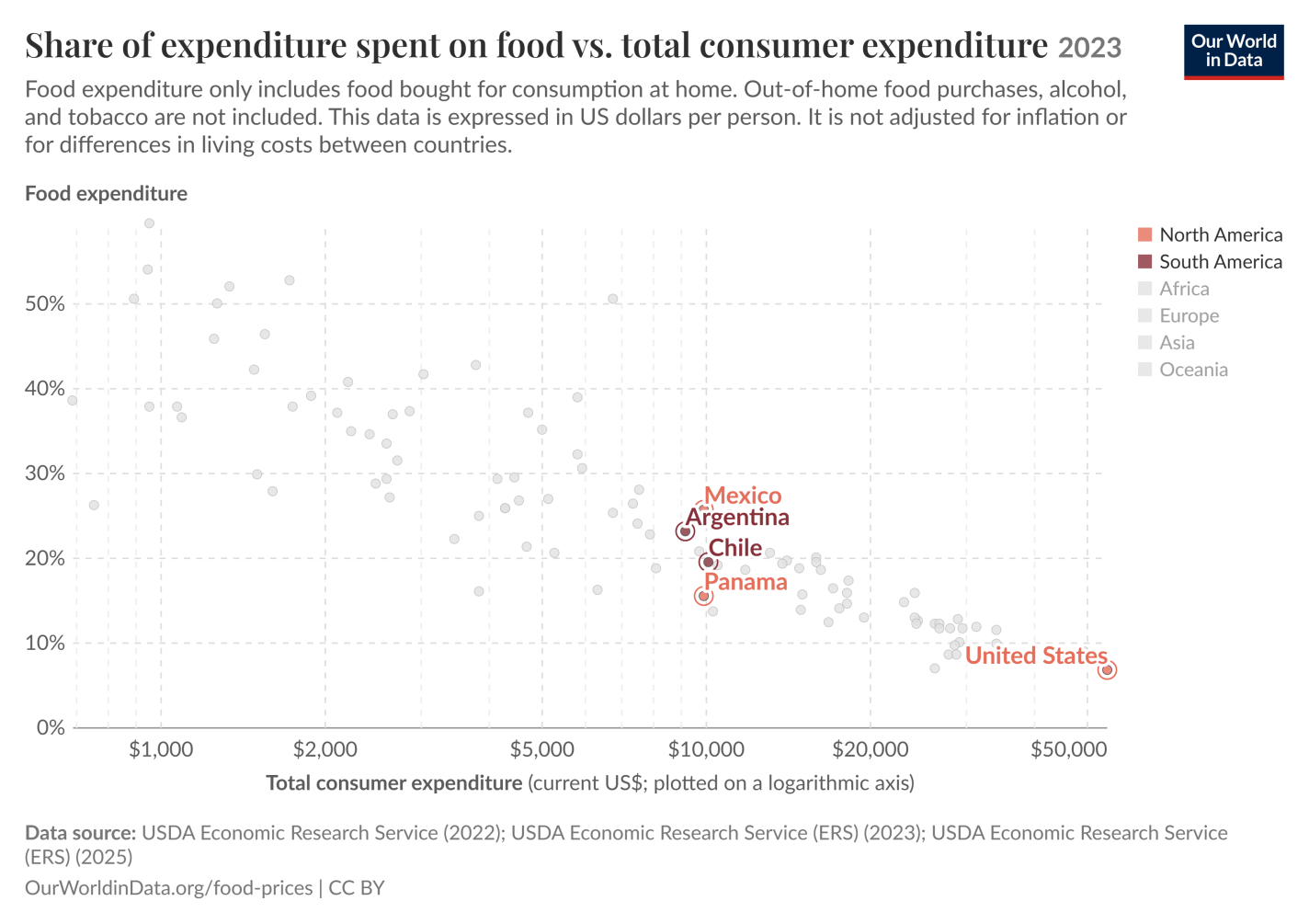
It will probably not surprise you that the US spends much less on food as a percent of total spending than Mexico, given that we are a high-income country. But it is still worth pointing out just how low food spending is in the US. However, this chart still paints Mexico in a very poor light: for countries with about the same income level in the Americas (as measured by consumer expenditures), Mexicans spend much more on food than Argentina, Chile, or Panama.
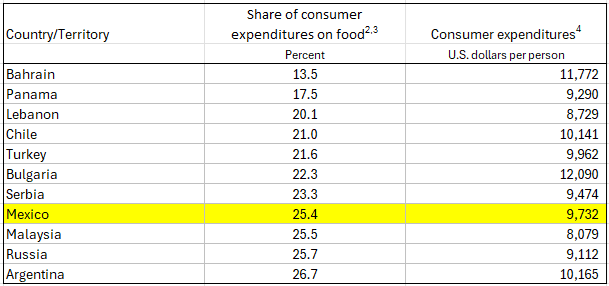
If we use the 2025 USDA data, and focus on the 10 countries with consumption expenditure closest to Mexico (between about $8,000 and $12,000 of consumption), we see that Mexico is very much on the high end: only Argentina was clearly higher:
Table 1
Finally, we can compare Mexico against itself in this data, looking at food spending going back to 2017:
Figure 2
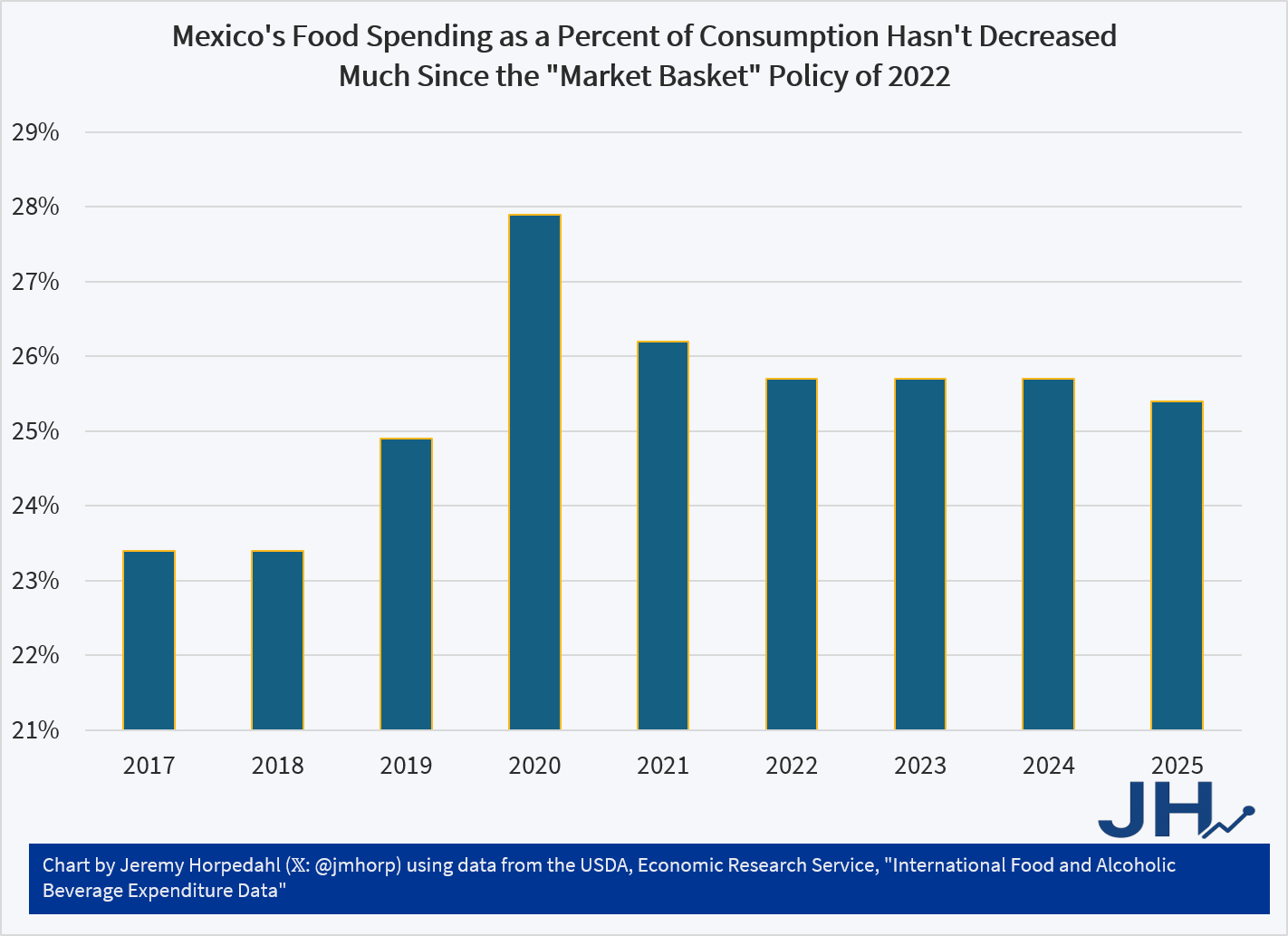
Food spending actually peaked in 2020, though be cautious of any data from 2020 as the pandemic made data collection difficult. After declining in 2021 and then into 2022 (the policy seems to have been put in place in mid-2022), there haven’t been any further declines. And food spending is still well above pre-pandemic levels (unlike the US, where the 2025 figure of 6.4% is the same as 2017-18).
Ultimately, we would want a more sophisticated analysis than my simple tables and charts here. But it doesn’t appear that Mexico’s 2022 policy really made food much more affordable, either relative to peer countries with similar income levels, or relative to Mexico’s own recent history. And that’s even before we get into any unintended consequences of the “price controls.” Of course, the policy may have made that basic basket of two-dozen items more affordable than it otherwise might be — for that we would need to compare individual item prices to peer countries — but it hasn’t obviously made food overall more affordable in Mexico.


