Yesterday Federal Reserve researcher Nathan Blascak presented a paper at my Economics Seminar Series that was a surprise hit, with the audience staying over 40 minutes past the end to keep asking questions. So today I’ll share some highlights from the paper, “Decomposing Gender Differences in Bankcard Credit Limits”.
The challenge here is that its hard to get data that includes both gender and credit card limits (its illegal to use gender as a basis for allocating credit, so credit card companies don’t keep data on it, as they don’t want to be suspected of using it). The paper is original for managing to do so, by merging three different datasets. But even this merged data only lets them do this for a fairly specific subgroup- Americans who hold a mortgage solely in their name (not jointly with a spouse). Even this limited data, though, is quite illuminating.
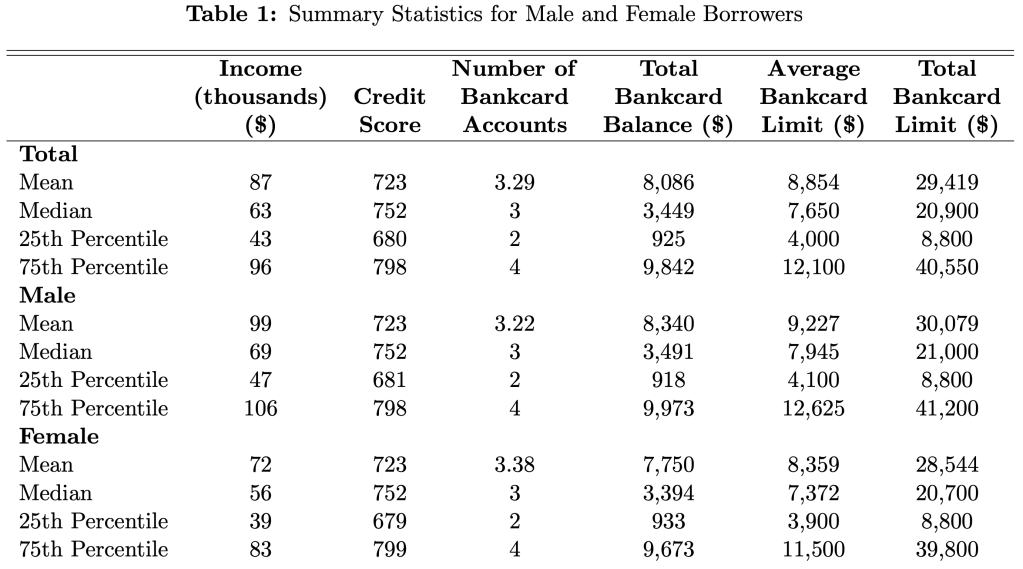
Their headline result is that men have 4.5% higher credit limits than women. Women actually have slightly more credit cards (3.38 vs 3.22), but have lower limits on each card; summing up their total credit limit across all cards yields an average of $28,544 for women vs $30,079 for men.
Two of the big factors that determine limits, and so could cause this difference, are credit scores and income. The table above shows that men and women have remarkably similar credit scores, while men have higher incomes. Still, when the paper tries to predict credit limits, controlling for credit scores, incomes, and other observables explains only about 13% of the gender gap.
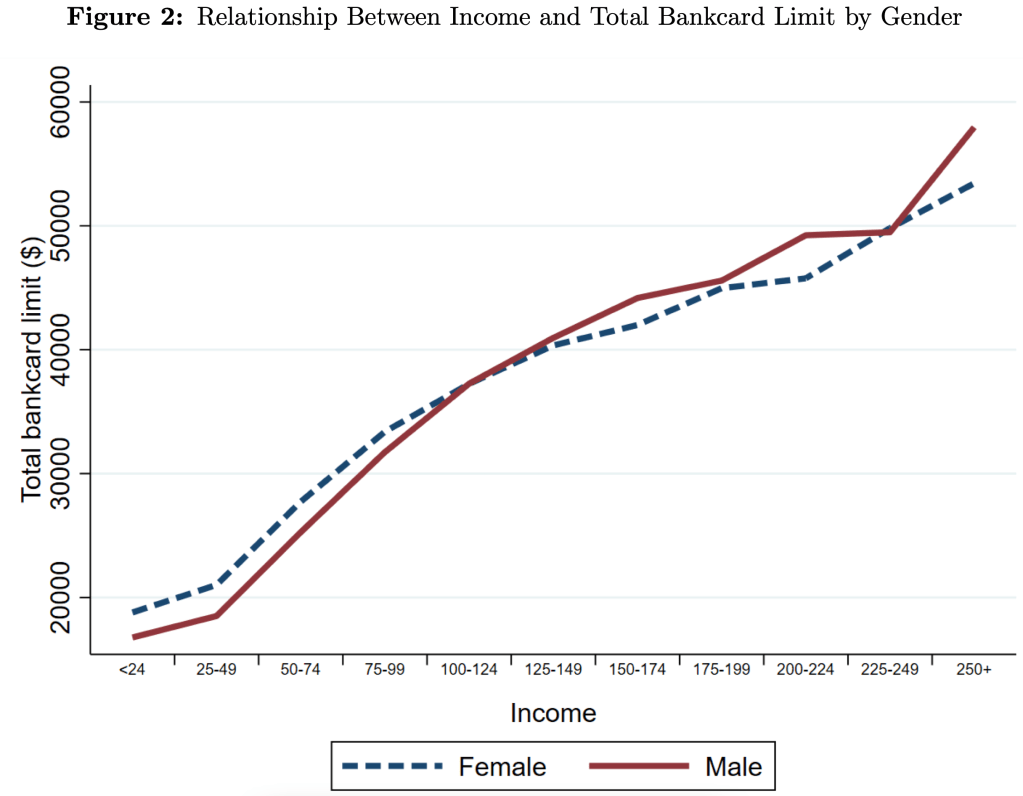
Men have 4.5% higher credit limits on average, but this difference varies a lot across the distribution. For credit scores, the gap is narrow in the middle but bigger at the extremes. For income, we see that men get higher limits at higher incomes, but women actually get higher limits at lower incomes- and not just “low incomes”, women do better all the way up to $100,000/yr:
The papers data covers 2006-2018, so they also show all sorts of interesting trends. The average number of credit cards held by men and women plunged after the 2008 recession and remains well below the peak. Total credit limits plunged too, though they were almost totally recovered by 2018.
There’s lots more in the paper, which is a great example of the value of descriptive work with new data. If anything I’d like to see the authors push even harder on the distribution angle. Its nice to see how limits vary across all incomes and credit scores, but why not show the full distribution of credit card limits by gender? My guess is that the 1st and 99th percentiles are very interesting places, because there’s all sorts of crazy behavior at the extremes. Finally, I wonder if higher limits are actually a good thing once you get beyond a relatively low amount- do you know of anyone who ever had a good reason to get their personal credit card balances over $20,000?
In the US wealth distribution, which group has seen the largest increase in wealth during the pandemic? A recent working paper by Blanchet, Saez, and Zucman attempts to answer that question with very up-to-date data, which they also regularly update at RealTimeInequality.org. As they say on TV, the answer may shock you: it’s the bottom 50%. At least if we are looking at the change in percentage terms, the bottom 50% are clearly the winners of the wealth race during the pandemic.
Average wealth of the bottom 50% increased by over 200 percent since January 2020, while for the entire distribution it was only 20 percent, with all the other groups somewhere between 15% and 20%. That result is jaw-dropping on its own. Of course, it needs some context.
Part of what’s going on here is that average wealth at the bottom was only about $4,000 pre-pandemic (inflation adjusted), while today it’s somewhere around $12,000. In percentage terms, that’s a huge increase. In dollar terms? Not so much. Contrast this with the Top 0.01%. In percentage terms, their growth was the lowest among these slices of the distribution: only 15.8%. But that amounts to an additional $64 million of wealth per adult in the Top 0.01%. Keeping percentage changes and level changes separate in your mind is always useful.
Still, I think it’s useful to drill down into the wealth gains of the bottom 50% to see where all this new wealth is coming from. In total, there was about $2 trillion of nominal wealth gains for the bottom 50% from the first quarter of 2020 to the first quarter of 2022. Where did it come from?
Gallup has polled Americans for many decades about their smoking habits. About 40-45% of adults smoked cigarettes from about 1945-1975, but the percentage has dropped steadily since then. A 2022 poll showed a new low of 11% being smokers. Roughly three in 10 nonsmokers say they used to smoke.
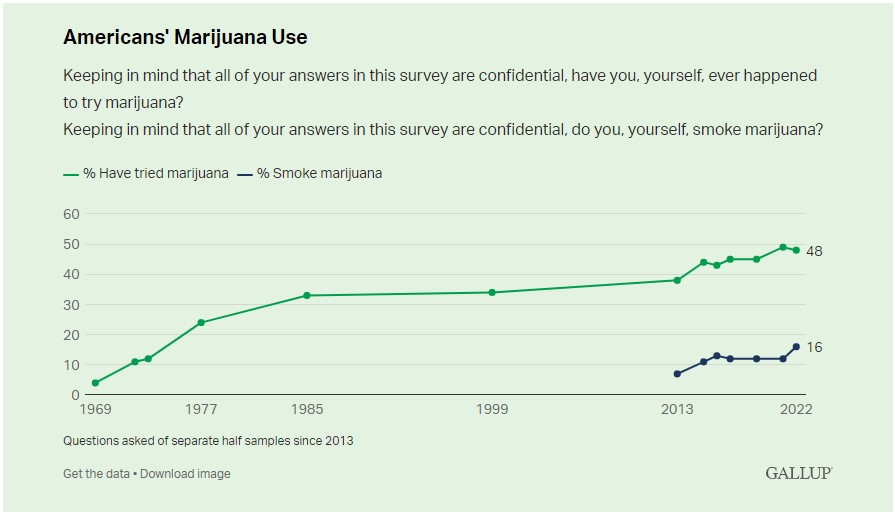
On the other hand, marijuana usage has climbed steadily since Gallup first asked about it in 1969. Some 16% of Americans say they currently smoke marijuana, while a total of 48% say they have tried it at some point in their lifetime:
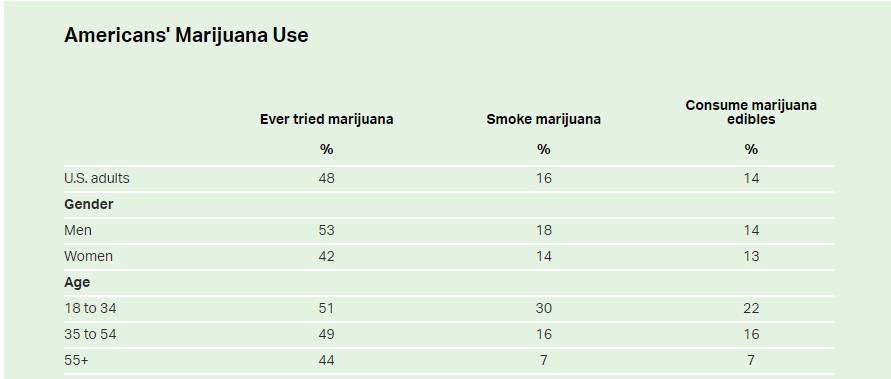
Younger adults (18-34) are much more likely to be current users, but the 55+ crowd tried it nearly as much (44%) as the younger cohorts:
Among all adults, opinion is about evenly split on whether marijuana has a positive or negative effect on society and on people who use it. However, opinion is skewed very positive among those who have actually tried it, and negative among those who have not:
(I can’t resist inserting a consistent anecdotal observation by reliable people I know or know of, that habitual smoking of MJ tends to be highly correlated with passivity / lack of initiative, especially among young men. When one young man I know of told his counselor, “Nothing happens [when I smoke weed]”, the response was, “That’s the problem, nothing happens [because with weed you just chill and don’t do the stuff you need to do].” Of course, correlation says nothing about the direction of causation here).
The big gorilla of substance usage is still alcohol. About 45% of Americans have had an alcoholic drink within the past week, while another 23% say they use it occasionally. Alcohol use has remained relatively constant over the years. The average percentage of Americans who have said they are drinkers since 1939 is 63%, which is close to Gallup’s most recent reading of 67%.
I was made aware of the editorial on Saturday and I’ll admit I was a little nervous when I first clicked, only to be relieved to find an accurate summary of the research and a relatively restrained commentary.
But why was I nervous, you may ask. Isn’t media attention something scholars want? Yes. Earlier in my career, that was an unqualified “yes”, but I’ve been doing this long enough now that I appreciate just how little control a scholar has over the conversation that can happen around their work. I’ve had a couple papers get non-trivial media attention over the years and each time it’s a reminder that the research itself is not just the subject of a conversation, it’s a prop that gives people an opportunity to have the conversation they already wanted to have. The findings of the research in question can prove quite immaterial to that conversation.
When I posted a thread about the paper two weeks ago, I was happy to see enough retweets to pass the paper around and get it some attention.
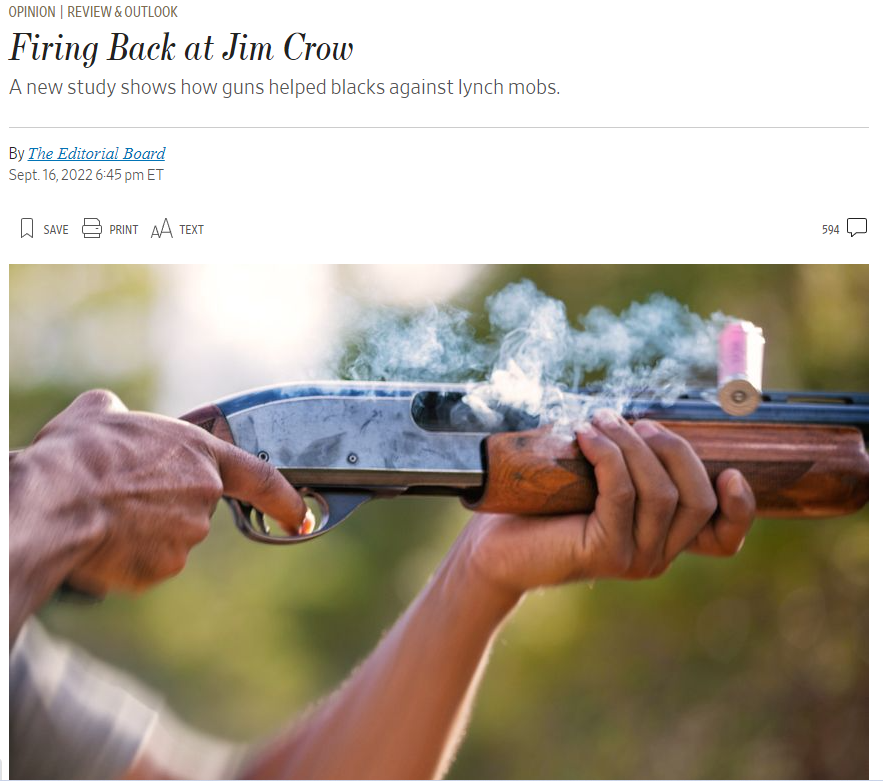
Main result: greater access to firearms in the Black community reduced the rate of lynching in the Jim Crow South. In a context where you are excluded from the institutions of governance and public safety, where terrorism against you is condoned, the tools of self-defense matter
— Mike Makowsky is here to violently equivocate (@mikemakowsky) September 7, 2022
What was less fun was the predictably over-reductive quote tweets and comments excitedly parading the paper as evidence of “guns are good.” Not unlike people excited to reduce a paper to “minimum wages are good” (or “this paper is bad because minimum wages are bad”), it can be frustrating to try to make a nuanced contribution towards understanding a complex context, only to see it reduced to a television debate chyron.
The key to surviving this process is accepting that a scholar, even those of tremendous standing inside and outside of the academy, has little to no control over the narrative that emerges around their work. Holding strong preferences over the surrounding narrative is folly varying only in consequences. You can try to fight the narrative, which typically results in the world either ignoring you or, worse, joyfully inviting you to wrestle in the mud. [Good rule of political discourse: never wrestle with a pig. You can’t win, you end up covered in mud, and the pig loves it.] Some scholars, though not as many as the more skeptical fear, prefer to shape the research to serve a narrative from the outset. This, of course, is no longer research, it’s advocacy masquerading as science. Don’t do this. And lastly, some create great research, only to apologetically bear the burden of the unintended narrative that emerges around their work. If you recognize yourself in this description, my only advice is a) don’t apologize and b) go easy on the sauce.
For what it’s worth, my view of “Firearms and Lynching”, in the context of the broader literature on firearms and public safety, is that things have to be horrifyingly bad before greater availability of firearms make for a safer public. Foreign invasions, institutionalized segregation, pogroms, lynch mobs, these are all contexts where an armed population can make for a better outcome. Probably not a happy ending, but maybe a less tragic one. The Jim Crow South was such a context. That’s how bad it was. That’s the takeaway.
If you want to translate this piece of historical research as evidence that a greater saturation of firearms in modern American society will make for better and safer lives, then I’ll admit that I think you are too pessimistic about the current state of the world. You’ve spent too much time reading about burning cities that actually aren’t burning. If you think that a greater taking up of arms by Black Americans will make their lives safer and better, then I’ll admit I still think that is probably wrong, but maybe less wrong. Black Americans have brought their reality to the eyes of broader America and that reality questions whether or not the police serve their communities or threaten them. It is certainly a legitimate question whether they can rely on police protection to secure their homes and their communities.
It doesn’t take a lot of imagination to make the next logical leap here. If police can’t be counted on, we’ll protect ourselves, and firearms are a tool to do that. That sort of thinking, however, is exactly why making leaps from history to contemporary contexts is so fraught. As bad as things are today, even in the most violent districts with the most contemptable police departments, it’s not the Jim Crow South. Lynch mobs are not roaming the streets and selling photos of their victims as postcards. Groups of young white men are not wandering into homes and stealing from them without fear of retribution. Firearms are tools of death, and their presence bring benefits and costs. To exceed the costs of broadly deadlier conflict throughout your community, the benefits to other dimensions of public safety have to be significant.
I’m sorry, did you think that I was going to close out this post with a solution to modern violence and policing in America? With an answer? The world is complex and difficult, policy for it doubly so. My colleague and I wrote a paper that tried to answer the question of whether a minority living under an indifferent regime that condoned terrorism could better live their lives armed. That’s the question we made a contribution towards answering, and our results point towards “Yes”. If you want me to make big claims about what that means today, well, get used to disappointment.
No matter how you feel about intelligent machines, you’ll be talking to them soon.
Talking to voice assistants right now feels stilted because it's slow, inaccurate, and you can't interrupt.
Widely-available high-quality fast ASR and TTS, paired with LLMs, is coming soon and will enable much more natural conversations. https://t.co/8UQP5YRZ5l
This restaurant has several robots delivering food and drinks to tables. It’s strange at first but easy to get used to. The robots can tolerate people walking in front of them and mild harassment from children. pic.twitter.com/F47IcPqruU
For many decades the Allied Social Science Association (ASSA) meetings, anchored by the American Economic Association, have been by far the world’s largest gathering of economists each year, typically attracting well over ten thousand. But the meetings went virtual-only for the past two years, and when they finally return in-person in 2023 they will likely be substantially diminished.
Some of this is due to potentially one-off factors; some people don’t want to travel to Louisiana because of its state laws, some still want to avoid large conferences because of Covid, others want to avoid the ASSA’s response to Covid:
All registrants will be required to be vaccinated against COVID-19 and to have received at least one booster to attend the meeting…. High-quality masks (i.e., KN-95 or better) will be required in all indoor conference spaces.
But the AEA made one big, apparently permanent change that means it could be a long time before we see a meeting as big as January 2020’s in San Diego- they gave up the job market. Prior to Covid the vast majority of first-round interviews to be a full-time US economics professor took place at ASSA. Naturally interviews moved online during Covid, but surprisingly the AEA has asked that they stay online, and in fact has specifically asked schools NOT to schedule interviews during ASSAs. This removes a huge source of demand for the meetings- the ~1200 new PhDs looking for their first jobs, the thousands of people there to recruit them (each hiring school typically sends 2-4 interviewers), and everyone trying to switch jobs. This was THE big thing that made AEAs special, that other conferences didn’t really have.
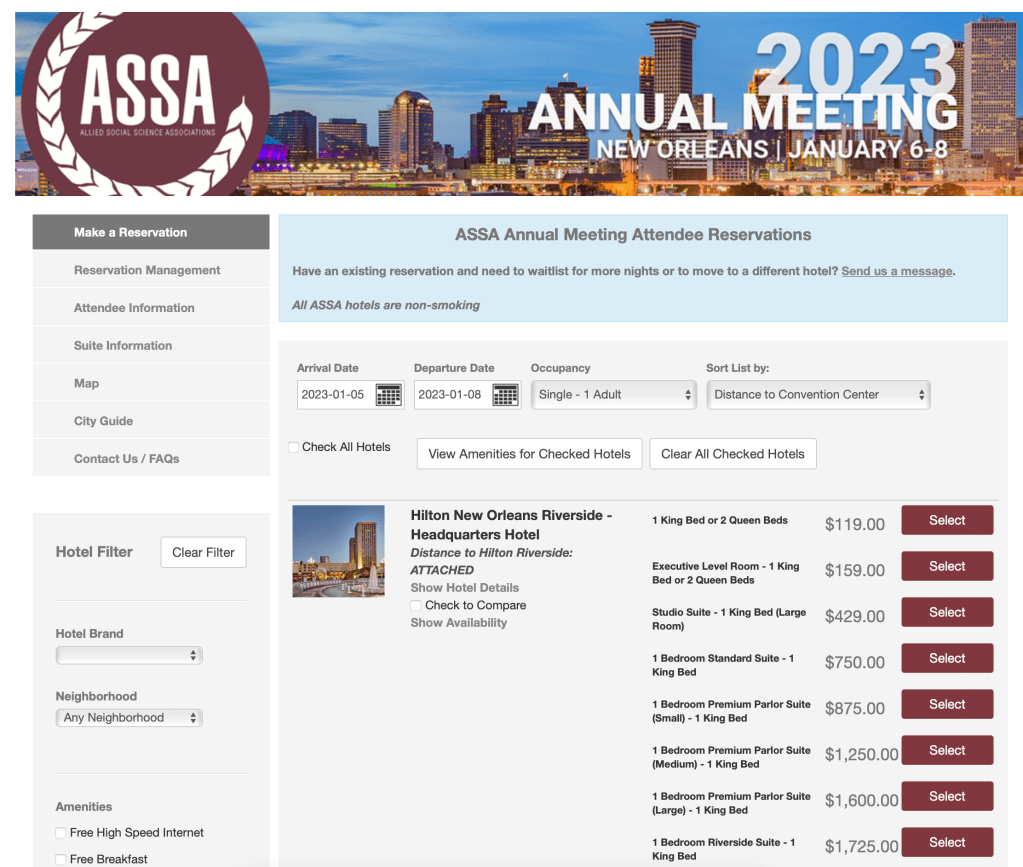
I’ll let everyone else debate whether this makes the job market better or worse; I’m agnostic there, but I’m sure it will shrink the conference. One silver lining to a smaller conference is that it is much easier to find a hotel room. Like usual I was waiting on the AEA website this Tuesday to book a hotel room on the first minute the AEA’s deeply discounted hotel blocks opened, because the good hotels tend to fill up near-instantly. But it appears this was unnecessary this year- two days later and even the headquarters hotel is still wide open:
I got the room I wanted at the Hotel Monteleone; I’ll be looking to grab a spot on the Carousel Bar, maybe see some of you there. I’ll present a poster at AEA, but mostly I’m just looking forward to spending real time in New Orleans for the first time since I moved away in 2017.
Yes, it rotates while you sit and drink
So I’m still looking forward even to a diminished AEA, but it does make me wonder- which other conferences will benefit most from AEA’s decline? I don’t know that anyone has put together the numbers for all the conferences enough to know what the 2nd-largest is, but my bet both for the 2nd-largest and most likely to benefit is the Southern Economic Association; I’ll be there too, in Ft. Lauderdale this November.
From the recent CPI inflation report, one of the biggest challenges for most households is the continuing increase in the price of food, especially “food at home” or what we usually call groceries. Prices of Groceries are up 13.5% in the past 12 months, an eye-popping number that we haven’t seen since briefly in 1979 was only clearly worse in 1973-74. Grocery prices are now over 20% greater than at the beginning of the pandemic in 2020. Any relief consumers feel at the pump from lower gas prices is being offset in other areas, notably grocery inflation.
The very steep recent increase in grocery prices is especially challenging for consumers because, not only are they basic necessities, if we look over the past 10 years we clearly see that consumer had gotten used to stable grocery prices.
The chart above shows the CPI component for groceries. Notice that from January 2015 to January 2020, there was no increase in grocery prices on average. Even going back to January 2012, the increase over the following 8 years was minimal. Keep in mind these nominal prices. I haven’t made any adjustment for wages or income! (If you know me, you know that’s coming next.) Almost a decade of flat grocery prices, and then boom!, double digit inflation.
But what if we compare grocery prices to wages? That trend becomes even more stark. I use the average wage for non-supervisory workers, as well as an annual grocery cost from the Consumer Expenditure Survey (for the middle quintile of income), to estimate how many hours a typical worker would need to work to purchase a family’s annual groceries. (I’ve truncated the y-axis to show more detail, not to trick you: it doesn’t start at zero.)
Corrosion is estimated to cost about $250 billion per year in the U.S. alone, so it is economically significant. The impact of corrosion hit home for me when I noticed that near the bottom of the right rear wheel well of my little 2007 sedan, a 2-3” hole had rusted right through the metal, exposing some inner chambers to water and salt and sand thrown from the wheel. The rust does not look like it has compromised the vehicle’s mechanical integrity (a real concern, since today’s cars rely on the body sheet metal for strength), but if it keeps on going it could turn my chariot into a junker.
I called an honest local body shop, and the guy told me it would probably cost more than the car is worth to fix it properly (replace the rocker panels, etc.), and it might run $1700 just to do a patch job.
Being a (retired) chemical engineer, I decided to read up on ways to deal with rusting metal. Especially, how to arrest the progress of rust. The most serious way is to do major surgery with cutting tools, and cut out all the rust, and weld good metal back in, and paint it all well. That is out of my league. So I looked for coatings that could stop the rusting progress.
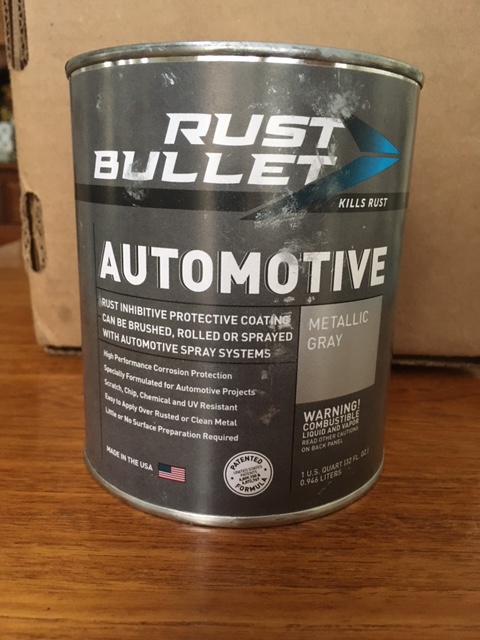
I have written an article on a different blog describing the various classes of coatings and rust converters that are available. For my project, I chose to use Rust Bullet, ordered from Amazon.
This can be painted directly on rusty metal surfaced, after scraping away all the loose rust. This stuff chemically reacts with the remaining surface rust to make it more inert, and also forms an impermeable seal over the surface, to block further water and oxygen from reaching the metal. It sticks to rusty and non-rusty surfaces. It seems to get good reviews.
One peculiarity of Rust Bullet is that if many hours have elapsed after application its surface gets so smooth that that that the next layer of Rust Bullet or top coat paint will not stick unless you sandpaper the smooth, hard, silvery surface. It’s easiest, therefore, to leave only 2 hours or so between coats of paint, to avoid the bother of sandpapering.
After two coats of Rust Bullet, I applied a top coat of Rustoleum enamel paint (white on the outside of the car, black on interior surfaces).
Some rust had started on surfaces of the inner chambers of sheet metal that had been exposed by the rusted-out hole. I could not readily reach them with a paint brush to apply Rust Bullet. I wanted to spray something that would form a coating that would inhibit further rusting. I settled on Cosmoline RP-342, ordered from the manufacturer.
This stuff sprays on like a thick oily liquid, that should soak into any rust. After maybe 2 hours, it hardens up to a very impermeable, fairly tough waxy coating. It will keep water off surfaces, though I don’t know about oxygen. Anyway, I sprayed the Cosmoline into the available openings, to try to coat the surfaces of the inner chamber parts. (If I had known about it in time, I might have chosen Eastwood Internal Frame Coating instead of Cosmoline for this step.) I was able to coat most, though not all, of the vulnerable surfaces. This was all with me lying on my side, beside/under the car, without great ergonomic access.
I then used several layers of aluminum foil duct tape (learned this trick from YouTube) to seal up the holes in the car body, then added a final coat of white or black Rustoleum. This has pretty well protected the car body there from further exposure to water/sand/sand. It should give me a couple more years of use, all for two days of picky handwork plus the cost of materials.
I want to write about the economics of the Wrexam football club. They have docu-series currently airing on FX weeking until late October. They have two celebrity owners whose level of wealth falls squarely within the range of optimum dramatic tension i.e. rich enough to buy and improve a tiny Welsh football club, but so rich that they can buy their way out of every problem without utterly ruining themselves and their families.
I want to write about it, but I won’t. I’ll be patient and wait until the first season is over. Instead, I want to encourage you to watch all or part of the season with an eye towards the drama and risk there is to be found in solving such a complex economic problem. Pay attention, there will be a quiz in two months:
How do you optimize your committment to an investment whose financial payoff is gaining access to a higher revenue stream via a process as unpredictable as finishing at or near the top in a 24 team football league? How do you cope with that much noise in a system with such poor underlying odds?
How do you optimize your committment to an investment whose payoff has an enormous non-pecuniary element (i.e. joy from the success of the team) and that non-pecuniary element is a true local public good (non-excludable and non-rival) that represents a significant portion of total utility in local households?
How should local stake holders treat their relationship to the team? The supporters group has significant voting power when transitioning ownership. What should they be maximizing when they cast their votes? On what observables should they base their decisions?
In what ways are the owners failing to optimally allocate resources within the team?
In what ways is the manager and coaching staff failing to optimally manage the player resources they have?
Are incentives aligned top to bottom in the organization? Within the team?
How do you measure success and failure with a sports club? Should these metrics, or the relative weights on these metrics, change with the scale of the club, it’s resources, and its fan base?
When the season is over we will revisit these questions and more. Running a sports team is an incredibly complex problem to solve. Most previous inside looks have been pure PR projects for the very biggest clubs, worth billions of dollars. These clubs/teams are enormous enterprises, with vast hierarchies and narrowly divided tasks. They are in many ways simply too big to fit into frame for an intimate documentary. If that’s what you’re interested in, fiction is the better channel because it can abstract away from all the field maintence and beer pricing, and just show you Brad Pitt cutting deals over the phone while stuffing food into his beautiful face.
To really understand this business from the inside, you gotta go small. To places where a small number of individuals are making an inefficiently vast range of decisions. Welcome to Wrexam so far looks to be one of the very best views into that world. I can’t wait to see more.
I just hope they find someone to update their zonal marking system on set pieces. I don’t know, maybe much some YouTube videos or something. Yikes.
“Can [the President] not at the head of his army beat down every opposition? Away with your President, we shall have a King: The army will salute him Monarch; your militia will leave you and assist in making him King, and fight against you: And what have you to oppose this force? What will then become of you and your rights? Will not absolute despotism ensue?” It is noted in the manuscript that the stenographer could not keep up with the torrent of terrible possible consequences that Henry was shouting about concerning a chief executive.
Most of his apocalyptic scenarios have not happened … yet. What inspired me in his speech was his energy more than his arguments. As much as he praised the American spirit of the past that ousted British rule, he was not complacent. He models a kind of patriotism that embraces an American project without holding to any fantasies about the morality of particular American leaders or soundness of American institutions. He would not have been disillusioned by the scandals and crimes of the American political class. He anticipated it.







 Economist Writing Every Day