For Tax Day 2026, here are some estimates of how progressive the US tax system is, drawing primarily from published academic work. While there is disagreement about exactly how progressive the tax system is (and should be), these papers all agree that as income rises, average tax rates rise. These estimates attempt to include, as best as possible, all federal, state, and local taxes, and to take account of tax incidence.
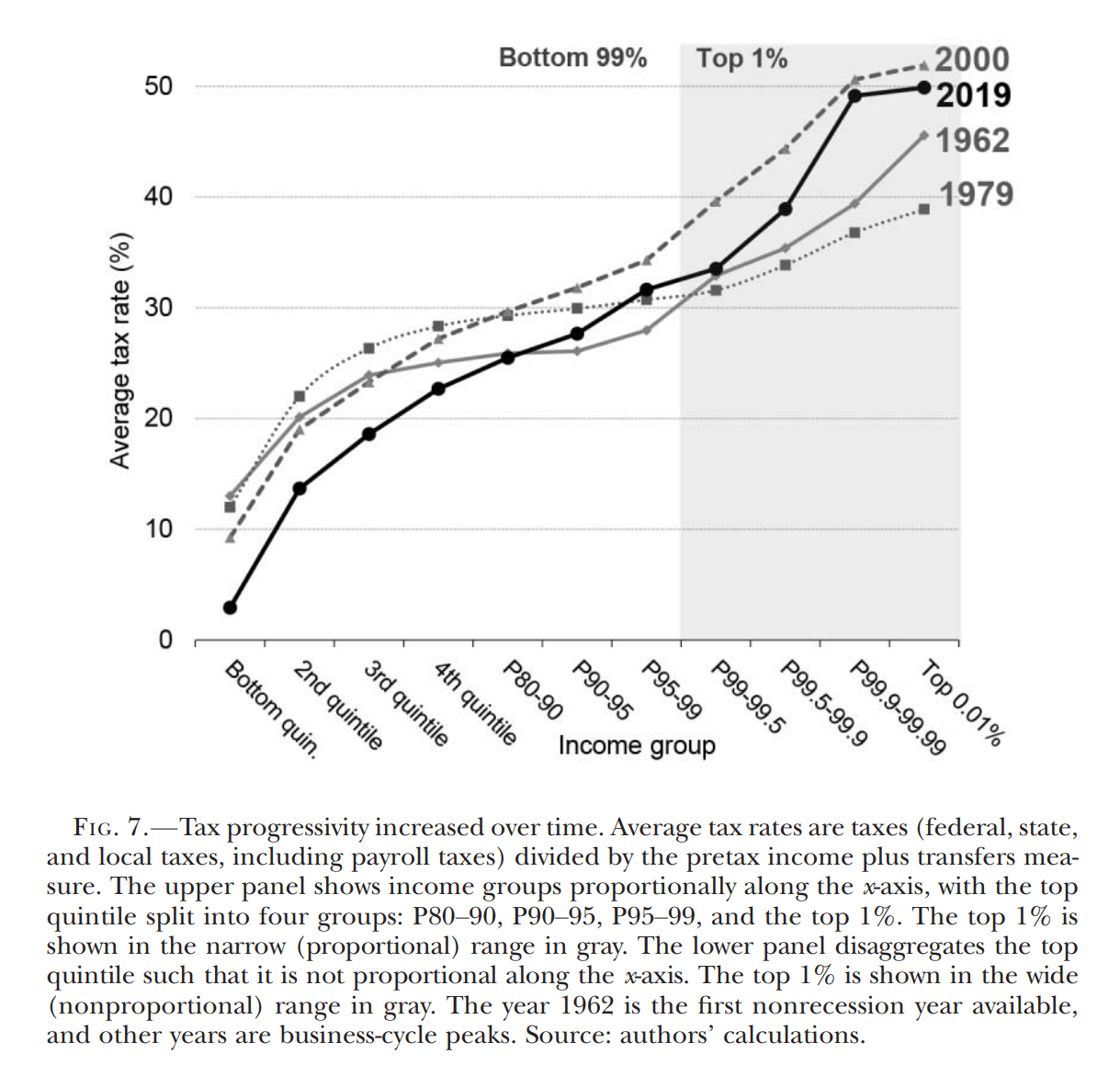
From Auten and Splinter in the Journal of Political Economy:
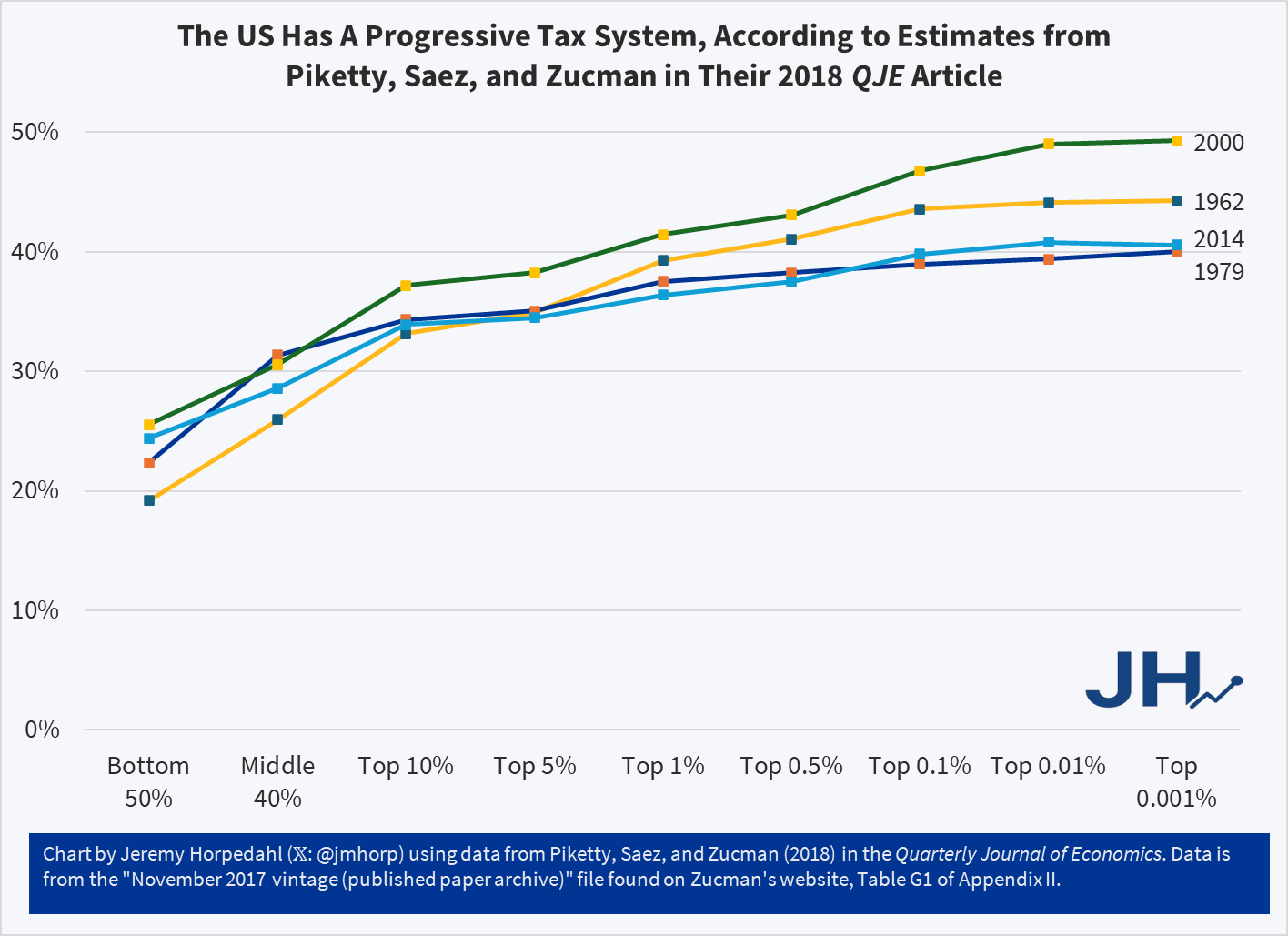
Piketty, Saez, and Zucman in the Quarterly Journal of Economics (Figure IX):
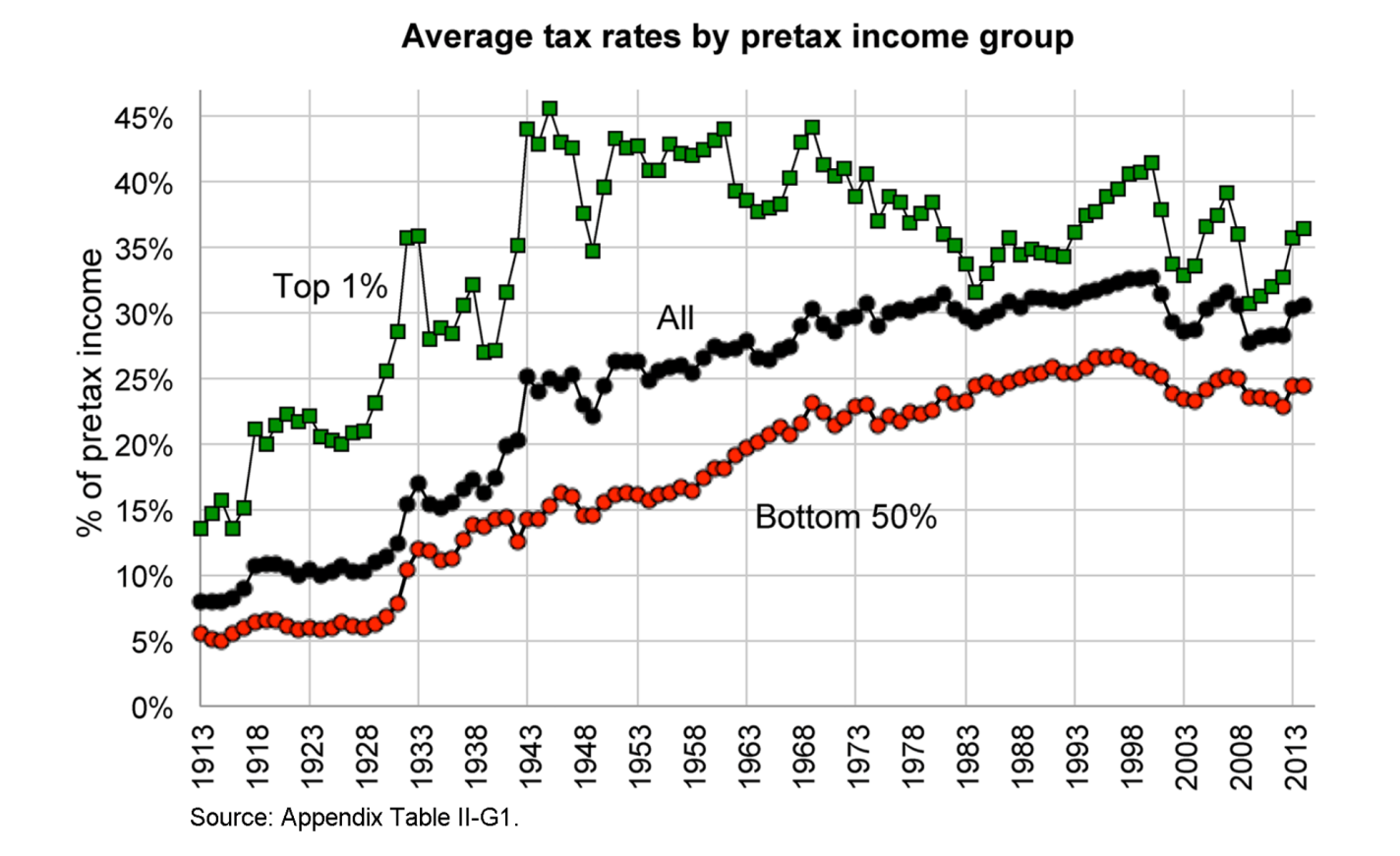
And here is a chart that I created, which comes from the appendix data for PSZ (2018), which is roughly comparable to the Auten-Splinter chart above. Note that it isn’t perfectly comparable: the income groups on the x-axis aren’t exactly the same, and the latest year in PSZ is 2014 rather than 2019 (they do have estimates for later years in updates to the work, but I am trying to stick with the published academic work). But they are roughly comparable:
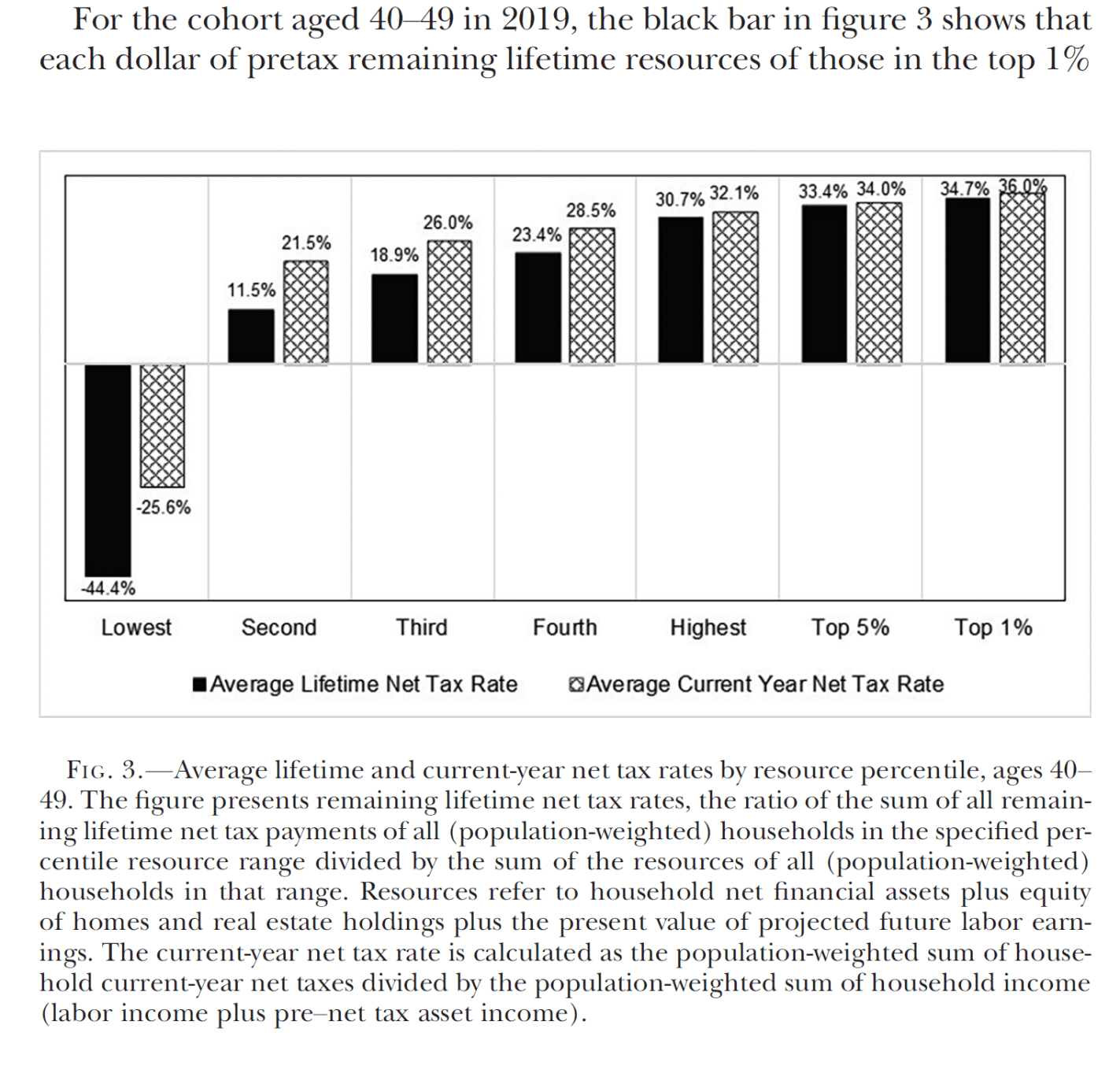
Auerbach, Kotlikoff, and Koehler in the Journal of Political Economy take the additional step of computing lifetime average tax rates, rather than for a single year, showing the US tax system is even more progressive when considered this way. Note: they also include the value of transfers, which makes these results not directly comparable to the papers above:
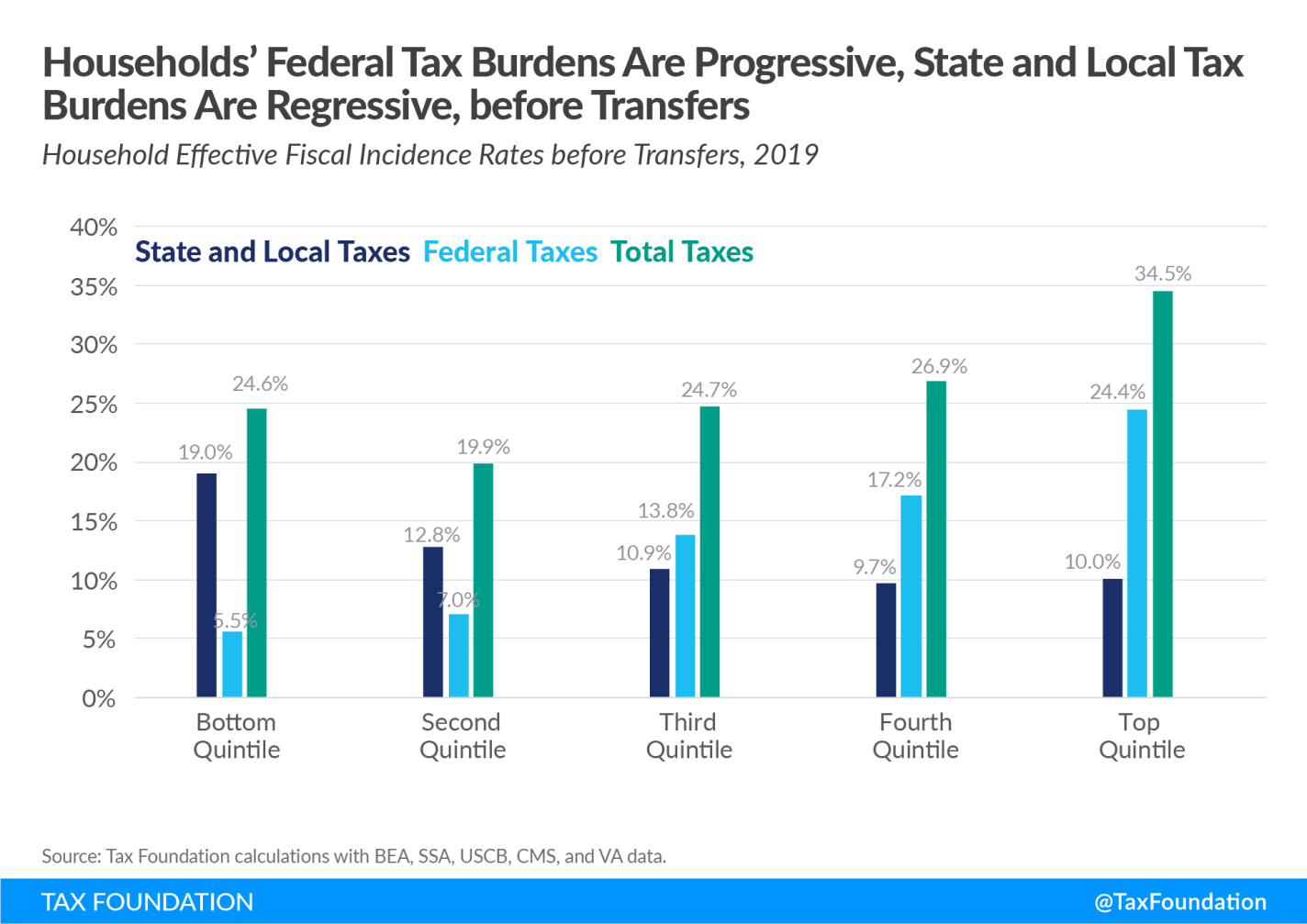
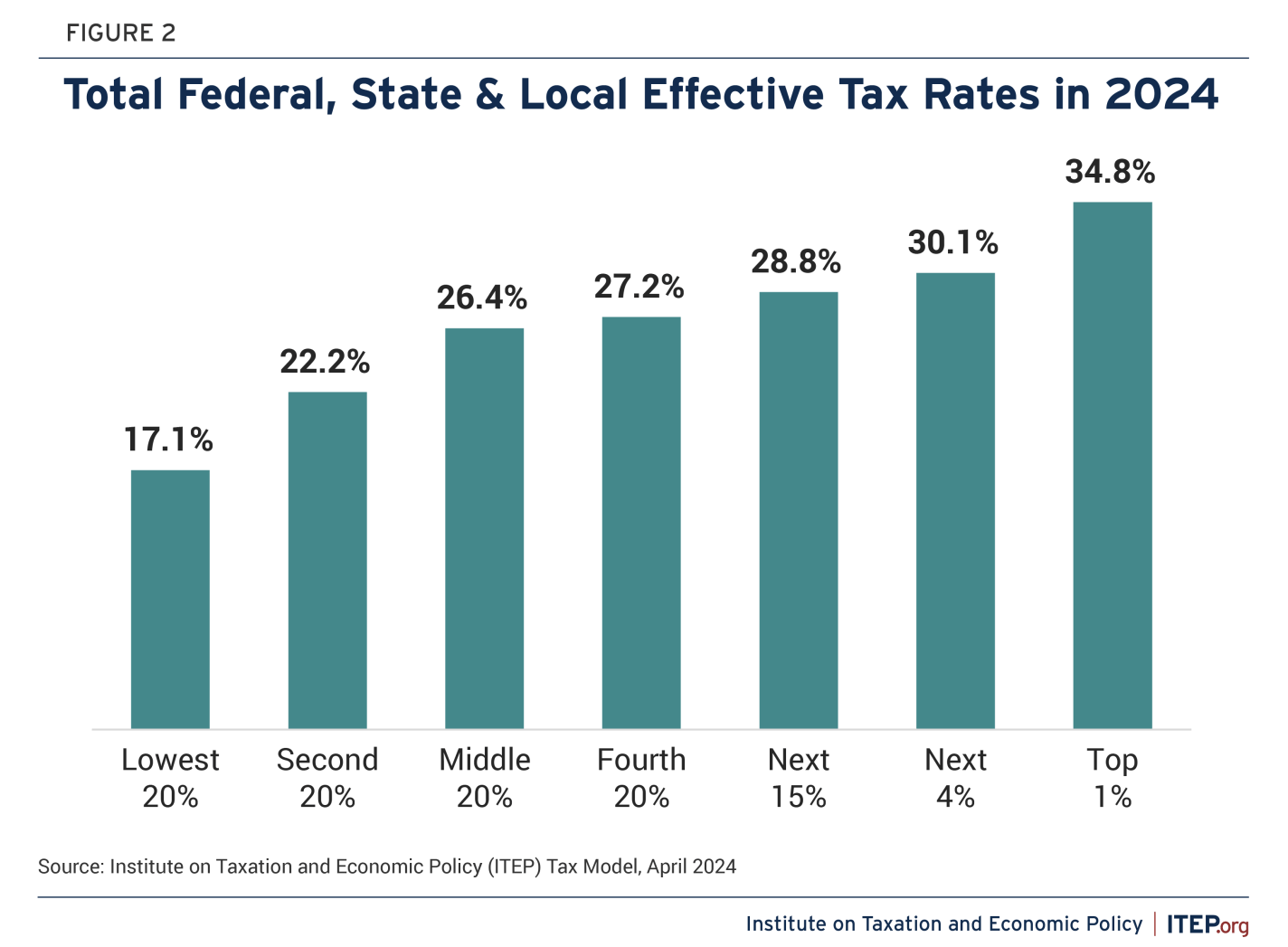
Finally, here are two estimates from think tanks that work on tax policy. Even though the Tax Foundation is considered more right-leaning and ITEP is considered more left-leaning, both agree that the overall US tax code is progressive.


re: there is no such thing as a progressive income tax
The numeraire of an economy is the labor hour, not the dollar. In a barter economy, market forces will force a ratio of labor hours between skilled and unskilled labor, say a 2-to-1 ratio. Now introduce money into such an economy, say $20/hr for skilled labor and $10/hr for unskilled labor. Here, money is acting as a proxy for the labor hour and the ratio still holds, i.e., an hour of skilled labor buys two hours of unskilled labor and two hours of unskilled labor buys an hour of skilled labor.
Now, introduce a flat tax of say 10%. After-tax earnings will be $18/hr for skilled labor and $9/hr for unskilled labor. The 2-to-1 ratio still holds.
Now, introduce a progressive tax system with say 30% for skilled labor and 10% for unskilled labor. Now after-tax earnings are $14/hr for skilled labor and $9/hr for unskilled labor. The ratio of skilled labor to unskilled labor has now fallen to 1.56.
Market forces will now drive the pretax income of skilled labor higher to compensate for the higher taxes such that the after-tax earnings are the same as before and the same labor ratio prevails. In this case, the wages of skilled labor rises to $25.71/hr which leaves $18/hr on an after-tax basis.
Here, the ratio of money wages has shifted but the ratio of labor hours has not. This is why the labor hour is the numeraire of an economy and not the dollar.
LikeLike
Further to my comment, a quote from EconLib writer Joel Slemrod in an article titled “Progressive Taxes’ that hopefully provides further clarity to my comment and the link to the article:
“Second, the tax burden—the hurt caused by taxes—is not borne entirely by the people who write the checks to the Internal Revenue Service. To some extent many taxes are “shifted” to other members of society. For example, because highly progressive taxes discourage people from entering high-paying professions, salaries in these professions will be higher than otherwise. Therefore, the taxes paid by the upper-income taxpayers who do enter these professions overstate the true burden of taxation on them. Also burdened by these high taxes are the people who pay higher prices for the goods and services provided by the people with higher salaries.”
https://www.econlib.org/library/Enc/ProgressiveTaxes.html
LikeLike
Also, this article by David Friedman titled “Getting Tax Burden Wrong” with a more nuanced view. Quote and link:
“What determines who really pays a tax is not who hands over the money but what effect the tax has on the terms of the transaction. Suppose the government imposes a tax of fifty thousand dollars a year on physicians. That makes it less attractive to be a physician so over time the number of physicians goes down. Since there are now fewer physicians they find that they can charge more, so their income goes up by (say) twenty-five thousand. All of the tax money is being paid by the physicians but half of it is coming from their patients.
There is no reason it has to be half. Perhaps most physicians are people who really like healing, will go into the profession even if it pays fifty thousand less. If so the number of physicians decreases only a little, the price goes up only a little, forty-five thousand is paid by the physicians, five thousand by their patients. Perhaps it is the other way around, perhaps most people who become physicians now would choose not to if the after-tax pay was a little less. When supply finishes adjusting, wages have gone up by most of fifty thousand, the after tax income of physicians is only a little lower and most of the tax is being paid by their customers.
If supply is very elastic, if the number of physicians is very sensitive to the wage, most of the tax ends up on the patients, if it is very inelastic on the doctors. The same logic applies to demand. If when the price of medical services goes up enough to increase physicians’ income by a few thousand dollars lots of people decide to see the doctor less often, most of the burden ends up on the doctors. If, on the other hand, the demand for medical services is very inelastic, quantity demanded almost independent of price, the doctors end up almost entirely compensated for the tax by the increase in their wages, putting most of the burden on their customers.”
https://daviddfriedman.substack.com/p/getting-tax-burden-wrong
LikeLike
Your comments seem to suggest that these estimates ignore tax incidence. In fact, the differences between the tax rates estimates are largely driven by differences in assumptions about incidence (primarily the corporate income tax). But they agree on incidence for some taxes, and they don’t merely allocate the tax by “who hands over the money.” For example, most authors allocate the full burden of the payroll tax to labor, even though on paper businesses legally pay half of this. This doesn’t mean they perfectly capture incidence, but your comments suggesting they ignore it are wrong.
LikeLike
Most of these estimates seem to be of nominal rates, not actual tax rates.
LikeLike