Elizabeth Gilbert of Eat, Pray, Love delivered an insight, second-hand from “Deborah the psychologist”.
I remember a story my friend Deborah the psychologist told me once. Back in the 1980s, she was asked by the city of Philadelphia if she could volunteer to offer psychological counseling to a group of Cambodian refugees—boat people—who had recently arrived in the city. Deborah is an exceptional psychologist, but she was terribly daunted by this task. These Cambodians suffered the worst of what humans can inflict on each other—genocide, rape, torture, starvation, the murder of their relatives before their eyes, then long years in refugee camps and dangerous boat trips to the West where people died and corpses were fed to sharks—what could Deborah offer these people in terms of help? How could she possibly relate to their suffering?
“But don’t you know,“ Deborah reported to me, “what all these people wanted to talk about, once they could see a counselor?“
It was all: I met this guy when I was living in the refugee camp, and we fell in love. I thought he really loved me, but then we were separated on different boats, and he took up with my cousin. Now he’s married to her, but he says he really loves me, and he keeps calling me, and I know I should tell him to go away, but I still love him and I can’t stop thinking about him. And I don’t know what to do…
I don’t agree with Elizabeth L. Cline on everything, but she’s written a reasonable book for Americans today. The Conscious Closet has some good advice for everyone.
A decade ago, Cline wrote Overdressed: The Shockingly High Cost of Cheap Fashion which investigated the environmental toll of clothes and the labor controversies. Since then, she has been working on what consumers can do differently.
Not every American household has practical knowledge of laundry and sewing anymore. Cline offers suggestions on how to economically maintain clothes longer by making sensible home repairs or washing them less. (Don’t wash a pair of jeans after just one wear. I don’t.) The Conscious Closet came out in 2019, so it’s up-to-date concerning chemicals and certifications and websites that operate today.
The way we wash and dry our clothes uses a lot of water and energy. If a person was looking for a way to lower their environmental footprint, then a marginal reduction of laundry loads might be a relatively easy way to do it. Since almost every American has an electric dryer, we have lost the tacit knowledge of how to air dry clothes. She gives the practical reminder, for example, that dark color clothes will fade if exposed to extended sunlight.
I feel like Cline could be even more conscious about the opportunity cost of time. She does explicitly acknowledge that in her chapter about re-selling your unwanted clothes.
I watched the Chapman Economic Forecast Update for 2023 live on June 22 (you can watch the whole thing free here). Go to their website for free videos and links. They have an excellent track record for being correct.
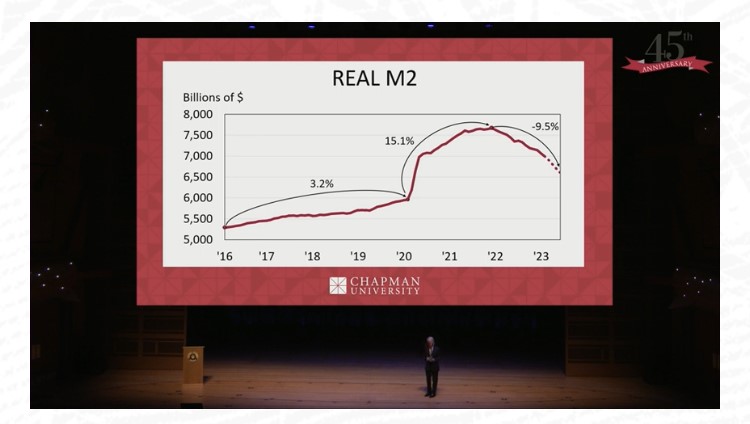
This time, Dr. Jim Doti believes we are headed for a recession by the third quarter of 2023 or at least what he conservatively calls a “slowdown”. He hates to make dramatic predictions or deliver bad news, but he saw the inflation brewing back in 2021, and I remember him correctly predicting what was to come.
For one thing, the dramatic growth in the money supply at the beginning of the pandemic has been corrected into a sharp contraction of the money supply.
People have been joking about how the recession isn’t happening.
The middle segment of the forecast, which I recommend watching, is about investing. Fadel Lawandy cautions that stocks are not a good bet right now, with a likely recession looming.
The third segment is focused on the economy of California. I didn’t finish that part, since I don’t live there anymore.
I’m writing an article about fast-fashion, so I’m reading Fashionopolis by Dana Thomas.
This paragraph is from the intro chapter:
Since the invention of the mechanical loom nearly two and a half centuries ago, fashion has been a dirty, unscrupulous business that has exploited humans and Earth alike to harvest bountiful profits. Slavery, child labor, and prison labor have all been integral parts of the supply chain at one time or another – including today. On occasion, society righted the wrongs, through legislation or labor union pressure. But trade deals, globalization, and greed have undercut those good works.
She invokes religion with “good works.” Thomas and I are of different opinions concerning globalization and “greed” and legislation. My instinct is to rip this paragraph apart. Has legislation never been motivated by greed? Has globalization not improved the lives of children? Has the mechanical loom not improved the lives of women who used to spend hours spinning and weaving by hand?
I am also reading pastor Tim Keller’s biography right now, so I’m having a What Would TK Do moment.
With his gifts (smart, funny, articulate…), Keller could have made a fortune by taking a side. He could have picked the Right or the Left. He could have expertly appealed to a Side, convincing them that they were good-smart and the Other is evil-stupid. Instead, Keller relentlessly stayed in the center. One of his books is actually called Center Church.
In November 1738, clothier Henry Coulthurst informed weavers that he was cutting their piecework rates and would henceforth pay them in goods rather than cash. Needless to say, they were upset. Food prices were rising, and lower wages meant hunger and want.
Over three days in December, the weavers rioted. They smashed Coulthurst’s mill, wrecked his home, and “drank, carried out, and spilt, all the Beer, Wine and Brandy in the cellars.” They returned the following day to demolish Coulthurst’s house…
Wow. Our paper on cutting nominal wages is called “If Wages Fell During a Recession” We ran an experiment in which workers could retaliate if they experienced a nominal wage cut. They did! They couldn’t smash their employer’s house, but some of the slighted workers dropped their effort level down to the minimum level which meant that their employer made no more money in the experiment.
In my talk at IUE (show notes here and YouTube video), I connect the wage cut paper to another experiment on beliefs. One wonders, considering how serious the consequences turned out to be for Henry Coulthurst, why he was not able to anticipate the backlash against wage cuts. Being wrong was costly for him.
People are not always good at appreciating how strongly others have become attached to their own reference points. That’s why the paper on beliefs is called “My Reference Point, Not Yours“
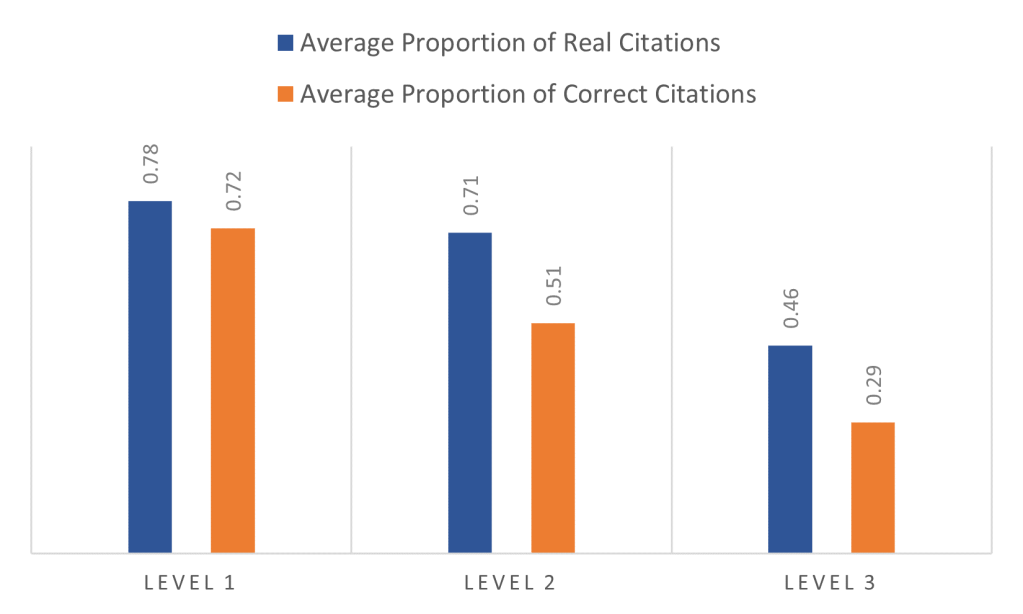
Abstract: We create a set of prompts from every Journal of Economic Literature (JEL) topic to test the ability of a GPT-3.5 large language model (LLM) to write about economic concepts. For general summaries, ChatGPT can perform well. However, more than 30% of the citations suggested by ChatGPT do not exist. Furthermore, we demonstrate that the ability of the LLM to deliver accurate information declines as the question becomes more specific. This paper provides evidence that, although GPT has become a useful input to research production, fact-checking the output remains important.
Figure 2 in the paper shows the trend that the proportion of real citations goes down as the prompt becomes more specific. This idea has been noticed by other people, but I don’t think it has been documented quantitatively before.
We asked ChatGPT to cover a wide range of topics within economics. For every JEL category, we constructed three prompts with increasing specificity.
Level 1: The first prompt, using A here as an example, was “Please provide a summary of work in JEL category A, in less than 10 sentences, and include citations from published papers.”
Level 2: The second prompt was about a topic within the JEL category that was well-known. An example for JEL category Q is, “In less than 10 sentences, summarize the work related to the Technological Change in developing countries in economics, and include citations from published papers.”
Level 3: We used the word “explain” instead of “summarize” in the prompt, asking about a more specific topic related to the JEL category. For L we asked, “In less than 10 sentences, explain the change in the car industry with the rising supply of electric vehicles and include citations from published papers as a list. include author, year in parentheses, and journal for the citations.”
The paper is only 5 pages long, but we include over 30 pages in the appendix of the GPT responses to our prompts. If you are an economist who has not yet played with ChatGPT, then you might find it useful to scan this appendix and get a sense of what GPT “knows” about varies fields of economics.
In the tapestry of human progress studies, two authors, Adam Smith and Virginia Postrel, have left their mark on the story of productivity and innovation. Their books, written centuries apart, both explore the power of specialization and the division of labor.
Part of the reason this came out this week is that I’m reading The Fabric of Civilization. So good! It had come highly recommended before, but I finally have an excuse to read it because I’m working on an article about fashion.
Tim Keller, who was the founding pastor of Redeemer Presbyterian Church in New York City, died last week. Starting and growing a church in Manhattan takes talent. I am reading Tim Keller’s biography by Collin Hansen through the lens of Tyler’s Talent book.
How did a successful leader and famous speaker get started? Keller is not described in the book as an outgoing child. Although academically gifted, “He grew up socially awkward, a wallflower…”
In 1968, Keller started at Bucknell University. Keller, who would go on to write multiple best-selling books, may have refined some of his writing skills through his coursework. From my reading, the most important aspect of his college experience was not the classes but the chance to be a leader of a campus (religious) club and having so many peers close by to practice “working” with. “Some 2,800 students lived within short walking distance of each other…[on campus].”
He planned retreats and invited famous guest speakers who appealed to his audience. He got feedback on the effectiveness of different messages and programs. Due to Keller’s efforts, the college club chapter meetings more than doubled in size. You can see the beginnings of the man who would go on to manage a large organization and attract over 5,000 people to hear him on the Sunday after 9/11.
In the debate over the value of a college education, the value of the experience students gain from holding officer positions in campus clubs is underrated. The information or credentials that can be obtained through online classes doesn’t build this kind of social capital. For leaders of organizations, college clubs are how some of them gained momentum and developed confidence.
Students can learn in a low stakes environment. For example, an ambitious club president can get 20 students to show up for pizza instead of 8. Club leaders get to make the key decisions and solve the problems that determine the success of their organization, because the faculty are too busy to micromanage club meetings. This gives students accurate feedback on the success of their own ideas.
In-person campus-based education is more than acquiring knowledge from textbooks. It is a dynamic environment in which students can develop social skills and form their network for future professional support. By participating in these organizations, students learn collaboration, decision-making, problem-solving, and mentoring — skills that are transferable across various domains of life.
There is something morally instructive about watching a preschooler melt down. It was the morning of my __th birthday yesterday. Kids still had to be dressed and fed and shipped to school on time.
My daughter, who is almost 5, was screaming on the stairs instead of coming to breakfast. Upon inspection, I realized that her head was through the arm hole of the sleeveless dress she had chosen to wear to school. I offered to help her. She screamed louder and lurched away from me. Her pride was more hurt than her neck at the thought of accepting help. She was not yet really wearing the Anna (the character from Frozen) dress because of the snafu of the sleeves. She stomped around screaming for minutes, refusing all offers of help or comfort from me.
Adults do this kind of thing all the time, although it looks different. People do the stupidest things and then dig in instead of accepting help and reversing course.
My daughter is exceptionally brilliant and kind. She is loved by everyone she meets. Even she has these moments, because we all do. That is some behavioral economics for you.




 Economist Writing Every Day