Decline in Consumer Use of Cash Is Offset by Criminal Usage of Benjamins

We have all seen the decline in consumer usage of physical currency. The trend has been going on for some years, with folks finding it more convenient to whip out a credit card or just wave their phone in order to make a purchase. The drop in cash use was dramatically accelerated during COVID when we avoided physical contact with anyone and anything outside our homes, preferring contactless payments or just ordering stuff on line.

The Federal Reserve has since 2016 run an annual survey of households to track trends in payments. This data set shows the big drop in cash use in 2020, with a corresponding increase in payments by credit cards and mobile apps:

Share of payments use for all payments, from Federal Reserve’s “Diary of Consumer Choice” , 2022 edition.

Similar trends hold for the U.K.; the main alternative to cash there seems to be debit cards:

Source: BBC

Cash use continues to decline but the rate of decline seems to be slowing. Among other things, some twenty-somethings have been inspired by social media discussions to practice budgeting by using physical envelopes of physical cash for specified categories of spending.

Our discussion so far has mainly dealt with retail purchases by consumers. However, there is another dimension of cash use. As pointed out by Andy Serwer, there has been a steady surge in international demand for the largest denomination of U.S. currency, which is the $100 bill. This chart from the Fed shows that the dollar value of U.S. dollars in circulation has roughly doubled in the past decade:

Nearly all this rise is due to the insatiable demand for $100 bills, and the vast majority of that new demand is from overseas. Some of those Benjamins may be innocently sitting in foreign central bank vaults, but it is understood that many (perhaps most) of them are used by arms and drug dealers and other criminals.  Cash is used way more than cryptocurrencies for criminal activity. According to Serwer:

A million dollars in $100 bills, in case you’re wondering, weighs about 22 pounds, they say. A double stack would be about 21.5 inches high by 12.28 inches by 2.61 inches. You could carry it in a big briefcase, or as I suggested, a satchel.

Drivers of Financial Bubbles: Addicts and Enablers

I recently ran across an interesting article by stock analyst Gary J. Gordon, The Bubble Addicts Are Here To Stay: A Bubble Investment Strategy. This article may be behind a paywall.  I will summarize it here. Direct citations are in italics.

SOME RECENT FINANCIAL BUBBLES

Gordon starts by recapping four recent financial bubbles:

The commercial real estate bubble of the mid-1980s

The internet stock craze of the late 1990s (with the highest price/earnings valuations ever – – e.g., a startup called Netbank possessed nothing but a website, yet was valued at ten times book value; and went bankrupt a few years later)

The mid-00s housing bubble.

The 2020/2021 COVID bubble:  “The trifecta of a ‘disruptive business model’ stock bubble, SPACs and crypto. You know how this story is ending.”

Gordon then presents an explanation of why humans keep doing financial bubbles, despite the experiences of the past. He suggests that there are both bubble addicts, who have a need to chase bubbles and therefore create them, and bubble enablers who are only too happy to make money off the addicts.

THE BUBBLE ADDICTS

The greedy. Some of us just think we deserve more. I think of an acquaintance who said he was approached to invest with Bernie Madoff, who famously promised steady 10% returns. My friend turned down the offer because he required 15% returns.

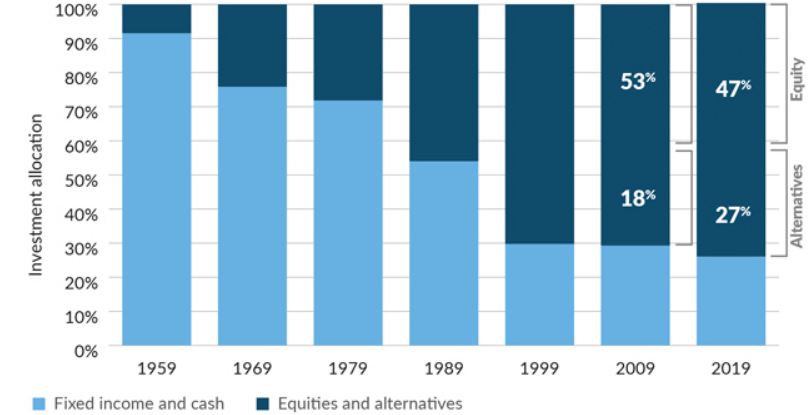
Pension funds. This $30 trillion pool of investment dollars targets about a 7% return in order to meet future pension obligations. If pension fund managers can’t consistently earn at least 7%, they have to go to their sponsor – a state government, a corporate CEO, etc. – and ask for more money, or for pension benefits to be cut. And probably lose their job in the process.

Back in the day, bonds were the mainstay pension fund investment. But over the past 20 years, bond yields haven’t gotten the pensions anywhere close to 7%. So increasingly they have invested in stocks and alternative investments like private equity, as this chart shows:

Source: Pew Institute

And venture capital fundraising, in large part from pension funds, has soared since the pandemic…

How many great new ideas are out there for venture capitalists to invest in? [Obviously, not an unlimited number]. So their investments are by necessity getting riskier. But if the pension funds back away from the growing risk, they have to admit they can’t earn that 7%. Then bad things happen, to retirees and to pension plan sponsors and then to pension fund managers. So pension fund managers are pretty much addicted to chasing bubbles.

The relatively poor. The “absolutely poor” have income below defined poverty levels. The “relatively poor” feel that they should be doing better, because their friends are, or their parents did, or because the Kardashians are, or whatever. Their current income and prospects just aren’t getting them to the lifestyle they aspire to. [Gordon provides example of folks chasing meme stocks and crypto, and getting burned]. …But can the relatively poor just walk away from chasing bubbles? Not without giving up dreams of better lifestyles.

THE BUBBLE FEEDERS

Bubbles don’t just spontaneously occur; they require skilled hands to shape them. And those skilled hands profit handsomely from their creations. Who are these feeders?

Private equity and venture fund managers. They typically earn a 2% management fee plus 20% of profits earned. That adds up fast. A $10 billion venture fund could easily generate $400 million a year in income, spread among a pretty small group of people. VC News lists 14 venture capitalists who are billionaires.

SPAC sponsors. [ A SPAC (Special Purpose Acquisition Company) is a shell corporations which raises money through stock offerings, for the purpose of going out and buying some existing company. SPAC sponsors make a bundle, and so are motivated to promote them. SPACs proliferated in 2020-2021, and for a while pumped money into acquiring various small-medium “growth” companies. But now it is clear that there are not a lot of great underpriced companies out there for SPACs to buy, so SPACs are fizzling]

Wall Street earns fees from (A) raising funds for private equity, venture capital and SPACs, (B) buying and selling companies, (C) trading bubble stocks, crypto, etc., and (D) other stuff I’m not thinking of right now.

The Federal Reserve. Part of the Federal Reserve’s mandate is to reduce unemployment. Lowering interest rates increases stock values, which creates wealth, which drives the “wealth effect”. The wealth effect is the estimate that households increase their spending by about 3% as their wealth increases. More spending increases GDP, which reduces unemployment, which makes the Fed happy, and politicians happy with the Fed.

In my view, the wealth effect is why the supposed economic geniuses at the Fed never figure out that bubbles are occurring, so they never take steps to minimize them.

Social media and CNBC certainly benefit from more viewers while bubbles are blowing up [i.e., inflating].

INVESTING IN CURRENT MARKET ENVIRONMENT

Gordon sees us still in recovery from the recent bubble of “disruptor companies” and crypto, and so the market may have more than the usual choppiness in the next year. So he advises being nimble to trade in and out, and not mindlessly commit to being either long or short. “Value stocks are probably the best near-term bet, even if they can’t offer the adrenaline jolt offered by bubble stocks.”

Bank for International Settlements: $70 Trillion Dollars Is Missing from Official Global Financial Accounting

Seventy trillion dollars is a lot of money. It is nearly three times the size of the U.S. GDP, and approaches total global GDP (around $100 trillion). That is the amount of funds that are missing from normally reported financial statistics, according to a December, 2022 report from the Bank for International Settlements. That report caused a bit of a flurry in financial circles.

It’s not that this money has been stolen, it’s just that it is not publicly known exactly where it is, i.e., how much money that which parties owe to whom. Here is the Abstract of this paper:

FX swaps, forwards and currency swaps create forward dollar payment obligations that do not appear on balance sheets and are missing in standard debt statistics. Non-banks outside the United States owe as much as $25 trillion in such missing debt, up from $17 trillion in 2016. NonUS banks owe upwards of $35 trillion. Much of this debt is very short-term and the resulting rollover needs make for dollar funding squeezes. Policy responses to such squeezes include central bank swap lines that are set in a fog, with little information about the geographic distribution of the missing debt.

Much of this money is in the form of currency swaps, especially foreign exchange (FX) swaps. Even though the U.S. economy no longer dominates the whole world, the U.S. dollar remains the premier basis for international trade and even more for foreign exchange:

As a vehicle currency, the US dollar is on one side of 88% of outstanding positions – or $85 trillion. An investor or bank wanting to do an FX swap from, say, Swiss francs into Polish zloty would swap francs for dollars and then dollars for zloty.

Who cares? Well, the incessant demand for dollars periodically leads to a dollar funding squeeze in international trade, which in turn reverberates into world GDP.

Currency Swaps as Lending Events

In many cases these currency swaps effectively amount to short-term lending /borrowing (of dollars). Much of the financial world is utterly dependent on smoothly flowing short-term funding to cover longer term debt or investments. Borrowing short-term (at usually lower interest rates) and investing or lending out longer-term (at higher rates) is how many institutions and funds exist. For instance, depositors at banks effectively lend their deposits to the bank (short-term), in return for some pitiful little interest on their checking or savings accounts, while the banks turn around and make say 5 year or 30-year loans to businesses or home-buyers. Banks earn profits on the spread between the interest rates they receive on the funds they loan out, and the typically lower rates on the short term funds they “borrow” from their depositors.

This “mismatch” between the maturities of borrowed funds (especially dollars) and invested funds can cause a complete melt-down of the financial system if holders of dollars stop being willing to lend them out, or to lend them out at less than ruinous interest rates:

The very short maturity of the typical FX swap/forward creates potential for liquidity squeezes. Almost four fifths of outstanding amounts at end-June 2022 in Graph 1.B matured in less than one year. Data from the April 2022 Triennial Survey show not only that instruments maturing within a week accounted for some 70% of FX swaps turnover, but also that those maturing overnight accounted for more than 30%. When dollar lenders step back from the FX swap market, the squeeze follows immediately.

Financial customers dominate non-financial firms in the use of FX swaps/forwards. Non-bank financial institutions (NBFIs), proxied by “other financial institutions” in Graph 1.C, are the biggest users of FX swaps, deploying them to fund and hedge portfolios as well as take positions. Despite their long-term foreign currency assets, the likes of Dutch pension funds or Japanese life insurers roll over swaps every month or quarter, running a maturity mismatch.  For their part, dealers’ non-financial customers such as exporters and importers use FX forwards to hedge trade-related payments and receipts, half of which are dollar-invoiced. And corporations of all types use longer-term currency swaps to hedge their own foreign currency bond liabilities .

It is really bad if pension funds or insurance companies get starved of needed ongoing funding. Central banks, especially the dollar-rich Fed, have had to repeatedly jump in and spray dollar liquidity in all directions to mitigate these “dollar squeezes”.  The BIS authors’ main concern is that these big public policy decisions are currently made in absence of data on what the actual needs and issues are.  Hence, “Policy responses to such squeezes include central bank swap lines that are set in a fog.”

This all is part of the murky “Eurodollar” universe of dollar-denominated bank deposits circulating outside the U.S. (more on this some other time).  Investing adviser Jeffery Snider offers the “Eurodollar University” on podcasts and on YouTube, in which he explores the many dimensions of the Eurodollar scene. He likens the Eurodollar system to a black hole: we cannot observe it directly, but we can estimate its size by its effects.

In his YouTube talk on this BIS paper, among other things Snider notes that this short-term lending associated with currency swaps functions much like repo borrowing, except the currency swaps (unlike repo) do not appear on bank or other balance sheets as assets/liabilities. That is part of the attraction of these swaps, since they are effectively invisible to regulators and are not constrained by e.g., capital requirements.

What the Fed does in a dollar squeeze is largely lend dollars to large dealer banks. But unless those other banks then lend those dollars out into the private marketplace of manufacturers and shippers and pension funds, having trillions of dollars in central bank reserves has little effect. It is not the case that “the Fed floods the world with dollars”  — actually, mainstream banks get those dollars, and then lend out at high rates to the dollar-starved rest of financial world, where they can actually do something.

The result, according to Snider, is that the Eurodollar is the only functional reserve currency in existence. This is the real, effective banking system (not “reserves” sitting on some bank’s balance sheet), even though the current accounting system doesn’t show it.

Can Central Banks Go Bankrupt?

Finnish crisis researcher Tuomas Malinen has for some time been predicting the collapse of the Western financial system, starting with the melt-down of the European Central Bank. Malinen, an associate professor of economics at the University of Helsinki, offers his views on his substack and elsewhere. He correctly warned in early/mid 2021 of coming inflation, which would present central bankers with severe challenges.

Among other things, by raising interest rates (to counter inflation), the banks necessarily cause the value of bonds to drop. However, a lot of the assets of the central banks consist of medium and long term bonds, especially those issued by sovereign governments. We have come to the point where some central banks are technically insolvent: the current cash value of their liabilities exceed their assets.

Is that a problem? Most authors I found did not seem to think so. For a normal private bank, as soon as the word got out that it was insolvent, customers would rush to withdraw their funds, in a classic “run on the bank”. Customers who waited too late to panic would simply lose their money, since there would not be enough assets on the bank’s balance sheet to cover all withdrawals.

However, no one seems to be in a hurry to beat down the doors of the Fed and demand their money. Most of the liabilities of the Fed are (a) paper currency in circulation, and (b) “Reserve” accounts of major banks at the Fed.

Bandyopadhyay, et al. note that negative equity in central banks (including those of smaller countries) is not uncommon; at any given time, about one out of seven central banks worldwide in the 2014-2017 timeframe suffered operating losses, some of which were large enough to wipe out their capital. However, most central banks are owned by, or have some other synergistic  relationship to , the governments of their respective countries. For instance, there is a standard contractual relationship between the Bank of England (BOE) and the British government. Thus, when the BOE recently fell into arrears, the government provided them with additional funds. This was apparently a routine non-event. (I don’t know where the government came up with those additional funds; did they just issue more bonds, which in turn were purchased by the BOE?)

The Fed, as a privately-owned public/private hybrid, technically has a more arms-length distancing from the U.S. Treasury. For instance, the Fed is not supposed to buy government bonds directly from the government. Rather, the government sells them to large banks, who in turn sell them to the Fed (if the Fed is buying). It is possible for the U.S. Treasury to transfer funds to the Fed to recapitalize it; but for now, the Fed is just booking losses as a “deferred asset”. Voila, the magic of central bank accounting. The presumption is that sometime in the future, the Fed will receive enough net income to overcome these losses.

The biggest debate is over the fate of the European Central Bank (ECB). Its relation to sovereign governments is even more arms-length; it is difficult to see all the European countries, with their own budget issues, agreeing to cough up money to give to ECB. As Malinen sees it, this likely leads to the “deferred asset” accounting scheme to handle negative equity for the ECB. He worries, “Will the markets or the banks trust the ECB after losses starts to mount forcing the Bank to operate with (large) negative equity? We simply do not know.” This is a weighty issue. As we noted earlier, “money” is in the end a social construct, an item of trust among parties for future payments of value. Central banks are the lenders of last resort, the source of money when it has dried up elsewhere; they regularly have to step into financial liquidity crises to inject more money to keep the system going. If people stopped accepted the keystroke-created money from central banks, the whole economy could freeze up.

A more sanguine view of central bank negative equity issues from MMT proponent Bill Mitchell. In his “Central banks can operate with negative equity forever” Mitchell heaps scorn on the very idea that central banks could run into solvency problems. He states that a “government bailout” is an inconsequential paper operation, merely transferring money from the left pocket to the right pocket of the government/central bank joint entity (as he views it). Furthermore, central banks have the capability of creating money out of thin air, so they can always meet their obligations and therefore can never be deemed insolvent:

The global press is full of stories lately about how central banks are taking big losses and risking solvency and then analysing the dire consequences of government bailouts of the said banks. All preposterous nonsense of course. It would be like daily news stories about the threat of ships falling off the edge of the earth. But then we know better than that. But in the economic commentariat there are plenty of flat earthers for sure. Some day, humanity (if it survives) will look back on this period and wonder how their predecessors could have been so ignorant of basic logic and facts. What a stupid bunch those 2022 humans really were.

“Let whoever needs to die, die”:  China’s Abrupt COVID Reopening To Achieve Rapid Herd Immunity and Resumption of Industrial Production, at the Cost of a Million Deaths

I noted a month ago that President Xi and the CCP have taken credit for relatively low (reported) deaths from COVID, due to strict lockdown protocols. By “strict” we mean locking down whole cities and blockading residents in their apartment buildings for months at a stretch. However, public protests rose to an unprecedented level, and so the Chinese government has done a surprising full 180 policy change, towards almost no restrictions.

According to Dr. Ezekiel Emanuel in the Wall Street Journal, the way this policy is being carried out has the makings of a mass human tragedy:

Zero Covid was always untenable and had to be ended. But it could have been done responsibly.

Among other things, that would involve buying Pfizer and Moderna bivalent vaccines and administering them to the elderly and other high-risk people, and purchasing Paxlovid and molnupiravir to treat those who test positive. Supplies of these products are ample. Authorities could continue mask mandates to reduce transmission. And China could institute a rigorous wastewater testing program to identify potential SARS-CoV-2 variants as soon as possible – and commit to sharing the data with the world.

Due to nationalistic pride, China has spurned the purchase of effective mRNA vaccines from Pfizer and Moderna, pushing instead the less-effective in-house vaccine.

Readers may recall in the early days of COVID spread in the West, masking and social distancing were promoted, not because they would prevent everyone from ultimately becoming infected, but because these measures would “flatten the curve” (i.e. reduce the peak load on hospitals at any one time, but instead spread it out over time). China is headed into a very un-flattened infection curve; some 800 million people (10% of the world’s population) may get COVID in the next 3 months, overwhelming hospitals and leading to over a million deaths. Besides the near-term human costs, this concentration of active COVID cases is likely to lead to a slew of new, even more virulent variants which will affect the rest of the world, along with China. What should help mitigate the situation is that the newer, most virulent variants of COVID may be somewhat less fatal than the original strain.

Why is the Chinese government doing it this way? Well, the sooner the country gets through mass exposure to the virus, the sooner everyone can get back to their factories and start producing stuff again. If in the process a bunch of (mainly older) people die, well, that’s just the price of progress. Let ‘er rip…

From MSN:

[U.S.] Epidemiologist and health economist Dr Eric Feigl-Ding estimate that 60 per cent of China’s population is likely to be infected over the next 90 days. “Deaths likely in the millions—plural,” he added.

According to Eric, bodies were seen piled up in hospitals in Northeast China. “Let whoever needs to be infected infected, let whoever needs to die die. Early infections, early deaths, early peak, early resumption of production,” the epidemiologist said terming it to be summary of Chinese Communist Party’s (CCP) current goal.

But don’t expect any acknowledgement of mass death from the official Chinese media. Just as the initial COVID outbreak was denied and censored by the Chinese propaganda machine, so the current surge is being minimized. From Barrons:

On Friday, a party-run newspaper cited an official estimate of half a million daily new cases in the eastern city of Qingdao. By Saturday, the story had been amended to remove the figure, an AFP review of the article showed….

Several posts on the popular Weibo platform purporting to describe Covid-related deaths appeared to have been censored by Friday afternoon, according to a review by AFP journalists.

They included several blanked-out photos ostensibly taken at crematoriums, and a post from an account claiming to belong to the mother of a two-year-old girl who died after contracting the virus.

Posts about medicine shortages and instances of price gouging were also taken down, according to censorship monitor GreatFire.org.

And social media users have posted angry or sardonic comments in response to the perceived taboo around Covid deaths.

Many rounded on a state-linked local news outlet after it reported Wu Guanying — designer of the mascots for the 2008 Beijing Olympics — had died of a “severe cold” at the age of 67.

Perhaps we should not be surprised that the Chinese Center for Disease Control and Prevention just reported zero COVID deaths for December 25 and 26.

Food Price Increases Won’t Be Solved by Raising Interest Rates

I make a hobby of reading, and sometimes acting on, investment advice, particularly regarding high-yielding securities (many of my holdings are now yielding over 10%/year). One of the best authors on the Seeking Alpha investing site writes under the name of Colorado Wealth Management. He mainly writes on REIT (real estate investment trust) stocks, but recently opined on the wisdom of raising interest rates to combat inflation regarding some of the major components of CPI.

His article, Why High Yields Will Be Popular Again, may be behind a paywall for some readers, so I will summarize some key points. He kind of sidesteps the influence of massive federal deficit spending that injected trillions and trillions of new dollars into the economy for COVID, which I think has been the major driver for this inflation; and the reignited deficit spending which is already on the books for November and likely even huger for December of this year. However, he does make some interesting (and new to me) points regarding food prices in particular.

He sees the price 2021-2022 price increases in some major food items as being driven by supply constraints, rather then by excessive demand. Specifically eggs, coffee, and vegetable oils have been hit by exogenous factors which have constrained supply; raising interest rates will not help here, and may even hurt if higher rates make it harder for farmers to recover and re-start high production. I’ll transition to his charts and mainly his excerpted words, in italics below:

Avian Flu, Culled Hens, and the Price of Eggs

The background here is that tens of millions of chickens, including egg-laying hens, have been deliberately killed (“culled”) this year in an attempt to slow the spread of avian flu. This, of course, cuts into the egg supply and raises egg prices. We went through a similar cycle in 2015 with avian flu, where culling led to a rise in egg prices, but then prices fell naturally as a new crop of chicks grew into egg-laying hens. Similarly, the current shortage in eggs should correct itself:

Raising interest rates has never produced additional eggs. Raising interest rates and driving a recession (with larger credit spreads) only makes it more difficult for farmers to get the funding necessary to replace tens of millions of hens that were culled to slow the spread of the avian flu….If interest rates don’t work, what will? The cure for high prices is high prices. We can see how it played out with the Avian flu in 2015:

  • Is Jerome Powell going to lay even one egg? Probably not.
  • Are farmers going to focus on turning their chicks into egg-laying hens? Absolutely.

Since eggs go into several other products, it drives inflation throughout the grocery store. Even if a product doesn’t use eggs, the drop in egg production means more people eating other foods.

Drought in Brazil and the Price of Coffee

Coffee prices have been rising rapidly. Well, domestic prices have been rising rapidly. Global prices actually declined since peaking in February 2022:

So, what drove the price up? Brazil normally produces over 35% of the world’s coffee and bad weather in Brazil (not to mention the pandemic impacts) drove dramatically lower production in 2021. As the shortfall in production became evident, global prices began rising rapidly. That’s why the global [wholesale] prices were ripping higher in 2021, not 2022. However, [retail] consumers are seeing most of the impact over the last several months.

War in Ukraine and the Price of Sunflower Oil

Margarine requires vegetable oil. Soybean, palm, sunflower, and canola oil are the key ingredients. What country produces the most sunflower oil? Ukraine. This is one of several inflationary impacts of the war. You can see the impact of reduced supply in the following chart:

Government Bungling in Indonesia and the Price of Palm Oil

What happened to palm oil? How could it soar so much and then fall so hard?

The first issue is that dramatic increases in the price of fertilizer made production more expensive. … That contributed to a reduction in supply. However, Indonesia is the world’s largest exporter of palm oil. Yet exports of palm levy were subject to a huge levy. That made exporting far more expensive. Despite the levy, it was still worth producing and exporting palm oil. Then the Indonesian government decided to simply ban exports over concern about higher domestic prices. Banning exports for a country that produces 59% of the world’s total palm oil exports had a predictable impact.

If you guessed that the supply of palm oil couldn’t be sold domestically, you’d be right. The ban was lifted. However, it was only after:

High palm oil stocks have forced mills to limit purchases of palm fruits. Farmers have complained their unsold fruits have been left to rot. There were 7.23 million tonnes of crude palm oil in storage tanks at the end of May, data from the Indonesian Palm Oil Association (GAPKI) showed on Friday.

With palm oil prices at all time-record highs, nearly triple the level from two years prior, the supply was left to rot. Each business tried to make the best decision they could, given the ban on exports. Rather than record profits for mills and record profits for farmers, the produce was wasted. That’s supply constraints for the global market, and it destroys the local economy.

Global prices are plunging now as mills seek to unload their storage. As bad as the higher prices were for the rest of the world, no one suffered worse than the farmers whose product became worthless as a result of government failure.

Contrary to today’s popular opinion, higher interest rates won’t do anything to improve production of vegetable oil.

Reckless Management Led to BlockFi Crypto Bankruptcy

Since my nontrivial deposits at the cryptocurrency lending firm BlockFi have been blocked (maybe forever) from withdrawal, I keep an eye on news from that front. My main source of information has been missives from BlockFi itself, in which management portrays itself as being very careful with customer funds; it was only the shocking, unforeseeable collapse of the FTX exchange that forced the otherwise sober and responsible BlockFi into its recent bankruptcy. I have believed that view of things, since that is all I knew.

However, Emily Mason at Forbes has poked around behind the scenes, including finding insiders willing to talk (off the record) about less-savory doings within BlockFi. The title of her recent article, BlockFi Employees Warned Of Credit Risks, But Say Executives Dismissed Them, pretty much says it all. The article starts out:

In its bankruptcy filing last week, New Jersey-based BlockFi attempted to paint itself as a responsible lender hit by plummeting crypto prices and the collapse of crypto brokerage FTX and its affiliated trading firm, Alameda.

That is the view I have held up till now. However, Mason then goes on to note:

 But a closer look at the company’s history reveals that its vulnerabilities likely began much earlier with missteps in risk management, including loosened lending standards, a highly concentrated pool of borrowers and unsustainable trading activity.

To keep this blog post short, I will just paste in a few excerpts where she fleshes out her case:

While the company regularly touted a sophisticated risk management team, current and former employees indicate in interviews that risk professionals were dismissed by executives preoccupied with delivering growth to investors. As early as 2020, employees were discouraged from describing risks in written internal communications to avoid liability, a former employee states.

Ouch. Not a good sign.

Until August 2021, BlockFi advertised that loans were typically over-collateralized. But large potential borrowers were often unwilling to meet those requirements, a cease and desist order brought by the Securities and Exchange Commission against BlockFi in February states. The availability of uncollateralized capital from competing companies like Voyager created stiff competition in the lending field.

Under pressure to continue growing and delivering yields, BlockFi began lending to these parties with less collateral than publicly stated without informing customers on the amount of risk involved with interest accounts, according to the SEC order which resulted in a $100 million fine for the company. As a result, BlockFi paused access to its interest accounts in the U.S.

Wait, that is MY money they were messing with. Now I am really annoyed.

In addition to lowering its collateral requirements, BlockFi’s due diligence process had flaws, former borrowers say. Available credit for borrowers was decided based on their assets, but BlockFi and other lenders failed to investigate both the size and quality of potential borrowers’ holdings. Like Voyager and other crypto lenders, BlockFi accepted unaudited balance sheets from hedge funds and proprietary trading firms former borrowers say, leaving room for manipulation on the borrower side.

In the due diligence process, lenders like BlockFi and Voyager did not examine whether borrowers’ balance sheet assets were denominated in dollars or less liquid tokens like FTX-issued FTT.

The revelation that Alameda’s balance sheet was mostly FTT tokens was the news that set off the unraveling of both Alameda and FTX and triggered contagion effects across the industry. In early November, Alameda defaulted on $680 million in loan obligations to BlockFi, according to the bankruptcy filing.

Some BlockFi employees reportedly warned of the shakiness of the parties to whom clients’ finds were being loaned. Management dismissed these concerns because the loans were “collateralized”,  but as noted above, the extent of that collateral was *not* what we clients were told:

An internal team at BlockFi also raised concerns that the borrower pool was too concentrated among a pool of crypto whales, including mega hedge funds Three Arrows Capital and Alameda, another former employee states. Management responded that the loans were collateralized, according to the employee.

This is a very common scenario in finance: In search of profits, management  cuts corners and takes more risks with client funds than they were telling the clients. Maybe Sam Bankman-Fried will up with cell-mates from BlockFi.

Because BlockFi survived the Luna/Terra collapse some months ago and because I believed the steady stream of reassuring pronouncements from BlockFi management, I only withdrew a third of my funds back in the summer. But as it turns out, that withdrawal was apparently bankrolled by a big loan to BlockFi from Bankman-Fried’s FTX; but FTX is now caput.  So the odds of my ever seeing the rest of my funds are slim indeed:

In BlockFi’s bankruptcy filing and in public statements made by its CEO, Zac Prince, the company points to its survival through the collapse of the Terra/Luna ecosystem and subsequent shuttering of Three Arrows Capital as evidence of strong management. But that endurance four months ago was made possible through a $400 million credit line from now-defunct FTX, which allowed the firm to meet panicked withdrawal requests from depositors. When FTX folded in early November, BlockFi lost its lending back stop and could no longer meet fresh waves of withdrawal requests.

One lesson learned: If there is a reasonable chance of a panic, it can pay to be the first to panic, not the last.

Gambler Ruined: Sam Bankman-Fried’s Bizarre Notions of Risk and the Blow-Up of FTX

The drama continues for Sam Bankman-Fried (SBF), the former head of now-bankrupt crypto exchange FTX. This past week has been giving a series of interviews, in which he (the brilliant master, the White Knight, of the crypto world a mere month ago) is trying to convince us (potential jurors?) that he is too dim-witted to have masterminded a shell game of international wire transfers, and that he had no idea what was happening in the closely-held company of which he was Chief Executive Officer. (For an entertaining take on what We The People think of SBF’s disclaimers, see responses in this thread ttps://twitter.com/SBF_FTX/status/1591989554881658880, especially the video posted by “Not Jim Cramer”). 

The word on the street is that his former partner Caroline Ellison (who he has been implicitly throwing under the bus with his disclaimers of responsibility for the multi-billion dollar transfers from his FTX to her Alameda company) may well be cutting a deal with prosecutors to testify against SBF.  It remains to be seen whether SBF’s monumental political donations will suffice to keep him from doing hard time.

But all that legal drama aside, the SBF saga brings up some interesting issues on risk management. Earlier here on EWED James Bailey  highlighted a revealing exchange between SBF and Tyler Cowen, in which SBF displayed a heedless neglect of the risk of catastrophic outcomes, as long as there is a reasonable chance of great gain:

TC: Ok, but let’s say there’s a game: 51% you double the Earth out somewhere else, 49% it all disappears. And would you keep on playing that game, double or nothing?

SBF: Yeah…take the pure hypothetical… yeah.

TC: So then you keep on playing the game. What’s the chance we’re left with anything? Don’t I just St. Petersburg Paradox you into non-existence?

SBF: No, not necessarily – maybe [we’re] St. Petersburg-paradoxed into an enormously valuable existence. That’s the other option.

Boiled down, the St Petersburg Paradox involves a scenario where you have a 50% chance of winning $2.00, a 25% (1/4) chance of winning $4.00, a 1/8 chance of winning $8.00, and so on without limit. If you add up all the probabilities multiplied by the amount won for each probability, the Expected Value for this scenario is infinite. Therefore it seems like it would be rational, if you were offered a chance to play this game, to stake 100% of your net worth in one shot. However, almost nobody would actually do that; most folks might spend something like $20 or maybe 0.1% of their net worth for a shot at this, since the likely prospect of losing a large amount does not psychologically compensate for the smaller chance of gaining a much, much larger amount. But SBF is not “most folks”.

Victor Haghani recently authored an article on risk management and on SBF’s approach:

Most people derive less and less incremental satisfaction from progressive increases in wealth – or, as economists like to say: most people exhibit diminishing marginal utility of wealth. This naturally leads to risk aversion because a loss hurts more than the equivalent gain feels good. The classic Theory of Choice Under Uncertainty recommends making decisions that maximize Expected Utility, which is the probability-weighted average of all possible utility outcomes.

SBF explained on multiple occasions that his level of risk-aversion was so low that he didn’t need to think about maximizing Expected Utility, but could instead just make his decisions based on maximizing the Expected Value of his wealth directly. So what does this mean in practice? Let’s say you find an investment which has a 1% chance of a 10,000x payoff, but a 99% chance of winding up worth zero. It has a very high expected return, but it’s also very risky. How much of your total wealth would you want to invest in it?

There’s no right or wrong answer; it’s down to your own personal preferences. However, we think most affluent people would invest somewhere between 0.1% and 1% of their wealth in this investment, based on observing other risky choices such people make and surveys we’ve conducted…

SBF on the other hand, making his decision strictly according to his stated preferences, would choose to invest 100% of his wealth in this investment, because it maximizes the Expected Value of his wealth.

Even in a game with a fair 50/50 outcome, a player with finite resources will eventually go broke. This is the “Gambler’s Ruin” concept in statistics. SBF’s outsized penchant for risk took his net worth to something like $30 billion earlier this year, something we more-timid souls will never achieve, but it eventually proved to be his undoing.

Most people have a more or less logarithmic sense of the utility of money – if you only have $1000, the gain or loss of $100 is significant, whereas $100 is lost in the noise for someone whose net worth is over a million dollars. SBF apparently felt that he was playing with such big numbers, that he did not need to worry about big losses, as long as there was a chance at a big, big win. Here is a Twitter Thread  by SBF, from  Dec 10, 2020:

SBF: …What about a wackier bet? How about you only win 10% of the time, but if you do you get paid out 10,000x your bet size?

[So, if you have $100k,] Kelly* suggests you only bet $10k: you’ll almost certainly lose. And if you kept doing this much more than $10k at a time, you’d probably blow out.

…this bet is great Expected Value; you win [more precisely, your Expected Value is] 1,000x your bet size.

…In many cases I think $10k is a reasonable bet. But I, personally, would do more. I’d probably do more like $50k.

Why? Because ultimately my utility function isn’t really logarithmic. It’s closer to linear.

…Kelly tells you that when the backdrop is trillions of dollars, there’s essentially no risk aversion on the scale of thousands or millions.

Put another way: if you’re maximizing EV(log(W+$1,000,000,000,000)) and W is much less than a trillion, this is very similar to just maximizing EV(W).

Does this mean you should be willing to accept a significant chance of failing to do much good sometimes?

Yes, it does. And that’s ok. If it was the right play in EV, sometimes you win and sometimes you lose.

(*The Kelly criterion is a formula that determines the optimal theoretical size for a bet.)

Haghani concludes, “It seems like SBF was essentially telling anyone who was listening that he’d either wind up with all the money in the world, which he’d then redistribute according to his Effective Altruist principles – or, much more likely, he’d die trying.”

( Full disclosure: I have lost an irritating amount of money thanks to SBF’s shenanigans. My BlockFi crypto account is frozen due to fallout from the FTX collapse, with no word on if/when I might see my funds again. )

Protests Erupt Across China Over COVID Policy But Lockdowns Continue: Why?

Headlines in today’s financial news include items like “Clashes in Shanghai as COVID protests flare across China“ from Yahoo Finance. There have been widespread protests this week, which are normally a rarity under the authoritarian regime, and are being suppressed by any means necessary. Apple stock is down about 4% in the past two trading days on fears that iPhone shortages will get worse due to worker unrest in the giant Foxconn factory in Zhengzhou. Wall Street keeps hoping the China will loosen up, since the lockdowns on the world’s second-largest economy are a drag on global markets.

China has pursued a “zero-COVID” policy, of strict mass lockdowns to halt any spread of the virus. Residents have been confined to their apartments for over 3 months in some cases. Whole cities with tens of millions of people have been locked down for months at a time whenever a number of cases are spotted. China’s economic growth has stagnated, and unemployment among young people has risen to 20%, which has helped fuel unrest.  Chinese people are aware that the rest of the world has moved on from mass lockdowns, and may be realizing the futility of thinking that lockdowns can stave off the virus indefinitely.

Given its discomfort with widespread discontent and protests, why does the Chinese government persist in this policy? An article in the Atlantic by Michael Shuman answers that question: “Zero COVID Has Outlived Its Usefulness. Here’s Why China Is Still Enforcing It. “  Back in 2020 when COVID first swept through the world, the strict lockdowns (readily enforced in an authoritarian regime) seemed like a big win for the Chinese leadership:

When the outbreak began in Wuhan in early 2020, the virus was unknown, vaccines were unavailable, and China’s poorly equipped health system could have quickly become overwhelmed by a sweeping pandemic. Yet the policy had a political element from the very beginning as well. The Communist Party is adept at sniffing out threats to its rule, and it quickly identified COVID as one of them. A major public-health crisis, with millions dying, would have raised serious doubts about the regime’s competence, which is, in effect, its sole claim to legitimacy.

Worse, the party could have faced a populace that directly blamed it for the outbreak—with good reason. The Chinese authorities at both the national and local levels botched their initial response to the novel coronavirus, suppressing information about its discovery by a Wuhan doctor and acting far too slowly to contain the initial spread. Sensing its potential vulnerability, the party shifted into anti-COVID overdrive, shutting down large swaths of the country, with the result that it did succeed in snuffing out an epidemic in a matter of weeks, even as it spread to the rest of the world.

That success allowed the Communist Party to transform a potential tragedy into a public-relations triumph. Within weeks of the Wuhan outbreak, China’s propaganda machine was touting the wonders of its virus-busting methods. And as the U.S. and other Western countries struggled to contain the disease, Beijing’s big win became even more valuable as evidence that its authoritarian system was more capable and caring than any democratic one. Beijing and its advocates pointed to rising case and death counts in the U.S. as proof of China’s superiority and American decline.

A number of other countries including Australia and New Zealand also implemented strict (stricter than in the U.S.) lockdown measures in 2020, and, like China, experienced far less impact from the virus in that timeframe than seen in the U.S. However, most of these measures were lifted in 2021. The widespread application of mRNA vaccines like those from Pfizer and Moderna in the West has served to mitigate the severity of the viral infection. Also, some measure of herd immunity has been achieved by the widespread exposure to COVID in the population; antibodies persist for at least eight months after contracting the disease. So, what’s up with China?

China has resisted using Western vaccines, relying instead on homegrown vaccines which are less effective, though they do give some measure of protection.  Also, “The additional layers of high-tech surveillance adopted in the name of pandemic prevention can be used to enhance the tracking and monitoring of the populace more generally,” which is another win for the government. However, the major factor is that the Party, and especially President Xi, cannot afford to loosen up now and risk an embarrassing explosion of cases that would overburden the healthcare system and probably lead to millions of deaths:

The victory of zero COVID was claimed not just as the party’s but as Xi Jinping’s in particular. The State Council, China’s highest governing body, declared in a 2020 white paper that Xi had “taken personal command, planned the response, overseen the general situation and acted decisively, pointing the way forward in the fight against the epidemic.”

This narrative became entrenched. If Beijing loosened up and allowed COVID to run amok, the Chinese system would appear no better than those of loser democracies, and Xi would seem like another failing politician, a mere mortal, not the virus-fighting superhero he was painted as. Zero COVID’s failure would be a disaster for the Communist Party’s veneer of infallibility.

So the leadership insists on zero COVID and damn the consequences.

My BlockFi Crypto Account Is Frozen Due to Monster FTX Exchange Blowup

About a year ago, I posted some articles touting the use of BlockFi as an alternative checking account. It paid around 9% interest (this was back when interest rates were essentially zero on regular savings accounts), and allowed withdrawal or deposit of funds at any time. Nice. BlockFi is associated with respected firm Gemini, and (unlike many crypto operations) is U.S. based, with consistent formal auditing. They earned interest on my crypto by lending it out to “trusted counter-parties”, always backed by extra collateral. What could possibly go wrong?

In July I wrote about a big cryptocurrency meltdown, in which a number of medium-sized players went bust.  At that time, BlockFi assured its customers that its sound business practices put it above the fray, no problemo. They did make it through that juncture OK. But I withdrew a third of my funds, just to be on the safe side.

The huge news in crypto this past week has been the sudden, total implosion of major exchange FTX (more on that below). FTX is a major business partner with BlockFi. No worries, though, as of Tuesday of last week,  BlockFi COO Flori Marquez tweeted that “All BlockFi products are fully operational”.  Then the hammer dropped: On Thursday (11/10), BlockFi froze withdrawals, due to complications with FTX. My remaining crypto is stranded, most likely for years of legal proceedings, and I may never get it all back. I’m not going to starve, but the amount is enough to hurt.

In this case, I don’t really blame BlockFi – by all accounts, they have been trying to run an honest, responsible business. Before last week, nobody had much reason to think that FTX was totally rotten.  My bad for not connecting the FTX-BlockFi dots earlier, and pulling out more funds when I had the chance.

The Great FTX Debacle

The star of this show is Sam Bankman-Fried, the (former) head of FTX:

James Bailey posted here on EWED on the FTX crash last week. CoinDesk author David Morris summarized the downfall of Bankman-Fried’s crypto empire:

FTX and Bankman-Fried are unique in the stature they achieved before self-immolating. Over the past three years, FTX has come to be widely regarded as a reputable exchange, despite not submitting to U.S. regulation. Bankman-Fried has himself become globally influential, thanks to his thoughts on cryptocurrency regulation and his financial support for U.S. electoral candidates – not necessarily in that order.

Facts first uncovered by CoinDesk played a major role in the events of the past week. On Nov. 2, reporter Ian Allison published findings that roughly $5.8 billion out of $14.6 billion of assets on the balance sheet at Alameda Research, based on then-current valuations, were linked to FTX’s exchange token, FTT.

This finding, based on leaked internal documents, was explosive because of the very close relationship between Alameda and FTX. Both were founded by Bankman-Fried, and there has been significant anxiety about the extent and nature of their fraternal dealings. The FTT token was essentially created from thin air by FTX, inviting questions about the real-world, open-market value of FTT tokens held in reserve by affiliated entities.

Negative speculation about a financial institution can be a self-fulfilling prophecy, triggering withdrawals out of a sense of uncertainty and leading to the very liquidity problems that were feared.

Customers started a “run on the bank”, withdrawing billions of dollars of assets, leading to total insolvency of FTX:

The Financial Times reported that FTX held approximately $900 million in liquid crypto and $5.4 in illiquid venture capital investments against $9 billion in liabilities the day before it filed for bankruptcy.

If FTX had been run as an honest exchange, this withdrawal should not have been too much of a problem – – just give customers back the coins they had deposited with FTX. Apparently, though, FTX had taken customer assets and transferred them over to a sister company, Alameda, to trade with. The valuable customer crypto assets left the FTX balance sheet, and were largely replaced by the self-generated (and now nearly worthless) FTT token:

It remains worryingly unclear, though, exactly why even such a dramatic rush for the exits would have led FTX to seek its own bailout. The exchange promised users that it would not speculate with cryptocurrencies held in their accounts. But if that policy was followed, there should have been no pause to withdrawals, nor any balance sheet gap to fill. One possible explanation comes from Coinmetrics analyst Lucas Nuzzi, who has presented what he says is evidence that FTX transferred funds to Alameda in September, perhaps as a loan to backstop Alameda’s losses.

It doesn’t help that on Friday (11/11) some $477 million was outright stolen from FTX wallets. (The Kraken exchange said it has identified the thief and are working with law enforcement).

Where does the FTX saga go from here? There seems little in the way of assets left for the bankruptcy judge to distribute to former customers and creditors. In the case of BlockFi, they are dependent on a $400 million line of credit extended to them by FTX back in June, to keep operating. And who knows how much of BlockFi assets were stored with FTX – – since FTX was to be their white knight, BlockFi would not be in a position to withdraw deposits from FTX like other customers did.

I predict that nothing really bad will happen to Bankman-Fried and his buddies who ran this thing. Although its operation was apparently dishonest, it is not clear how much is subject to U.S. federal or state legal jurisdiction. Bankman-Fried and friends ran their empire from a big apartment suite in the Bahamas. Plus, he is pretty well-connected. Beside his massive campaign contributions, his business and sometimes romantic partner Caroline Ellison (she is CEO of Alameda) is the daughter of MIT professor Glenn Ellison, the former boss (as colleagues at MIT) of the U.S. Securities and Exchange Commission chair Gary Gensler. These relations were captured in an impish tweet by Elon Musk: