The nature of power, the stories people tell about us, and the stories we tell ourselves is a current throughline within seemingly everything I’ve been watching lately.
Dune Part 2. Loved it, IMAX recommended. The sheer scale of story isn’t just something exposited, you feel the crushing weight of it throughout. The film is trimmed to the point where some detail is skipped over, but the upside is the story never loses momentum. The underlying political economy remains relevant at all times.
Shogun feels true to the source material. Beautifully rendered. The possibility of power, and in turn the taking of power from others, can force your hand. How many coups are forced by the expectation of a coup? Funny how a world can hinge on an inelastic resource, be it a planet’s worth of hallucinogen or a single sailor’s navigational human capital.
The Great. Funny, decadent, ludicrous, and pitch dark at different times, I see a shocking amount of my own worldview in the writing. The alchemy of fear and self-interest swirling around power makes for an incredible comedic substrate. I recommend this to anyone who will listen and I’m probably going to write more about it.
The Kid Detective. How did none of you tell me about this movie? Much like Confess Fletch, it is an absolute gem that fell through the cracks of a theater-less pandemic. A dark comedy about the tragedy of being labeled a prodigy and how that can short-circuit a young person’s development, set within a town short-circuited by a crime. It’s not a happy movie, so don’t expect a happy ending, but it felt honest at every step.
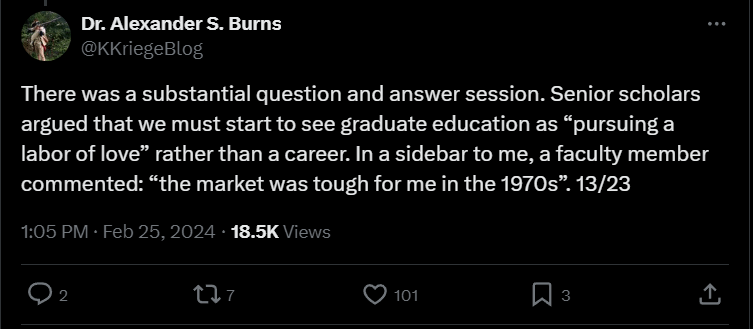
Alex Burns recapped a conference session about the market for PhD students in History. It was, predictably, rather despondent as is the nature of the job market for all graduate students in history, but doubly so for those outside the absolutely most elite 3 to 5 schools. The whole thread tells the story of graduate education in history, and the broader humanities, with sincerity and empathy.
Now, if I were a respectable economist, I would note that discussed plans to increase the supply of graduate student labor in a market with already paper thin demand is most certainly not the answer. Economists rarely pass up the opportunity to roll their eyes at any academic failing to understand supply and demand, but fortunately Christopher Jones (a proper historian) already made the appropriate observation:
This would be a disaster, as shortening time to degree UK style means more people successfully complete PhDs, flooding the market with candidates and making the jobs crisis even worse than it is now. https://t.co/bdLVnXApBv
What caught my eye, however, was the noted recommendation that faculty stop identifying scholarship in their field as a viable career altogether:
This makes my blood run cold for a number of reasons. First, its a trap whose bait is appealing to those students who are simultaneously the most earnest and most insecure. Unsure of what life will be like after college but know in your heart that you loved your classes in rhetoric or 16th century literature? Then why not make the noble decision to forsake the material world for a life of the mind? That’s exactly the kind of trap that makes for the pompous 23-year olds who turn into angry and despondent 30 year olds.
Perhaps worse, however, is the forsaking of an entire discipline that once held the mantle of profession and might now resign itselft to the standing of a hobby. I’m a STEM-y, arrogant economist who consumes very nearly no pre-19th century literature but that doesn’t mean I don’t think the deepest understanding of the foundations of a culture, any culture, doesn’t have profound insight to offer future generations. There is value there, the kind that might even qualify as a public good, whose provision we might want to collectively support, if we so chose.
It’s especially frustrating, however, because I can’t help but think the answer is right in front of them. It just happens to be nearly the inverse of the first suggested policy. History and the humanities need to reduce the supply of graduate students. That’s all there is to it. Yes, research and teaching will be more slower and more arduous without as many graduate assistants. It’s a tough break, but it sure as hell seems a more modest price to pay than the abandonment of scholarly training as something that leads to a viable career. I’d also like to very much hope that it would ease the conscience of faculty taking on graduate students as assistants, then thesis advisees, knowing that 5 years of laborious apprenticeship isn’t destined from the beginning to end in tears. You’ll have fewer graduate students, but hey, at least now you’ll be able to look them in the eye.
There’s a term in urban development: shrinking to greatness. A city can in fact shrink in population and still come out the other side viable, even potentially stronger than ever. That’s the story of Pittsburgh. Embrace what you are, not what you used to be or wished you were. There are a lot of disciplines and subdiscplines that are going to destroy themselves trying to become the STEM fields they wished they were or the recreate past golden ages of dubious veracity. But there will be some, across fields or within single universities, who will recharacterize themselves as custodians and curators of scholarship whose demand may have shrunken, at least for the moment, but whose contributions can carry forward. If that means at a slower pace or smaller scale, so be it. Better to embrace what you are than recruit the naive as kindling for a bonfire lit by arrogance and denial.
There are two ways to increase profits or available funds: grow revenues or reduce costs. We typically laud the creative teams that identify paths to greater revenues while, at best, tolerating those in charge of tightening belts. Given the tones in which we speak of austerity, there’s the thought that perhaps those at it’s vanguard are underrated (and they probably are, at least relatively). On the other hand, we often find ourselves operating within an economy of credit and blame. Credit for revenue gains tends to spread to the whole team, while credit for profits attributable to spending cuts specifically accrue to the management imposing those cuts. In such a model, spending cuts would be overemphasized as a profit-maximizing strategy. Growth can also be overemphasized of course – venture capital has come to exist as an institution that seems to only be interested in “home run” investment outcomes, likely at the expense of simply supernormal returns. We could keep pursuing this line of thinking, but I’m not really interested in adjudicating where austerity or growth is overrated. I think there is a broader concern to be considered in the growth/austerity strategy dichotomy. Within such a model of optimal decision-making there is an unstated, but critical, assumption that the relevent set of revenues and costs is perfectly fungible, and in turn comparable, across all contexts.
I think of this phenomena as the Unified Theory of Excel (UTE), an operating principle that can take over decision-making within a company or institution. The UTE carries the false promise that all contexts across an operating entity can be reduced to columns in a spreadsheet and, in turn, a decision made by netting out the effect of changes to those columns. Now, If you think that I, your friendly neighborhood economist, am about to make woo-woo claims deriding the information held within costs and revenues, get used to disappointment. My concern lies in the arrogance, sometimes negligence, in the assumption that numerically identical changes in costs and revenues across different contexts are comparable. It’s not that the information within the columns is bogus or irrelevant, but rather that the lack for context characterizing the relationships between the columns undermines any hope for knowledge to be produced. Data are just meaningless numbers absent a modelto characterize the relationships between the numbers. And that’s all a model is – an attempt to place the data in the appropriate context.
Complaints from those on ground about clueless management and soulless beancounters are, essentially, complaints that they are operating without a model. Cutting $100k from a marketing budget is not the same thing as cutting $100k on jet engine inspections and quality control. The world of possible outcomes from marketing cuts might include between $25k to $50k less in sales revenue, a large drop the worst attributable failure possible. In contrast, $100k quality control cuts will result in $100k in increased profits in 99% of possible outcomes, but of course there’s also a 1% chance that 10,000 people die in a fiery blaze, billions are lost in lawsuits, and the company ceases to exist. To be clear, I am fully aware of the resources that companies invest in projecting risk from decisions. Rather, the point is to illustrate the importance of context and the dangers of treating all numbers on a ledger as comparable and complete.
The Unified Theory of Excel is the belief that everything is fungible and can be abstracted to a spreadsheet absent any context or model. This belief in universal business fungibility is especially alluring given that the most recent wave of “people who got rich off of low-hanging fruit” were finance folks who observed the fungibility of risk across debt instruments. This false fungibility ignored the dangers of stripping numbers of context, which in the case of mortgage debt instruments included the relationship of ledgers across markets and higher statistical moments i.e. tail risk. Economic theory is built on abstraction, but abstraction has the fun property of being useful until it is disastrous. It’s the last step that kills you. Or creates a financial crisis. Or produces a jet where those 1% events keep happening.
What I am observing, in the news and broader conversation, is a frustration with management that I think is often being misinterpreted as “frustration with business” but I think is more correctly viewed as “frustration with business done poorly” or, perhaps more precisely, “business done with the wrong model”. Writers, actors, and film crews are frustrated with management operating with models that have been outdated for at least a decade. Journalists are losing their minds dealing with publishers who can’t keep outlets afloat and make payroll on time because an underlying model appears to be absent entirely. If this was purely about competing interests then the answer would, in theory, be available in competitive markets or at the collective bargaining table. But something seems off. It I didn’t know better, I’d be looking for a broad inefficiency, some sort of negative technology shock. An investment or commitment to operating in a contextual vacuum.
The thing about MBAs is they are generalists by training who often, by dint of their advanced credentialing, sometimes think of themselves as specialists. Their speciality being “business” carries with it an implied concept that business can be reduced to the universal application of their training and expertise, both of which have increasingly come to be…well…Excel. Excel is many things, but it is not a model (or at least not a very good one). Neither is “business”, for that matter. A spreadsheet supporting a pivot table embedded in a power point slide deck is something that you can carry from job to job, contract to contract. A 73kb hammer you carry in a world of nails waiting to be enumerated on your LinkedIn. It can accomplish tasks, present outcomes, but it offers no more context than a three-ring binder. It’s a model that says that everything is the same, everything is fungible. That the world can be reduced to mathematics no more complicated than 4th grade arithmetic. The sort of simple answer to a complex problem that HL Mencken warned us of.
One of my grad school classmates had a turn of phrase that I’ve grown to appreciate: “Hippy Hayekians”. These were folks who favored free markets not because business people were geniuses or heros, or because goverment was inherently evil, but because good decision-making comes down to the tacit knowledge that only comes from being in and of something, on the ground, embedded in it day to day. I’m by no means an Austrian economist, and my friend would never have put it this way, but I’m increasingly of the view that good management often does in fact come down to “vibes”. If, of course, by “good management” you mean a holistic understanding of the entire enterprise, including not just ledgers, but also risks, ambitions, culture, customers, and constraints. And by “vibes” you mean the tacit knowledge held and communicated by every single human being within a firm. Perhaps the occasional dogor cat.
I’m a data-driven guy down to my bones. Whether its criminal justice policy or how to produce a successful new brand of toothpaste, the best possible answer is in the data. But interpreting data is impossible without context, without a model. So maybe this whole post is a warning to be careful of anyone, be they managers, consultants, or management consultants, offering advice without a model.
Cards on the table, I’ve long felt this was the most egregious abuse of labor currently active in our country. We scream at each other over whether the minimum wage should be higher while ignoring a group of workers upon whom a cartel is enforcing a maximum pecuniary wage of zero? Is there a side of the political spectrum currently arguing for ceilings on wages for anyone? How bans on athlete compensation survived this long is beyond me, though when left to speculate upon it my mind inevitably wanders to our worst cultural sins.
Let’s assume that the union eventually comes to be. Let’s further assume that the unions of teams and sports federate, eventually forming an umbrella union of all NCAA athletes across all divisions and sports. What will happen? When economists talk about unions, they typically focus on two channels through which they can have positive effects for their members. The first is they can close shop, restricting the supply of labor, driving up wages. This is Econ 101, not a lot of controversy. The second is that they can solve a collective action problem, enabling cooperation amoung members when bargaining for wages against employers. The size of this benefit depends largely on how organized employers are. The more cartelized employers, the more effectively they can collude, the larger the expected gain from collective action on behalf of labor. As such, we can expect the largest positive effect for labor when the union is negotiating against a monopsonistic employer (i.e. the employer constitutes the entire labor market) or a perfectly organized cartel of employers.
As such, when economists argue about (private sector) unions, any disagreement typically comes down to an empirical question: how concentrated is the labor market? How much power does the employer have in the labor market? With long-standing unions, political economy and bigger picture policy cost come into play, but we let’s put that aside for now (NB: we won’t even touch public sector unions. Those are a completely different bag).
What makes the NCAA context interesting is that there is no debate as to whether the NCAA is a cartel or sufficiently well-organized to impose significant costs on labor. It’s a >$16 billion dollar industry and the mission-critical employees haven’t been getting paid any pecuniary income at all. My suspicion is that even amongst the most union critical economists you could fine, most would agree that, conditional on the continuing existence of the NCAA, athletes would benefit from unionizing.
Ok, great, but what’s going to happen?
Athletes will incrementally unionize.
Compensation will increase, even beyond Name, Image, and Licensing (NIL) compensation.
Scholarships will appear, in some form, at Ivy League schools.
Sports will remain nearly everywhere, but I expect some schools will find that costs now exceed benefits, exiting Division 1 and 2.
The model of compensating with “exposure” to professional scouts will continue to dissipate. You don’t need to be on national television anymore to have a scouting profile. Data and YouTube have changed the value-add of playing for a top 10 versus top 200 school, which means that compensation will become an even more critical deciding factor in recruitment.
Athletes will frequently exit college with savings but also having already peaked in terms of lifetime yearly earnings. Which is fine – there is no shame in never making $200k/year again.
The competive advantage of the the top schools in “big roster” sports i.e. football will grow. This will make already lopsided football matchups less tenable and, quite frankly, too dangerous. The formation of a collegiate football “super conference” is inevitable. It will make big money and so will the athletes. The NFL will have a true minor league, albeit one with a rabid fan base. It’s the rare win-win-win.
Alumni donations will create “upstart schools” in sports overnight. A single $5 million dollar donation can make you the best gymnastics program in the country overnight. University hospitals have long been funded by saving the lives of very grateful, very rich people. Don’t be surprised when a walk-on who wrestled at 149 pounds and invented the next killer app writes a check that creates a dynasty.
Coaches salaries will decline, often enormously. Head coach salaries will recover to some degree, assistant coach salaries will not. Coaches will become the labor class being most paid in “exposure” and “opportunity”.
My guess is the only losers in this entire story will be a) Division 1 football and basketball coaches and b) officials at the NCAA. I will shed no tears for them.
Enterprising athletes will start making money on Twitch playing the video game version of their sports, possibly themselves, against fans on their nights off. It will be awesome until 19 year olds start getting canceled for saying bad things in the heat of competitive video game competition.
Athletes will negotiate more favorable practice and travel schedules. Graduation rates will go up.
Schools won’t want to pay salaries for unused players. Red shirt rates will go down.
Athlete influencers. There’s going to be so many college athlete influencers.
Please, no selfies and livestreams in my class. Please. I’m just trying to get through my day.
Inter- and intratstate migration has collapsed within the United States over the last 60 years.
From “Understanding migration aversion using elicited counterfactual choice probabilities” Kosar, Ransom, and van der Klauw, Journal of Econometrics (2022).
This observation has been lurking in the not-completely-the-background of labor economics for 20 years. The best summary of the literature, by Jia et al, came out in the JEL last year. It’s a very useful and relatively complete treatment. I think a lot about migration these days, mostly asking about the determinants of our reservation wage of migration i.e. how much of a wage increase would someone have to offer you to pick up and move to an entirely new community.
If we take the above figure at face value, it would appear the reservation wage of migraton has increased for Americans. Quite a bit, actually. Of course, it is also possible that American’s no longer have to migrate to find a better job or wage, but that seems a hardly universal phenomenon over that last 50 years. Work from home has only had traction for a decade now at best. Labor markets aren’t as concentrated as they perhaps once were, loosening the monopsonistic lid a bit in a lot of markets, but at the same time the labor share of revenues hasn’t increased, in fact it’s decreased on average. So why aren’t people moving? I have some narrow, testable, answers that I am pursuing as research projects, but I also have a broad hypothesis that seems supremely untestable for the moment, sitting as it were in that thinkpiece uncanny valley between narrow research and podcast cheaptalk.
The concept of diminishing returns is an easy intuition to adopt. We all know the first bite of dessert is the best, the last the one most encumbered with regret. Economic growth remains a miracle, but it’s still true that nothing gained at the margin of the modern developed world will ever compete with those first steps out of subsistence. Very nearly every form of household capital and consumption in the modern work is characterized by some amount of diminishing returns, but that doesn’t mean they are diminishing at the same rate.
There are some goods for which there are few, if any substitutes. Demand for these special goods can be quite inelastic – we’re willing to sacrifice a lot to maintain a certain level of consumption. There are also goods that are quite complementary with one another, their value to us increasing as they are bundled together. Complements are powerful, putting together the right mix of consumption is quite literally the recipe for a better life. Complements, however, are often part and parcel to a cautionary tale. If something is a powerful complement to everything else in your life, we might find ourselves saying things like “I can’t live without it.” No amount of wealth in the world can survive being multiplied by zero.
There are few, if any, substitutes for friends, family, and our broader social network. Some goods cannot be consumed alone. If the sociological literature is to be believed, Americans are lonelier than ever. Both our deepest and most casual friendships have diminished in number. Relationships with neighbors are nonexistent, our ties to communities at a premium. That might, at first blush, make it sound like moving should be less costly– why stick around to maintain relationships that you don’t have. But on the other hand, if new relationships are harder to form than previously, then the relationships you already have are worth more than ever, to be protected jealously. Your only friend is, by definition, your best friend. No one wants to move away from their best friend.
Putting it all together, if personal relationships are an inelastic demand good that is complementary with a large chunk of our consumption bundle, then the price, the shadow price, we are willing to pay for it is going to go through the roof in the face of a negative supply shock. In a world where relationships are sudenly at a premium, you will be willing to forego a lot of additional income in order to preserve a small network in which you have a lot of social capital.
In two weeks half the country is going to be watching the Superbowl with a 3 or 4 friends, maybe 10 or 20. Thanks to innovation and economic growth, most people will be watching it on a 55 inch high definititon television with decent food and beverages. What about game would change if the host got a 20% raise? The TV might get a a little bigger, the snacks less fried, the beer more imported. What if the host moved two years ago? Would they have friends close enough to invite over? $15,000 worth of catering is a poor substitute for having someone to high-five.
The more I think about our lives and how little economic pressure, survival pressure, there is to find a 10% higher wage in the modern developed world, I’m surprised anyone migrates at all.
I’ll be honest, the implication that free mosquito nets are net negative for poverty and health sent me into that special kind of rage that can only be fomented by someone on the internet being both condescending and egregiously wrong at the same time. Do I even need to go over why this is bad? Why malaria prevention at a continental level outweighs hypothesized marginal seagress loss? I didn’t think so.
What I want to talk about is is subfield tunnel vision. A common piece of advice passed on to each generation of PhD students is to become a genuine expert in something. If you write a dissertation on the effect of malaria nets on elementary school attenance in Uganda, then you should become an expert, on the bleeding edge of all related-research, on mosquitos, nets, and primary education in Africa. As you career takes shape, the both the questions that strike you as important and the opportunities presented to you by institutions and administrators will shape your research. Bit my bit you will be shaped (and occasionally sanded down) into an ever-narrower expert. And that’s fine, that’s the story of incentives to specialize that comes for us all (NB: if your mind went to one of the public intellectual generalists you admire, do note that being a generalist in the modern world is very much its own niche specialty).
Specialization is good, but do take care that while your expertise becomes narrower that your view of world remains wide. We all know the relevant cliche about all the world becoming a nail whilst holding a hammer, but this is about about the rationalizing of tools and techniques. This is about how your specialization fits within the world and, more specifically, how the consquences of choices you might advise stand in the grand utilitarian calculus.
The authors of the paper in question are the Chief Scientific Officer and Chief Conservation Officer of Project Seagrass. These are people who have dedicated their lives to the preservation of seagrass meadows and, in turn, ocean health and the global stock of fish. Should we be surprised that their paper’s abstract closes with “We conclude that the use of mosquito nets for fishing may contribute to food insecurity, greater poverty and the loss of ecosystem functioning”? No, we should not. First, you could argue that they are just putting, in words, the implied signs of their analysis, and not the relative magnitudes. Maybe they aren’t implying mosquito nets are a net negative. You could be generous and argue that all they are trying to say is “Mosquito nets are great, but as soon as the malaria vaccine is universally distributed we should ditch all these nets because the costs will outweigh the benefits.
I don’t think they are, though. They lean heavily on Short et al (2018) and their claim that fishing nets are the primary use of freely provided mosquito netting. That Short et a result appears to be based almost entirely on an online survey with 113 respondents. The implication is that the massive reduction in malaria specifically attributed to the distribution of free mosquito nets is in fact a mirage, that these nets are instead finding their way into the ocean as improvised capital for small scale fishing operations (“artisanal fishing”, in the parlance of the paper), with the resulting consequence of catching additional juvenile fish at the margin, harming the future stock of fish.
The second part of that equation seems entirely feasible! Unintended costs happen. What I want to emphasize is that the authors are narrowly focused on establishing the cost of future fish in seagrass meadows while also being overly credulous of what is, I’m sorry, a ridiculously crappy survey that dismisses the enormous benefits of those nets to save human lives, especially children under the age of 5.
I don’t think the authors are being selfish, have ill-motivations, or have been bought off by a global conspiracy of wealthy fishery magnates. I just think they have succumbed to a bias that afflicts every scholar at one time or another, myself included. Gatekeepers won’t publish your paper in top journals, fund your research with needed grants, or invite you to prestigious conferences unless you hype your work to the absolute maximum of feasible importance. Spend a couple years as the conductor on your subfield’s hypetrain and maybe you start to believe it just a wee bit too much. Your subject of concern remains concrete, the questions imperative, while everything else increasingly fades into the realm of the abstract, the consequences negotiable.
As for the twitter commenter being dunked on, I just think it’s classic overeagerness to denigrate everything touched by someone you find odious. SBF is a bad person, did bad things, has bad hair. Sure, but maybe don’t? Maybe leave the most successful malaria prevention endeavor in the history of the world out of your public disgust for a <checks notes> young cryptocurrency embezzler? Don’t let your deserved anger for a genuinely bad person make you dumber at the margin. Bad people already impose costs on us all. Letting them skew your view of everything they touch just makes their societal footprint bigger.
There is no shortage of advice that falls along the lines of “If you aren’t eating at least one disappointing meal a weak/month/etc, then you aren’t trying enough new recipes or restaurants.” It all falls along the lines of increasing your risk of experiences that are subpar relative to what you already know you like so that you can increase your probability of adding something new to your portfolio of “likes” while also getting that one-time dopamine hit that comes from personal discovery.
It’s a good framing and broad set of advice. I endorse it.
What’s interesting though is that there’s a greater breadth to the foundational concept. Our lives are sufficiently short that we really don’t have that great of an idea of what we like and don’t like, especially for forking decisions that don’t allow for easy exploration of the counterfactual. At the same time, dedicating your life to the repeated pure act of discovery carries a certain…shallowness. To perpetually be on the lookout for the new and better is to never invest in the experiences that fill us with satisfication and joy. To get really good at doing what makes us happy. To get really good at being happy.
So where’s the balance? I don’t know and I am reasonably certain that’s at the core of the human condition, so I don’t think I going to come up with the answer in a blog post. But it strikes me that cultivating a certain taste for disappointment, not unlike a particularly peaty Scotch, is an incredible adaptation towards a better overall lived experience.
Which is to say that, after 30 years of telling anyone who would listen that I would never want a cat, that I refuse to get a cat, that a cat would offer no value to me, I absolutely love having a cat. My cat rules and it’s left me wondering what other things am I absolutely convinced I have no interest in that would fill my life with greater joy. What are things that I think I can’t stand, that other people love, that I might actually find incredibly-well suited to my tastes. A random list of things that, at the moment, I have no interest in:
Motorcycles
Cricket (the sport)
Lasik
Traveling to (actually) dangerous countries
Committing crimes
Running for office
Eating any dish that includes raw chicken
That’s in no particular order, but I can’t help but wonder if there is something on that list I should give a go. City council? Visiting the Middle East? Larceny? To be clear, I’m not going to do any of those things, but that doesn’t me I shouldn’t. But there is a balance to having experiences you might not like, you probably won’t like, and, every few years, you think you definitely won’t like. Just in case.
The anecdotes in Hedrick Smith’s “The Power Game” may be 40 years out of date, but the core insight into the US system of governance remains the same: power is fluid, fleeting, and indeterminant. A shocking variety of people can, for a given moment, find themselves to be the most powerful person in the US. Sometimes it is in fact the president, but it can just as easily be a block of senators, or a particularly flush and motivated donor. It can be losing candidate in a three-way race who, simply by considering dropping out, finds a moment of irresistible political leverage. Power in our republic is a constantly changing and uncertain mantle, almost as much projection as reality. I would also argue that it is the central selling point of our system: people think twice about how to go about swinging a sword if they’re not sure who’ll be swinging it tomorrow and what end they’re actually holding on to today.
Which brings me to plagiarism.
Bill Ackman wants use AI to investigate academics for plagiarism at scale. The scale here is key, the implication that AI will allow a wide net to be cast. Plagiarism never struck me as a particularly widespread problem in high level research, but I could at least feasibly be wrong and I’m in no position to tell him how to spend his time. What is fairly clear to me, however, is that there is amongst some the perception that academics have too much power. The ambition behind, or at least the gleeful anticipation for, these hypothesized plagiarism purges is to reduce that power and influence.
But where does this perception come from and why plagiarism? Power is fluid, based as much on perception as reality. In an age when the quantity of information is never in question and the price is approaching zero, the short-side of the market will always be quality, credibility, and context. Maybe we’re entering into a golden age of power and influence for academic scribblers, and that’s a reality some would like to head off at the pass. An accusation of plagiarism could stunt a career. A mass accusation of “rampant” plagiarism could diminish the broad credibility of scholars, reducing the perceived quality of the information relayed and the context they provide for policy and social discussions.
The US has three branches of federal government, four military branches, and 50 states, all sitting on top of thousands of municipal governments. As far as spreading power goes, that’s a pretty good start. If the 3,982 degree-granting institutions in the US have to be added to the registry of power, that’s fine, but I’ll have to admit that my students don’t seem all that awed by any power I’m currently wielding. Going by the focus of the media and Ackman, maybe we only need to add institutions in Cambridge, MA to the registry of power, but that doesn’t make power any less fluid and fleeting. It’s just political whack-a-mole, which I would remind everyone is a game where you can smack one source of power down, but you can’t control where power pops up next. Maybe power shifts to Silicon Valley. Maybe a cluster of TikTok influencers whose politics makes the median MIT professor look like Barry Goldwater. Be careful what you wish for…
Some of us are relishing what by all accounts appears to be a successful recession-resistant soft landing that was enabled, at least in part, by the management of interest rates by the Federal Reserve bank. But some of us also might be a little bummed. Pandemic stimulus led to non-trivial inflation for the first time in 30 years that had real consequences for the economy. Those issues were confronted by policy makers at the Federal Reserve bank who did their part to raise interest rates that ease us out of this inflationary window without triggering a recession. Those consecutive events, stylized facts even, appear to have left “Modern Monetary Theory” in shambles. I only interject the “appear to” qualification because MMT is a theoretic vacuum that better serves as a quasi-economic Rorschach test than falsifiable model. What are we to do without our favorite economic punching bag? What could ever unite us all, Keynesians, New Keynesians, Neoliberals/New Liberals, Monetarists, Austrians, like defending the shared empirical reality that money is real, printing money isn’t a policy free lunch, and hyperinflation is an economic tragedy to be taken deadly serious?
Well, don’t fret. There’s one more gift not everyone has opened yet. The gift that is “degrowth”. Not unlike MMT, degrowth is a little tricky to pin down. The central tenet, if there is one, is that economic growth needs to be both reversed and re-defined. That we all need to learn to live with less. As best I can tell. I guess I could link to Jason Hinkel’s book…but I don’t want to. If wikipedia is to be trusted: “The main argument of degrowth theory is that an infinite expansion of the economy is fundamentally contradictory to the finiteness of material resources on Earth”. I’m not going to spend an entire blog post dismantling this school of thought that is somehow both amusingly silly and darkly bleak in what it speaks of it’s advocates. Though spare me this one shot at an obviously wrong idea: the entire point of economic growth is that the economy can, in fact, expand forever, because new ideas (i.e. technology) and exchange both add value to the world without requiring any additional material resources (i.e. they are “non-rival”). There will never be an end to new ideas and, given those new ideas, there will never be an end to the prospective gains from exchange. Are we done here?
Of course not, don’t be silly. There are careers to be had. Keynotes to be given. Books to sell. Conferences to host. I took a shot at this on twitter, but I’m actually far more sanguine on the subject than I come across in my grim little tweet.
The most frustrating thing about the social media age is that a) people can get a lot of attention for exceptionally bad ideas b) those people revel in the attention and the opportunity that it brings c) even when their bad ideas are discredited, they will still personally gain https://t.co/IVWK2aRIQz
— Mike Makowsky is here to violently equivocate (@mikemakowsky) December 29, 2023
I’m emotionally unburdened by the attention paid to degrowth for the same reason I slept fine knowing MMT advocates were out their peddling their terrible policies. I take it as a sign of good health within the broader discipline of economics that for all of our squabbles, most of us are speaking the same language and engaging with an objective reality. Which is not to say that there aren’t knock-down, drag-out arguments about what we are observing empirically and what it means, but everyone knows what it is we are arguing about. There’s no Sokal hoax on the horizon for economics. The data is real. The policies are real. The consequences of bad decisions are very, very real.
What that means is that when a tribe forms around bad ideas and pushes them into the broader public, they have to defend those ideas. And their defense can’t elude criticism with nothing but rhetorical sleight of hand or pandering to fortified political identities for shelter from the scholarly storm. At least not for long. Whether they like it or not, their ideas will have to come into contact with reality, with formal rigor, with the data. There’s no postmodern escape hatch - to be exposed as unfasifiable is to fail at first contact. *
Yes, bad ideas can get you tenure somehwere. Or a letter published in Nature. Or a nice circuit of hosts willing to prop you up as the academic scribbler to provide the intellectual scaffolding their political movement is desperate for. But you’re not going to matter to the discipline. Your terrible, vacuous ideas will be confronted, considered, and then dismissed. No harm, no foul.
That these ideas can enter the arena at all is a sign of excellent health within the discipline. You can posit some truly wild ideas and still get them in front of the global jury of economists. You don’t have to be a Harvard economist. You don’t even have to be an economist. No position of power, no union card. The doors are open. That doesn’t mean, however, that you’re going to get a show. There’s no minimum stage time owed. Your ideas are terrible, get off the stage, next. You expected to come home from the battle either with your shield or on it, a grand warrior exposing the soft underbelly of the dismal dragon, but turned out to be just another 5 seconds of empty calories. You didn’t get what you wanted from this belch of a conflict, but the economists sitting together in the jury box did get something: a reminder that we’re all doing the best we can. We’re hissing and fighting, but only because we care. We’re trying to do it right, which is hard, and but that’s what matters the most at the end of the day. The trying.
*Sometimes what looked, to some or most, to be bad ideas turn out to, in fact, be good ideas. Great ideas, even, the kind that move the discipline forward. That’s actually the most beautiful part, that small minority of ideas that look too far afield to be taken seriously only to survive these trials by fire and become internalized in the broader mainstream of economics. Ironically, this often proves a harder test for many members of the revolutionary factions. From my own interactions, I would note that the internalization of “public choice” into the broader mainstream of economics as “political economy” proved hard for some scholars to adapt to.
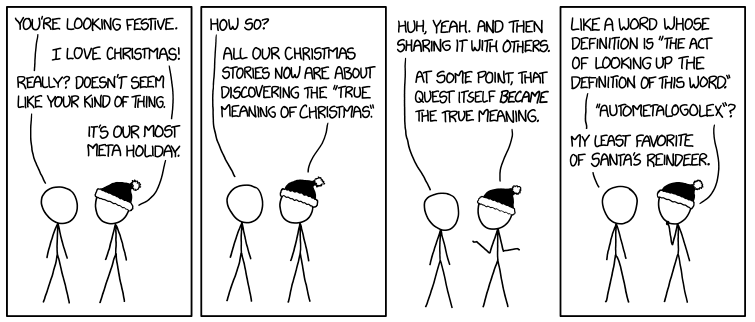
Whether it’s a high holiday or just a nice day to get Chinese food with your family and watch old movies, I hope you all have the very best Christmas possible, no matter what that means for you. But do take the day off if at all possible and, if the opportunity arises, make it a little easier for those who can’t.


 Economist Writing Every Day