Supply & Demand, with Tables?

When I was a graduate student, I paid for my tuition by tutoring for the university athletics department. I tutored stat, math, micro, macro, excel, and finance. I tutored the same students each week, so I got to know them pretty well over the course of the semester. I also got to know their strengths and weaknesses. It was at this time that I realized most quantitative or even analytical ideas could be described in 4 potentially equivalent ways:

  1. Mathematically
  2. Using logic in English
  3. Graphically
  4. With a Table

In this post I want to share the Supply & Demand cheat-sheet that I use to help my students learn about the effects of supply and demand.

Continue reading

Early or Late, Never On-Time

Say that you live in a metropolitan area and that everyone works downtown. If you leave early, then you get to work WAY early. If you leave late, then you get to work WAY late. What’s up with that? Let’s say that the closer people live to downtown, the proportionally deeper you work in downtown.

Odds are that you live somewhere in between super far away and somewhere super close. That means that when you arrive at work, there are people closer to and further from the city center also arriving at their jobs. They are your competition. Their mere existence adds congestion to the roads and slows your velocity. As you all make your way closer to the downtown area, the congestion increases and the velocity falls still further such that your slowest speed occurs as you approach work.

Continue reading

Beware of Scatterplots

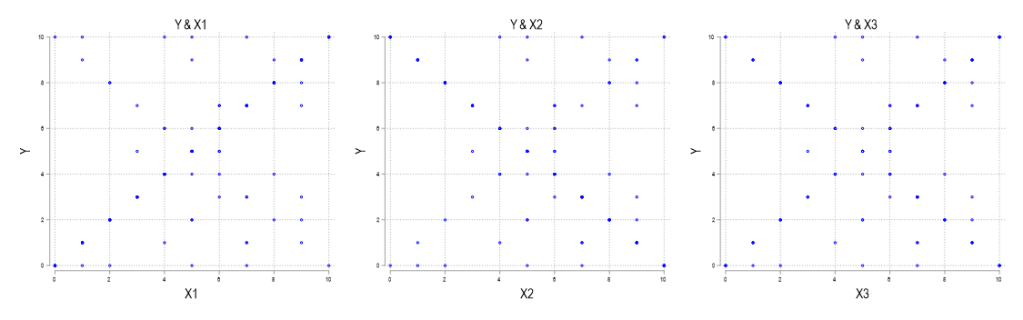
Scatterplots are a great investigatory tool. You can scatterplot raw data for two variables and, if the relationship is strong, then you can see the functional form that relates x and y (linear, polynomial, exponential, etc.). However, there are two data characteristics that are a scatterplots Achilles’ heel: large samples and discrete variables. And they create misleading scatterplots for the same reason.

Examine the below scatterplots for y vs the discrete variables x1, x2, & x3 on the interval [0,10]. What do you think slopes or correlations are?

Continue reading

Improved University Retention By Selecting for Mission Fit

The president of my university said that he wants the following strategy publicized.

The purpose of an admission application is to find good matches between students and the university. We want the application to be easy for people to complete, but to filter out those with low conscientiousness and those who aren’t a good mission fit. If the application is arbitrarily difficult or convoluted, then we’ll lose great applicants. But, if it’s not costly enough, we’ll attract students who are closer to indifferent about attending. Those are the freshmen who don’t return for their sophomore year.

Continue reading

Animated AS AD Model

Gifs are really cool. They’re like the animated photos on loop from Harry Potter. They’re also great for teaching. You can show students exactly what you want them to see over, and over, and over. They don’t need to navigate to the right part of the video, wait for ads, or worry about whether the particular grammar of a book is opaque. They can just look and think.

For example: Why are prices higher than 3 years ago? We can use the Aggregate Supply- Aggregate Demand model (AS-AD) to help us think about it. Prices have increased because demand has grown faster than long-run aggregate supply (LRAS).

At first, the SRAS, which does the work of finding the long run equilibrium, increased rightward. This is because we’ve had a decade of low, stable inflation and inflation expectations were anchored at a low level. Greater demand was met with greater output. But, as AD continued to grow and people began to confront the unavoidable reality of scarcity, SRAS began moving upward, increasing the price to ration the quantity demanded.*

See the below gif. I made it in Stata and ezgif.com. It’s pretty cool.

Continue reading

Buying Your New Home: Process and Strategy

I’m currently purchasing a new house and I want to share some insights. Baseline knowledge: Houses are unique goods on multiple margins that are imperfect substitutes. Let’s assume that both a buyer and a seller have real estate agents in the USA. The opportunity cost to the buyer is selecting another house that is not quite as desirable or finding a comparably desirable house after a wait (due to time searching and the appearance of new listings). Legally, the seller is not allowed to lie about the property details (though they can claim ignorance). The lending process makes it difficult for the buyer to lie.

Step 1: List and Bid

The seller chooses a price low enough that will permit a sale within their preferred timeframe, and high enough so that they earn a commensurate return. There is a tradeoff.

The buyer makes an offer. Before buying, I thought that the offer was, more or less, just bidding a price. That would make the problem nice and 1-dimensional. It would fit nicely into the auction theory that I learned in grad school. But that’s not the whole story. As it turns out, an offer specifies other details too. It specifies:

  1. The price.
  2. Earnest money. This is the amount that the buyers pays immediately in order to signal legitimate interest in the property. It’s often held in escrow by a 3rd party in order to improve credibility.
  3. The number of days until closing (signing the final contract).
  4. The number of days for ‘due diligence’. This is the period during which inspections must/can be done. The seller or their agent must make the house reasonably available for inspection during this period.
  5. The appraisal period. This is the length of time during which an appraisal of the property determines the value of the home insofar as a lending institution is concerned. Without a loan, this number can be zero is irrelevant.
  6. A lender’s pre-approval letter specifying the permitted size of the loan and the down payment. This is a signal of credibility that the buyer is able to pay. The buyer can request to be approved for a smaller loan in order to signal unwillingness to pay more.
  7. Any contingencies, such as whether another property must sell first, or a delay is requested. Really, this can be almost anything that the buyer wants. Some people get creative in their offers, like paying a higher price in exchange for a later closing date or rent-to-own contracts.

Given the above details, a potential buyer would like to craft the offer to meet the seller’s preferences while also acknowledging the scarcity of the buyer’s resources. As it turns out, not all resources are instantly convertible. One may be willing to move quickly but have a lower budget. Or, be willing to pay a higher price, contingent on the sale of another property.

Continue reading

Clarity on the Federal Debt

I have a list of economics topics that I like to teach about because they conflict with the biases of my average student. The list includes fiat currency, inflation, deficits, net exports, and immigration. The list also includes the importance – or lack thereof – of the federal government’s debt. This post walks through a few graphs to do a gut-check of what we think is true and how it compares to reality. For example, do you have a sense of when the debt grew historically and when it was constant? Do you have a sense for when it shrank?

Continue reading

Spending Like a…

Is the federal government spending at a faster rate? Your answer probably has more to do with your biases than with anything else. Most people don’t know the numbers or they imagine some more appropriate past. Below is logged current federal expenditures (this does not include government fixed investment, only consumption. Yes, we can argue about measures. This doesn’t include transfers).

The line of best fit is about 1.6% per quarter or 6.4% per year. Golly! Our spending is rising so fast! But, US federal spending grew relatively slowly in the 90s – maybe due to that fiscal conservative, Bill Clinton. And our federal spending grew even more slowly between 2010 and 2016 – maybe due to that other fiscal conservative, Barack Obama.

But, inflation varied over this period. What about real, inflation adjusted federal spending? See Below.

Continue reading

Minor Investment

Gary Becker, the Nobel laureate in economics, applied economic reasoning to social circumstances and particularly to families. He argued that children are a normal consumption good, and people consume more children with higher incomes. However, he also emphasized a quantity-quality trade-off. More children in a family means fewer resources and attention for each child. Higher-income couples may opt to invest in classes, training, and spend more time with a unitary child rather than increasing the number of children.

However, goods have multiple attributes and children do not merely provide a stream of consumption value while in the household. They offer access to future resources when they become employed themselves. Having more children or higher-quality children increases the economic benefits that older parents can enjoy, such as more help with household activities and the ability to travel with their adult children. Old-age benefits such as social security now serve the function of insulating people from their prior investments in future consumption.

Continue reading

Fed Priority #1: Financial System Stability

The Fed was founded after a spat of banking crises.

We know that the Federal Reserve also has the goals of full employment and steady, moderate inflation. Since the 1990s, that’s meant 2%. But it’s a relatively recent addition to the Fed’s policy goals. The primary purpose was initially and always has been financial system stability.


In 2008, the Fed demonstrated that it’s willing to attain financial stability at the cost of employment. After and during the financial crisis, the Fed purchased mortgage backed securities (MBS) from private banks at a time when their value was highly uncertain (and discounted). The purpose was to replace these assets of uncertain value with less risky assets. At the time, there was resentment that these security holders were insulated from losses while the homeowners whose loans composed the MBS did not get comparable relief. I remember arguing that the Fed, with the cooperation of congress, could have just paid part of the mortgages on behalf of the homeowners such that there were fewer foreclosures and fewer personal bankruptcies. That way, both the borrowers wouldn’t default and the debt holders would enjoy stable returns.


But, the primary goal of the Fed is financial system stability. Pre-financial crisis, banks had loaded-up on securities of uncertain value with the help of regulatory arbitrage and some lending shenanigans. The Fed needed to avoid the ensuing catastrophe that was a consequence of the greater-than-anticipated realized risk. Importantly, catastrophe to the Fed is financial-sector specific. Markets losing liquidity, bank-runs, and financial sector business failures all qualify as the stuff of concern (all of which occurred). While making mortgage payments for specific mortgages would have been popular amongst many debtors, it also would have taken much more time to implement. The Fed wanted to avoid more financial instability than had already occurred. And frankly, the Fed’s first priority isn’t to take care of the public. Given the alternative between a slow popular option and a quick adequate option, the Fed has demonstrated an inclination toward the latter.

Continue reading