State health care spending usually gets reported in terms of dollars per capita, leading to maps like this that show Alaska as the highest-spending state and Utah as the lowest:
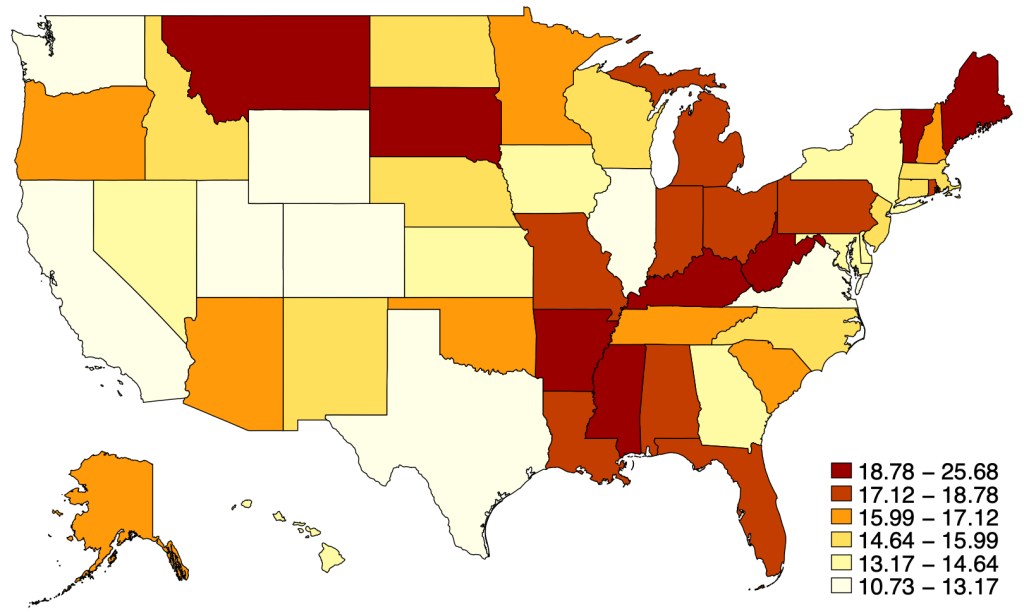
But states differ greatly in how rich they are and how much they have to spend. I wanted to know the states where health care takes up the largest and smallest share of the economy, so I got the data:
Health Care Spending as Share of State Gross Domestic Product in 2019:
You can see that health spending as a share of GDP looks pretty different from health spending in raw dollars. We’ve gone from a high-spending North and low-spending South to more of a mix. Health spending is now highest in West Virginia, where it makes up more than a fourth of the economy; and lowest in Washington State and Washington D.C., where it makes up less than one ninth of the economy.
The biggest change when considering things this way is in Washington D.C., which has the highest spending in $ terms but the lowest as a share of GDP because it has an enormous GDP per capita. Many other states that spend a lot in $ also fall a lot in the rankings due to high GDP per capita, including Alaska, New York, and Massachusetts. The states that rise the most in this ranking are poor states like Arkansas, Alabama, and Mississippi. Mississippi rises the most, gaining 37 spots in the rankings of highest-spending states when we go from $ per capita to share of GDP.
I share the data here so you can do your own comparisons:
As we enter election season, I can sympathize with those that want to ignore it as much as possible. But if you do want to follow it closely, here is my advice: talk is cheap, so follow the money.
And by money, I am not referring to campaign contributions. I mean prediction markets, where people are putting their money where their mouth is, rather than just making predictions based on their own intuition (or their own “model,” which is just a fancy intuition).
There are a number of betting markets online today, but a good aggregator of them is Election Betting Odds.
In addition to all the usual items for a principles of macroeconomics class, I’m asking my students to listen to one podcast episode this semester. They have to write a short summary on a discussion board for credit.
It took me a bit of time to collect this list of links. I also give them some discretion to find their own episode, but I’m not posting my rules on that point here. This list is something you can copy, paste, and modify. The point is to have all the web links in one place so that students can just click around. There have been many great podcasts over past 2 decades, but I list relatively new content so that we get a bit of “current events” thrown in. So, even if you’ve assigned podcasts before, this new list might be helpful.
I’ve discussed the ways to teach supply and demand in the past. Regardless, almost all principles of economics classes require a book. But even digital books are often just intangible versions of the hard copy. Supply and demand are illustrated as static pictures, using arrows and labels to do the leg-work of introducing exogenous changes. There’s often a text block with further explanation, but it lacks the kind of multi-sensory explanation that one gets while in a class.
In a class, the instructor can gesticulate and vary their speech explain the model, all while drawing a graph. That’s fundamentally different from reading a book. Studying a book requires the student to repeatedly glance between the words and the graph and to identify the appropriate part of the graph that is relevant to the explanation. For new or confused students, connected the words to one of many parts of a graph is the point of failure.
This is part of why the Marginal Revolution University videos do well. They’re well produced, with context and audio-overlaid video of graphs. It’s pretty close to the in-person experience sans the ability to ask questions, but includes the additional ability to rewind, repeat, adjust the speed, display captions, and share.
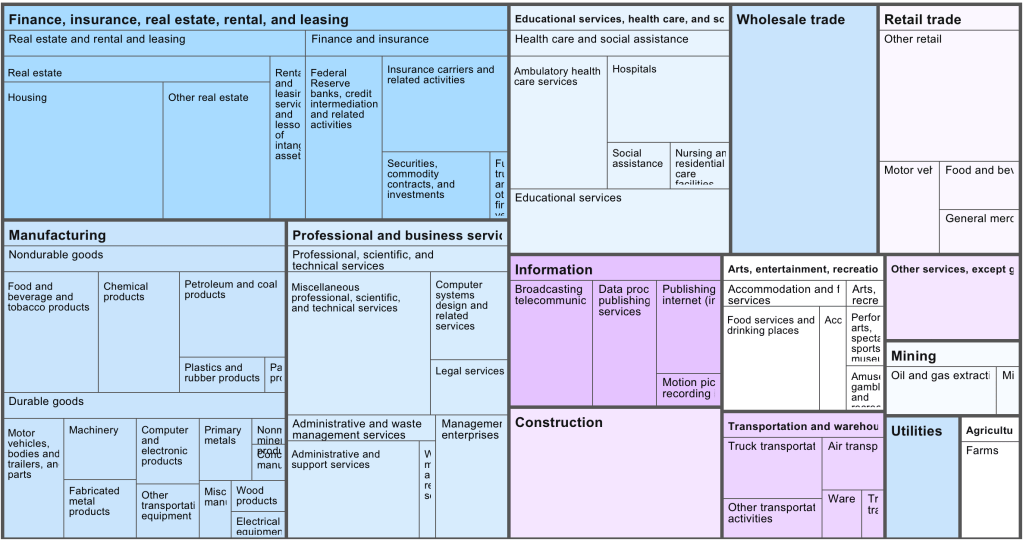
Venture-capital backed startups almost all cluster in the same handful of industries, mostly various types of software. This leaves a variety of large and economically important sectors with almost no venture-capital backed startups. That means those industries see fewer new companies and new ideas; they must rely on either growth from existing firms, which are unlikely to embrace disruptive innovation, or on startups that bootstrap and/or finance with debt, which tend to grow slowly.
Venture capital firm Fifty Years has done a nice job cataloging exactly which industries see the most, and least, investment relative to their size. Here is their picture of the US economy by industry market size:
Now their picture of which industries get the investment (though unfortunately, they aren’t very clear about their data source for it):
They use this to create an “Opportunity Ratio”- current market size divided by current startup funding:
They call the industries with the largest Opportunity Ratios the “Top Underfunded Opportunities”:
I don’t necessarily agree; some industries face shrinking demand, prohibitive regulation, or other fundamental issues making them bad candidates for investment. Conversely, investors haven’t just focused on software randomly or through imitation; they see that it is where the growth is.
Still, herding by investors is real, and I always like the strategy of finding a new game instead of trying to win at the most competitive games, so I do think there is something to the idea of investing in an unsexy industry like paper. Growing up in Maine and watching one paper mill after another close, I always wondered how they managed to lose money in a state that is 90% trees, and whether anyone could find a way to reverse the trend. Perhaps related technology like mass timber or biochar will be the way to take advantage of cheap lumber.
Thanks again to Fifty Years for releasing the data.
Every month we get new data on the labor market in the US from the Bureau of Labor Statistics. As I pointed out last month, the labor market data from 2023 was very good!
But lately on social media, some have been to ask whether this data is credible. Specifically, several people have pointed out that the initial numbers we receive each month almost always seem to be revised downward. Since the initial reports are based on incomplete data (for the jobs data, this would be reports from employers), it is normal that there would be some revisions with more complete data.
Is it the best of times or the worst of times? This question I asked myself as I saw the following three headlines juxtaposed last week:
“US consumers are in the best shape ever” is sandwiched between two downers. The American consumer’s ongoing spending has staved off the long-predicted recession, quarter after quarter after quarter. Can we keep those plates spinning?
We noted earlier that the huge windfall of pandemic benefits (direct stimulus plus enhanced unemployment benefits) put trillions of dollars into our bank accounts, and the spending down of that surplus seems to have powered the overall economy and hence employment (and inflation). How the economy does going forward is still largely determined by that ongoing spend-down. Thus, the size of the remaining hoard is critically important.
Unfortunately, it seems to be difficult to come up with an agreed-on answer here. The San Francisco Fed maintains a web page dedicated to tracking “Pandemic-Era Excess Savings.” Here is a key chart, tracking the ups and downs of “Aggregate Personal Savings”:
This is compared to a linear projection of pre-pandemic savings, which is the dotted line. (Which dotted line you choose is crucial, see below) . The next chart plots the cumulative savings relative to that line, showing a steady spend-down, and that this excess savings is just about exhausted:
If this represents reality, then we might expect an imminent slowdown in consumer spending and in GDP growth, and presumably a lessening in inflationary pressures, which may in turn justify more rate cuts by the Fed.
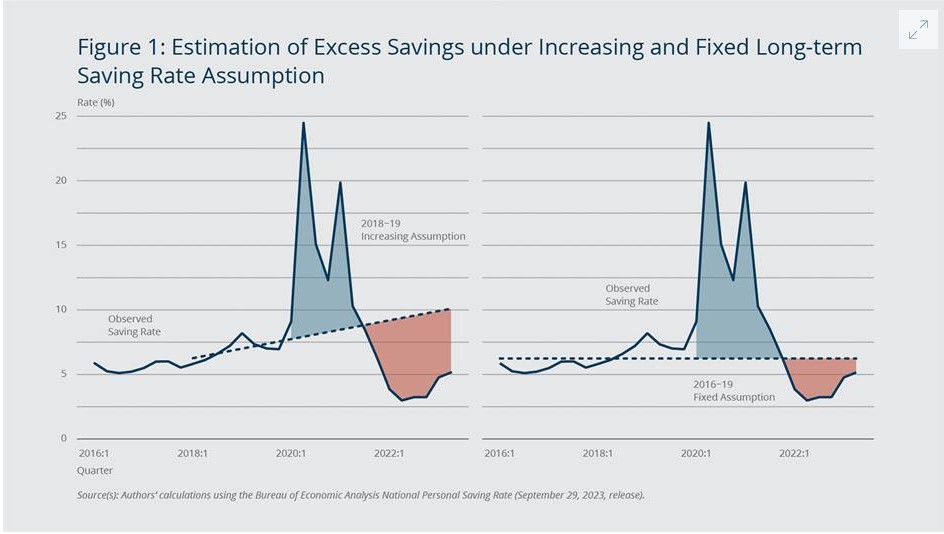
The following chart shows two versions of the first plot shown above, with (on the left) a linear, increasing projection of 2018-2019 savings trends, versus a flat savings rate baseline:
Two significant differences between these plots and the San Francisco Fed plot shown above are that these plots only run through the end of 2022, and that they display per cent savings rate rather than dollar amounts. However, they demonstrate the difference that the baseline makes. Using an increasing savings rate baseline (2018-2019 trend projection), the surplus was nearly exhausted at the end of 2022. Using a flat rate average of 2016-2019 for the baseline, the surplus was barely dented.
We will see how this plays out. My guess is that at the first whiff of actual recession and job losses, the administration will gush out the maximum amount of largesse; while we may have ongoing inflation and high interest rates due to the deficit spending, we will not have a hard landing. I think.
There is a new generative AI product called Phind. Does it make up fake citations like ChatGPT? I will report experimentation with the free-tier product from January 7, 2023.
Phind is an intelligent search engine and assistant for programmers.
Prompt: “In less than 10 sentences, explain how the ideas of Hayek are connected to bailing out failed banks, and include citations from published papers as a list. include author, year in parentheses, and journal for the citations.”
Friedrich Hayek, a prominent Austrian economist, advocated for a free market system where businesses and individuals make decisions based on individual knowledge and self-interest, rather than central planning by government or bureaucrats. His ideas suggest that interventions, such as bailing out failed banks, should be minimal and temporary, allowing the market to correct itself.
However, the financial crisis of 2008, including the failure of many banks, led to significant government intervention, including the bailout of banks. This action can be seen as a departure from Hayek’s principles, as it involves direct government intervention to stabilize the financial system.
According to a paper by Todd Zywicki (2009), the Federal Reserve’s artificial lowering of short-term interest rates and the resulting shift by consumers to adjustable rate mortgages (ARMs) triggered the housing bubble and subsequent crisis [Source 1](https://reason.org/wp-content/uploads/files/federal_reserve_monetary_policy_hayek_rule.pdf). This aligns with Hayek’s critique of central banking’s manipulation of interest rates.
Moreover, the Basel Accords, international capital adequacy and liquidity requirements for banks, were designed to encourage banks to hold securitized loans in their portfolios, thereby concentrating risk and leveraging up, thereby increasing their exposure to risk. This approach, contrary to Hayek’s preference for decentralization and competition, may have contributed to the financial crisis [Source 1](https://reason.org/wp-content/uploads/files/federal_reserve_monetary_policy_hayek_rule.pdf). In conclusion, while Hayek’s ideas of minimal government intervention and self-regulating markets provide a useful theoretical framework, practical implementation in complex and interconnected modern economies may require different strategies, including bank bailouts.
Are the citations real and correct? Phind simply is not trying to write with in-text citations and academic references. There is a mention of “Todd Zywicki (2009)” and also a weblink. The weblink is to a policy paper published by Reason. This policy paper is on the correct topic and the paper does exist. The Zywicki citations also exists, in the sense that if you go into the Reason paper it cites a real Wall Street Journal op-ed. So, if you follow the trail, you can see what document Phind learned to cite Zywicki from. It seems like it is stealing the citation more than reading the source documents. To be fair, sometimes human academics work that way, too.
What I was hoping for was in-text citations with a compiled bibliography at the end. Phind did not give me that.
I’ll try another test that I ran on ChatGPT and Bing in 2023.
The prompt is “In what paper did John Duffy propose that economists use experiments to study equilibrium selection?”
Phind does not attempt an in-text citation in the response. The link in the paragraph (link number 2) points to John Duffy’s list of papers, which is better than just making up fake citations but also does not create a literature review for me. Phind is, as with the Hayek test above, providing breadcrumbs of links through which I can discover existent papers.
Is there a paper called “The Transition from Stagnation to Growth: An Adaptive Learning Approach”? Yes. And it is by Duffy.
Phind lists weblinks to sources. Has Phind done more for me than Google, on this search? Not much, in terms of finding and synthesizing references.
According to a chart circulating this week, attendance at the AEA winter meeting exceeded 13,000 economists at the peak. I had some job interviews at Chicago in 2017, and I spoke on a panel at San Diego in 2020. Chicago was freezing cold. San Diego was lovely in January. Cold or not, probably every economist on the job market showed up in person to those conferences. There are harrowing stories of people who missed job interviews because of snow and cancelled flights.
A privilege of being in this profession is the chance to meet people from around the world. At my lunch table currently there are people from Chile and Southern China to my right and Kansas and Hong Kong to my left. #ASSA2020
A privilege of being in this profession is the chance to meet people from around the world. At my lunch table currently there are people from Chile and Southern China to my right and Kansas and Hong Kong to my left. #ASSA2020
It is (or was) a huge win for the US to be the meeting place. Now that job interviews have moved to Zoom, attendance has fallen by more than half. I assume that the attendees here in 2024 skew more America-based.
A European economist predicts attendance in 2024 will fall even lower because “the interview stage of the market has moved online, and at a random date between October and January. No point in flying to ASSA, especially if you are a candidate based in Europe hoping for a job in Europe”
Lower, the interview stage of the market has moved online, and at a random date between October and January. No point in flying to ASSA, especially if you are a candidate based in Europe hoping for a job in Europe
Instead of asking why the economics job market unraveled, maybe we should be surprised that it was ever so centralized. People really did travel from all over the world to an American city in January to interview for almost every serious job available in the economics profession.
Small points:
I’ve seen several people complain that it’s a bad time of year. For me, it’s a good time of year. Since I do a lot of teaching, it’s good to have a conference that happens before my teaching starts.
I was happy to see that childcare is available here (for a fee).
I talked to a job market candidate who was trying to weigh a tenure-track job offer from a teaching school against the possible offer of a postdoc. He would prefer the postdoc. Because of the new system, job offers come in sequence. He risks losing the teaching offer before he finds out if he will get the postdoc offer in writing. In the old days, candidates would have been more likely to know what their best option was going to be.
The online JOE job board still serves for coordination. It is still administered by the AEA for jobs globally.
James provided evidence that the AEA will start letting more people get on the program to present research. (By contrast, the Southern Economic Association meeting has actually increased in attendance since Covid. They allow accept more people to present research on the program.)
When my grad school research group went out for lunch, I was sometimes the only American at the table. I loved it. I’m grateful that those brilliant people came here to start their careers.
We’ve all heard the stereotype. Millennials eat avocado toast (so say the older generations). The uncharitable version is that they can’t afford other things like cars, houses, etcetera due to their expensive consumption habits otherwise. And avocado on toast is the standard bearer for that spendthrift consumption.
I’m here to tell you that it’s bunch of nonsense and that the older folks are just jealous. Millennials, those born between 1981 & 1996, weren’t intrinsically destined to spend their money poorly as some generational sense of entitlement. Nor did the financial crisis imbue them with the mass desire for small but still affordable treats. The reason that millennials got the reputation for eating avocado on toast is that 1) it’s true, 2) because they could afford it, and 3) older generations didn’t even have access.





 Economist Writing Every Day