Health Insurance and Wages: Compensating Differentials in Reverse?

One of the oldest theories in economics is the idea of compensating differentials. A job represents not just a certain amount of money per hour, but a whole package of positive and negative things. Jobs have more or less stability, flexibility, fun, room to grow, danger… and non-cash benefits like health insurance. The idea of compensating differentials is that, all else equal, jobs that are good on these other margins can pay lower cash wages and still attract workers (thus, the danger of doing what you love). On the other hand, jobs that are bad on these other margins need high wages if they want to hire anyone (thus, the deadliest catch)

I think this theory makes perfect sense, and we see evidence for it in many places. But when it comes to health insurance, everything looks backwards. A job that offers employer-provided health insurance is better to most employees than one that doesn’t, so by compensating differentials it should be able to offer lower wages. There’s just one problem: US data shows that jobs offering health insurance also offer significantly higher wages. The 2018 Current Population Survey shows that workers with employer-provided health insurance had average wages of $33/hr, compared to $24/hr for those without employer insurance.

All the economists are thinking now: that’s not a problem, compensating differentials is an “all else equal” claim, but not all else is equal here. The jobs with health insurance pay higher wages because they are trying to attract higher-skilled workers than the jobs that don’t offer insurance.

That’s what I thought too. It is true that jobs with insurance hire quite different workers on average:

Source: 2017 CPS analyzed here

The problem is, once we control for all the observable ways that insured workers differ, we still find that their wages are significantly higher than workers who don’t get employer-provided insurance. Like, 10-20% higher. That’s after controlling for: year, sex, education, age, race, marital status, state of residence, health, union membership, firm size, whether the firm offers a pension, whether the employee is paid hourly, and usual hours worked. I’ve thrown in every possibly-relevant control variable I can think of and employer-provided health insurance always still predicts significantly higher wages. Of course, there are limits to what we get to observe about people using surveys; I don’t get any direct measures of worker productivity. Possibly the workers who get insurance are more skilled in ways I don’t observe.

We can try to account for these unobserved differences by following the same person from one job to another. When someone switches jobs, they could have health insurance in both jobs, neither, only the new, or only the old. What happens to the wages of people in each of these situations? It turns out that gaining health insurance in a new job on average brings the biggest increase in wages:

What could be going on here? One possibility is that health insurance makes people healthier, which improves their productivity, which improves their wages. But we control for health status and still find this effect. The real mystery is that papers that study mandatory expansions of health insurance (like the ACA employer mandate and prior state-level mandates) tend to find that they lower wages. Why would employer-provided health insurance lower wages when it is broadly mandated, but raise wages for individuals who choose to switch to a job that offers it?

My current theory is that “efficiency benefits” are offered alongside “efficiency wages”. The idea of efficiency wages is that some firms pay above-market wages as a way of reducing turnover. Workers won’t want to leave if they know their current job pays above-market, and so the company saves money on hiring and training. But this only works if other firms aren’t doing it. The positive correlation of wages and insurance could be because the same firms that pay “efficiency wages” are more likely to pay “efficiency benefits”- offering unusually good benefits as a way to hold on to employees.

I still feel like these results are puzzling and that I haven’t fully solved the puzzle. This post summarizes a currently-unpublished paper that Anna Chorniy and I have been working on for a long time and that I’ll be presenting at WVU tomorrow. We welcome comments that could help solve this puzzle either on the empirical side (“just control for X”) or the theoretical side (“compensating differentials are being overwhelmed here by X”).
Spending on Housing: It Hasn’t Really Increased in the Past 40 Years

UPDATE: see also this post on homeowners versus renters, which givens important context to this post.

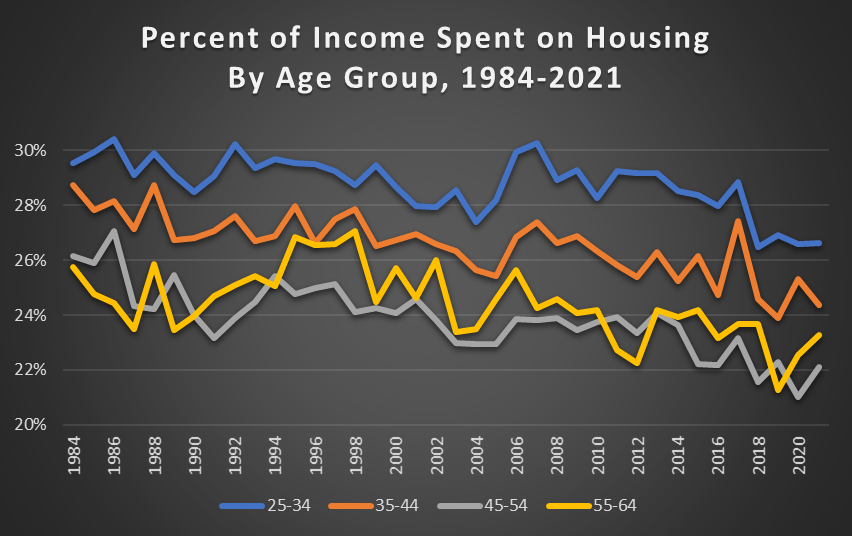
Are Americans spending more of their income on housing than in the past? Using data from the Consumer Expenditure Survey back to 1984, the answer is pretty clear: no. In fact, it has declined mildly.

This concern is usually raised on the context of young people. Are young people spending more of their income on housing than in the past? No.

For working-age Americans, the percent of their income spent on housing has declined mildly since 1984, but I think it’s accurate to say it’s pretty stable (I have truncated the y-axis so you can see the detail). It’s true that young people spend more of their income on housing than older people, but this has always been true, and the gap is pretty constant.

Continue reading

China To Squeeze West by Restricting Export of Essential Rare Earths

Rare earths are a set of 17 metals with properties which make them essential to a swathe of high-tech products. These products include lasers, LEDs, catalysts, batteries, medical devices, sensors, and above all, magnets. Rare earth magnets are used in electric motors and generators and vibrators, making them essential to electric cars, wind turbine generators, cell phones/tablets/computers, airplanes, phones, and all sorts of military devices. 

China happens to have large amounts of rare earth oxide ores for mining, relatively lax environmental standards, and a large, compliant workforce. The Chinese government has harnessed these resources to make the nation by far the largest producer of rare earths. Their massive, relatively low-cost production has suppressed production in other countries. This has been a conscious policy, to achieve global control over a vital raw material.

The first time China used this effective monopoly as a political weapon was in a maritime dispute with Japan in 2010. China cut off exports of rare earth metals to Japan for two years, crimping the Japanese electronics industry.  Other nations took note of this threat, and since then have been a number of half-hearted (in my opinion) efforts in various Western nations to develop some domestic capacity and to redesign motors to reduce dependence on rare earth materials.

 China’s share of rare earth ore mined is down to 60%, but they totally dominate processing the ore to metals, and subsequent fabrication of magnets from the metal.  Nearly all of the ore mined in the U.S. is shipped over to China for processing, mainly because of environmental regulations here.  

According to the Asia Times,

The PRC still dominates the entire vertical industry and can flood global markets with cheap material, as it has done before with steel and with solar panels. In 2022, it mined 58% of all rare earths elements, refined 89% of all raw ore, and manufactured 92% of rare earths-based components worldwide.

There is no other global industry so concentrated in the hands of the Chinese Communist Party, nor with such asymmetric downstream impact, as rare earths.

It seems the only way for the West to blunt the Chinese monopoly in rare earths is with large, long-term subsidies (since the Chinese can always undersell the rest of the world on a free market basis) and probably some pushing past environmental objections.

Alarmed by the rapid buildup of Chinese military forces (towards a possible invasion of Taiwan), the U.S. and its allies have begun restricting exports of the highest-power silicon chips to China. In retaliation, China has reportedly made plans to restrict exports of rare earths, starting in 2023. If they follow through, that move would crush fabrication of magnets and of magnet-dependent devices like motors and generators in other countries; the rest of the world would have to come crawling to China for all these items.

This move would in turn cause the rest of the world to accelerate its plans to produce rare earths outside China, but there would be several years of great disruption, and Chinese-made final devices like motors and generators would always have a huge price advantage, due to their cheaper raw material inputs.

I suspect there may be a high-stakes game of brinksmanship going on behind the scenes. The Chinese leadership presumably knows that they can only play this rare earth export ban card once, and the West does not really want to plow a lot of resources into producing large amounts of rare earths much more expensively than they can be bought from China. So maybe we will see some relaxation in chip export controls for China in exchange for them not pulling the final trigger on a rare earth export ban.

We live in interesting times.

Clarity on the Federal Debt

I have a list of economics topics that I like to teach about because they conflict with the biases of my average student. The list includes fiat currency, inflation, deficits, net exports, and immigration. The list also includes the importance – or lack thereof – of the federal government’s debt. This post walks through a few graphs to do a gut-check of what we think is true and how it compares to reality. For example, do you have a sense of when the debt grew historically and when it was constant? Do you have a sense for when it shrank?

Continue reading

More Ideas Pages

I’ve written here about my ideas page of economics papers I’d like to see.

After that post I heard from others who maintain similar pages. David Friedman has a small page here with research ideas, along with larger pages of short story ideas and product ideas.

HiveReview is a site where one can post or comment on both completed papers and paper ideas. The site does many things at once, but one use case is to post ideas in search of collaborators or to search for projects where someone wants a collaborator for their idea.

I learned today that Gwern Branwen maintains a large page of “Questions“, some of which could be research ideas, mostly outside of economics. He also has pages of research ideas and startup ideas. Some examples of Questions:

Given the crucial role of trust and shared interests in success stories like Xerox PARC or the Apollo Project or creative collaborations in general, why are there so few extremely successful pairs of identical twins?

Nicotine alternatives or analogues: there seem to be none, but why not?

Nicotine is one of the best stimulants on the market: legal, cheap, effective, relatively safe, with a half-life less than 6 hours. It also affects one of the most important and well-studied receptors. Why are there no attempts to develop analogues or replacements for nicotine which improve on it eg. by making it somewhat longer-lasting or less blood-pressure-raising, when there are so many variants on other stimulants like amphetamines or modafinil or caffeine?

Inflation and GDP Growth in the G7 Revisited

In August 2022, I wrote a post showing that among G7 nations, the US had the highest inflation during the pandemic, but also the highest rate of real economic growth. But since the economic situation is evolving rapidly, I wanted to update that data from mid-2022 (I also use core inflation, but I’ll use total inflation in this post).

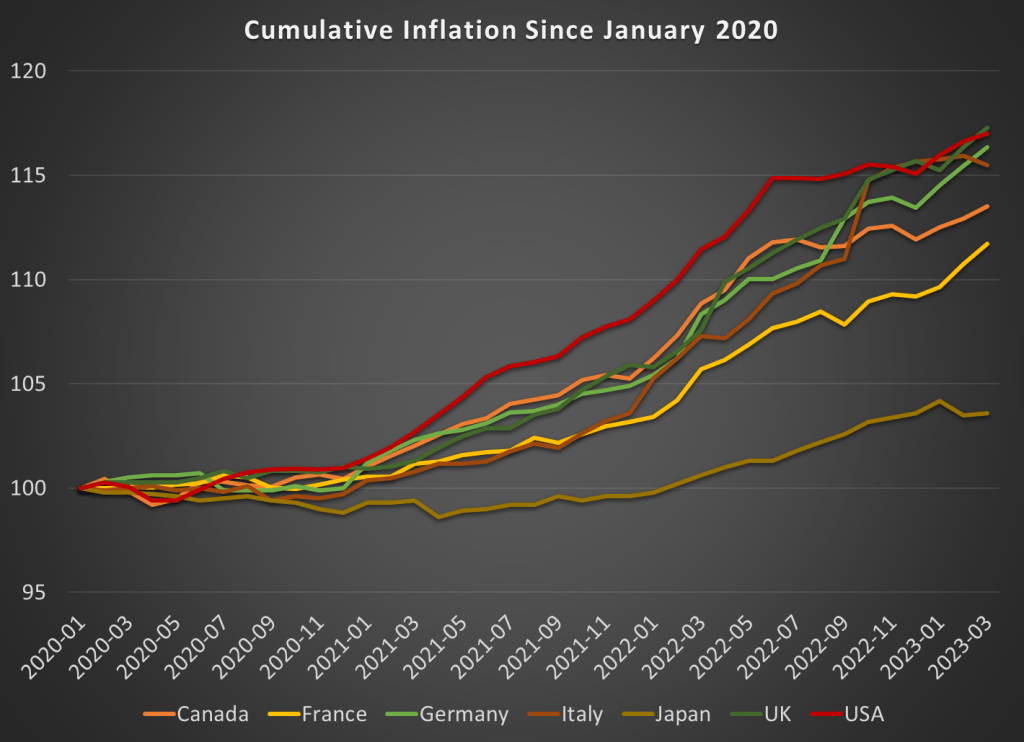
Here’s how inflation has looked during the pandemic:

While the US had the most cumulative inflation for much of the pandemic, the cooling of inflation in the US and the acceleration in Europe has changed things a bit. By late 2022, the UK and Italy had caught up to the US, and Germany is closing in too. These countries have cumulative inflation of between 15 and 17 percent since January 2020.

Japan looks to be the winner here. But wait, we don’t only care about low and stable inflation. We also want economic growth. Here’s the data through the 4th quarter of 2022 (we’ll start to get 2023q1 data from countries next week):

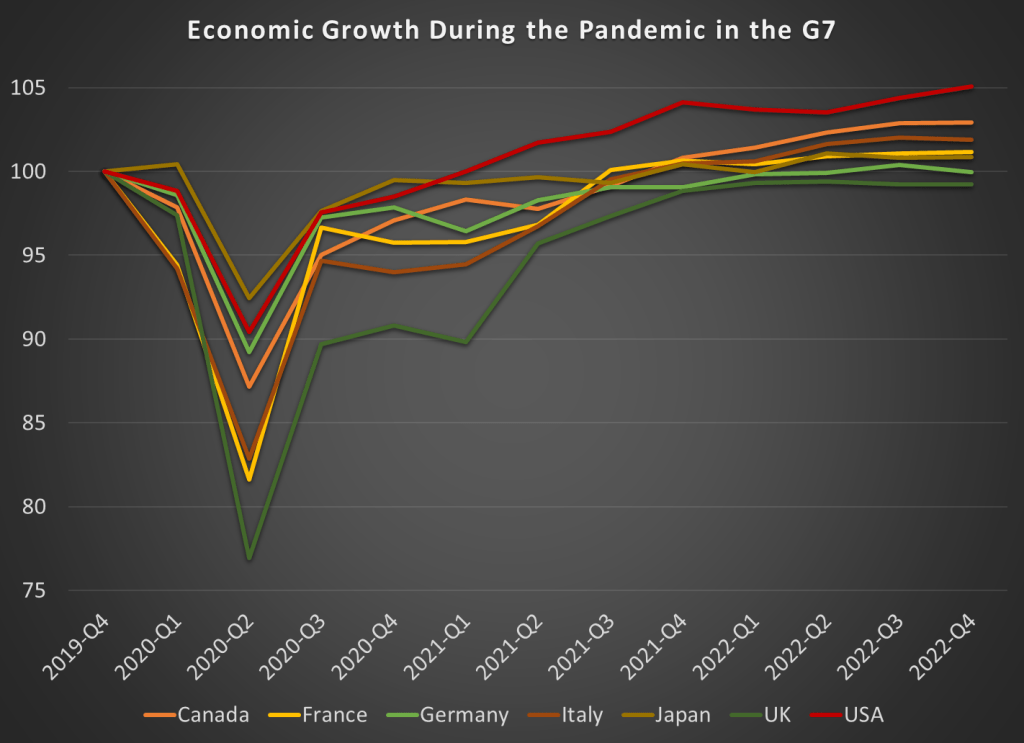
By this measure, the US comes out as the clear winner, with real GDP being about 5 percent higher than the end of 2019. That might not sound impressive for 3 years of growth, until you realize that 5 of the 7 nations had growth below 2 percent, with Germany and the UK actually still smaller than the end of 2019! And this doesn’t take account of the cumulative losses. Notice that the US had the second smallest dip in 2020q2 as well.

It’s hard to know exactly what the right non-COVID counterfactual would be, since these countries all had different rates of growth before the pandemic. But adding up the GDP scaled to 100 before the pandemic, the US is the only G7 country where these 12 quarters of data add up to more than 1,200. The other countries haven’t even had enough growth since the 2020 recession to make up for the losses during the recession, to say nothing of what their potential growth would have been. Japan comes the closest to making up the losses, while the UK stands out as the worst.

Here’s the figures for all the G7 countries, with 100% meaning they have had enough growth to offset the losses from the 2020 recession:

US: 100.8%

Japan: 99.3%

Canada: 98.6%

Germany: 98.0%

France: 97.1%

Italy: 96.9%

UK: 94.5%

Bitcoin’s Dramatic Comeback: Resurrection or Dead Cat Bounce?

In the past year, one cryptocurrency firm after another has gone bust, culminating in the grand implosion of the FTX exchange. The crypto vortex also contributed to some of the recent banking failures.

The prices of cryptocurrencies shot up in 2021, probably fueled by pandemic stimulus money sloshing around in the bank accounts of restless 20- and 30-somethings. All this came crashing back to earth in 2022, giving ample scope for skeptics to say, “I told you this was all foolishness.” Last rites were said, and crypto was left for dead.

But wait… in 2023, when no one was looking, the lid of the crypto coffin started to rattle, a bony hand reached out, and…crypto is back!!

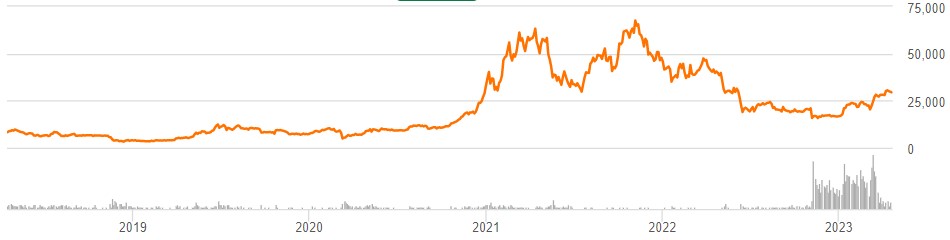
Well, sort of. Here is a five-year chart of Bitcoin from Seeking Alpha, in U.S. dollars:

And here is the past six months:

We can see that Bitcoin took its final big leg down in November, 2022, with the FTX collapse. Its price stayed fairly plateaued down there (with heavy trading volume) until January. Since then, it has nearly doubled.

What has triggered this rise in 2023? Observers such as Michael Grothaus at Fast Company suggests some four factors:

( a ) A shift to “risk-on” with the prospect of the Fed easing off with interest rate hikes this year.

( b ) A flight to alternative assets in the wake of the turbulence in the banking sector. Also, since the total amount of bitcoin is programmed to never increase over a certain number, Bitcoin should be a hedge against inflation. (Many observers believe that the Fed will live with 3-4 % inflation indefinitely, to help inflate away the gigantic debt that the federal government incurred with pandemic relief).

( c ) Buying of Bitcoin by traders who were short, and now need to cover their positions.

( d ) The usual rise in Bitcoin values as a bitcoin “halving” event is on the horizon. (About every four years, with the next time scheduled for May 2024, the rewards for mining new bitcoins drops by 50%).

Will the rise in Bitcoin prices continue? Is this truly a resurrection from the dead, or just a “dead cat bounce”? [1] Nobody knows. But this latest, sustained rally seems to have helped it recover some luster of legitimacy as an asset class. Here is a list of some popular crypto exchanges that are still in operation.

My personal take: I hold a sliver of the Bitcoin fund GBTC, just to have some skin in the game. I have been too lazy to learn about and activate an actual crypto wallet. I think Bitcoin in particular is an intriguing entity. Many other cryptos at some level depend on some centralized administration, but Bitcoin embodies the ideal of a decentralized, power-to-the-people form of something like money.

[1] From Wikipedia: In finance, a dead cat bounce is a small, brief recovery in the price of a declining stock.  Derived from the idea that “even a dead cat will bounce if it falls from a great height”, the phrase is also popularly applied to any case where a subject experiences a brief resurgence during or following a severe decline. This may also be known as a “sucker rally”.

Spending Like a…

Is the federal government spending at a faster rate? Your answer probably has more to do with your biases than with anything else. Most people don’t know the numbers or they imagine some more appropriate past. Below is logged current federal expenditures (this does not include government fixed investment, only consumption. Yes, we can argue about measures. This doesn’t include transfers).

The line of best fit is about 1.6% per quarter or 6.4% per year. Golly! Our spending is rising so fast! But, US federal spending grew relatively slowly in the 90s – maybe due to that fiscal conservative, Bill Clinton. And our federal spending grew even more slowly between 2010 and 2016 – maybe due to that other fiscal conservative, Barack Obama.

But, inflation varied over this period. What about real, inflation adjusted federal spending? See Below.

Continue reading

Why States Hate Nursing Homes

Medicaid is a health insurance program for those with low incomes, funded largely by states. Overall it accounts for less than 20% of US medical spending. But there is one area where it is the dominant payer: nursing homes. Nursing homes are expensive, and Medicare (the typical insurance for those over 65) won’t cover them after the first hundred days, so most nursing home residents end up paying out of pocket until they burn through all their savings and wind up on Medicaid. At which point, Medicaid pays about $100,000 per year to the nursing home for the rest of their life.

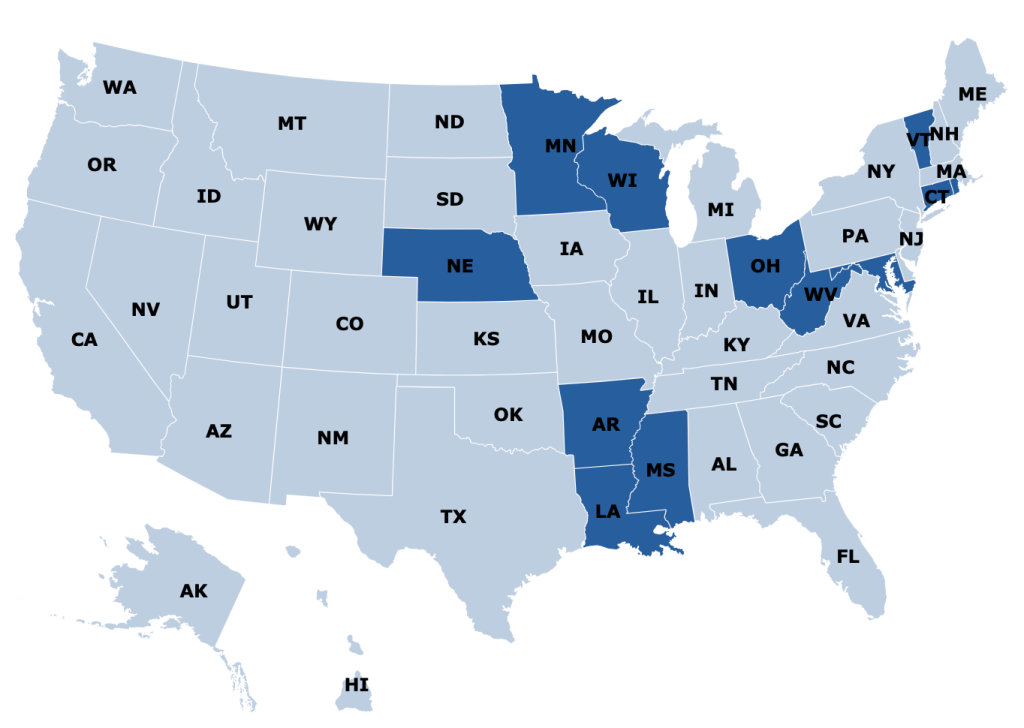
States are responsible for up to half of that cost, and so start looking for ways to save money. One idea they have is to make it harder to build nursing homes: if there aren’t beds available, potential nursing home patients will have to stay home instead, where they can’t rack up Medicaid spending the same way. In fact, some states go all the way to a complete moratorium on new nursing homes:

Source: Institute for Justice

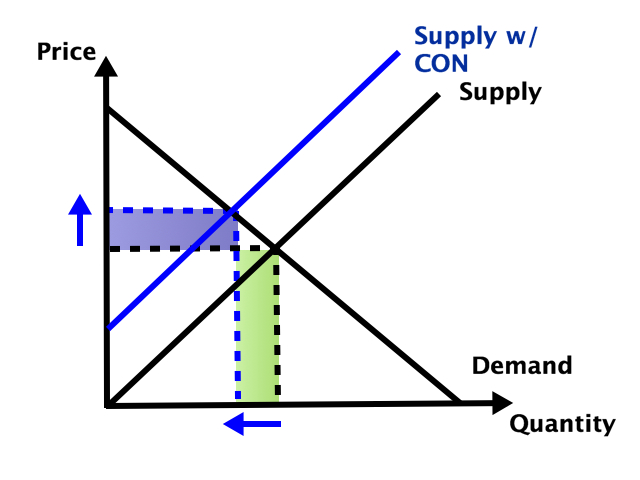
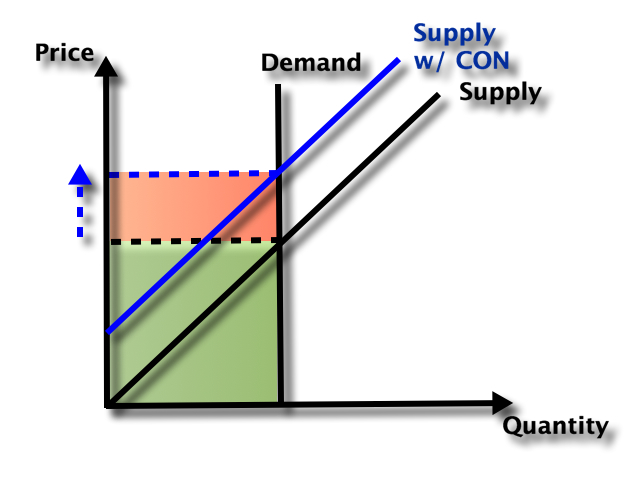
Some other states allow new nursing homes, but only with a special permission slip called a Certificate of Need (CON). CON is often required for other types of health facilities as well, like hospitals or dialysis centers. Research by me and others has generally found that CON doesn’t work as a way to reduce spending, and in fact actually increases it. CON might reduce the number of facilities, but that reduction of supply and competition gives the remaining facilities more power to raise prices.

So which effect dominates- does the smaller number of facilities reduce total spending, or do the higher prices increase it? It depends on the elasticity of demand:

In health care demand is typically quite inelastic, so the price effect dominates, and spending goes up:

But nursing homes could be an exception here. Elasticity of demand could be relatively high because of the number of potential substitutes- home care or assisted living for those with relatively low medical needs, hospitals for those with relatively high medical needs. Plus this is the one type of health care where Medicaid is the dominant payer. They could be especially resistant to price increases here, both due to their market power and their willingness to keep prices so low that facilities won’t take Medicaid patients (another way to save money!).

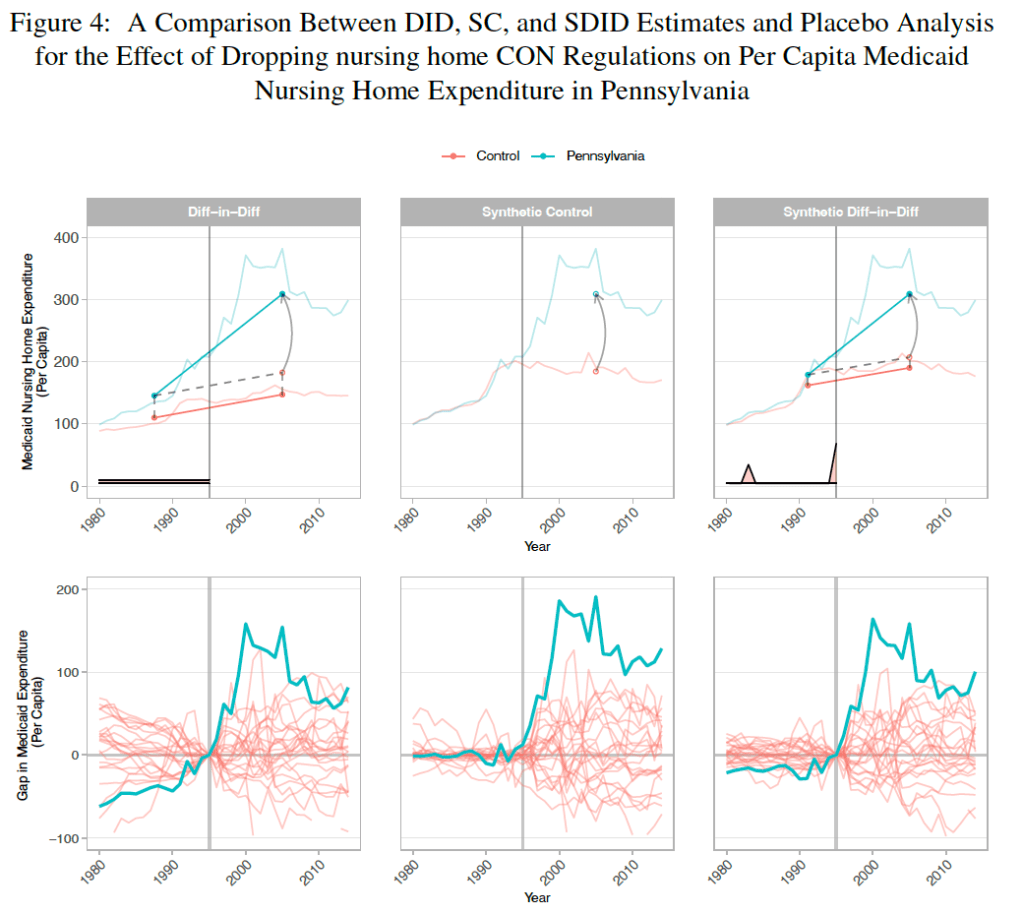
A new paper by Vitor Melo and Elijah Neilson finds that this is indeed the case. Indiana, Pennsylvania, and North Dakota repealed their nursing home CON requirements in the ’90s, and at least for IN and PA their Medicaid spending went way up. The paper uses a new “synthetic difference in difference” technique that seems appropriate, and creates figures that seem confusing at first but get a ton of information across:

They correctly note that they don’t evaluate the welfare effects of the policy; it’s possible that the extra nursing home beds following CON repeal bring huge benefits to seniors that are worth the higher spending. But nursing homes could be the exception to the general rule that CON fails to achieve the goals, like reduced spending, that advocates set for it.

Workers Finally Get a Real Annual Raise

Back in December I pointed out that, thanks to slowing inflation, real wages had been rising since June 2022 (using either the CPI or the PCEPI for inflation adjustments).

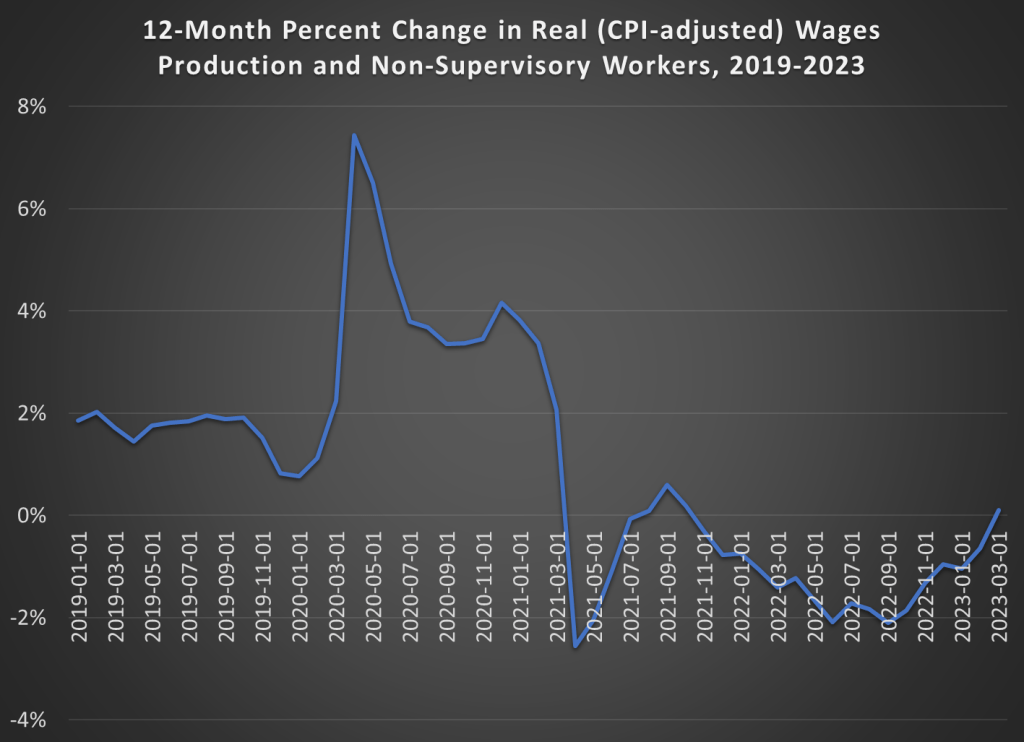
With the latest monthly data, we can now report more good news for wage earners: CPI-adjusted wages have increased over the past 12 months. That had happened since 2021. In the past 12 months, wages of production and non-supervisory workers are up 5.1%, just a hair more than the annual increase in the CPI of 5.0%. It’s not much, and we’re not back to our pre-pandemic norm of 2% real wage growth. But it is more good news that we may finally getting past our post-COVID inflationary hangover.