Do Required Personal Finance Classes Work?

41 states now require students to take a course in economics or personal finance in order to graduate high school:

Source: Council for Economic Education

12 states representing 21% of US high schoolers passed mandates for personal finance classes just since 2022. This sounds like a good idea that will enable students to navigate the modern economy. But does it work in practice?

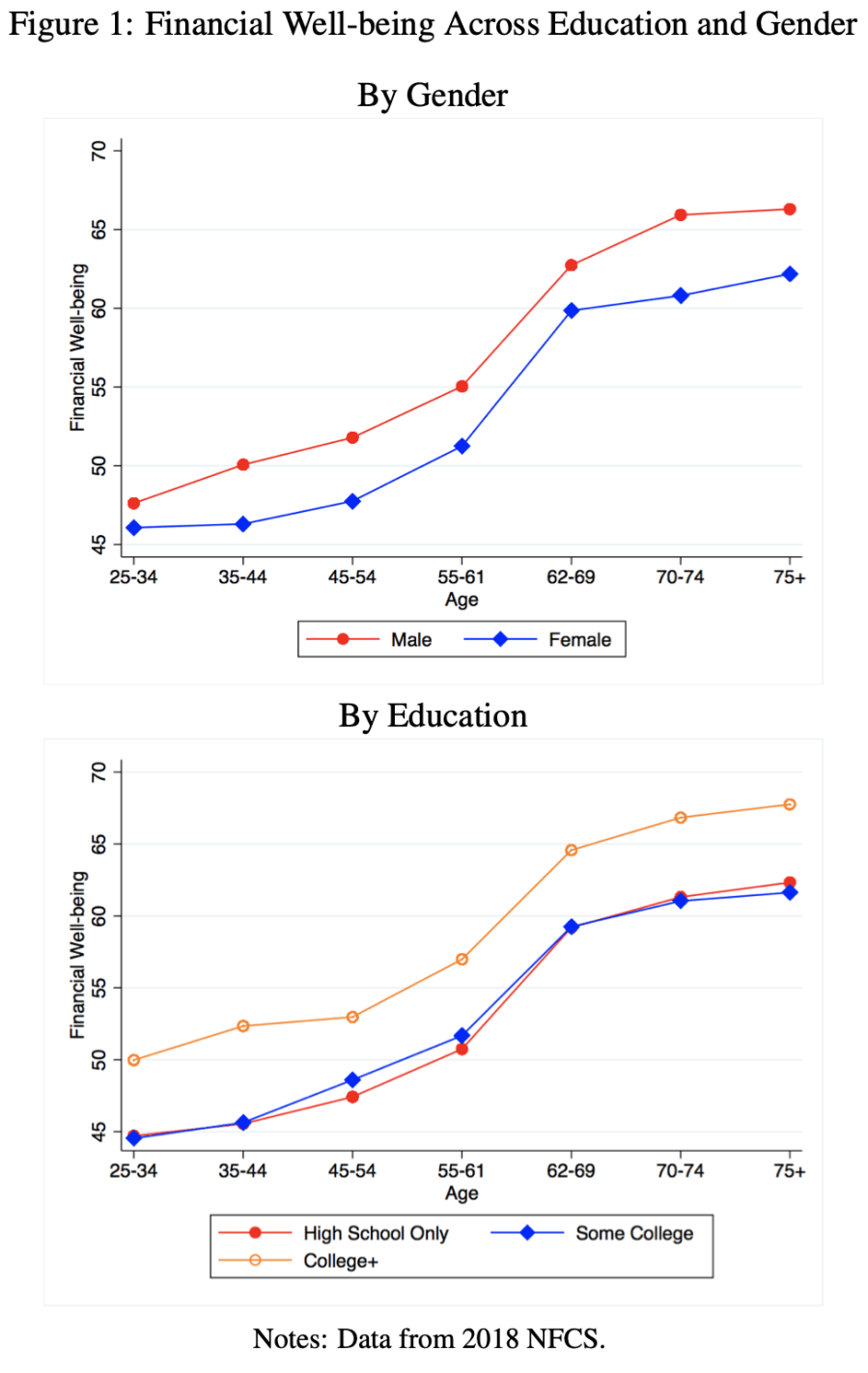
A 2023 working paper “Does State-mandated Financial Education Affect Financial Well-being?” by Jeremy Burke, J. Michael Collins, and Carly Urban argues that it does, at least for men:

We find that the overall effects of high school financial education graduation requirements on subjective financial well-being are positive, between 0.75 and 0.80 points, or roughly 1.5 percent of mean levels. These overall effects are driven almost entirely by males, for whom financial education increases financial well-being by 1.86 points, or 3.8 percent of mean financial well-being.

The paper has nice figures on financial wellbeing beyond the mandate question:

As soon as I heard about the rapid growth in these mandates from Meb Faber and Tim Ranzetta, I knew there was a paper to be written here. I was glad to see at least one has already tackled this, but there are more papers to be written: use post-2018 data to evaluate the new wave of mandates, evaluate the economics mandates in addition to the personal finance ones, and use a more detailed objective measure like the Survey of Consumer Finances.

There’s also more to be done in practice, hiring and training the teachers to offer these new classes:

our estimates are likely attenuated due to poor compliance by schools subject to new financial education curriculum mandates. Urban (2020) finds evidence that less than half of affected schools may have complied. As a result, our estimated overall and differential effects may be less than half the true effects

What’s the Best Major to Prepare for Law School?

  • This is post coauthored with Jack Cavanaugh, Ave Maria University Graduate of 2025.

Say that you want to become a successful lawyer. What does that mean? One possible meaning is that you are well-compensated. Money is not everything, but it does give people more options for how to spend their time and resources. Law degrees are a type of graduate degree. So, what bachelor’s degree major should one choose in preparation for law school? We lack rich administrative data on college majors and LSAT scores.

Luckily, the 2023 American Community Survey (ACS) comes to the rescue. It has all of the typical demographic covariates, income, occupation, and college major. So, if we make the small leap that well-prepared law school students become high-performing lawyers who are ultimately paid more, then what college major puts you on the right path? What should your major be?

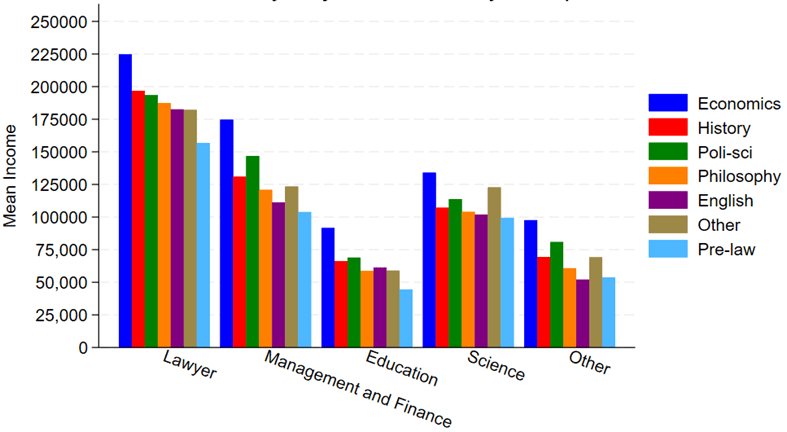
We don’t look at an exhaustive list. We place several occupations into bins and examine only a few alternative majors. Any unlisted major falls under ‘other’. Below are the raw average incomes by occupational category and college major. Note two majors in particular. First, Pre-law literally has the word ‘law’ in the name and is marketed as preparation for law school. However, it is the undergraduate major associated with the lowest paid lawyers. For that matter, Pre-law majors have the lowest pay no matter what their occupation is. Second, Economics majors are the most highly paid in all of the occupations.

Continue reading

Is AI learning just MOOCs again?

I created a provocative title for fun. Tyler pointed me to this podcast:

Joe Liemandt  – Building Alpha School, and The Future of Education (Apple podcast link)

I suppose I’m sold on their claim that most kids can learn basic facts and some academic skills from an iPad app. Listen all the way through if you are going to listen at all, because even some cracks in the tech product are revealed after the big pitch in the beginning.

I have been using Duolingo to review my high school French and Spanish. I think the few minutes a day I spend have helped drag some vocabulary back out of long-term storage. Although, as I recently heard a comedian say, “All my friends who have Duolingo are still speaking English to me.”

Folks should consider whether AI learning apps is just MOOCs again. Essentially, they need to get kids to watch (short, this time) videos of lecture content. MOOCs were longer lecture content videos. Maybe shorter is the key, combined with personalized feedback. Maybe not, for getting cheap effective comprehensive education that scales.

Last year I wrote Why Podcasts Succeeded in Gaining Influence Where MOOCs Failed

About half an hour in, Liemandt asserts that anyone in America would agree that kids learn life skills through “sports” not school. That’s an oversimplification, but I agree that sports ranks higher than “math class” for developing leadership ability.

Since they at Alpha School believe that have solved quickly learning facts, it’s interesting to hear how they do the rest of “education.” The school must fill enough time that the parents don’t have to see their kids half the day and also teach leadership/ communication/character. Alpha school is expensive ($40,000 a year) and there are many paid adults involved who are called “guides and coaches.”

The extracurriculars that Alpha school offers sounds a lot like what most kids can do in some form at a good public middle school or high school in America.  I wrote about the value of outside-class activities in college here: The Value of Student Organizations and On-Campus Education: Anecdotal Evidence from Tim Keller

My students at Samford are especially good at taking on leadership roles and creating a thriving community. Residential college provides a good testing ground for leadership and there are real “market tests” of success for things like sorority events, as the Alpha school encourages for older kids.

I applaud people trying to innovate. I think we’ll see more educational apps in schools, and that will be great. I’m not trying to dump on Alpha School. I just think the underperformance arc of MOOCs should temper our enthusiasm.

We Don’t Have Mass Starvations Like We Used To

Two ideas coalesced to contribute to this post. First, for years in my Principles of Macroeconomics course I’ve taught that we no longer have mass starvation events due to A) Flexible prices & B) Access to international trade. Second, my thinking and taxonomy here has been refined by the work of Michael Munger on capitalism as a distinct concept from other pre-requisite social institutions.

Munger distinguishes between trade, markets, and capitalism. Trade could be barter or include other narrow sets of familiar trading partners, such as neighbors and bloodlines.  Markets additionally include impersonal trade. That is, a set of norms and even legal institutions emerge concerning commercial transactions that permit dependably buying and selling with strangers. Finally, capitalism includes both of these prerequisites in addition to the ability to raise funds by selling partial stakes in firms – or shares.

This last feature’s importance is due to the fact that debt or bond financing can’t fund very large and innovative endeavors because the upside to lenders is too small. That is, bonds are best for capital intensive projects that have a dependable rates of return that, hopefully, exceed the cost of borrowing. Selling shares of ownership in a company lets a diverse set of smaller stakeholders enjoy the upside of a speculative project. Importantly, speculative projects are innovative. They’re not always successful, but they are innovative in a way that bond and debt financing can’t satisfy. Selling equity shares open untapped capital markets.

With this refined taxonomy, I can better specify that it’s not access to international trade that is necessary to consistently prevent mass starvation. It’s access to international markets. For clarity, below is a 2×2 matrix that identifies which features characterize the presence of either flexible prices or access to international markets.

Continue reading

Why I Started Grading Attendance

I’ve taught college classes since 2010, but I never graded attendance directly until this year. I thought that students are adults who can make their own choices about where to spend their time, and if they could do well on my tests and assignments without spending much time in class, more power to them.

But I got tired of seeing students miss a lot of class, then fail by getting poor grades on the tests and assignments, or scramble for the last few weeks to avoid failing. Explaining the importance of attendance didn’t seem to help, so I finally turned to the economist’s solution- incentives. This Spring I tried grading attendance in one class, and this successful experiment plus the growth of AI mean I plan to grade attendance in all classes from now on.

The Benefits:

  • Get to know student’s names faster
  • Students feel rewarded for showing up
  • Students show up more, bringing more energy to the room
  • Students show up more, so they learn more and do better on other assignments
  • Physically showing up is one thing I can be sure the AI isn’t doing for them, it will be a while before humanoid robots are that good

The Costs That Turned Out Not to Be Big Deals

  • I thought students would dislike me policing their whereabouts and give me lower course evaluations (which is part of why I waited for tenure to try this). But my Spring evals were at least as high as usual, with none mentioning the attendance policy. When I asked students in a different class about this, most said they wished I would grade attendance if it meant less weight on exams.
  • I thought tracking attendance would be burdensome, but it turns out my main course software (Canvas) already has an attendance-tracking tool built in that lets you just click on names in a seating chart each day and enters grades automatically. It is certainly less burdensome than grading most assignments.

I still had some students disappear for a while due to personal issues; sometimes even the strongest grade incentives aren’t enough to get people to class. But overall I can’t believe I waited this long. I’m currently putting attendance as 10-15% of the course grade, but I dream about someday running a discussion-based class like a Liberty Fund seminar, doing a 100% attendance/participation grade, and not having to grade anything.

I’m Chair! 😬

As of July 1st of this year, I am the Chairman of the Department of Economics at my university. It’s one of those positions that includes more work and not much compensation. Depending on who I tell, I’m given both congratulations and condolences. Generally, at my university there is an expectation that department faculty ‘take turns’ being chair. So, we’re expected to serve whether the pay is good or not. There’s a lot of informal practice around this process.

In addition, Economics Majors have been less popular at liberal arts institutions over the past several years. No one knows why and there are probably multiple reasons. At my institution, our department has healthy enrollment among the peripheral majors. So, the Economics BA and BS have lower enrollment, but the Business Economics and the Global Affairs majors are more popular than ever.

All the same, I’d like to increase the number of students who have declared majors in our department and the number of Economics graduates. How do I do that?

Continue reading

US State Growth Statistics 2005-2024

In macroeconomics we have basic tools to help us talk about economic growth, which is simply the percent change in RGDP per capita. What causes growth? Lot’s of things. All else constant, if more people are employed, then more will be produced. But the productivity of those workers matters too. That’s why we calculate average labor productivity (ALP), which is the GDP per worker. This tells us how much each worker produces. All else constant, more ALP means more GDP.*

What affects ALP? Nearly everything: Technology, demographics, health, culture, and public policy. Most of these have long-term effects. So, it’s better to think in terms of regimes. After all, incurring debt now can result in a lot of investment and production, but there’s no guarantee that it can be sustained year after year. This is why I don’t get terribly excited about individual good or bad policies at any moment. There’s a lot of ruin in a nation. I care more about the long-run policy regime that is fostered over time.

Given the variety of inputs to economic growth, there’s always plenty of room for complaint about policy – even if the economy is doing well. In this post, I’m inspired by a Youtube video that a student shared with me. The OP laments poor policy in Massachusetts. But compared to some other nearby states, MA is doing just fine economically. This is not the same as saying that the OP is wrong about poor policies. Rather, a regime of policy, technology, interests, etc. is built over time and there can be a lot wrong in growing economies.

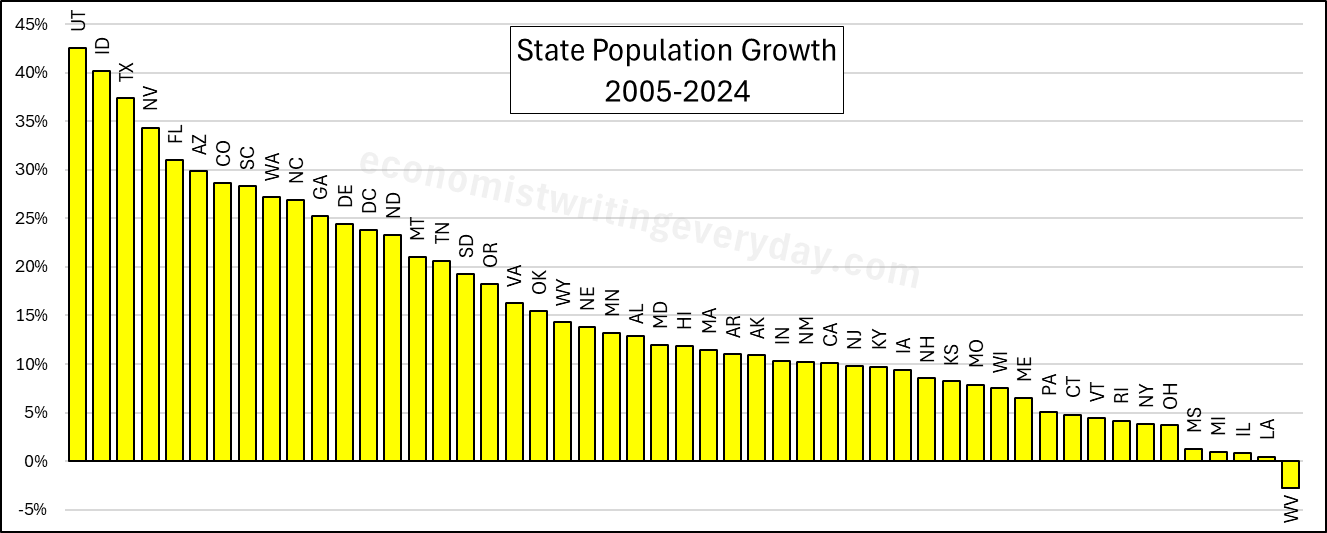
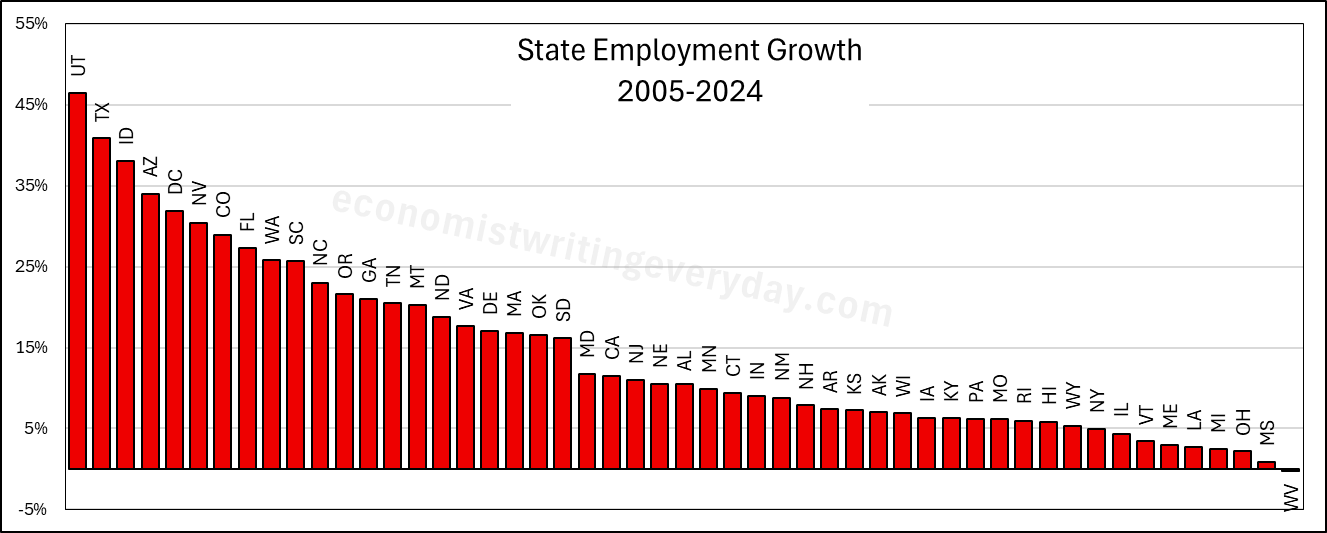
In the interest of being comprehensive, this post includes basic growth stats for all states from 2005 through 2024 (the years of FRED-state GDP).** First, let’s start with the basic building blocks of population, employment, and RGDP. Institutions matter. Policy affects whether people migrate to/from the state, fertility, how many people are employed, and what they can produce.

People like to talk about migration and the flocking to Texas & Florida. But that fails to catch the people who choose to stay in their state. Utah is  43% more populous than it was 20 years ago. But you don’t hear much clamoring for their state policies. Idaho and Nevada also beat Florida in terms of percent change. Where are the calls to be like Idaho? Employment largely tracks population, though not perfectly. The RGDP numbers can change quickly with commodity prices, reflected in the performance of North Dakota. But remember, these numbers cover a 20 year span. So, any one blockbuster or dower year won’t move the rankings much.

Of course, these figures just set the stage. What about the employment-population ratio, ALP, and RGDP per capita? Read on.

Continue reading

The End of Easy Student Loans

The Senate Health, Education, Labor and Pensions Committee is proposing to cut off student loans for programs whose graduates earn less than the median high school graduate. The House proposed a risk-sharing model where colleges would partly pay back the federal government when their students fail to pay back loans themselves. Both the House and Senate propose to cap how much students can borrow for graduate loans. Both would reduce federal spending on higher ed by about $30-$35 billion per year, cutting the size of the $700 billion higher ed sector by 4-5%. I expected that something like this would happen eventually, especially after the student loan forgiveness proposals of 2022:

While we aren’t getting real reform now, I do think forgiveness makes it more likely that we’ll see reform in the next few years. What could that look like?

The Department of Education should raise its standards and stop offering loans to programs with high default rates or bad student outcomes. This should include not just fly-by-night colleges, but sketchy masters degree programs at prestigious schools.

Colleges should also share responsibility when they consistently saddle students with debt but don’t actually improve students’ prospects enough to be able to pay it back. Economists have put a lot of thought into how to do this in a manner that doesn’t penalize colleges simply for trying to teach less-prepared students.

I’d bet that some reform along these lines happens in the 2020’s, just like the bank bailouts of 2008 led to the Dodd-Frank reform of 2010 to try to prevent future bailouts. The big question is, will this be a pragmatic bipartisan reform to curb the worst offenders, or a Republican effort to substantially reduce the amount of money flowing to a higher ed sector they increasingly dislike?

Of course, there is a lot riding on the details. How exactly do you calculate the income of graduates of a program compared to high school grads? The Senate proposal explains their approach starting on page 58. They want to compare the median income of working students 4 years after leaving their program (whether they graduated or dropped out, but exempting those in grad school) to the median income of those with only a high school diploma who are age 25-34, working, and not in school.

Nationally I calculate that this would make for a floor of $31,000. That is, the median student who is 4 years out from your program and is working should be earning at least $31k. In practice the bill would implement a different number for each state. This seems like a low bar in general, though you could certainly quibble with it. For instance, those 4 years out from a program may be closer to age 25 than age 34, but income typically rises with age during those years. If you compare them to 26 year old high school grads, the national bar would be just $28k.

What sorts of programs have graduates making less than $31k per year?

Continue reading

The Average Teaching Load of US Professors

“One of the closest guarded secrets in American higher education is the average teaching loads of faculty.” -Richard Vedder

I saw this quote in a recent piece arguing that US professors should teach more. I thought it sounded extreme, but as I look into it, it is surprisingly difficult to find data on this compared to other things like salaries:

Since 1996, for instance, the University of Delaware has administered the annual National Study of Instructional Costs and Productivity, surveying faculty and teaching assistants about course loads and enrollment. The data, though, are “only available to four-year, non-profit institutions of higher education.”[7] This secrecy, needless to say, is not the norm for surveys collected by publicly supported institutions. Tellingly, this study is being discontinued because the number of participating institutions “has slowly declined to unsustainable levels.”[8] *

There are some decent older studies that are public, like this 2005 survey of top liberal arts colleges showing that almost all have teaching loads between 4 and 6 courses per year. But in terms of recent data that is publicly available, the best I’ve found is the Faculty Survey of Student Engagement. It still isn’t great, since their 2024 survey only covers 54 of the 2000+ bachelor’s degree granting colleges in the US, and their tables show that these 54 aren’t especially representative. They make nice graphics though:

The graphics show exact percentages if you hover over them on the original Tableau site. Doing this shows that the median professor teaches 4 undergraduate courses per year. Knowing the full distribution would require the underlying data they don’t share, but from these graphics we can at least compute a rough average (rounding 4+ graduate courses to 4 and 9+ undergraduate courses to 9).

This shows that the average professor teaches 4.43 undergraduate courses and 0.75 graduate courses, for a total of 5.18 courses per academic year. If I restrict the data to full-time tenured or tenure-track professors, they teach an average of 4.72 undergraduate courses and 0.91 graduate courses, for a total of 5.63 courses per academic year.

Overall these loads are higher than I expected, especially since the survey sample is skewed towards research schools. But its still lower than the standard 3-3 load at my own institution, and low enough that it makes for a great job, especially compared to teaching K-12.

Overall though I don’t know why we need to rely on one-off surveys to get data on teaching loads, it seems like data the US Department of Education should collect from all accredited schools and share publicly.

*The Delaware Cost study is not just discontinuing new surveys, they plan to pull down existing data by December 15th 2025. Only schools that participate in their survey get access, so I can’t get the data, but perhaps some of you can.

We’re All Magical

The widespread availability and easy user interface of artificial intelligence (AI) has put great power at everyone’s fingertips. We can do magical things.

Before the internet existed we would use books to help us better interpret the world.  Communication among humans is hard. Expressing logic and even phenomena is complex. This is why social skills matter. Among other things, they help us to communicate. The most obvious example of a communication barrier is language. I remember having a pocket-sized English-Spanish dictionary that I used to help me memorize or query Spanish words. The book helped me communicate with others and to translate ideas from one language to another.

Math books do something similar but the translation is English-Math. We can get broader and say that all textbooks are translation devices. They define field-specific terms and ideas to help a person translate among topic domains, usually with a base-language that reaches a targeted generalizability. We can get extreme and say that all books are translators, communicating the content of one person’s head to another.

But sometimes the field-to-general language translation doesn’t work because readers don’t have an adequate grasp of either language. It isn’t necessarily that readers are generally illiterate. It may be that the level of generality and degree of focus of the translation isn’t right for the reader. Anyone who has ever tried to teach anything with math has encountered this.  Students say that the book doesn’t translate clearly, and the communication fails. The book gets the reader’s numeracy or understood definitions wrong. Therefore, there is diversity among readers about how ‘good’ a textbook is.

Search engines are so useful because you can enter some keywords and find your destination, even if you don’t know the proper nouns or domain-specific terms. People used to memorize URLs and that’s becoming less common. Wikipedia is so great because if you want to learn about an idea, they usually explain it in 5 different ways. They tell the story of who created something and who they interacted with. They describe the motivation, the math, the logic, the developments, and usually include examples. Wikipedia translates domain-specific ideas to multiple general languages of different cognitive aptitudes or interests. It scatters links along the way to help users level-up their domain-specific understanding so that they can contextualize and translate the part that they care about.

Historical translation technology was largely for the audience. More recently, translation technology has empowered the transmitters.

Continue reading