Protein, Protein Everywhere

If you’ve ever been vegetarian or if you have ever spoken to a vegetarian about their diet, then you have probably heard or asked “How do you get enough protein?”.  While it’s important for health and economic achievement to get adequate protein, not too long after comes the questions about types and sources of protein. This question is relevant for vegetarians and vegans, but also people with meat allergies and people with religious dietary guidelines that prohibit meat always or seasonally. Let’s break it down.

Some omnivores are incredulous that vegetarianism can provide adequate protein or protein quality. But protein itself is relatively easy to get and any judgmental attitudes on both sides are mostly just vibes. Legumes and nuts tend to have a lot of protein. But relative to what?

The World Health Organization recommends that an 80-kilogram (176 lb) adult should get 66.4 grams of protein per day (0.83g per kg). That’s the protein content of about a 9oz of peanuts. Protein is super important and it’s luckily not that hard to get if you eat a variety of foods. Even if you’re trying to consume double the WHO recommended daily intake (RDI), it’s an easy feat.

Below is a table of some popular protein sources. The table includes the grams of protein per 100 grams of food, which makes the protein content a percent. The table also includes the number of grams needed in order to achieve the WHO protein RDI of 66.4 grams. The last column is for our American readers who need the serving to be in ounces.

Continue reading

Interest Rates & Wining

There’s so much to say about interest rates. Many people think about them in the context of whether they should refinance or in terms of their impact on borrowing. But interest rates also matter for production beyond impacting loans for new productive projects. Interest rates aren’t just a topic for debtors.

Interest rates impact all production that takes time. That’s the same as saying that interest rates affect all production – but the impact is easier to see for products that require more time to produce.

There’s this nice model called ‘Portfolio Theory’. Taken literally, it says that everything you own can be evaluated in terms of its liquidity, the time until it will be sold, its expected returns, and the volatility and correlation of those returns. Once you start to look at the world with this model, then it’s much easier to interpret. Buying a car? That’s usually a bad investment. It’s better to tie up a smaller amount of money into that depreciating asset rather than to let a larger sum of money experience dependably negative returns. Of course, this assumes that there are alternative uses for your money and alternative places to invest your resources – hopefully in assets with growing rather than decaying value. People often recommend purchasing used cars rather than new cars. Both new and used cars are bad investments and you can choose to invest a lot or a little.

Producers make a similar calculation. All kinds of things motivate them: love, tradition, excellence…  But everyone responds to incentives. Consider vintners. They might be a farmer of grapes and a manufacturer and seller of wine. They might like to talk about nostalgia, forward notes, a peppery nose, and other finer things. But even they respond to prices and opportunity cost.

Continue reading

What Makes Rhode Island Special?

Other than being the smallest state, of course. In other places I’ve lived, it was more obvious what made them stand out. Boston has the most high-quality universities, including the oldest one (though it is expensive and traffic-ridden). New Orleans has the best food, live music, and festivals (though terrible crime and roads). I’ve lived in Rhode Island since 2020 and I’ve enjoyed how it seems to have no big negatives the way many other places do- it’s been pretty nice all around. But it has been harder to see anything where Rhode Island really stands out.

What should a tourist see or do here that they couldn’t do elsewhere? The Italian food is great, but that’s true of several other cities. You can find Portuguese food here in a way you can’t in most of the US. Probably the Cliff Walk in Newport is our best entry: a 3-mile trail along cliffs where you can see the Atlantic on one side, and Gilded-age mansions on the other.

For those living here, what stands out is the compactness. This makes sense for the smallest state, but it is even more true than you would expect, because even within Rhode Island most people are clustered within the small portion of the state that is within 5 miles of Providence.

Because of this, I almost never feel the need to drive more than 10 miles or 20 minutes; this wasn’t so true any of the other ~dozen places I’ve lived. I can easily walk to the Bay, the Zoo, and my kids’ school; then its a 20 minute drive or less to work, several good hospitals and universities, sailing, several beaches, forest hikes, the state capital, the excellent airport, Amtrak, every good grocery store, leaving the state, et c. Most other places either lack some of those things entirely or involve longer drives to get to them, though probably there’s somewhere else like this I don’t know about.

Or perhaps the best thing about Rhode Island is our people:

What do you think I missed about Rhode Island? Or if you haven’t been here, what do you think is most special about where you live?

When Beer is Safer than Water

I’ve often heard that before modern water treatment, it was safer to drink beer; but I’ve also heard people call this a historical myth. A new paper in the Journal of Development Economics by Francisca Antman and James Flynn comes down strongly on the side of “beer really was safer”:

This paper provides the first quantitative estimates into another well-known water alternative during the Industrial Revolution in England.

Although beer in the present day is regarded as being worse for health than water, several features of both beer and water available during this historical period suggest the opposite was likely to be true. First, brewing beer requires boiling the water, which kills many dangerous pathogens often found in drinking water. As Bamforth (2004) puts it, “the boiling and the hopping were inadvertently water purification techniques”. Second, alcohol itself has antiseptic qualities. Homan (2004) notes that “because the alcohol killed many detrimental microorganisms, it was safer to drink than water” in the ancient near-east.

They use several identification strategies to establish this, for instance when a tax on malt was increased and mortality went up:

But did this mean people were drunk all the time? Probably not:

beer in this period was generally much weaker than it is today, and thus would have been closer to purified water. Accum (1820) found that common beers in late 18th and early 19th century England averaged just 0.75% alcohol by volume, a fraction of the content of the beers of today. Beer in this period was therefore far less harmful to the liver. Taken together, these facts suggest that beer had many of the benefits of purified water with fewer of the health risks associated with beer consumption today.

In fact, people at the time didn’t necessarily know that beer was healthier:

Thus, even though people did not recognize beer as a safer choice, drinking beer would have been an unintentional improvement over water, and thus may have contributed to improvements in human health and economic development over the period we investigate

Though as usual, Adam Smith was ahead of his time. Here’s what he had to say in his 1776 Wealth of Nations, in a chapter on malt taxes:

Spirituous liquors might remain as dear as ever, while at the same time the wholesome and invigorating liquors of beer and ale might be considerably reduced in their price.

“Cheapflation”: Inflation Really Does Hit the Bottom Harder

During the peak of the Covid inflation in 2022 I speculated that food inflation was worst for the cheapest products:

typical McDouble now costs well over $2 in most of the US, while a typical Big Mac is still well under $6. You used to be able to get 4-5 McDoubles for the price of a Big Mac; now you typically get less than 3 and sometimes, as in Keene, less than 2.

What’s going on here? First, the McDouble was always absurdly cheap. Second, prices rise most quickly where demand is inelastic, and demand is less elastic for goods that are cheaper and goods that are more like “necessities” than “luxuries”.

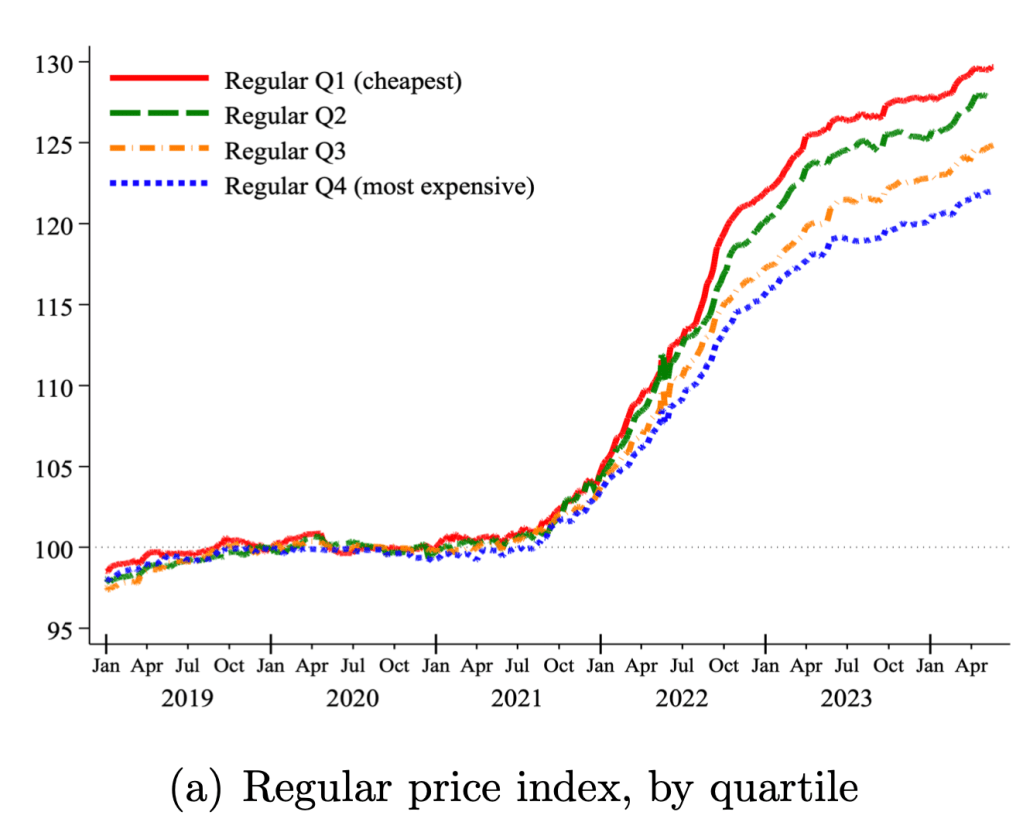
That post was just based on a couple anecdotes from my personal experience, but a new NBER working paper by Alberto Cavallo and Oleksiy Kryvtsov confirms that this really was a general trend:

We use micro price data for food products sold by 91 large multi-channel retailers in ten countries between 2018 and 2024. Measuring unit prices within narrowly defined product categories, we analyze two key sources of variation in prices within a store: temporary price discounts and differences across similar products. Price changes associated with discounts grew at a much lower average rate than regular prices, helping to mitigate the inflation burden. By contrast, cheapflation—a faster rise in prices of cheaper goods relative to prices of more expensive varieties of the same good—exacerbated it. Using Canadian Homescan Panel Data, we estimate that spending on discounts reduced the change in the average unit price by 4.1 percentage points, but expenditure switching to cheaper brands raised it by 2.8 percentage points….

The prices of cheaper brands grew between 1.3 to 1.9 times faster than the prices of more expensive brands—and only when inflation surged, not before or after.

Sugar Fast Blog

Why do Americans eat a lot of junk food? Because it’s the easy way out.

Unhappy? Open a candy bar. You’ll feel happy again in seconds. Kid crying? Hand them a fun-sized candy bar. They will be quiet.  

If you are struggling with paying bills or health (I know, the health one is ironic here), then you’ll tend to reach for anything that is fast and easy to deal with immediate problems.

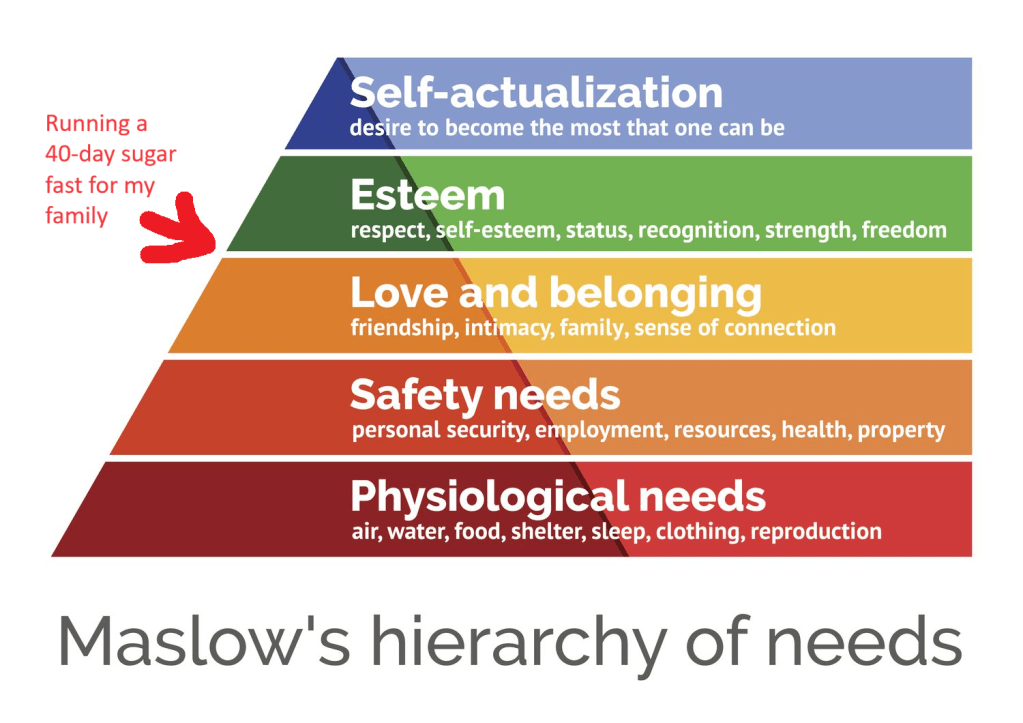
For me, I decided to wait until my semester is over, so I won’t be attempting this while teaching or traveling. A 40-day sugar fast for the whole family technically began on May 1, but the grocery shopping changed earlier. The idea was to eat down junk and not buy new for over a week.

Forty days isn’t much in the big scheme. The idea is to make a deposit on health. Possibly, I’ll break a mild sugar addiction to the point where the body doesn’t expect it so much. Maybe something that we end up doing to meet this artifactual goal will end up getting into the routine on a regular part of the year when there is more travel and work. Part of the problem I identify is that there are points throughout the day where people feel unhappy. If sugar is on hand, then there is a tendency to reach for it. Part of what I’m going to do is insert more healthy food and activities, but of course that is a lot more work. If it’s just not there, people barely miss it.

I’m already so much happier at home. There is barely any sugary junk food left in the house. Now if the kids circulate the kitchen, I don’t have to stress out and yell at them to not eat cookies before dinner or whatnot.

Internet: So, you’re going to meal plan and not eat dessert for a month? This was worth telling everyone?

Me: I’ve been thinking about it constantly since Christmas.

Internet: Wasn’t this the site where we get more optimistic about the world?

Me: There are some things I read about and decided against. I will not worry about sugar in sauces (e.g. Chicken teriyaki bowl). I will not cut out bread or pasta. There is a sliding scale of how healthy you can be and how much time you are willing to put in. I have decided on a level of effort and a fixed amount of time. I’m not even going to turn down cookies if they are offered to us for free. The most important thing is to stop buying junk from the grocery store. It’s financially very cheap, but actually very costly.

P.S. It’s a small step toward getting my personal chef, but I saw an ad for Walmart “emeals” which is more intelligent grocery delivery plus recipes. I haven’t tried it myself, but it seemed like an update on What the Superintelligence Can Do For Us. When I have the equivalent of “former restaurateur, Frances,” in my house, then I just won’t need anything else and innovation can stop there, thanks.

Grocery Inflation is Under Control, Fast Food Prices Aren’t

Thankfully for US consumers, grocery prices have leveled off. They haven’t fallen, of course, which will still lead to viral complaints about egg prices, etc. But over the past 4 years, wages have almost caught up with grocery prices.

Not so with fast food prices (“limited service meals”), which have definitely outpaced wages over the past 4 years, and continue to grow at an annual rate of about 5 percent (also more than wages).

Furthermore, if we go back to 2014, we see it’s not just a post-pandemic effect on fast food. Prices since 2014 are up 54 percent for fast food according to the BLS, more than the 31 percent overall CPI-U increase and more than average wages (46 percent).

An article from FinanceBuzz puts together some more specific data on a dozen fast-food chains in the US. Consumer favorites for a quick, cheap bite to eat like Taco Bell and McDonald’s have seen menu prices increase by 80 or even 100 percent!

Check out the article for even more specific food item data at each of these restaurants. For example, the most famous of fast-food sandwiches is the Big Mac, which is up from $3.99 in 2014 to $5.99 in 2024, a 50 percent increase. A Whopper meal at Burger King is up 79 percent. All the more reason to seek out deals in the apps, or just good-old in-store discounts, like the “buy one get one for $1” promo at most McDonald’s. This deal would get you two Big Macs for $7, or $3.50 each… less than in 2014! Or since today is Wednesday, you might want to head to Burger King, where Whoppers are $3 at most locations (regular price: around $6).

Price discrimination is alive and well at the drive-thru window, and if you are just ordering from the menu without any discounts, you are really going to feel the pain of inflation.

Coffee’s Supply & Demand Dance during Prohibition

I’ve written about coffee consumption during US alcohol prohibition in the past. I’ve also written about visualizing supply and demand. Many. Times. Today, I want to illustrate how to use supply and demand to reveal clues about the cause of a market’s volume and price changes. I’ll illustrate with an example of coffee consumption during prohibition.

The hypothesis is that alcohol prohibition would have caused consumers to substitute toward more easily accessible goods that were somewhat similar, such as coffee. To help analyze the problem, we have the competitive market model in our theoretical toolkit, which is often used for commodities. Together, the hypothesis and theory tell a story.

Substitution toward coffee would be modeled as greater demand, placing upward pressure on both US coffee imports and coffee prices. However, we know that the price in the long-run competitive market is driven back down to the minimum average cost by firm entry and exit. So, we should observe any changes in demand to be followed by a return to the baseline price. In the current case, increased demand and subsequent expansions of supply should also result in increasing trade volumes rather than decreasing.

Now that we have our hypothesis, theory, and model predictions sorted, we can look at the graph below which compares the price and volume data to the 1918 values. While prohibition’s enforcement by the Volstead act didn’t begin until 1920, “wartime prohibition” and eager congressmen effectively banned most alcohol in 1919. Consequently, the increase in both price and quantity reflects the increased demand for coffee. Suppliers responded by expanding production and bringing more supplies to market such that there were greater volumes by 1921 and the price was almost back down to its 1918 level. Demand again leaps in 1924-1926, increasing the price, until additional supplies put downward pressure on the price and further expanded the quantity transacted.

We see exactly what the hypothesis and theory predicted. There are punctuated jumps in demand, followed by supply-side adjustments that lower the price. Any volume declines are minor, and the overall trend is toward greater output. The supply & demand framework allows us to image the superimposed supply and demand curves that intersect and move along the observed price & quantity data. Increases toward the upper-right reflect demand increases. Changes plotted to the lower-right reflect supply increases. Of course, inflation and deflation account for some of the observed changes, but similar demand patterns aren’t present in the other commodity markets, such as for sugar or wheat. Therefore, we have good reason to believe that the coffee market dynamics were unique in the time period illustrated above.


*BTW, if you’re thinking that the interpretation is thrown off by WWI, then think again. Unlike most industries, US regulation of coffee transport and consumption was relatively light during the war, and US-Brazilian trade routes remained largely intact.

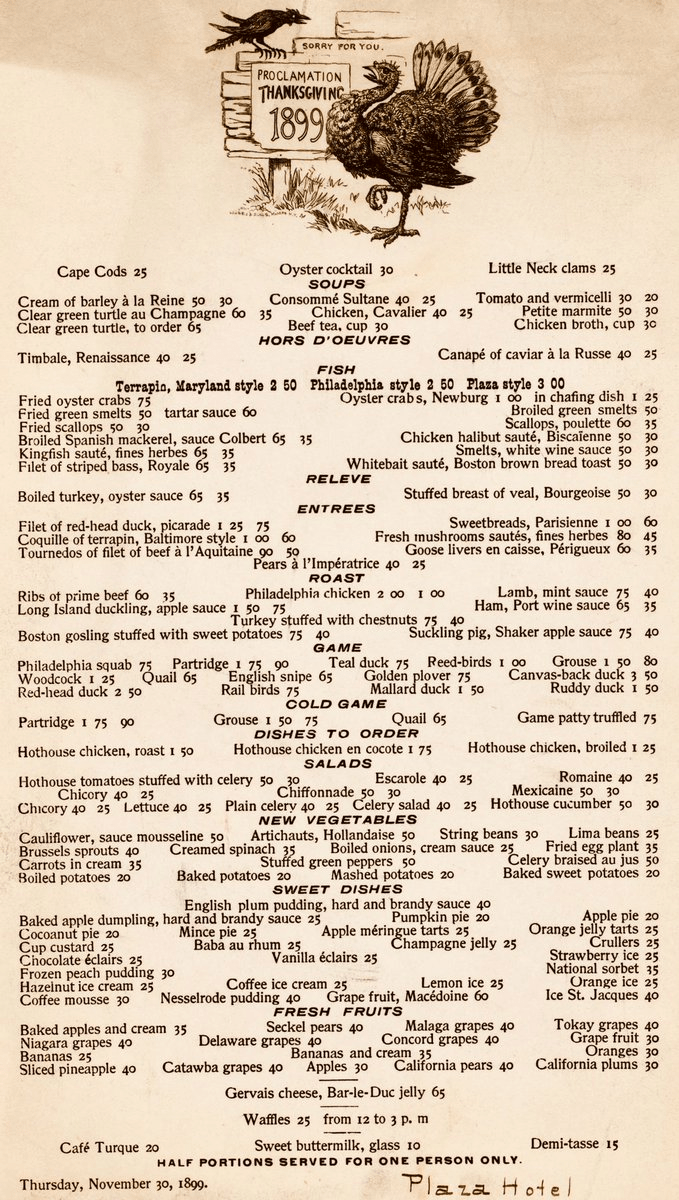
Where Can You Still Buy a Great Dinner in the US?

Last year, Jeremy wrote “Where Can You Still Buy an Affordable Home in the US?” He pointed out a few metro areas in the US that are not classified as “unaffordable”. All of the biggest cities have nice amenities such as great restaurants but are very expensive.

There is such a thing as an American town that is too small to find a good restaurant. But you don’t have to go all the way to the middle of New York or Chicago to find interesting menus. If you love food and good creative restaurants, there are some smaller cities that can deliver. Parking and hotels should be cheaper, so you can spend more of your money on food. (I don’t have any data on hand with regard to how menu prices in Birmingham compare to menu prices in NYC. Presumably they are lower here where labor is relatively cheaper.)

This list of cities was compiled in 2022. Birmingham, AL is on the list.  “10 Unexpected U.S. Cities With a Surprisingly Good Food Scene” 

I can recommend the following: “The 30 Best Restaurants In Birmingham, Alabama” (Southern Living, 2023)

To get a bit more recent national data: “Surging restaurant prices are making dining out a luxury” (CNN, 2024)

I think I care more about food quality than “service.” Nothing has bothered me about the gradual nation-wide shift away from table service toward placing my order at the counter or from a computer screen.

I don’t do much with them, but Jeremy is an advocate for restaurant apps. If you track deals and order directly through the app, you might save around 10% on low-to-mid quality restaurant food.

On a side note, I’m wondering if and when AI will approach the service level of a personal chef. I wish I could outsource all family meals to someone else. I have experimented with grocery delivery and “meal kits” and recipe apps. Nothing ever feels like a personal chef, although some of those services are nice to have. I feel like a superintelligence could encompass all of the restaurant apps, and grocery delivery and family meal planning together. I wish I could just enter a list of taste and health preferences and then not think about it anymore.

Borrowing, Beef, and Break-even

Interest rates communicate the value of resources over time. For example, if you take out a loan, then the interest rate tells you how much you must to pay in order to keep that money over the life of the loan. The interest rate also reflects how much the lender will be compensated in exchange for parting with their funds. On the consumer side, the interest rate reflects the price that the borrower is willing to pay in order to avoid delaying a purchase.

When a business borrows, the interest rate reflects the minimal amount of value that they would need to create in order to make an accounting profit. For example, if a business borrows $100 for one year at an interest rate of 5%, then they need to earn $105 by the time that they repay the loan in order to break even with zero profit. The business would need to earn more than 5% in order to earn a profit on their borrowing and investment venture.

The longer the business takes to repay their loan, the more interest that accrues. And, the higher the interest rate, the more they need to earn in order to repay their loan.

This logic applies to all production because all production takes time. If production takes very little time, then the impact of the interest cost is miniscule. But, if production takes longer, then interest rates become increasingly relevant. These kinds of products include trees, cheese, wine, livestock, etc. Anything that ages, ferments, or has a lengthy production process will be more sensitive to the cost of borrowing.

How?

The growth pattern for most (all?) goods looks similar. Below-left is a growth chart for dairy cows . Notice that calves grow quickly at first, and their growth slows over time. For the sake of argument, let’s say that the change in value of a cow mimics the change in weight (Yes, I know that dairy and beef cows are different, but the principle is the same).  Below-right is the monthly percent change. Even at an age of 25 months a cow is still growing in value at 2.4% per month or 33% per year.

Of course, there is a risk that some cows don’t survive to slaughter, lowering the expected growth rate. Since most cattle are slaughtered between 18 and 24 months of age, their growth rate at the time of slaughter is 4.4%-2.7% per month. As the interest rate at which farmers borrow rises, the optimal age at slaughter falls. Otherwise, the spread between the growth rate and the interest rate could go negative. Even so, what an investment! If you can borrow at, say, 8% per year, then you’ll make money hand-over-fist on the spread.

Except… Cows cost money to raise, and most of that cost is feed. According to the production indicators and estimated returns published by the USDA, the cost of feed in February of 2023 was $158.11 per hundred pounds of beef. The selling price of beef was $161.07. That leaves $2.96 or a profit of 1.87% earned over the course of 1.5-1.75 years. That investment is starting to look a lot less good, especially since it doesn’t include the cost of maintaining facilities, insurance, etc. It’s no wonder that farmers and ranchers are serious about their subsidies. Clearly, with such tight margins, farmers and ranchers are going to look good and hard at the interest rates that they pay on their debt. And, they do have debt.

However, the recent increase in beef prices is not caused by higher interest rates.

That 1.87% profit margin is at prices and costs from February 2023. Since 2020, the price of cattle feed ingredients (grain, bean, and oil) peaked in the summer of 2022 and are still substantially more expensive than pre-Covid (see below). That means that cows getting slaughtered right now were raised on more expensive feed. This February 2024, the cost of feed per 100lb. of cattle was $191.80. But the cattle selling price was only $180.75. That’s a $11.05 loss for cattle raising. Wholesale prices of cattle might be up recently, but the cost of feed is up by more. It’s not the cattle farmers who are benefiting from the high beef prices. In fact, they’re getting squeezed hard.

There is good news. The cost of feed ingredients has been falling recently, which means that beef farmers should begin to see some relief if the recent trend continues. For Consumers, the price of beef is already down from its 2023 peak.