Excess Mortality and Vaccination Rates in Europe

Much ink has been spilled making cross-country comparisons since the start of the COVID-19 pandemic. I have made a few of these, such as a comparison of GDP declines and COVID death rates among about three dozen countries in late 2021. I also made a similar comparison of G-7 countries in early 2022. But all such comparisons are tricky to interpret if we want to know why these differences exist between countries, which surely ultimately we would like to know. I tried to stress in those blog posts that I was just trying to visualize the effects, not make any claims about causation.

Here’s one more chart which I think is a very useful visualization, and it may give us some hint at causation. The following scatterplot shows COVID vaccination rates and excess mortality for a selection of European countries (more detail below on these measures and the countries selected):
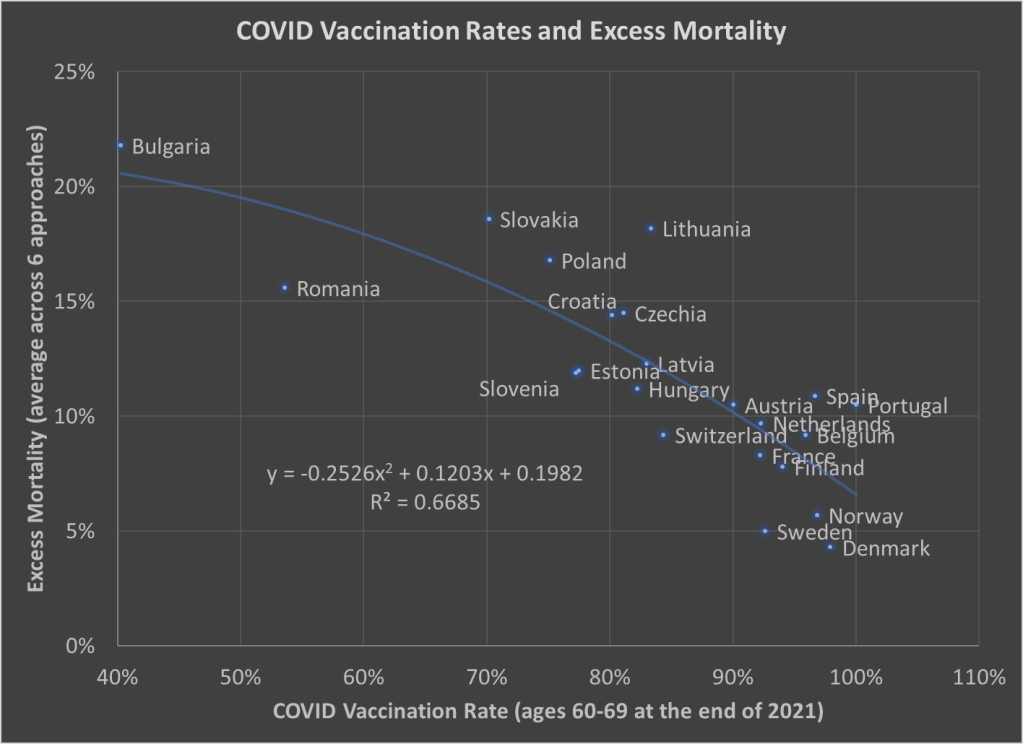
The selection of countries is based on data availability. For vaccination rates, I chose to use the rate for ages 60-69 at the end of 2021. Ages 60-69 is somewhat arbitrary, but I wanted a rate for an elderly age group that was somewhat widely available. There is no standard source for an international organization that published these age-specific vaccine rates (that I’m aware of), but Our World in Data has done an excellent job of compiling comparable data that is available.

Note: I’m using the data on at least one dose of the vaccine. OWID also has it available by full vaccine series, and by booster, but first dose seemed like a reasonable approach to me. Also, I could have used different age groups, such as 70-79 or 80+, but once you get to those age groups the data gets weird because you have a lot of countries over 100%, probably due to both challenging denominator calculations and just general challenges with collecting data on vaccination rates. By using 60-69, only one country in my sample (Portugal) is over 100%, and I just code them as 100%. Using the end of 2021, rather than the most current data, is a bit arbitrary too, but I wanted to capture how well early vaccination efforts went, though ultimately it probably wouldn’t have mattered much.

Also: dropping the outliers of Bulgaria and Romania doesn’t change things much. The second-degree best fit polynomial still has an R2 over 0.60 (for those unfamiliar with these statistics, that means about 60% of the variation is “explained” in a correlational sense).

The excess mortality measure I use comes from the following chart. In fact, this entire post is inspired by the fact that this chart and others similar to it have been shared frequently on social media.
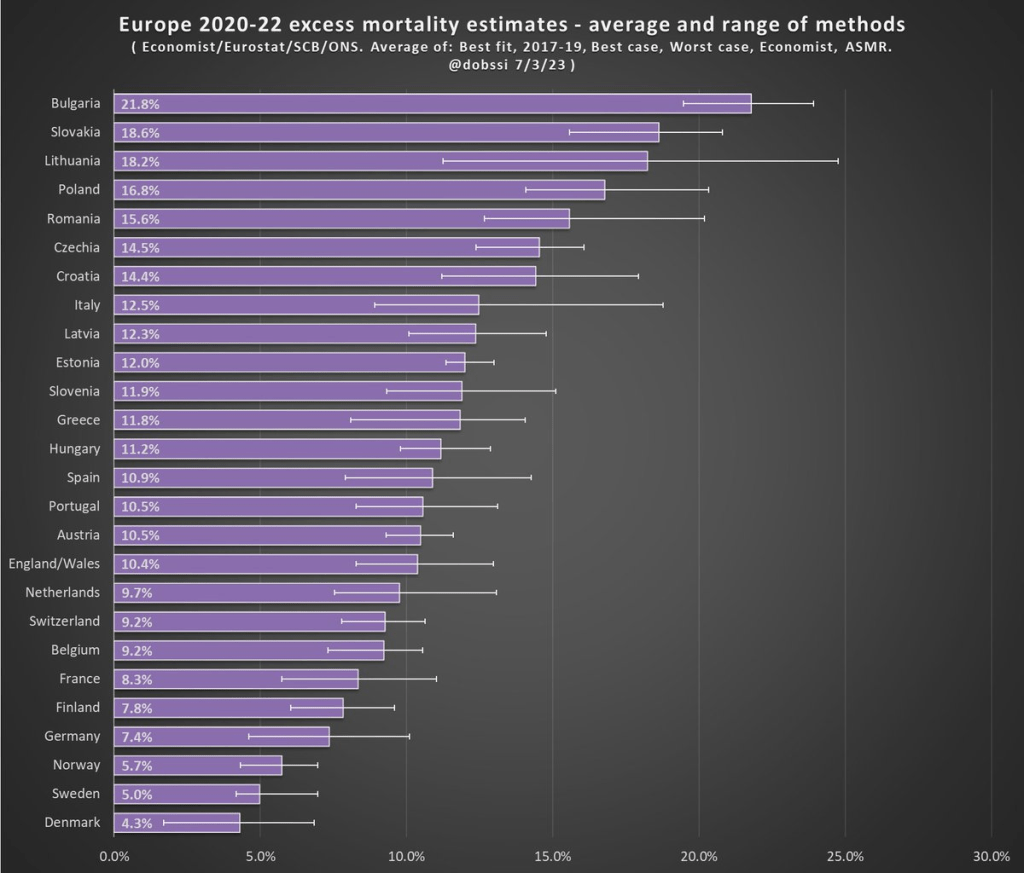
The chart comes from a Tweet thread by Paul Collyer. The whole thread is worth reading, but this chart is the key and summary of the thread. What he has done is shown the average and range of a variety of ways of calculating excess mortality. Read his thread for all the details, but the basic issues are what baseline to use (2015-2019 or 2017-2019? A case can be made for both), how to do the age-standardized mortality, and other issues. I won’t make a claim as to which method is best, but averaging across them seems like a fine approach to me.

For the y-axis in my chart, I just used the average for each country from Collyer’s chart. There are 34 countries in his chart, but in the OWID age-specific vaccination rates, only 22 countries were available the overlapped with his group. Unfortunately, this means we drop major countries like Italy, Spain, the UK, and Germany, but you work with the data you have.

For many sharing this and similar chart (such as charts with just one of those methods), the surprising (or not surprising) result to them is that Sweden comes out with almost the lowest excess mortality rate. Some approaches even put Sweden as the very lowest. Sweden!

Why is Sweden so important? Sweden has been probably the most debated country (especially by people not living in the country in question) in the COVID pandemic conversation. In short, Sweden took a less restrictive (some might say much less restrictive) approach to the pandemic. This debate was probably the most fevered in mid-to-late 2020, when some were even claiming that the pandemic was over in Sweden (it wasn’t). The extent to which Sweden took a radically different approach is somewhat overstated, especially in relation to other Nordic countries. And as is clear in both charts above, the Nordic countries all did relatively very well on excess mortality.

The bottom line from my first chart is that what really matters for a country’s overall excess mortality during the pandemic is how well they vaccinated their population. There seems to be a lot of interest on social media to rehash the debates about whether lockdowns (and lighter restrictions) or masks worked in 2020. But what really mattered was 2021, and vaccines were key. A scatterplot isn’t the last word on this (we should control for lots of other things), but it does suggest that a big part of the picture is vaccines (you can see this in scatterplots of US states too). It’s frustrating that many of those wanting to rehash the 2020 debates to “prove” masks don’t work, or whatever, either ignore vaccines or have bought into varying degrees of anti-vaccination theories. It’s completely possible that lockdowns don’t pass a cost/benefit test, but that vaccines also work very well (this has always been my position).

Why did Sweden have such great relative performance on excess mortality? Vaccines are almost certainly the most important factor among many that matter to a much smaller degree.

What About the US?

Note: for those wondering about the US, we don’t have the vaccination rate for ages 60-69 that I can find. Collyer also didn’t include the US in his analysis, it was only Europe. So, for both reasons, I didn’t include them in this post. The CDC does report first-dose vaccinations for ages 65+ in the US, though they top-code states at 95%. As of the end of 2021, here are the states that were below 95%: Mississippi, Louisiana, Tennessee, West Virginia, Indiana, Ohio, Wyoming, Georgia, Arkansas, Idaho, Alabama, Montana, Alaska, Missouri, Texas, Michigan, and Kentucky. These states generally have very high age-adjusted COVID death rates. Ideally we would use age-adjusted excess mortality for US states, but in the US that is horribly confounded by the rise in overdoses, homicides, car accidents, and other causes that are independent of vaccination rates (though they may be related to 2020 COVID policies — this is still a matter of huge debate).

The ACA and Entrepreneurship: The Importance of Age

Thinking about one of my older papers today, since I just heard it won the Eckstein award for best paper in the Eastern Economic Journal in 2019 & 2020.

One big selling point of the Affordable Care Act was that by offering more non-employer-based options for health insurance, it would free people who felt locked into their jobs by the need for insurance. This would free people up to leave their jobs and do other things like start their own businesses. Did the ACA actually live up to this promise?

It did, at least for some people. The challenge when it comes to measuring the effect of the ACA is that it potentially affected everyone nationwide. If entrepreneurship rises following the implementation of the ACA in 2014, is it because of the ACA? Or just the general economic recovery? Ideally we want some sort of comparison group unaffected by the ACA. If that doesn’t really exist, we can use a comparison group that is less affected by it.

That’s what I did in a 2017 paper focused on younger adults. I compared those under age 26 (who benefit from the ACA’s dependent coverage mandate) to those just over age 26 (who don’t), but found no overall difference in how their self-employment rates changed following the ACA.

In the 2019 Eastern Economic Journal paper, Dhaval Dave and I instead consider the effect of the ACA on older adults. We compare entrepreneurship rates for people in their early 60’s (who might benefit from the availability of individual insurance through the ACA) with a “control group” of people in their late 60’s (who are eligible for Medicare and presumably less affected by the ACA). We find that the ACA led to a 3-4% increase in self-employment for people in their early 60’s.

Figure 1 from our 2019 EEJ paper

Why the big difference in findings across papers? My guess is that it’s about age, and what age means for health and health insurance. People in their 60s are old enough to have substantial average health costs and health insurance premiums, so they will factor health insurance into their decisions more strongly than younger people. In addition, the community rating provisions of the ACA generally reduced individual premiums for older people while raising them for younger people.

In sum, the ACA does seem to encourage entrepreneurship at least among older adults. At the same time, our other research finds that the employer-based health insurance system still leads Americans to stay in their jobs longer than they would otherwise choose to.

Itching to Change (Property Rights)

I live in southwest Florida where it is quite tropical. We don’t have four seasons. We mark the passage of time with the rainy season for 8 months and the dry season for 4 months. We also mark time with ‘season’. Season is when the snow-birds – those who live in places further north – migrate to and occupy Florida for about 4-5 months. During those times the roads are more crowded and the grocery store customers are less friendly. We can also mark the passage of time with mosquitos. January has fewer mosquitos. The rest of the year we know not to go outside at dusk.

Therefore, we have the Collier Mosquito Control District. This little government entity does several things. But I want to focus on spraying. On some nights, more so during the rainy season, the CMCD flies airplanes and sprays our inland bodies of water that are susceptible to mosquito infestation. Let’s put aside for the moment any alleged negative human health effects that spraying might cause.

I want to talk about taxes.

Continue reading

Online Reading Onpaper

We have six weekly contributors here at EWED and I try to read every single post. I don’t always read them the same day that they are published. Being subscribed is convenient because I can let my count of unread emails accumulate as a reminder of what I’ve yet to read.

Shortly after my fourth child was born over the summer, I understandably got quite behind in my reading. I think that I had as many as twelve unread posts. I would try to catchup on the days that I stayed home with the children. After all, they don’t require constant monitoring and often go do their own thing. Then, without fail, every time that I pull out my phone to catch up on some choice econ content, the kids would get needy. They’d start whining, fighting, or otherwise suddenly start accosting me for one thing or another – even if they were fine just moments before. It’s as if my phone was the signal that I clearly had nothing to do and that I should be interacting with them. Don’t get me wrong, I like interacting with my kids. But, don’t they know that I’m a professional living in the 21st century? Don’t they know that there is a lot of good educational and intellectually stimulating content on my phone and that I am not merely zoning out and wasting my time?

No. They do not.

I began to realize that it didn’t matter what I was doing on my phone, the kids were not happy about it.

I have fond childhood memories of my dad smoking a pipe and reading the newspaper. I remember how he’d cross his legs and I remember how he’d lift me up and down with them. I less well remember my dad playing his Game Boy. That was entertaining for a while, but I remember feeling more socially disconnected from him at those times. Maybe my kids feel the same way. It doesn’t matter to them that I try to read news articles on my phone (the same content as a newspaper). They see me on a 1-player device.

So, one day I printed out about a dozen accumulated EWED blog posts as double-sided and stapled articles on real-life paper.

The kids were copacetic, going about their business. They were fed, watered, changed, and had toys and drawing accoutrement. I sat down with my stack of papers in a prominent rocking chair and started reading. You know what my kids did in response? Not a darn thing! I had found the secret. I couldn’t comment on the posts or share them digitally. But that’s a small price to pay for getting some peaceful reading time. My kids didn’t care that I wasn’t giving them attention. Reading is something they know about. They read or are read to every day. ‘Dad’s reading’ is a totally understandable and sympathetic activity. ‘Dad’s on his phone’ is not a sympathetic activity. After all, they don’t have phones.

They even had a role to play. As I’d finish reading the blog posts, I’d toss the stapled pages across the room. It was their job to throw those away in the garbage can. It became a game where there were these sheets of paper that I cared about, then examined , and then discarded… like yesterday’s news. They’d even argue some over who got to run the next consumed story across the house to the garbage can (sorry fellow bloggers).

If you’re waiting for the other shoe to drop, then I’ve got nothing for you. It turns out that this works for us. My working hypothesis is that kids often don’t want parents to give them attention in particular. Rather, they want to feel a sense of connection by being involved, or sharing experiences. Even if it’s not at the same time. Our kids want to do the things that we do. They love to mimic. My kids are almost never allowed to play games or do nearly anything on our phones. So, me being on my phone in their presence serves to create distance between us. Reading a book or some paper in their presence? That puts us on the same page.

Steal My Paper Ideas!

Since early in graduate school I’ve kept a running list of ideas for economics papers I’d like to write and publish some day. I’ve written many of the papers I planned to, and been scooped on others, but the list just keeps growing. As I begin to change my priorities post-tenure, I decided it was time to publicly share many of my ideas to see if anyone else wants to run with them. So I added an ideas page to my website:

Steal My Paper Ideas! I have more ideas than time. The real problem is that publishing papers makes the list bigger, not smaller; each paper I do gives me the idea for more than one new paper. I also don’t have my own PhD students to give them to, and don’t especially need credit for more publications. So feel free to take these and run with them, just put me in the acknowledgements, and let me know when you publish so I can take the idea off this page.

Here’s one set of example ideas:

State Health Insurance Mandates: Most of my early work was on these laws, but many questions remain unanswered. States have passed over a hundred different types of mandated benefits, but the vast majority have zero papers focused on them. Many likely effects of the laws have also never been studied for any mandate or combination of mandates. Do they actually reduce uncompensated hospital care, as Summers (1989) predicts? Do mandates cause higher deductibles and copays, less coverage of non-mandated care, or narrower networks? How do mandates affect the income and employment of relevant providers? Can mandates be used as an instrument to determine the effectiveness of a treatment? On the identification side, redoing older papers using a dataset like MEPS-IC where self-insured firms can be used as a control would be a major advance.

You can find more ideas on the full page; I plan to update to add more ideas as I have them and to remove ideas once someone writes the paper.

Thanks to a conversation with Jojo Lee for the idea of publicly posting my paper ideas. I especially encourage people to share this list with early-stage PhD students. It would also be great to see other tenured professors post the ideas they have no immediate plans to work on; I’m sure plenty of people are sitting on better ideas than mine with no plans to actually act on them.

On Counting and Overcounting Deaths

How many people died in the US from heart diseases in 2019? The answer is harder than it might seem to pin down. Using a broad definition, such as “major cardiovascular diseases,” and including any deaths where this was listed on the death certificate, the number for 2019 is an astonishing 1.56 million deaths, according to the CDC. That number is astonishing because there were 2.85 million deaths in total in the US, so over half of deaths involved the heart or circulatory system, at least in some way that was important enough for a doctor to list it on the death certificate.

However, if you Google “heart disease deaths US 2019,” you get only 659,041 deaths. The source? Once again, the CDC! So, what’s going on here? To get to the smaller number, the CDC narrows the definition in two ways. First, instead of all “major cardiovascular diseases,” they limit it to diseases that are specifically about the heart. For example, cerebrovascular deaths (deaths involving blood flow in the brain) are not including in the lower CDC total. This first limitation gets us down to 1.28 million.

But the bigger reduction is when they limit the count to the underlying cause of death, “the disease or injury that initiated the train of morbid events leading directly to death, or the circumstances of the accident or violence which produced the fatal injury,” as opposed to other contributing causes. That’s how we cut the total in half from 1.28 million to 659,041 deaths.

We could further limit this to “Atherosclerotic heart disease,” a subset of heart disease deaths, but the largest single cause of deaths in the coding system that the CDC uses. There were 163,502 deaths of this kind in 2019, if you use the underlying cause of death only. But if we expand it to any listing of this disease on the death certificate, it doubles to 321,812 deaths. And now three categories of death are slightly larger in this “multiple cause of death” query, including a catch-all “Cardiac arrest, unspecified” category with 352,010 deaths in 2019.

So, what’s the right number? What’s the point of all this discussion? Here’s my question to you: did you ever hear of a debate about whether we were “overcounting” heart disease deaths in 2019? I don’t think I’ve ever heard of it. Probably there were occasional debates among the experts in this area, but never among the general public.

COVID-19 is different. The allegation of “overcounting” COVID deaths began almost right away in 2020, with prominent people claiming that the numbers being reported are basically useless because, for example, a fatal motorcycle death was briefly included in COVID death totals in Florida (people are still using this example!).

A more serious critique of COVID death counting was in a recent op-ed in the Washington Post. The argument here is serious and sober, and not trying to push a particular viewpoint as far as I can tell (contrast this with people pushing the motorcycle death story). Yet still the op-ed is almost totally lacking in data, especially on COVID deaths (there is some data on COVID hospitalizations).

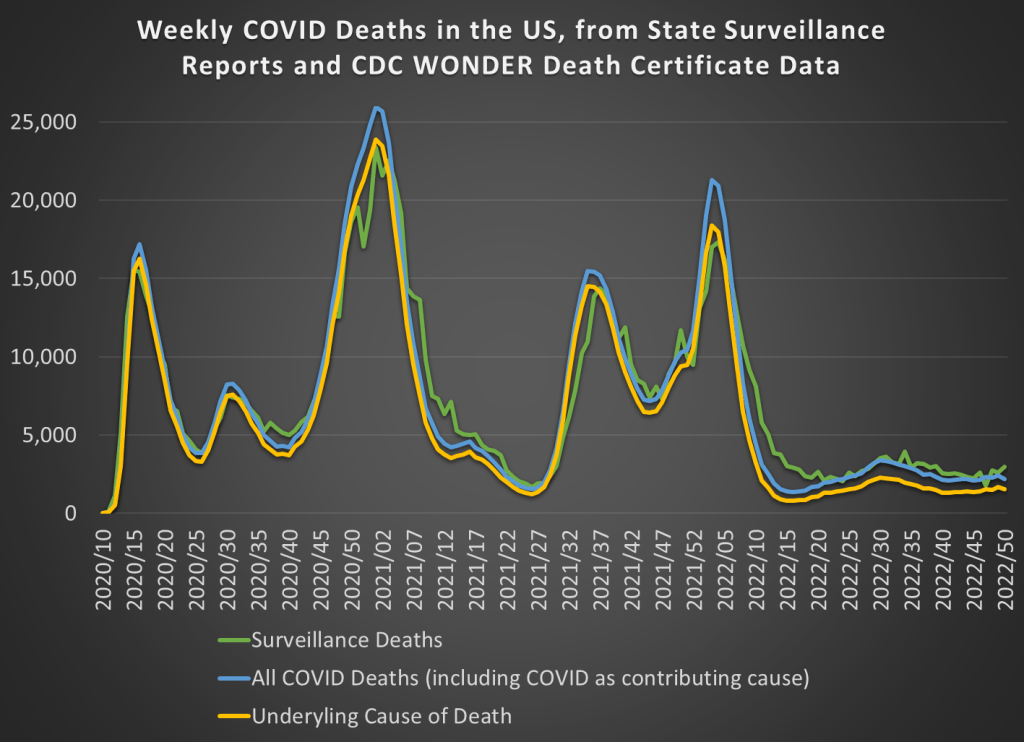
But most of the data she is asking for in the op-ed is readily available. While we don’t have death totals for all individuals that tested positive for COVID-19 at some point, we do have the following data available on a weekly basis. First, we have the “surveillance data” on deaths that was released by states and aggregated by the CDC. These were “the numbers” that you probably saw constantly discussed, sometimes daily, in the media during the height of the pandemic waves. The second and third sources of COVID death data are similar to the heart disease data I discussed above, from the CDC WONDER database, separated by whether COVID was the underlying cause or whether it was one among several contributing causes (whether it was underlying or not).

Those three measures of COVID deaths are displayed in this chart:

Continue reading

“Let whoever needs to die, die”:  China’s Abrupt COVID Reopening To Achieve Rapid Herd Immunity and Resumption of Industrial Production, at the Cost of a Million Deaths

I noted a month ago that President Xi and the CCP have taken credit for relatively low (reported) deaths from COVID, due to strict lockdown protocols. By “strict” we mean locking down whole cities and blockading residents in their apartment buildings for months at a stretch. However, public protests rose to an unprecedented level, and so the Chinese government has done a surprising full 180 policy change, towards almost no restrictions.

According to Dr. Ezekiel Emanuel in the Wall Street Journal, the way this policy is being carried out has the makings of a mass human tragedy:

Zero Covid was always untenable and had to be ended. But it could have been done responsibly.

Among other things, that would involve buying Pfizer and Moderna bivalent vaccines and administering them to the elderly and other high-risk people, and purchasing Paxlovid and molnupiravir to treat those who test positive. Supplies of these products are ample. Authorities could continue mask mandates to reduce transmission. And China could institute a rigorous wastewater testing program to identify potential SARS-CoV-2 variants as soon as possible – and commit to sharing the data with the world.

Due to nationalistic pride, China has spurned the purchase of effective mRNA vaccines from Pfizer and Moderna, pushing instead the less-effective in-house vaccine.

Readers may recall in the early days of COVID spread in the West, masking and social distancing were promoted, not because they would prevent everyone from ultimately becoming infected, but because these measures would “flatten the curve” (i.e. reduce the peak load on hospitals at any one time, but instead spread it out over time). China is headed into a very un-flattened infection curve; some 800 million people (10% of the world’s population) may get COVID in the next 3 months, overwhelming hospitals and leading to over a million deaths. Besides the near-term human costs, this concentration of active COVID cases is likely to lead to a slew of new, even more virulent variants which will affect the rest of the world, along with China. What should help mitigate the situation is that the newer, most virulent variants of COVID may be somewhat less fatal than the original strain.

Why is the Chinese government doing it this way? Well, the sooner the country gets through mass exposure to the virus, the sooner everyone can get back to their factories and start producing stuff again. If in the process a bunch of (mainly older) people die, well, that’s just the price of progress. Let ‘er rip…

From MSN:

[U.S.] Epidemiologist and health economist Dr Eric Feigl-Ding estimate that 60 per cent of China’s population is likely to be infected over the next 90 days. “Deaths likely in the millions—plural,” he added.

According to Eric, bodies were seen piled up in hospitals in Northeast China. “Let whoever needs to be infected infected, let whoever needs to die die. Early infections, early deaths, early peak, early resumption of production,” the epidemiologist said terming it to be summary of Chinese Communist Party’s (CCP) current goal.

But don’t expect any acknowledgement of mass death from the official Chinese media. Just as the initial COVID outbreak was denied and censored by the Chinese propaganda machine, so the current surge is being minimized. From Barrons:

On Friday, a party-run newspaper cited an official estimate of half a million daily new cases in the eastern city of Qingdao. By Saturday, the story had been amended to remove the figure, an AFP review of the article showed….

Several posts on the popular Weibo platform purporting to describe Covid-related deaths appeared to have been censored by Friday afternoon, according to a review by AFP journalists.

They included several blanked-out photos ostensibly taken at crematoriums, and a post from an account claiming to belong to the mother of a two-year-old girl who died after contracting the virus.

Posts about medicine shortages and instances of price gouging were also taken down, according to censorship monitor GreatFire.org.

And social media users have posted angry or sardonic comments in response to the perceived taboo around Covid deaths.

Many rounded on a state-linked local news outlet after it reported Wu Guanying — designer of the mascots for the 2008 Beijing Olympics — had died of a “severe cold” at the age of 67.

Perhaps we should not be surprised that the Chinese Center for Disease Control and Prevention just reported zero COVID deaths for December 25 and 26.

Farewell to the First Normal Semester in 3 Years

Today as I gave my last final and took my kids to a huge school party, it struck me that things are finally back to something like 2019 levels of normality.

2020 was a lost cause, of course. I had high hopes for 2021 that vaccines would immediately get us back to normal. They did get my school back to fully in-person by Fall 2021, but not really back to normal, partly thanks to the variants. My students were out sick more than normal, and I was out watching my sick kids more than normal, as every cold meant they would be home until the school was sure it wasn’t Covid. Toward the end of the Spring 2022 semester worries were subsiding, and my state was pretty much fully re-opened, but things still weren’t really back to normal. Student attendance and effort were still way below normal, partly from the lingering effects of Covid, and partly from celebrating its end- partying to make up for lost time (and cheering on a great basketball team).

Fall 2022 finally felt like a basically normal semester. I still see the occasional mask, still hear from the occasional student out with Covid, and still have one kid missing 2 school days with every cough (policies stricter than 2019, but much relaxed from the days when both kids were at schools that could have them miss 5+ days with every non-Covid cough). Overall though student attendance and effort are back to what seem like normal levels. Up to Spring 22 I’d have students just disappear for a few weeks, not in class, not answering e-mails about why they weren’t showing up or completing work, needing lots of help to get on track once they finally reappeared. This Fall that didn’t happen; in my Senior Capstone everyone turned in a quality paper basically on-time and without me having to chase anyone down for it. Also, everyone just seemed happier now that their stress levels are back down to the baseline for college students.

This semester was nothing special- and that was beautiful.

Ban, Subsidize, Mandate: Ethics and US Healthcare Policy

Tomorrow (Friday 12/2) I’ll be speaking at the Fall Ethics Forum at Sacramento State. The Center for Practical and Professional Ethics there does a forum every year on a different field of practical ethics, and this year they chose healthcare (some previous iterations look quite interesting, like Bryan Caplan on education and Lyman Stone on population). The event is open to the public if you happen to live near Sacramento, and I hope to be able to post a recording later. But for now, here’s a short preview of what I plan to say:

In many key respects, US health policy is about restricting the choices available to patients and health care providers: banning things the government doesn’t want, while mandating or subsidizing things they want. These restrictions on autonomy are typically justified by the idea that they lead to superior health or economic outcomes. In some cases this tradeoff between freedom and efficient utilitarian outcomes is real, but I highlight some policies such as Certificate of Need laws that appear to harm both freedom and efficiency. I argue that the overarching US approach to health policy is to subsidize demand while restricting supply, which together lead to exceptionally high prices but mediocre health outcomes.

I’ll also take on some classic questions like: when are free lunches truly free? And when is moral hazard really immoral?

Protests Erupt Across China Over COVID Policy But Lockdowns Continue: Why?

Headlines in today’s financial news include items like “Clashes in Shanghai as COVID protests flare across China“ from Yahoo Finance. There have been widespread protests this week, which are normally a rarity under the authoritarian regime, and are being suppressed by any means necessary. Apple stock is down about 4% in the past two trading days on fears that iPhone shortages will get worse due to worker unrest in the giant Foxconn factory in Zhengzhou. Wall Street keeps hoping the China will loosen up, since the lockdowns on the world’s second-largest economy are a drag on global markets.

China has pursued a “zero-COVID” policy, of strict mass lockdowns to halt any spread of the virus. Residents have been confined to their apartments for over 3 months in some cases. Whole cities with tens of millions of people have been locked down for months at a time whenever a number of cases are spotted. China’s economic growth has stagnated, and unemployment among young people has risen to 20%, which has helped fuel unrest.  Chinese people are aware that the rest of the world has moved on from mass lockdowns, and may be realizing the futility of thinking that lockdowns can stave off the virus indefinitely.

Given its discomfort with widespread discontent and protests, why does the Chinese government persist in this policy? An article in the Atlantic by Michael Shuman answers that question: “Zero COVID Has Outlived Its Usefulness. Here’s Why China Is Still Enforcing It. “  Back in 2020 when COVID first swept through the world, the strict lockdowns (readily enforced in an authoritarian regime) seemed like a big win for the Chinese leadership:

When the outbreak began in Wuhan in early 2020, the virus was unknown, vaccines were unavailable, and China’s poorly equipped health system could have quickly become overwhelmed by a sweeping pandemic. Yet the policy had a political element from the very beginning as well. The Communist Party is adept at sniffing out threats to its rule, and it quickly identified COVID as one of them. A major public-health crisis, with millions dying, would have raised serious doubts about the regime’s competence, which is, in effect, its sole claim to legitimacy.

Worse, the party could have faced a populace that directly blamed it for the outbreak—with good reason. The Chinese authorities at both the national and local levels botched their initial response to the novel coronavirus, suppressing information about its discovery by a Wuhan doctor and acting far too slowly to contain the initial spread. Sensing its potential vulnerability, the party shifted into anti-COVID overdrive, shutting down large swaths of the country, with the result that it did succeed in snuffing out an epidemic in a matter of weeks, even as it spread to the rest of the world.

That success allowed the Communist Party to transform a potential tragedy into a public-relations triumph. Within weeks of the Wuhan outbreak, China’s propaganda machine was touting the wonders of its virus-busting methods. And as the U.S. and other Western countries struggled to contain the disease, Beijing’s big win became even more valuable as evidence that its authoritarian system was more capable and caring than any democratic one. Beijing and its advocates pointed to rising case and death counts in the U.S. as proof of China’s superiority and American decline.

A number of other countries including Australia and New Zealand also implemented strict (stricter than in the U.S.) lockdown measures in 2020, and, like China, experienced far less impact from the virus in that timeframe than seen in the U.S. However, most of these measures were lifted in 2021. The widespread application of mRNA vaccines like those from Pfizer and Moderna in the West has served to mitigate the severity of the viral infection. Also, some measure of herd immunity has been achieved by the widespread exposure to COVID in the population; antibodies persist for at least eight months after contracting the disease. So, what’s up with China?

China has resisted using Western vaccines, relying instead on homegrown vaccines which are less effective, though they do give some measure of protection.  Also, “The additional layers of high-tech surveillance adopted in the name of pandemic prevention can be used to enhance the tracking and monitoring of the populace more generally,” which is another win for the government. However, the major factor is that the Party, and especially President Xi, cannot afford to loosen up now and risk an embarrassing explosion of cases that would overburden the healthcare system and probably lead to millions of deaths:

The victory of zero COVID was claimed not just as the party’s but as Xi Jinping’s in particular. The State Council, China’s highest governing body, declared in a 2020 white paper that Xi had “taken personal command, planned the response, overseen the general situation and acted decisively, pointing the way forward in the fight against the epidemic.”

This narrative became entrenched. If Beijing loosened up and allowed COVID to run amok, the Chinese system would appear no better than those of loser democracies, and Xi would seem like another failing politician, a mere mortal, not the virus-fighting superhero he was painted as. Zero COVID’s failure would be a disaster for the Communist Party’s veneer of infallibility.

So the leadership insists on zero COVID and damn the consequences.