Was the US at Our Richest in the 1890s?

Donald Trump has repeatedly said that the US was at our “richest” or “wealthiest” in the high-tariff period from 1870-1913, and sometimes he says more specifically in the 1890s. Is this true?

First, in terms of personal income or wealth, this is nowhere near true. I’ve looked at the purchasing power of wages in the 1890s in a prior post, and Ernie Tedeschi recently put together data on average wealth back to the 1880s. As you can probably guess, by these measures Trump is quite clearly wrong.

So what might he mean?

One possibility is tax revenue, since he often says this in the context of tariffs versus an income tax. Broadly this also can’t be true, as federal revenue was just about 3% of GDP in the 1890s, but is around 16% in recent years.

But perhaps it is true in a narrower sense, if we look at taxes collected relative to the country’s spending needs. Trump has referenced the “Great Tariff Debate of 1888” which he summarized as “the debate was: We didn’t know what to do with all of the money we were making. We were so rich.” Indeed, this characterization is not completely wrong. As economic historian and trade expert Doug Irwin has summarized the debate: “The two main political parties agreed that a significant reduction of the budget surplus was an urgent priority. The Republicans and the Democrats also agreed that a large expansion in government expenditures was undesirable.” The difference was just over how to reduce surpluses: do we lower or raise tariffs?

It does seem that in Trump’s mind being “rich” in this period was about budget surpluses. Let’s look at the data (I have truncated the y-axis so you can actually read it without the WW1 deficits distorting the picture, but they were huge: over 200% of revenues!):

It is certainly true that under parts of the high-tariff period, we did collect a lot of revenue from tariffs! In some years, federal surpluses were over 1% of GDP and 30% of revenues collected. But notice that this is not true during Trump’s favored decade, the 1890s. Following the McKinley Tariff of 1890, tariff revenue fell sharply (though probably not likely due to the tariff rates, but due to moving items like sugar to the duty-free list, as Irwin points out). The 1890s were not a decade of being “rich” with tariff revenue and surpluses.

Finally, also notice that during the 1920s the US once again had large budget surpluses. The income tax was still fairly new in the 1920s, but it raised around 40-50% of federal revenue during that decade. By the Trump standard, we (the US federal government) were once again “rich” in the 1920s — this is true even after the tax cuts of the 1920s, which eventually reduced the top rate to 25% from the high of 73% during WW1.

If we define a country as being “rich” when it runs large budget surpluses, the US was indeed rich by this standard in the 1870s and 1880s (though not the 1890s). But it was rich again by this standard in the 1920s. This is just a function of government revenue growing faster than government spending. And the growth of revenue during the 1870s and 1880s was largely driven by a rise in internal revenue — specifically, excise taxes on alcohol and tobacco (these taxes largely didn’t exist before the Civil War).

1890 was the last year of big surpluses in the nineteenth century, and in that year the federal government spent $318 million. Tariff revenue (customs) was just $230 million. There was only a surplus in that year because the federal government also collected $108 million of alcohol excise taxes and $34 million of tobacco excise taxes. In fact, throughout the period 1870-1899, tariff revenues are never enough to cover all of federal spending, though they do hit 80% in a few years (source: Historical Statistics of the US, Tables Ea584-587, Ea588-593, and Ea594-608):

One more thing: in some of these speeches, Trump blames the Great Depression on the switch from tariffs to income taxes. In addition to there really being no theory for why this would be the case, it just doesn’t line up with the facts. The 1890s were plagued by financial crises and recessions. The 1920s (the first decade of experience with the income tax) was a period of growth (a few short downturns) and as we saw above, large budget surpluses. The Great Depression had other causes.

After the Fall: What Next for Nvidia and AI, In the Light of DeepSeek

Anyone not living under a rock the last two weeks has heard of DeepSeek, the cheap Chinese knock-off of ChatGPT that was supposedly trained using much lower resources that most American Artificial Intelligence efforts have been using. The bearish narrative flowing from this is that AI users will be able to get along with far fewer of Nvidia’s expensive, powerful chips, and so Nvidia sales and profit margins will sag.

The stock market seems to be agreeing with this story. The Nvidia share price crashed with a mighty crash last Monday, and it has continued to trend downward since then, with plenty of zig-zags.

I am not an expert in this area, but have done a bit of reading. There seems to be an emerging consensus that DeepSeek got to where it got to largely by using what was already developed by ChatGPT and similar prior models. For this and other reasons, the claim for fantastic savings in model training has been largely discounted. DeepSeek did do a nice job making use of limited chip resources, but those advances will be incorporated into everyone else’s models now.

Concerns remain regarding built-in bias and censorship to support the Chinese communist government’s point of view, and regarding the safety of user data kept on servers in China. Even apart from nefarious purposes for collecting user data, ChatGPT has apparently been very sloppy in protecting user information:

Wiz Research has identified a publicly accessible ClickHouse database belonging to DeepSeek, which allows full control over database operations, including the ability to access internal data. The exposure includes over a million lines of log streams containing chat history, secret keys, backend details, and other highly sensitive information.

Shifting focus to Nvidia – – my take is that DeepSeek will have little impact on its sales. The bullish narrative is that the more efficient algos developed by DeepSeek will enable more players to enter the AI arena.

The big power users like Meta and Amazon and Google have moved beyond limited chatbots like ChatGPT or DeepSeek. They are aiming beyond “AI” to “AGI” (Artificial General Intelligence), that matches or surpasses human cognitive capabilities across a wide range of cognitive tasks. Zuck plans to replace mid-level software engineers at Meta with code-bots before the year is out.

For AGI they will still need gobs of high-end chips, and these companies show no signs of throttling back their efforts. Nvidia remains sold out through the end of 2025. I suspect that when the company reports earnings on Feb 26, it will continue to demonstrate high profits and project high earnings growth.

Its price to earnings is higher than its peers, but that appears to be justified by its earnings growth. For a growth stock, a key metric is price/earnings-growth (PEG), and by that standard, Nvidia looks downright cheap:

Source: Marc Gerstein on Seeking Alpha

How the fickle market will react to these realities, I have no idea.

The high volatility in the stock makes for high options premiums. I have been selling puts and covered calls to capture roughly 20% yields, at the expense of missing out on any rise in share price from here.

Disclaimer: Nothing here should be considered as advice to buy or sell any security.

How FRASER Enhances Economic Research and Analysis

Most of us know about FRED, the Federal Reserve Economic Data hosted by the Federal Reserve of St. Louis. It provides data and graphs at your fingertips. You can quickly grab a graph for a report or for a online argument. Of course, you can learn from it too. I’ve talked in the past about the Excel and Stata plugins.

But you may not know about the FRED FRASER. From their about page, “FRASER is a digital library of U.S. economic, financial, and banking history—particularly the history of the Federal Reserve System”. It’s a treasure trove of documents. Just as with any library, you’re not meant to read it all. But you can read some of it.

I can’t tell you how many times I’ve read a news story and lamented the lack of citations –  linked or unlinked.  Some journalists seem to do a google search or reddit dive and then summarize their journey. That’s sometimes helpful, but it often provides only surface level content and includes errors – much like AI. The better journalists at least talk to an expert. That is better, but authorities often repeat 2nd hand false claims too. Or, because no one has read the source material, they couch their language in unfalsifiable imprecision that merely implies a false claim.

A topical example would be the oft repeated blanket Trump-tariffs. That part is not up for dispute. Trump has been very clear about his desire for more and broader tariffs. Rather, economic news often refers back to the Smoot-Hawley tariffs of 1930 as an example of tariffs running amuck. While it is true that the 1930 tariffs applied to many items, they weren’t exactly a historical version of what Trump is currently proposing (though those details tend to change).

How do I know? Well, I looked. If you visit FRASER and search for “Smoot-Hawley”, then the tariff of 1930 is the first search result. It’s a congressional document, so it’s not an exciting read. But, you can see with your own eyes the diversity of duties that were placed on various imported goods. Since we often use the example of imported steel and since the foreign acquisition of US Steel was denied, let’s look at metals on page 20 of the 1930 act. But before we do, notice that we can link to particular pages of legislation and reports – nice! Reading the Smoot-Hawley Tariff Act’s original language, we can see the diverse duties on various metals. Here are a few:

Continue reading

The Big Ideas

Do I really think that the things I write about here and in my papers are the most important things in the world? No. Like most academics, I tend to emphasize the issues where I think I bring a unique perspective, rather than most important issues. But if you don’t realize this, you might get the impression that I think the things I normally talk about are the most important, rather than simply the most neglected and tractable / publishable. I don’t work on the most important issues because I see no good way for me to attack them- but if you do see a way, that is where you should focus. So what are the big issues of the 2020’s?

I see two issues that stand out above the many other important events of the day:

  • Artificial Intelligence: At minimum, the most important new technology in a generation; has the potential to bring about either utopia or dystopia. Do you have ideas for how to nudge it one way or another?
  • Rise of China: From extreme poverty to the world’s manufacturing powerhouse in two generations. What lessons should other countries learn from this for their own economic policy? How can we head off a world war and/or Chinese hegemony?

Focusing a bit more on economics, I see two perennial issues where there could be new opportunities to solve vital old questions:

  • Economic Development: We still don’t have a definitive answer to Adam Smith’s founding question of economics- why are some countries rich while other countries are poor, and how can the poor countries become rich? I think economic freedom is still an underrated answer, but even if you agree, the question remains of how to advance freedom in the face of entrenched interests who benefit from the status quo.
  • Robust Prediction: How can we make economics into something resembling a real science, one where predictions that include decimal places don’t deserve to be laughed at? Can you find a way to determine how much external validity an experiment has? Or how to use machine learning to get at causality? Or at least push existing empirical research to be more replicable?

I’ve added these points to my ideas page, since all this was inspired by me talking through the ideas on the page with my students and realizing how small and narrow they all seemed. Yes, small and narrow ideas are currently easier to publish in economics, but there is more to research and life than easy publications.

One Hundred Years of U.S. State Taxation

From a paper recently published in the Journal of Public Economics by Sarah Robinson & Alisa Tazhitdinova, here is the history of federal and state taxation in the past century in the US in one picture:

The paper primarily focuses on US state taxes, thus mostly ignoring local taxes, but in the Appendix the authors do show us similar charts for local taxes:

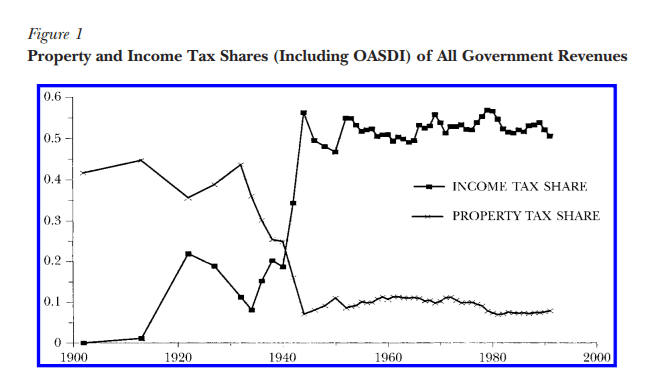
In broad terms, the history of taxation in the US in the 20th century is a history of the decline of the property tax, and the rise of the income and sales taxes. In 1900, there were barely any federal taxes (other than those on alcohol and tobacco), 50% of state taxes were property tax, and almost 90% of local taxes were property taxes. Property taxes were essentially the only form of taxation most Americans would directly recognize (excise taxes and tariffs were baked into the price of the goods).

John Wallis (2000) provided a similar, and simpler picture of these changes: considering all taxes in the US, property taxes were over 40% of the total in 1900, but today are under 10%. Income taxes come out of nowhere and are now about half of all government revenues in the US:

Keeping Receipts

Online shopping is convenient and even the norm for many items. Going to the store sounds like a time-consuming labor or an exceptional outing. My family, for example, lives in a suburban location that doesn’t have well-priced grocery home delivery. Shipping only works for some non-perishables. So, for many items we order online and do ‘drive-up pick-up’. We don’t even need to go into the store for many items. And reordering the same items repeatedly is a breeze.

We are also accustomed to the ability to return things. If your blender breaks on your first smoothie, then no worries – you can return it. If the chocolate cookies don’t taste like chocolate? Return it – satisfaction guaranteed. You can buy three pairs of shoes in different sizes and then keep the ones you want at the original sale price. Return the others.

For me, besides the time saved and convenience, a major factor in my decision to make purchases online is the documentation. I don’t need to save the receipt in a shoe box, Ziploc, or file drawer – the online retailer keeps an archive of all my purchases. Often this includes the date, amount, and shipping details including delivery date. There’s a super convenient digital paper trail.

If I need to contact a seller in order to exercise a warranty, then I have their contact information. I don’t need to retain the product packaging or investigate the brand at a future inopportune time. For example, I recently bought a Little Tykes water table for my kids. As I was assembling it on Christmas Eve I realized that I was missing a small part. I was able to work around it. But I was also able to immediately contact the manufacturer with a copy of my invoice. I emailed the date of purchase, the product model number, and the instruction manual had conveniently included part numbers. They were able to ship me the parts after a single email. Online shopping, and the resulting trail of evidence, makes the process much more practical than keeping paper records in a likely unorganized fashion.

There are other benefits to the paper trail. Back before widespread online shopping, retailers would often offer rebates as a sales strategy. In the year 2004, I bought a computer hard drive for $120 before a $40 mail-in rebate. The retailer (or manufacturer, I can’t remember) was hoping that people saw the post-rebate price and then failed to redeem it. And that often happened.  You needed to fill out a rebate form on an index card, cut the UPC bar code of the product packaging, and then mail them with your receipt to the company rebate department in a stamped envelope. If you dragged your feet, then you’d probably lose an important piece of the crucial combination and lose out on your $40 rebate. If the items were lost in the mail, then you were shucks-out-of-luck. Now, rebates have gone the way of the dodo since receipts are automatically retained and retrievable.

Continue reading

2024 in Books

Quick thoughts on what I read in 2024- though note that none of these were published in 2024, since almost all the best stuff is older. First some econ books I reviewed here this year:

Rockonomics– “Alan Kreuger’s 2019 book on the economics of popular music…. a well-written mix of economic theory, data, and interviews with well-known musicians, by an author who clearly loves music.”

We’ve Got You Covered– “Liran Einav and Amy Finkelstein are easily two of the best health economists of their generation.… while I don’t agree with all of their policy proposals, the book makes for an engaging, accurate, and easily readable introduction to the current US health care system.”

The Psychology of Money– “Morgan Housel’s Psychology of Money is not much like other personal finance books…. The book is not only pleasant to read, but at least for me exerts a calming effect I definitely do not normally associate with the finance genre, as if the subtext of ‘just be chill, be patient, follow the plan and everything will be alright’ is continually seeping into my brain.”

One Up on Wall Street– “Peter Lynch was one of the most successful investors of the 1970’s and 1980’s as the head of the Fidelity Magellan Fund. In 1989 he explained how he did it and why he thought retail investors could succeed with the same strategies”

Leave Me Alone and I’ll Make You Rich– “a 2020 book by Dierdre McCloskey and Art Carden…. attempts to sum up McCloskey’s trilogy of huge books on the ‘Bourgeois Virtues‘ in one short, relatively easy to read book”

Non-fiction I didn’t previously mention here:

The Simple Path to Wealth (JL Collins, 2016): the book is indeed simple, and its advice is indeed likely to leave you fairly wealthy in terms of money. One sentence summarizes it well: save a large portion of your income and invest it in VTSAX, and perhaps VBTLX. Easy to read, a bit like reading a series of blog posts, which is how much of the material originated. Good introduction to the lean-FIRE type mentality. But the book, like that mentality, is too frugal and debt-averse for my taste, and I say that as someone much more frugal and debt-averse than the average American.

The Great Reversal: How America Gave Up on Free Markets: Thomas Philippon argues that markets have been growing less competitive in America because of weakening antitrust enforcement, and that this has harmed consumers and productivity. He acknowledges that over-regulation can also harm competition, but clearly thinks antitrust is much more important; I think otherwise and didn’t find the book convincing. He sets European markets as an example for what America should aspire to, which means the book has aged poorly since its 2019 publication. It still of course has some value, and I may do a full review at some point.

The Storm Before the Storm: The Beginning of the End of the Roman Republic (Mike Duncan, 2017): Non-fiction but more exciting than most novels. A story of obvious importance to those who worry about modern republics teetering, but fresh compared to the much more famous events around Julius and Augustus Caesar and the ‘official’ fall of the Republic. Though arguably the Republic fell in the 80s BC, not the 40s- the book explains that Rome was taken over three times in this era by armies seeking political change.

Self-Help Is Like a Vaccine: Essays on Living Better: Nice collection of Brian Caplan blog posts on the subject.

Fiction:

Ivanhoe (Walter Scott, 1819): A particularly medieval telling of the Robin Hood tale, with a focus on the nobility and knights of England at that time. Chivalric romance, trial by combat, storming a castle. Highs are high but it needed an editor, could be cut by at least 1/3 without losing anything.

Kim (Rudyard Kipling, 1901): Three books in one, all excellent: a coming of age story, a spy thriller, and a portrait of the many different types of people and religions to be found in India around 1900. All wrapped together with beautiful English prose that makes heavy use of Indian loan words.

Final Thoughts:

Obviously I’m not Tyler Cowen reading a book a day, unless you count the kids books I read to my 1-year-old. But overall 2024 was a good year, better than I realized before I put this post together. Partly I credit the 1-year-old who wants to take my phone and computer but doesn’t mind when I have a book in my hands.

WSJ: Nothing Important Happened in China, India, or AI This Year

I normally like the Wall Street Journal; it is the only news page I check directly on a regular basis, rather than just following links from social media. But their “Biggest News Stories of 2024” roundup makes me wonder if they are overly parochial. When I try to zoom out and think of the very biggest stories of the past five to ten years, three of the absolute top would be the rapid rise of China and India, together with the astonishing growth in artificial intelligence capabilities.

All three of those major stories continued to play out this year, along with all sorts of other things happening in the two most populous countries in the world, and all the ways existing AI capabilities are beginning to be integrated into our businesses, research, and lives. But the Wall Street Journal thinks that none of this is important enough to be mentioned in their 100+ “Biggest Stories”.

To be fair, China and AI do show up indirectly. AI is driving the 4 (!) stories on NVIDIA’s soaring stock price, and China shows up in stories about spying on the US, hacking the US, and the US potentially forcing a sale of TikTok. But there are zero stories regarding anything that happened within the borders of China, and zero that let you know that AI is good for anything besides NVIDIA’s stock price.

Plus of course, zero stories that let you know that India- now the world’s most populous country, where over one out of every six people alive resides- even exists.

AI’s take on India’s Prime Minister using AI

This isn’t just an America-centric bias on WSJ’s part, since there is lots of foreign coverage in their roundup; indeed the Middle East probably gets more than its fair share thanks to “if it bleeds, it leads”. For some reason they just missed the biggest countries. They also seem to have a blind spot for science and technology; they don’t mention a single scientific discovery, and only had two technology stories, on SpaceX catching a rocket and doing the first private spacewalk.

The SpaceX stories at least are genuinely important- the sort of thing that might show up in a history book in 50+ years, along with some of the stories on U.S. politics and the Russia-Ukraine war, but unlike most of the trivialities reported.

I welcome your pointers to better takes on what was important in 2024, or on what you consider to be the best news source today.

Economic Nostalgia: 1890s Edition

You see a lot of nostalgia for the recent past. People pining for the simpler life of the 1950s, or claims that wages have stagnated since the late 1970s or early 1980s. I’ve tried to take these arguments seriously and respond to them, such as in a paper I wrote with Scott Winship and summarized in a blog post last June. But occasionally, you find really weird economic nostalgia, like for the 1890s. Yes, the 1890s, not the 1990s.

Here’s one example: a cartoon shared on social media of workers being oppressed in the 1890s, with the caption “the problem has only gotten worse.” That post received 2 million views on Twitter, possibly because many people are criticizing it, but it also has a lot of retweets and likes.

If it was just one semi-viral social media post from an anonymous Twitter account, we could easily dismiss it. But 1890s economic nostalgia has been coming from another important place lately: President Elect Trump. Of course he is nostalgic for the policies of the 1890s. But on occasion, Trump will say things like “Go back and look at the 1890’s, 1880’s with McKinley and you take a look at tariffs, that was when we were at our richest” (emphasis added).

Really, our richest in the 1890s? Can this be true? Are the anonymous socialist Twitter accounts correct? Let’s look at the data. But the answer probably won’t surprise you: your intuition is correct, we are much better off today than the 1890s, in almost every way of looking at it economically.

Continue reading

“Time Prices” Today Compared With 1924 and 1971

I’ve written before on this blog about “time prices”: the amount of time it takes at a particular wage to buy a specific product. Time prices are especially useful for making historical comparisons of the real price of a good or service. Rather than adjusting historical prices for inflation (which only tells you whether they have increased faster or slower than average prices), time prices give you a real comparison of whether a good has become more or less affordable.

Antony Davies recently did a 100-year comparison of time prices for an average worker in the US. He compared prices in 1924 for several common food items, gasoline, electricity, movie tickets, airline tickets, an automobile, and several measures of housing costs to the best comparable thing in 2024. This following table shows his results:

You will notice a few things here. For the median worker, most things are much more affordable in 2024. Some things are dramatically so! For many items, the median worker in 2024 is similar to someone in the top 1% in 2024. Huge improvements in the standard living.

It will probably not surprise you that one major exception is housing. For renters, things are not obviously worse, but they are not better, depending on what size of city you are in (renters also have lower incomes, but that would be true in both time periods). However compared to the average home price, things look much worse in 2024. You can reasonably reply that the home is much larger and better quality in 2024 (as late as 1940, barely half of homes had complete indoor plumbing!), and this is all true. Still, an average house today is much better, but also much less affordable.

Despite the high cost of housing, the average worker today is much better off than 1924. It’s hard to deny it.

But what about more recent times? As a recurring meme likes to date it, what about since 1971?

Continue reading