Freedom for Freestanding Birth Centers

Iowa recently joined the growing list of states where midwives or obstetricians can open a freestanding birth center without needing to convince a state board that it is economically necessary. The Des Moines Register provides an excellent summary:

A Des Moines midwife who sued the state for permission to open a new birthing center may have lost a battle in court, but ultimately, she has won the war.

Caitlin Hainley of the Des Moines Midwife Collective sought to open a standalone birthing center in Des Moines, essentially a single-family home repurposed with birthing tubs and other equipment needed to give birth in a comfortable, home-like environment.

To do so, the collective alleged in its 2023 lawsuit, would have required going through a lengthy, expensive regulatory process that would give already established maternity facilities, such as local hospitals, the chance to argue against granting what is known as a certificate of need for the new facility, essentially vetoing competition.

A federal district judge ruled in November that Iowa’s certificate-of-need law is constitutional, finding that legislators had a rational interest in protecting existing hospitals and health care providers.

But while losing the first round in court, the collective’s cause was winning support in a more important venue: the Iowa Capitol. Iowa legislators in their 2025 session passed a bill, which Gov. Kim Reynolds signed on May 1, removing birth centers from the definition of health facilities covered by the certificate-of-need law. The law will formally take effect July 1.

I’m honored to have played a small part in this as the expert witness in the lawsuit.

If you’d like to get involved in making sure birth options are available your state, a great place to start would be to attend the Zoom seminar Roadmap For Reform: Advancing Birth Freedom on July 23rd. It is hosted by the Pacific Legal Foundation, which represented the midwives pro-bono in the Iowa case.

There is strong momentum here with Connecticut, Kentucky, Michigan, Vermont, and West Virginia also recently repealing Certificate of Need requirements for birth centers, but a variety of other barriers remain. States often require freestanding birth centers to obtain a transfer agreement with a nearby hospital before opening to ensure that the hospital will take their emergency cases, even though hospitals are legally required to take all emergency cases. The problem is that hospitals provide both complementary services (emergency care) and substitute services (labor and delivery), and they often choose not to sign transfer agreements in order to prevent competition from a partial substitute. This whole area would benefit both from more academic study, as well as more investigation from antitrust enforcement.

But for today, congratulations to Caitlin Hainley and to Iowa on their victory.

Economic Impact of Agricultural Worker Deportations Leads to Administration Policy Reversals

Here is a chart of the evolution of U.S. farm workforce between 1991 and 2022:

Source: USDA

A bit over 40% of current U.S. farm workers are illegal immigrants. In some regions and sectors, the percentage is much higher. The work is often uncomfortable and dangerous, and far from the cool urban centers. This is work that very few U.S. born workers would consider doing, unless the pay was very high, so it would be difficult to replace the immigrant labor on farms in the near term. I don’t know how much the need for manpower would change if cheap illegal workers were not available, and therefore productivity was supplemented with automation.

It apparently didn’t occur to some members of the administration that deporting a lot of these workers (and frightening the rest into hiding) would have a crippling effect on American agriculture. Sure enough, there have recently been reports in some areas of workers not showing up and crops going unharvested.

It is difficult for me as a non-expert to determine how severe and widespread the problems actually are so far. Anti-Trump sources naturally emphasize the genuine problems that do exist and predict apocalyptic melt-down, whereas other sources are more measured. I suspect that the largest agribusinesses have kept better abreast of the law, while smaller operations have cut legal corners and may have that catch up to them. For instance, a small meat packer in Omaha reported operating at only 30% capacity after ICE raids, whereas the CEO of giant Tyson Foods claimed that “every one who works at Tyson Foods is authorized to do so,” and that the company “is in complete compliance” with all the immigration regulations.

With at least some of these wholly predictable problems from mass deportations now becoming reality, the administration is undergoing internal debates and policy adjustments in response. On June 12, President Trump very candidly acknowledged the issue, writing on Truth Social, “Our great Farmers and people in the hotel and leisure business have been stating that our very aggressive policy on immigration is taking very good, long-time workers away from them, with those jobs being almost impossible to replace…. We must protect our Farmers, but get the CRIMINALS OUT OF THE USA. Changes are coming!” 

The next day, ICE official Tatum King wrote regional leaders to halt investigations of the agricultural industry, along with hotels and restaurants. That directive was apparently walked back a few days later, under pressure from outraged conservative supporters and from Deputy White House Chief of Staff Stephen Miller. Miller, an immigration hard-liner, wants to double the ICE deportation quota, up to 3,000 per day.

This issue could go in various ways from here. Hard-liners on the left and on the right have a way of pushing their agendas to unpalatable extremes. It can be argued that the Democrats could easily have won in 2024 had their policies been more moderate. Similarly, if immigration hard-liners get their way now, I predict that the result will be their worst nightmare: a public revulsion against enforcing immigration laws in general. If farmers and restaurateurs start going bust, and food shortages and price spikes appear in the supermarket, public support for the administration and its project of deporting illegal immigrants will reverse in a big way. Some right-wing pundits would not be bothered by an electoral debacle, since their style is to stay constantly outraged, and (as the liberal news outlets currently demonstrate), it is easier to project non-stop outrage when your party is out of power.

An optimist, however, might see in this controversy an opening for some sort of long-term, rational solution to the farm worker issue. Agricultural Secretary Brooke Rollins has proposed expansion of the H-2A visa program, which allows for temporary agricultural worker residency to fill labor shortages. This is somewhat similar to the European guest worker programs, though with significant differences. H-2A requires the farmer to provide housing and take legal responsibility for his or her workers. H-2B visas allow for temporary non-agricultural workers, without as much employer responsibility. A bill was introduced into Congress with bi-partisan support to modernize the H-2A program, so that legislative effort may have legs. Maybe there can be a (gasp!) compromise.

President Trump last week came out strongly in favor of this sort of solution, with a surprisingly positive take on the (illegal) workers who have worked diligently on a farm for years. By “put you in charge” he is seems to refer to the responsibilities that H-2A employers undertake for their employers, and perhaps extending that to H-2B employers. He acknowledges that the far-right will not be happy, but hopes “they’ll understand.” From Newsweek:

“We’re working on legislation right now where – farmers, look, they know better. They work with them for years. You had cases where…people have worked for a farm, on a farm for 14, 15 years and they get thrown out pretty viciously and we can’t do it. We gotta work with the farmers, and people that have hotels and leisure properties too,” he said at the Iowa State Fairgrounds in Des Moines on Thursday.

“We’re gonna work with them and we’re gonna work very strong and smart, and we’re gonna put you in charge. We’re gonna make you responsible and I think that that’s going to make a lot of people happy. Now, serious radical right people, who I also happen to like a lot, they may not be quite as happy but they’ll understand. Won’t they? Do you think so?”

We shall see.

The Ugly Gray Rhino Gathers Speed

A black swan is a crisis that comes out of nowhere. A gray rhino, by contrast, is a problem we have known about for a long time, but can’t or won’t stop, that will at some point crash into a full-blown crisis.

The US national debt is a classic gray rhino. The problem has slowly been getting worse for 25 years, but the crisis still seems far enough off that almost no one wants to incur real costs today to solve the problem. During the 2007-2009 financial crisis and the 2020-2021 Covid pandemic we had good reasons to run deficits. But we’ve ignored the Keynesian solution of paying back the deficits incurred in bad times with surpluses in good times.

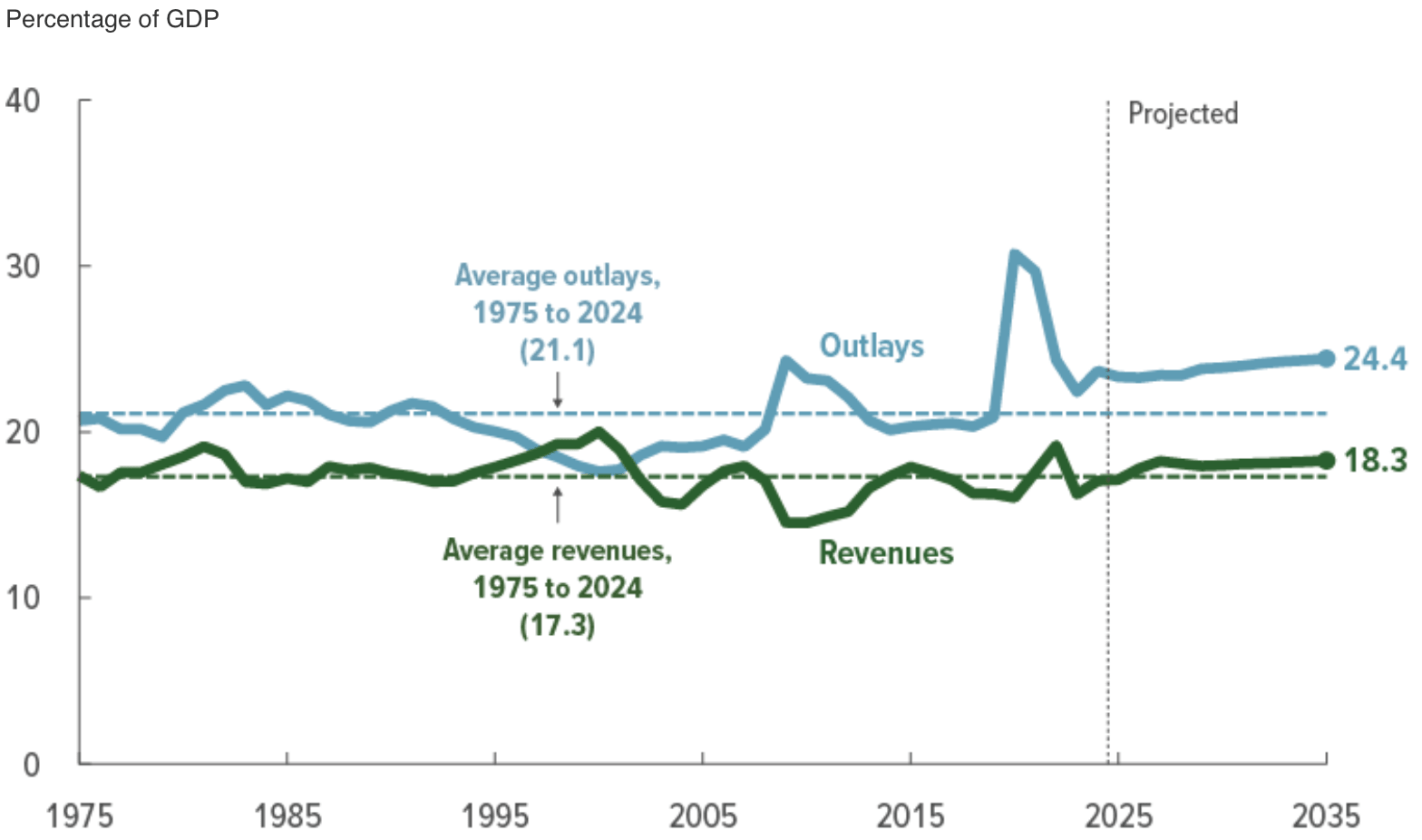
We are currently in reasonably good economic times, but about to pass a mega-spending bill that blows the deficit up from its already-too-high-levels. At a time when we should be running a surplus, we are instead running a deficit around 6% of GDP:

Source: Congressional Budget Office

Our ‘primary deficit’ is lower, a more manageable 3% of GDP. But if interest rates go higher, either for structural reasons or because of a loss of confidence in the US government’s willingness to pay its debts, the total deficit could spiral higher rapidly. The CBO optimistically assumed that the interest rate on 10-year treasuries will fall below 4% in the 2030s, from 4.3% today:

Source: Congressional Budget Office

But their scoring of H.R. 1 (“One Big Beautiful Bill Act”) shows it adding $3 trillion to the debt over the next 10 years, increasing the deficit by ~1% of GDP per year.

I already suspected this gray rhino would eventually cause a crisis, but this bill and the milieu that produced turn it into a near guarantee- nothing stops the deficit train until we hit a full blown crisis. That crisis is no longer just a long-term issue for your kids and grandkids to worry about- you will see it in 7 years or so. Unfortunately, that is still far enough away that current politicians have no incentive to take costly steps to avoid it. In fact, deficits will probably make the economy stronger for a year or two before they start making things worse- convenient for all the Congresspeople up for election in less than 2 years.

Here are the ways I see this playing out, from most to least likely:

  1. By around 2032, either the slowly aging population or a sudden spike in interest rates forces the government to touch at least one of the third rails of American politics: cut Social Security, cut Medicare, or substantially raise taxes on the middle class (explicitly or through inflation).
  2. We get bailed out again by God’s Special Providence for fools, drunks, and the United States of America. AI brings productivity miracles bigger than those of computers and the internet, letting GDP grow faster than our debts.
  3. We default on the national debt (but this is a risky option because we will still want to run big deficits, and lenders will only lend if they expect to get paid back).
  4. We do all the smart policy reforms that economists recommend in time to head off the crisis and stop the rhino. Medical spending falls without important services being cut thanks to supply-side reforms or cheap miracle drugs (GLP-1s going off patent?).

I’m hoping of course for numbers 2 and 4, but after this bill I’m expecting the rhino.

Salty SALT in the OBBB

The Republicans hold a majority in both chambers of congress and they are the party of the president. They want to use that opportunity to pass substantial legislation that addresses their priorities. Hence, the One, Big, Beautiful Bill (OBBB). But, just like the Democratic party, Republican congressmen are a coalition with various and sometimes divergent policy agendas. There are ‘Trump’ Republicans, who want tariffs, executive orders, and deportations. There are more liberal members who want more free markets. You can also find the odd ‘crypto bro’, blue-state representatives, and deficit hawks. Given the slim majority in the House of Representatives, they all have to get something out of the legislation. Put them together, and what have you got?* You get a signature piece of legislation that no one is happy about but everyone touts.

One example of such compromise is the State and Local Tax federal income tax deduction, or SALT deduction. The idea behind it is that income shouldn’t be taxed twice. If you pay a part of your income to your state government in the form of taxes, then the argument goes that you shouldn’t be taxed on that part of your income because you never actually saw it in your bank account. The state took it and effectively lowered your income. The state and local taxes get deducted from the taxable income that you report to the federal government.  The reasoning is that you shouldn’t need to pay taxes on your taxes.

Paying taxes on your taxes sounds bad. And plenty of people don’t like one tax, much less two. The Tax Foundation has done a lot of good work to cut through the chaff and has published many pieces on the SALT deduction over the years.**

Cut and Dry SALT Deduction Facts:

  • It’s a tax cut
  • It reduces federal tax revenue
  • It adds tax code complication
  • It is used by people who itemize rather than take the standard income tax deduction
  • Prior to the 2017 Tax & Jobs Act, there was no limit on the SALT deduction. After, the limit was $10k.
  • The current OBBB increases the SALT deduction.

Those are the basics. Everything else is analysis. The Grover Norquist Republicans never see a tax cut that looks bad, so they’d like to see the SALT limit raised or disappear. Tax think tanks that like simplicity don’t like the SALT deduction because it adds complication. Plenty of others say they don’t like complication, but often change their mind when it comes to the details (much like cutting government waste). Think tanks tend to be a bit lonely on this point.

People mostly care about the SALT deduction due to the distributional effects. Who ends up benefiting from the deduction? The short answer is people who 1) itemize & 2) have heavy state and local tax bills. Who is that? Rich people of course! They have high incomes and lots of wealth and real estate – on which they pay taxes. But not all rich people pay loads of state taxes. So the SALT deduction is a tax cut that primarily benefits rich people who live in high tax districts. Where’s that? See the below.

Continue reading

The End of Easy Student Loans

The Senate Health, Education, Labor and Pensions Committee is proposing to cut off student loans for programs whose graduates earn less than the median high school graduate. The House proposed a risk-sharing model where colleges would partly pay back the federal government when their students fail to pay back loans themselves. Both the House and Senate propose to cap how much students can borrow for graduate loans. Both would reduce federal spending on higher ed by about $30-$35 billion per year, cutting the size of the $700 billion higher ed sector by 4-5%. I expected that something like this would happen eventually, especially after the student loan forgiveness proposals of 2022:

While we aren’t getting real reform now, I do think forgiveness makes it more likely that we’ll see reform in the next few years. What could that look like?

The Department of Education should raise its standards and stop offering loans to programs with high default rates or bad student outcomes. This should include not just fly-by-night colleges, but sketchy masters degree programs at prestigious schools.

Colleges should also share responsibility when they consistently saddle students with debt but don’t actually improve students’ prospects enough to be able to pay it back. Economists have put a lot of thought into how to do this in a manner that doesn’t penalize colleges simply for trying to teach less-prepared students.

I’d bet that some reform along these lines happens in the 2020’s, just like the bank bailouts of 2008 led to the Dodd-Frank reform of 2010 to try to prevent future bailouts. The big question is, will this be a pragmatic bipartisan reform to curb the worst offenders, or a Republican effort to substantially reduce the amount of money flowing to a higher ed sector they increasingly dislike?

Of course, there is a lot riding on the details. How exactly do you calculate the income of graduates of a program compared to high school grads? The Senate proposal explains their approach starting on page 58. They want to compare the median income of working students 4 years after leaving their program (whether they graduated or dropped out, but exempting those in grad school) to the median income of those with only a high school diploma who are age 25-34, working, and not in school.

Nationally I calculate that this would make for a floor of $31,000. That is, the median student who is 4 years out from your program and is working should be earning at least $31k. In practice the bill would implement a different number for each state. This seems like a low bar in general, though you could certainly quibble with it. For instance, those 4 years out from a program may be closer to age 25 than age 34, but income typically rises with age during those years. If you compare them to 26 year old high school grads, the national bar would be just $28k.

What sorts of programs have graduates making less than $31k per year?

Continue reading

Not a Ranked-Choice Failure

I have a good friend who is a professor in philosophy at another university. He was telling me about the struggle among his colleagues to determine the recipient of their annual department award. Every year the department chooses from among the graduating philosophy major students one to recognize for excellence. This year, they faced the challenge of incommensurables.

One student had a high GPA in the major, but had a severe case of senioritis and had phoned-in her senior courses. A second had a slightly worse GPA, but had face-planted the senior thesis. Still a 3rd student had merely a good GPA, but wrote an excellent publishable thesis.

The philosophy faculty could not agree. They each shared stories and arguments about the relative weights of the performance indicators and the relative value of the performances. I don’t know if you know any academics, but suffice it to say that they both A) tend not to be good administrators and B) tend not to be invited to productive meetings. I’m glad that I wasn’t in the room.

In fact, the faculty met twice! They were at an impasse. The department award winner is usually no contest. The person who excels in one area tends to also excel in the others. This year, the decision was so unclear and the faculty were so divided that they even seriously considered withholding the award entirely. None of the candidates was excellent on all counts.

Finally, trying to come to a decision – if not an agreement – they decided to adopt something that they’d heard good things about: Ranked Choice Voting. I was thrilled to hear this. What an opportunity to exhibit the nuance and beauty of this collective choice method! They agreed to adopt whatever the outcome would be. As my friend told me this, I was giddy with anticipation. What an exciting story! More good experiences with ranked choice voting may improve its popularity and make widespread its adoption.

If you don’t know, Ranked Choice Voting involves everyone ranking the candidates in order of preference. In this case 1 is most preferred and 3 is least preferred. Then, the candidate with the fewest first-ranked votes is eliminated from the running. The voters whose first preference was nixed now have their votes reallocated to their 2nd preferred candidates. Since only two candidates remain, one of them has won the majority and the election ends with an outcome that is usually considered better than the simple ‘just choose your favorite’ version that most of us use at our local polls.

How did the philosophers fare?

Continue reading

Montana’s New Property Tax System

SPOILER ALERT if you are watching the TV Series Yellowstone: at the start of Season 5, John Dutton (played by Kevin Costner) is sworn in as Governor of Montana. One of his first proposals in his inaugural address is that the state legislature “double property taxes for non-residents” who have been buying up vacation homes in the state, and contributing to the increase in property values in the state (a fact which drives many plotlines throughout the series). This episode aired in November 2022.

This week, the real governor of Montana signed a pair of bills which effectively did what the fictional governor John Dutton proposed: significantly increasing property taxes on non-residents. Starting in tax year 2026, the property taxes for non-primary residences (which will include non-Montana residents and Montanans who own vacation homes) will be based on 1.9% of market value, while Montana residents will pay a graduated rate structure for their primary residence: 0.76% for property up to the state median (currently about $340,000), 0.9% up to two times the state median, 1.1% for the value between 2 and 4 times the state median, and 1.9% (the same as non-residents) for the value of homes above 4 times the state median ($1.36 million currently). Currently residential property is taxed at 1.35% of market value, meaning that while the rate hasn’t fully doubled for non-residents, most non-residents will be paying twice or more in property taxes than Montana residents.

I was a non-resident member of the Montana Property Tax Task Force, and served on the “Tax Fairness” subcommittee where the plan for HB 231 originated, so I have somewhat of a unique perspective on these changes to property tax rates. I will offer a few thoughts, some of which are critical, but let me first say that it was a great honor to be asked to serve on the Task Force by Montana’s Governor. Also, everyone on the Task Force was very friendly and receptive to ideas from outsiders (I was one of three non-Montanans on the Task Force), and so my comments here are not critical of the Task Force process nor anyone on it. As I did when I served on the Task Force, my goal in this post is to try, as best as I can, to objectively analyze how this proposal (now law) will impact Montana.

Continue reading

95 Days of Trump Spending & Cutting

Generally, decisions to spend federal funds come is the authority of congress. But the Trump administration has very publicly made clear that it will try to cut the things that are within its authority (or that it thinks should be within that authority). Truly, the fiscal year with the new Republican unified government won’t begin until October of 2025. So, the last quarter is when we’ll see what the Republicans actually want – for better or for worse. In the meantime, we can look past the hyperbole and see what the accounting records say. The most recent data includes 95 days after inauguration.  First, for context, total spending is up $134 billion or 5.8% from this time last year to $2.45 trillion.

The Trump administration has been making news about their desire and success in cutting. Which programs have been cut the most? As a proportion of their budgets, below is a graph of were the five biggest cuts have happened by percent. The Cuts to the FCC and CPB reflect long partisan stances by Republicans. The cuts to the Federal Financing Bank reflect fewer loans administered by the US government and reflect the current bouts to cut spending. Cuts in the RRB- Misc refer to some types of railroad payments to employees. In the spirit of whiplash, the cuts to the US International Development Finance Corporation reverse the course set by the first Trump administration. This government corporation exists to facilitate US investment in strategically important foreign countries.

But some programs have *increased* spending since 2024. The five largest increases include the USDA, the US contributions to multilateral assistance, claims and judgments against the US, the federal railroad administration, and the international monetary fund. Funding for farmers and railroads reflect the old agricultural and new union Republican constituencies. The multilateral assistance and IMF spending reflects greater international involvement of the administration, despite its autarkic lip service.

Continue reading

Anti-Tariff Declaration

The Smoot-Hawley Tariff of 1930 was opposed by a thousand economists, but passed anyway, exacerbating the Great Depression. Now that the biggest tariff increase since 1930 is on the table, the economists are trying again. I hope we will find a more receptive audience this time.

The Independent Institute organized an “Anti-Tariff Declaration” last week that now has more signatures than the anti-Smoot-Hawley declaration, including many from top economists. One core argument is the sort you’d get in an intro econ class:

Overwhelming economic evidence shows that freedom to trade is associated with higher per-capita incomes, faster rates of economic growth, and enhanced economic efficiency.

But I thought the Declaration made several other good points. Intro econ textbooks say that tariffs at least benefit domestic producers (at the expense of consumers and efficiency), but in practice these tariffs have been mainly hurting domestic producers, because:

The American economy is a global economy that uses nearly two thirds of its imports as inputs for domestic production.

I get asked to sign a petition of economists like this every year or so, but this is the first one I have ever agreed to sign onto. Most petitions are on issues where there are good arguments on each side, like whether to extend a particular tax cut, or which Presidential candidate is better for the economy. But the argument against these tariffs is as solid as any real-world economic argument gets.

The full Declaration is quite short, you can read the whole thing and consider signing yourself here.

How Scott Bessent Outfoxed Peter Navarro to Get the 90 Day Tariff Pause

Despite the nearly universal outcry, President Trump was standing firm on his massive tariffs. “No backing down”, etc., despite the evaporation of trillions of dollars in stock values. On Tuesday, April 8, White House spokesperson Karoline Leavitt affirmed: “The President was asked and answered this yesterday. He said he’s not considering an extension or delay. I spoke to him before this briefing. That was not his mindset. He expects that these tariffs are going to go into effect.” However, the next day, Wednesday, April 9, Trump announced on his social media platform, Truth Social, that for all countries but China, there would be a 90-day pause in reciprocal tariffs.

What happened here? The common explanations are that (1) the chaos and losses in the markets had finally grown intolerable, or that (2) the president had planned all along to pause the tariff hikes on April 9. I suspect there is some merit to both of these factors – -despite all the prior warnings, I think (1) Trump did not expect such market devastation (he sincerely believes that he is making the American economy great, so why should markets crash?), and also (2) that he had indeed planned to play around with tariff implementations in pursuit of deals.

But what some analysts pointed out as a further factor was the drop in the market value of U.S. Treasury bonds, which correlates directly to a rise in interest rates. The actions of the Administration have seemingly caused market participants, especially abroad, to question the risk-free status of U.S. debt. If the government has to pay higher interest on its debt, it is game over, as interest payments will spiral up and consume an ever-higher share of the federal budget. The chart below shows in orange the price movement of the TLT fund, which holds long-term T-bonds, plummeting on April 7, 8, and 9 (red arrow), as an indicator of rising rates. TLT price then shot upwards, along with stocks (the green line is S&P 500 fund SPY) late on April 9, in the relief following the tariff announcement:

As Treasury Secretary, Scott Bessent would be particularly sensitized to the interest rate issue, and able to communicate that to the boss. He has been a successful hedge fund trader and manager, so he understands the plumbing of the system, unlike some other presidential advisors. Up till then, however, economist Peter Navarro, who is ultra-hawkish on tariffs, had had the ear of the president.

So, what did Bessent do? (This is the part that only came to my attention a few days ago, even though technically this is old news). It seems he enlisted the support of Commerce Secretary Lutnick, and adroitly chose a time when Navarro was tied up in a meeting, and barged in on the president in an unscheduled meeting so they could get him alone. And it worked! Evidently, they persuaded him that now was the time to do the clever deal-making thing and issue a pause. It’s a mark of how readily the president can change his mind that his own press spokespeople were unaware of this volte-face, and had to scramble to make sense of it. It is also interesting that cabinet members are resorting to cloak-and-dagger tactics to get policy done.

Bessent naturally gave all the credit to the president for the decision, but he and Lutnick had photos taken to show who saved the financial world – for now:

Scott Bessent (standing, left) and Howard Lutnick (right) with President Trump as he signs 90-day pause in reciprocal tariffs.  Source: Daily Mail.

The president’s recent musings about trying to fire the supposedly independent Fed chairman have since contributed to interest rates going back up again, but that is another story.