Spending Like a…

Is the federal government spending at a faster rate? Your answer probably has more to do with your biases than with anything else. Most people don’t know the numbers or they imagine some more appropriate past. Below is logged current federal expenditures (this does not include government fixed investment, only consumption. Yes, we can argue about measures. This doesn’t include transfers).

The line of best fit is about 1.6% per quarter or 6.4% per year. Golly! Our spending is rising so fast! But, US federal spending grew relatively slowly in the 90s – maybe due to that fiscal conservative, Bill Clinton. And our federal spending grew even more slowly between 2010 and 2016 – maybe due to that other fiscal conservative, Barack Obama.

But, inflation varied over this period. What about real, inflation adjusted federal spending? See Below.

Continue reading

Why States Hate Nursing Homes

Medicaid is a health insurance program for those with low incomes, funded largely by states. Overall it accounts for less than 20% of US medical spending. But there is one area where it is the dominant payer: nursing homes. Nursing homes are expensive, and Medicare (the typical insurance for those over 65) won’t cover them after the first hundred days, so most nursing home residents end up paying out of pocket until they burn through all their savings and wind up on Medicaid. At which point, Medicaid pays about $100,000 per year to the nursing home for the rest of their life.

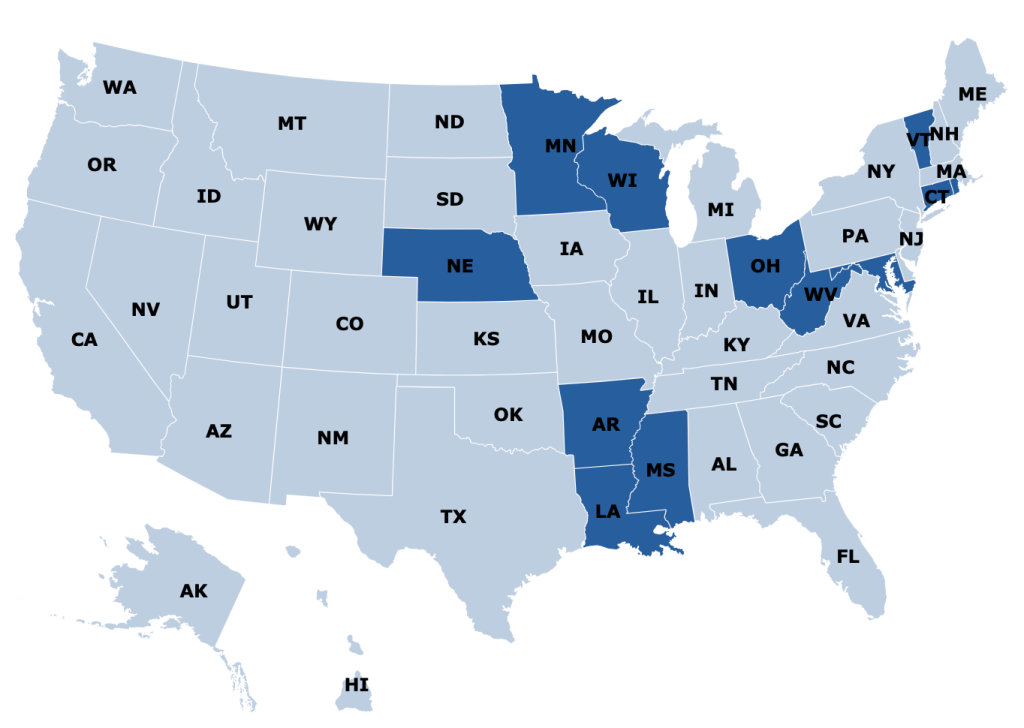
States are responsible for up to half of that cost, and so start looking for ways to save money. One idea they have is to make it harder to build nursing homes: if there aren’t beds available, potential nursing home patients will have to stay home instead, where they can’t rack up Medicaid spending the same way. In fact, some states go all the way to a complete moratorium on new nursing homes:

Source: Institute for Justice

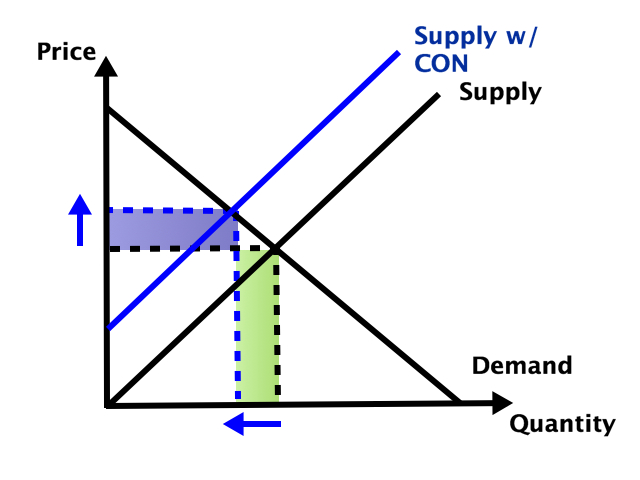
Some other states allow new nursing homes, but only with a special permission slip called a Certificate of Need (CON). CON is often required for other types of health facilities as well, like hospitals or dialysis centers. Research by me and others has generally found that CON doesn’t work as a way to reduce spending, and in fact actually increases it. CON might reduce the number of facilities, but that reduction of supply and competition gives the remaining facilities more power to raise prices.

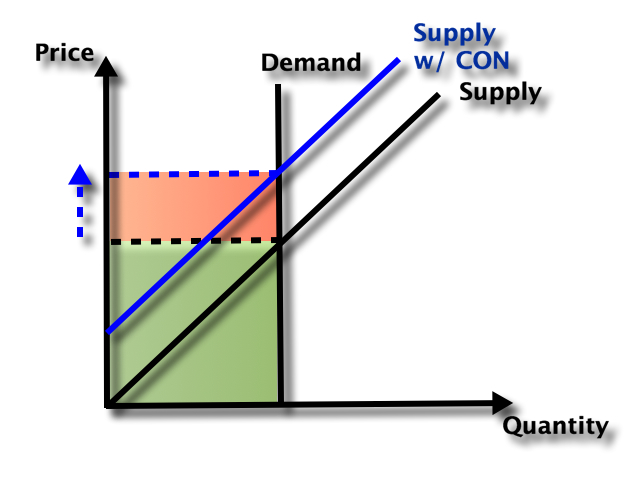
So which effect dominates- does the smaller number of facilities reduce total spending, or do the higher prices increase it? It depends on the elasticity of demand:

In health care demand is typically quite inelastic, so the price effect dominates, and spending goes up:

But nursing homes could be an exception here. Elasticity of demand could be relatively high because of the number of potential substitutes- home care or assisted living for those with relatively low medical needs, hospitals for those with relatively high medical needs. Plus this is the one type of health care where Medicaid is the dominant payer. They could be especially resistant to price increases here, both due to their market power and their willingness to keep prices so low that facilities won’t take Medicaid patients (another way to save money!).

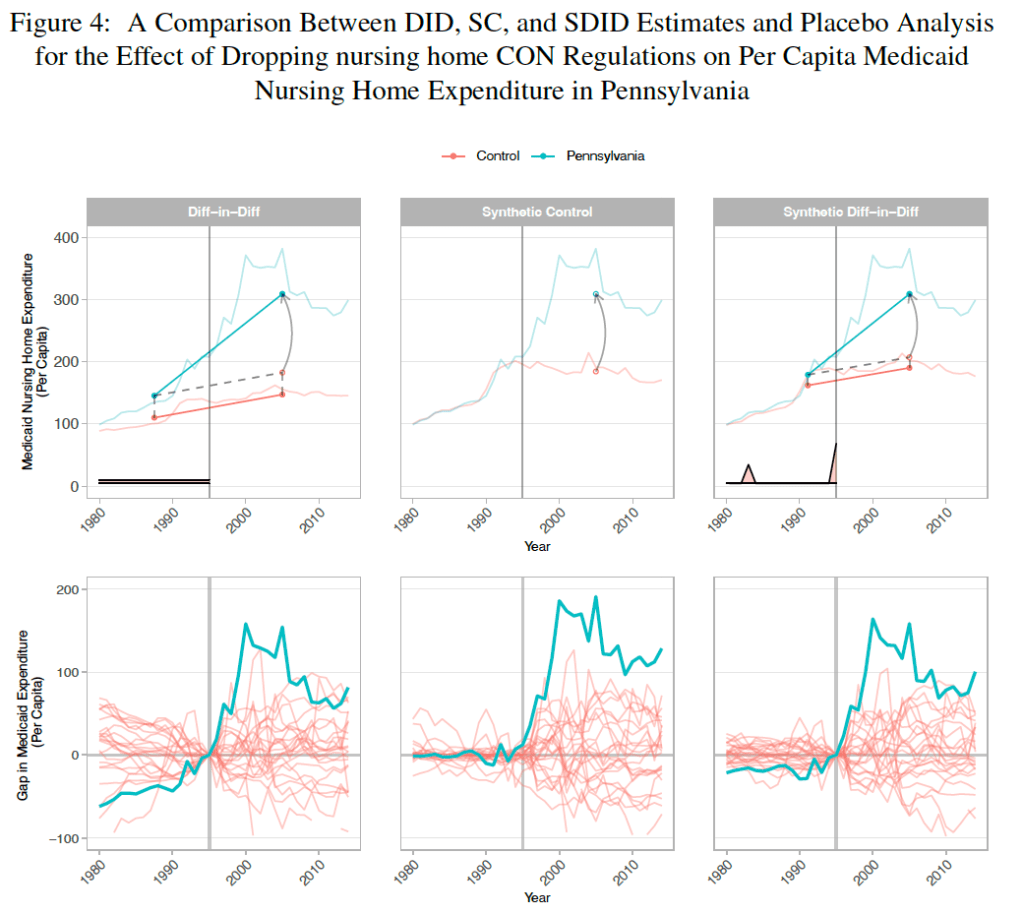
A new paper by Vitor Melo and Elijah Neilson finds that this is indeed the case. Indiana, Pennsylvania, and North Dakota repealed their nursing home CON requirements in the ’90s, and at least for IN and PA their Medicaid spending went way up. The paper uses a new “synthetic difference in difference” technique that seems appropriate, and creates figures that seem confusing at first but get a ton of information across:

They correctly note that they don’t evaluate the welfare effects of the policy; it’s possible that the extra nursing home beds following CON repeal bring huge benefits to seniors that are worth the higher spending. But nursing homes could be the exception to the general rule that CON fails to achieve the goals, like reduced spending, that advocates set for it.

Hospitals Just Got Easier to Build in West Virginia

West Virginia just repealed their Certificate of Need requirement for hospitals and birthing centers. Until now anyone wanting to open or expand a hospital needed to apply to a state board for permission. The process took time and money and could result in the board saying “no thanks, we don’t think the state needs another hospital”.

Now anyone wanting to open or expand a hospital and birthing center can skip this step and get to work. This means more facilities and more competition, which in turn leads to lower health care spending relative to trend.

Of course, the rest of West Virginia’s Certificate of Need requirements remain in place; if you want to open many other type of health care facilities, or purchase major equipment like an MRI, you must still get the state board to approve its “necessity”. In some cases, you shouldn’t even bother applying; West Virginia has a Moratorium on opioid treatment programs. Ideally West Virginia would join its neighbor Pennsylvania in a complete repeal of Certificate of Need requirements.

But making it easier to build hospitals and birthing centers is a major step. Hospitals are the largest single component of health spending in the US, and improved facilities might help reduce West Virginia’s infant mortality from its current level as the 4th worst state.

Update 4/7/23: A knowledgable correspondent suggests that the law may only allow existing hospitals to expand without CON (while totally new hospitals would still require one), citing this article. The text of the bill itself seems ambiguous to me. The section “Exemptions from certificate of need” adds “Hospital services performed at a hospital”. For birthing centers by contrast, new construction is clearly now allowed by right: exemptions from CON now include “Constructing, developing, acquiring, or establishing a birthing center”.

Whiteboard Macroeconomics

There’s nothing that economists love more than a good blackboard (or in modern times, a whiteboard) to work out some basic models of how we think the world works. Supply and demand rules in microeconomics, but macroeconomics has a few good blackboard models too.

So I was excited to see when a member of Congress was using a whiteboard to work through some basic economic logic, as Rep. Katie Porter did in this video she tweeted using the textbook macroeconomics aggregate demand and aggregate supply model:

However, while I haven’t taught macroeconomics in about a decade, it seems there are a few flaws in her analysis. Flaws enough that this probably wouldn’t get a passing grade on an oral exam. I could detail them myself, but… I will leave this to the readers as an exercise! For fun, even if you don’t think this is the best model in the world, just assume it’s a good model. What did Rep. Porter miss? Leave a comment.

Renting From the Government?

When I was younger, and a more disagreeable libertarian, I was staunchly against almost all taxes. And not just all taxes in general. Each type of tax was a specific affront to human dignity in its own egregious way.

  • Sales taxes represented government meddling in private contracts.
  • Income taxes represented government stealing people’s time.
  • Property tax represented that living on land was a privilege provided by the state landlord. Private property was a myth.

I won’t win the fight over whether the state governments should be spending money. But, given that we have to pay for services, I can definitely opine on the desirable and undesirable traits of one tax or another. Economists tend to like sales taxes because they encourage saving, investment, capital formation, and greater output. Maybe that’s a good idea. But it’s not clear to me that we should incentivize consumption tomorrow at the cost of consumption today.  There is no singular right answer to that tradeoff.

I would love to have a per-adult lump sum tax in which everyone pays the same dollar figure no matter what. I would also love to receive a million dollars – and that ain’t going to happen either. In lieu of a lump sum tax on people, I think that the next best thing is a lump sum tax on land. Each acre in a county can pay the same tax bill. On the margin, firms would economize on land and tend toward density. That would bring lots of agglomeration and economies of scale. Jeremy wrote recently about land taxes, which have a lot of proponents. I share the concerns about estimating land value and I think that it’s a non-trivial challenge.

Continue reading

Land-Value Taxes in the Real World: Split-Rate Taxes

Tyler Cowen is skeptical about the possibility of a pure land-value tax, even though it has many theoretical benefits. In particular, Cowen points to a host of what we might call “Public Choice NIMBY” issues. In the real world, the same political forces that drive all of the current urban planning issues would either prevent it from being implemented at all, or prevent it from actually being implemented the way Henry George would have wanted.

I grant all these objections, but I do note that there have been multiple YIMBY successes in recent years, particularly in California where NIMBY forces are probably the strongest in the country. Still, if Cowen is mostly correct, are there any real-world options that offer some of the benefits of a LVT? In short, the main benefits are that the deadweight loss of the tax is very small, and that land is more likely to be used for its highest-valued use (which in many cases will mean more density, though this intersects with zoning policy).

Yes. For the clearest example, look to Pennsylvania. Cities are allowed to implement what is called a “split-rate property tax.” It does not only tax land, as a pure LVT would do, but instead taxes land at a higher rate than improvements. A ratio around 5:1 is typical (meaning land is taxed at 5 times the rate of improvements), though some cities have been as high as 26:1.

Continue reading

Itching to Change (Property Rights)

I live in southwest Florida where it is quite tropical. We don’t have four seasons. We mark the passage of time with the rainy season for 8 months and the dry season for 4 months. We also mark time with ‘season’. Season is when the snow-birds – those who live in places further north – migrate to and occupy Florida for about 4-5 months. During those times the roads are more crowded and the grocery store customers are less friendly. We can also mark the passage of time with mosquitos. January has fewer mosquitos. The rest of the year we know not to go outside at dusk.

Therefore, we have the Collier Mosquito Control District. This little government entity does several things. But I want to focus on spraying. On some nights, more so during the rainy season, the CMCD flies airplanes and sprays our inland bodies of water that are susceptible to mosquito infestation. Let’s put aside for the moment any alleged negative human health effects that spraying might cause.

I want to talk about taxes.

Continue reading

“Let whoever needs to die, die”:  China’s Abrupt COVID Reopening To Achieve Rapid Herd Immunity and Resumption of Industrial Production, at the Cost of a Million Deaths

I noted a month ago that President Xi and the CCP have taken credit for relatively low (reported) deaths from COVID, due to strict lockdown protocols. By “strict” we mean locking down whole cities and blockading residents in their apartment buildings for months at a stretch. However, public protests rose to an unprecedented level, and so the Chinese government has done a surprising full 180 policy change, towards almost no restrictions.

According to Dr. Ezekiel Emanuel in the Wall Street Journal, the way this policy is being carried out has the makings of a mass human tragedy:

Zero Covid was always untenable and had to be ended. But it could have been done responsibly.

Among other things, that would involve buying Pfizer and Moderna bivalent vaccines and administering them to the elderly and other high-risk people, and purchasing Paxlovid and molnupiravir to treat those who test positive. Supplies of these products are ample. Authorities could continue mask mandates to reduce transmission. And China could institute a rigorous wastewater testing program to identify potential SARS-CoV-2 variants as soon as possible – and commit to sharing the data with the world.

Due to nationalistic pride, China has spurned the purchase of effective mRNA vaccines from Pfizer and Moderna, pushing instead the less-effective in-house vaccine.

Readers may recall in the early days of COVID spread in the West, masking and social distancing were promoted, not because they would prevent everyone from ultimately becoming infected, but because these measures would “flatten the curve” (i.e. reduce the peak load on hospitals at any one time, but instead spread it out over time). China is headed into a very un-flattened infection curve; some 800 million people (10% of the world’s population) may get COVID in the next 3 months, overwhelming hospitals and leading to over a million deaths. Besides the near-term human costs, this concentration of active COVID cases is likely to lead to a slew of new, even more virulent variants which will affect the rest of the world, along with China. What should help mitigate the situation is that the newer, most virulent variants of COVID may be somewhat less fatal than the original strain.

Why is the Chinese government doing it this way? Well, the sooner the country gets through mass exposure to the virus, the sooner everyone can get back to their factories and start producing stuff again. If in the process a bunch of (mainly older) people die, well, that’s just the price of progress. Let ‘er rip…

From MSN:

[U.S.] Epidemiologist and health economist Dr Eric Feigl-Ding estimate that 60 per cent of China’s population is likely to be infected over the next 90 days. “Deaths likely in the millions—plural,” he added.

According to Eric, bodies were seen piled up in hospitals in Northeast China. “Let whoever needs to be infected infected, let whoever needs to die die. Early infections, early deaths, early peak, early resumption of production,” the epidemiologist said terming it to be summary of Chinese Communist Party’s (CCP) current goal.

But don’t expect any acknowledgement of mass death from the official Chinese media. Just as the initial COVID outbreak was denied and censored by the Chinese propaganda machine, so the current surge is being minimized. From Barrons:

On Friday, a party-run newspaper cited an official estimate of half a million daily new cases in the eastern city of Qingdao. By Saturday, the story had been amended to remove the figure, an AFP review of the article showed….

Several posts on the popular Weibo platform purporting to describe Covid-related deaths appeared to have been censored by Friday afternoon, according to a review by AFP journalists.

They included several blanked-out photos ostensibly taken at crematoriums, and a post from an account claiming to belong to the mother of a two-year-old girl who died after contracting the virus.

Posts about medicine shortages and instances of price gouging were also taken down, according to censorship monitor GreatFire.org.

And social media users have posted angry or sardonic comments in response to the perceived taboo around Covid deaths.

Many rounded on a state-linked local news outlet after it reported Wu Guanying — designer of the mascots for the 2008 Beijing Olympics — had died of a “severe cold” at the age of 67.

Perhaps we should not be surprised that the Chinese Center for Disease Control and Prevention just reported zero COVID deaths for December 25 and 26.

Sympathy for the Sauds

I’ve always been confused by the US alliance with Saudi Arabia. Its a state with values abhorrent to many Americans, and it seems like we don’t get much practical value out of the alliance.

This essay on Saudi history, politics, and economics by Matt Lakeman makes the situation more comprehensible. I still don’t know that I want the alliance, but I can now see how so many US presidents have continued with it without necessarily being stupid, crazy, or corrupt. In short, they think that most of the realistic alternatives are worse. Some highlights:

Before starting this research, I had the same perception as Wood that the Saudi economy is essentially what he calls a “petrol-rentier state.” Basically, Saudi Arabia sits on top of a giant ocean of easily-accessed oil which they suck out of the ground and sell at enormous profit to prop up the rest of their extremely inefficient economy and buy the loyalty of their own people and foreign powers. Saudi Arabia is the wealthiest large state in the Middle East today by sheer virtue of geographic luck rather than any innovation or business acumen on the part of its people.

And after doing my research, all of the above is… basically true.

But all of that should also be true of Iran, Iraq, Venezuela, Libya, and a few other countries which are also situated on giant oceans of oil but are far poorer than Saudi Arabia.

Economically, Saudi Arabia deserves little credit for its success. Politically, Saudi Arabia deserves a tremendous amount of credit for enabling its economic success. 

Dealing with the resource curse is always challenging, and foreign ownership is an additional challenge. How did they manage it?

the Sauds struck a clever balance between being too aggressive and too placating of the foreigners operating their oil wells. If the Saudi state had been aggressive and tried to nationalize its oil quickly, Saudi Arabia could have ended up becoming another Venezuela or Iran with lots of external political pressure from hostile Western countries and a low-efficiency oil industry. But if they had nationalized too late, they would have ended up like a lot of African nations who have all their natural wealth siphoned away by foreigners.

Instead, the Sauds executed a patient, and most importantly, amicable assertion of power over Aramco, which did not become fully owned by Saudis until 1974. At the very start of Aramco, the company was entirely owned and operated by Americans aside from menial labor. However, the Saudi government inserted a clause into their contract with the corporation requiring the American oil men to train Saudi citizens for management and engineering jobs. The Americans held up their end of the bargain, and over time, more and more Saudis took over management and technical positions.

In addition to carefully negotiating the balance of power with various foreigners, the Sauds have done so with the religious establishment:

Though the monarch has absolute power, his authority is at least in part derived from Saudi Arabia’s Islamic religious establishment. The ulema (a group of the highest-ranking clerics) is officially integrated into the government, and plays an important role in legal matters. However, the religious establishment has slowly been marginalized by the monarchy over the last few decades, and has possibly been subjugated entirely since the reform era began five years ago.

Winning freedom of action has been a long road with many setbacks:

[King] Abdulaziz constantly had to reassure enraged Wahhabi clerics that he wasn’t selling out the Arab homeland to treacherous infidels. IIRC, it was some time in the 1920s that Abdulaziz had to publicly smash a telegraph to prove to the clerics that he wasn’t bewitched by infidel technology.

In late 1979, 400-500 extremist Sunni Saudis seized the Grand Mosque in Mecca (the holiest Islamic site on earth) and demanded the overthrow of the Saud dynasty in favor of a theocratic state meant to await an imminent apocalypse. They held on for two weeks while managing to fight off waves of Saudi police and military squads. Eventually, three French commandos flew to Mecca, converted to Islam in a hotel room, and led a successful assault to retake the Mosque. Over 100 men died on each side, with hundreds more wounded.

The Grand Mosque seizure was the final wake-up call for the Saud dynasty. Something drastic had to be done or their regime would likely be ground down under mounting internal and external pressure…. King Khalid led a social/religious/political reactionary revolution within Saudi Arabia to align with the Sunni extremists. Up until about four years ago, Saudi society was still gender segregated and enforced a largely literalist interpretation of Sharia, hence the array of bizarre and antiquated laws – gender segregation in public, requiring women to cover their faces, outlawing of non-Muslim religious buildings (there are a few Shia mosques), restrictions on foreign media, etc. Saudi Arabia was always conservative, but most of these draconian laws were only put into place in the 1980s. The Saud dynasty purposefully induced a reactionary legal regime and pulled Saudi Arabia further away from liberalism.

The charitable take on making an already oppressive regime even more oppressive is that the Sauds were trying to bend Saudi Arabia to the extremists so the country would not break. And by all accounts, it worked; the conservative Wahhabi clerics backed by the Saud dynasty placated a sizeable portion of the Sunni extremists inside and outside of Saudi Arabia, and they became a pool of support against the Shia and Baathists. Saudi Arabia was certainly made a worse country for its citizens, but that was the price to pay for averting civil war.

More recently, Crown Prince Salman has consolidated power to the point where he can make modernizing reforms that Wahhabis might have opposed, like allowing women to drive, allowing non-Muslim foreigners to to get tourist visas, allowing music concerts, et c. Lakeman obviously likes these reforms, but at the same time worries that the concentrated power that so far Salman has largely used to enact positive reforms could be abused going forward, and on a larger scale than murdering the occasional dissident.

Wood argues that a worst case scenario parallel to MBS is Syrian Dictator Bashar al-Assad. Like MBS, there were high hopes that Assad would be a liberal reformer when he took over Syria. After all, Assad had been living and working in the UK as an ophthalmologist with no political aspirations, and was known to be a fan of Phil Collins. He was called to the throne after the unexpected death of his older brother, and so the West hoped that this nerdy British doctor would bring upper-middle class liberal values to Syria. Instead, Assad became one of the worst dictators of the modern Middle East, probably second only to Saddam Hussein.

I recommend reading the whole thing, here I’m quoting relatively small parts of an article full of interesting detail on the history, economics, and politics of Saudi Arabia. There’s also a section on visiting:

The silver lining to Saudi Arabia’s lack of tourism is that there aren’t many tourist restrictions. I went to two ancient settlements and I found no guards, no gates, no notices at all. I walked in, around, and on top of 2,000 year old houses, and I honestly have no idea if I was allowed to.

Fight for $15? $25? $40?

Remember the “Fight for $15”? It’s a 10-year-old movement to raise the federal minimum wage to $15 per hour. While there hasn’t been any increase in the federal minimum wage since the movement began in 2012, plenty of states and localities have done so.

I won’t rehash the entire debate on the minimum wage here, but I will point you to this post from Joy on large minimum wage changes, and here are several other posts on this blog on the same topic. But lately I have seen an increasing call for even larger minimum wage increases, well beyond $15.

A prominent recent call for a higher wage comes from the SEIU, the second largest labor union in the nation. They are calling for a $25 minimum wage in Chicago, where the legal minimum wage just recently crossed $15 last year. Again, without getting into the detailed debates about the economics of the minimum wage, we can recognize that this would be a massively high minimum wage, given that median hourly wage for the Chicago MSA was $22.74 in May 2021. It’s certainly a bit higher in 2022, and the city of Chicago is probably a bit higher than the entire MSA. Still, we are talking about a minimum wage that would cover roughly half the workforce. Well, at least half the current workforce. The negative employment effects would potentially be large.

Here I will dabble a little bit in the minimum wage literature. One of the most famous recent papers that suggests increasing the minimum wage doesn’t have large negative employment effects is a 2019 paper by Cengiz, et al. This paper only looks at legal minimum wages that go up to 59% of the median market wage, which is the highest wages have been pushed up so far. By contrast, that $25 minimum wage in Chicago would be somewhere around 100% (!) of the local median market wage. That’s huge, and goes far beyond what even the most sympathetic-to-the-minimum-wage research has looked at.

But here’s the most recent minimum wage call that really takes the cake: over $40 per hour in Hawaii. That comes from, in a way, a Tweet from Hal Singer:

Now in fairness, he doesn’t exactly call for a $40 minimum wage in Hawaii, but he does say we should use the minimum wage as a tool to address homelessness, and then points to a study showing that you would need to earn $40/hour in Hawaii to afford a two-bedroom apartment. That’s pretty close. The median wage in Hawaii? About $23 in May 2021. In fact, the 75th percentile wage in Hawaii was $36.50 in 2021! So, depending on exactly how much wage growth there has been in Hawaii since May 2021, we are likely talking about a $40 minimum wage covering 75% of the workforce! That would likely have some “bite,” as economists say.