I teach macroeconomics, finance, and other things.
Often, I use Excel to complete repetitive calculations for my students. The version that I show them is different from the version that I use. They see a lot more mathematical steps displayed in different cells, usually with a label describing what it is. But when I create an answer calculator or work on my own, I usually try to be as concise as possible, squeezing what I can into a single cell or many fewer cells. That’s what brings me to to the sumproduct excel function that I recently learned. It’s super useful I’ll illustrate it with two examples.
Example 1) NGDP
One way to calculate NGDP is to sum all of the expenditures on the different products during a time period. The expenditures on a good is simply the price of the good times the quantity that was purchased during the time period. The below image illustrates an example with the values on the left, and the equations that I used on the right. That’s the student version. There is an equation for each good which calculates the total expenditure on the individual goods. Then, there is a final equation which sums the spending to get total expenditures, or NGDP.
Last year was the first time I saw a family that owned their own bounce house and just set it up in their living room. At the time I thought, what a lucky rich kid, that must cost at least a thousand dollars. But my wife looked into it and found out that bounce houses are surprisingly cheap these days. She got our kids this one last Christmas, its currently going for $234 on Amazon:
The kids love it and its still going strong ten months later, despite substantial use from kids and the presence of two sharp-clawed cats. It was certainly a bigger hit than the other major gift we tried last Christmas- telescopes are surprisingly hard to use.
Using a COVID test is a fairly serious matter – the results of such tests drive decisions on staying home and isolating or not, which in turn affect the spread of the virus in the population. I am known to use medicines that maybe expired six months earlier, figuring that the med will still be say 80% effective, but for a COVID test I want it to be as accurate as possible.
We all have on our shelves boxes of rapid COVID tests which were send out by the government in the first half of 2022. Most of these tests had nominal six-month lives, so according to what is stamped on the box, they are expiring right about now.
But wait – – that six-month life was just a (conservative) estimate from back when the tests were manufactured. For about a dozen out of the original 22 approved tests, subsequent data has shown that the tests remain accurate for longer than six months. Typically, the approved life is extended an additional six months or more. So before using or throwing out a box whose stamped expiration date has passed, go to this FDA link. You can quickly find your brand of test. The instructions for using this site are:
To see if the expiration date for your at-home OTC COVID-19 test has been extended, first find the row in the below table that matches the manufacturer and test name shown on the box label of your test.
If the Expiration Date column says that the shelf-life is “extended,” there is a link to “updated expiration dates” where you can find a list of the original expiration dates and the new expiration dates. Find the original expiration date on the box label of your test and then look for the new expiration date in the “updated expiration dates” table for your test.
If the Expiration Date column does not say the shelf-life is extended, that means the expiration date on the box label of your test is still correct. The table will say “See box label” instead of having a link to updated expiration dates.
A couple more notes re COVID Tests:
( 1 ) The tests do detect the omicron BA.5 subvariant, which has driven much of the infections lately. However, if you have been exposed to COVID, the new recommendation is to take three (instead of just two) tests, at least 48 hours apart. (If you take the test too early, not enough antigen has built up to detect, so you might get a false negative).
( 2 ) Although the initial federal program for free tests has expired, there are several ways to still get free tests. Any health insurer will pay for them, as will Medicare. And there are other venues for uninsured or low-income people. See this article.
Although fracking technology has enabled renewed oil production in the U.S., the West remains heavily dependent on oil imports, especially from the Middle East. Even in the U.S., the current refining capacity is not well-matched to the type of light oil produced by fracking, so we still import oil (of types that our refineries can handle), although we also export fracked oil. Since oil remains the basis of so much economic activity, and since many oil exporting countries are unstable or even hostile to the U.S and our allies, the U.S. in 1975 established a large Strategic Petroleum Reserve (SPR) to store up crude oil. The storage is mainly in caverns in Texas and Louisiana, dissolved out of underground salt deposits. It was mainly filled in the Reagan/Bush administrations in the late 1970’s, and topped up under Bush II around 2003-2004.
The statutory purpose of this stockpile is to protect us and our allies against a “a significant reduction in supply which is of significant scope and duration,” per the Department of Energy. If such an event occurs, leading to high prices and associated economic impact, the President is authorized to release oil from the SPR. However,
In no case may the Reserve be drawn down…
(A) in excess of an aggregate of 30,000,000 barrels with respect to each such shortage;
(B) for more than 60 days with respect to each such shortage;
Somehow various administrations and also Congress have circumvented these restrictions on draining the SPR, and over the years have sold off bits and pieces to raise money for government spending. However, the current administration has decimated the SPR, selling off a third of it (some 200 million barrels), mostly in the past six months:
The administration projects this gusher to stop after November. Essentially all objective observers recognize this as primarily a political move, to reduce gasoline prices in order to curry favor with voters for the mid-term elections this November. It’s one thing to knock the price of gasoline down from $5.00/gallon back in the spring, when the world was panicked about Russia’s invasion of Ukraine, but to keep on selling into a moderated market is irresponsible. We haven’t had an actual shortfall in supply these past few months. Among other things, Russia keeps happily pumping and selling, out into the global grey market.
I won’t belabor the point here (stay tuned for more posts on this subject), but the world is structurally short of oil. With this administration having spent its first year demonizing oil and oil companies, the petroleum industry is understandably cautious about making expensive investments in future oil production. They know they will be stabbed in the back as soon as the current party in power no longer needs them.
By dumping this oil now, the administration is making the U.S. and the West more vulnerable later, if there is an actual global oil supply crisis (think: Iran vs. Saudi Arabia in the Persian Gulf…). Irritated by the lowish oil prices engendered by the SPR release, OPEC just announced production cuts which will drive prices right back up. They can cut production far longer than we can drain the SPR. If this all motivates further investment in low CO2 energy (including nuclear), that is perhaps a good thing. But between now, and attaining a carbon-free utopia in the future, we need to keep the crude flowing. Let us hope for the best here.
Ultimately, drawing down the SPR was a political decision. Think about it. An administration that has frequently emphasized the importance of reducing carbon emissions is trying to increase oil supplies to bring down rising oil prices — which will in turn help keep demand (and carbon emissions) high.
But even though the Biden Administration wants to address rising carbon emissions, high gasoline prices cause incumbents to lose elections. So, they try to tame gasoline prices even though it contradicts one of their key objectives of reducing carbon emissions.
The SPR has now been depleted since President Biden took office from 640 million barrels to 450 million barrels…
President Biden’s gamble to deplete the SPR in order to fight high oil prices may not hurt him at all. Of course, if for some reason we had a true supply emergency and found ourselves needing that oil, it would be looked upon as a terrible decision.
Authors of the kinds of books I read present themselves as a voice of reason against our declining society that no longer can evaluate arguments or define moral principles. (I’m fun at parties.) “Postmodernism” has been attacked all my life.
For a while, I have been looking for a successor of postmodernism. To simply define our age as the one that came after modernism seems unsatisfactory. How many more decades can we coast along on this antithesis idea?
One reason I don’t like the term postmodernism is that it gives a sense of progress where we might be losing ground. If you aren’t modern, then you are pre-modern. If you aren’t a verbal culture, then you have regressed to pictographs. If you aren’t engaging arguments, then you have degenerated to tribalism. So, postmodern might be dressing up a decline with a word that is too respectable sounding.
Calling people who use smartphones premodern does not seem right. But, what information are they consuming on those screens? Is it mostly low-quality videos and quick poasts? That doesn’t seem like what someone in 1900 would expect of a modern person.
Here’s an idea for the new century. We are in an age of poastmodernism, beginning with the founding of Twitter. This is different from the kind of skepticism or moral relativism that defined postmodernism. The poasters and their followers can be earnest. They retweet like evangelists. (A “poast” is a message posted in an internet forum.)
Poasts are short. This does not allow for nuance or traditional rational forms of argumentation. A poast could be referencing a rich history or body of literature, but if this generation has not evaluated those original sources then they are really just getting the meme. The poast does not provide its own context. Tyler Cowen says that people who think “modern art” is absurd have no context. Context for modern art would be the classical art and realistic landscape paintings that came before. Most Americans including myself are pretty ignorant about classical art. Similarly, how much value would teenagers get from Lord of the Rings internet memes if they have never seen the movies or read the books?
I’m on Twitter. The pace of discourse is more fun than reading a 50-page econ journal article. I get the appeal of poasting. It’s easy. Our first pediatrician told us not to let our baby use touchscreen games. She told us that it is good for a child to struggle to touch a ball that is two feet away across the floor. Better that they cry over the ball than get the dopamine too easily on a tablet game. Tapping on a screen trains kids for instant rewards. Something that concerns me about a generation that was not raised on books is that they will actually enjoy poasting less than I do, because they will be used to the rapid pace of reward. Twitter as a company benefits from the current generation of people who did not grow up with Twitter.
Poasting affects politics. This week two US Senate candidates had a debate. What would someone who gets most of their news from social media learn about the debate? Some top poasts about the debate have almost zero positive policy substance. Campaigners use the internet medium to dunk on their opponents instead of offer solutions to problems. What attracts engagement is the fire emoji.
It says a lot about Blake Masters that he’s the only one on this stage who never wore a uniform for our country, and yet he thinks he knows better than our military on how to fight wars.
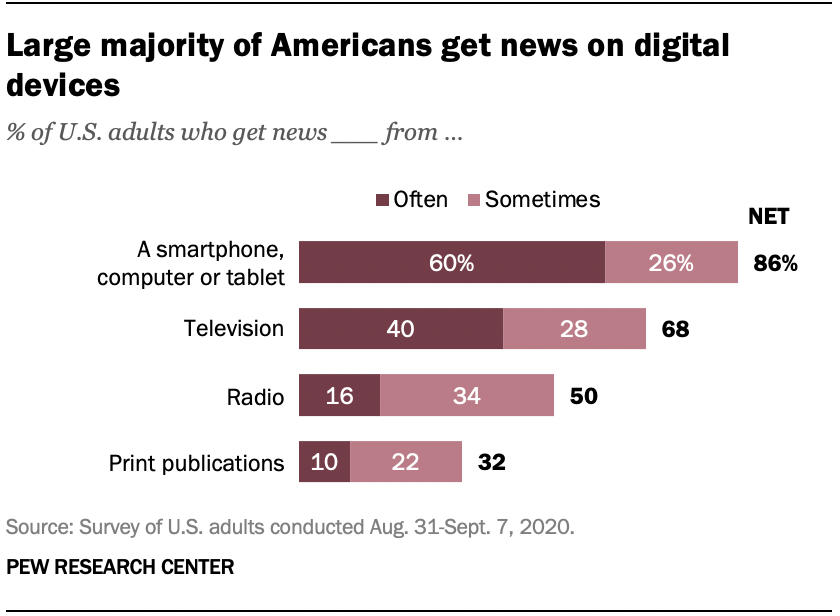
This is not meant as a comment on either men as candidates. I share these jabs because lots of Americans are consuming their “news” in this form (see Pew Research chart). In postmodernism a successful political candidate has to appeal to feelings as much as reason. In poastmodernism, they only have 280 characters to work with. (Donald Trump was a skilled poaster.)
Getting elected today might require great poasting, but that has little to do with being good at governing. Most people think the details of government are dull. Ten minutes into a city council meeting, I’m bored and ready to check the notifications on my phone. And yet, we cannot just poast about poasting. It’s the physical political world and the classic books that make the best subjects of conversation. So, I’m not sure if the era of poastmodernism will last for a long time, or simply to the end of my lifetime. Millennials are not going to give up the dog fire meme.
You’ll have to pry it from our hands after our large generation has passed on. But will it inspire people in the future? I have already been informed that teenagers are calling our gifs “cringe”. They seem to prefer 90 second videos of their peers dancing to pop music. Don’t ask me what comes next after that.
I’ll end on a positive note by saying that sometimes shorter is better. Get to the point quickly, if you can. Some of the novels produced in the modern era were too long. Adam Smith’s books would be more widely read if they were shorter. Long-winded speeches are not necessarily good and I’m glad I am not forced to listen to them. (I get the tl;dr the next day.)
A lot of bad ideas were dressed up in pages of smart-sounding language and then passed off for wisdom in the modern era. It might be harder to pull that off today. Authoritarian regimes in the past relied on being able to lie about conditions on the ground. Today, we know what is happening because of individuals on the ground sharing to Twitter (although social media can also be used for disinformation). American elites believed lies about what was going on inside the Soviet Union for years. That would be more difficult today.
I am pleased to announce that my paper “Willingness to be Paid: Who Trains for Tech Jobs?” has been accepted at Labour Economics.
Having a larger high-skill workforce increases productivity, so it is useful to understand how workers self-select into high-paying technology (tech) jobs. This study examines how workers decide whether or not to pursue tech, through an experiment in which subjects are offered a short programming job. I will highlight some results on gender and preferences in this post.
Most of the subjects in the experiment are college students. They started by filling out a survey that took less than 15 minutes. They could indicate whether or not they would like an invitation for returning again to do computer programming.
Subjects indicate whether they would like an invitation to return to do a one-hour computer programming job for $15, $25, $35, …, or $85.[1]This is presented as 9 discrete options, such as:
“I would like an invitation to do the programming task if I will be paid $15, $25, $35, $45, $55, $65, $75 or $85.”,
or,
“I would like an invitation to do the programming task if I will be paid $85. If I draw a $15, $25, $35, $45, $55, $65 or $75 then I will not receive an invitation.”,
and the last choice is
“I would not like to receive an invitation for the programming task.”
Ex-ante, would you expect a gender gap in the results? In 2021, there was only 1 female employee working in a tech role at Google for every 3 male tech employees. Many technical or IT roles exhibit a gender gap.
To find a gender gap in this experiment would mean female subjects reject the programming follow-up job or at least they would have a different reservation wage. In economics, the reservation wage is the lowest wage an employee would accept to continue doing their job. I might have observed that women were willing to program but would reject the low wage levels. If that had occurred, then the implication would be that there are more men available to do the programming job for any given wage level.
However, the male and female participants behaved in very similar ways. There was no significant difference in reservation wages or in the choice to reject the follow-up invitation to program. The average reservation wage for the initial experiment was very close to $25 for both males and females. A small number of male subjects said they did not want to be invited back at even the highest wage level. In the initial experiment, 5% of males and 6% of females refused the programming job.
The experiment was run in 3 different ways, partly to test the robustness of this (lack of) gender effect. About 100 more subjects were recruited online through Prolific to observe a non-traditional subject pool. Details are in the paper.
Ex-ante, given the obvious gender gap in tech companies, there were several reasons to expect a gender gap in the experiment, even on a college campus. Ex-post, readers might decide that I left something out of the design that would have generated a gender gap. This experiment involves a short-term individual task. Maybe the team culture or the length of the commitment is what deters women from tech jobs. I hope that my experiment is a template that researchers can build on. Maybe even a small change in the format would cause us to observe a gender gap. If that can be established, then that would be a major contribution to an important puzzle.
For the decisions that involved financial incentives, I observed no significant gender gaps in the study. However, subjects answered other questions and there are gender gaps for some of the self-reported answers. It was much more likely that women would answer “Yes” to the question
If you were to take a job in a tech field, do you expect that you would face discrimination or harassment?
I observed that women said they were less confident if you just asked them if they are “confident”. However, when I did an incentivized belief elicitation about performance on a programming quiz, women appear quite similar to men.
Since wages are high for tech jobs, why aren’t more people pursing them? The answer to that question is complex. It does not all boil down to subjective preferences for technical tasks, however in my results enjoyment is one of the few variables that was significant.
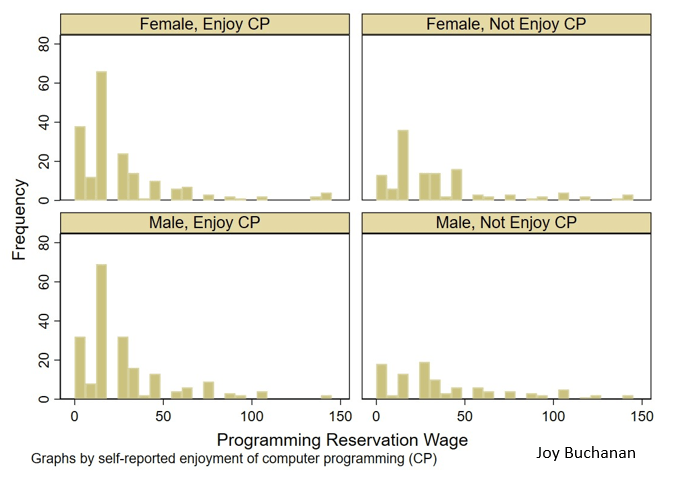
People who say they enjoy programming are significantly more likely to do it at any given wage level, in this experiment.
Fig. 3 Histogram of reservation wage for programming job, by reported enjoyment of computer programming (CP) and gender, pooling all treatments and samples
Figure 3 from the paper shows the reservation wage of participates from all three waves. Subjects who say that they enjoy programming usually pick a reservation wage at or near the lowest possible level. This pattern is quite similar whether you are considering males or females.
Interestingly, enjoyment mattered more than some of the other factors that I though would predict willingness to participate. About half of subjects said they had taken a class that taught them some coding, but that factor did not predict their behavior in the experiment. Enjoyment or subjective preferences seemed to matter more than training. To my knowledge, policy makers talk a lot about training and very little about these subjective factors. I hope my experiment helps us understand what is happening when people self-select into tech. Later, I will write another blog about the treatment manipulation and results, and perhaps I will have the official link to the article by then.
Buchanan, Joy. “Willingness to be Paid: Who Trains for Tech Jobs.” Labour Economics.
[1] We use a quasi-BDM to obtain a view of the labor supply curve at many different wages. The data is not as granulated as that which a traditional Becker-DeGroot-Marschak (BDM) mechanism obtains, but it is easy for subjects to understand. The BDM, while being theoretically appropriate for this purpose, has come under suspicion for being difficult for inexperienced subjects to understand (Cason and Plott, 2014). We follow Bartling et al. (2015) and use a discrete version.
No matter how you feel about intelligent machines, you’ll be talking to them soon.
Talking to voice assistants right now feels stilted because it's slow, inaccurate, and you can't interrupt.
Widely-available high-quality fast ASR and TTS, paired with LLMs, is coming soon and will enable much more natural conversations. https://t.co/8UQP5YRZ5l
This restaurant has several robots delivering food and drinks to tables. It’s strange at first but easy to get used to. The robots can tolerate people walking in front of them and mild harassment from children. pic.twitter.com/F47IcPqruU
In a world where China and India continue to build huge, CO2-belching coal power plants, and a world where global supply chains can no longer be taken for granted, you might think that a small, crowded country like the Netherlands would prioritize home-grown food production over concerns about greenhouse gas emissions from a relatively small volume of cow manure. But this is Europe, the land of eco-utopianism, and so you would be wrong.
Cow poop does emit nitrous oxide (a greenhouse gas) and ammonia (which can potentially pollute local water if uncontained). In a burst of green virtue, the Netherlands has, “unveiled a world-leading target to halve emissions of the gasses, as well as other nitrogen compounds that come from fertilizers, by 2030, to tackle their environmental and climate impacts.” This target is expected to result in a 30% reduction in livestock numbers and the closure of many farms. Dutch farmers are not amused, and have vented their ire by dumping hay bales on highways and smearing manure outside the home of the agricultural minister. Protests over green policies hobbling local farmers have spread to Germany and Canada.
All this raised in my mind the question, could we really get along with using much less nitrogen-based fertilizers? I found a great article by Hannah Ritchie on OurWorldinData.org, “Can we reduce fertilizer use without sacrificing food production?”, which provides lush tables and graphs on the subject.
First, it’s estimated that artificial nitrogen fertilizers (where hydrogen, mainly derived from natural gas, is reacted with atmospheric nitrogen at high pressure over catalysts to make ammonia and derivatives) allow the world’s population to be about twice as high is it would be otherwise. Put another way, take away nitrogen fertilizers, and half of us die. So any campaign to massively scale back on fertilizer usage would result in mass starvation. You first…
That said, Ritchie’s article pointed out that some countries such as China seem to be (inefficiently) using much more fertilizer than they need to get similar results, some countries (e.g. America) seem to be about in balance, and some areas (e.g. sub-Saharan Africa) would benefit from using more fertilizer. So globally we could probably use a bit less fertilizer if the profligate countries used (a lot) less, while the deprived countries used a little more.
I’ll conclude with two charts from Ritchie’s article. The first chart shows, for instance, that Brazil uses twice as much fertilizer per hectare or per acre as the U.S, and China uses three times as much, while Ghana uses about a tenth as much.
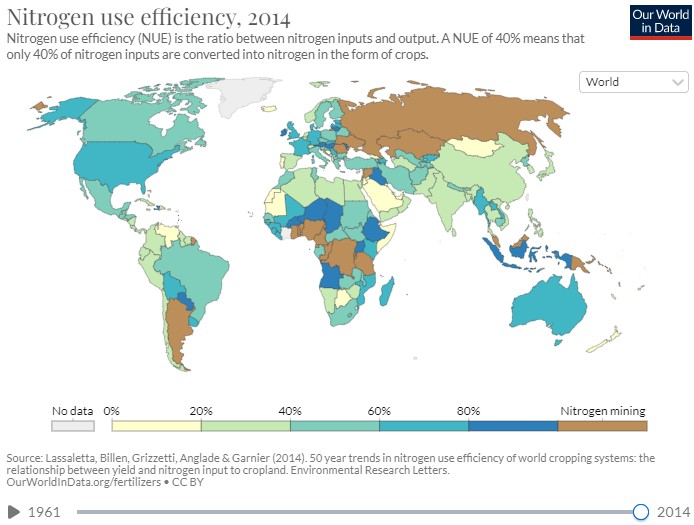
The second chart shows estimated nitrogen use efficiency (NUE). An NUE of 40%, for instance, shows that 40% of the nitrogen in the fertilizer is converted to nitrogen in the form of crops, while the other 60% of the nitrogen becomes pollutants. In China and India, only about a third of the applied nitrogen is fully utilized, compared to two thirds in places like the U.S. and France. ( Some countries have a very high NUE – greater than 100%. This means they are undersupplying nitrogen, but continue to try to grow more and more crops. Instead of utilizing readily available nutrients, crops have to take nitrogen from the soil. Over time this depletes soils of their nutrients which will be bad for crop production in the long-run).
If you are trying to pick a career, it would help to know what the daily experience is like in various professions.
A friend of mine recently quit her old job and did a coding bootcamp. She worked hard, went through interviews and is now working in tech. She was correct in expecting that coding is more interesting and provides more opportunity than her old job.
She is not at a FAANG or grinding at a startup. She got hired in a remote position that requires an understanding of code. She’s starting at the bottom of the hierarchy in her 30’s, as someone with no experience.
Now that she has started work in the industry, she reported to me that, “I don’t think I could have predicted that the people would be this much fun.”
She is genuinely enjoying tech culture. She texts me obscure tech jokes now as if it’s an SNL skit that I would enjoy. (e.g. https://www.youtube.com/watch?v=kHW58D-_O64 somewhat obscure YouTube channel) Her previous job was boring, and she never told me a positive thing about it. She is happy, not just with her financial return on investment but with her community.
If you read much about tech policy, you have heard about harassment in the workplace, especially for women. This is indeed an important issue. I’m not presenting my anecdote to imply that everything is fine everywhere. If people are trying to make important life decisions, then this is worth discussing.
One factor that might make people not want to learn to code is that they are afraid the work would be isolating and boring. It can be, but there is also a community aspect that can be positive.
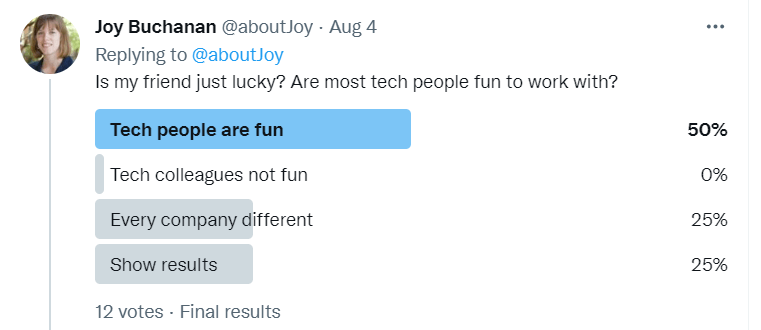
I polled my Twitter friends and got this result (small, biased sample, albeit, and I suspect it’s mostly men who answered):
No one disputed that tech folk can be fun, although some people wanted to qualify the statement by saying that different companies have different cultures.
John Vandevier (@JohnVandivier) sent me a blog he wrote about a study on tech culture. “Analyzing ‘Resetting Tech Culture’ by Accenture and Girls Who Code” The study shows that the world is complex. Lots of women are happy in tech. At the same time there are people who face harassment. There is good news and bad news. Offenders should stop offending. There are also good opportunities out there for people who train for tech.
When I shared the story about my friend’s good news, it was mostly ignored on Twitter. Good news does not drive engagement. Happy people are not interesting and so no one hears about them. Tech is not the right choice for everyone, and some people have been mistreated at tech companies, but on the margin a few more people should probably go for it.
Here’s something to balance out my rosy report about all the laughing and LOLing among coders. Last year I had a miserable long day of coding. I wrote up a diary entry about how much I hated that day. I’m not trying to get sympathy for myself. I wanted to capture a modern experience that is shared by many.
Coding can be hard and frustrating and lonely. The jokes are funny because the pain is real.
Drone racing was an event at the World Games in my city. Now I know it exists (as does canoe polo!).
The composition of contestants was interesting. One pilot was only 14 years old, the youngest person competing in the 2022 World Games. Another pilot was in a wheelchair. Drone racing is for sports like Work From Home is for professional jobs – the number of competitors is potentially enormous.
Spectators reported that it was hard to follow the actual drones with your eyes. People in the stadium for the race usually watched the jumbo screens that show the point of view of the pilots. This raises the question: why bother with the drones at all when we could just be doing e-sports? There is something special about the extra challenge of a physical race. The machinery adds a NASCAR-like element, and it gives people an excuse to gather together.
Videos, if you’d like to get a sense of how the sport works:
Polaris published an industry report that predicts growth.
Drone racing will grow in the United States. This seems like a sport that will appeal to Generation Alpha and their parents.
As a parent, I would support it. It’s expensive, so that’s going to be prohibitive for a while, but millions of Americans bought drones at some point in the last decade. Drones get broken in races, but the cost of components is coming down. Part of the sport is being able to repair and build your own custom drones.
A handful of US high school already have drone racing clubs. Adults will be able to point to the value of learning technology that comes along with racing for fun.



:format(webp)/cdn.vox-cdn.com/uploads/chorus_image/image/49493993/this-is-fine.0.jpg)




 Economist Writing Every Day