Is Long Covid Really a Thing?

We seem to be somewhat exhausted by all the dire predictions around Covid, now that life has largely gotten back to the normal. Shops and theaters are open, and people are once more crowding aboard those floating petri dishes called cruise ships. The most vulnerable segments of the population have mainly been vaccinated, and each new strain of the disease seems less harmful. All the anti-vaxxers I know have had Covid at least once and hence have some level of immunity, or else they caved and got vaccinated after seeing a close friend or relative die back in the winter of 2021-22. One enduring benefit of Covid is much more availability to work from home.

One of the direst prognostications was that the world would suffer a more or less permanent step down in standards of living due to “long Covid.”  According to this narrative, untold numbers of healthy young or middle-aged people would remain debilitated indefinitely due to the ongoing after-effects of a Covid infection: struck down in their prime, never to rise again.

A recent review of the field in Nature concluded, “The oncoming burden of long COVID faced by patients, health-care providers, governments and economies is so large as to be unfathomable”. Ouch. The federal government has provided $1.15 billion for research into the problem of long COVID and its mitigation.

Just the Facts

A couple of facts stand out: First, in many cases, scans of internal organs have shown changes in victims’ hearts and lungs and brains, following a severe Covid infection. Second, many people have reported symptoms such as weakness, fatigue and general malaise, impaired concentration and breathlessness, weeks after the primary symptoms of the disease have resolved.

How big a problem is this? I cannot, in the scope of a short blog post, adequately canvass all the data and literature. I will just cite a few numbers and charts, and let the professional data analysts dig into the fine points.

One meta-analysis found that a full “41.7% of COVID-19 survivors experienced at least one unresolved symptom and 14.1% were unable to return to work at 2-year after SARS-CoV-2 infection.” [That number seems much higher than my personal observations would suggest]. A CDC survey found that as of July 26-Aug 7, 2023, about 5.8 % of all Americans (which is 10.4% of Americans who ever had Covid) report experiencing some effects of long Covid, with 1.5% of all American adults experiencing significant activity limitations as result of long Covid. These numbers show a modest downward trend with time.

The chart below depicts the incidence of long Covid in England, again showing a modest downward trend in the latest year:

Weekly estimates of prevalence of COVID-19 and long COVID in England. Source.

Correlation versus Causation

So: we have many people experience severe symptoms from Covid, but most resolve within a few months at most. That leaves a small but nontrivial minority of Covid victims reporting problems long after that window. A significant question is whether Covid of itself caused those long-term symptoms, or just precipitated some problem that was bound to show up anyway.

I have read poignant anecdotes of perfectly healthy young people who suffer from brain fog two years later. But I have lived long enough to be wary of generalizing from poignant anecdotes. After all, the whole anti-vaccination movement has been fueled by poignant anecdotes of, say,  perfectly normal two-year-olds going autistic shortly after getting their vaccine shots.

The 2023 metastudy referred to earlier found that long Covid sufferers tended to be older, and had pre-existing medical comorbidities.  Similarly, we have known since 2020 that the cohorts most likely to die from Covid were older folks (such as me!), many of whom were bound to die anyway.  

In this light, the data brought forth by James Baily in his recent article on this blog, Long Covid is Real in the Claims Data… But so is “Early Covid”?, is most interesting. He noted that on average people use more health care for at least 6 months post-Covid compared to their pre-Covid baseline, which is consistent with some measure of long Covid. However, those same individuals also spent significantly more on healthcare 1-2 months before their Covid diagnosis. This seems consistent with the notion that some of what gets blamed on Covid would have occurred sooner or later anyway.

A Nuanced View of Long Covid

An article in Slate by Jeff Wise has dug deeper into the data. He noted that the survey-based datasets that have been largely used to estimate the effects of long Covid tend to be biased: those who feel ongoing symptoms are more likely to complete the surveys, giving rise to some of the largish numbers I have shared above. Newer, better-controlled retrospective cohort studies tend to show much lower ongoing incidence of symptoms, especially compared to control groups who had not had Covid. The feared tidal wave of mass disabilities never arrived:

“The best available figures, then, suggest two things: first, that a significant number of patients do experience significant and potentially burdensome symptoms for several months after a SARS-CoV-2 infection, most of which resolve in less than a year; and second, that a very small percentage experience symptoms that last longer. ”

Further, “Another insight that emerges from the cohort studies into long COVID is that it is not so easy to prove causality between a particular infection and a symptom. Almost all the symptoms associated with long COVID can also be triggered by all sorts of things, from other viruses to even the basic reality of living through a pandemic.”

Finally:

It looks more as if people who complain of long COVID are suffering from a collection of different effects. “I think there’s quite a heterogeneous group of people all sailing under the one flag,” said Alan Carson, a neuropsychiatrist at the University of Edinburgh in Scotland. Some patients may be experiencing the lingering aftereffects that occur in the wake of many diseases; some patients with chronic comorbidities might be experiencing the onset of new symptoms or the continuation of old ones; others might be affected by the sorts of mood disorders and psychiatric symptoms you’d expect to find in a population undergoing the stress of a global pandemic.

Another Slate article from last month gently debunks alarmism stemming from a Nature Medicine study of U.S. veterans who showed increased susceptibility to disease even two years after contracting Covid.

 There is often great difficulty in discerning the actual organic, biochemical basis for the reported symptoms. This makes it hard to come up with a pill or a shot that might adjust the body’s metabolic pathways in order to cure them. Thus, simply treating the symptoms as such may offer the best near-term relief. To that end, a team of French researchers had the audacity to propose that much of the fatigue and brain fog associated with long Covid may be largely in our heads. In an article in the Journal of Psychosomatic Research  Why the hypothesis of psychological mechanisms in long COVID is worth considering , Lemogne, et al. noted strong links between a patient’s prior expectations of symptom severity and the actual reported outcomes. The intent of the researchers is not to belittle the reported distress of long Covid sufferers, but to point towards established therapeutic methods to help treat disorders with at least a partial psychosomatic basis:

Many potential psychological mechanisms of long COVID are modifiable factors that could thus be targeted by already validated therapeutic interventions. Beside the treatment of a comorbid psychiatric condition, which may be associated with fatigue, cognitive impairment or aberrant activation of the autonomous nervous system, therapeutic interventions may build on those used in the treatment of ‘functional somatic disorders’, defined as the presence of debilitating and persistent symptoms that are not fully explained by damage of the organs they point. These disorders are common after an acute medical event, particularly in women, and include psychological risk factors, such as anxiety, depression, and dysfunctional beliefs that can lead to deleterious, yet modifiable health behaviors. Addressing these factors in the management of long COVID may provide an opportunity for patient empowerment.

In sum: A significant number of those who contract COVID suffer ongoing symptoms for a number of months afterward. Over a billion dollars of research has been directed at the problem. The severity of these symptoms tends to decline with time, in the vast majority of cases resolving by twelve months. This leaves some individuals still suffering fatigue and brain fog over a year later. Studies are ongoing to discern the organic basis of these complaints, and the exact role that COVID may have played, in the light of the fact that complaints of enduring fatigue and brain fog were not uncommon before the pandemic. We hope that following the science will bring more relief here.

Circling back to our original interest in the economic impact of long COIVD, early studies indicated that a large fraction of the population might continue to be debilitated, to the point of being unable to work, with significant effects on the workforce and GDP. Actual data (e.g., on disability claims) indicate that these problems have not actually materialized.

Collapsible Boats You Can Store in Your Apartment: ORU Folding Kayaks and MyCanoe Canoes

My wife and I were sitting on a bench near a local lake, having a picnic dinner. On a little grassy spot nearby I noticed a young woman put down a large bag, and then slide out some large, odd-looking plastic pieces. Then she unfolded something, and, oh my goodness, she had brought a fold-up kayak in that bag:

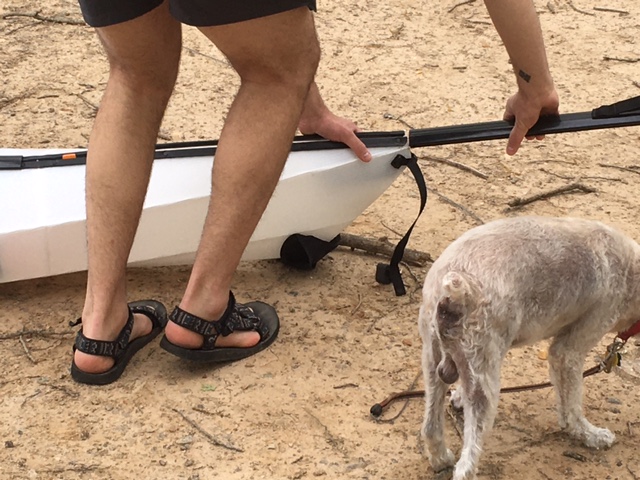
A friend joined her with sliding some joiner tubular pieces over the seams on top to zip these seams together:

The whole assembly took less than ten minutes. The resulting kayak was very light to carry:

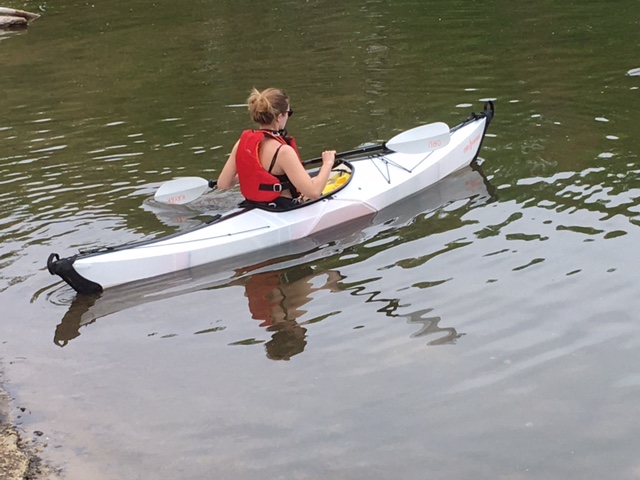
And away she paddled:

I had drifted over to talk to her as she was assembling the kayak, and she said she just stored the boat in its bag in a closet in her apartment. Also, that it was great  fun to use.

This was one of a selection of foldable kayaks sole by ORU. They make smaller, lighter, cheaper models for paddling on still water, and heavier-duty kayaks for ocean waves and white-water rivers. These kayaks get generally very high reviews. They are a bit pricy, and may not stand up for long scraping over rocks. But they are  clearly  full-blown, worth-paddling kayaks with rigid sides and clean lines.

This resonated with me, because maybe twenty years ago, I got a pair of inflatable kayaks that we could store in the basement and pull out and inflate at the lake. Paddling them was an awful experience. Although we inflated them to spec, they sagged in the middle, with the two ends sticking up in the air and catching the wind. It was like paddling a bathtub which was being constantly carried downwind.

I also found through that experience that kayaking was very uncomfortable for me. But I do like canoeing. So, after seeing how great the folding kayak was, I looked online and found a similar collapsible canoe, made by MyCanoe.  The design is a little harder to execute, because with a canoe you have an open top, whereas with a kayak you can seal up the top and get the whole boat to be something of a nice structural tubular structure. But the MyCanoe seems to work OK, and has the same advantages of being lightweight (19 lb for one-person Solo, 43lb for two-person Duo) and of folding into a small package for transport and storage. There is an oar-lock accessory so you can row it with two oars, as an alternative to paddling. The Solo is pretty short and wide, so it is very maneuverable , but I would be surprised if it tracks well in a straight line when you just want to paddle from point A to point B using one paddle.

You can find plenty of demos and reviews on YouTube for these folding kayaks and canoes. And there are other collapsible kayaks out there, per this review, but some of them are heavier and more involved to assemble.

Anyway, these folding craft are a pretty classy, free-enterprise technology solution for folks who like to get out on the water, but don’t have a garage or backyard to store a regular kayak or canoe, much less a trailer for a motorboat or a sailboat.

New EG.5  Variant Spreading: Start of New Covid Surge?

The spread of highly-contagious and sometimes fatal Covid-19, and the responses to it (lockdowns and then trillions of dollars of federal giveaway money to mitigate the effects of the lockdowns and now huge interest rate hikes to counter the inflation caused by that giveaway money) have been arguably the most economically momentous events of this decade so far. Thus, it behooves us to keep an ongoing eye on this beast, since it seems to keep coming back in waves.

We all know that Covid is spread by little “aerosol”  droplets coming out the infected people’s mouths and noses. Those aerosols are mainly generated by speaking and singing. So being in a room full of talking or singing people (e.g., a happy convention or bar, or a hymn-singing church) can be a super-spreader situation.

I have reasons to try to avoid respiratory diseases, and so I attended church on-line or outdoors for most of the past three years. The Covid numbers finally got low enough this spring that I started attending inside, and even going unmasked the past two months.

Alas, Covid cases and hospitalizations are back on the rise, it seems due to the new Eris or EG.5 subvariant. Like the infamous omicron variant of a year ago, it is very transmissible and resistant to existing vaccines, but is not as deadly as the original strain. Much of the population has some immunity due to vaccines and/or prior exposure. Also, antivirals like Paxlovid are widely available to help mitigate symptoms. Still, a case of Covid often makes for an uncomfortable and disruptive  week or two, and can still be fatal or debilitating.

So, I have done a quick amateur scan of the internet, trying to get a fix on what to expect. One thing that stands out is that actual case numbers are far higher than officially reported, for a couple of reasons. One is that the rigorous, systematic reporting of cases has fallen off, since Covid was deemed no longer an emergency. Also, with the end of free test kits and the generally more lax public attitude (we just want to be done with this), there is far less testing done than in 2022. (In communities with systematic testing, it turns out that the best way to track Covid is by analyzing wastewater).

Will the Latest Vaccines Save Us?

The vaccine story seems somewhat mixed. The latest booster vaccine, to be available around October, will target the XBB.1.5 subvariant, which is what was mainly circulating earlier this year. However, it is expected that since EB.5 is closely related to XBB.1.5 (both of these are of the general omicron family), the booster will confer some immunity to EB.5. That is the good news.

The bad news is that the public’s uptake of boosters in general is well under 50%, so we may expect EB.5 or whatever the next subvariant is to continue to circulate, and probably surge during the colder months when respiratory diseases tend to spread. Also, vaccines do not really stop you from getting Covid, they mainly act to mitigate the symptoms by helping your body’s defenses to react faster.

Starting next week, I will resume wearing an effective KN-95 or my preferred KF-94 mask at church and other venues where a lot of people are talking or singing.

5 Easy Steps to Improve Your Course Evals.

Incentives matter. I’ve taught at both public and private universities, and students have given me both great course evaluations and less great student evaluations. The private university cared a lot more about them. Obviously, some parts of student evaluations of their instructors are beyond the instructor’s control. The instructor can’t control inalienables and may not be able to change their charisma. But what about the things that instructors can control? Regardless of your current evals, here are 5 policies that are guaranteed to improve your course evaluations.

1: Very Clear Expectations/Schedule

Have all deadlines determined by the time that the semester starts. Students are busy people and they appreciate the ability to optimally plan their time. Relatedly, students desire respect from their instructor. Having clear rubrics and deadlines helps students know your expectations and how to meet them – or at least understand how they failed to meet them. Students want to feel like they were told the rules of the game ahead of time. This means no arbitrary deductions or deadlines. The syllabus is a contract if you treat it like one.

2: Mid-Semester Evaluations

One of the absolute best ways to improve your evaluation is to ask your evaluators for a performance update. Make a copy of your end-of-semester course evaluation and issue it about halfway through the semester. Then, summarize the feedback and review it with your class. This achieves three goals. (1) It is an opportunity to clarify policy if there are misplaced complaints. You may also wish to explain why policy is what it is. Knowing a good reason makes students more amenable to policies that they otherwise don’t prefer.  (2) It provides voice to students who have things to say. Often, students want to be heard and acknowledged. It’s better that a student vents during the informal mid-semester survey than on the important one at the conclusion of the course. (3) If there are widespread issues with your course, then make changes. If you’re on the fence about something, then take a poll. And if you decide to make changes, then be graciously upfront about it. Unexplained or covert changes violate policy #1.

Continue reading

Solar Cookers: Save Money, Save Lives, Save the Planet by Cooking with the Sun’s Rays

The Case for Solar Cooking

We all know we ought to reduce our CO2 generation to mitigate global warming and to conserve limited fuel reserves. Without descending into a tussle over exactly how man-made it is or whether it is part of a natural cycle which may turn soon to plunge us into yet another ice age, it does seem clear that the earth is experiencing a warming trend with possible serious consequences, and it is obvious that fossil fuel reserves (oil, natural gas, coal) are finite.

Although domestic cooking in developed countries comprises only a tiny fraction of total energy consumption, this is not true in some regions. Some 2 billion people still cook over fires of wood, charcoal, or animal dung. It is usually the women doing the cooking over these fires, inhaling smoke with all its consequences. Also, it is again women who largely end up gathering the fuel. All this gathering and fire-tending consumes time which takes away from other tasks like raising food. Also, women are often assaulted in the forests while they are foraging for wood.

It is possible to construct devices which capture enough of the sun’s rays to cook food (more technical details below). Many NGOs try to help people in poor, mainly sunny/tropical regions and in refugee camps to purchase or construct solar cookers. It is possible to set up cottage industries for locally making and selling these devices at low cost. It is just a win-win-win.  Solar Cookers International specializes in this work, and has developed and shared some of the most useful technology here. They claim some four million solar cookers are in use, and present figures for how much CO2 emissions and money for fuel are saved.

Why is this relevant to us in the West? Well, if we care to help the lot of the less-fortunate, we can give money to support these solar cooking initiatives. As noted, they can help the well-being of people, especially women, in many ways. A less-obvious  impact of us using solar cookers in our own homes is that folks in other lands are aware of our life-styles. It turns out that a non-trivial barrier to wide-spread adoption of solar cooking is that they are suspicious of Western aid workers promoting a method of cooking that no one back in the developed countries uses. If solar cooking could be more visible in our lifestyles it would have a significant effect in lands where it is really needed.

And getting around to our more personal motivations – it is kind of intriguing and rewarding to cook directly from the sun. On a hot day, it can mean cooking a casserole without heating the oven/kitchen. You can do great projects with kids (your own or others), designing and making and using solar ovens. And of course, you can signal your virtue by reducing your CO2 footprint.

If you find yourself in some situation when you have no other means to cook, a solar cooker could be a life-saver. To temper this reality, however, in most  temperate regions there will be many days without sufficient sunshine to make these work. Also, they are often much slower to heat up and cook than conventional stoves, so you need to plan ahead. That said, if you have a sunny morning or afternoon, you can put your pot of rice or whatever out to cook in the sun, go about your business, and come back in 2-3 hours, knowing your “solar crock pot” will have simmered your dish without burning it.

Types of Solar Cookers

I find the technical details here fascinating, but I will skip the juicies here and just briefly describe how these things are made and how they work. In all cases, there are some mirrored reflecting surfaces which concentrate the sun’s rays onto a cooking pot. For reflecting surfaces, one can glue aluminum foil onto cardboard. However, the foil grows dull with time, so it is better to use some kind of aluminized plastic surface, such as car windshield reflectors, mirrored craft adhesive sheeting, or even the insides of potato chip bags. Usually, the pot is in some kind of enclosure which is transparent to let the sunlight in but traps heat around the pot.  

There are a number of configurations that work. A description of various designs, with illustrations, is here  and here.

Perhaps the most minimalistic solar cooker is the panel cooker. Here, the pot is enclosed in a clear  oven bag or within two glass bowls. Segmented or curved reflective panels are arranged to reflect the sun on the pot from multiple angles. Solar Cookers International’s Cookit ($50) is said to be the most widely produced solar cooker, and it is of this design. There are many DIY designs floating around, including ones made from bent car windshield sun screens. A high-end, high-performance panel solar cooker is the Haines 2 ($100). These panel cookers lose effectiveness in cold, windy conditions, due to excessive heat loss.

Another design that people make a lot at home (see the internet) is a box solar cooker. Typically, you use a smaller cardboard box within a larger box, with the spaces between the two boxes filled with some kind on insulation (e.g., crumpled newspaper). A hinged glass lid and some reflecting panels on top of the box complete the device. A very expensive ($450) but very effective box-type solar cooker is the All-American Sun-Oven. This can function year-round, but takes up a lot of space in storage.

In tropical regions with the sun high overhead, there is some use of a plain, large parabolic mirror which can focus a very hot spot of sunlight onto the bottom of a pot or pan suspended above the mirror.

A more recent, high-tech approach is the line of solar cookers from Go-Sun. These feature smallish parabolic reflectors that focus the rays on a long, skinny cooking tube inserted in a double-walled glass tube with vacuum insulation. These cookers have only medium size capacity, but cook food really hot, really fast (e.g., can bake biscuits) and are not affected by cold weather. So, they are the most convenient and versatile cookers in many ways, although they do best with relatively solid foods like hot dogs or breads or cut-up meat or vegetables, not with liquidy loads like stew or soup or simmering beans. (Full disclosure: I caved in to my itch for one of these things, and have put it on my birthday list).

Easy FRED Stata Data

Lot’s of economists use FRED – that’s Federal Reserve Economic Data for the uninitiated. It’s super easy to use for basic queries, data transformations, graphs, and even maps. Downloading a single data series or even the same series for multiple geographic locations is also easy. But downloading distinct data series can be a hassle.

I’ve written previously about how the Excel add-on makes getting data more convenient. One of the problems with the Excel add-on is that locating the appropriate series can be difficult – I recommend using the FRED website to query data and then use the Excel add-on to obtain it. One major flaw is how the data is formatted in excel. A separate column of dates is downloaded for each series and the same dates aren’t aligned with one another. Further, re-downloading the data with small changes is almost impossible.

Only recently have I realized that there is an alternative that is better still! Stata has access to the FRED API and can import data sets directly in to its memory. There are no redundant date variables and the observations are all aligned by date.

Continue reading

Malwarebytes Poll: Public Fascination with ChapGPT Has Turned to Suspicion

ChatGPT and related AI have been all the rage these past few months. Among other things, “AI” became the shiny object that companies have dangled before investors, rocketing upward the shares of the “Magnificent Seven” large tech stocks.

However, a recent poll by computer security firm Malwarebytes notes a marked turn in the public’s attitude towards these products:

It seems the lustre of the chatbot-that’s-going-to-change-everything is starting to fade….

When people explored its capabilities in the days and weeks after its launch, it seemed almost miraculous—a wonder tool that could do everything from creating computer programs and replacing search engines, to writing students’ essays and penning punk rock songs. Its release kick-started a race to disrupt everything with AI, and integrate ChatGPT-like interfaces into every conceivable tech product.

But those that know the hype cycle know that the Peak of Inflated Expectations is quickly followed by the Trough of Disillusionment. Predictably, ChatGPT’s rapid ascent was met by an equally rapid backlash as its shortcomings became apparent….

A new survey by Malwarebytes exposes deep reservations about ChatGPT, with optimism in startlingly short supply. Of the respondents familiar with ChatGPT:

  • 81% were concerned about possible security and safety risks.
  • 63% don’t trust the information it produces.
  • 51% would like to see work on it paused so regulations can catch up.

The concerns expressed in the survey mirror the trajectory of the news about ChatGPT since its introduction in November 2022.

As EWED’s own Joy Buchanan has been pointing out specifically with regard to citations for research papers (here, here, and in the Wall Street Journal), ChatGPT tends to “hallucinate”, i.e., to report things that are not simply true. In the recent working paper “GPT-3.5 Hallucinates Nonexistent Citations: Evidence from Economics” , she warns of the possibility of a vicious spiral of burgeoning falsehoods, where AI-generated errors which are introduced into internet content such as research papers are then picked up as “learning” input into the next generation of AI training.

Real-world consequences of ChatGPT’s hallucinations are starting to crop up. A lawyer has found himself in deep trouble after filing an error-ridden submission in an active court case. Evidently his assistant, also an attorney, relied on ChatGPT which came up with a raft of “citations to non-existent cases.” Oops.

And now we have what is believed to be “the first defamation lawsuit against artificial intelligence.” Talk show host Mark Walters filed a complaint in Georgia which is:

…asking for a jury trial to assess damages after ChatGPT produced a false complaint to a journalist about the radio host.  The faux lawsuit claimed that Mr. Walters, the CEO of CCW Broadcast Media, worked for a gun rights group as treasurer and embezzled funds.

…Legal scholars have split on whether the bots should be sued for defamation or under product liability, given it’s a machine — not a person — spreading the false, hurtful information about people.

The issue arose when an Australian mayor threatened to sue the AI company this year over providing false news reports that he was guilty of a foreign bribery scandal.

Wow.

Thousands of AI experts and others have signed an open letter asking: “Should we let machines flood our information channels with propaganda and untruth? Should we automate away all the jobs, including the fulfilling ones? Should we develop nonhuman minds that might eventually outnumber, outsmart, obsolete and replace us? Should we risk loss of control of our civilization?”.    The letter states that “Such decisions must not be delegated to unelected tech leaders. Powerful AI systems should be developed only once we are confident that their effects will be positive and their risks will be manageable.”    It therefore urges  “all AI labs to immediately pause for at least 6 months the training of AI systems more powerful than GPT-4…If such a pause cannot be enacted quickly, governments should step in and institute a moratorium…AI labs and independent experts should use this pause to jointly develop and implement a set of shared safety protocols for advanced AI design and development that are rigorously audited and overseen by independent outside experts.”

Oh, the irony. There is reason to believe that our Stone Age ancestors were creating unreal images like this:

whilst stoned on peyote, shrooms, or oxygen deprivation. And here we are in 2023, with the cutting edge in information technology, running on the fastest specially-fabricated computing devices, and we get…hallucinations.

EconTwitter Platforms and Threads

There is a community called #EconTwitter. This agglomeration of not-anonymous accounts links together professional economists, academics, and independent intellectuals. Twitter.com is the home base and origin of #EconTwitter. Mike wrote about turmoil in EconTwitter in December 2022. Find me on Twitter at @aboutJoy

The #EconTwitter group has experimented with leaving Twitter to join new networks. For some people, getting away from the billionaire owner is the explicit goal. Others join the new platform to be where the people are.

Mastodon launched in 2016 but it was not until recently that #EconTwitter made a go at that.

Mastodon is also part of the Fediverse ensemble of computer servers, which use shared protocols allowing users to interact with other users on computers running compatible software packages such as PeerTube and Friendica. Mastodon is crowdfunded and does not contain ads.

https://en.wikipedia.org/wiki/Mastodon_(social_network)

Fediverse? Protocols? The average Twitter user does not want to be bothered with “computer servers”. That’s part of the problem. On Mastodon I am @JoyBuchanan@econtwitter.net

When I joined, I was not confident that it would build on the initial momentum. The reason that the move to Mastodon was large and sudden is that Paul Goldsmith-Pinkham volunteered to set up econtwitter.net It’s paid for out of his research budget and he serves as the monitor. He can ban anyone who violates his speech/civility rules. So there is a moderator but not one paid by Mastodon.

I wrote about “Content Moderation Strategy” back in April 2022 when Elon at Twitter was big news.

Elon Musk buying Twitter is the big news this week. He wants to enhance free speech on the site and, according to him, make it more open and fun. Some fans are hoping that he will make the content moderation and ban policy more transparent. 

me in April 2022

Some people thought Twitter would crash – as in go offline – because of Elon. That has not happened, but users and brands have been irked by his management and personal style.

EconTwitter at Mastodon is still going. As far as I can tell, most people have reverted to Twitter for their main feed because the audience is larger and writers want engagement. The level of engagement at Mastodon probably peaked about a month after Paul started the server for economists. One reason I think it never overtook real EconTwitter is that economists like having a big audience that includes journalists and sociologists. Silo-ing on an EconTwitter-dedicated server was less fun. People say they don’t want to have to deal with weird strangers online, but revealed preference indicates otherwise.

Another notable development was the launch of Bluesky. I’m there as @joybuchanan.bsky.social

Making a good handle at the beginning is easy and there is some upside if it turns out to attract a large community. A few “Twitter famous” people will join these new apps and commit to posting just in an attempt to unseat Twitter. This sort of works in the sense that both networks are still operating, however neither ever got close to the Twitter scale.

Threads, launched this week, might be different.

Mark Zuckerberg opened up Threads for anyone with an Instagram account, which most of us already have. Millions of people joined in just two days. If you already have an Insta, then you can download the free Threads app on your phone and port over your Insta account.

I’m @_Joy_Buchanan_ on Threads. The underscores might look awkward, but there is no “early adopter” phenomenon here, unless you were an early adopter of Instagram.

Brands and celebrities are comfortable on Threads, so it will be able to make money without asking users to pay for a Blue Check. I have no problem with Elon asking Twitter users to pay. Someone who is worried about free speech should want to be able to pay for service.

The Silicon Valley phrase is: “If you’re not paying for the product, you are the product.

That’s going to be true on Threads, since I’m not paying for the product.

Threads will not kill Twitter, but it is going to make a bigger dent than Bluesky and Mastodon did. Nothing is free and nothing is perfect. I know a lot of people are upset about Twitter. However, there are some people who got a voice through it. People stuck inside authoritarian countries had a way to send messages out to a global audience.

Here is my most bullish case for Threads: it might unite the “TikTok generation” that never joined Facebook or Twitter but had Instagram with the older people from Twitter who never joined TikTok. The Twitterers will stay if they get enough attention.

Thus, Threads might put a dent in TikTok, too. Zuckerberg is probably sophisticated enough to make a “TikTok person” feel engaged by sending them more food videos and less BLS update charts.

Continue reading

Canadian Wildfires Will Burn All Summer; Ways to Filter the Air in Your Home

This past week, smoke from wildfires in Canada once again drifted southward and gave very unhealthy air in parts of the U.S.  Several sources I checked indicated that it is unrealistic to expect human effort to extinguish these fires (see here , here, and here). The Canadian forests are just too huge in relation to the fire-fighting resources. What usually happens, even during a normal fire season, is that summer fires just keep burning until they are dampened down by winter rain, snow, and cold. Most of the fire-fighting efforts are devoted to saving communities that are in the path of the flames.

Thus, we may expect periodic episodes of unhealthy air for the next several months. The most hazardous smoke particles are those less than 2.5 microns in size. Particles this small make it past your body’s defenses and penetrate deep into your lungs, promoting a number of serious medical conditions. These smoke particles are made of toxic chemicals like polycyclic aromatic hydrocarbons.

What to do to protect yourself? A first line of defense is to don an effective mask, even indoors. We all probably have Chinese KN95 or Korean KM94 masks left over from pandemic days, and (properly fitted around the nose) these should filter out most of the smoke, including the particles that are less than 2.5 microns. (I prefer the more-comfortable KM94 masks, as discussed here.)  These masks are supposedly about as effective as the more-rigid N95 masks that are the U.S. standard.

Air Filters in Your Furnace

See here for some general tips on dealing with smoke in the home, e.g. damp-mop non carpet floors rather than vacuuming, to avoid shooting settled particles into the air. However, what is really needed is some means to filter the smoke out of the air in your home, otherwise over time the air inside may be as polluted as the air outside. All furnace/central air conditioning systems have a filter in the circuit. A simple solution would be to use an air filter which can catch the smoke particles. The problem here is that the better the filter is at catching small particles, the more restrictive of air flow it is.

Most air filters are rated according to MERV values. MERV 13 filters can remove most smoke particles in a single pass. Unfortunately, most home heating/cooling systems cannot handle that much restriction in air flow; the fan motor would get overloaded and perhaps burn out. One solution here is to install a parallel air filter, with its own booster fan, using a MERV 13 filter. Here, only part of the home air circulation goes through the MERV 13 filter on each pass, but with time most of the home air gets cleaned.

Another approach is to install a MERV 11 or (if your furnace is newer) MERV 12 filter in the furnace. A MERV 11 filter might only capture around 25% of smoke particles per pass, but in the course of a day your whole house air volume should pass through the filter several times. If you have a common size air filter, you can probably get a MERV 11 that would fit on Amazon or at a local big box store. For uncommon sizes, try here.

Make Your Own High-Capacity Filter Box

In addition to working with your furnace/air conditioning filter, you can buy a compact stand-alone air purifier for your home. This Shark HP202 model will provide a continuous read-out of air quality.

For even more air-cleaning muscle, you can make a box-style air purifier by duct-taping together four MERV 13 furnace air filters (four sides of a cube), and adding a box fan on top. Instructions (including YouTube links) for doing this are here, with further details here. These diagrams give the general picture:

An example of a finished product is below; note the red tape covering the outer part of the fan outlet. Blocking that outer area, giving a smaller diameter opening for the air to blow out, increases the net air flow significantly. (It prevents back-eddies of air around the edges).

 It turns out that the air flow through one of these home-made air filters is so high that, even though the per-pass capture efficiency is lower than a HEPA filter, the home-made filter box can remove more particulates from a room than a store-bought HEPA filter.

I have made two of these filter boxes so far, using premium and regular filters. They have worked quite well in clearing the smoke from our rooms: the benefit is well worth the cost of parts and labor. See here for more on my experiences and construction tips.

Some on-line resources:

Accuweather  seems to have straightforward reporting of air quality, including specifically the less than 2.5 micron particles. (Search on your location, then find Air Quality and click Details).

NOAA provides a real time satellite map of smoke patterns (click on “Surface Smoke”), but don’t rely on their color coding to decide whether your local condition is orange or red.

This web site from Natural Resources Canada shows locations of current wildfires in Canada. See Overlays for the meaning of the symbols; red denotes fires that are out of control. You can click Fire Perimeter Estimate to see the enormous extents of some of these fires.

How Ceramic Pans Work and How to Restore Their Non-Stick Coating

I really don’t like the time and effort wasted in cleaning crudded-up frying pans, so I appreciate non-stick coatings. I have a small diameter Gotham ceramic pan that works well, and I was thinking of getting a larger one for cooking bigger loads. As usual, I went to the internet for wisdom on preferred ceramic pans to buy.

However, in the course of trying to get a fix on how they work, I fell down a rabbit hole. It turns out that this subject is complex and controversial. I will try to summarize my understanding in a brief post, with the caveat that I am not sure of everything here.

First of all, the “ceramic” coating is not really ceramic. Typical ceramics are made from firing powders of inorganic materials like silicon/aluminum oxides (including clays) at extremely high temperatures to where the particles fuse together. For the ceramic coatings on pans, this is not the case. I looked pretty hard on line without success to pin down the actual process or composition of the pan coating. It seems to involve some sort of silicone or silica polymer, applied using a sol-gel process. (Silica is just silicon and oxygen – quartz and white sand are pure silica – while silicone is typically a Si-O-Si-O-Si polymer with two extra hydrocarbon side groups attached to each Si).

100% silicone, in the form of rubbery sheets or cupcake papers for cooking on or in, is known to give a non-stick cooking surface. The “ceramic” coating in pans appears to be a solid equivalent of silicone cookware. A key factor mentioned in why it is slick and why it loses its slickness is that (supposedly) a thin layer of silica or silicone comes off with each cooking episode, and that thin layer is what gives the non-stick effect. (I would not mind ingesting a little adventitious silica, but eating random silicone worries me a little – but I don’t know if all this is actually true).

See this link for further discussion of the safety of ceramic versus teflon coatings. Be aware that makers of teflon coatings often choose names for their coatings that include the words “stone” or “granite”, perhaps to make the unwary consumer believe that these are ceramic coatings. My teflon pans have usually started to flake (into my food!) after a couple years’ use. A happy exception is a newer electric skillet which has temperature control so it never gets above about 425 F (high temperature destroys teflon). We do keep it oiled in use. Its teflon coating is still good as new after two years.

There seems to be general agreement that ceramic pans start off super slick, that fried eggs slide right out, but that after some months of use, food starts sticking noticeably. It helps to use a little oil every time you cook, and to avoid using metal utensils or abrasive cleaning pads, and to avoid very high temperatures or the use of cooking sprays (which deposit something harmful to the ceramic coating) or olive oil (which can burn on). Some users say it is important to clean the pan well between uses, e.g., using salt as a mild abrasive.

Why Do Ceramic Pans Lose Their Non-Stickiness?

There seem to be two main schools of thought as to the deterioration of performance. One school points to the (alleged) continual loss of silica particles or (presumably oily) silicone from the surface; perhaps once this surface layer is depleted, it’s game over. Another camp points to the buildup of burned-on deposits, even very thin, nearly invisible deposits, that then become a locus of food sticking.

What Can Be Done to Restore a Ceramic Pan Coating?

It is common to read that you just have to be prepared throw the pan away every 1-2 years. However, this does not seem economical. Can these pans be salvaged?  One author claims that slickness can be restored by “seasoning” a ceramic pan, similar to how cast-iron pans are treated: after cleaning the pan, rub a very thin layer of a recommended oil (e.g. soybean oil, not olive oil) on the pan and then heat it to the smoke point. This should bond a polymerized oil layer to the surface. I have not tried this, but it might be worth a try.

A diametrically opposite approach is recommended by the maker of GreenPan ceramic pans. Here the theory is that if an offending film of cooked-on crud is removed, the native, clean ceramic layer beneath will once again be non-stick. A wet Magic Eraser type cleaning pad is recommended.

A similar remedy touted on the internet (e.g. here and here) is to rub with coarse salt (for long time, but not too hard) to get down to a pristine ceramic surface. Good results are claimed.

As a (retired) experimental scientist, I was itching to try something like this. At a family member’s house, I found an older ceramic pan that was not in really bad shape, but had lost its primal non-stick.

The BEFORE picture is above. There was a persistent brown film in parts of the pan, and cooked omelets (my test vehicle) did not simply slide out. I cleaned the pan with soap and water and a sponge, then went at it with a wetted Magic Eraser. I got the brown film off, though you could still see some pitting in the coating due to the use of metal utensils.

The AFTER picture is below. This is after cooking yet another omelet (with oil), and just wiping the pan with paper towel afterward. I can’t say that it was a night and day difference, but the Magic Eraser treatment definitely seemed to improve the performance. Score one for sustainability.

APPENDIX:  Finally Understanding What Make Ceramic Pan Coatings Non-Stick

As noted in the original article above, I was puzzled over how the ceramic coatings worked. The descriptions in articles I could find on-line talked of forming these coatings from sol-gel solutions, using ingredients such as tetraethoxysilane. Without going into details, my chemical intuition led me to believe that, yes, you could form a dense silica pan coating from that, but the final outer surface would have Si-OH groups, like quartz or glass or ordinary “enamel” ceramic pan coatings. This would not give the oily, silicone-like surface that is evident with the nonstick ceramic pan coatings.

My “Aha” moment came when examining a patent application ( United States Patent Application No. 20180170815) for making a GreenPan ceramic pan coating. Among the ingredients for making the coating is methyltrimethoxysilane (MTMS).  And THAT should give Si-CH3 groups on the outer surface, which is exactly the type of oil-like outer surface that silicone has.  (The -CH3 methyl group is a fairly nonpolar, “oily” hydrocarbon type group).

A restless itch has now been scratched. I think I now understand why fresh ceramic pan coating can have such fine non-stick properties, and perhaps why they might be vulnerable to losing their non-stick properties. With Teflon type pan coatings, it is plasticky, oily Teflon all the way down, so if you abrade off a hundred molecular layers, it should make no difference. But with the ceramic coatings, it is not clear to me whether the oily Si-CH3 groups are only in the topmost atomic layer; maybe if that gets abraded off, there is only the quartz-like Si-OH groups to be found; or maybe there is a substantial (in atomic terms) topmost layer rich in Si-CH3 groups. Anyway, it makes sense to keep using oil when cooking on ceramic pans, to keep a hydrocarbon-type surface coating going there, and to avoid using metal utensils that can scrape and scratch the coating.