“Final Notice” Traffic Ticket Smishing Scam

Yesterday I got a scary-sounding text message, claiming that I have an outstanding traffic ticket in a certain state, and threatening me with the following if I did not pay within two days:

We will take the following actions:

1. Report to the DMV Breach Database

2. Suspend your vehicle registration starting June 2

3. Suspension of driving privileges for 30 days…

4. You may be sued and your credit score will suffer

Please pay immediately before execution to avoid license suspension and further legal disputes.

Oh, my!

A link (which I did NOT click on) was provided for “payment”.

I also got an almost (not quite) identical text a few days earlier. I was almost sure these were scams, but it was comforting to confirm that by going to the web and reading that, yes, these sorts of texts are the flavor of the month in remote rip-offs; as a rule, states do not send out threatening texts with payment links in them.

These texts are examples of “smishing”, which is phishing (to collect identity or bank/credit card information) via SMS text messaging. It must be a lucrative practice. According to spam blocker Robokiller, Americans received 19.2 billion spam robo texts in May 2025. That’s nearly 63 spam texts for every person in the U.S.

Beside these traffic ticket scams, I often get texts asking me to click to track delivery of some package, or to prevent the misuse of my credit card, etc. I have been spared text messages from the Nigerian prince who needs my help to claim his rightful inheritance; I did get an email from him some years back.

The FTC keeps a database called Sentinel on fraud complaints made to the FTC and to law enforcement agencies. People reported losing a total of $12 billion to fraud in 2024, an increase of $2 billion over the previous year. That is a LOT of money (and a commentary on how wealthy Americans are, if that much can get skimmed off with little net impact on society). The biggest single category for dollar loss was investment; the number of victims was smaller than for other categories, but the loss per victim ($9,200) was quite high. Other areas with high median losses per capita were Business and Job Opportunities ($2,250) and Mortgage Foreclosure Relief and Debt Management ($1,500).

Imposter scams like the texts I have gotten (sender pretending to be from state DMV, post office, bank, credit card company, etc.) were by far the largest category by number reported (845,806 in 2024). Of those imposter reports, 22% involved actual losses ($800 median loss), totaling a hefty $2,952 million. That is a juicy enough haul to keep those robo frauds coming.

How to not get scammed: Be suspicious of every email or text, especially ones that prey on emotions like fear or greed or curiosity and try to engage you to payments or for prying information out of you. If it purports to come from some known entity like Bank of America or your state DMV, contact said entity directly to check it out. If you don’t click on anything (or reply in any way to the text, like responding with Y or N), it can’t hurt you.

I’m not sure how much they can do, considering the bad guys tend to hijack legit phone numbers for their dirty work, but you can mark these texts as spam to help your phone carrier improve their spam detection algorithm. Also, reporting scam texts to the U.S. Federal Trade Commission and/or the FBI’s Internet Crime Complaint Center can help build their data set, and perhaps lead to law enforcement actions.

Later add: According to EZPass, here is how to report text scams:

You can report smishing messages to your cell carrier by following this FCC guidance.  This service is provided by most cell carriers.

  1. Hold down the spam TXT/SMS message with your finger
  2. Select the “Forward” option
  3. Enter 7726 as the recipient and press “Send”

Additionally, to report the message to the FBI, visit the FBI’s Internet Crime Complaint Center (ic3.gov) and select ‘File a Complaint’ to do so.  When completing the complaint, include the phone number where the smishing text originated, and the website link listed within the text.

We’re All Magical

The widespread availability and easy user interface of artificial intelligence (AI) has put great power at everyone’s fingertips. We can do magical things.

Before the internet existed we would use books to help us better interpret the world.  Communication among humans is hard. Expressing logic and even phenomena is complex. This is why social skills matter. Among other things, they help us to communicate. The most obvious example of a communication barrier is language. I remember having a pocket-sized English-Spanish dictionary that I used to help me memorize or query Spanish words. The book helped me communicate with others and to translate ideas from one language to another.

Math books do something similar but the translation is English-Math. We can get broader and say that all textbooks are translation devices. They define field-specific terms and ideas to help a person translate among topic domains, usually with a base-language that reaches a targeted generalizability. We can get extreme and say that all books are translators, communicating the content of one person’s head to another.

But sometimes the field-to-general language translation doesn’t work because readers don’t have an adequate grasp of either language. It isn’t necessarily that readers are generally illiterate. It may be that the level of generality and degree of focus of the translation isn’t right for the reader. Anyone who has ever tried to teach anything with math has encountered this.  Students say that the book doesn’t translate clearly, and the communication fails. The book gets the reader’s numeracy or understood definitions wrong. Therefore, there is diversity among readers about how ‘good’ a textbook is.

Search engines are so useful because you can enter some keywords and find your destination, even if you don’t know the proper nouns or domain-specific terms. People used to memorize URLs and that’s becoming less common. Wikipedia is so great because if you want to learn about an idea, they usually explain it in 5 different ways. They tell the story of who created something and who they interacted with. They describe the motivation, the math, the logic, the developments, and usually include examples. Wikipedia translates domain-specific ideas to multiple general languages of different cognitive aptitudes or interests. It scatters links along the way to help users level-up their domain-specific understanding so that they can contextualize and translate the part that they care about.

Historical translation technology was largely for the audience. More recently, translation technology has empowered the transmitters.

Continue reading

EconTalk Extra on Daisy Christodoulou

I wrote an Extra for the How Better Feedback Can Revolutionize Education (with Daisy Christodoulou) episode.

Can Students Get Better Feedback? is the title of my Extra.

Read the whole thing at the link (ungated), but here are two quotes:

For now, the question is still what kind of feedback teachers can give that really benefits students. Daisy Christodoulou, the guest on this episode, offers a sobering critique of how educators tend to give feedback in education. One of her points is that much of the written feedback teachers give is vague and doesn’t actually help students improve. She shares an example from Dylan William: a middle school student was told he needed to “make their scientific inquiries more systematic.” When asked what he would do differently next time, the student replied, “I don’t know. If I’d known how to be more systematic, I would have been so the first time.” 

Christodoulou also turns to the question many of us are now grappling with: can AI help scale meaningful feedback?

What is truth? The Bayesian Dawid-Skene Method

I just learned about the Bayesian Dawid-Skene method. This is a summary.

Some things are confidently measurable. Other things are harder to perceive or interpret. An expert researcher might think that they know an answer. But there are two big challenges: 1) The researcher is human and can err & 2) the researcher is finite with limited time and resources. Even artificial intelligence has imperfect perception and reason. What do we do?

A perfectly sensible answer is to ask someone else what they think. They might make a mistake too. But if their answer is formed independently, then we can hopefully get closer to the truth with enough iterations. Of course, nothing is perfectly independent. We all share the same globe, and often the same culture or language. So, we might end up with biased answer. We can try to correct for bias once we have an answer, so accepting the bias in the first place is a good place to start.  

The Bayesian Dawid-Skene (henceforth DS) method helps to aggregate opinions and find the truth of a matter given very weak assumptions ex ante. Here I’ll provide an example of how the method works.

Let’s start with a very simple question, one that requires very little thought and logic. It may require some context and social awareness, but that’s hard to avoid. Say that we have a list of n=100 images. Each image has one of two words written on it, “pass” and “fail”. If typed, then there is little room for ambiguity. Typed language is relatively clear even when the image is substantially corrupted. But these words are written, maybe with a variety of pens, by a variety of hands, and were stored under a variety of conditions. Therefore, we might be a little less trusting of what a computer would spit out by using optical character recognition (OCR). Given our own potential for errors and limited time, we might lean on some other people to help interpret the scripts.

Continue reading

Discuss AI Doom with Joy on May 5

If you like to read and discuss with smart people, then you can make a free account in the Liberty Fund Portal. If you listen to this podcast over the weekend: Eliezer Yudkowsky on the Dangers of AI (2023) you will be up to speed for our asynchronous virtual debate room on Monday May 5.

Russ Roberts sums up the doomer argument using the following metaphor:

The metaphor is primitive. Zinjanthropus man or some primitive form of pre-Homo sapiens sitting around a campfire and human being shows up and says, ‘Hey, I got a lot of stuff I can teach you.’ ‘Oh, yeah. Come on in,’ and pointing out that it’s probable that we are either destroyed directly by murder or maybe just by out-competing all the previous hominids that came before us, and that in general, you wouldn’t want to invite something smarter than you into the campfire.

What do you think of this metaphor? By incorporating AI agents into society, are we inviting a smarter being to our campfire? Is it likely to eventually kill us out of contempt or neglect? That will be what we are discussing over in the Portal this week.

Is your P(Doom) < 0.05? Great – that means you believe that the probability of AI turning us into paperclips is less than 5%. Come one come all. You can argue against doomers during the May 5-9 week of Doom and then you will love Week Two. On May 12-16, we will make the optimistic case for AI!

See more details on all readings and the final Zoom meeting in my previous post.

Kaggle Wins for Data Sharing

I like to take existing datasets, clean them up, and share them in easier to use formats. When I started doing this back in 2022, my strategy was to host the datasets with the Open Science Foundation and share the links here and on my personal website.

OSF is great for allowing large uploads and complex projects, but not great for discovery. I saw several of my students struggle to navigate their pages to find the appropriate data files, and they seem to have poor SEO. Their analytics show that my data files there get few views, and most of the ones they get come from people who were already on the OSF site.

This year I decided to upload my new projects like County Demographics data to Kaggle.com in addition to OSF, and so far Kaggle is the clear winner. My datasets are getting more downloads on Kaggle than views on OSF. I’ve noticed that Kaggle pages tend to rank highly on Google and especially on Google Dataset Search. I think Kaggle also gets more internal referrals, since they host popular machine learning competitions.

Kaggle has its own problems of course, like one of its prominent download buttons only downloading the first 10 columns for CSV or XLSX files by default. But it is the best tool I have found so far for getting datasets in the hands of people who will find them useful. Let me know if you’ve found a better one.

Old Fashioned Function Keys

Your Function Keys Are Cooler Than You Think
by someone who used to press F1 by mistake

Ever notice the F keys on your keyboard? F1 through F12. Sitting at the top like unused shelf space. If you’re at a computer now, take a glance. I used to think they did nothing, or at least nothing for me. Maybe experts used them. Experts who know what BIOS and DOS are.  But for me, just little space fillers with no purpose. I frequently pressed F1 by accident rather than escape. A help window would pop up, wasting half a second of my life until I closed it.

But the Fn keys (function keys) are sneaky useful. They can save you serious time. No clicking. No dragging. No fumbling with touchpad mis-clicks.

When using a web browser, F5 refreshes the web page. Windows has added the same functionality for folders too, updating recently edited files. Fast and easy. F11 changes your web browser view to full screen. Great for long reads or historical documents. F12 shows the guts of a webpage. That’s perfect if you web scrape or need to know what things are called behind the scenes. Ctrl + F4 closes a tab. Alt + F4 shuts the whole application instance down. That last one works for almost all applications.

Excel? F4 saves so much of your life. It toggles absolute cell, row, and column references. Have you ever watched someone try to click on the right spot with their touchpad and manually press the ‘$’ sign… twice? I can feel myself slowly creeping toward death as my life wastes away. Whereas pressing F4 lets you get on with your life. F12 in most Microsoft applications is ‘Save As’. No need to find the floppy disk image on that small laptop screen. PowerPoint has its own tricks—F5 begins the presentation. Shift + F5 starts it from the current slide. Not bad. And don’t forget F7! That’s the spellcheck hotkey. But now it’s been expanded to include grammar, clarity, concision, and inclusivity.

Continue reading

Join Joy to discuss Artificial Intelligence in May 2025

Podcasts are emerging as one of the key mediums for getting expert timely opinions and news about artificial intelligence. For example, EconTalk (Russ Roberts) has featured some of the most famous voices in AI discourse:

EconTalk: Eliezer Yudkowsky on the Dangers of AI (2023)

EconTalk: Marc Andreessen on Why AI Will Save the World 

EconTalk: Reid Hoffman on Why AI Is Good for Humans

If you would like to engage in a discussion about these topics in May, please sign up for the session I am leading. It is free, but you do need to sign up for the Liberty Fund Portal.

The event consists of two weeks when you can do a discussion board style conversation asynchronously with other interested listeners and readers. Lastly, there is a zoom meeting to bring everyone together on May 21. You don’t have to do all three of the parts.

Further description for those who are interested:

Timeless: Artificial Intelligence: Doom or Bloom?

with Joy Buchanan

Time: May 5-9, 2025 and May 12-16, 2025

How will humans succeed (or survive) in the Age of AI? 

Russ Roberts brought the world’s leading thinkers about artificial intelligence to the EconTalk audience and was early to the trend. He hosted Nick Bostrom on Superintelligence in 2014, more than a decade before the world was shocked into thinking harder about AI after meeting ChatGPT. 

We will discuss the future of humanity by revisiting or discovering some of Robert’s best EconTalk podcasts on this topic and reading complementary texts. Participants can join in for part or all of the series. 

Week 1: May 5-9, 2025

An asynchronous discussion, with an emphasis on possible negative outcomes from AI, such as unemployment, social disengagement, and existential risk. Participants will be invited to suggest special topics for a separate session that will be held on Zoom on May 21, 2025, 2:00-3:30 pm EDT. 

Required Readings: EconTalk: Eliezer Yudkowsky on the Dangers of AI (2023)

EconTalk: Erik Hoel on the Threat to Humanity from AI (2023) with an EconTalk Extra Who’s Afraid of Artificial Intelligence? by Joy Buchanan

“Trurl’s Electronic Bard” (1965) by Stanisław Lem. 

In this prescient short story, a scientist builds a poetry-writing machine. Sound familiar? (If anyone participated in the Life and Fate reading club with Russ and Tyler, there are parallels between Lem’s work and Vasily Grossman’s “Life and Fate” (1959), as both emerged from Eastern European intellectual traditions during the Cold War.)

Optional Readings:Technological Singularity” by Vernor Vinge. Field Robotics Center, Carnegie Mellon U., 1993.

“‘I am Bing, and I Am Evil’: Microsoft’s new AI really does herald a global threat” by Erik Hoel. The Intrinsic Perspective Substack, February 16, 2023.

Situational Awareness” (2024) by Leopold Aschenbrenner 

Week 2: May 12-16, 2025

An asynchronous discussion, emphasizing the promise of AI as the next technological breakthrough that will make us richer.
Required Readings: EconTalk: Marc Andreessen on Why AI Will Save the World 

EconTalk: Reid Hoffman on Why AI Is Good for Humans

Optional Readings: EconTalk: Tyler Cowen on the Risks and Impact of Artificial Intelligence (2023)

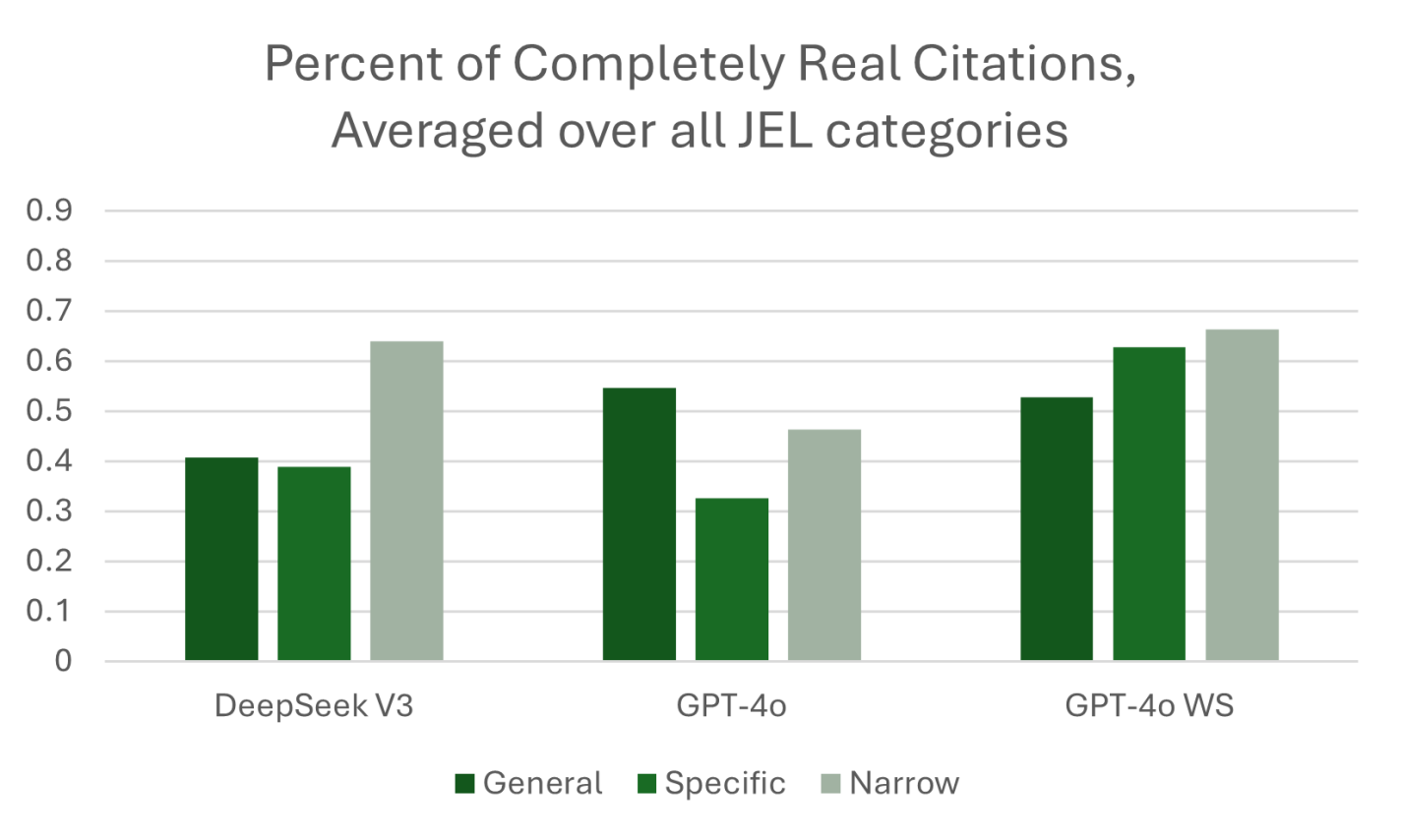
ChatGPT Hallucinates Nonexistent Citations: Evidence from Economics” (2024) 

Joy Buchanan with Stephen Hill and Olga Shapoval. The American Economist, 69(1), 80-87.

What the Superintelligence can do for us (Joy Buchanan, 2024)

Dwarkesh Podcast “Tyler Cowen – Hayek, Keynes, & Smith on AI, Animal Spirits, Anarchy, & Growth

Week 3: May 21, 2025, 2:00-3:30 pm EDT (Zoom meeting)
Pre-registration is required, and we ask you to register only if you can be present for the entire session. Readings are available online. We will get to talk in the same zoom room!

Required Readings: Great Antidote podcast with Katherine Mangu-Ward on AI: Reality, Concerns, and Optimism

Additional readings will be added based partially on previous sessions’ participants’ suggestions

Optional Readings: Rediscovering David Hume’s Wisdom in the Age of AI (Joy Buchanan, EconLog, 2024)

Professor tailored AI tutor to physics course. Engagement doubled” The Harvard Gazette. 2024. 

Please email Joy if you have any trouble signing up for the virtual event.

EconTalk Extra on Erik Hoel

Sometimes a Russ Roberts podcast gets an “Extra” post following up on the topic. I wrote an Extra for the Erik Hoel on the Threat to Humanity from AI episode:

Who’s Afraid of Artificial Intelligence? is the title of my Extra

Hoel’s main argument is that if AI becomes more intelligent than humans, it could pose a serious threat. What if the AI agents start to treat humans the way we currently treat wild deer, not necessarily with malice but without much regard for the welfare of every human individual?

Things that are vastly more intelligent than you are really hard to understand and predict; and the wildlife next door, as much as we might like it, we will also build a parking lot over it at a heartbeat and they’ll never know why. 

County Demographic Data: A Clean Panel 1969-2023

Whenever researchers are conducting studies using state- or county-level data, we usually want some standard demographic variables to serve as controls; things like the total population, average age, and gender and race breakdowns. If the dataset for our main variables of interest doesn’t already have this, we go looking for a new dataset of demographic controls to merge in; but it has always been surprisingly hard to find a clean, easy-to-use dataset for this. For states, I’ve found the University of Kentucky’s National Welfare Database to be the best bet. But what about counties?

I had no good answer, and the best suggestion I got from others was the CDC SEER data. As so often, the government collected this impressively comprehensive dataset, but only releases it in an unusable format- in this case only as txt files that look like this:

I cleaned and reformatted the CDC SEER data into a neat panel of county demographics that look like this:

I posted my code and data files (CSV, XLSX, and DTA) on OSF and my data page as usual. I also posted the data files on Kaggle, which seems to be more user-friendly and turns up better on searches; I welcome suggestions for any other data repositories or file formats you would like to see me post.

HT: Kabir Dasgupta