How Americans Can Thank the World

Dear World,

Thank you for the heritage of philosophical and scientific ideas, preserved through an international effort over thousands of years. Thank you for coming to study at American universities in this century, and for staying to teach.

Thank you all for buying into our heroes. What is Star Wars without a global audience? Your enthusiasm transforms our characters into shared legends. Thank you for cheering on Harrison Ford and Will Smith. Thank you for feeling the joys and heartbreaks of Taylor Swift, Luke Combs and Beyoncé. Thank you for sending us Lord of the Rings, Howl’s Moving Castle, and Squid Game.

Video games unite us all. Thanks for Elden Ring from Japan, and Minecraft, which started in Sweden before it was acquired by Microsoft. It helps us be more creative when the world buys U.S.-made games like Call of Duty and Fortnite.

Merci France, for helping us in our war of independence and giving us the Statue of Liberty. (And for printing my cartoon.)

Thank you to England, for the inheritance of a system of limited government, whose principles of common law, parliamentary tradition, and constitutional rights became the foundation upon which we built our republic.

Thank you, world, for listening to our national anthem at the Olympics. For training with us and competing against us in feats of endurance and collectively celebrating as humans have recently broken so many records of performance. Congrats to Eliud Kipchoge and Katie Ledecky.

Thank you for believing in the American Dream. The wealth enjoyed by average Americans today would not be possible without globalization.

Thank you for seeing good in us and trusting our soldiers and businesses.

Thank you for trading with us. Thanks for keeping the modern F-150 truck affordable.  Quality is better today, because it’s more powerful with stronger engines and still gets better gas mileage while being safer. Part of what keeps the price down is getting so many component parts through imports from places like Mexico and Asia.

Thank you for sharing your genuine thoughts on our social media platforms. Thank you for making the World Wide Web worldwide, starting with http://info.cern.ch.

Thailand, thank you for welcoming my college friends who do not speak your language. You gave them a break from the monotony of their local landscapes. What would our Instagram be without you, and Iceland and Ecuador? The generosity with which you welcome travelers enriches not just our photo albums, but our perspectives.

We are who we are because of you.

What Makes Rhode Island Special?

Other than being the smallest state, of course. In other places I’ve lived, it was more obvious what made them stand out. Boston has the most high-quality universities, including the oldest one (though it is expensive and traffic-ridden). New Orleans has the best food, live music, and festivals (though terrible crime and roads). I’ve lived in Rhode Island since 2020 and I’ve enjoyed how it seems to have no big negatives the way many other places do- it’s been pretty nice all around. But it has been harder to see anything where Rhode Island really stands out.

What should a tourist see or do here that they couldn’t do elsewhere? The Italian food is great, but that’s true of several other cities. You can find Portuguese food here in a way you can’t in most of the US. Probably the Cliff Walk in Newport is our best entry: a 3-mile trail along cliffs where you can see the Atlantic on one side, and Gilded-age mansions on the other.

For those living here, what stands out is the compactness. This makes sense for the smallest state, but it is even more true than you would expect, because even within Rhode Island most people are clustered within the small portion of the state that is within 5 miles of Providence.

Because of this, I almost never feel the need to drive more than 10 miles or 20 minutes; this wasn’t so true any of the other ~dozen places I’ve lived. I can easily walk to the Bay, the Zoo, and my kids’ school; then its a 20 minute drive or less to work, several good hospitals and universities, sailing, several beaches, forest hikes, the state capital, the excellent airport, Amtrak, every good grocery store, leaving the state, et c. Most other places either lack some of those things entirely or involve longer drives to get to them, though probably there’s somewhere else like this I don’t know about.

Or perhaps the best thing about Rhode Island is our people:

What do you think I missed about Rhode Island? Or if you haven’t been here, what do you think is most special about where you live?

See New York City for Cheap

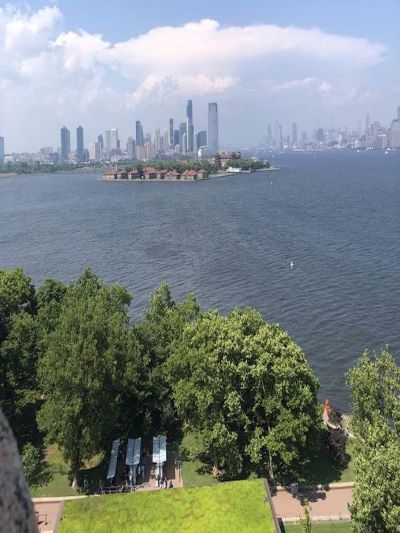
Two years ago, when we still had a preschooler, I wrote “See New York City for Free.” In the spirit of Do Less for Preschool, we did not actually go into the city. We looked at the Manhattan skyline from Liberty State Park in New Jersey (free parking). The park has points of interest. I do not believe my kids would have benefitted from an expensive trip into NYC, in 2022 (which isn’t to say that parents should rule it out if they are primarily going for themselves). Remember that a 4-year-old enjoys poking a bucket of rain water about as much as a trip to Disneyworld. Sticking to the nap schedule is probably better for everyone than doing a forced march through fancy landmarks in any weather, for preschool kids.

Now in 2024, we have graduated to actually going into the city (for now, assume the constraint of spending our nights in New Jersey, you guys). I’ll describe two low-budget day trips that will tire but not exhaust school-age kids.

On the first day, we used NJ Transit trains to get to New York Penn Station. Since my kids do mostly cars and suburbs, the train itself was fun. On weekends and holidays, kids ride free on NJ Transit. From there, we walked all the way to Central Park, which took us through Time Square. You call this “urban hiking” now (previously known as walking). We stopped into a few stores along the way. I’ve taught my kids to “window shop” in a store, meaning they are warned ahead of time that we are not buying anything. We spent money on food and drinks, but it would have been possible to pack in a lot more food if desired. Once we had walked all the way to the upper east side (about 3 miles), we took a taxi back to the train station.

On the second day, we avoided high parking fees once again by departing on the ferry from the New Jersey terminal to see the Statue of Liberty. There were plenty of families with preschool kids or babies, by the way. Strollers are allowed on the ferries, just not inside the pedestal or statue. The ferry ticket includes access to all of the indoor museums and audio tours. If you want to be allowed to walk up the stairs into the crown of the statue, be aware that you need to book those tickets many months in advance. If you just want to take the ferry to the island, then you don’t have to plan so far ahead.

These plans rely heavily on being outside, so rain would pose a problem. There are plenty of places to escape the rain, but it would not be nearly as fun/cheap.

If you are road tripping anywhere with kids, read Zach on long family car trips. I’ll add that you can fill up a large insulated thermos of ice from the hotel and bring it along to provision drinks from cans throughout the day.

Pictured: Central Park, view from Statue of the Statue, view from the Statue of the city

Advice For Travelling With Children

My family regularly takes long trips up and down the east coast of the US. It takes us about 6 hours just to travel through Florida. We have several kids between the ages of 1 & 7 and we’ve got it down to a pretty good science. Here’s some great advice for travelling with children. A lot of it is OK advice if you cherry pick, but together their benefits compound.

1) Depart Early

It doesn’t matter if it’s a 3 hour trip or a two day trip. To us, ‘early’ means that our target departure time is 5 AM, but ‘early’ may mean something different for you and yours. Benefits include:

  • Kids may remain or resume sleeping for the first portion of the travel. That’s time that they are occupied.
  • Earlier arrival at your destination gives kids time to burn off some energy and adults time to decompress. For multi-day trips, we like to stop at a hotel that has a pool.

2) Carry-on Backpacks

Just as you would have a small personal item on an airplane, such as a purse, give each child a backpack that contains car-ride content (make sure that they put away one thing before beginning the next). Maybe ensure that each kid has a different color. This puts their stimulation in their own hands. The idea is not to avoid interacting with your kids. The idea is to help them take care of themselves. Here’s what to include:

Continue reading

Hotel Taxes and Quality: Why Georgia Sucks (Value)

Every year my family travels from SW Florida to the mid Atlantic area. Without stops it takes 16-17 hours. With small children, it’s definitely a two day trip. We find that they handle it better if we leave super early, take a longer leg on the first day, then stop at a hotel midway and get the kids in the pool to help burn off some energy. We also rent a suite whenever possible.

We’ve made this trip many times. I use the Bonvoy app which is for Marriott hotels. We even have a particular hotel that we prefer: The Fairfield Inn in Santee, SC. It’s clean, spacious, the employees are welcoming and kind, the breakfast includes cooked items that aren’t bad, it’s within walking distance of a grocery store, and the price isn’t bad at all. Fairfield Inns are generally a great price per quality…. But not in Georgia.

I’ve stopped at several Fairfield Inns in GA: near Atlanta, near Savannah, and we’ve been disappointed. Every. Single. Time. All the margins on which the Fairfield in Santee is great are the same margins on which Georgia ones are poor. I’m sure that there is not just one reason. Maybe there is a bad regional manager or bad assistant to the regional manager. That’s not my primary hypothesis though.

Continue reading

Where Can You Still Buy a Great Dinner in the US?

Last year, Jeremy wrote “Where Can You Still Buy an Affordable Home in the US?” He pointed out a few metro areas in the US that are not classified as “unaffordable”. All of the biggest cities have nice amenities such as great restaurants but are very expensive.

There is such a thing as an American town that is too small to find a good restaurant. But you don’t have to go all the way to the middle of New York or Chicago to find interesting menus. If you love food and good creative restaurants, there are some smaller cities that can deliver. Parking and hotels should be cheaper, so you can spend more of your money on food. (I don’t have any data on hand with regard to how menu prices in Birmingham compare to menu prices in NYC. Presumably they are lower here where labor is relatively cheaper.)

This list of cities was compiled in 2022. Birmingham, AL is on the list.  “10 Unexpected U.S. Cities With a Surprisingly Good Food Scene” 

I can recommend the following: “The 30 Best Restaurants In Birmingham, Alabama” (Southern Living, 2023)

To get a bit more recent national data: “Surging restaurant prices are making dining out a luxury” (CNN, 2024)

I think I care more about food quality than “service.” Nothing has bothered me about the gradual nation-wide shift away from table service toward placing my order at the counter or from a computer screen.

I don’t do much with them, but Jeremy is an advocate for restaurant apps. If you track deals and order directly through the app, you might save around 10% on low-to-mid quality restaurant food.

On a side note, I’m wondering if and when AI will approach the service level of a personal chef. I wish I could outsource all family meals to someone else. I have experimented with grocery delivery and “meal kits” and recipe apps. Nothing ever feels like a personal chef, although some of those services are nice to have. I feel like a superintelligence could encompass all of the restaurant apps, and grocery delivery and family meal planning together. I wish I could just enter a list of taste and health preferences and then not think about it anymore.

ASSA 2024: Unrejected

Is this the year the world’s largest economics conference settles into its new normal? ASSA 2024 starts in San Antonio today.

Like most conferences, the Allied Social Science Association took a big hit during the pandemic. Unlike most other conferences, a big fraction of this hit appears to be permanent. Part of what made ASSA so popular was that it was the site of most 1st-round job interviews for economists, but the pandemic made this shift to remote interviews. The American Economic Association decided the job market was better that way, so they made the arrangement permanent.

This shrunk their conference by about half compared to pre-2020; overall I thought it was still fine last year, but that the transition creates a problem:

The big problem with attendance falling to 6k is that they’ve planned years worth of meetings with the assumption of 12k+ attendance. Getting one year further from Covid and dropping mask and vaccine mandates might help some, but the core issue is that 1st-round job interviews have gone remote and aren’t coming back. The best solution I can think of is raising the acceptance rate for papers, which in recent history has been well under 20%.

I suspect the AEA is starting to take my advice. Acceptance rates ticked up slightly in 2023 (from 7% to 9% for individual papers, and from 16% to 30% for complete sessions). They have yet to release full information on acceptance rates this year, but my own experience indicates that this summer they realized they had a problem. I got a rejection email in July that said:

We were able to accept less than one third of the more than 1,150 submissions for paper or poster sessions.

This was followed by something I’ve never seen from an economics conference before- a rejection of the rejection:

You have probably already received an email saying your paper which you submitted for the American Economic Association program at the meeting in San Antonio, TX in January 2024 was not accepted. However, the AEA has decided to select a few more papers for the poster session.

I am pleased to inform you that your paper entitled

Certificate of Need and Self-Employment


which you submitted for the American Economic Association program, has been selected to be part of the AEA’s poster session.

This sums up my relationship to the core of the profession nicely: I’m exactly on the margin of it. But this time, just barely on the right side of it, helping them fill up a newly-oversized hotel block.

The odds aren’t what they were in the mega-conference days before 2020, but I expect I’ll still see some of you in San Antonio.

New Orleans Redux: SEA 2023

I’m heading to New Orleans tomorrow for the 2023 meeting of the Southern Economic Association, where I’ll present research on the labor market effects of Certificate of Need laws.

I’ll take this as an excuse to re-up two previous posts on New Orleans:

First, my travel guide post for anyone else heading there soon

Second, my bigger-picture take on how the city has changed over the last decade: Waxing Crescent: New Orleans 2013-2023

I recommend reading the whole thing, but here’s the conclusion:

As much as things have changed since 2013, my overall assessment of the city remains the same: its unlike anywhere else in America. It is unparalleled in both its strengths and its weaknesses. If you care about food, drink, music, and having a good time, its the place to be. If you’re more focused more on career, health, or safety, it isn’t. People who fled Katrina and stayed in other cities like Houston or Atlanta wound up richer and healthier. But not necessarily happier.

Hope to see some of you there!

Bored?  You Can Join in a Giant Tomato Fight in Spain!!

The other day I was chatting on Zoom with a friend. She noted that she and a couple of girl friends go on an interesting vacation each year. They start off by each of them writing down their top three destinations, and then comparing notes. This year, it is a tour of the Danube region.

Thinking of a similar “Where do we go next year for kicks, guys?” scenario in the movie City Slickers, I jokingly suggested running with the bulls in Pamplona. That is kind of a guy thing (50-100 injuries each year, occasional fatal goring), but it triggered a comeback from her: “Well, maybe the tomato festival instead.”

So of course I started poking around the internet to see what was up with tomato festivals. They sounded less than exhilarating, on a par with a midwestern pumpkin growing contest.
Now, in Lancaster County, PA (Amish country), some of the tomato festivals feature..wait for it….a bounce house! That’s nice, but maybe not worth a plane flight to get there.

Nashville goes all out with their Tomato Art Fest, with food vendors, live performances and people walking around costumed as giant tomatoes. This year’s theme was, ““THE TOMATO: A Uniter, NOT A Divider! – Bringing Together Fruits & Vegetables.” In Leamington, Ontario they get really physical by putting a layer of tomatoes in kiddie pools on the ground, so you can take off your shoes and socks and step in and squoosh those tomatoes under your bare feet. Woo hoo!

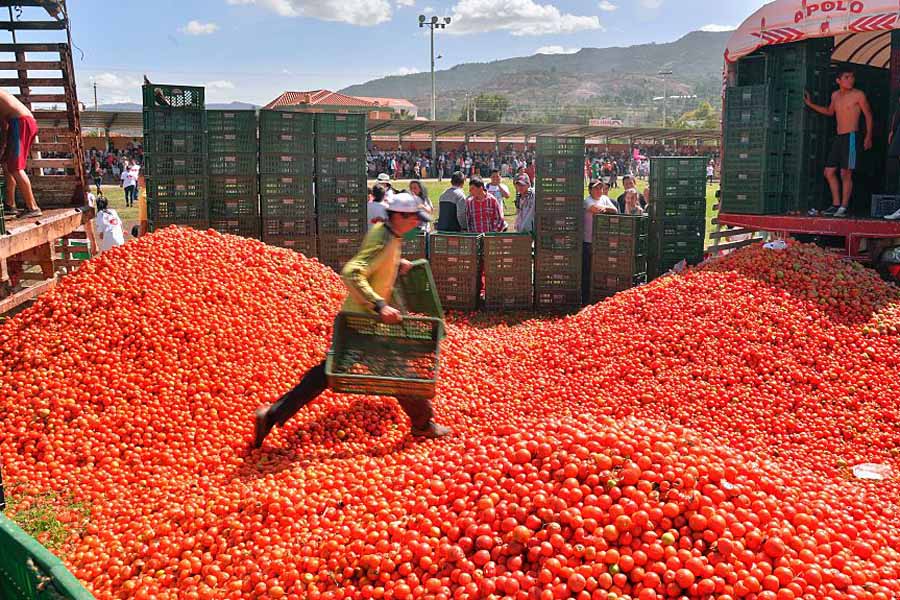
But it turns out the real action is La Tomatina in Bunol, near Valencia (Spain). Excitement builds as truckloads of ripe tomatoes are brought into town:

Source https://allthatsinteresting.com/wordpress/wp-content/uploads/2016/08/tomato-stockpile.jpg

Then there is the greasing of a tall pole with lard; a ham is perched at the top of the pole. And then (since the pole is unclimbable), enthusiastic people pile their bodies up around the pole till someone can reach the top of the pole and cast down the ham, whereupon a signal cannon fires.

That is the signal for total mayhem to erupt – 20,000 people (you have to buy a ticket beforehand) hurling tomatoes at each other, until the whole town square is deep in squishy red pulp. Participants are asked to hand-squash each tomato before throwing it.

PHOTO  https://www.centives.net/S/wp-content/uploads/2015/08/082715_1146_TheEconomic1.jpg

After an hour, a second cannon fires to signal cease firing. Local residents may hose you off, or you can go wash off in the river. (Tips include bringing a change of clothes, because you aren’t allowed on the train or bus with your gooey clothes). Afterward, the firetrucks come and hose down the town square. Reportedly, due to the annual rinsing with acidic tomato juices, the town streets appear remarkably clean. During the days leading up to the main event, there are local parades and tours and a paella cooking contest. (Paella is an amazing local rice-based dish, worth of a blog article of its own)

So if you want to do something memorable in Spain but you are too lazy to walk 500 miles on the  Camino de Santiago pilgrimage, or you are too chicken to run in front of a crowd of angry bulls, put La Tomatina on your bucket list.

Econ Tourism

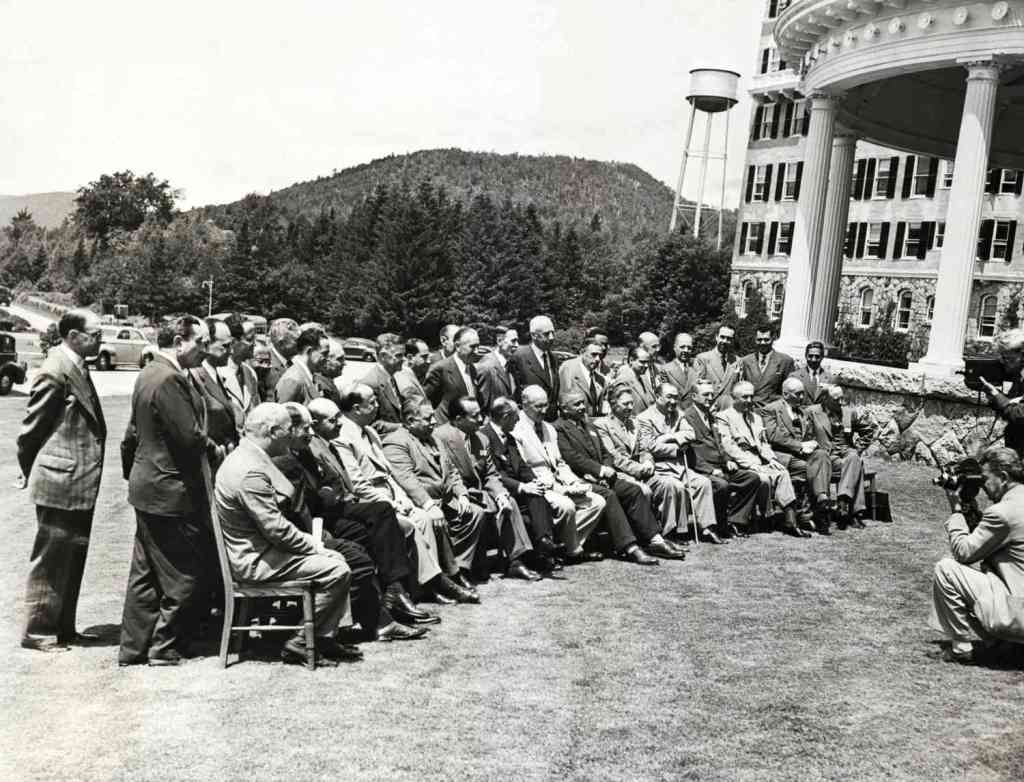
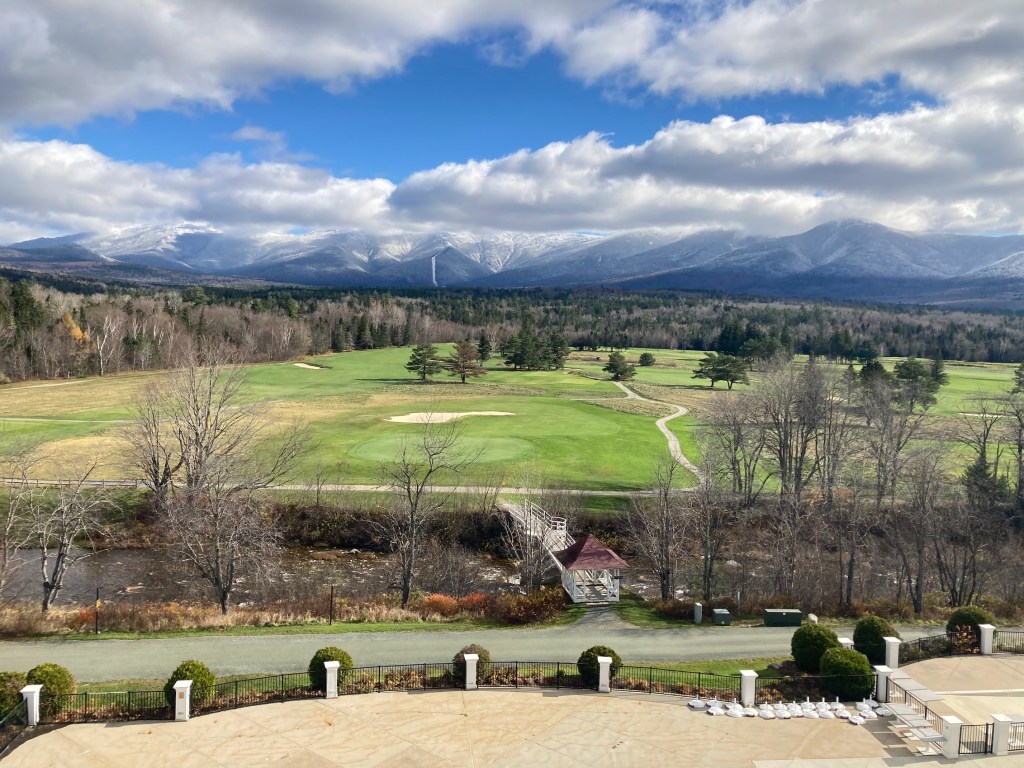
This week I was in Bretton Woods, New Hampshire. The Mount Washington Resort there is lovely on its own terms as a grand old hotel surrounded by mountains, but it is better known (at least among economists) as the site of the 1944 conference that gave us the International Monetary Fund, the World Bank, and the postwar international monetary system.

This got me thinking about what other destinations should top the list of sites for economics tourism. Adam Smith’s house in Scotland has to be on there. In the US I’ve been trying to visit all 12 Federal Reserve banks; they tend to have nice architecture as well as a Money Museum. You can stay at Milton and Rose Friedman’s cabin in Vermont, Capitaf. I’d like to go to Singapore for many reasons, but one is that they seem to listen to economists more than any other country; I’m not sure what places to visit within Singapore that best reflect that, though.

The places I’ve listed so far are somewhat inward looking to the economics profession; you could get a much bigger list by looking outward to the economy itself, doing “economic tourism” rather than “economics tourism”. Visit a port, a mine, or a factory (like Adam Smith visiting a pin factory and getting ideas for the Wealth of Nations); visit a stock exchange or a bazaar. Visit whatever country currently has the fastest economic growth, or the worst inflation.

Those are my ideas, but I’d love to hear yours: what are the best places for econ tourism?