Because I’m not a financial planner. I’m not even an active investor. I’m an economist who follows the standard economist dictum regarding passive investing and low-fee index funds. But at some point the, if we take parallels to the past seriously, there arises the question of whether a 40 year old with a 100% index fund portfolio should consider hedging/reallocating their porfolio a decade sooner than they planned on becase, well, just look at that chart.
Maybe AI is great. The internet certainly was an is pretty great. But that doesn’t mean there won’t be a massive dotcom bubble-esque correction, and a 20% hedge can be the difference between 4 years getting back to even versus 7 years getting back to even. Even at the risk of misisng out on some growth in the longer term, the calculus with basic risk aversion checks out.
So, seriously. Are we hedging? And what are we hedging into? Asking for a friend. Who is an economist. And also me.
Within my social network the exodus from the service industry is now almost complete. Ten years ago I had no fewer than 7 good friends in the restaurant busines, now only one remains (and he is, by his own classification, 40% retired). The reasons were both myriad and similar. The physiscal toll is substantial, the hours long, and lack of weekends, the separation from non-industry people working diametrically opposed schedules. What really keeps pushing people out, however, that seems to tip the scales over and over, is the lack of health insurance consistent across most restaurants. With the expiration of the ACA subsidies driving up premiums for those without an employer pool to participate in, the calculus has shifted. Who’s leaving? Is it just the friends of economists?
No, it’s everyone over 35. It’s not really more complicated than that. They are entering the age where health insurance has a lot more marginal value, so they are leaving. Sometimes for substantial paycuts.
Between the ACA subsidies expiring and ICE enforcement targeting the keep service industry labor pools, the business that make our meals are going to look very, very different. Will they be worse? I guess I can’t say for sure…no, scratch that, I absolutely can. It’s worse. Everything is going to be worse. Younger, less experience, fewer immigrants? Yeah, that’s the formula to make everything worse.
It is very good. See it in IMAX if you can, though I strongly recommend wearing concert ear plugs (i.e. the kind that let you still hear dialogue clearly). Minor spoilers ahead, if such a thing is even possible with a 2,800 year old epic poem.
The themes of the adaptation/translation are wonderful and poignant. The layers of shame and trauma never, to me, felt forced. As someone who spends a lot of time thinking about the fragility of civiliation as solution to the grand collective action problem, the idea that a single betrayal can unravel an entire society and that the “heroic” cenceiver of that betrayal might feel shame, well, that is not without current relevance.
So yes, the film as story is great. But, sitting here now 4 days after viewing it, what I find myself constantly returning to is the sheer, overwhelming competence of the film. The acting, costuming, set and prop design, lighting, sound design, editing, musical scoring. It all just worked. As a champion of practical effects, the texture of the film was transporting. Yes, there is CGI, but it blends in seemlessly, always complementing the practical elements in a way to never let the imagery fall into the uncanny valley. The final product coordinates a vast array of individual and team efforts that, together, create an experience that always felt purposeful, decisive, and real.
Given the small city that must be erected, populated, struck, and moved to create each element of a film like The Odyssey, it’s a great reminder of what can be accomplished when all of the people involved actually and truly know what they are doing. In an age of carnival barkers and con men, there is nothing more epic than grand demonstrations of competence.
I am not an attentive soccer (football) follower, but it was hard to ignore the 2026 FIFA World Cup being played in my own country (or at least my own continent). I tuned in for more and more games as the play progressed. Spain progressed further and further along, and finally won the gold.
This was not a one-off fluke. Spain won the World Cup in 2010, and has dominated European soccer for the past 3-4 years. Spain also won the most recent women’s World Cup in 2023. My inquiring mind naturally wanted to know what was behind this success. Spain’s population (49 million) is below that of England, France, or of Germany, so it is not simply having a huge demographic to pull from.
When this question was posted on Reddit, a Spanish fan gave this answer:
This is an interesting question with a lot of possible answers.
The most evident one is the Olympic Games of Barcelona 1992. This created a huge shockwave in Spain, which was still a little bit “isolated” from the rest of the world. The preparation of these games and their success made Spain invest a lot of money on sports infrastructure, trainers and programs, which directly impacted on the accomplishments of the big Spanish sportsmen of that generation: Rafa Nadal, Pau Gasol, Fernando Alonso, the whole Spanish football team 2008-2012 and many others. The success of the modern Spanish football team is supported by them.
But it also has a more deep and old reason. Before the 21st century the Spanish football team, even if they didnt win titles, managed to get good positions in international tournaments. Why? Spaniards have been, traditionally, smaller and weaker than the other Europeans (even if that has obviously changed). We couldn’t engage on physical play with the Dutch, Germans, French, English etc. that ran faster and were stronger than us. We don’t even have that many physical players TODAY. So, we had to rely on mentality and skill.
So the team started to become recognized by their fierce attitude, their relentless energy and attacking spirit, gaining the nickname of “La furia Roja” (red fury). And also had to rely on skill, passes, building the game from behind and being more tactical and strategical on the field. This set the foundations for the modern “tiki-taka“, the Barça and Spanish playstyle that basically created modern football. These two things, plus Barcelona ’92 were the perfect mix to create a football tradition for many years.
Poking around the AI and Wikipedia and other sources, I found that this reply did a good job summarizing the sources of Spain’s success. I will just elaborate on a few aspects here.
Certainly, the Spanish technique of rapid, relentless passing (so-called tiki-taka) to maintain possession and to draw the opponent out of position to create scoring opportunities was in full view in this World Cup. It is more efficient and effective to rapidly move the ball than to run your players around. The specifics of this style actually puzzled me when I watched it. In my brief, undistinguished non-career in intramural soccer, I was taught to receive a pass by controlling it with typically two taps, then maybe kick it onward with a third “touch”. But the Spanish players would take an incoming pass and just whack it onward with only one “touch.” That takes exquisite control; get that wrong by just a hair on one of those dozens and dozens of taps back and forth, and there goes your possession.
The internet agrees that Spanish teams historically could not compete head-to-head physically with a team full of hulking northern Europeans, and so they deliberately came up with this alternative playing style that relied on skillful control, not brute strength or size. Another strategic decision by Spanish coaches (trusting in their team’s ball control skills to maintain possession) is to play the defenders up-field, closer to the opponent’s goal, where they can play a role in building attacking pressure.
This playing style depends heavily on teamwork, and is the style promoted through all levels of the Spanish junior/farm teams as well. The whole team operates like a hive-mind organism, with players thinking several moves ahead and trusting the others to do the right thing at the right time. Unlike some other teams, this system is not dependent on one or two superstars to carry the load. I found the Spanish play to be an inspiring facet this year of “the beautiful game.”
Tyler Cowen once said over lunch “I don’t know why I don’t agree with everything Greg Mankiw says. He’s much smarter than me.” He was being entirely earnest and it doesn’t seem on it’s face a crazy question. Yes, with a little reflection it is easy to observe that smart people are wrong sometimes, but there’s nonetheless a probabilistic logic to it. If someone is smarter than me, I should just adopt all of their ideas which are, on average, more likely to be correct than those I form on my own, therefore increasing my average “correctness” through pure imitation, adoption, and replication. Almost none of us do this, thank the gods of ecological rationality and group selection, thus preserving the wisdom of crowds and the robustness of our collective wisdom, but I think it’s still worth revisiting how intelligence correlates with “correctness.” Specifically, I’m taking this as my opportunity to run a little thought experiment I like to call “The Genius Trap.” I apologize if there is a pre-existing thought experiment associated with someone famous. I haven’t read nearly enough philosophy.
To start, let’s make some gratuitous, outright rude reductions of people. People will be characterized by two attributes: how often they make correct assessments of the information being considered, which we will call “wisdom”, and how complex of an abstract system they can hold in their head while maintaining the consistency and coherence of each individual element, which we will refer to as “intelligence.” Now, it’s easy to observe that some people are wise but not intelligent, or vice versa, but that’s trite. To make things interesting, let’s assume that wisdom and intelligence are positively correlated. Some people will be low in both (“slow”), others will be medium (“average”), and a few blessed folks will be both highly wise and highly intelligent (“geniuses”).
Now typically in a thought experiment we leave everything in the realm of adjectives (high, low, slow, genius, etc), but bear with me here because this experiment benefits from assigning hard numerical paramaters. Let’s say that slow people are correct 85% of the time but can only only a 2 element system in their head. Average people are correct 90% of the time and can consider and evaluate an 32 element system. No need for symmetry here, let’s really go all-in on geniuses, and say they are correct 95% of the time and can hold a 1024 element system in their head. Following so far? Geniuses are carrying around 2^10 element models in their head, each element of which is correct 95% of the time.
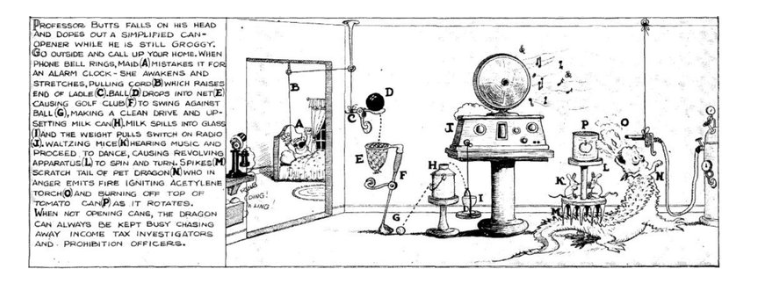
You ever play “Mousetrap”?
Rube Goldberg Machines (RGMs) make for useful allegorical references, but why are some funny and others just sweaty metaphors? An RGM is an overly complex device drawn or conceived for comedic effect. They are purposefully absurb in their individual design elements, but what is key is that, if the events proceed as planned the intended result will actually occur. The metaphorical intent is usually that the complexity is unnecessary, but what makes an RGM funny is precisely that it would work if events proceeded as expected. The audience, of course, knows with certainty born of experience that there is absolutely no way this machine will function because anything with high levels of complexity and narrow tolerances for deviation will always fail. Comedic irony comes for us all.
It is in this manner that the opinions, most notably the politics, of really smart people can go so entirely off the rails. Recall our slow individual. Sure, they’re only right 85% of the time, but in a two elemement model of the world that still gets you home intact 72.25%. And for most of daily life, a two element model is more than sufficient to get you through your day hale and hearty. But alas, our poor geniuses, they cannot help themselves. The world is a rich and complex place of which they want to unlock the deepest mysteries. And why not? Point by point their lived experience is confronting all of the exam questions they knew the correct answers to when others were obviously mistaken. The rub, of course, is that being right 95% of the time can’t survive in the face of a 10 element model, for which their understanding remains pure and intact only 59.87% of the time. By the standards of a daily life, they have been reduced to dullards, clumsily shouting their world view at those without the luxury of ignoring them.
It is precisely because they are capable of holding in their heads and considering the ramifications of fantastically complex mental models of the world, each element itself well considered and defended, brilliant people can find themselves with very specific opinions that stand no chance of being remotely correct. The solution, of course, is social. It’s friends and coworkers who challenge you, pointing out your foolishness in fun and good faith. It’s the academy, going through every line of your proof with a fine toothd comb, sometimes perhaps taking a little too much glee in pointing out your errors (often, in turn, making errors of their own), but the system persists and science proceeds in no small part because of the wisdom of crowds.
Some of the worst political ideas in history have come from geniuses, but as a light consumer of intellectual biography, it’s interesting how often the very worst ideas happen after the world decides someone is a genius, isolating them in a web of fame, worship, self-regard, and, in our modern era, extreme wealth. In many ways, it’s the opposite of herding, where the mechanics of herd safety disables the wisdom of crowds. Less common, do doubt, than herding simply because of the tautologically lesser prevalence of extreme intelligence, but nonetheless important.
Which is a long-winded waying of saying that the trap is not in being a genius,per se, but in being a genius alone. Of becoming surrounded by yes men or moving to an off the grid cabin in the woods. Of building a steel cocoon of your own narcissism, formulating ever more complex models within models, each mistake compounding and eroding your mind like intellectual termites. Avoiding the genius trap is not to limit yourself or the complexity of your thinking, but simply to open yourself to the criticism of others, particularly those invested in neither your brilliance or your censure. To wholly avail yourself of the possibility that the mouse trap might never fall because you are completely and utterly wrong.
I had an interesting dinner with two macroeconomists, Paulo Lins and Michael Navarrette. A follow-up conversation led to me skimming this paper, which dives into the regional heterogeneity of food inflation. Now inflation is not something we typically think of having particularly local or granular heterogeneity (“inflation is everywhere and always a monetary phenomena”, etc, etc), but it’s important to remember that the biggest difference between chalkboard inflation and real-life inflation is measurement.
Economic data is something we often take for granted, in no small part because it’s the substrate from which so much economic research is grown. To fight over it almost feels like nihlism. But just because we aren’t fighting about it doesn’t mean that measurement is easy. It is, in fact, brutally challenging for a host of reasons. Now, a lot of those reasons come down to the demand for immediacy in measurements, which can in turn be dealt with through updates over time. But there’s a deeper challenge that we shouldn’t lose sight of.
Every good is a bundle.
A tomato is a vegetable that is secretly a fruit. Sometimes the price is higher, sometimes it’s lower. But here’s the rub: sometimes when the price is higher it’s secretly lower, and vice versa. Sometimes it’s the same, only it’s not. Sometimes that modestly increased price is secretly a catastrophic increase threatening marinara all across the nation.
Yesterday the tomatoes I bought were 3 for $2. Today they were 2 for $1.50. A modest 11% increase in price. Ah, but see, it isn’t.
The tomatoes today are a little smaller. They came from farther away, representing a seed line that is more tolerate of travel and refrigeration. They are less uniform in color, more acidic, less sweet. Diving deeper, we find that the cost for a 100 lbs of tomatoes purchased in bulk were unchanged. There was, however, less variety to be chosen from because those crates of bulk tomatoes were increasingly curated to fit the needs of Sysco, the chief purveyer for mid to lower tier restaurants, which needs them more for median-customer approved red sauces than spinach salads and bruschetta.
So, dear reader, I ask you – did the price of tomatoes go up? For me, they certainly did. For the median American they barely budged. For Pizza Hut they may have actually gone down!
It’s easy to see how complex goods are bundles of attributes, but it’s amazing how products as commodified as sand or amino acids for livestock feed can quickly become bundles once you put yourself in the shoes of the customers for those goods. When quality, timing, and uniformity enter the mix, damn near every good becomes a rich bundle of attributes for which profit-maximizing suppliers are working diligently to not just meet the needs of their customers, but serve the terms of the explicit and implicit contracts from which any deviation brings the spector of margin-spoiling transaction costs. There’s a lot of gravity at the status quo. Which, in a way, is simple rediscovering menu costs, but with the important distinction that just because the number on the menu hasn’t changed doesn’t mean the price hasn’t. The menu is a lie.
Mexico plays England tonight in the World Cup and I will be rooting for Mexico. Which is interesting considering that Harry Kane is one of my favorite global players to watch and Mexico, for most of my life, as been the primary rival for the US Men’s National Team (who play Monday night against Belgium, another household dilemma since my wife used to run a Belgian restaurant).
I could go on about this, but Ryan Rosenblatt covers it ably. The rivalry was fun so long as it stayed on the pitch. After 12 years of racist political rhetoric about Mexico and Mexicans, it’s no fun to root against them. Combined with the fact that the team plays genuinely enjoyable soccer (relative to the broad standard of international soccer, which I am contractually obligated to note is aesthetically inferior to 95% of club soccer), I would love to see Mexican soccer fans collectively lose their minds advancing deep in the tournament.
There is a broadertheme this WorldCup of wonder and awe at the sense of camaderie amongt fans from 48 different countries and the communities hosting them. Which is wonderful and the World Cup as an institution deserves a lot of credit (the Cup itself, mind you, not FIFA- they’re as corrupt as they come), but honestly I think this is the result of just a lot of people coordinating to travel at the same time.
The reality is and always has been that most people don’t carry any (or, at least, much) nationalistic hate in their hearts, and certaintly not the ones willing to the incur the discomfort of flying to a different part of the world. The hate isn’t real. It’s mostly a fugazi, a masquerade carried out because it’s materially and politically profitable for a few hundred and the only source of identity and pride for a few thousand. The World Cup, by comparison, is a collective endeavor of a few million, and once you get to those numbers, it’s mostly folk who like having a good time with other folk.
We made it to 250! Some people didn’t even think we would make it this long. Happy 4th of July!
I have seen America 250 merchandise and banners all over this year. American patriotism was not so cool a decade ago, and it’s interesting to see the displays back in.
An example of the “USA Merch” seen all over this year. This was near Chattanooga, TN (which is the city the Spanish national team picked for their World Cup training base).
Something that has been fun this year was watching the 2026 Winter Olympics and the ongoing World Cup hosted here (Remember we went around the moon? People are just watching soccer now). People have told me how much fun they had either witnessing or hearing about Scottish World Cup fans partying in Boston. Fun is back, at least in one sense.
Americans enjoy winning. Getting knocked out of the World Cup early would have been disappointing. But most Americans don’t care if we completely win the World Cup. In fact, fun mode is highest if we get to watch someone else enjoy a victory. A nontrivial percent of Americans were genuinely rooting for Cape Verde.
For EconLog, I wrote a piece about Freddy the German World Cup tourist.
At the link, I present Freddy and his Twitter/X posts as evidence that some of Tocqueville’s highest hopes have been fulfilled, so far.
If you go looking for Freddy, as of when I checked on July 3, he has deactivated his X account. With nearly a million followers he probably could have become a paid influencer, but he does not want to. I suppose he wants to return to Germany and live a more stable life. He never expected to get this much attention.
I’ve recently gone back and started listening to the archived episodes of the ‘Macro Musings’ podcast hosted by David Beckworth. The show started in 2016. At that time, there was still a sense of malaise after the 2007-2008 Great Financial Crisis (GFC) and the slow recovery that followed it. We were also in a prolonged low-interest rate environment.
A recurring theme is whether the Fed should have engaged in expansionary policy earlier than they did in response to the GFC. There are multiple ways to answer. It’s not helpful to say ‘knowing what we know now’. The Fed didn’t have that opportunity. It’s a little bit more helpful to say ‘if the Fed had a different target or different tools’. The target and tools are higher-order policy decisions and changing them can be helpful in the future. But they typically can’t be changed with the flip of a switch. After all, the 2% inflation target itself rolled out over the course of decades.
The most awkward/damning question is “Given the target, tools, and data that the fed actually had, did they make the right decision?”. If the answer is ‘no’, then that warrants a serious investigation of individuals, groups, processes, etc. I don’t mean a legal investigation. I mean the decentralized kind in which public and expert trust can be affected.
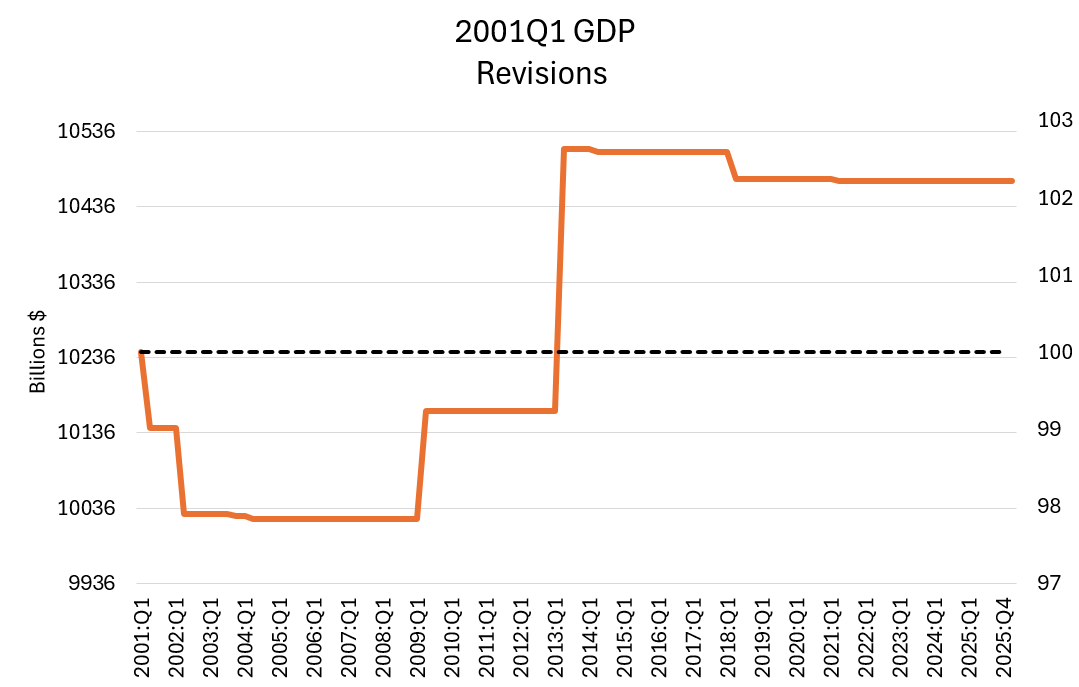
A concept that Beckworth often mentions concerning Fed culpability/performance during the GFC is the problem of data revisions. Currently, we know what the revised data says about NGDP, inflation, employment, etc. But the Fed only had the contemporary numbers and immediate revisions. In a world where economic growth is lousy or stellar in a range of 1-3%, small revisions can matter a lot. For example, below are the 2001q1 NGDP revision values over time.
Revisions occurred twice by 2002q2, revising NGDP down by more than 2%. Subsequent revisions raised the value on record to nearly +3% of the initial estimate, before settling at a less elevated value. Sheesh! In a world where a 1% swing is a big deal, how can we possibly expect the Fed to succeed at managing aggregate demand?
Things are not so scary as they might seem. The Fed doesn’t much care about revisions to an individual quarter. Rather, they care about the direction of change over time. Whether future revisions increase GDP by 2% is unimportant. What’s important is whether one period’s value is lower relative to the earlier value. That’s the relevant difference that tells us how the economy is changing.
Now, in 2026, our current understanding of NGDP during the GFC follows the below pattern starting in 2005q1 (lest I omit important pre-trends). NGDP growth had weakened in 2007q4, turning negative in 2008q1. Weak growth resumed in 2008q2. Then we had near-zero or negative growth for the next five quarters. Of course, we’re now approaching twenty years later, so we have the huge benefit of hindsight and revisions. Keep in mind that the contemporary numbers aren’t available until the subsequent quarter. By the yard stick of NGPD, the Fed should have been loosening by Q3 or certainly Q4 of 2008 if they cared about supporting total spending. Maybe as early as Q2 is they were especially sensitive.
The Knicks won the NBA championship and the Canes won the Stanley Cup. The World Cup is here, with all of its grim authoritarian appeasement and absolutely incredible drama. It all serves as a reminder that so much of the joy is in the noise, the inability to forecast, both as individuals and collectively in the market, what will happen. Make no mistake, the hockey playoffs are grossly unfair as a measure of who exactly is the best hockey team (that was the Colorado Avalanche who were unceremonially swept in the conference finals). Pucks bounce, refs make mistakes, goalies get hot. Any knockout tournmanent is outrageously unfair to identify the best soccer/football team. Dominating teams losing 1-0 on a fluke goal is sufficiently frequent as to be commonly referred to as “getting footballed”.
And that, to be exceptionally clear, is the point. Sports remain an opportunity to watch something that is not only unscripted, but highly difficult to forecast with any sense of certainty. Upsets are joyful not just because they are unexpected, but because they happen just often enought that you don’t feel a fool hoping and cheering for one.
With all of the growing concern over sports gambling and prediction sites, I do wonder what people are more upset about. The self-debasement of individuals eroding their financial security in pursuit of a not-so-cheap high? Or the threat to unpredictability as the incentives of actors inside and outside the games being rearranged to undermine what is supposed to be a random number generator with a multi-agent human engine purposed towards creation of drama unpolluted by audience service and manipulation.
Because here’s the thing. People want to get hurt. They want the disappointmen of losing. Of failing. Or coming up just short. Of giving it away when victory was all but assured. They want that so that when things finally do work out they can wholly and earnestly give themselves away to celebration of something that really actually happened as a product of forces we cannot control. Movies, televisions, books, they all want to give you happy endings so you’ll come back. If they don’t they know what someone else will.
But sports? Sports cannot be bullied by the customer into any such contract because any competition there always and forever has to be a loser. And as a sports fan you will lose. Sometimes a lot. Sometimes for your entire life. But you keep coming back because the noise in the system says that you might win next time. You might get a lucky bounce. A hot goalie. Or a generationally great guard so grotesquely undervalued by another team that for the cost of having the 46th highest salary in the league, you get to have an NBA finals MVP lead you to your first championship in 53 years.
The joy is in the noise. Congrats to any and all Knick fans, especially my Aunt Jean, a dyed in the wool New Yorker who’s been waiting a long time for this.
.jpg)