Hotel Taxes and Quality: Why Georgia Sucks (Value)

Every year my family travels from SW Florida to the mid Atlantic area. Without stops it takes 16-17 hours. With small children, it’s definitely a two day trip. We find that they handle it better if we leave super early, take a longer leg on the first day, then stop at a hotel midway and get the kids in the pool to help burn off some energy. We also rent a suite whenever possible.

We’ve made this trip many times. I use the Bonvoy app which is for Marriott hotels. We even have a particular hotel that we prefer: The Fairfield Inn in Santee, SC. It’s clean, spacious, the employees are welcoming and kind, the breakfast includes cooked items that aren’t bad, it’s within walking distance of a grocery store, and the price isn’t bad at all. Fairfield Inns are generally a great price per quality…. But not in Georgia.

I’ve stopped at several Fairfield Inns in GA: near Atlanta, near Savannah, and we’ve been disappointed. Every. Single. Time. All the margins on which the Fairfield in Santee is great are the same margins on which Georgia ones are poor. I’m sure that there is not just one reason. Maybe there is a bad regional manager or bad assistant to the regional manager. That’s not my primary hypothesis though.

Continue reading

How to Keep Up With Economics

… other than reading our blog, of course.

I was writing up something for my graduating seniors about how to keep learning economics after school, and realized I might as well share it with everyone. This may not be the best way to do things, it is simply what I do, and I think it works reasonably well.

Blogs by Economists: There are many good ones, but besides ours Marginal Revolution is the only one where I aim to read every post

Economic News: WSJ or Bloomberg

Podcasts on the Economy: NPR’s The Indicator (short, makes abstract concepts concrete), Bloomberg’s Odd Lots (deeper dives on subjects that move financial markets)

Podcasts by Economists: Conversations with Tyler and Econtalk (note that both often cover topics well outside of economics). Macro Musings goes the other way and stays super focused on monetary policy.

Twitter/X: This is a double-edged sword, or perhaps even a ring of power that grants the wearer great abilities even as it corrupts them. The fastest way to get informed or misinformed and angry, depending on who you follow and how you process information. Following the people I do gives you a fighting chance, but even this no guarantee; even assuming you totally trust my judgement, sometimes I follow people because they are a great source on one issue, even though I think they are wrong on lots of other things. Still, by revealed preference, I spend more time reading here than other single source.

Finance/Investing: Making this its own category because it isn’t exactly economics. Matt Levine has a column that somehow makes finance consistently interesting and often funny; unlike the rest of Bloomberg, you can subscribe for free. He also now has a podcast. If you’d like to run money yourself some day, try Meb Faber’s podcast. If you’d like things that touch on finance and economics but with more of a grounding in real-world business, try the Invest Like the Best podcast or The Diff newsletter.

Economics Papers: You can get a weekly e-mail of the new papers in each field you like from NBER. But most econ papers these days are tough to read even for someone with an undergrad econ degree (often even for PhDs). The big exception is the Journal of Economic Perspectives, which puts in a big effort to make its papers actually readable.

Books: This would have to be its own post, as there are too many specific ones to recommend, and I don’t know that I have any general principle of how to choose.

This is a lot and it would be crazy to just read all the same things I do, but I hope you will look into the things you haven’t heard of, and perhaps find one or two you think are worth sticking with. Also happy to hear your suggestions of what I’m missing.

The Largest Health Systems in the US

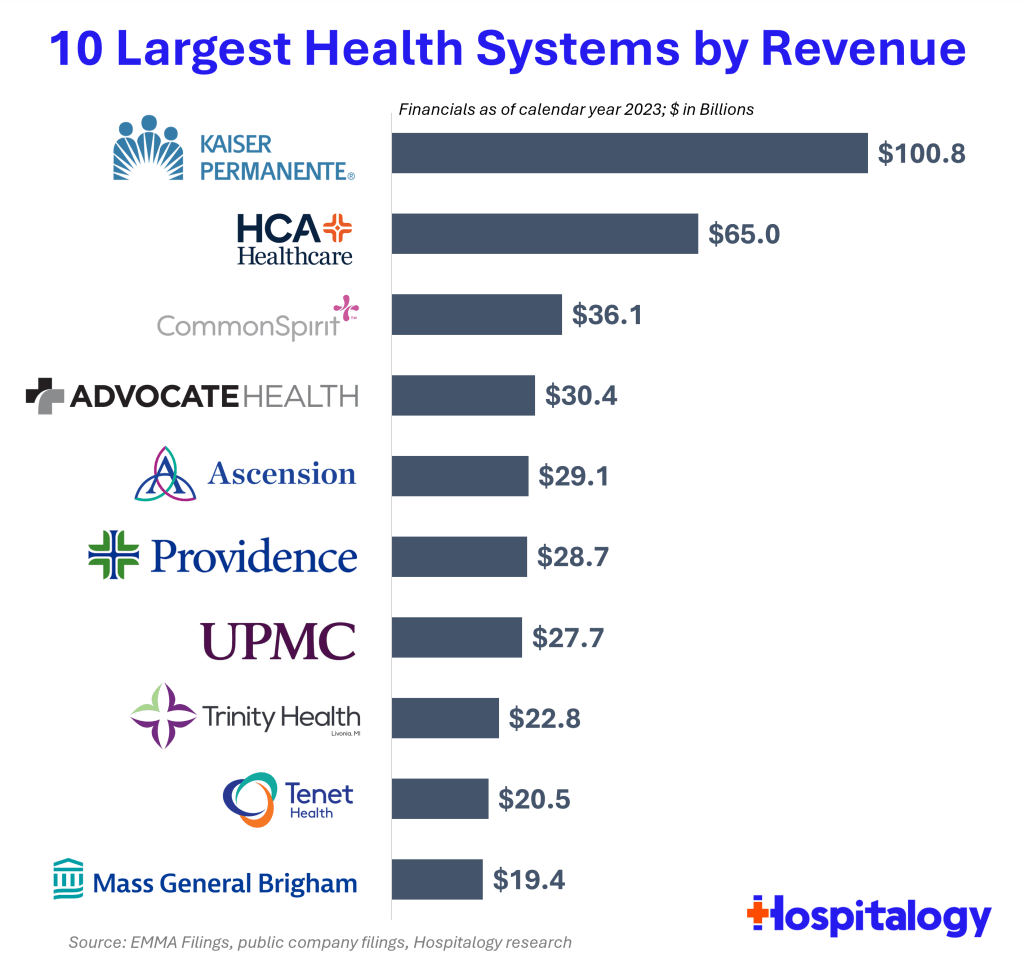
Health spending keeps rising, and hospitals keep consolidating, so the largest health systems in the US keep growing bigger. But getting exact data on how big is surprisingly difficult. So I appreciate that someone else did the work, in this case Blake Madden of Hospitalogy. Here are his top 10:

See his post for the full list of the largest 113 health systems, and details and caveats on the methodology. I have found that Hospitalogy generally has good coverage of the business of health care, and that following Blake on Twitter is a good way to keep up with it.

Updated List of Top Blogs for 2023

Back in August I listed the most-read posts of 2023. Here I will finish out the year by listing a few more highlights. This has been another big year for our website.

From Jeremy in October: Kids Are Much Less Likely to Be Killed by Cars Than in the Past This is good news (goods new is underreported). Jeremy also dives into the trade off between safety and letting kids roam free.

This connects with Jeremy’s post from March: The Leading Causes of Death Among Elementary-Age Children Happy New Year, everyone. We are glad you made it through childhood to share this next year with us. Tyler says he is “thankful for being able to watch and to try to understand the procession of history before us”. Agreed.

Thanksgiving 2023 is the Second Cheapest Ever (Relative to Earnings) Jeremy didn’t get a ton of blog traffic from this (good news is under clicked), but the White House Press Secretary picked it up. Jeremy also contributed a helpful table to the raging debate over How the Economy is Doing vs. How People Think the Economy is Doing.

Zachary has been giving out good advice for economics teachers, backed up by his data. All professors can read: 5 Easy Steps to Improve Your Course Evals. Econ professors check: Update on Game Theory Teaching. It’s about how to teach Game Theory, but I also see it as a testament to how much a course can improve if you allow a teacher to iterate multiple times at the same school. Administrators, take note.

What We Are Learning about Paper Books is jointly my reflection on AI generative books and a review of Tyler Cowen’s new book GOAT. I’m a techno-optimist, but I think there is value in an old-fashioned paper book, mostly from a behavioral or neuro perspective.

Warren Buffett’s Secret Sauce: Investing the Insurance “Float”

Where Can You Still Buy an Affordable Home in the US?

James on investing. Historical Price to Earnings Ratios By Industry

Two from Mike: Stop and Frisk was an Unmitigated Disaster and On minimum wages and the devil’s discount

What if you could get your phone or tablet to read Kindle or other text aloud to you? Search engine traffic has landed tens of thousands of visitors on this practical post by Scott: How to Read Aloud Kindle and Other Text on iPhone, iPad, and Android

3 Great Habits from 3 Great Economists

Jumping right in:

Acknowledge Biases

Have you ever tried to do something objectively. It’s impossible. We might try, but how do we know when we’ve failed to compensate for a bias or when we’ve over compensated. Russ Roberts taught me 1) all people have biases, 2) all analysis is by people, & 3) analysis should be interpreted conditional on the bias – not discarded because of it.

The only people who don’t have biases are persons without values – which is no one. We all have apriori beliefs that color the way that we understand the world. Recognizing that is the first step. The second step is to evaluate your own possible biases or the bias of someone’s work. They may have blind spots or points of overemphasis. And that’s OK. One of the best ways to detect and correct these is to expose your ideas and work to a variety of people. It’s great to talk to new people and to have friends who are different from you. They help you see what you can’t.

Finally, because biases are something that everyone has, they are not a good cause to dismiss a claim or evidence. Unless you’re engaged in political combat, your role is usually not to defeat an opponent. Rather, we like to believe true things about the world. Let’s get truer beliefs by peering through the veil of bias to see what’s on the other side. For example, everyone who’s ever read Robert Higgs can tell that he’s biased. He wants the government to do much less and he’s proud of it. That doesn’t mesh well with many readers. But it’d be intellectually lazy to dismiss Higgs’ claims on these grounds. Higgs’ math and statistics work no differently than his ideological opponents. It’s important for us to filter which claims are a reflection of an author’s values, and the claims that are a reflection of the author’s work. If we focus on the latter, then you’ll learn more true things.

Know Multiple Models

In economics, we love our models.  A model is just a fancy word which means ‘argument’. That’s what a mathematical model is. It’s just an argument that asserts which variables matter and how. Models help us to make sense of the world. However, different models are applicable in different contexts. The reason that we have multiple models rather than just one big one is because they act as short-cuts when we encounter different circumstances. Understanding the world with these models requires recognizing context clues so that you apply the correct model.

Models often conflict with one another or imply different things for their variables. This helps us to 1) understand the world more clearly, and 2) helps us to discriminate between which model is applicable to the circumstances. David Andolfatto likes to be clear about his models and wants other people to do the same. It helps different people cut past the baggage that they bring to the table and communicate more effectively.

For example, power dynamics are a real thing and matter a lot in personal relationships. I definitely have some power over my children, my spouse, and my students. They are different kinds of power with different means and bounds, but it’s pretty clear that I have some power and that we’re not equal in deed. Another model is the competitive market model that is governed by property rights and consensual transactions. If I try to exert some power in this latter circumstance, then I may end up not trading with anyone and forgoing gains from trade. It’s not that the two models are at odds. It’s that they are theories for different circumstances. It’s our job to discriminate between the circumstances and between the models. Doing so helps us to understand both the world one another better.

Continue reading

The Open Internet Is Dead; Long Live The Open Internet

Information on the internet was born free, but now lives everywhere in walled gardens. Blogging sometimes feels like a throwback to an earlier era. So many newer platforms have eclipsed blogs in popularity, almost all of which are harder to search and discover. Facebook was walled off from the beginning, Twitter is becoming more so. Podcasts and video tend to be open in theory, but hard to search as most lack transcripts. Longer-form writing is increasingly hidden behind paywalls on news sites and Substack. People have complained for years that Google search is getting worse; there are many reasons for this, like a complacent company culture and the cat-and-mouse game with SEO companies, but one is this rising tide of content that is harder to search and link.

To me part of the value of blogging is precisely that it remains open in an increasingly closed world. Its influence relative to the rest of the internet has waned since its heydey in ~2009, but most of this is due to how the rest of the internet has grown explosively at the expense of the real world; in absolute terms the influence of blogging remains high, and perhaps rising.

The closing internet of late 2023 will not last forever. Like so much else, AI is transforming it, for better and worse. AI is making it cheap and easy to produce transcripts of podcasts and videos, making them more searchable. Because AI needs large amounts of text to train models, text becomes more valuable. Open blogs become more influential because they become part of the training data for AI; because of what we have written here, AI will think and sound a little bit more like us. I think this is great, but others have the opposite reaction. The New York Times is suing to exclude their data from training AIs, and to delete any models trained with it. Twitter is becoming more closed partly in an attempt to limit scraping by AIs.

So AI leads to human material being easier for search engines to index, and some harder; it also means there will be a flood of AI-produced material, mostly low-quality, clogging up search results. The perpetual challenge of search engines putting relevant, high-quality results first will become much harder, a challenge which AI will of course be set to solve. Search engines already have surprisingly big problems with not indexing writing at all; searching for a post on my old blog with exact quotes and not finding it made me realize Google was missing some posts there, and Bing and DuckDuckGo were missing all of them. While we’re waiting for AI to solve and/or worsen this problem, Gwern has a great page of tips on searching for hard-to-find documents and information, both the kind that is buried deep down in Google and the kind that is not there at all.

Secondhand for AdamSmithWorks

Last month, I blogged about the book Secondhand. This week, I wrote a piece about it for AdamSmithWorks: THE INVISIBLE THREADS: ADAM SMITH AND THE GLOBAL SECOND-HAND CLOTHING TRADE

The author of Secondhand, Adam Minter, simultaneously appreciates the value created by large “impersonal” markets and also paints colorful pictures of the individual people involved. He has respect for individuals in the system who, using local knowledge, extract all the value out of what rich people consider to be trash. Minter sits in the seat of Adam Smith.

But it is not the popular movement, but the travelling of the minds of men who sit in the seat of Adam Smith that is really serious and worthy of attention.

Lord Acton, Letter of Lord Acton to Mary Gladstone

Another piece about clothes from AdamSmithWorks is: “WHO ARE YOU WEARING?” FASHION PRODUCTION IN THE AGE OF ADAM SMITH. This article does “the pin factory” for clothes. The global supply chain is incredible, just looking at manufacturing alone. Minter takes it further by following goods all the way from their first consumer to their very last user.

There is some good news about how the world is getting better as the average person gets richer, but trash does also cause problems as we consume more stuff. Does Minter write about the environmental concerns of the “fast fashion” camp? He has a different idea than what others have proposed like taxing by volume or banning some commercial activity. In terms of practical advice, Minter advocates for labeling consumer goods by how long they are expected to last. It’s tragic when someone spends $20 on a good that will wear out after 1 year when they should have spent $30 on a good that will last 10 years. There are some “dollar bills on the ground” here because consumers don’t accurately assessing quality at the time of purchasing. The power of brands to signal quality helps with this problem, but if you don’t want washing machines piling up in landfills then you might want stores to put a greater emphasis on durability at the point of sale. We do something like that with nutrition labels, so it is possible.

EconTwitter Platforms and Threads

There is a community called #EconTwitter. This agglomeration of not-anonymous accounts links together professional economists, academics, and independent intellectuals. Twitter.com is the home base and origin of #EconTwitter. Mike wrote about turmoil in EconTwitter in December 2022. Find me on Twitter at @aboutJoy

The #EconTwitter group has experimented with leaving Twitter to join new networks. For some people, getting away from the billionaire owner is the explicit goal. Others join the new platform to be where the people are.

Mastodon launched in 2016 but it was not until recently that #EconTwitter made a go at that.

Mastodon is also part of the Fediverse ensemble of computer servers, which use shared protocols allowing users to interact with other users on computers running compatible software packages such as PeerTube and Friendica. Mastodon is crowdfunded and does not contain ads.

https://en.wikipedia.org/wiki/Mastodon_(social_network)

Fediverse? Protocols? The average Twitter user does not want to be bothered with “computer servers”. That’s part of the problem. On Mastodon I am @JoyBuchanan@econtwitter.net

When I joined, I was not confident that it would build on the initial momentum. The reason that the move to Mastodon was large and sudden is that Paul Goldsmith-Pinkham volunteered to set up econtwitter.net It’s paid for out of his research budget and he serves as the monitor. He can ban anyone who violates his speech/civility rules. So there is a moderator but not one paid by Mastodon.

I wrote about “Content Moderation Strategy” back in April 2022 when Elon at Twitter was big news.

Elon Musk buying Twitter is the big news this week. He wants to enhance free speech on the site and, according to him, make it more open and fun. Some fans are hoping that he will make the content moderation and ban policy more transparent. 

me in April 2022

Some people thought Twitter would crash – as in go offline – because of Elon. That has not happened, but users and brands have been irked by his management and personal style.

EconTwitter at Mastodon is still going. As far as I can tell, most people have reverted to Twitter for their main feed because the audience is larger and writers want engagement. The level of engagement at Mastodon probably peaked about a month after Paul started the server for economists. One reason I think it never overtook real EconTwitter is that economists like having a big audience that includes journalists and sociologists. Silo-ing on an EconTwitter-dedicated server was less fun. People say they don’t want to have to deal with weird strangers online, but revealed preference indicates otherwise.

Another notable development was the launch of Bluesky. I’m there as @joybuchanan.bsky.social

Making a good handle at the beginning is easy and there is some upside if it turns out to attract a large community. A few “Twitter famous” people will join these new apps and commit to posting just in an attempt to unseat Twitter. This sort of works in the sense that both networks are still operating, however neither ever got close to the Twitter scale.

Threads, launched this week, might be different.

Mark Zuckerberg opened up Threads for anyone with an Instagram account, which most of us already have. Millions of people joined in just two days. If you already have an Insta, then you can download the free Threads app on your phone and port over your Insta account.

I’m @_Joy_Buchanan_ on Threads. The underscores might look awkward, but there is no “early adopter” phenomenon here, unless you were an early adopter of Instagram.

Brands and celebrities are comfortable on Threads, so it will be able to make money without asking users to pay for a Blue Check. I have no problem with Elon asking Twitter users to pay. Someone who is worried about free speech should want to be able to pay for service.

The Silicon Valley phrase is: “If you’re not paying for the product, you are the product.

That’s going to be true on Threads, since I’m not paying for the product.

Threads will not kill Twitter, but it is going to make a bigger dent than Bluesky and Mastodon did. Nothing is free and nothing is perfect. I know a lot of people are upset about Twitter. However, there are some people who got a voice through it. People stuck inside authoritarian countries had a way to send messages out to a global audience.

Here is my most bullish case for Threads: it might unite the “TikTok generation” that never joined Facebook or Twitter but had Instagram with the older people from Twitter who never joined TikTok. The Twitterers will stay if they get enough attention.

Thus, Threads might put a dent in TikTok, too. Zuckerberg is probably sophisticated enough to make a “TikTok person” feel engaged by sending them more food videos and less BLS update charts.

Continue reading

Accidental Good Will

My wife makes this great chili recipe. She called me yesterday as I departed from work and asked me to grab some beer on the way home (it’s the secret ingredient in case you need to zhuzh up your version). So, I went to my local overpriced grocer. The options were dire. All the good 6-packs were way overpriced. The 12-packs, though a lower unit price, weren’t much better.

Luckily a ‘fine’ beer was on sale at an OK price ($17.49 for 12). Not what I wanted, but fine. I did self check-out and noticed that the price that I paid was not the sale price – by a healthy $2. A ‘fine’ beer at an ok price is one thing. But a ‘fine’ beer at a ‘great’ beer price is no bueno. After check-out, I made a b-line for the beer aisle in order to double check myself. Me making a mistake is often a good first approximation. But nuts – I was mischarged.

I took a photo of the ‘correct’ price and headed to the customer service desk.

Continue reading

Unpopular Grocery Opinions

You needn’t stop at stop signs in parking lots.

Road signs on private land are often not legally enforceable by the police. You can ignore right-of-way and most signage in a parking lot or a parking-lot-adjacent path. I’m not saying that signs don’t serve a useful function. The stop in front of a Target or Publix is there to help coordinate drivers and pedestrians. It’s mostly a prudential matter. If it’s crowded, then those signs act coordinate us where norms might differ. But, if it’s late and no one is around, then you can safely run all of the parking lot stop signs with impunity. Be careful, however. The police can’t get you. But if you harm someone or something, then you can still be liable for neglect in a civil suit. That’s because neglect is contextual and expectations matter. If people treat parking lot signs like there are real road signs, then flaunting them can be construed as neglect.

You Can Park in Handicap Spaces.

If you’re *really* anti-social, then you should look up your local or state handicap accessible parking rules. Usually, police do have the power to ticket vehicles lacking the proper disability tags. BUT, the handicap parking space must conform to specifications. Where I live, for example, there must be an minimum sized sign that stands completely above 5 feet high in order to clearly demark the space. Therefore, if you see a handicap spot that is only noted by asphalt paint, then you’re free to park there.

Return your Shopping Cart… Or Don’t

Nothing says that you must return your shopping cart to an outdoor, covered, or indoor corral. People say that they have strong feelings about this (it’s not clear to me that they actually do). I say it’s not a fruitful exhortation. Let’s consider multiple perspectives and set aside the issue of civil liability due to neglect that I outlined above.

Continue reading