Is the Fed’s Inflation Target Really 2%?

The Fed has had an official inflation target of 2% since 2012, a commitment they reaffirmed just last month after their policy review:

The Committee reaffirms its judgment that inflation at the rate of 2 percent, as measured by the annual change in the price index for personal consumption expenditures, is most consistent over the longer run with the Federal Reserve’s statutory maximum employment and price stability mandates.

But since 2020, they haven’t been acting like it. Lets look at their preferred measure of inflation, the annual change in the PCE price index:
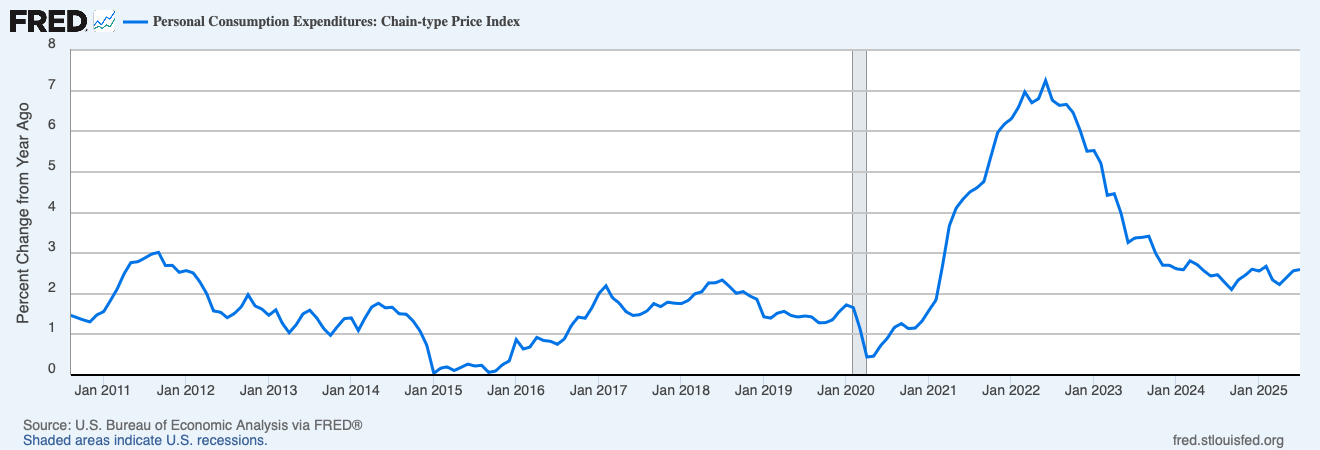
The last time annual inflation was at or below 2.0% was February 2021. The Fed just cut rates despite inflation being at 2.6%. If you didn’t know about their 2% target and were trying to infer their target based solely on their actions, what would you guess their target is?
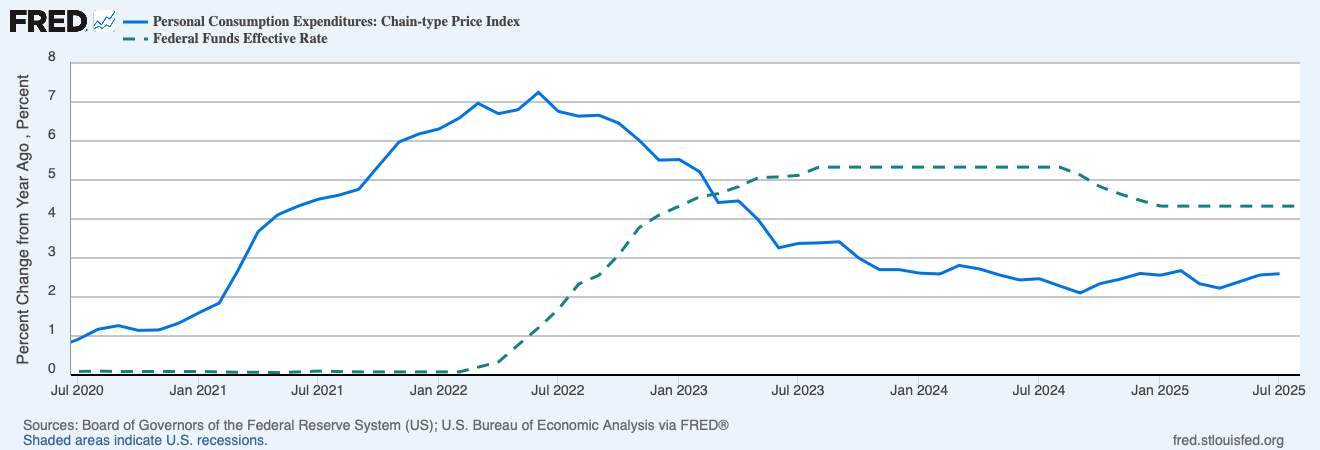
Considering the post-Covid period, I see their actions as being more consistent with a 3% target than a 2% target. They stopped raising rates once inflation got below 3.4%, and started cutting them again once inflation got below 2.4%. The Fed’s own projections show more rate cuts coming despite the fact that they don’t expect inflation to get back to 2.0% until 2028! Bloomberg’s Anna Wong does the math and infers their target is 2.8%:
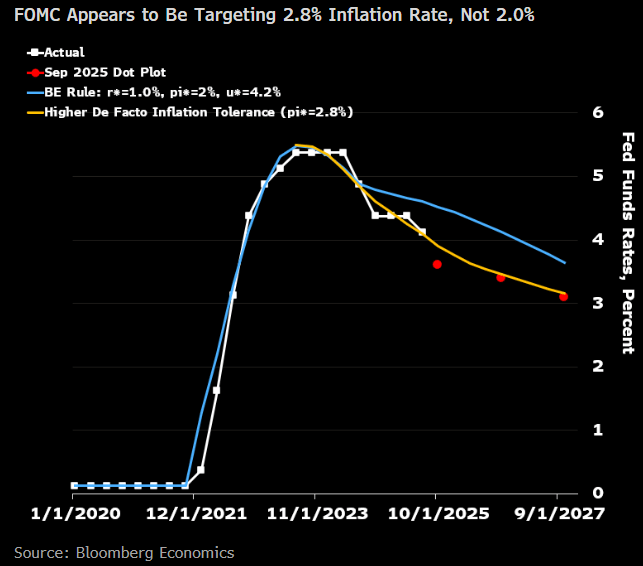
Perhaps the Fed’s target should be higher than 2%, but if they have a higher target, they should make it explicit so as not to undermine their credibility. Or at least make explicit that their target is loose and they’d rather miss high than low, if that is in fact the case. This is what Greg Mankiw would prefer:

I feel strongly that a target of 2 percent is superior to a target of 2.0 percent….. It would be better if central bankers admitted to the public how imprecise their ability to control inflation is. They should not be concerned if the inflation rate falls to 1.6. That comfortably rounds up to 2. And they should be ready to declare victory in fighting inflation when the inflation rate gets back to 2.5. As the adage goes, that is good enough for government work. Maybe the Fed should even ditch a specific numerical target for inflation and instead offer a range, as some other central banks do. The Fed could say, for example, that it wants to keep the inflation rate between 1 and 3. Doing so would admit that the Fed governors are notquite as godlike as they sometimes feign.

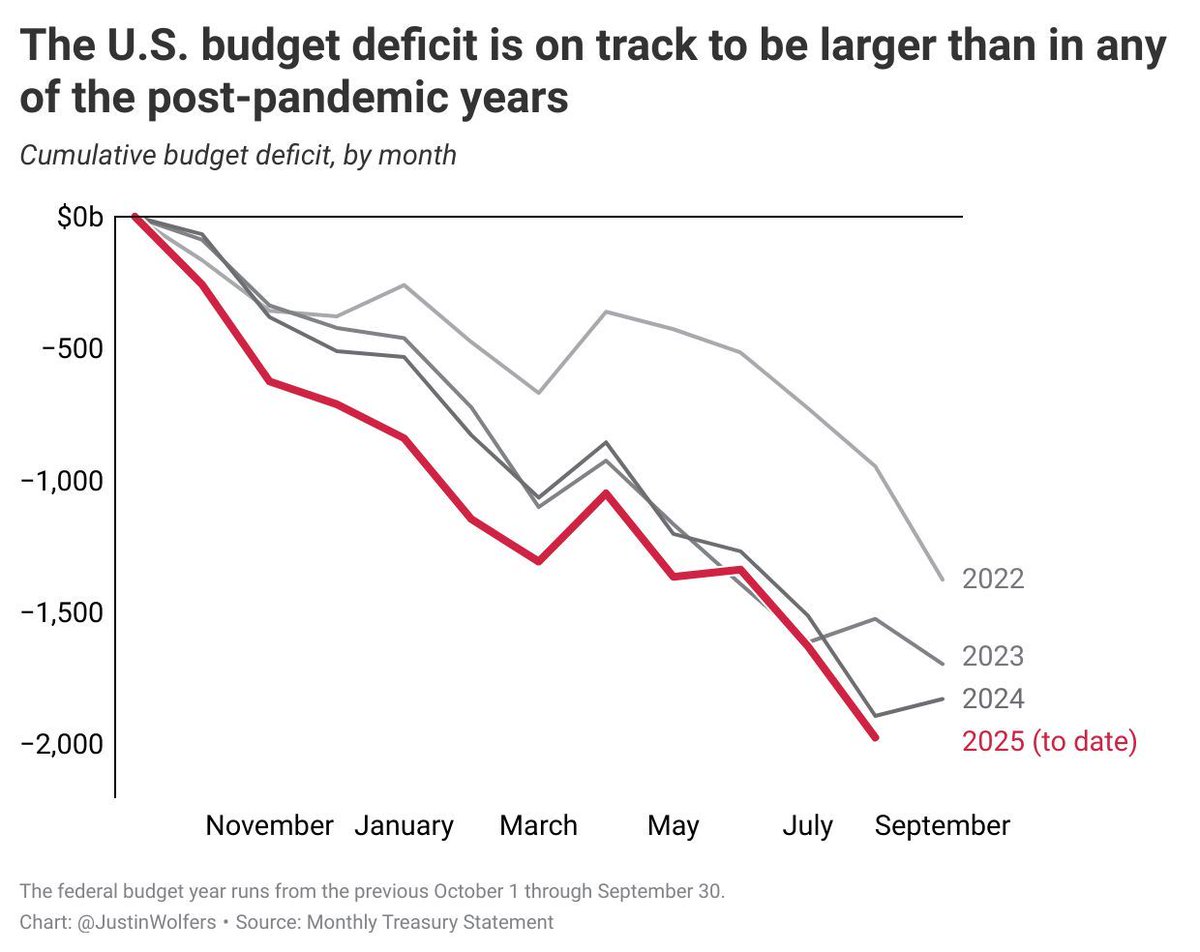
The Fed seems to have taken Mankiw’s approach to heart, except with a preferred range of 2.0-3.5%. I take Mankiw’s point about not being able to fine-tune everything, but given the bigger picture I think the Fed should if anything err on the low side of 2.0%. The Federal deficit is in the trillions and rising, inflation has been above target since 2021, and consumers never got over the Covid-era increase in the price level:
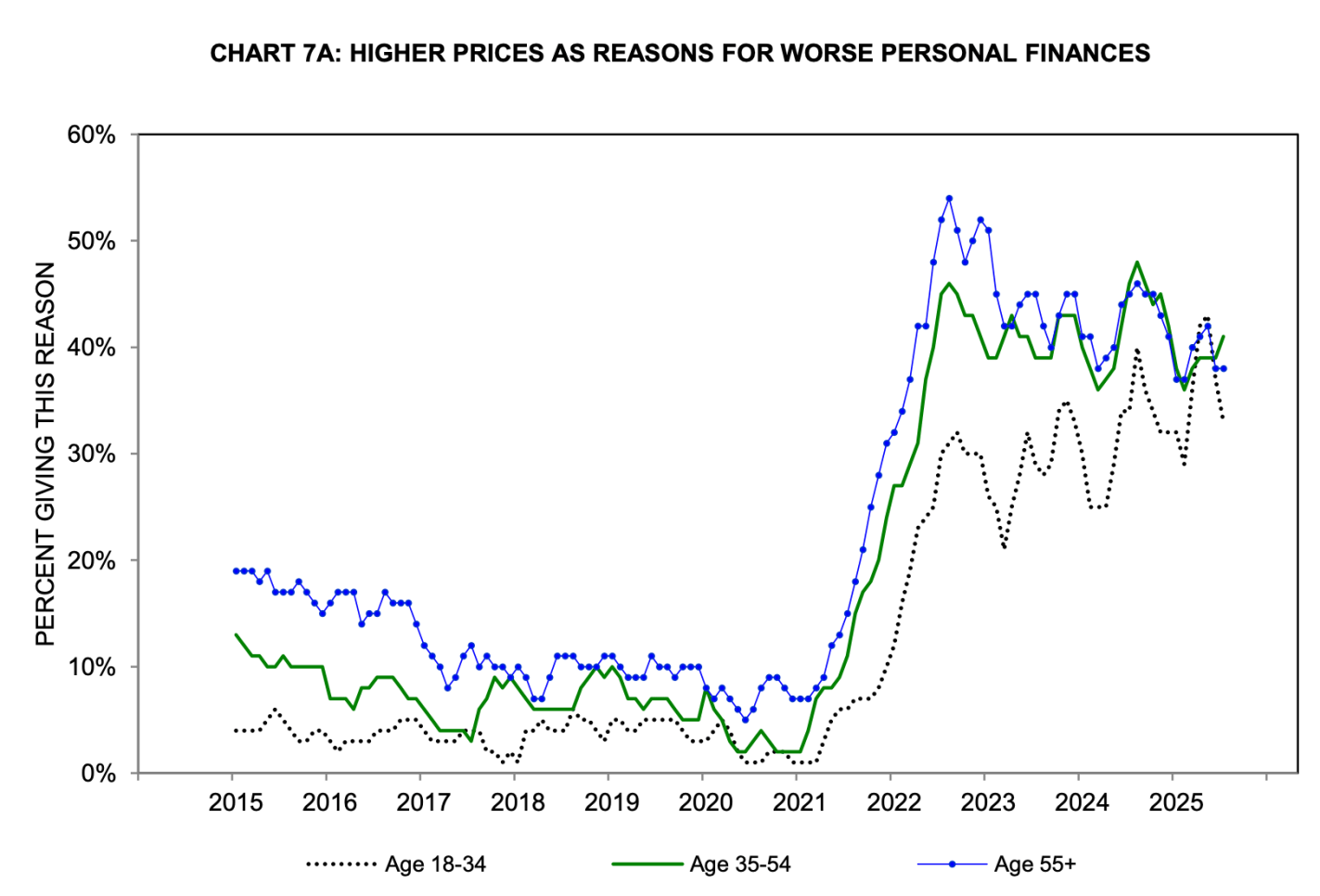
Source: Michigan Consumer Survey

The Fed let inflation stay mostly below 2% during the 2010s, to the detriment of the labor market. They updated their policy framework in 2020 to allow for “Flexible Average Inflation Targeting”, where they would let inflation stay above 2% for a while to make up for the years of below 2% inflation. This is part of why they let inflation get so out of hand in 2022. This made up for the 2010s and then some- our price level is now 3-4% higher than it would be if we’d had 2.0% inflation each year since 2007. But the sudden big burst of inflation in 2022 led the Fed to abandon this flexible targeting idea in the 2025 framework. The lack of “make up” policy latest framework means that they don’t see themselves as needing to do anything to repair their 2022 mistake- “just don’t do it again”.

We’re certainly being stuck with permanently higher prices as a result, and I worry we will be stuck with higher inflation too.

One-Third of US Families Earn Over $150,000

This is from the latest Census release of CPS ASEC data, updated through 2024 (see Table F-23 at this link). In 1967, only 5 percent of US families earned over $150,000 (inflation adjusted).

Addendum: Several comments have asked how much of these trends can be explained by the rise of dual-income households. The answer is some, but not all of it, which I have written about before. Dual-income households were already the most common family structure by the 1980s. There hasn’t been an increase in total hours worked by married households since Boomers were in their 30s. You can explain some of the increase up until the Boomers by rising dual-income households, but this doesn’t explain the continued progress since the 1980s. And as Scott Winship and I have documented, even if you look just at male earnings, there has been progress since the 1980s.

Even more data on this question in a new post!

Leveraged Bullion and Mining Funds to Cash in on the Gold Bonanza

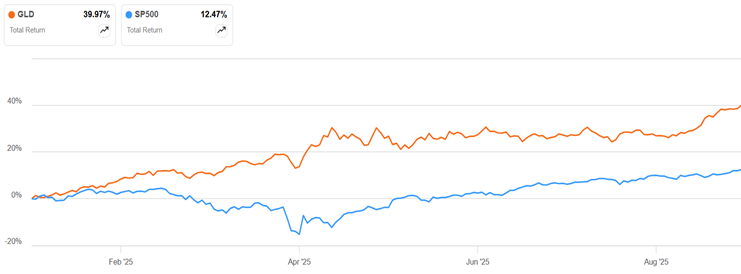
Stocks (e.g., S&P 500) are up 12.5 % year to date. That is pretty good for 9.5 months. But gold has been way better, up 40%:

Fans of gold cite various reasons for why its price should and must keep going up (out of control federal debt and associated money-printing, de-dollarization by non-Western nations, buying by central banks, etc.). I have no idea if that is true. But if it is, that raises the question in my mind:  for the limited amount of funds I have to invest in gold, can I get more bang for my investing bucks, assuming gold continues to rise?

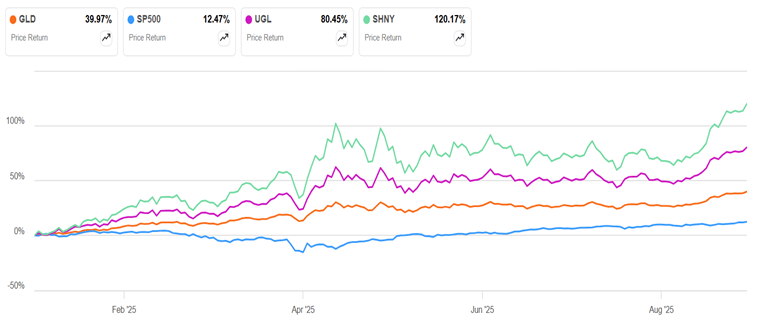
It turns out the answer is yes.  A straightforward way is to buy into a fund which is 2X or 3X leveraged to the price of gold. If gold goes up 10%, then such a fund will go up 20% or 30%. Let’s see how two such funds have done this year, UGL (a large 2X gold fund) and a newer, smaller 3X fund, SHNY:

Holy derivatives, Batman, that leverage really works! With GLD (1X gold) up 40%, UGL was up 80% year to date, and 3X SHNY is up 120%. So, your $10,000 would have turned into $24,000. The mighty S&P500 (blue line) looks rather pitiful in comparison.

But wait, there’s more. Let’s consider gold “streamers”, like WPM (Wheaton Precious Metals) or FNV. They give money to mines in return for a share of the production at fixed, discounted prices, so their cash flow soars when gold prices rise. Year to date, FNV is up 73%, while WPM is up 91%.

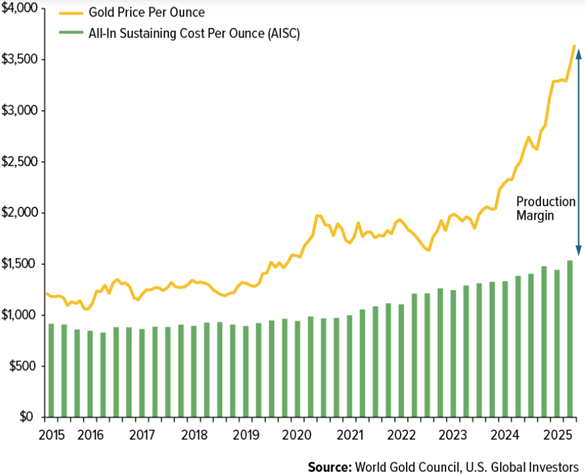
And then there are the gold miners themselves. They tend to have fairly fixed breakeven costs of production, currently around $1200-1400/oz.  Again, their profit margin rockets upward when gold prices get far above their breakeven:

Source

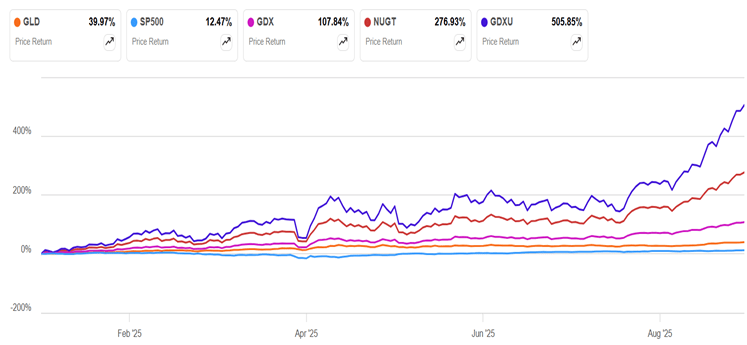
GDX is a large fund of representative mining stocks. For icing on the cake, there are funds that are 2X (NUGT) or 3X (GDXU) leveraged to the price changes in mining stocks. The final chart here displays their year-to-date performance in all their glory:

The blue S&P 500 line is lost in the noise, and even the orange 40% GLD line is left in the dust. The 1X miner fund was up 108%, the 2X fund NUGT was up 276%, and the 3X GDXU was up 506%. Your $10,000 would have turned into $51,000.

Of course, what goes up fast will also come down fast, since leverage works both ways. For instance, from Oct 21 to Dec 30, 2024, gold was down a mere 4%, but WPM was down 15%, the 1X gold miner GDX was down 20%, and 3X GDXU down an eye-watering 54%. That means that your $10,000 turned into $4,600 in two months. Imagine watching that unfold, and not panic-selling at the bottom. Gold fell by more than half between 2011 and 2015. If it fell by even 20% (i.e., gave up half of this year’s gains), I could see a 3X miner fund losing over 90% of its value (just a guess).

One more twist to mention here is the “stacked” fund GDMN, which uses derivatives to be long 1X gold PLUS 1X gold miners. It is up 151% this year, which is nearly four times as much as gold. This fund seems to have a nice combination of decent leverage with moderate volatility. It has on average kept pace with the 2X miner fund NUGT, with shallower dips. NUGT has surged way ahead in the past two months as miner stock prices have gone nuts, but that is somewhat exceptional.

Disclaimer: As usual, nothing here should be considered advice to buy or sell any security.

“A Woman Under the Influence” (1974)

I’ve been making a point to fill in the “gaps” in my film history lately. Yesterday I finally watched the John Cassavettes classic “A Woman Under the Influence” starring Gena Rowlands and Peter Falk. It is a fantastic film, with two incredible performances by the leads, but it is also emotionally exhausting as you watch an already strained woman entirely unravel. It’s the kind of movie that a modicum of chain smoking would probably make for easier viewing. I broke it into two separate sittings.

Nobody needs a new review of a 50 year old film- Roger Ebert already covered it ably, but there is reason to see it with fresh eyes. The principal word used to describle Mabel (played by Rowlands in a jaw dropping performance) is “crazy”. A least one person refers to her as anxious, but insanity is the general catch-all concept.

When you watch it now, though, you see a woman who would likely be be diagnosed with some variation of bipolar disorder, triggered by social anxiety. If she were to grow up today the observation of repeated physical “ticks” might have been associated with Tourettes or identified as the physical coping mechanisms of a child on the autism spectrum dealing with an avalanche of indecipherable social cues. I don’t actually know – the character is fictional and I am not a psychiatric professional. The point is that there are social, medical, and educational mechanisms in place to help a greater variety of people thrive. Maybe it’s just that we recognize a richer set of personal attributes and diversity of personalities than prior decades. There are handles for a person to grab on to before their life spins out of control.

There exists a sentiment that maybe we’ve gone too far, that we’re overdiagnosing, over- compartmenalizing, and over-accomodating a variety of behaviors as mental illness or disorder. And I can see the logic sometimes. But I think we’ve come so far that we can sometimes lose sight of the incredible value of the progress made. There are easily thousands, likely millions, of people who would have in prior generations been expected to endure a life of quiet misery or, barring that, be pushed sufficiently to the periphery that their suffering was just out of earshot. Instead they are provided language to understand themselves and communicate their needs to others, and sometimes the tools to optimize within their diverse set of needs and constraints. That’s much better.

Nirvana fallacies abound, especially when nostalgia paints over the obviously inferior parts of our personal histories. The present is taken for granted, it’s flaws drawn in sharp relief against an imagined perfect future rather than vastly inferior past. There is little to be looked back upon fondly in the formal and informal institutions of mental health. Better to have progressed an overly diagnosed and indulgent inch passed the unknowable social optimum than regress to a past where ignorance obstructed our empathy.

New TV Comedies on Netflix

I don’t spend a lot of time watching TV, but sometimes I do for fun. If you loved The Office and Parks and Recreation, then here are two new shows that are currently free on Netflix (September 2025).

I normally ignore lawyer shows (and cop/crime shows). But my first recommendation is an Australian lawyer show called Fisk.

Summary: A corporate lawyer must take a job at a suburban law firm after her life implodes in Sydney, and struggles to find her feet navigating grief, money, family, and entitlement.

I have only seen the first three episodes. I have no idea where the story is going, and I love that. Right now Helen has started a new job and is trying to get back on her feet after a divorce. I think it’s safe to say that the character is neurodivergent. The tone reminds me of Ricky Gervais’s The Office (maybe because Australian humor is close to British humor).

Like most Americans, I first discovered Leanne Morgan on Instagram. The real comedian has an interesting story (what Henry Oliver might call a Late Bloomer). So, I was excited when her TV show finally dropped. The first episode might not have hooked me if I didn’t already like her. I thought it picked up as the season went on, and I enjoyed the whole thing. It’s a bit like 30 Rock complete with an appearance by Jack McBrayer.

What’s Wrong with Sales Tax Holidays?

Tax holidays are when some set of goods are tax-free for a period of time. These might be back-to-school supplies for a week or a weekend, or hurricane supplies for several months. These policies tend to be popular among non-economists.

There are practical reasons for anyone to decry tax holidays. Usually, there is a particular type of good that qualify for tax-free status. These are often selected politically rather than by an informed and reasoned way with tradeoffs in mind. Sometimes, there is a subpopulation that is intended to benefit. However, the entire population gets the tax holiday and those with the most resources, who often have higher incomes, are best able to adjust their consumption allocations and enjoy the biggest benefits. A tax holiday weekend is no good to a single-mom who can’t get off work during that time.

Getting more economic logic, these holidays also concentrate shopping on the tax-free days, causing traffic and long lines that eat away at people’s valuable time – even if they aren’t purchasing the tax-free items. Furthermore, retailers must comply with the law. This means ensuring that all items are taxed correctly, making neither mistakes in over-taxing or under-taxing. Given the variety of goods and services out there, this is a large cost for individual firms.

Finally, as economists know, there is a deadweight loss anytime that there is a tax. As a consequence, you might think that economists would love anytime that taxes are low. But, holding total tax revenue constant, a tax break on a tax holiday implies that there must be greater tax revenues on the other non-holidays. In particular, economists also know that losses in welfare increase quadratically with changes in tax rates. Therefore, higher tax rates on some days and lower rates on other days causes more welfare loss than if the tax rate had been uniform the entire time. In the current context, such welfare loss manifests as forgone beneficial transactions. These non-transactions are hard for non-economists to understand because we can’t see purchases that don’t happen, but would have happened in the absence of poor policy.

Let’s look at some graphs.

Continue reading

Don’t Cut Rates

The Federal Reserve will probably cut rates next week:

I can’t advise them on the complex politics of this, but based on the economics I think cutting would be a mistake. I see one good reason they want to cut: hiring is slow and apparently has been for a year. But that could be driven by falling labor supply rather than falling demand, and most other indicators suggest holding rates steady or even raising them.

Most importantly, inflation is currently well above their 2% target, 2.9% over the past year and a higher pace than that in August. Inflation expectations remain somewhat elevated. Real GDP growth was strong in Q2 and looks set to be strong in Q3 too, and NGDP growth is still well above trend.. The Conference Board’s measure of consumer confidence looks bad, but Michigan’s looks fine.

Financial conditions are loose, with stocks at all time highs and credit spreads low. Its only September and we’ve already seen more Initial Public Offerings than in any year since 2021 (when the last big bout of inflation kicked off):

Source: https://stockanalysis.com/ipos/statistics/

Crypto prices are back near all time highs and crypto is becoming more integrated into public stocks through bitcoin treasury companies and IPOs from Gemini and Figure.

The Taylor Rule provides a way of putting all this together into a concrete suggestion for interest rates. Some versions of the rule say rates are about on target, while others including my preferred Bernanke version suggest they should be closer to 6%. To me this is what the debate should be- do we keep rates steady or raise them? I see good arguments each way, but the case for a cut seems very weak.

I look forward to finding out in a year or two whether I or the FOMC is the crazy one here.

* The Usual Disclaimer, hopefully extra obvious in this case: These views are mine and I’m not speaking for any part of the Federal Reserve System.

The Latest BLS Job Growth Revision Actually is a Big One

Are you tired of hearing about revisions to jobs data? Well, there was another hot one released by BLS yesterday. Known as the “preliminary estimate of the Current Employment Statistics (CES) national benchmark revision to total nonfarm employment,” this change isn’t yet incorporated into the official jobs data. But it will, possibly slightly modified, be included with the January 2026 jobs release, altering jobs data back to April 2024. It is part of the normal annual process of reconciling the monthly, survey-based jobs data with the near-universe data from unemployment insurance records. Normally, this is a quiet affair, especially the preliminary estimate which is just giving a heads up to researchers about what will be coming in a few months.

I wrote about these preliminary figures last year, when the initial estimate was a negative revision 818,000 jobs. When revised and actually incorporated into the data, it was a somewhat smaller 598,000 jobs, which I then used in a post just last month to show that BLS hasn’t been getting worse at estimating jobs. If anything, they have been getting better. Yesterday’s report showed that the revision could be negative again, this time 911,000 jobs. That’s a little bigger than last year, but maybe it will end up being smaller in the final number. So, no big deal again?

Maybe not. The 911,000 jobs revision would actually be much larger than last year’s revisions because it’s coming on top of a slower growing labor force already. The initial report for March 2024 showed 2.9 million jobs added in the past year, so the 818,000 revision was a much smaller share than this most recent data, since the March 2025 initial report showed just 1.9 million jobs added in the prior year. And the March 2025 jobs numbers have already been revised down by over 100,000 jobs since the initial report, meaning that potentially half or more of the initially reported job gains would be lost due to the revision, as opposed to about 20 percent last year.

Is losing half of the job gains large? Yes. In fact, almost unprecedented:

(note: I am trying out a new chart template. Let me know what you think!)

Continue reading

What is in a QR Code?

Bar codes have been common in retail stores since the 1970s. These give a one-dimensional read of digital data. The hardware and software to decode a bar code are relatively simple.

The QR code encodes information in a two-dimensional matrix. The QR code, short for quick-response code, was invented in 1994 by Masahiro Hara of the Japanese company Denso Wave for labelling automobile parts. It can pack far more information in the same real estate than a bar code, but it requires sophisticated image processing to decode it. Fortunately, the chip power for image processing has kept up, so smart phones can decode even intricate QR codes, provided the image is clear enough.

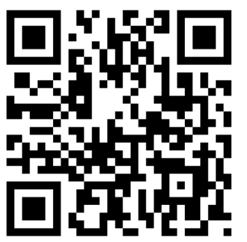
Here is the QR code that encodes the URL for Wikipedia, i.e., the characters: “https://en.wikipedia.org/wiki/Wikipedia”.

Like most QR codes, it has three distinctive square patterns on three corners, and a smaller one set in from the fourth corner, that give information to the image processing software on image orientation and sizing.

As time goes on, more versions of QR codes are defined, with ever finer patterns that convey more information. For instance, here is a medium-resolution QR Code (version 3), and a very high resolution QR code (Version 40):

Version 3 QR Code (29×29), encodes up to 50 characters

Version 40 QR Code  (177×177), encodes up to 1852 characters

My phone could not decode the Version 40 above; the limit may be how much detail the camera could capture.

QR codes use the  Reed–Solomon error correction methodology to correct for some errors in image capture or physical damage to the QR code. For instance, this QR code with the torn-off corner still decodes properly as the URL for Wikipedia (whole image shown above):

Torn QR Code still decodes properly.

Getting down a little deeper in the weeds, this image shows, for Version 3  (29×29) QR code, which pixels are devoted to orientation/alignment (reddish, pinkish), which define the format (blueish), and which encode the actual content (black and white):

Uses Of QR Codes

A common use of QR codes is to convey a web link (URL), so pointing your phone at the QR code is the equivalent of clicking on a link in an email. Here is an AI summary of uses:

They are used to access websites and digital content, such as restaurant menus, product information, and course details, enabling a contactless experience that reduces the need for printed materials. Smartphones can scan QR codes to connect to Wi-Fi networks by automatically entering the network name (SSID), password, and encryption type, simplifying the process for users. They facilitate digital payments by allowing users to send or receive money through payment apps by scanning a code, eliminating the need for physical cash or cards. QR codes are also used to share contact information, such as vCards, and to initiate calls, send text messages, or compose emails by pre-filling the recipient and message content. For app downloads, QR codes can directly link to the Apple App Store or Google Play, streamlining the installation process. In social media and networking, they allow users to quickly follow profiles on platforms like LinkedIn, Instagram, or Snapchat by scanning a code. They are also used for account authentication, such as logging into services like WhatsApp, Telegram, or WeChat on desktop by scanning a code with a mobile app. Additionally, QR codes are employed in marketing, event ticketing, and even on gravestones to provide digital access to obituaries or personal stories. Their versatility extends to sharing files like PDFs, enabling users to download documents by scanning a code. Overall, QR codes act as a bridge between the physical and digital worlds, enhancing efficiency and interactivity across numerous daily activities.

Note that your final statement in this world might be a QR code on your gravestone.

Security with QR Codes

On an iPhone, if “Scan QR Codes” (or something similar) has been enabled, pointing the phone at a QR code in Camera mode will display the first few characters of the URL or whatever, which gives you the opportunity to click on it right then. If you want to be a bit more cautious, you can take a photo, and then open Photos to look at the image of QR code. If you then press on the photo of the QR code, up will come a box with the entire character string encoded by the QR code. You can then decide if clicking on something ending in .ru is what you really want to do.

Accessing a rogue website can obviously hurt you. And even if you aren’t dinged by that kind of browser exploit, the reader’s permissions on your phone may allow use of your camera, read/write contact data, GPS location, read browser history, and even global system changes. The bad guys never sleep. Who would have thought that a QR code on a parking meter posing as a quick payment option could empty your bank account? Our ancestors needed to stay alert to physical dangers, for us it is now virtual threats.

ACKNOWLEDGEMENT: The bulk of the content, and all the images, in this blog post were drawn from the excellent Wikipedia article “QR code”.

Denial and doomerism are products of the same collective action problem

Disappearing people to El Salvador is bad. Unilaterally raising tariffs is unconstitutional and bad. Threatening an American city with violently imposed martial law is really bad. Unilaterally defunding USAID of their legislated resources was bad. The consistent spectacle of cruelty is a spewing sewer geyser of bad. There’s so much bad that I can’t really do it justice here. I’d call it the death of democracy by a thousand papercuts, but these feel more like slashes from raptor claws looking for each and every weakness in an ever-diminishing cage.

Enumerating what is bad and what it means if things get worse is not what I want to write about today. What I want to discuss is how we collectively comment and respond to it. Obviously there is a wide spectrum of responses that we can sift through and evaluate, but broadly there seems to be three categories.

  1. This is fantastic
  2. This is catastrophically bad
  3. Sure, it’s bad, but it’s not that bad.

I don’t care about the first category. If you are cheering this on, well, I can’t help you. You’re either entirely detached or a person whose lens on the world allows them to enjoy personal cruelty and institutional arson. Persuading you otherwise through a blog post is way, way above my pay grade. What I’m interested in understanding, and possibly mediating, is the conversation between types 2 and 3.

Whether you identify as a “highly alarmed” 2 or a “calmly observant” 3, I want you to step back and consider the possibility that you are in 80% agreement with the alternative type, you just don’t know it.

Consider your typical policy expert. They are engaged with the same information ecoystem as everyone else, but there is a policy channel or mechanism they participate in via their expertise. They observe the general sentiment that things are bad, hearing each day about things that are specifically bad. But sometimes there is a news item that either they created (“Here’s a new bad thing I found”) or are impeccably credentialed to comment on (“You can trust me when I say this bad thing is especially bad”). They aren’t going to abstain from contributing or commenting just because other bad things are happening. And neither is anyone else who shares their vein of expertise. Further, those who aggregate or broadly comment on such things will contribute as well. The system quickly becomes oversaturated, and that oversaturation incentivizes and selects for a darker, sometimes panicked tone. There’s a collective action problem here because individuals cannot coordinate to produce an coherent message, ordinal queue, or collective tone.

That’s the primary collective action problem. The secondary problem occurs at the level of commentators who, either because of political or personal temperament, are skeptical of anything that achieves the status of conventional wisdom in the commentariat. Each time a newly weakened democratic guardrail or act of indiscriminate cruelty raises the collective tone beyond what would be a “normal” response in an unsaturated information environment, the skeptic will feel compelled to lower the temperature. This response, however, backfires because it is not engaged with by the uncoordinated collective, but rather an individual. An indvidual, often, who is the relevant expert in question, who knows exactly why it is very bad, and has no interest in the collective temperature, but rather the validity of the narrow and specific bad thing. As experts in narrow fields don’t like being told they’re wrong by non-experts, they likely see the temperature of their own language rise, making the marginal discussion of the bad thing in question more, not less, angry and concerned. The skeptic has not only made things, from their own point of view, worse, they have procured further evidence that the conventional wisdom is overly panicked, compelling them to try to tamp down that much harder on the next wave of concern.

What we are left with is an inner and outer set of collective action problems that are recursively feeding into cohorts of panicking experts fueling doomer fatalism while smug denialists reassure every frog who will listen that their cozy pots of water are not in fact getting warmer.

I’m sure it’s obvious that I’m in the camp that thinks the United States is in greater institutional danger at the moment than at any time since the Civil War. What might not be clear is that I think that the probability of an actual collapse to early 20th century authoritarianism within the next 20 years is about 2 to 4%.** Mathematically, that is a slim chance, but in terms of expected cost its terrifying. Many of you may have read my tone as an implied near inevitability (>90%), a hurricane at sea that is rapidly approaching the shore. Some of you may actually hold that belief, that the US is exactly on track to becoming a failed state, and upon seeing my estimated probability of collapse think me a denialist myself (NB: To be clear, even if the worst doesn’t come to bear there will still be terrible costs along the way). In the context of our discussion, it doesn’t actually matter whether I’m right or wrong. What matters is the failure of collective tone to actually reveal the beliefs held by the individuals that comprise it.

What are the outcomes you are concerned about? What do you think are the odds they will each come to be realized? If we want to take small steps towards improving communication and increasing the quality of collective beliefs, I think we need evolve social norms around communicating our beliefs more directly, even, yes, quantifiably. That way, when our beliefs are internalized in the information zeitgeist, they retain more of their intended meaning, regardless of the tone that emerges after a couple cycles through the collective wash.

** Yes, a 4% chance of democratic collapse within a decade is very large. Think about it this way – if 4% was anywhere near normal, the US would have probabilistically collapse to authoritarianism long ago.