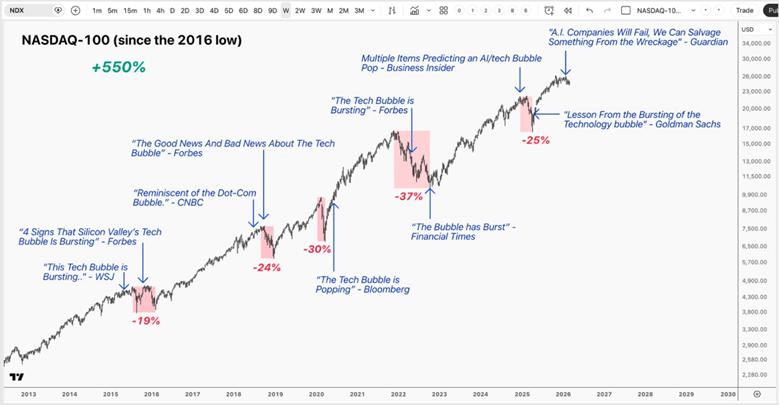
AI isn’t going to be what you expect

Perhaps a more accurate title would be “AI isn’t going to be what you want it to be or are afraid it will be.” And by “you” I mean specifically you. Whatever you have in your mind’s eye, that’s what you should correct your expectations against. Those rare times where we have the slow unveiling of a revolutionary technology, over the span of years or even decades, there is a window of time where we all form an expectation of that it will look like in it’s final form and we’re all wrong. Everyone of us. Except Neal Stephenson, but that is another story.

I think we come by this bias honestly. There’s this tendency to see a new technology and either try to will it into being exactly that thing that would be a optimal for you, or succumb to pessimistic paranoia that this is why you were always fated to lose. In the early 00’s, the start-up tech boom and, later, stock market bubble were driven, I think, but the irresistable optimism that “The Internet” was a way that someone could enter a new market via their garage and bootstrap their way to millions while skipping those less than fun decades of grinding your way to a customer base. If you had a clever concept, then millions of customers were a click away. It was “idea person” catnip. And by idea person I mean someone who has lots of ideas but rarely can be bothered to follow through with anything more a few days. Eventually enough vaporware was a bought and sold that people started to question what was real, Microstrategy got caught cooking the books, everyone had the “maybe this thing isn’t real” thought all at once, and the market tanked. Flash foward 15 years and the internet had radically changed everyone’s life, but how it did so was in hard to foresee ways, through firms that were painstakingly built by experts and/or exploded into market leadership through network effects they’ve been teaching in Econ 101 for at least 30 years.

I observed a similar effect in my own research career. In my early years I was obsessed with agent-based computatonal modeling (something I’ve written about before). For all the optimism I carried for the methodology, it always paled in comparison to expectations and claims made by other. There was an observable pattern, too. What I saw was a way to model things that weren’t tractable in other economic methods, be it classic analytics, game theory, or dynamic stochastic general equilibrium models. What they saw was a way to write and publish economic models without having to learn high level math. Its both a way in and a way around. A way to skip a stage that they wanted to believe was unnecessary to make a scholarly contribution and/or make a career in academic social science. For some it was also a way to retake scientific territory annexed by economists. In either case, their expectations were deeply biased.

What I hear within a lot of a commentators, particularly those most obsessed and optimistic for AI, is wishing into existence the tool that would best serve them. To reimagine the cliche of a hammer in a world full of nails, they are toolbox that is missing a screwdriver, but have no fear, AI will be the universal screwdriver. No need for screwdrivers anymore, everyone will have a near infinite supply of (near) zero marginal cost universal screwdrivers, ready at a moments notice. If you are a professional screwdriver, well, you are out of luck, but that’s how the fates work and bully for me because I can accomplish so much now that I have an infinite supply of the skill I lacked. I am neither constrained by my own personal deficiencies, nor am I constrained by resources insufficient to hire a team of screwdrivers. I am what I always I dreamed I would be: a specialist in what the world still needs that is no longer dependent or deferential to people with the skills I lack. If a prognosticator is predicting a specific future for AI that will greatly increase their relative status among a narrow strata of professionals or scholars, you should index their prediction accordingly.

The inverse of this, of course, is the people who imagine themselves to be the screwdrivers in the previous story. They have specialized in labor product that is soon to be available at zero marginal cost. They’re value will be decimated and thus there is no hope. The irony, of course, is that it is the exact same story but perhaps seems more likely now that it is put in a pessimistic light. Obsolescence happens, after all. They’re both almost guaranteed to be wrong, though. Both sets of expectations are being radically biased by the narcicissm of the imaginer.

My impulses are, of course, similar to everyone elses. I try to keep this in check through my experience with the tech bubble (N=1, I know). AI will change our lives, but it will probably take at least 5-7 years longer than expected, and at least that long before that change is successfully “monetized”. The changes will be significant, it will show up in almost all of our work lives. It will disappoint in many ways. I remember telling someone that our expectations for the internet were too high for it to ever meet them. Then the iPhone came out and suddenly its penetration into our lives was fully actualized.

I don’t know what you think AI will be, but you’re wrong. And that’s ok. We all are.

Everything Except Book Reviews

For the last few years the blog Astral Codex Ten has run contests for the best reader-submitted book reviews. This year Scott mixed things up and asked people to review anything except books.

You can review a movie, song, or video game. You can review a product, restaurant, or tourist attraction. But don’t let the usual categories limit you. Review comic books or blog posts. Review political parties – no, whole societies! Review animals or trees! Review an oddly-shaped pebble, or a passing cloud! Review abstract concepts! Mathematical proofs! Review love, death, or God Himself!

The 13 finalists have a couple of entries on the sorts of things that are typically reviewed: a play, a food, a specific school. But most are pretty abstract or unusual as reviews go: like the general idea of school, dating men in the Bay Area, and fighting in the Russo-Ukranian War.

“This is not like Iraq” the Ukrainian recruiting officer soberly told me with a thick accent. “You have 50% chance of dying.” That wasn’t actually true, but it was a lot closer to being true than almost anything you can voluntarily sign up for in an organized way. I decided it was worth it.

Recommended, I thought several of the essays were excellent, voting goes through October 13th.

James Webb Telescope Still Orbiting the Sun

Last week I took kids to an excellent show at Samford’s Christenberry Planetarium. If you live in Alabama, follow them on Instagram for updates on events (often free).

I have heard people say that the liberal project is doomed because people just want to war.
Well, did you know that the James Webb Space Telescope orbits the sun? (I was busy on Christmas 2021 when the rest of the world was alerted to this fact.)

You can keep up with the mission here https://science.nasa.gov/mission/webb/

You can see what is Webb observing

Make discoveries through international collaboration, not war.

For a small number of readers who have time and interest in cutting edge physics and speculation, I know Julian Gough through Emergent Ventures and he’s at : “man-made black holes, the hidden catastrophe at the heart of materialist science

Children Don’t Die Like They Used To

Academics generally agree on the changing patterns of mortality over time. Centuries ago, people died of many things. Most of those deaths were among children and they were often related to water-borne illness. A lot of that was resolved with sanitation infrastructure and water treatment. Then, communicable diseases were next. Vaccines, mostly introduced in the first half of the 20th century, prevented a lot of deaths.

Similarly, food borne illness killed a lot of people before refrigeration was popular. The milkman would deliver milk to a hatch on the side of your house and swap out the empty glass bottles with new ones full of milk. For clarity, it was not a refrigerated cavity. It was just a hole in the wall with a door on both the inside and outside of the house. A lot of babies died from drinking spoiled milk. 

Now, in higher income countries, we die of things that kill old people. These include cancer, falls that lead to infections, and the various diseases related to obesity. We’re able to die of these things because we won the battles against the big threats to children. 

What prompts such a dreary topic?

I was perusing the 1870 Census schedules and I stumbled upon some ‘Schedule 2s’. Most of us are familiar with schedule 1, which asks details about the residents living in a household. But schedule 2 asked about the deaths in the household over the past year.  Below is a scan from St. Paul, Minnesota.

Continue reading

What Counts As “In Shape”?

Given where we are starting from, the average American would probably be satisfied with a fairly low bar, like “not obese” or “can run a mile without stopping”. But the kind of person who writes about the topic a lot tends to be a fitness nut insisting on crazily high standards. So what makes for a reasonable middle-ground measure?

I think the US military’s standards do. They vary by branch and are changing, but here are some previous military fitness standards from the Air Force:

Pushups and sit-ups are how many can be done in one minute

Here’s what the Marines expect from recruits before they show up for training:

The Army has a complex points system that varies by age and gender, but their minimum standards for a 20-year-old Male include: hex bar deadlift 150 lbs for 3 reps, 15 hand-release pushups within 2 minutes, plank for a minute 30, and a 2 mile run in 19:57 (plus their own sprint/drag/carry test in 2:28).

I like that the standards all involve a mix of strength and speed, and that they might take some work but should be achievable in a reasonable amount of time for a healthy person. I also like that they give stretch goals for the over-achievers in addition to their minimums.

What about the real over-achievers, the ones who want to be not just “in shape” but “in great shape” or “in excellent shape”? For them, there are the special forces fitness tests. Here’s the Green Berets:

The Navy SEALs naturally add a swim:

I’m in no way an authority on any of this, but for what it’s worth, you have my permission to say you’re in shape if you can meet any branch’s minimum requirements.

Purchasing Power in 1868: Guinness Edition

When reading an old novel or watching a period drama movie or TV show, it is almost inevitable that some historical currency amounts will be mentioned. This is especially true when the work is dealing with money and wealth, for example the series “The Gilded Age” is about rich people in late 19th century America. So money comes up a lot. I wrote a post a few weeks ago trying to contextualize a figure of $300,000 from 1883 for that show.

A new Netflix series “The House of Guinness” is another period piece that spends a lot of time focusing on rich people (the family that produces the famous beer), as well as their interactions with poorer folks. So of course, there are plenty of historical currency values mentioned, this time denominated in British pounds (the series is primarily set in Ireland, where the pound was in use). On this series, though, they have taken the interesting approach of giving the viewers some idea of what historical currency values are worth today, by overlaying text on the screen (the same way they translate the Gaelic language into English).

For example, in Episode 4 of the first season, one of the Guinness brothers is attempting to negotiate his annual payment from the family fortune. He asks for 4,000 pounds per year. On the screen the text flashes “Six Hundred Thousand Today.”

The creators of the show are to be commended for giving viewers some context, rather than leaving them baffled or pausing the show to Google it. But is 600,000 pounds today a good estimate? Where did they get this number? As with the “Gilded Age” estimate, it’s complicated, but it is probably more than you think.

Continue reading

The “Lost World” of 2% Inflation

Here is a chart of the Core Personal Consumer Index for inflation (Core PCE), which is the Fed’s favorite measure on inflation, from 1970 through early 2024:

This chart is from an article by the Richmond Fed, The Origins of the 2 Percent Inflation Target. That article has a long discussion of how and why the Fed decided to name an explicit inflation target of 2% in 2012. Although controlling inflation has been formally part of the Fed’s “dual mandate” since the Federal Reserve Reform Act of 1977, it had traditionally not set a single numerical target. After years of discussions within the Fed, it was decided that the benefits of a clear single target outweighed the potential downsides. 2% was though to be about the lowest you could run, while still giving the Fed some room to cut short term rates in a recession without running up against the dreaded zero lower bound. It was understood that 2% was a loose target, with some years a little over or under to be allowed to balance each other out.

That Richmond Fed article was published in early 2024. At that point, inflation was falling quickly and steadily from its post-Covid high, as consumers finished spending down their gigantic stimulus package windfalls.

Unsurprisingly, this article concludes that “Even during this period, long-run inflation expectations have remained anchored, rising no higher than 2.5 percent, according to the Cleveland Fed.”

That was about 18 months ago. The actual path of inflation since then has not be a descent to 2-2.5%. Between gigantic peacetime deficits by two administrations, and the results of tariffs, inflation seems to have leveled out at around 3%:

Source

The sub-2% inflation that was normal for twenty years (2000-2020) may now be a lost world.   This puts the Fed in an awkward spot. Even ignoring the irresponsible squawking from some quarters of the government, it will not be an easy decision to keep cutting rates (to address soft employment) if inflation stays this high. The Fed’s mantra this time around is that the current inflation is just a transient response to tariffs and so can be largely discounted. But I recall similar verbiage in 2021, as the Fed dismissed the ramping inflation back then as merely a transitory effect of pandemic supply chain restrictions. They were wrong then, and I suspect it would be wrong now to be too complacent. The 1970s-80’s showed that once the inflation genie gets out of the bottle, it can be very costly to subdue it. Whether 2.0 % is still the right target, however, may be open to debate.

Updating how you update

An overlooked part of being a good Bayesian is revisiting your past failures of imagination, so that past stuggles with Knightian Uncertainty can be transformed into simple failures to accurately forecast probailities.

I posted earlier today about things getting weirder, but it’s worth considering the exercise proposed by Jonathan V. Last over at The Bulwark, where he goes through his own worst case scenario from November of 2024 and then compares it to the current observed reality.

JVL provides the following list of current events that he never even considered as possible. Going through the list below, which of these would you have considered as genuine possibilities? Not whether you predicted they would happen, but whether you would have even considered in your forecast that they could happen.

I think there are only two items, maybe three on that list I would have thought of as >1% chance of happening. That’s a failure of my imagination and I don’t think I am alone. If we’re good Bayesians, I think that means not just updating our priors, but updating how we update, and opening the door to the darker parts of our imagination when forecasting going forward. No, I’m not enjoying it either.

It’s only getting weirder: deferred resignation windows start closing

Tomorrow the first of the “deferred resignation program” windows close, adding to the growing sources of a chaos as the signs of a recession continue to mount. The supply chain is filled with tariff uncertainty. The tech sector is scrambling to deal with a potentially crippled H1-B channel (conditional on court rulings). Layoffs are showing up in retail and tech. Employers everywhere are coping with worker absences due to chaotic National Guard call-ups.

Between 150k and 200k employees took the government up on option to defer resignation i.e. collect 8 months of pay before resigning. This is about 2% of the federal workforce, though it’s notable that 20% of the IRS workforce took the offer in anticipation that they were going to be laid off with fewer benefits if they didn’t. For at least half of those who accepted DRP, it appears to simply be letting them coast into an already planned retirement, but it could also feasibly be used to bridge you to your next job, on the only condition that it be outside of the federal government.

A 100k workers showing up in the job market in the next few weeks isn’t catastrophic by any means, but combined with a government shutdown that would turn off benefits weeks or months before individuals planned is just another injection of chaos into an already uncertain labor market.

I’m not telling you if and when a recession will officially hit. I’m not in that kind of forecasting business. But I am comfortable saying their is more uncertainty about the state of the economy and institutions now than at any point since 2008, more concern over a speculative bubble surrounding a new bundle of technologies than any time since 2000, and more uncertainty around the robustness of the rule of law since I was born. Make of that what you will.