I learned about the children’s cartoon Gravity Falls this year from my kids.
Bluey is wonderful for kids and adults, but it does feel like a baby show since the younger dog Bingo is 4. If you are getting out of the baby stage with kids, Gravity Falls is great next step with 12-year-old twins. The jokes are funny, especially for American parents today who would have grown up with the cultural references.
Gravity Falls has emotional depth. These days the young folks are in “situationships” trying not to catch feelings (I hear). In Gravity Falls, everyone catches feelings so hard. It’s tragically beautiful like Anna Karenina. You can watch it on Disney+ and YouTube.
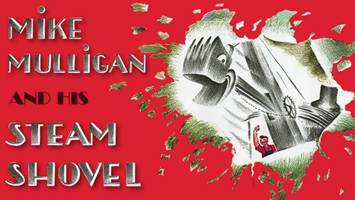
Mike Mulligan and His Steam Shovel, by Virginia Lee Burton, is a classic 1939 children’s book about a man, Mike Mulligan, and his beloved steam shovel, Mary Anne, who are replaced by modern machinery. They get one last chance to demonstrate their worth by digging the cellar for a new town hall in a single day.
This book is more than just a nostalgic children’s story with a happy ending. This is a tale about economic history, comparative advantage, non-pecuniary benefits, labor and capital heterogeneity, and, of course, transaction costs.
Here’s some background. Historically, excavating or earth-moving equipment was powered by steam. Much like a steam engine locomotive (train), a steam shovel burns coal to heat water in a boiler, creating steam that can drive pistons that operate the mechanics. The result is machinery that can move a greater volume of soil at a faster speed than humans with simple hand shovels. Advancements in oil extraction and refining and internal combustion made the steam methods obsolete. Diesel or gasoline made earth movers safer, faster, and larger all because there was no need to build high pressures from boiling water. Steam pressure in the field takes a lot of time and is dangerous.
Here is how the story goes. Mike enjoys his earth-moving work with his steam-shovel and is proud to be more productive than hand-shovels. One day, diesel, electric, and gasoline-powered shovels arrive. They’re bigger and better than Mary Anne. She is now obsolete. It’s unclear whether Mike’s skills are transferable to the newer equipment, but he implicitly prefers working with Mary Anne. Together, they can’t compete in the urban areas where the value placed on quick excavation is high. So, they flee to the countryside.
The text doesn’t say why the newer shovels aren’t in the countryside. Let’s address that first. The new shovels haven’t spread to the rural areas because the opportunity cost is too high. Diesel Shovels are expensive and the owners/operators need revenue from many jobs in order to pay for their equipment in a reasonable amount of time and earn a positive return. Rural areas don’t have the same willingness to pay for as many projects, so less specialized capital is limited by the smaller extent of the market. Clearly, a higher cost of capital – the cost of the loan that pays for the diesel shovels or the alternative uses of the resources – accentuate the necessity for project volume.
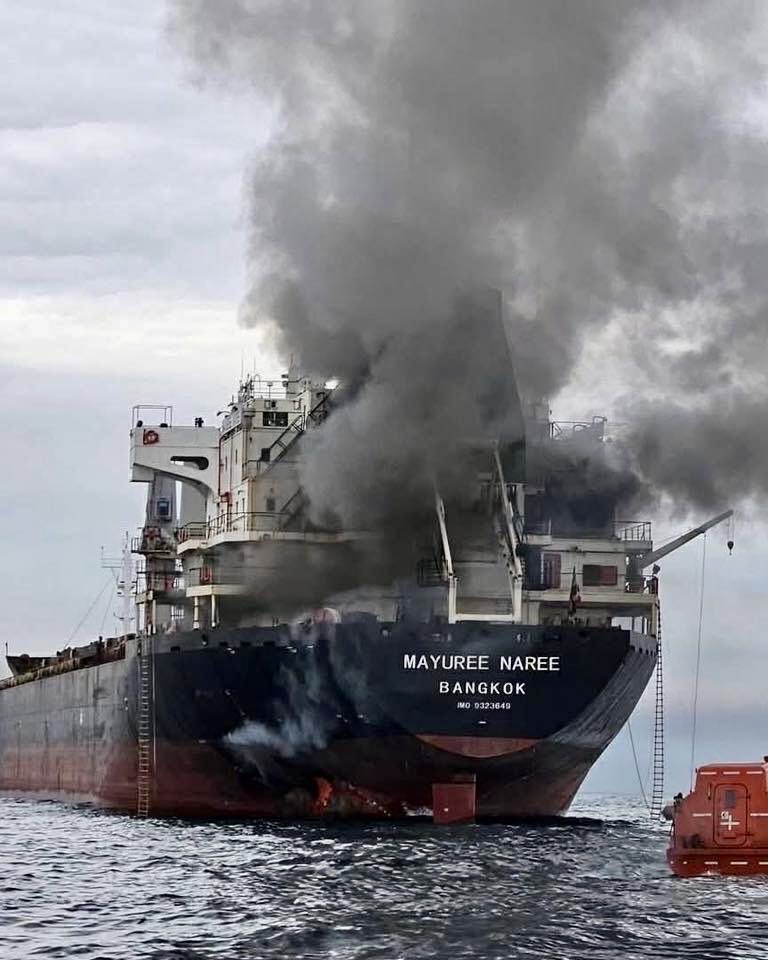
The Iran regime’s military strategy seems to be that by bombing the oil infrastructure of their neighbors and neutral shipping, US gasoline prices will go so high that Americans will demand an end to the war.
How many Americans would be willing to pay $6/gallon gas for months for a ~50% chance of toppling a regime that oppresses 90 million people and destabilizes its region on the other side of the world? Probably only a minority of voters, especially when the President didn’t make the case to the American people or Congress beforehand.
But the US produces more than enough oil for its own needs. Why does the Strait of Hormuz being closed mean higher gas prices here? Only because US oil companies can sell to global markets, and they won’t choose to sell a barrel of oil to a US refiner for $60 when they could sell it to a foreign refiner for $100. If the government took away the foreign option, US oil producers would sell to US refiners at prices consistent with pre-war sub-$3/gallon gasoline.
Naturally there would be costs to an export ban. US oil producers would miss out on windfall profits, while Russian producers would benefit. Foreign customers of US oil, many of them in allied countries, would be angered by the missed shipments and global oil prices would soar further.
But if the US administration wants to avoid a midterm wipeout driven by high gas prices, I see only 3 options:
Get lucky and see the Iranian regime fall quickly
Negotiate an end to the war quickly (which might itself be unpopular if they can’t get a good deal) or just declare victory and go home (but its not clear whether Iran would re-open the strait now just because the US stopped bombing)
Restrict Exports
I say “restrict” not “ban” because I don’t think a complete export ban is necessary to stabilize US prices. You could instead do an export tax (high enough to stop many exports but low enough to allow the buyers with the highest values / fewest alternatives to stay in the market), or you could do a ban but allow a few export waivers for favored buyers or sellers (which seems like Trump’s style), or similarly a quota limiting exports to a certain number (say, limit each company’s monthly exports to 90% of their volume in the same month last year).
This has an obvious precedent: the Biden administration stopped issuing new permits to export liquified natural gas in 2024 to prevent prices spiking here during the Ukraine war (which led to even higher prices for our European allies). But a total ban on oil exports would be a much bigger deal.
Will the Trump administration actually try something like this? It will be an interesting test of US political economy to see what happens when the interests of the military-industrial complex conflict with the interests of oil producers.
The following chart shows cumulative population growth in the US since 2010, from two sources: the natural population growth (birth minus deaths) and international migration:
In total, the US population has increased by about 30 million people since 2010. Cumulatively, about 55 percent of the growth has been from international migration, but there are two distinct periods within this 15-year timeframe. From 2010 to 2020, about 60 percent of the population growth was from natural population change, both cumulatively and in most of those years. From 2021 forward, 70-90 percent of the growth has been from international migration.
The flip in 2021 happens because both factors changed. First, the natural rate of population growth slowed dramatically, with just 146,000 people added to the population, compared with close to 1 million or more before the COVID pandemic. The decline in population growth is a result of gradually slowing birth rates, but also skyrocketing death rates in 2021-2022: about 3.4 million deaths per year, compared with about 2.8 million pre-pandemic. Second, international migration picked up dramatically, from around half a million people in 2019-2020, to an average of over 2 million per year from 2022-2024.
Note: the years in this data run from July to June, so when it says 2025 in the chart, this means from 7/1/2024 to 6/30/2025. Thus, we don’t yet have a full year of data under Trump. But even with the half year under Trump, which includes 6-7 months under Biden when the border policy was already being reversed, the latest year of data from Census suggests the US still had a net international migration of almost 1.3 million people. That’s half the number from 2024, but still well above pre-pandemic numbers. Keep in mind that these are estimates, subject to change, and estimating changes in the illegal immigrant population is often very difficult to do accurately. But these are probably the best estimates that we have right now.
What does the future hold? Of course, any future projection has to make assumptions about how both the birth rate and immigration rate will change over the coming years. But a recent estimate from CBO suggests that by around 2032-2033 the natural rate of population growth will essentially hit zero, and that by the early 2050s it will be so negative as to completely offset the projected immigration. In other words, total population growth could essentially be zero in the US by 2055 or so. That’s 30 years in the future, so take it with a grain of salt, as any small change in immigration, births, or deaths could throw that projection way off. But it seems like a fairly likely scenario.
After being convinced by a series of favorable articles, I bought a few shares last month of the EWY fund, which holds shares of major South Korean companies. The narrative seemed compelling: the vast production of compute processing chips for AI has led to a structural supply shortage of fast memory chips. South Korean firms excel in making these chips, and so high, growing profits seemed assured. What could possibly go wrong?
What I didn’t know was that thousands of other retail investors were thinking the exact same thing, and hence had bid the price of EWY up to possibly unreasonable levels. Somehow, my bullish analysts missed that point. In particular, the South Korean market is driven by an unusually high level of margin trading, where investors borrow money on margin to buy shares. A market drop leads to margin calls, which leads to forced selling, which really crashes prices.
The other thing I did not know was that, two days after my purchase, the attacks on Iran would commence. Oops. Among other things, this would drive up the world price of oil, which impacts energy importers like South Korea. This seems to have been the trigger for the sharp stock drop.
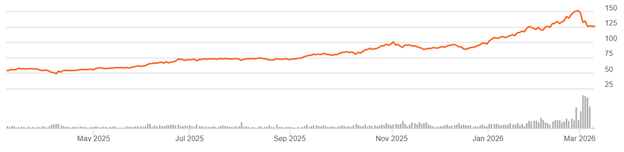
Here is the six-month price chart for EWY:
As it happened, I bought pretty much at the top, and as of Monday midday when I am writing this, EWY was down about 17%. That doesn’t look like much of a drop on the chart, because of the long run-up to this point, but it is an unpleasant development if you just bought in two weeks ago.
Fortunately, when I bought the EWY shares, I set up a protective options collar, since this was not a high conviction buy. First, I bought a put with a strike price about 7% below my purchase price, which would limit my maximum loss on the EWY shares to 7%. A problem is that this put cost serious money (about 11% of the share price), so my maximum loss could actually be 7% plus 11% = 18%. Therefore, I offset nearly all the cost of the put by selling a call with a strike price about 17% above the current EWY share price. That meant that I could profit from a rise in EWY share price by up to 17%, while being protected against a drop of more than 7%. That seemed like a favorable asymmetry (7% max loss vs 17% max gain).
This arrangement (buying a protective put to limit downside, financed by selling a call which limits upside) is called an options “collar”. I’d rather accept a limited upside than have to worry about doing clever trading to mitigate a big loss.
As of Monday, my collar was working well to protect the overall position. As might be expected, the value of my put increased, with the drop in EWY share price. But also, the value of my call decreased, which further helps me, since I am short that call. The net result was that about 75% of the loss in the stock price was compensated by the changes in values of the two options.
This is just a small, experimental position, but it was nice to see practical outcomes line up with theory.
Disclaimer: As usual, nothing here should be considered advice to buy or sell any security.
I don’t have an article or statistic to point to, just a question: what is the threshold at which a betting market outcome becomes endogenous to the existence of the betting market?
Polymarket recenttly removed its market for a nuclear detonation. The implication is straightforward: if a market exists for an outcome that a singular individual (or small group) can make manifest, then as the market becomes takes on greater volume, the maximal reward for independently producing the wagered upon outcome increases. This generates a testable hypothesis: does the predicted possibility of a positive outcome increase with market volume?
If and when the answer is yes, market volume has a positive causal relationship with market outcomes, then the welfare proposition of the market existing comes into question. I don’t care about more accurately predicting nuclear detonation if the market yielding the prediction is increasing it’s probability of occurring.
Now, do I think betting markets are increasing the probability of a nuclear explosion? Eh….probably not, or at the very least the effect should be quite modest. But there are lots of events on prediction markets that raise this possibility without wading into the waters of apocalypse-adjacent outcomes. As I discussed previously, the endogeneity of sports outcomes to betting markets is threatening the integrity of professional competition. Many of those obscure sports wagers don’t seem like thick markets, but relative to a 20 years where such wagers didn’t even exist, they are positively rippling with volume.
In a world where unscrupulous individuals are betting big on their ability to extract enough rents in public life before the world catches up with them, we would be wise not that add more profit channels for corruptuon than we are capable of credibly monitoring.
The Economic Science Association has listed some exceptions to the under-40 rule for being considered a success. I approve.
– *ESA Young Scholar Prize*: This prize is to be awarded to one young scholar whose research has made a significant contribution to experimental methodology. Nominees must
be under the age of 40; ESA will consider nominations of individuals over the age of 40 who started their research career late, or have had career interruptions, (b) hold an untenured position, or (c) have completed their PhD at most 10 years previously.
One does start to question if we ought to use the word “young” at all, if we are going to admit all those exceptions, since Awards for young talent are antinatalist.
Perhaps the worst thing about older people is a lower willingness to move-to-opportunity geographically. That’s not so bad from the perspective of an institution that has already made a hire, but it is bad from the perspective of a subfield or with respect to graduate admissions.
Experimental Economics is a small world, so I think there was a genuine impact on the way of thinking due to the success of Gary Charness.
Claude writes:
Charness did not follow the standard trajectory of a prodigy moving seamlessly from PhD to tenure-track stardom. He earned his doctorate from UC Berkeley relatively late, in 1999, after a career in business and industry. He was in his early 40s when he entered the academic job market — an age at which many economists assume a researcher’s most creative years are already behind them.
Despite entering academia so late, Charness went on to become one of the most cited and prolific experimental economists in the world. He continued producing high-impact work well into his 60s, with no visible declining trajectory in the originality or influence of his research.
Joy again:
Notice the move-to-opportunity at the age of 50, as indicated by Wikipedia “After commuting for three years between San Francisco and Barcelona (and floating free for another year), Gary accepted a position as an assistant professor at UCSB in 2001.”
Whether full-time permanent research jobs or research awards for writing papers will still exist at all in 20 years, because of changes wrought by AI, I do not know. This week a student walked into my office to ask for help with Excel, which I was happy to provide. I told her that she could have just asked AI, but she claimed that, “Claude was acting up this week.” The year 2026 is odd because I am trying to synthesize the claim that “AGI is here” with the fact that AI still cannot perform most basic tasks correctly. Do organizations need a contingency plan for when Claude is “acting up?”
Individuals or their families act as infinitely lived agents.
All governments and agents can borrow and lend at a single rate.
The path of government expenditures is independent of financing choices
Assumption 2) appears patently absurd on its face. I certainly cannot borrow at the same interest rate that the US Treasury can. QED. Do not pass go, do not collect $200. The yield on 1-year US treasuries is 3.58%. I can’t borrow at that rate… Or can I?
Let’s do some casuistry.
What is a loan?
It’s a contract that:
Provides the borrower with access to spending
with or without collateral
with a promise to repay the lender at defined times, usually with interest.
So, when you borrow $5 from a friend and pay it back on the same day, it’s a loan. The contract is verbal, there is no collateral, the repayment time is ‘soon’ with flexibility, and the interest rate is zero.
A mortgage is a collateralized loan. You borrow from a bank, make monthly payments for the term of the loan, and accrue interest on the principal. The contract is written, the house or a portion of its value is the collateral, and the interest rate is positive.
What about a Pawnshop loan? Most of us are probably unfamiliar with these. In this circumstance, a person has valuable non-assets that and the pawnshop has money. They engage in a contractual asset swap. The borrower lends the non-money asset to the pawnshop as collateral and borrows money from the pawnshop. The pawnshop borrows the non-money asset and lends the money to the borrower. The borrower can use the money as they please, but the pawnshop can not use the non-money asset – they can simply hold it. They collect interest in order to cover their opportunity costs.
One outcome is that the borrower repays the loan and interest by the maturity date and reclaims their non-money asset. Another outcome is that the borrower retains the option to default without any further obligation. But they lose the right to reclaim their property according to the repayment terms. If the borrower exercises the option to default, then the pawnshop acquires full rights to the non-money asset. The pawnshop often resells the asset at a profit. The profit is relatively reliable because the illiquidity of the non-money asset allows the pawnshop to lend much less than its retail value. That illiquidity is also why the borrower is willing to accept the terms.
If we accept that the pawnshop contract is a loan, which is just a collateralized loan with a mostly standard default option, then get ready for this.
We’re bombing Iran, and Iran is now bombing most of its neighbors. Oil prices are up ~20% since the bombing began last weekend, and stocks are down.
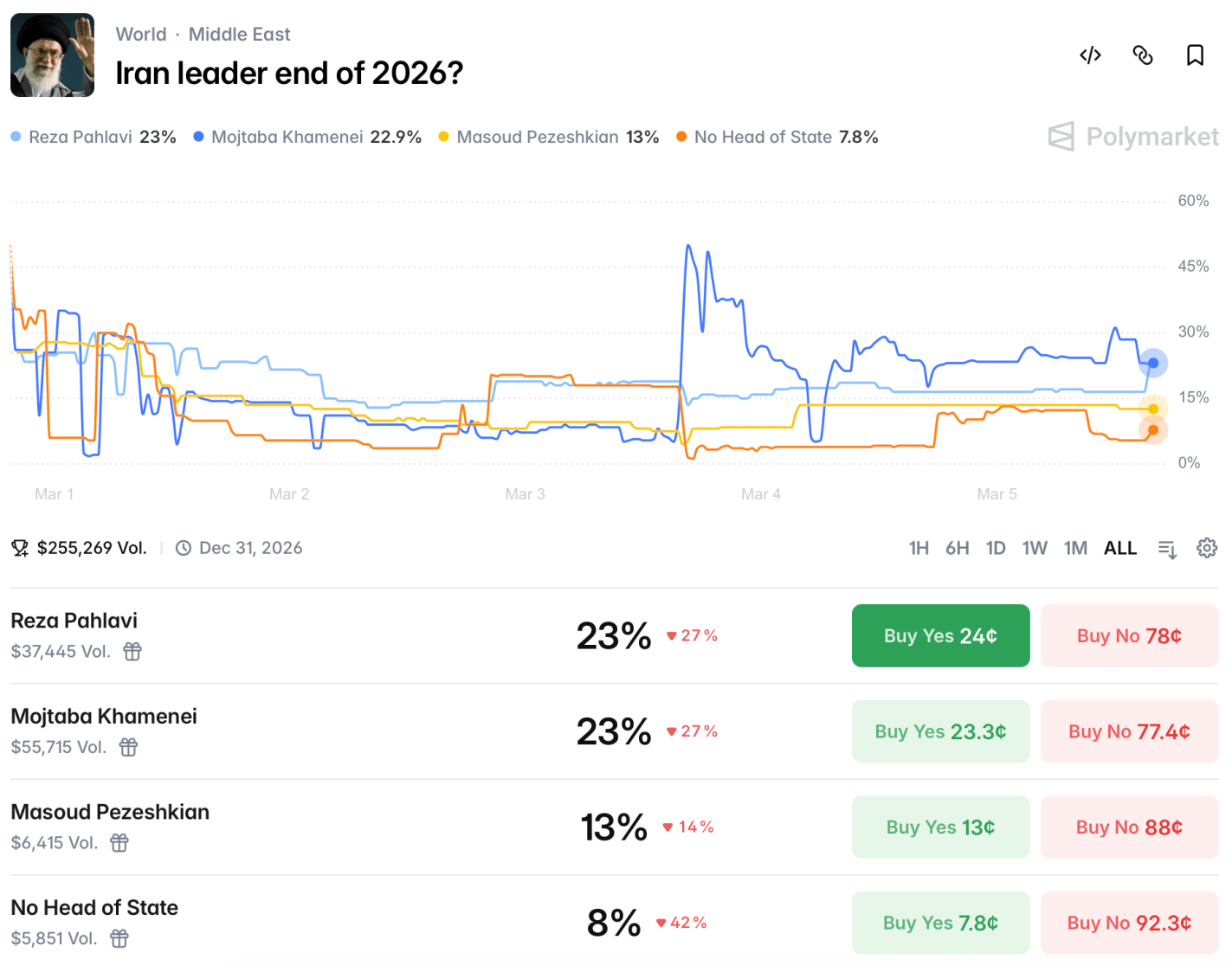
Iranian “Supreme Leader” Khamenei is now dead. Prediction markets sort of saw this coming; I mentioned here a month ago that markets thought it more likely than not that Khamenei would be “out of office” this year.1
Real-money US-regulated exchanges can’t directly cover the war, but others can and do, such as the international Polymarket:
Polymarket’s argument for why they offer these markets
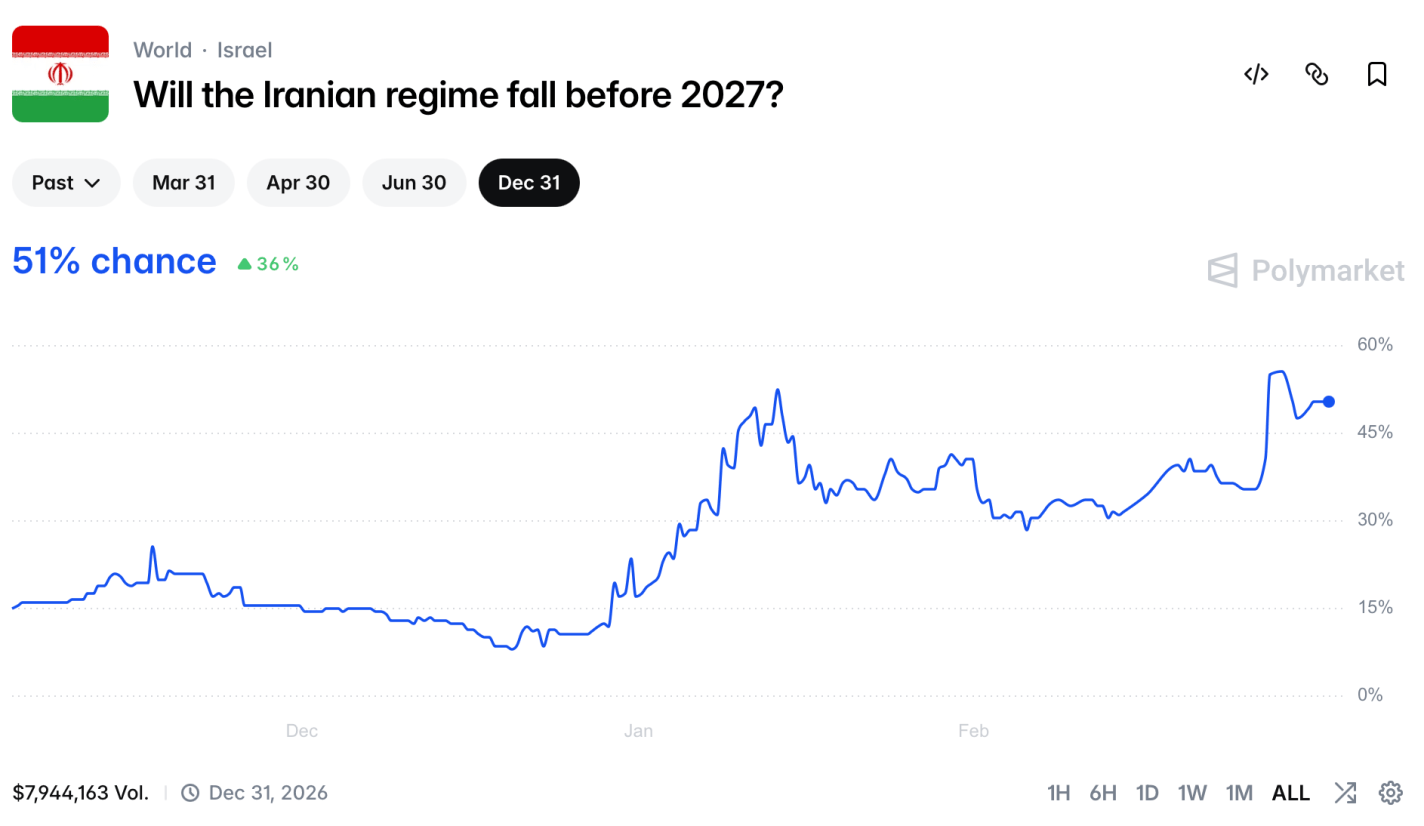
This market shows that regime change is likely, but will take time- a 51% chance by the end of the year, but only a 13% chance by the end of the month.
How would this be achieved? Markets see a 60% chance that there will be US troops in Iran this year, though this market could be triggered by just a few special forces operators, or by troops visiting for humanitarian purposes after domestically-driven regime change. There will likely be a US-Iran ceasefire by the end of May. It’s not clear at all who will be running Iran at the end of the year:
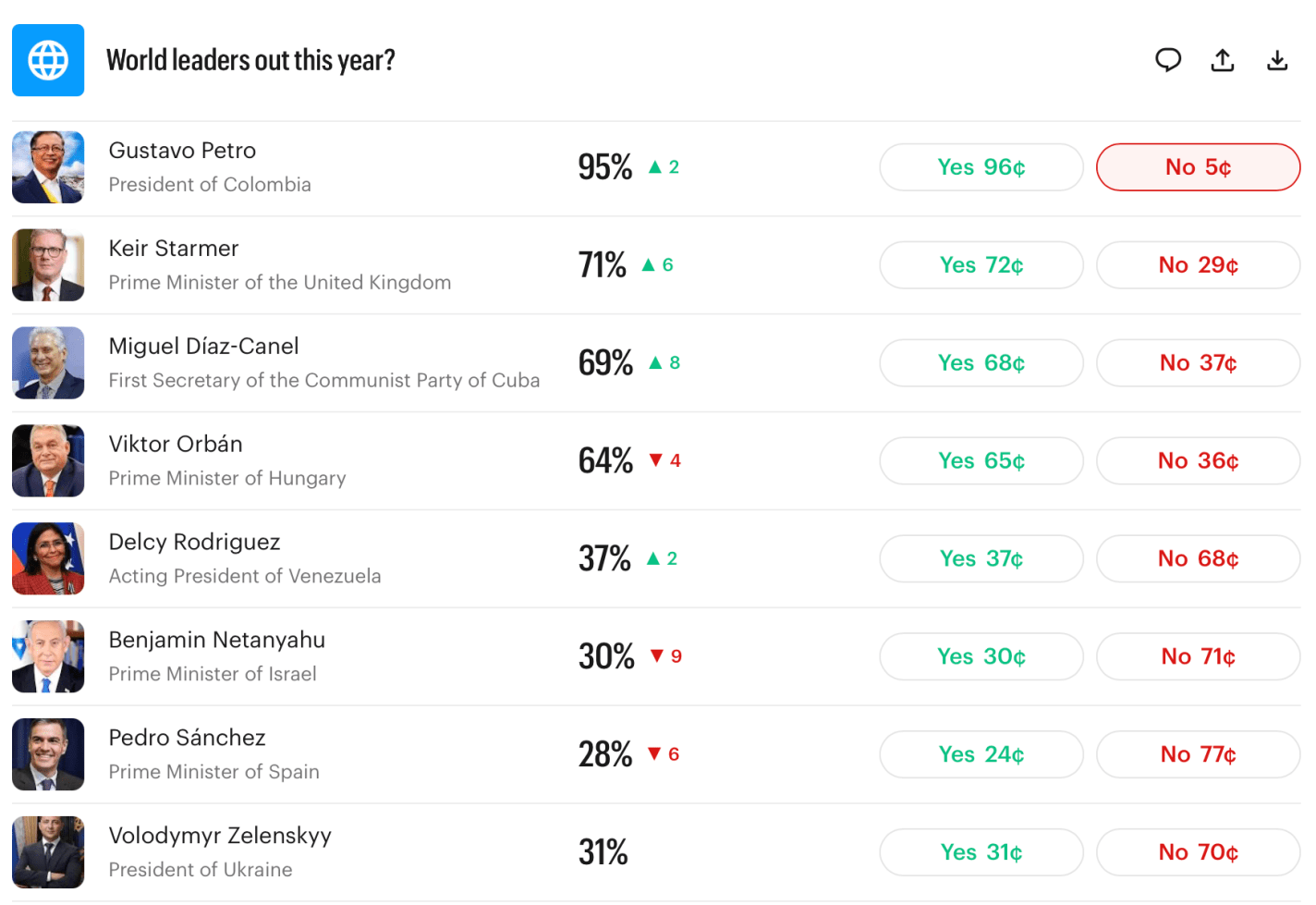
Iran is far from the only country whose future leadership is unclear. Last month I noted that the current leaders of Britain, Hungary, and Cuba would likely be out of office by year end. These are all now looking even more likely than they did a month ago:
So I’ll repeat:
Myself, I find most of these market odds to be high, and I’m tempted to make the “nothing ever happens” trade and bet that everyone stays in office. But even if all these markets are 10pp high, it still implies quite an eventful year ahead. Prepare accordingly.
US-regulated exchanges can’t offer markets on death. Kalshi’s rules stated that if Khamenei died, the market would refund everyone at current prices rather than paying as if he were “out of office”. When he died many people got mad at Kalshi- some who had bet he’d be “out of office” and were mad that they weren’t paid at 100%, others that Kalshi was offering something too close to a death market- “how else would he lose power” (even though Maduro and Assad provide clear recent examples) ↩︎
Last week I had the opportunity to see (and touch!) some first edition copies of Adam Smith’s books, including The Wealth of Nations and The Theory of Moral Sentiments.
For an economist, of course this was a very cool experience. The books from the Remnant Trust were still in great condition, despite people like me handling these copies from time-to-time. The books were also beautiful editions, which got me thinking: how much did these cost to purchase when originally published?
According to John Rae’s Life of Adam Smith, the original price for The Wealth of Nations was 1 pound, 16 shillings. Average wages per day in England were somewhere around 15 pence per day (1 pence is 1/12 of a shilling), it would take close to 30 days of labor to purchase the book. But that’s assuming you spent all of your wage on books, which of course would have been impossible: a common laborer would have been spending 80-90% of their wages on food, beer, and rent. And that’s assuming no unexpected expenses or sickness. In reality, it might take a common laborer months, years, or maybe his entire life to save up for that book.
Today, of course we can read this book online for free, but what if you want a nice hardcover version? Amazon has several nice hardback versions available for just under $30. These are not quite as beautiful as the 1776 edition, but they would look nice in any library. Given that the average wage in the US today is close to $32, it would take less than one hour of labor to purchase the book. And thankfully the cost of necessities today is much lower than 1776, indeed much lower than 1900, so it would be much easier to set aside that one hour of wages relative to the past, and purchase yourself a little treat like a book written 250 years ago.